Using a fogger for varroa mites: does it actually work?
TL;DR
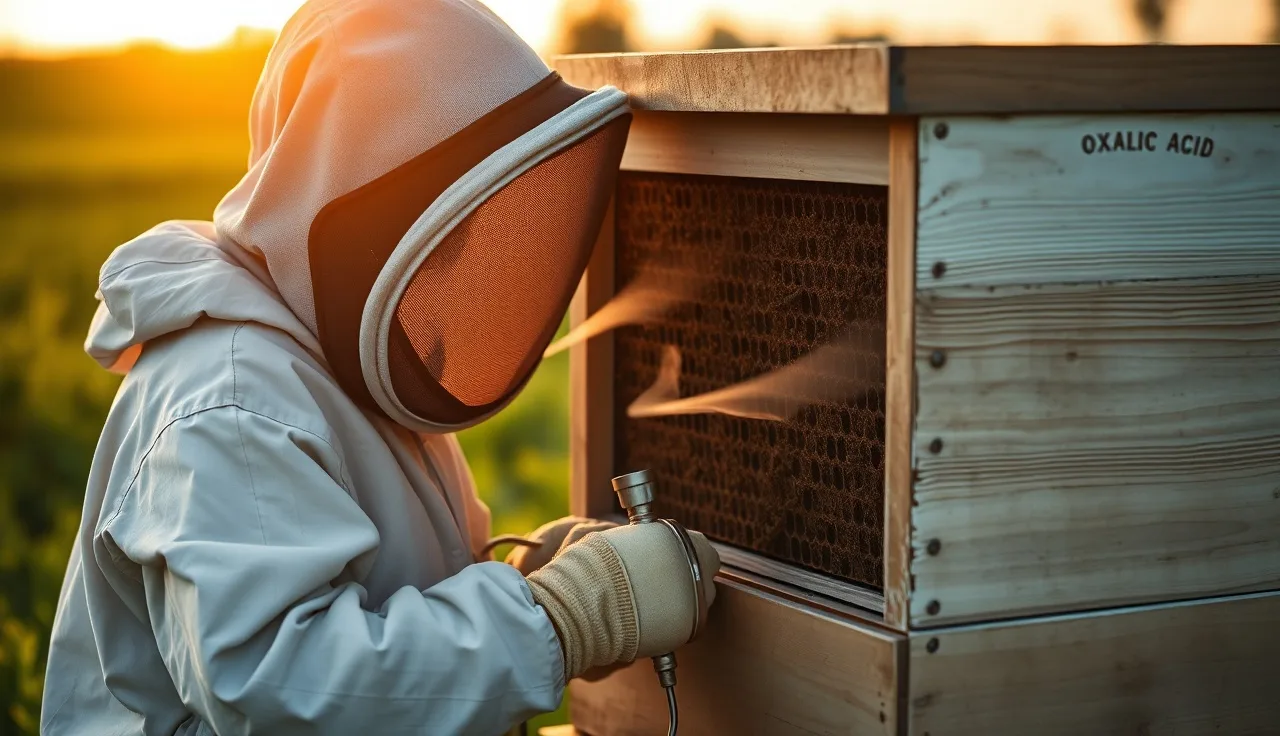
- Oxalic acid foggers (vaporizers) kill phoretic varroa on adult bees by sublimating OA crystals into fine particles that coat the bees and mites.
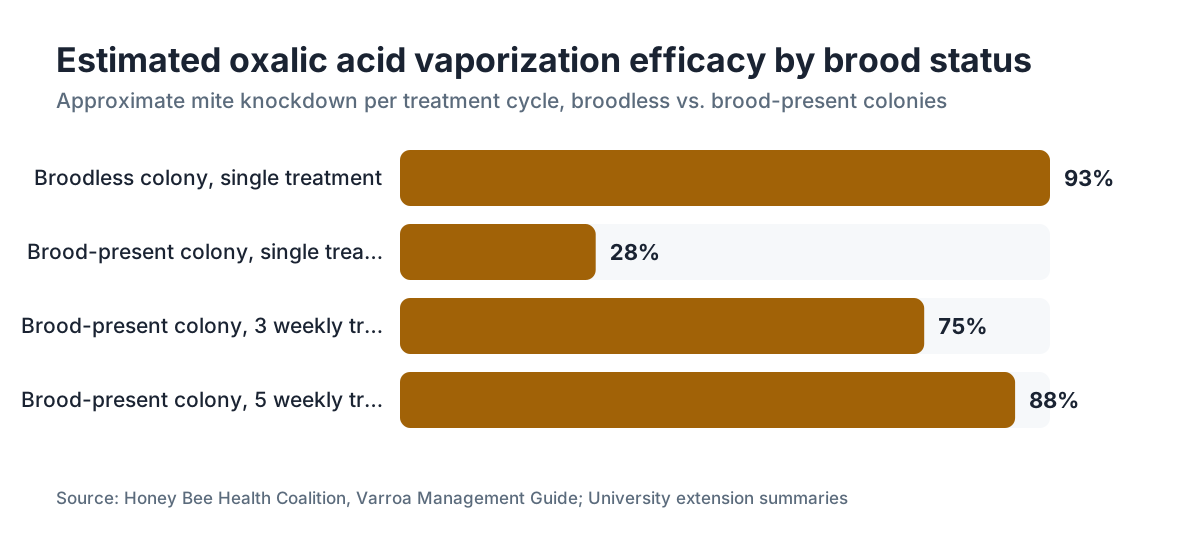
- In broodless conditions, a single treatment can achieve 90-95% mite knockdown.
- With brood present, you need multiple treatments spaced 5-7 days apart.
- Only EPA-registered products with a current label are legal to use in the U.S.
What does a varroa fogger actually do?
A varroa fogger, most often called an oxalic acid vaporizer or OA vaporizer, heats oxalic acid dihydrate crystals until they sublimate into a fine aerosol that drifts through the hive. The particles land on the bees and, more to the point, on the phoretic varroa mites riding those bees. Oxalic acid is naturally present in many plants and in raw honey, but at treatment concentrations it disrupts the mite's cuticle and kills it.
The key word is phoretic. A varroa inside a capped cell is completely protected. The acid cannot get through the wax cap. That single fact is why brood status decides whether this method works or wastes your afternoon.
Some beekeepers still use essential oil foggers, usually thymol-based products like Apiguard or ApiLife VAR, but those are applied differently (gel or tablet, not vapor) and are a separate category. When most people today say 'varroa fogger,' they mean an oxalic acid vaporizer. That's what this article focuses on.
Is fogging with oxalic acid actually effective against varroa?
Yes, in the right conditions, very. In broodless hives, a single oxalic acid vaporization treatment produces 90-95% mite knockdown in well-documented field trials [1]. That number drops hard once brood is present, because any mites sealed inside capped cells survive untouched.
A 2006 study published in PLOS ONE found that repeated oxalic acid vaporization across a brood cycle reduced mite populations far more than a single treatment, which tracks once you understand the biology [2]. The practical takeaway: if you're treating a colony with brood, plan on 3 to 5 treatments spaced 5-7 days apart to catch emerging mites before they re-infest new brood.
The Honey Bee Health Coalition's Varroa management guide states that oxalic acid is "most effective when colonies are broodless," which is why winter treatments, swarm trapping, and brood breaks are so popular among beekeepers who lean on OA vaporization [3].
Technique matters too. Poor coverage, gaps that let vapor escape, or treating when it's too cold (below about 50°F / 10°C) all cut your results. Temperature counts because at lower temps bees cluster tightly and vapor struggles to reach every bee.
Here's the honest summary. Use a fogger correctly, in a broodless hive or across a full brood cycle of repeated treatments, and it's one of the most effective tools a hobbyist owns.
What fogger equipment do you need and what does it cost?
There are two main styles of OA vaporizer: electric (battery or corded) and propane-heated.
Electric vaporizers usually cost $150 to $250 for a decent unit. They use a heating element that reaches sublimation temperature in 2 to 3 minutes. Popular U.S. models run on 12V batteries (a car battery or a dedicated LiFePO4 pack) or on standard 120V outlets. Electric units are easier to use without scorching the OA, which produces acrolein, a toxic byproduct of overheating.
Propane vaporizers cost less upfront, often $50 to $100, but they take more skill to hit the right temperature range (roughly 315-375°F / 157-190°C) without overheating. Scorch the oxalic acid and you create harmful byproducts and cut efficacy. Experienced beekeepers tend to prefer electric for consistency.
| Type | Typical cost | Power source | Learning curve |
|---|---|---|---|
| Electric (12V) | $150-$250 | Battery | Low |
| Electric (120V) | $120-$200 | Corded | Low |
| Propane | $50-$100 | Propane torch | Moderate-high |
The oxalic acid itself, sold as Api-Bioxal (the only EPA-registered OA product for bees in the U.S. as of this writing), costs roughly $25 to $35 for a 35-gram packet, which is enough for many treatments [4]. Generic or pool-grade oxalic acid is not legal to use on honey bee colonies in the U.S. even if the chemistry is identical. The label is the law.
For a full list of where to source equipment, see our guide to beekeeping supply companies.
Which oxalic acid products are legal to use in the U.S.?
As of mid-2025, Api-Bioxal (EPA Reg. No. 69577-3) is the only oxalic acid product registered by the EPA for use in honey bee colonies in the United States [4]. It's registered for three application methods: dribble (direct application to bees), spray, and vaporization.
The label sets the dose for vaporization at 1 gram of Api-Bioxal per brood box (Langstroth standard). It also caps use at no more than 3 treatments per year in colonies with brood, though a single treatment is permitted in broodless colonies. Read your current label every season. Labels change.
The EPA requires that you wear a NIOSH-approved respirator rated for acid vapors (OV/P100) during treatment, and that you stay out of the hive entrance area during vaporization [4]. These are legal requirements printed on the label, not friendly suggestions.
Canada is a different story. Health Canada's Pest Management Regulatory Agency runs its own registration process, and the registered products may differ. Always check with your provincial apiarist.
Using any unregistered OA product, or any application method not listed on the label, violates FIFRA (the Federal Insecticide, Fungicide, and Rodenticide Act) [7]. That matters for two reasons: your own legal exposure, and the risk that residues in honey above tolerance limits hurt your market access.
How do you use an oxalic acid vaporizer step by step?
The process is simple, but a few steps are easy to skip and shouldn't be.
First, seal the hive. Stuff a folded cloth or foam plug into the entrance. Some beekeepers tape the screened bottom board from below. You want the vapor inside the hive for at least 10 minutes, not drifting out immediately. This is the single most common beginner mistake.
Second, load the correct dose. For Api-Bioxal, that's 1 gram per brood box. Use a digital scale that reads to 0.1g. Eyeballing it is not good enough.
Third, put on your PPE before you load the vaporizer. NIOSH OV/P100 half-face respirator, safety glasses, and nitrile gloves at minimum. The acid vapor is a genuine respiratory hazard and the label makes this non-negotiable [4].
Fourth, insert the vaporizer pan into the entrance or through the bottom board slot and heat to sublimation temperature. For electric units, run the heating cycle until the OA has fully vaporized (most units signal this with an indicator or by the smoke stopping). Do not stand downwind of the entrance.
Fifth, leave the entrance sealed for 10 minutes after the OA has fully vaporized. Then pull the plug and the vaporizer.
Sixth, record the treatment: date, product, lot number, dose, number of boxes treated, and mite wash counts before and after. The label requires you to follow its directions, and good records tell you whether the treatment actually worked.
Want to build a full treatment protocol with reminder scheduling? VarroaVault's free tools track your mite counts and treatment windows alongside your other hive records.
On timing, keep the temperature above 50°F at the moment of treatment. Below that, the cluster is too tight and coverage suffers. Evening treatments cut bee flight and drift during the process.
When is the best time of year to fog for varroa?
Late fall or early winter, when colonies are broodless or nearly broodless, is the single best window for OA vaporization. Every varroa mite in the hive is phoretic then, riding on adult bees, fully exposed to the acid. One treatment hits them all. University of Bern research and extension guidance from Virginia Tech both point to the broodless period as the highest-efficacy timing for any oxalic acid application method [1][5].
In much of the northern U.S., that window runs roughly from late November through January, depending on local conditions and the genetics of your colony (some queens keep laying later than others). Do a mite wash before you treat. If your count is zero or near zero and you see no brood, the colony may have already handled the problem or the mite population is low enough to leave until spring.
Spring splits and artificial swarms are a second excellent window. A newly made split with the old queen goes broodless for the roughly 24-day stretch while a new queen is raised. Treat during that gap and you get near-broodless efficacy without waiting for winter.
Summer is the hardest time to use a fogger well, because colonies are packed with brood. If your mite wash shows 2% or higher infestation in summer, you probably want a faster-acting treatment like Apivar (amitraz strips) or a formic acid product rather than leaning only on repeated OA vaporizations, though repeated treatments can keep a population from exploding while you plan a brood break.
The varroa mite life cycle is the reason timing matters this much. Roughly 70-80% of varroa in an active colony sit inside capped cells at any moment. A fogger that hits only the 20-30% on adult bees does real work, but it's no one-shot cure with brood present.
How many fogger treatments do you need per season?
For a broodless colony in winter, one well-executed treatment is usually enough. That's the gold standard. Some beekeepers add a second treatment 7 days later as insurance, but the evidence that it adds much in a truly broodless hive is thin.
For colonies with brood, the math changes. Each mite inside a capped cell survives any fogger treatment. Once the cap comes off, the mite goes phoretic again for a day or two before finding new brood to enter. Treating every 5-7 days catches those mites during that phoretic window, at least in theory. In practice, most extension guidance recommends 3 consecutive weekly treatments during brood season [5].
The Api-Bioxal label permits a maximum of 3 treatments per year in colonies with brood. In broodless colonies, a single treatment still counts against that limit. So if you treat once in winter and again across 3 weekly summer applications, you're at your label limit for the year [4].
Some beekeepers run a split-and-treat strategy: make a split in midsummer, let both halves ride through a brood break, treat each once during the broodless period, then recombine or leave them as separate colonies. That gets you near-winter-quality efficacy in the middle of the season.
Is fogging oxalic acid safe for the bees?
At label rates, yes. Api-Bioxal vaporization at 1g per brood box has a well-documented safety record and does not cause measurable brood damage or queen loss when dosed correctly [1][4].
Overdosing is a real risk. Higher-than-label doses can kill brood, damage the queen, and cause odd bee behavior. This is one reason the scale matters. Using 2g instead of 1g in a single box sounds like a small slip, but it's a double dose.
Residues in honey are another question. Oxalic acid is naturally present in honey at roughly 8 to 40 mg/kg depending on floral source. The EPA has set a tolerance of 900 mg/kg for residues in honey, and documented treatment residues sit well below that threshold [4]. Still, skip treating during a honeyflow when you can, and some beekeepers pull honey supers before treatment as a habit, though the label doesn't require it for vaporization.
Brood safety: one common worry is treating colonies with very young larvae. At label rates, OA vaporization is generally not harmful to open brood, but some beekeepers report higher brood mortality when treating heavily with open brood present. The evidence is mixed. The most conservative approach is to treat broodless, or to time treatments when most cells are capped rather than open.
Queens tolerate OA vaporization at label rates in most studies, though there are anecdotal reports of queen loss after treatment. Nobody has great controlled data on queen sensitivity across genetic lines. If you're treating a newly mated queen or a colony that's otherwise stressed, watch her for a week after treatment.
What safety gear do you need when fogging for varroa?
This is not the place to cut corners. Oxalic acid vapor is corrosive to mucous membranes and the respiratory tract. Chronic low-level exposure is a real occupational risk for beekeepers who treat often.
Required by the Api-Bioxal label: a NIOSH-approved respirator with organic vapor and P100 (particulate) cartridges. A dust mask or surgical mask does not cut it. Chemical splash goggles or safety glasses. Nitrile or chemical-resistant gloves [4].
Worth adding beyond label minimums: a Tyvek suit or dedicated treatment clothing you wash separately, closed-toe shoes, and treating upwind of the hive entrance. Keep bystanders, children, and pets away from the treatment area during vaporization and for at least 10 to 15 minutes after.
If you treat multiple hives in a session, take breaks and watch yourself for throat irritation, coughing, or eye irritation. Those are signs of poor protection or a wind shift.
Store oxalic acid in its original labeled container, away from children and food. Api-Bioxal crystals are hygroscopic and clump if they get damp, which throws off your dosing accuracy.
How does fogging compare to other varroa treatments?
Varroa treatments split broadly into hard chemicals (synthetic miticides like amitraz/Apivar and tau-fluvalinate/Apistan) and soft chemicals (organic acids and essential oils, including OA and thymol). Foggers sit in the organic acid camp.
| Treatment | Active ingredient | Brood penetration | Resistance risk | Cost per treatment | Honey concerns |
|---|---|---|---|---|---|
| OA vaporization | Oxalic acid | None | Very low | ~$2-4 | Low (natural residue) |
| OA dribble | Oxalic acid | None | Very low | ~$1-2 | Low |
| Apivar strips | Amitraz | Yes (slow) | Moderate | ~$5-15 | Remove before flow |
| Apistan strips | Tau-fluvalinate | Partial | High in many regions | ~$5-10 | Remove before flow |
| Mite Away Quick Strips | Formic acid | Yes | Very low | ~$8-12 | Remove supers |
| ApiLife VAR | Thymol blend | Partial | Very low | ~$3-6 | Remove supers |
The big edge of OA vaporization over OA dribble is that you don't have to open the hive and you get better distribution in multi-box colonies. The downside against Apivar or formic acid is the lack of brood penetration. There is no single best treatment. The right choice depends on brood status, time of year, temperature, and resistance patterns in your local mite population.
VarroaVault's free protocol tracker maps treatment choices against your mite wash calendar, so you can see which approaches actually work in your apiary over time.
Resistance deserves a mention. Varroa has developed resistance to tau-fluvalinate and coumaphos in many U.S. populations [6]. Oxalic acid resistance in varroa has not been documented in field populations as of this writing. Rotating organic acid treatments into your protocol is a sound resistance-management move, more than a preference for 'natural' chemistry.
What mistakes do beekeepers most often make with varroa foggers?
Not sealing the hive. Vapor that escapes the entrance in the first 60 seconds does not treat the bees. It treats the air outside. Plug the entrance and any big gaps before heating the vaporizer.
Wrong timing. Treating in summer with a single vaporization and expecting winter-level knockdown. It doesn't work that way. In peak brood season, with mite counts climbing, a single fogger treatment is a stopgap, not a fix.
Skipping mite washes. A fogger treatment feels satisfying. It makes visible smoke and the bees react. But without a mite wash 48 to 72 hours after treatment, you have no idea whether you knocked down 90% of mites or 40%. Do the count. A 2% alcohol wash on a 300-bee sample is the standard method recommended by the Honey Bee Health Coalition [3][10].
Using non-registered OA. Pool-grade oxalic acid is chemically similar to Api-Bioxal, but it is not registered for use on bees in the U.S. Using it is a FIFRA violation, and the concentration and purity may differ in ways that affect safety and efficacy [7].
Overdosing. More is not better. Stick to 1g per brood box. Two brood boxes on a hive means 2g total. Some beekeepers split the dose between two insertions (once from the front, once from the back) for better distribution in large colonies, but the total dose stays the same.
Treating during a honeyflow. The tolerance threshold is high, but treating with supers on while nectar is actively being processed raises the odds of elevated OA residues in finished honey. Remove supers or wait for the flow to end when you can.
If you're gearing up your apiary with good equipment, our overview of beekeeping supplies covers what's actually worth buying.
Does fogging work for Africanized or other bee species?
OA vaporization works on any Apis mellifera colony, Africanized genetics included. The chemistry and the mite biology are the same. The practical difference is that Africanized colonies are far more defensive, which makes the slow job of inserting a vaporizer into the entrance and waiting 10-plus minutes considerably more hazardous to the beekeeper. Full protective equipment and calm conditions are non-negotiable.
For more on working with defensive colonies, see our article on africanized honey bees.
OA vaporization has not been tested or labeled for use in Apis cerana, the eastern honey bee that is the natural host of varroa. Cerana has evolved behavioral resistance to varroa and is generally not kept in commercial contexts where OA treatment would apply. For context on different beekeeping species, see beekeeping species.
Varroa destructor has essentially no natural hosts other than Apis mellifera, which it adapted to after jumping from Apis cerana sometime in the 20th century. That host jump is why A. mellifera colonies carry no evolved behavioral defenses against varroa at the population level, and why chemical and mechanical management stays necessary.
Frequently asked questions
Can you use a fogger on a hive with honey supers on?
The Api-Bioxal label does not require removing honey supers for vaporization, unlike dribble application. OA residues from vaporization in finished honey have been measured well below the EPA tolerance of 900 mg/kg. That said, many beekeepers pull supers anyway during honeyflow treatments as a precaution. It's a judgment call with no clear wrong answer, as long as you follow the label.
How do I know if my fogger treatment actually worked?
Run a 48-72 hour sticky board count or an alcohol wash 2-3 days after treatment. For a broodless hive, a successful OA vaporization shows a big mite drop on the sticky board in the first 48 hours. With brood, compare mite wash percentages before and 7-10 days after the final treatment in your series. No treatment counts as success without a mite count to confirm it.
What temperature is too cold to fog for varroa?
Below about 50°F (10°C), bees cluster tightly and vapor distribution across the colony deteriorates. Most extension recommendations set 50°F as the lower practical limit for OA vaporization. Winter broodless treatments can work at lower temps if the hive is small and well-clustered, but 50°F is a reasonable default. Above 50°F, bees move enough on the comb to get adequate vapor exposure.
How long does oxalic acid stay active in the hive after fogging?
OA vapor knockdown is essentially immediate for phoretic mites on contact. There is no persistent residual activity against mites like a strip treatment provides. Once the vapor dissipates, which takes 10-30 minutes after treatment, there's no ongoing chemical pressure on newly emerging mites. This is why multiple treatments spaced 5-7 days apart are needed when brood is present.
Is an electric or propane vaporizer better for a hobbyist?
Electric is almost always the better choice for hobbyists running fewer than 20 hives. Temperature control is more consistent, which cuts the risk of overheating the OA and making harmful byproducts. Propane units cost less upfront but take practice to hit the right temperature range without scorching. If you're treating 3-5 hives a season, spend a bit more on an electric unit and pair it with a good battery.
Can varroa mites become resistant to oxalic acid fogger treatments?
No documented field resistance to oxalic acid has been reported in varroa populations as of mid-2025. The mechanism of OA toxicity in mites is not fully characterized, but it appears to involve multiple pathways at once, which makes resistance harder to develop than with single-target synthetic miticides. This is one reason OA vaporization is recommended as a cornerstone of integrated varroa management.
Do I need a license or permit to use an oxalic acid vaporizer?
In most U.S. states, hobby and sideliner beekeepers can use EPA-registered Api-Bioxal without a pesticide applicator license, because the label classifies it as a general-use pesticide. Some states may have registration requirements for beekeepers; check with your state department of agriculture. You do need to follow the label exactly, including PPE requirements, regardless of licensing status.
Can I make my own oxalic acid solution and fog it instead of buying Api-Bioxal?
No. Using any non-registered oxalic acid product in a honey bee colony violates FIFRA in the U.S. That includes pool-grade OA, lab-grade OA, and homemade solutions. Api-Bioxal is the only registered product for this use. Beyond the legal issue, purity and concentration differences in non-registered products could affect efficacy and bee safety in unpredictable ways.
How many grams of Api-Bioxal do I use per hive?
The Api-Bioxal label specifies 1 gram of oxalic acid dihydrate per brood box per application for vaporization. A two-brood-box hive gets 2 grams total. Use a digital scale that reads to 0.1 grams. The label is explicit about this dose, and exceeding it risks harming the queen and brood without improving mite kill.
Will fogging kill varroa mites inside capped brood cells?
No. Oxalic acid vapor cannot penetrate wax capping. Mites inside sealed brood cells are completely protected from fogger treatments. This is the fundamental limit of OA vaporization and why it's most effective in broodless colonies. When brood is present, repeated treatments spaced 5-7 days apart are needed to catch mites as they emerge phoretic before entering new cells.
How soon after fogging can I inspect the hive?
Wait at least 10-15 minutes after treatment before opening the entrance plug, and longer before a full hive inspection. The vapor needs time to settle and dissipate. The bees are temporarily agitated right after treatment. Inspecting the next day is ideal: you can check for excessive mite drop on a sticky board, look for any odd bee behavior, and confirm the queen is still present and laying normally.
Is fogging safe to do near other hives in an apiary?
Yes, with good practice. Seal each hive being treated thoroughly to hold the vapor in. Bees from untreated hives can rob at entrance plugs during treatment, so keep the area calm and move quickly between hives. There's no evidence that vapor drifting between hives at treatment concentrations harms untreated colonies, but good sealing makes treatments more effective anyway.
Can you fog a nucleus colony or a package?
Yes, but adjust the dose. A nucleus colony typically has one brood box equivalent, so 1 gram of Api-Bioxal applies. A fresh package without drawn comb is essentially broodless, which is an ideal treatment condition. Package bees shipped long distances often carry elevated mite loads; treating a package shortly after installation (once they've drawn a few cells and the queen is released) is a smart early intervention.
Sources
- Rademacher & Harz, PLOS ONE 2006 (repeated OA treatment efficacy): Repeated oxalic acid vaporization over a brood cycle reduces mite populations significantly more than a single treatment
- Honey Bee Health Coalition, Tools for Varroa Management Guide: Oxalic acid is most effective when colonies are broodless; mite wash protocol recommendations
- EPA, Api-Bioxal Registration (Reg. No. 69577-3), product label and pesticide tolerance: Api-Bioxal label requirements: 1g per brood box, NIOSH OV/P100 respirator required, max 3 treatments with brood, honey tolerance 900 mg/kg
- Virginia Cooperative Extension, Honey Bee Varroa Mite Management: Broodless period is highest-efficacy timing for OA application; 3 weekly treatments recommended for brood-present colonies
- USDA Agricultural Research Service, Varroa Resistance to Miticides: Varroa has developed resistance to tau-fluvalinate and coumaphos in many U.S. populations
- EPA, FIFRA (Federal Insecticide, Fungicide, and Rodenticide Act) overview: Using non-registered pesticide products or applying contrary to label directions violates FIFRA
- Penn State Extension, Varroa Mite Treatment Options: OA vaporization efficacy, seasonal timing guidance, and comparison with other miticides for Pennsylvania beekeepers
- University of Minnesota Extension, Managing Varroa Mites in Honey Bee Colonies: Temperature thresholds, mite wash protocols, and treatment timing for upper midwest beekeepers
- Honey Bee Health Coalition, Varroa Management Decision Tool: 2% infestation rate threshold for summer treatment action; 300-bee sample as standard mite wash
Last updated 2026-07-09