Formic acid bee treatment patties: the complete guide
TL;DR
- Formic acid patties (Mite-Away Quick Strips, MAQS) kill varroa mites under sealed brood cappings by releasing formic acid vapor inside the hive.
- They work between 50°F and 85°F (10°C to 29°C), need no honey super removal for MAQS, and hit roughly 90 to 97% efficacy in field trials when applied right.
- The main risk is queen loss at high temperatures.
What are formic acid bee treatment patties and how do they work?
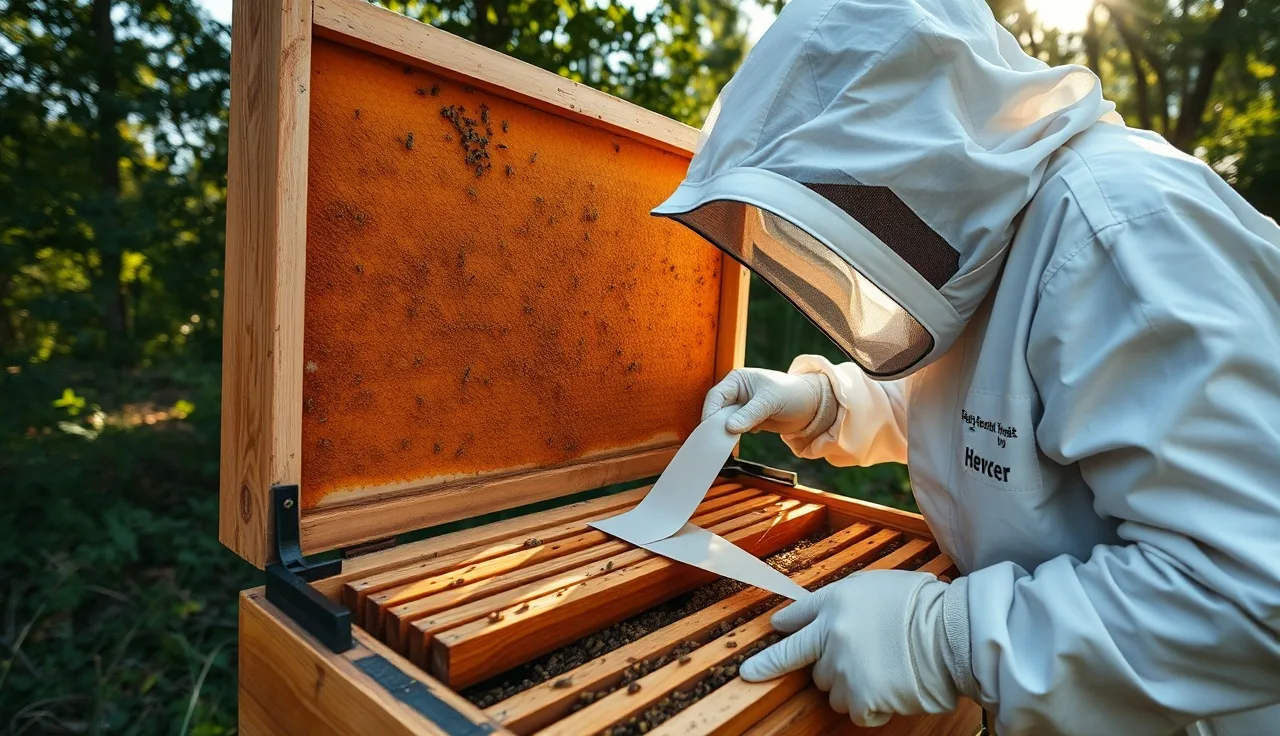
Formic acid patties are gel-matrix strips saturated with formic acid, a natural organic acid found in honey and bee venom, that you lay right on the top bars of the brood box. As the acid vaporizes over several days, the vapor moves through the wax cappings of sealed brood cells and kills varroa mites feeding on the pupae inside. That penetration is the whole point. Oxalic acid, amitraz, and most synthetic miticides can't reach mites hidden under brood cappings. Formic acid can. That's what makes it the only organic option able to knock down a mite population in a colony that still has capped brood.
The mechanism is direct toxicity to the mite's nervous and respiratory systems. Bees tolerate a useful range of vapor concentrations, but not an unlimited one. Too much acid volatilizing too fast (usually because it's too hot) damages brood and risks the queen. Too little (usually because it's too cold) kills almost nothing. The gel matrix in MAQS (Mite-Away Quick Strips) is built to meter that release across a 7-day window [1].
Formic acid is also why these products can go on colonies with honey supers in place. The acid already sits in honey at natural background levels, the treated honey shows no detectable residue increase once the strips come out, and the EPA approved MAQS with a zero-day pre-harvest interval [2]. That's a real practical edge over synthetics.
The varroa mite is the target. Formic acid patties are not a general hive tonic, and they do nothing for small hive beetles, nosema, or bacterial diseases.
What products are available and what are the differences?
In North America, two formic acid strip products dominate: MAQS (Mite-Away Quick Strips, from NOD Apiary Products) and Formic Pro (also NOD, which replaced the earlier MAQS formula with some changes). Both are EPA-registered and OMRI-listed for organic use [2][3].
MAQS uses a 7-day single treatment: two strips laid side by side on the top bars. Formic Pro gives you more flexibility, including a 14-day extended treatment that uses one strip at a time. Some beekeepers prefer that for colonies that seem sensitive to the acid load. The extended protocol usually causes less acute brood damage in warm weather, at some cost to how fast the mites drop.
Europe has its own registered products. ApiLife VAR is a thymol-dominant pad with a small formic acid component. Hive Clean and other strips exist in various markets. Outside the US, check your national pesticide authority for what's registered where you live. Applying an unregistered treatment is illegal, and the label differences matter.
Pricing (as of mid-2025) runs roughly $25 to $35 USD for a pack of 10 MAQS or Formic Pro strips, enough for five colonies on the standard two-strip protocol [4]. That's $5 to $7 per colony per treatment, mid-range for organic options. You can find strip suppliers through beekeeping supply companies that carry treatment lines.
| Product | Strips per treatment | Treatment duration | Temp range | Honey supers allowed? | Organic/OMRI? |
|---|---|---|---|---|---|
| MAQS (NOD) | 2 | 7 days | 50°F, 85°F | Yes (zero pre-harvest) | Yes |
| Formic Pro (NOD) | 1 or 2 | 7 or 14 days | 50°F, 85°F | Yes (zero pre-harvest) | Yes |
| ApiLife VAR (EU) | 1 pad | 35 days (replace 3x) | 59°F, 95°F | No (remove supers) | Varies by country |
How effective are formic acid patties against varroa mites?
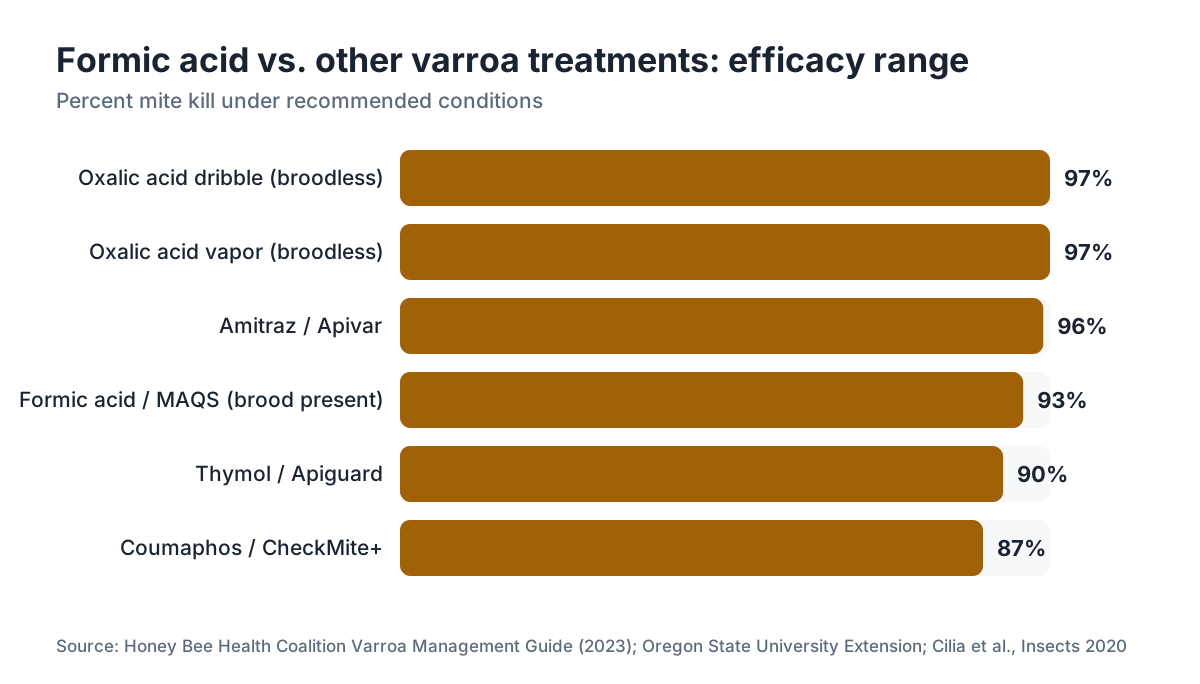
Efficacy runs about 87% to 97% mite kill in published trials, depending on temperature, colony size, and brood area [5][6]. That's genuinely good. The Honey Bee Health Coalition's Varroa management guide lists formic acid among the most effective organic treatments available, and points to its ability to reach capped brood as the key difference [5].
A field study by Giovanna Cilia and colleagues (2020, Insects) measured mite drop and alcohol wash counts before and after MAQS application across Italian colonies. Mean efficacy was 93.1% across all treatment groups under standard temperature conditions [6]. An Oregon State University extension trial found 90 to 97% efficacy when ambient temperature stayed inside the recommended window for the full 7-day exposure [7].
Be honest about the variability, though. You'll see lower numbers in real apiaries when temperatures spike mid-treatment, when colonies are very large with big brood nests, or when you place strips on top of an Imirie shim that chokes vapor concentration. Nobody has great systematic data on how colony size affects efficacy, and most of what exists comes from standard Langstroth 10-frame single or double-deep setups. Run nucs or very strong colonies in 14-frame Layens hives and the label dosing may not be tuned for you.
Efficacy also depends on what you're comparing it to. Against a hard synthetic like amitraz (Apivar), formic acid usually lands 5 to 10 percentage points lower in head-to-head trials. That gap matters at high mite loads. If you're treating at 3% or higher infestation in late summer, you may want the faster, deeper knockdown of amitraz over the slower organic route.
What temperature range do formic acid patties require?
Both MAQS and Formic Pro need ambient temperatures between 50°F and 85°F (10°C to 29°C) for the entire 7-day treatment window [2]. This is the most common source of treatment failure, and the most common source of colony damage.
Below 50°F the acid doesn't volatilize fast enough to reach therapeutic concentrations inside the hive. You finish a treatment and wonder why your mite counts barely moved. Above 85°F the volatilization rate runs past what the bees can handle, pushing acid concentrations to levels that kill brood, knock the queen off her laying pattern, and in bad cases cause outright queen loss.
So spring and fall treatments are the sweet spot in temperate climates. A late-August or early-September treatment, before overnight lows drop below 50°F, is the classic timing. In the deep South or California's Central Valley, summer daytime highs routinely top 85°F in July and August, which makes MAQS basically unusable in midsummer. Beekeepers in hot climates often have to choose between treating early (before mite populations build) or waiting for a fall window.
If a heat wave rolls in 2 days into your 7-day treatment, pull the strips. The label directs you to do exactly that, and the Honey Bee Health Coalition echoes it [5]. Leaving strips in through a 90°F stretch is a reliable way to lose your queen.
What is the risk of queen loss from formic acid treatments?
Queen loss is the most frequently reported adverse effect, and it's real. NOD's own MAQS label names queen loss as a possible outcome, especially in smaller colonies and at high temperatures [2]. Published estimates vary a lot. Some university extension reports put the risk between 5% and 15% of treated colonies under normal conditions, climbing higher when temperatures run past the recommended range [7].
Young, freshly mated queens seem more vulnerable than established layers, probably because they produce less brood pheromone to blunt the colony's stress response to the vapor. Some beekeepers report zero queen losses over years of MAQS use. Others lose queens on nearly every treatment. Temperature alone doesn't explain the spread.
The practical mitigations: confirm the forecast holds in range before the strips go in, use the 14-day Formic Pro protocol instead of the 7-day MAQS protocol if you're in marginal temperature territory, and check for queen activity (eggs, young larvae) 10 to 14 days after treatment. See no eggs and a nervous cluster, and you've likely lost your queen and need to move fast.
That risk is why I'd be careful using formic acid patties on a mating nuc or an early spring nuc. For established full-size colonies with a proven layer, the risk is manageable. For a 3-frame nuc with a newly mated queen in warm weather, you're rolling dice.
Can you use formic acid patties with honey supers on?
Yes, for MAQS and Formic Pro specifically. The EPA registration for MAQS includes a zero-day pre-harvest interval, so you can treat with honey supers in place and harvest immediately after removing the strips [2]. This is one of the product's best features for sideliner and commercial beekeepers who can't afford to pull supers every time they treat.
The reasoning behind the approval is that formic acid occurs naturally in honey. A 2006 study by Bogdanov and colleagues in Apidologie found formic acid levels in honey after MAQS treatment were not significantly different from untreated control honey once the treatment period ended. The EPA weighed that data in granting the zero pre-harvest interval [2][8].
A few caveats. During the 7-day treatment window, acid vapor does move through the whole hive, supers included. Honey being processed in cells during that window may carry slightly elevated formic acid levels temporarily. Most experienced beekeepers are fine with this given the regulatory clearance. But if you sell honey to a chemistry-sensitive customer base, you might time treatments so the main nectar flow finishes before the strips go in. That's a marketing choice, not a safety one.
How do you apply formic acid patties correctly?
Always read and follow the current product label. The label is the law under FIFRA, and it beats anything you read here or anywhere else [9].
For MAQS and Formic Pro, the general steps are:
- Confirm ambient temperatures will stay between 50°F and 85°F for the full 7-day treatment period. Check a 10-day forecast before opening the package.
- Wear nitrile gloves and eye protection. Formic acid is corrosive. Keep the package sealed until you're at the hive.
- Open the strips at the hive, not in your car or shed. The vapors are strong and will burn mucous membranes in an enclosed space.
- For MAQS (7-day protocol): lay both strips flat on the top bars of the lower brood box, paper side down, gel side up, centered over the brood nest. Don't cover more than two-thirds of the top bar surface; you need airflow.
- For Formic Pro (14-day extended protocol): place one strip per brood box, one strip at a time.
- Replace the inner cover and outer cover. Keep the bottom entrance open for ventilation; this is not the time for a reducer.
- Remove strips after 7 days (MAQS) or 14 days (Formic Pro extended). Strips can go in household trash after treatment in most jurisdictions, but check your local rules.
- Do an alcohol wash or sugar roll 3 to 7 days after strip removal to confirm efficacy. If mite counts are still above threshold, decide whether a follow-up treatment with a different mode of action makes sense.
One more thing. The Honey Bee Health Coalition's Varroa management guide, probably the best free practitioner reference out there, tells you to verify mite levels before and after any treatment rather than treating on a calendar [5]. That's good advice for any treatment, and tools like the ones at VarroaVault can help you track counts and decide timing.
When in the season should you use formic acid patties?
The two best windows in temperate North America are late spring (May, once overnight temperatures stay above 50°F) and late summer into early fall (late August through September, before nights drop below 50°F for good).
The late-summer window is the one that matters most. Varroa populations peak in late summer as bee populations fall off, and the mites made in August and September infest the long-lived winter bees that carry the colony to spring. A successful late-summer formic acid treatment, done before August 15 to September 1 depending on your latitude, is one of the highest-leverage moves you can make for colony survival. The Honey Bee Health Coalition's Varroa management guide names this pre-winter treatment the single most important intervention for overwinter survival [5].
Spring treatments make sense if you skipped fall or if a colony came out of winter with high mite counts (2% or above on an alcohol wash). Spring colonies with lots of capped brood are ideal candidates, since that's exactly the mite population oxalic acid can't touch.
Summer treatments during a nectar dearth in warm climates are the hard case. If daytime highs sit consistently above 80°F, you're close to the risk zone even inside label. In that spot, I'd reach for an oxalic acid dribble or glycerine-based OA pads for a partial knockdown, or wait for the fall window.
How does formic acid compare to other varroa treatments?
Here's a direct comparison across the main treatment categories. This is a simplified overview; actual efficacy numbers shift by study and conditions.
| Treatment | Mode of action | Penetrates capped brood? | Organic/OMRI? | Supers on? | Temp constraints | Efficacy range |
|---|---|---|---|---|---|---|
| Formic acid (MAQS/Formic Pro) | Fumigant vapor | Yes | Yes | Yes (MAQS) | 50 to 85°F | 87 to 97% |
| Oxalic acid dribble | Contact toxicant | No | Yes | No | >40°F | 90 to 99% (broodless only) |
| Oxalic acid vapor (OAV) | Fumigant vapor | Partial (repeated treatments) | Yes | No (sublimator proximity) | >40°F | 90 to 99% |
| Amitraz (Apivar) | Neurological (synthetic) | Partial (strip contact) | No | No | 50 to 105°F | 93 to 99% |
| Coumaphos (CheckMite+) | Organophosphate (synthetic) | Partial | No | No | Limited | 80 to 95% |
| Thymol (Apiguard) | Fumigant vapor | Partial | Yes | No | 59 to 105°F | 85 to 93% |
The big picture: oxalic acid dribble or vapor in a broodless colony is the most effective single treatment available, often 95%+ efficacy. But it needs a broodless state, which happens naturally only in winter in most climates, or has to be forced (caging the queen). Formic acid is your best organic option when the colony has active brood and you can't or don't want to force broodlessness.
Amitraz is the most reliable broad-spectrum synthetic. It works across a wider temperature range, penetrates brood well over a 6-to-8-week treatment period, and generally beats formic acid in high-infestation situations. The trade-offs: it's synthetic, needs honey supers off, and there are documented cases of resistance in varroa populations exposed to amitraz for many consecutive generations [10]. Rotating modes of action is smart practice.
What safety precautions do you need when handling formic acid patties?
Formic acid is classified as a corrosive. At the concentrations in MAQS strips, it can cause skin burns with prolonged contact, eye irritation or damage from splashes, and serious respiratory tract irritation if inhaled in an enclosed space. These are not theoretical risks [9].
The EPA label and safety data sheet for MAQS call for chemical-resistant gloves (nitrile at minimum, thicker chemical gloves are better), safety glasses or goggles, and no inhaling vapors during application. Apply strips outdoors, at the hive. Never open packages in a vehicle or building [2].
Get formic acid on your skin, flush with water for 15 to 20 minutes. Eye exposure needs at least 15 minutes of flushing and prompt medical evaluation. Keep the product SDS within reach while you treat.
Bees will sometimes ball or act agitated right after strips go in. That's normal. Don't panic at more dead bees under or in front of the hive in the first 48 hours; some bee mortality during treatment is expected and documented. Unusually high dead bee numbers (more than a cup or two) or piles of dead brood may mean temperatures blew past the safe range, and you should think about pulling the strips.
Store unused strips in a cool spot in the original sealed packaging. Shelf life on MAQS is about 18 months from manufacture date; check the package.
How do you know if a formic acid treatment actually worked?
You test before and after. There's no shortcut.
Before treatment, do an alcohol wash (or CO2 roll) on a 300-bee sample from the brood nest. Record your mite count. For a 300-bee sample, multiply the mite count by 0.33 to get percent infestation. Nine mites on 300 bees equals 3% infestation, the standard treatment threshold most extension guides use [5][7].
After treatment, wait 3 to 7 days from strip removal before sampling again. Test too soon, while dead mites are still falling, and you can overestimate post-treatment mite levels. Testing after 7 days from removal gives you a truer read on the surviving reproductive mite population.
A successful treatment should cut your infestation by 90% or more. Start at 3% and finish at 0.3% or below, and you're in good shape heading into winter. Start at 3% and finish at 1.5%, and something went wrong: a temperature excursion, strip placement off-center from the brood nest, or a big colony where two strips weren't enough.
Sticky board counts are less reliable here than alcohol washes, because you can't control for natural mite drop rate, temperature effects on mite movement, or dead mites from the initial kill versus live mites that survived. Use alcohol washes.
Can formic acid patties be used in cold climates or for winter treatment?
No, not practically. Below 50°F, formic acid doesn't vaporize at a useful rate. Place strips in October in Michigan, pull them 7 days later, and you've accomplished almost nothing, while your bees ate stress from an incomplete treatment.
For winter or late-fall treatment after colonies go broodless, oxalic acid is the right tool. Oxalic acid dribble works at temperatures as low as about 40°F and hits 90%+ efficacy in a broodless colony because every mite sits exposed on adult bees. Extended-release oxalic acid glycerine treatments (Api-Bioxal on cardboard or shop towel carriers, where registered in your state) can release slowly through the early winter.
The correct fall sequence in a cold climate looks like this: formic acid patties in late August while brood is still present and temperatures allow, then an oxalic acid dribble in late November or December once the colony is broodless. That two-step approach covers both the reproductive mites under brood and the phoretic mites on the bees going into winter.
Are formic acid patties approved for organic beekeeping?
Yes. MAQS and Formic Pro are both OMRI-listed (Organic Materials Review Institute), which means they're approved for use in USDA National Organic Program (NOP) certified operations [3]. Formic acid is one of a handful of mite treatments organic beekeepers can use without losing certification.
The USDA NOP regulations under 7 CFR Part 205 specify that organic livestock (bees included) may be treated with allowed substances on the National List. Formic acid appears on the National List of Allowed and Prohibited Substances for organic crop and livestock production [11]. Sell honey as certified organic, and you document treatments with lot numbers and application dates for your certifier.
Thymol (Apiguard, ApiLife VAR) and oxalic acid (Api-Bioxal) are also OMRI-listed. Synthetic treatments like amitraz (Apivar) and coumaphos (CheckMite+) don't work with organic certification. That constraint is one reason formic acid gets used so widely in organic operations, handling hassle and all.
Frequently asked questions
How long do formic acid patties stay in the hive?
For MAQS and Formic Pro's standard protocol, strips stay in 7 days, then come out. Formic Pro's extended protocol uses 14 days with a single strip. Leave them in longer than the label says and you risk ongoing brood damage. Pull them too early and you sacrifice efficacy, especially against mites in capped cells that need the full exposure window to be reached.
Can I use formic acid patties on a nuc?
You can, with caution. Smaller colonies and nucs are more vulnerable to queen loss because the smaller cluster concentrates the acid and younger queens are more susceptible. If you treat a nuc, use the 14-day extended Formic Pro protocol to slow vapor release, keep temperatures in the lower part of the 50 to 85°F range, and check for eggs 10 days after treatment to confirm the queen made it.
Do I need to remove honey supers before using MAQS?
No. MAQS and Formic Pro both carry an EPA-registered zero-day pre-harvest interval, so honey supers can stay in place during treatment. This is different from most synthetic miticides, which require super removal. The zero-day interval is based on data showing formic acid residue in honey does not increase measurably above natural background levels after treatment.
What if temperatures go above 85°F during my MAQS treatment?
Remove the strips immediately. The MAQS label explicitly says to remove strips if temperatures exceed 85°F during the treatment window. Above that threshold, formic acid vaporizes too fast, producing concentrations that can kill brood, disrupt the brood pattern, and cause queen loss. Once temperatures return to range, you can re-treat with fresh strips, but wait a few days for the colony to stabilize.
How do formic acid patties compare to oxalic acid for varroa?
They fit different situations. Oxalic acid in a broodless colony hits 95%+ efficacy but can't reach mites under capped brood. Formic acid reaches capped brood, making it the better choice when the colony has an active brood nest. Oxalic acid wins on simplicity, cost, and winter treatment. Many beekeepers run formic acid in late summer, then oxalic acid in winter, to cover the full year.
Can varroa mites become resistant to formic acid?
No documented field resistance to formic acid in varroa has been published as of 2025. The toxicity is physical (acid vapor disruption) rather than a specific receptor pathway, which makes resistance much harder to evolve than with synthetic acaricides like amitraz or coumaphos. That makes formic acid a valuable long-term tool in an IPM rotation, though it's not a reason to lean on it alone.
How much do formic acid bee treatment patties cost per hive?
A pack of 10 MAQS or Formic Pro strips costs roughly $25 to $35 USD at most beekeeping supply retailers. Since each colony needs two strips per treatment, that works out to about $5 to $7 per colony. For a sideliner with 20 hives, expect around $100 to $140 per treatment round. Prices vary by supplier; buying in larger quantities from wholesale beekeeping supply companies can drop the per-strip cost.
Do I need a prescription or license to buy formic acid bee treatment patties?
In the United States, MAQS and Formic Pro are available over the counter without a veterinary prescription. They're EPA-registered pesticides, so you must follow the label, but no Veterinary Feed Directive (VFD) or prescription is required, unlike some antibiotics used in beekeeping. In Canada, regulations differ; check with Health Canada's Pest Management Regulatory Agency for current registration status.
Can formic acid treatments hurt my bees or brood?
Some brood and bee mortality during treatment is normal and expected. You'll usually see more dead bees in front of the hive in the first 48 to 72 hours and sometimes spotty brood after strip removal. Serious damage, like large piles of dead larvae or adult bees, signals that temperatures blew past 85°F or that colony conditions amplified vapor concentration. Healthy full-size colonies at correct temperatures recover from treatment losses within a couple of weeks.
How do I store unused formic acid patties?
Store MAQS and Formic Pro strips in a cool (below 77°F, ideally refrigerated), dry spot in the original sealed packaging. Shelf life is about 18 months from the manufacture date stamped on the package. Heat degrades the gel matrix and drives premature volatilization of the acid, cutting efficacy. Never store open or partially used packages; the vapor will irritate you and the strips will lose potency.
What mite count level should trigger a formic acid treatment?
The most widely cited threshold is 2% infestation on an alcohol wash (roughly 6 mites per 300-bee sample) in the brood season, or 2% in late summer before winter prep. The Honey Bee Health Coalition's Varroa management guide names 2% as the action threshold during the brood season and advises against waiting for 3% heading into fall. Test with an alcohol wash rather than relying on calendar dates.
Can I make my own formic acid patties at home?
Technically possible, but not advisable and legally messy. DIY formic acid treatments using hardware-store formic acid are not EPA-registered, so using them in a managed colony is a FIFRA violation in the US. Concentration control is a real problem too: the commercial gel matrix is engineered to meter release rate within a safe range. Homemade pads have caused big bee and brood losses from uncontrolled rapid volatilization. Use registered products.
How soon after a formic acid treatment can I add a honey super?
For MAQS and Formic Pro, the pre-harvest interval is zero days, so you can add or leave supers at any point during or after treatment. If you removed supers as a precaution before treating, you can put them back the same day you remove the strips. There's no waiting period under the EPA registration, which sets formic acid apart from synthetic treatments like Apivar that require a 14-day wait after removal.
Sources
- EPA, MAQS (Mite-Away Quick Strips) pesticide registration documents: MAQS carries a zero-day pre-harvest interval and is approved for use with honey supers; label requires 50 to 85°F ambient temperature and specifies queen loss as possible adverse effect
- OMRI (Organic Materials Review Institute), OMRI Products List: MAQS and Formic Pro are OMRI-listed for use in certified organic operations
- Mann Lake Beekeeping Supplies, product pricing page: 10-strip packs of MAQS or Formic Pro retail for approximately $25, $35 USD
- Honey Bee Health Coalition, Varroa Management Guide (2023 edition): Formic acid listed as one of the most effective organic treatments for penetrating capped brood; late-summer pre-winter treatment identified as highest-leverage intervention; 2% infestation cited as action threshold
- Cilia G et al., 'Efficacy of Mite-Away Quick Strips against Varroa destructor in honey bee colonies', Insects 2020: Field study measured mean MAQS efficacy at 93.1% across all treatment groups under standard temperature conditions
- Oregon State University Extension Service, Varroa Mite Management in Honey Bee Colonies: MAQS efficacy 90 to 97% when ambient temperature stays within recommended window; queen loss risk estimated at 5 to 15% under normal conditions
- Bogdanov S et al., 'Bee product science', Apidologie 2006: Formic acid levels in honey after MAQS treatment not significantly different from untreated control honey after treatment period ended
- EPA, Label Requirements for Pesticides and Devices (FIFRA Section 2(p)): Pesticide label is legally binding under FIFRA; formic acid classified as corrosive requiring PPE including gloves and eye protection
- Maggi M et al., 'Varroa destructor resistance to amitraz in Argentina', Apidologie 2011: Documented cases of varroa resistance to amitraz in populations with repeated generational exposure
- USDA Agricultural Marketing Service, National Organic Program, 7 CFR Part 205 National List of Allowed and Prohibited Substances: Formic acid appears on the USDA NOP National List as an allowed substance for organic livestock and crop production
- University of Minnesota Extension, Varroa Mite Management: Formic acid described as the only organic treatment capable of reaching varroa mites in capped brood cells; oxalic acid efficacy drops significantly with capped brood present
Last updated 2026-07-09