Formic acid for bee mites: how it works, when to use it, and what to expect
TL;DR
- Formic acid is one of the few varroa treatments that kills mites inside capped brood cells, not only on adult bees.
- Registered products (Mite-Away Quick Strips, Api-Bioxal formic pads, and Apivite) hit 90 to 95% efficacy in published trials when applied within the 50 to 92°F window.
- At label doses it leaves no artificial residue in honey.
What is formic acid and why does it work on varroa mites?
Formic acid is an organic acid that already exists in small amounts in honey. Bees make it in their venom glands, and it turns up in trace quantities in ordinary hive products. That fact gives it a rare regulatory status: used at label rates, it leaves no artificial residue in honey or wax [1].
The chemistry is simple. Formic acid is volatile. It evaporates inside the hive as a gas, and that gas moves through the wax cappings of brood cells. Varroa mites (Varroa destructor) reproduce inside those capped cells, where most other acaricides never reach them. A single formic acid treatment kills reproducing mites under the cap, something oxalic acid (in its standard dribble or vaporization form) cannot reliably do. That sub-cap reach is the entire reason beekeepers tolerate the handling hassle and the temperature rules.
The acid attacks mite respiration. At the concentrations that build up inside a cell, it is lethal to the mite's cuticle-dependent gas exchange. Honey bees handle it reasonably well at labeled doses because they ventilate the hive and control their exposure by fanning.
One thing to be clear about: formic acid is dangerous to handle. It is corrosive. Skin or eye contact needs immediate flushing. The label is not safety theater. Read it, wear the nitrile gloves and eye protection it calls for, and keep water within reach.
Which formic acid products are registered for honey bee mite treatment in the US?
Three products carry EPA registration in the United States for varroa control with formic acid [2].
| Product | Formulation | Application method | Treatment duration |
|---|---|---|---|
| Mite-Away Quick Strips (MAQS) | 68.2% formic acid gel pad | 2 strips placed on top bars | 7 days |
| Api-Bioxal (formic pad presentation) | 65% formic acid | Pad on top bars | 7 days |
| Apivite | 65% formic acid | Pad or extended-release sachet | 14 to 20 days (extended release) |
MAQS is the one you will actually find on shelves across the US and Canada. It has been sold since 2012 and carries the deepest pile of beekeeper field data. The Apivite formic acid bee treatment uses a slower-release sachet that some beekeepers like for gentler, longer exposure and possibly lower queen loss, though North American field data on Apivite is thin next to MAQS.
Check with your state department of agriculture before you buy. A handful of states add their own registration requirements on top of the federal label, and a product legal in one state can be a problem in another.
Here is the registration detail that changes summer planning: formic acid products can stay in the hive while honey supers are on. The EPA label for MAQS permits super-on use directly [2]. That is a real advantage over amitraz (Apivar) or an oxalic acid dribble during a flow, and it decides how a lot of beekeepers time their July and August treatments.
How effective is formic acid treatment for honey bees against varroa?
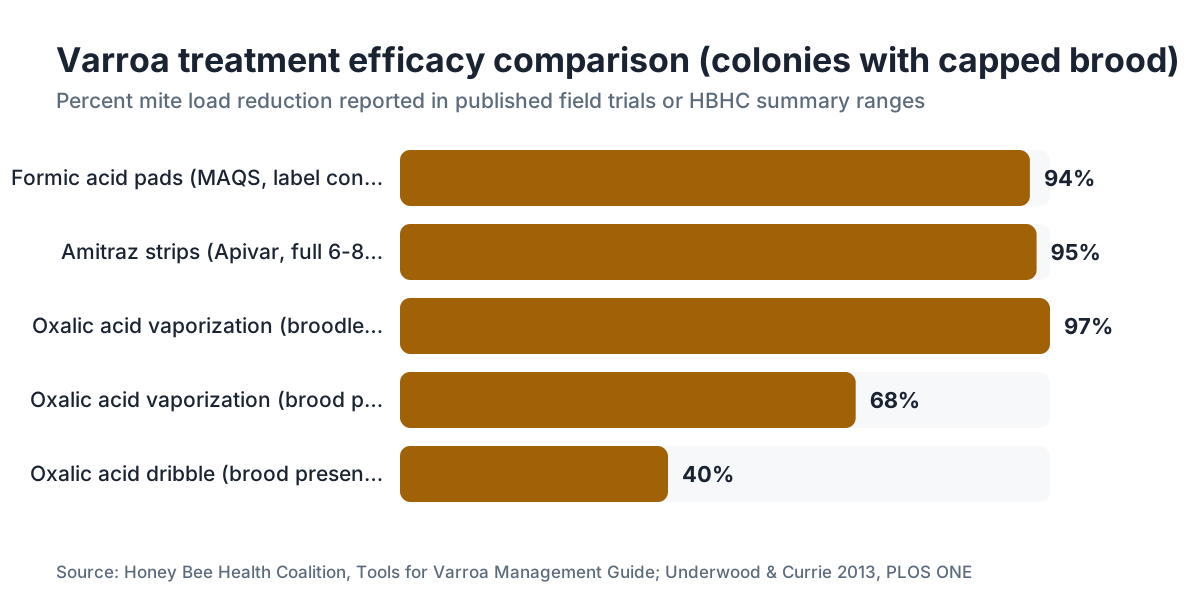
Formic acid runs 90 to 95% mite reduction in colonies with capped brood when temperatures cooperate. The published numbers swing with temperature, colony size, and whether the study measured mite drop or actual mite load reduction. Here is what the trials say.
A 2013 peer-reviewed field trial in PLOS ONE found MAQS cut varroa infestation by an average of 94.4% over 42 days against controls, beating the oxalic acid dribble in that same trial [3]. A Honey Bee Health Coalition efficacy summary puts formic acid treatments (pads and extended-release forms) in the 90 to 95% range for colonies with capped brood once the temperature window is met [4].
Formic acid falls apart at temperature extremes. Below about 50°F (10°C), evaporation crawls and the treatment mostly fails. Above 92°F (33°C), evaporation runs so fast that colony stress and queen loss climb hard. The label window reflects the chemistry, not caution for its own sake.
Efficacy also sags in very large colonies packed with brood. A deep, full brood box dilutes the gas concentration. Some beekeepers split or checkerboard a two-deep to shrink brood volume before treating. It is more work, but it is a real strategy.
The Honey Bee Health Coalition's Varroa management guide states that "formic acid is one of only two treatments known to penetrate brood cappings to kill mites in capped cells" (the other being hop beta acids in certain experimental formulations) [4]. That single line is why formic acid is the practical standard for brood-penetrating control.
What temperature range is safe for formic acid honey bee treatment?
Stay between 50 and 92°F daytime highs across the whole 7-day treatment. Temperature is the biggest management constraint with formic acid, and beekeepers underestimate it over and over.
MAQS label guidance sets 50 to 92°F (10 to 33°C) daytime highs for the 7-day period [2]. Apivite's extended-release format claims slightly more room on the cold end because it evaporates slower, but treat the 92°F ceiling as firm for every pad-based product.
The danger above 92°F is concrete. Queen loss in hot weather has been reported at 5 to 15% in some field accounts, against 0 to 2% in the right temperature range. Colony die-off from overheating is rare but real. If a heat wave lands in your treatment window, pull the strips early. Do not gamble.
Below 50°F, the treatment does not blow up. It just underperforms. You waste product and hit the bees with some acid stress without earning much mite kill. That is why formic acid is a poor choice for late-fall varroa work in the north, where oxalic acid vaporization (which does not lean on warmth the same way) is the better call.
The best formic acid windows in most of the continental US: late summer (late July to mid-September) after you pull the honey supers, and spring buildup (April to May) before the main flow if counts are already high. Seven days of stable temperatures under 90°F is all it takes.
How do you apply formic acid strips to a beehive correctly?
Applying the strips is easy. The prep is where people go wrong.
For MAQS and similar pad products:
- Check your mite count first with an alcohol wash or sugar roll. Treat if you are at or above 2 mites per 100 bees (2%), the action threshold the Honey Bee Health Coalition recommends [4].
- Confirm the 7-day forecast sits within 50 to 92°F.
- Suit up with nitrile gloves (not latex, formic acid eats latex fast) and eye protection. Keep water nearby.
- Open the package carefully. The gel inside is the active ingredient. Do not puncture the pouch past the marked perforations.
- Place one strip across the top bars of the lower brood box and one across the top bars of the upper brood box (two-deep hive). For a single-deep, one strip centered on the top bars is the label direction.
- Leave the entrance at normal width or a little wider so bees can ventilate. Some beekeepers prop the inner cover slightly for extra airflow and lower heat buildup.
- Do not inspect during treatment. Seven days of no disruption is part of what makes it work.
- Remove and dispose of the strips after 7 days. Do not compost them. Bag and trash.
For honey supers: formic acid is label-approved with supers on, but pull any super holding uncapped nectar or liquid honey in the top frames. Concentrated formic acid vapor touching liquid honey can leave an off-taste. Capped honey is fine.
Can you use formic acid while honey supers are on the hive?
Yes. This is one of formic acid's biggest practical edges over most other treatments.
The EPA registration for MAQS allows use with honey supers in place [2]. The reasoning: formic acid already sits in honey at low levels (up to about 40 mg/kg in untreated hives), and label-rate treatment does not push honey past the Codex Alimentarius limit of 40 to 50 mg/kg in most studies [1].
That said, "supers on" does not mean any super in any condition. The caveats:
Pull supers loaded with watery, uncapped nectar in the top frames. During a warm treatment period, concentrated vapor touching liquid honey can leave detectable off-notes. Capped honey dodges this.
If you plan to extract the same supers right after treatment, give the bees a few days once the strips come out before you pull frames. A week is plenty.
Cut-comb and chunk honey producers should be more careful. The wax itself absorbs some formic acid during treatment and off-gasses slowly afterward. That matters less for extracted honey but is worth knowing for specialty products.
For most summer treatments, formic acid lets you work through a flow without losing honey or waiting for a broodless gap. You do not get that flexibility with Apivar or an oxalic dribble.
What are the risks and side effects of formic acid treatment for bees?
Formic acid is not gentle. It works because it is aggressive, and that aggression costs something.
Queen loss is the most discussed risk. In the right temperature band (50 to 85°F), published queen loss runs 0 to 5%. In hot conditions (above 88°F), field reports show 10 to 15% or higher in some apiaries [3]. A queen that is already old, stressed, or poorly mated can tip over the edge. Judge queen quality before you treat.
Temporary bee mortality is normal. Bees close to the strips die in higher numbers during the first 24 to 48 hours. A pile of dead bees at the entrance on day 1 or 2 looks alarming but usually means nothing about the treatment failing or the colony being hurt. If heavy die-off keeps up past day 3, that is your signal to pull the strips.
Absconsion happens rarely. A colony can abandon the hive during treatment, mostly when it was already stressed or temperatures spiked. Colonies with a big foraging force ride out treatment better than small or weak ones.
For you, the beekeeper: formic acid fumes irritate the eyes, nose, throat, and lungs. Do not open a treated hive without protecting your face. The concentrated liquid inside the pads burns skin on contact. The California Office of Environmental Health Hazard Assessment lists formic acid as a developmental toxicant at high occupational exposures. That is not a concern at normal beekeeper handling levels, but it is a good reason to respect the gloves.
Nobody with asthma or real respiratory sensitivity should use formic acid. The fumes during application, and during any inspection while a treatment is active, can trigger serious reactions.
How does formic acid compare to oxalic acid and amitraz for varroa control?
This is the question that decides your treatment plan, and the honest answer is that no single product wins everywhere.
| Treatment | Penetrates capped brood? | Supers allowed? | Residue risk | Temperature limits | Queen loss risk |
|---|---|---|---|---|---|
| Formic acid (MAQS, etc.) | Yes | Yes (label) | None at label rates | 50 to 92°F window | Low to moderate |
| Oxalic acid dribble | No | No | None | Best in broodless period | Very low |
| Oxalic acid vaporization | Partial (repeated treatments) | No | Very low | Below 50°F OK | Very low |
| Amitraz (Apivar strips) | No | No | Detectable in wax | Year-round, broader | Very low |
The strategic split is clean. Formic acid is your summer brood-penetrating option. Oxalic acid vaporization is your late-fall or early-spring option when colonies are broodless or close to it. They are seasonal tools, not rivals.
Amitraz (Apivar) is the highest-efficacy synthetic option (95%+ in most trials) but cannot run with supers on, builds accumulating wax residue with repeated use, and has documented resistance in some mite populations in Europe [5]. Formic acid resistance in varroa has not shown up to the same degree, probably because the mechanism is physical and chemical rather than a specific receptor target.
The Honey Bee Health Coalition's Varroa management guide recommends rotating treatment modes across seasons to slow resistance, which is sound advice. A spring formic acid treatment followed by a fall oxalic acid vaporization campaign is a sensible, resistance-managing plan for most hobbyist operations [4].
If you want help tracking which treatment you used and when, the free tools at VarroaVault include a treatment log and mite count tracker that make rotation planning easy without a spreadsheet.
How often can you treat a colony with formic acid?
Twice a season is the sane maximum for most colonies. The MAQS label allows a second treatment cycle but recommends waiting at least 14 days after the first 7-day treatment before repeating [2]. Most extension guidance lands on two treatments per season [6].
Why not more? Cumulative stress. Each treatment hits the bees, the queen, and the colony's balance. The goal is enough mite kill with the fewest treatments, not maximum acid. If counts are still above threshold 14 days out, a second round makes sense. If counts are under control, stop.
There is also a diminishing-returns problem. Formic acid reaches capped brood, but a mid-summer colony full of capped cells will have some mites that survive simply because they sat in cell stages the acid missed during that specific 7-day window. A follow-up catches the next generation. That is the logic behind what some beekeepers call a "double-MAQS" protocol.
Do not go past two treatments a season without a real reason. If you are reaching for a third or fourth round, the underlying problem is usually a colony that went into summer undersized, a mite load that was already too high before you started, or a first treatment that failed on temperature.
Does formic acid treatment leave residue in honey or wax?
Formic acid at label rates is the most residue-clean treatment you can put in a honey-producing hive. That is not marketing. It reflects how the chemical behaves.
Formic acid already lives in honey naturally. The Codex Alimentarius standard for honey (Codex Stan 12-1981) sets a maximum of 50 mg/kg for formic acid [1]. Untreated hive honey usually runs 10 to 40 mg/kg on its own. Studies measuring honey from MAQS-treated hives found post-treatment levels at or below that limit in most scenarios, as long as the label application rate is followed [3].
Wax residue is not the concern it is with amitraz. Amitraz breaks down slowly in beeswax and stacks up over years of repeated treatments, a documented problem in European apiculture [5][11]. Formic acid does not bind to wax that way. It volatilizes and disperses. Old comb from formic-acid-treated hives does not carry meaningful residue into later seasons.
That behavior is why the EPA and the Canadian Pest Management Regulatory Agency cleared it for super-on use. Extension guides from Penn State and other universities back this up [6].
When should you NOT use formic acid for varroa?
Formic acid is a good tool, not a universal one. These are the situations where you reach for something else.
Broodless colonies in late fall or winter. There is no reason to use formic acid here. Your mites are all riding adult bees, not hiding in brood. Oxalic acid dribble or vaporization is safer for the bees, cheaper, and just as effective when there is no brood.
Temperatures above 92°F with no break in sight. If a heat wave is coming and you cannot count on the 7-day window staying under 92°F, do not start. Wait. Treating through a heat wave can kill your queen and knock the colony back badly.
Weak or struggling colonies. A colony below about 5 frames of bees can get pushed over the edge by formic acid stress. Treat it with something gentler, or combine it with a healthy colony first.
High-value queen mating nucs. The queen loss risk is real enough that experienced queen rearers avoid formic acid in nuclei holding virgin or freshly mated queens. Established laying queens handle it better than virgins.
Beekeepers with respiratory conditions. Not a colony problem, a personal one. If you have asthma or reactive airway disease, the application fumes are a genuine hazard. Amitraz strips or oxalic acid vaporization (with proper respiratory protection) may be safer for you.
How much does formic acid mite treatment cost, and where do you buy it?
Expect roughly $6 to $8 per colony per treatment for MAQS. Prices move with retailer and pack size, but here are the real 2024 to 2025 numbers.
MAQS (10-strip pack, treats 5 colonies) runs about $28 to $40 depending on retailer [7]. That is roughly $6 to $8 per colony per treatment.
Apivite costs more and is harder to find in North America, generally $12 to $18 per application unit when it turns up through specialty beekeeping supply companies.
For a hobbyist running 2 to 20 hives, formic acid is not the cheapest per-treatment choice (oxalic acid crystals for vaporization can come in under $2 per treatment at scale). It stays competitive because one treatment reaches capped brood, work that would take several oxalic vaporization sessions over weeks to match.
Where to buy: most major beekeeping supplies retailers stock MAQS, including Mann Lake, Dadant, and Kelley Beekeeping. Apivite comes through a smaller set of specialty importers. Always confirm the product is EPA-registered and carries an intact, readable label. A product without a registered label is illegal to use and gives you no dosing guidance.
Shelf life: unopened MAQS pouches keep for 2 years stored cool and dry. Once you open the outer package, use the strips within a few hours.
What do beekeepers actually experience when using formic acid?
No manufactured testimonials here, but the community experience is consistent across forums, extension surveys, and published beekeeper feedback studies.
Most beekeepers say the treatment is easy to apply and that mite boards show a heavy drop in the first 3 to 4 days. The visible bee mortality at the entrance in the first 48 hours is the usual shock for first-timers. It is startling until you know to expect it.
Queen loss is the most common bad outcome, and it almost always tracks with high temperatures during treatment or with queens that were already failing. If you lose a queen after a formic acid treatment during a hot week, the heat is the likelier cause than the treatment being "too strong."
The smell is real. Treated hives put off a sharp, vinegar-like odor. If your hives sit near a neighbor's yard or patio, a courteous heads-up before treating is a good move. The smell fades within a day or two of pulling the strips.
One thing experienced beekeepers repeat: do not skip the follow-up mite count 14 to 21 days after treatment. Efficacy in your hive, at your timing, in your conditions, is the only data that counts. The 90 to 95% average from controlled trials does not promise 90 to 95% in your backyard on a 91°F week in August. Count your mites. Treat to data, not to the calendar.
Frequently asked questions
Can I use formic acid on a hive with a laying queen?
Yes. Formic acid products including MAQS are registered for colonies with actively laying queens. The main risk is higher queen loss if temperatures top 88 to 92°F during the 7-day treatment. In the right temperature band, queen loss usually runs 0 to 5%. Avoid treating colonies with virgin queens or very recently mated queens, since they seem more vulnerable to the acid stress.
How long does it take for formic acid to kill varroa mites?
Mite drop is heaviest in the first 3 to 4 days of a MAQS or pad treatment. The treatment keeps working across the full 7-day label period, including penetrating capped brood as the acid volatilizes. Judge full efficacy 14 to 21 days after treatment ends, not right away, because mites emerging from surviving brood cells add to the count before they die.
Does formic acid treatment affect honey taste?
At label application rates with supers on, most studies find no detectable flavor change in extracted honey. The risk is highest if you leave supers with large amounts of watery, uncapped nectar exposed to the vapor. Capped honey is not significantly affected. Pulling supers with active uncapped nectar before treatment, or waiting a few days after treatment to extract, is the conservative move most beekeepers use.
What is the Apivite formic acid bee treatment and how is it different from MAQS?
Apivite uses a slower-release sachet compared to the 7-day gel pad in MAQS. The extended-release design aims to lower peak acid concentration in the hive, which should reduce queen loss risk while still killing mites over a 14 to 20 day period. North American availability is limited and field data is thinner than for MAQS. Some beekeepers prefer it for sensitive queen-right colonies, but MAQS is still the dominant registered product in the US.
Can formic acid kill varroa mites in capped brood cells?
Yes, and this is its biggest advantage over oxalic acid and most synthetic treatments. The acid volatilizes into a gas that moves through wax cappings and reaches mites reproducing inside capped worker and drone brood. The Honey Bee Health Coalition notes that formic acid is one of only two treatments known to penetrate brood cappings to kill mites in capped cells.
Is formic acid safe for use in organic or treatment-free adjacent beekeeping?
The USDA National Organic Program lists formic acid as an allowed substance for livestock (bees) when used per the registered label [8]. Because it leaves no synthetic residue in honey or wax, it works with certified organic honey production. Treatment-free beekeeping, though, avoids all mite treatments including organic acids, so formic acid would not fit that specific approach even as a naturally derived compound.
What happens if temperatures exceed 92°F during a formic acid treatment?
Above 92°F, formic acid evaporates far faster than intended and builds higher-than-label concentrations inside the hive. That sharply raises the risk of queen loss, heavy bee mortality, and in rare cases absconsion. If a heat wave is forecast during your 7-day window, remove the strips early. Reapply when temperatures return to the 50 to 92°F range.
How do I know if my formic acid treatment worked?
The most reliable check is an alcohol wash mite count 14 to 21 days after treatment ends. You want your mite load below 2 mites per 100 bees (2%). Mite board drop during treatment gives a rough sense of activity but is not a precise efficacy measure. If post-treatment counts are still above threshold, ask whether temperatures stayed in range during treatment before you decide to retreat or switch products.
Can formic acid be used in combination with other varroa treatments?
Generally no. Running formic acid alongside oxalic acid or amitraz at the same time is not label-compliant and adds stress without a clear efficacy payoff. The standard approach is to finish a formic acid treatment, wait at least 2 weeks, check mite counts, then decide whether a follow-up with a different product is needed. Rotating modes across seasons (formic acid in summer, oxalic acid in fall) is widely recommended to slow resistance.
How do I store MAQS or other formic acid strips before use?
Store unopened MAQS pouches below 86°F (30°C) in a cool, dry spot out of direct sun. The manufacturer states a shelf life of about 2 years from the production date when stored correctly. Once the outer sealed package is open, use the strips within a few hours; do not store partially used packs. Keep them away from food, children, and pets. The acid can slowly degrade the pouch material if kept warm for a long stretch.
Do I need a prescription or VFD to buy formic acid bee treatment in the US?
No. EPA-registered formic acid products like MAQS need no veterinary prescription or VFD. They sell over the counter at beekeeping supply retailers. Some states add registration or permit requirements for pesticide use, so check with your state department of agriculture. This is different from antibiotics for bees, which do require a VFD from a licensed veterinarian.
What protective equipment do I need to apply formic acid strips?
At minimum: nitrile gloves (formic acid degrades latex fast), safety glasses or a face shield, and a standard bee veil and suit. The concentrated acid inside the pads burns skin on direct contact and can cause serious eye injury. Work in a well-ventilated outdoor area. If you have asthma or reactive airway disease, the application fumes can trigger reactions, so consider a half-face respirator with organic vapor cartridges.
How many strips of MAQS do I use for a two-deep hive vs. a single-deep?
Standard MAQS dosing is two strips for a full-sized two-deep colony: one across the top bars of the bottom box and one across the top bars of the upper box. For a single-deep hive, one strip centered on the top bars is the label-directed dose. Do not use more than two strips per colony. The label rate is set to hive volume, and exceeding it raises bee and queen stress without improving mite kill.
Sources
- Codex Alimentarius Commission, Codex Standard for Honey (CODEX STAN 12-1981): Formic acid is naturally present in honey and the Codex maximum is 50 mg/kg; formic acid at label rates does not produce artificial residue
- US EPA, Mite-Away Quick Strips (MAQS) pesticide product registration: MAQS is EPA-registered for 7-day treatment, temperature window 50 to 92°F, and is permitted for use with honey supers in place
- Underwood RM & Currie RW (2013), PLOS ONE, 'The Effects of Temperature and Dose of Formic Acid on Efficacy and Bee Safety': MAQS reduced varroa infestation by an average of 94.4% over 42 days in field trials; queen loss rates rise significantly above 88°F
- Honey Bee Health Coalition, Tools for Varroa Management Guide (current edition): Formic acid efficacy is 90 to 95% with brood present; treat at 2 mites per 100 bees threshold; formic acid is one of only two treatments known to penetrate brood cappings
- Wallner K (1999), Apidologie, 'Varroacides and their residues in bee products': Amitraz accumulates in beeswax over repeated treatments; formic acid does not bind to wax in the same persistent manner
- Penn State Extension, Varroa Mite Management for Honey Bees: Two formic acid treatments per season is the recommended maximum; formic acid leaves no detectable residue in honey at label rates
- Mann Lake Ltd, MAQS product listing: MAQS 10-strip pack (treats 5 colonies) retails at approximately $28, $40 depending on retailer and year
- USDA Agricultural Marketing Service, National Organic Program, Allowed and Prohibited Substances: Formic acid is listed as an allowed substance for livestock including honey bees under the USDA National Organic Program
- University of Minnesota Extension, Varroa Mite Management: Formic acid treatments are recommended for summer use; oxalic acid vaporization recommended for broodless period treatment
- Traynor KS et al. (2021), Science of the Total Environment, 'Pesticides in honey bee colonies': Amitraz and its metabolites show cumulative wax residue accumulation in long-term treated apiaries
Last updated 2026-07-10