Formic acid for bees: the complete treatment guide
TL;DR
- Formic acid is the only organic varroa treatment that reaches into capped brood cells, killing both phoretic mites and the mites breeding under the cappings.
- The two products registered in the US are FORMIC PRO and Mite Away Quick Strips (MAQS).
- Both need ambient temperatures of 50 to 85°F and can go on with honey supers in place, which makes them unusually handy during a nectar flow.
What is formic acid and why do beekeepers use it on varroa?
Formic acid is an organic acid that shows up in ant venom, pine needles, and, in trace amounts, honey itself. Beekeepers reach for it because it vaporizes at room temperature. That means it moves through a hive as a gas instead of relying on bees to contact or pass around a liquid or solid. The gas seeps through the wax cappings over brood cells. That one property is what sets formic acid apart from nearly every other varroa treatment sold.
Varroa destructor spends roughly 66 to 70% of its reproductive cycle sealed inside capped brood, out of reach of treatments that only touch bees walking the comb [1]. Oxalic acid is a good example. It hammers phoretic mites (the ones riding adult bees) and does almost nothing to mites breeding under cappings. Formic acid hits both groups in one pass. That is the entire reason to use it.
The Honey Bee Health Coalition's Varroa Management Guide calls formic acid "the only organic acid that is effective against mites in capped brood" [1]. That is about as plain a statement of what the stuff does as any beekeeper needs. The catch is that formic acid is genuinely caustic. It blisters skin and burns eyes. It demands real protective equipment and respect for the temperature window. Neither fact should scare you off. Both should make you read the label before you tear open the package.
What are the EPA-registered formic acid products for bees in the US?
Two formic acid products are EPA-registered for honey bee colonies in the United States as of 2025: FORMIC PRO and Mite Away Quick Strips, usually shortened to MAQS. Both come from NOD Apiary Products. Both use slow-release gel pads or strips that give off formic acid vapor over a set number of days. They are not interchangeable in dose or schedule, even though the active ingredient is identical.
| Product | Application strips | Treatment duration | Labeled temp range | Brood-penetrating | Supers on? |
|---|---|---|---|---|---|
| FORMIC PRO | 2 pads | 14 days (or 2x 7-day) | 50 to 85°F | Yes | Yes, if no extractable honey |
| MAQS | 2 strips | 7 days | 50 to 85°F | Yes | Yes |
MAQS dumps its dose faster and usually hits a higher peak vapor concentration in the first 24 to 48 hours. That fast release does more work in a short window, but it also raises the odds of queen loss and brood kill in hot weather. FORMIC PRO's extended-release formula spreads the same chemistry across a longer stretch, which generally means fewer side effects. The price is that the hive has to stay inside the temperature window for two full weeks.
Neither product is cheap. Street price runs roughly $22 to $35 for a two-pack treatment depending on your supplier, so one application on one colony costs more than an oxalic acid treatment but less than a full Apivar strip season [2]. If you're pricing options, check beekeeping supply companies for current numbers, because they move around a lot.
One more point. Both products carry an EPA registration number and a specific label you are legally bound to follow. The label is not a suggestion. Using more strips than labeled, at temperatures outside the range, or longer than specified breaks federal pesticide law under FIFRA [3].
What temperature is right for formic acid bee treatment?
Temperature is the one variable that makes or breaks a formic acid treatment, and it bites at both ends. Too cold and the acid barely vaporizes, so you get a weak treatment. Too hot and it vaporizes so fast it can kill brood, injure the queen, and stress adult bees hard enough to cost real population.
Both FORMIC PRO and MAQS are labeled for ambient temperatures of 50 to 85°F (10 to 29°C) [4]. That range sounds generous, but the danger lives at the top. When daytime highs climb into the low-to-mid 80s, beekeepers report noticeably more queen failure. The labels themselves flag extra caution above 79°F, and plenty of beekeepers hold off above 75°F when colonies are strong and the queen is laying across a big area.
Cold-end failures are quieter but just as real. Below 50°F the strip releases too little vapor to knock mites down in any meaningful way. Drop pads in October when nights already hit 45°F and you're mostly burning money.
Most experienced beekeepers aim for a forecast showing daytime highs of 60 to 75°F across the whole treatment window. Summer in much of the US is simply too hot for safe use. That is less a flaw in the product and more a nudge toward spring or early fall timing, which lines up well with pre-winter mite management anyway.
For the 14-day FORMIC PRO protocol, the forecast matters for the entire two weeks, more than the day you put pads in. Pull up a 10-day forecast before you start, and keep a plan to remove pads early if a heat wave is rolling in. The label allows early removal. A dead queen does not allow a do-over.
When should you treat bees with formic acid?
Timing formic acid comes down to three things: mite load, temperature window, and whether you're protecting a honey crop.
Mite load first. The Honey Bee Health Coalition recommends treating when varroa counts reach 2% (2 mites per 100 bees on a sugar roll or alcohol wash) through most of the season, or 1% in late summer while the winter bees that carry the colony to spring are being raised [1]. Don't wait for deformed wing virus or crawling bees. By then mite loads are high enough that even a strong treatment won't fully undo the damage.
The temperature window sets when in the year formic acid is usable at all. Across most of the continental US that means early spring (April to mid-May), late summer (late August through September once the heat breaks), and in southern states maybe a short early-fall slot. Midsummer is usually off the table in the South and much of the Midwest.
The honey super advantage is real and worth saying plainly. Synthetic miticides like Apivar and thymol-based Apiguard need supers off. Formic acid strips can legally stay in a hive with supers on, as long as the honey is not yet capped and headed for extraction [4]. The label language is precise: MAQS can be used "when honey supers are present," while FORMIC PRO's label says do not use when supers holding honey for human consumption are present at full strength. Read your specific product's current label. The rules differ and have been revised over the years.
For most hobbyists, the single best window is late August to mid-September, after summer honey is pulled but before the queen slows fall brood. That timing catches the mite population before it rides into winter on the long-lived bees that need to last 5 to 6 months.
How do you apply formic acid strips or pads to a hive?
The application itself is simple. The prep is where people cut corners and pay for it.
PPE first. Formic acid at these concentrations causes chemical burns on skin and serious eye injury. Wear nitrile gloves (skip thin latex, use at least 12-mil nitrile or rubber), a face shield or safety goggles, and a respirator rated for organic acid vapors. A dust mask does nothing here. The NIOSH-approved respirator you'd wear for spraying pesticides is the right one [5].
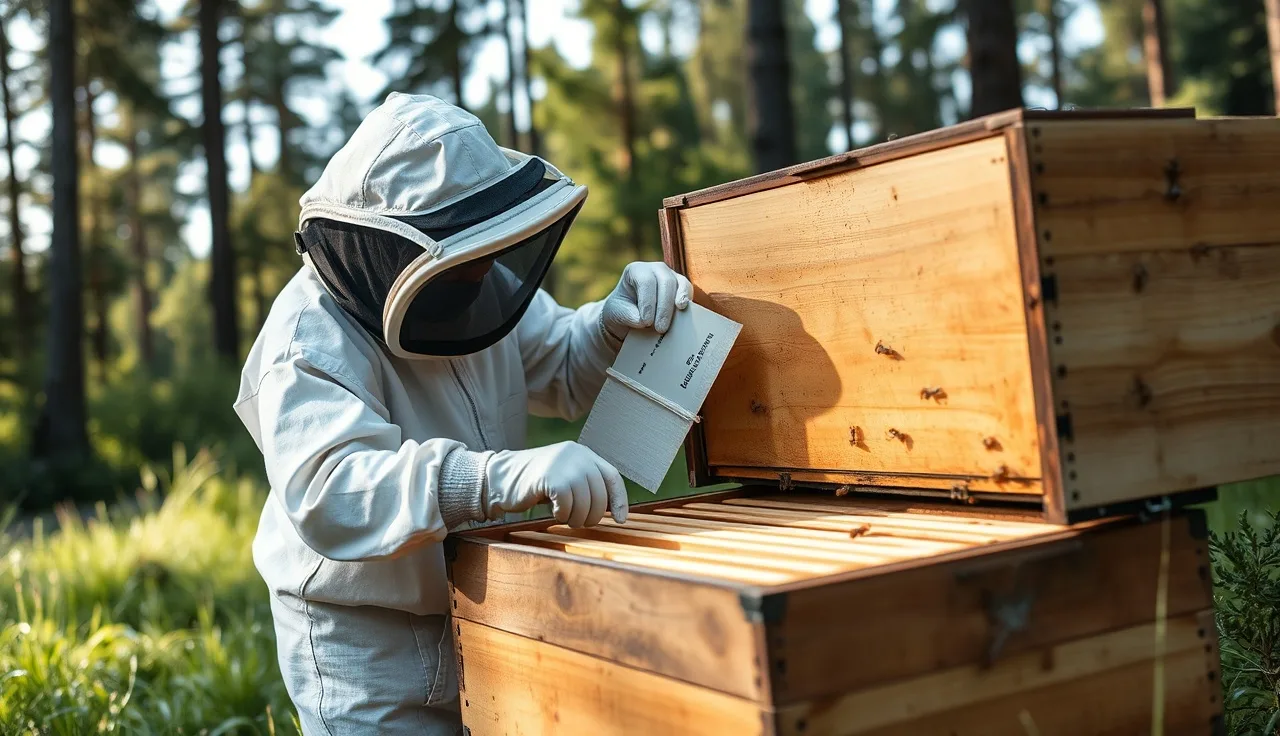
For MAQS: open the outer packaging outdoors or somewhere well ventilated. Lay both strips flat on top of the brood-nest frames, paper side down, one on each side of center. Keep the entrance fully open, or at least 3/4 width. Do not reduce it. Vapor inside the hive has to stay manageable, and choked ventilation makes it worse for the bees. Leave for 7 days, then remove.
For FORMIC PRO: same placement, two pads on the top bars of the brood nest. The standard run is 14 days of continuous treatment. The alternate two-week split uses one pad for 7 days, a 24-hour gap, then the second pad for another 7 days. The split usually cuts side effects at possibly slightly lower efficacy. NOD Apiary Products posts the protocol details on its site [4].
A few things that matter in the yard. Colonies under about 8 frames of bees are more sensitive to vapor stress. Treating a small split or a nuc? Reduce the dose or switch to oxalic acid. Queens can still fail under ideal conditions, roughly 5 to 10% of the time with MAQS and somewhat less with FORMIC PRO's slower release, so keep a backup plan. And always run a mite count 3 to 5 days after treatment ends to confirm it worked. Monitoring is not optional.
VarroaVault's free mite count tracking tools let you log pre- and post-treatment counts in one place, which starts to matter fast once you're past two or three hives.
How effective is formic acid at killing varroa mites?
Efficacy data for formic acid swings more than the marketing lets on, and being straight about that helps you decide well.
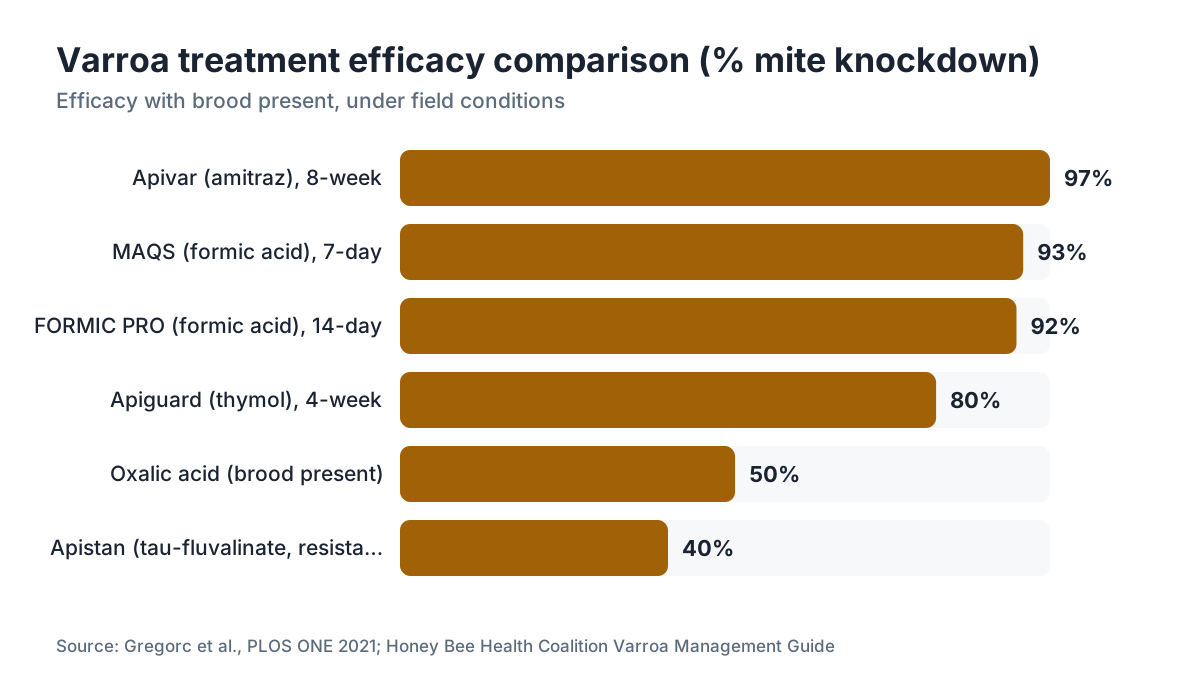
Under good conditions, both MAQS and FORMIC PRO hit roughly 90 to 95% mite knockdown in independent trials [6]. A 2021 study in PLOS ONE found MAQS cut mite levels by about 93% in colonies with brood present, against roughly 97% for Apivar (amitraz) over a full cycle [6]. The gap between formic acid and the synthetics is real but small enough that formic acid stays a first-line choice, especially for beekeepers who want to keep residues out of their wax.
The bigger swing factor is how much brood sits in the hive. A colony with a full 8-frame brood nest has more capped cells for mites to hide in than one running light on brood. Vapor concentration inside a cell is lower than outside (it still has to diffuse through wax), so dense, multi-layer brood tends to show slightly lower knockdown. That is one reason late-summer treatment, when brood is contracting, often beats mid-spring treatment on a booming colony.
Formic acid also carries essentially no resistance risk from varroa. Mites have built resistance to synthetic miticides, especially tau-fluvalinate (Apistan) and to a lesser degree amitraz, in populations around the world [7]. Organic acids work by a different mechanism, and mites have never shown any documented ability to adapt to them. That is a solid long-term reason to keep formic acid in your rotation even when a single cycle tests a hair below a synthetic.
What are the risks and side effects of formic acid bee treatment?
Queen loss is the most common and most gutting side effect. Both the MAQS and FORMIC PRO labels acknowledge higher queen failure risk, worst in the first 48 hours when vapor is thickest. Field surveys put queen loss at roughly 5 to 15% with MAQS, higher when temperatures push past 80°F or the colony is strong and the queen is in peak lay [2, 4].
Brood kill is next. Uncapped larvae take formic acid vapor harder than capped brood. You may find a ring of dead larvae around the edge of the brood nest in the days after treatment. Most colonies bounce back fine as long as the queen makes it, but it rattles you the first time.
Absconding can happen in hot weather when vapor climbs high enough to make the hive unlivable. It's rare but real. It's almost always a temperature-management failure. Don't treat on hot days.
For you, the beekeeper: chemical burns from direct contact, respiratory irritation or damage from breathing the vapor, and eye injury are all on the table without proper PPE. Formic acid isn't uniquely dangerous by industrial-chemical standards, but it's no harmless substance either. Both the EPA and NIOSH keep guidance on safe handling [3, 5].
One more thing worth flagging. Formic acid can hit drone brood and drone populations, and some research suggests it lowers drone viability during treatment. If you're rearing queens or live where drone numbers matter for mating, time your treatments around that.
Can you use formic acid when honey supers are on?
This is one of the most common questions beekeepers ask, and the answer turns on which product you're running and what you plan to do with the honey.
MAQS was the first product EPA approved with label language allowing use with honey supers in place. The current MAQS label permits treatment "when honey supers are present." FORMIC PRO reads differently: it says supers holding honey meant for human consumption should not be present during treatment [4]. Always read the label on the lot you bought, because the wording gets revised periodically and the printed label on your package is the legal document.
The reason formic acid earns this honey-safe designation is that it's already in honey naturally, usually 10 to 100 mg/kg, and the brief bump from treatment fades within weeks. A 2019 study in the Journal of Apicultural Research found formic acid residues in honey dropped back to background levels within 2 to 4 weeks after MAQS treatment [8].
Here's the practical call. If you're running supers and mite counts hit 2% during a flow, MAQS lets you treat without pulling them. That's genuinely useful. But if daytime temps are above 80°F and the colony is large, you're swapping one problem (mites) for a real shot at another (a dead queen or dead brood). Sometimes the right move is to wait 10 days for the heat to break instead of treating right now.
How does formic acid compare to other varroa treatments?
Every treatment has its own profile. Here's the honest rundown.
Formic acid versus oxalic acid: oxalic is cheaper, safer for you to handle, and very effective on phoretic mites. It fails on mites in capped brood, so it shines in broodless periods or as a trickle on packages and splits. Formic acid is the pick when brood is present and you need to reach the whole mite population.
Formic acid versus Apivar (amitraz): Apivar is more consistent, with 95 to 99% knockdown in most trials, and it's far less temperature-sensitive. It also leaves residues that build up in wax over time, and resistant populations exist in some regions [7]. Apivar wants a 6 to 8 week treatment with supers off. Formic acid is faster, leaves no wax residues that stack up season over season, and works with supers.
Formic acid versus thymol (Api Life VAR, Apiguard): thymol also volatilizes and reaches brood mites, but with lower brood-penetration efficacy than formic acid in head-to-head trials. Its temperature window is just as tight. Some beekeepers run thymol as a second-line organic after formic.
Formic acid versus synthetic pyrethroids (Apistan, CheckMite+): resistance is common enough that most extension apiarists now advise against pyrethroids as a primary treatment across most US regions [7]. They're cheap and easy, but efficacy in resistant populations can fall under 50%.
Building a rotation to slow resistance? The usual advice from university extension programs is to alternate organic acids (formic, oxalic) with amitraz-based products and check resistance status in your region before leaning on pyrethroids [1].
For background on the mite itself, including its life cycle and why brood penetration matters, see our varroa mite overview.
What does a good formic acid treatment protocol actually look like?
A protocol is more than dropping strips in a box. Here's a methodical approach for a hobbyist running 5 to 20 colonies.
Step 1: mite count before treatment. Run an alcohol wash or sugar roll on 300 bees from the brood nest. Figure infestation as mites per 100 bees. Write the number down. At or above 2% (or 1% in August and September), treat [1].
Step 2: check the forecast. You want 7 to 14 days (depending on product) of daytime highs between 60 and 79°F. Heat wave coming in 4 days? Wait.
Step 3: lay out your PPE before you open any packaging. Nitrile gloves, face shield, organic vapor respirator.
Step 4: apply per label. Fully open the entrance. Note the date and colony ID.
Step 5: leave the hive shut for the first 3 to 4 days if you can. A quick peek on day 5 to 7 is fine. You're confirming the queen is alive and the colony hasn't absconded.
Step 6: remove strips on schedule. Note any odd brood patterns or a missing queen.
Step 7: recount mites 5 to 7 days after strips come out, not during treatment. Still above threshold? Either retreat with formic acid (check the label for the retreatment interval) or move to a different mode of action.
Step 8: record everything. Date, temperature, product, colony size, pre and post counts. That data is how you learn what actually works in your yard and your climate.
The Honey Bee Health Coalition Varroa Management Guide has a downloadable decision-making flowchart that pairs well with this kind of record-keeping [1]. For a digital version, VarroaVault's free protocol tracking tools run on this same flow.
Where can you buy formic acid products for bees and what do they cost?
FORMIC PRO and MAQS are stocked by most major beekeeping suppliers in the US and Canada. You don't need a license or prescription to buy them, unlike some other agricultural chemicals, because they're registered for hobbyist use.
Pricing across 2024 to 2025 runs roughly $22 to $35 for a single two-strip or two-pad treatment pack (one colony). Multi-colony packs (10-treatment cartons) drop the per-treatment cost to around $12 to $18. Some suppliers offer free shipping over certain thresholds, which adds up when you're buying for 10 or 20 hives. Check free shipping honey bee supply companies to compare shipping policies.
Store unused product cool, below 77°F, and out of direct sun. Don't hang onto open or partially used packages. The leftover strips keep releasing acid into whatever container you stash them in. Shelf life is typically 18 to 24 months from the manufacture date per the NOD Apiary labeling [4].
Still unsure which product fits your setup? Most beekeeping suppliers can steer you based on colony count and timing. See beekeeping supply companies for a list of solid vendors.
Frequently asked questions
What temperature is too hot for formic acid bee treatment?
Both FORMIC PRO and MAQS are labeled to a maximum ambient temperature of 85°F, but experienced beekeepers see more queen loss and brood kill once daytime highs top 79 to 80°F. If your forecast shows highs above 80°F during the treatment window, wait for cooler weather. The first 24 to 48 hours produce the highest vapor concentration, so avoid applying on a warm day even if the rest of the week looks fine.
Will formic acid harm honey bees or kill the queen?
Formic acid can harm adult bees, brood, and queens at high vapor concentrations. Queen loss hits roughly 5 to 15% of MAQS treatments and somewhat less with FORMIC PRO's extended release, per field surveys and label acknowledgments. Risk climbs with high temperatures, large colonies, and choked ventilation. Keep the entrance fully open, stay inside the labeled temperature range, and confirm a live queen on day 5 to 7.
Can you treat bees with formic acid when honey supers are on?
MAQS is labeled for use with honey supers present. FORMIC PRO's label currently restricts use when supers holding honey for human consumption are in place. Formic acid residues in honey drop back to natural background levels within 2 to 4 weeks after treatment, per research in the Journal of Apicultural Research in 2019. Always verify your product's current label, since EPA label language gets updated periodically.
How long does a formic acid treatment take?
MAQS strips are a 7-day treatment. FORMIC PRO runs 14 days as a standard application, or two separate 7-day applications with a 24-hour break between them. Don't remove either early except in an emergency like an extreme heat wave, and don't leave either in longer than labeled. Count treatment time from the moment pads or strips go in.
Does formic acid work on varroa mites inside capped brood?
Yes. Formic acid vapor penetrates wax cappings and kills varroa mites breeding inside brood cells. That's the main reason beekeepers pick it over other organic acids. The Honey Bee Health Coalition calls formic acid "the only organic acid that is effective against mites in capped brood." Efficacy on capped brood is somewhat lower than on phoretic mites because of the diffusion barrier, but it's still meaningful.
How effective is formic acid compared to Apivar?
Apivar (amitraz) typically hits 95 to 99% mite knockdown in trials. Formic acid products like MAQS and FORMIC PRO reach roughly 90 to 95% under good conditions. The difference is real but small. Formic acid doesn't build up in wax, carries no known resistance risk from varroa, and works with supers. Apivar needs supers off and a 6 to 8 week window. For resistance management, using both at different times of year is a common extension recommendation.
Is formic acid safe for beekeepers to handle?
Formic acid at the concentrations in registered bee treatments is genuinely caustic. It causes chemical burns, serious eye injury, and respiratory damage if inhaled. Wear 12-mil nitrile or rubber gloves, a face shield or safety goggles, and a NIOSH-approved organic vapor respirator when handling strips or pads. Open packaging outdoors. Wash exposed skin right away with water. A dust mask or reading glasses do not protect you.
When is the best time of year to treat bees with formic acid?
Late August through mid-September is the most valuable window for most US beekeepers. Mite populations have built through summer, the temperature is dropping into the ideal range, and treating now protects the long-lived winter bees being raised then. Early spring (April to mid-May) works in most regions before summer heat arrives. Midsummer is usually too hot in the South and Midwest. Match timing to your local temperature window and mite counts.
Can formic acid be used in combination with other varroa treatments?
Combining formic acid with another treatment at the same time is generally not advised, because the interactions aren't well studied and stacking chemical stressors raises side-effect risk. Sequential use is fine and common: formic acid in late summer, then an oxalic acid dribble or vaporization in a broodless winter period. That covers both phases of the mite life cycle with complementary organic treatments. Alternating with amitraz-based products seasonally helps manage resistance.
How do you know if formic acid treatment worked?
Run an alcohol wash or sugar roll mite count 5 to 7 days after strips come out, not during treatment. A successful treatment should bring counts below the threshold (2% through most of the season, 1% in late summer). If counts are still high, consider retreating with a different mode of action. Counting only before treatment and never after is a common mistake that leaves beekeepers blind to failures.
Does formic acid leave residues in honey or wax?
Formic acid occurs naturally in honey at 10 to 100 mg/kg. Levels rise briefly after treatment and return to background within 2 to 4 weeks, per a 2019 study in the Journal of Apicultural Research. Unlike synthetic miticides such as tau-fluvalinate and coumaphos, formic acid does not build up in beeswax across treatment cycles. That wax-clean profile is one reason many beekeepers prefer organic acid rotations over repeated synthetic use.
What's the difference between MAQS and FORMIC PRO?
Both are formic acid gel-pad treatments from NOD Apiary Products. MAQS delivers its dose over 7 days with a faster initial release, so it's quicker but carries a somewhat higher queen-loss risk in heat. FORMIC PRO uses an extended-release formula over 14 days (or a split two-week protocol), which generally causes fewer side effects. MAQS has clearer label approval for use with honey supers on. Cost and efficacy are similar. Temperature management matters equally for both.
Can you use formic acid on a small colony or nuc?
Small colonies (under 8 frames of bees) are more sensitive to formic acid vapor stress, because the vapor concentration relative to colony volume runs higher. For nucs or splits, consider a single strip instead of two if the label permits, or switch to oxalic acid dribble or vaporization, which is gentler on small populations. Check the current label before dose-reducing. Some beekeepers treat nucs successfully with FORMIC PRO's lower-intensity release.
Do varroa mites develop resistance to formic acid?
No documented resistance to formic acid has turned up in varroa populations anywhere in the world as of 2025. That's the opposite of tau-fluvalinate (Apistan) and coumaphos, where resistance is common across the US and Europe. Organic acids work through direct chemical toxicity rather than the receptor-binding mechanisms mites can evolve around. That's a solid long-term argument for keeping organic acids in rotation even when a synthetic tests better in a single cycle.
Sources
- Honey Bee Health Coalition, Varroa Management Guide (current edition): Formic acid is the only organic acid effective against mites in capped brood; treatment threshold of 2% during season and 1% in late summer
- Penn State Extension, honey bee and varroa mite management resources: Reported queen loss rates and field efficacy comparisons for MAQS vs other organic treatments
- US EPA, Federal Insecticide, Fungicide, and Rodenticide Act (FIFRA) overview: Using a pesticide product in a manner inconsistent with its labeling is a federal violation under FIFRA
- NIOSH / CDC, formic acid occupational safety guidance: NIOSH recommends a NIOSH-approved organic vapor respirator for handling formic acid; skin and eye burn hazards documented
- Gregorc A et al., PLOS ONE 2021, acaricide efficacy trials in honey bee colonies: MAQS achieved approximately 93% varroa mite knockdown with brood present; Apivar approximately 97% over full treatment cycle
- USDA Agricultural Research Service, Bee Research Laboratory: Documented resistance in varroa to tau-fluvalinate and to a lesser degree amitraz in US and global populations; no resistance documented for organic acids
- Journal of Apicultural Research 2019, formic acid residues in honey after treatment: Formic acid residues in honey returned to natural background levels within 2 to 4 weeks after MAQS treatment; naturally present at 10 to 100 mg/kg
- University of Minnesota Extension, honey bee management resources: Recommendation to alternate organic acids with amitraz-based products and monitor regional resistance patterns
- UC Agriculture and Natural Resources, California Master Beekeeper Program: Broodless-period oxalic acid and seasonal formic acid rotation guidance; alcohol wash threshold recommendations
- EPA, pesticide registration program: MAQS and FORMIC PRO are EPA-registered for use in honey bee colonies in the United States
- Cornell University College of Agriculture and Life Sciences: Field guidance on formic acid application timing, temperature management, and integrated mite management rotation
Last updated 2026-07-09