Formic acid liquid for bees: how it works, doses, and when to use it
TL;DR
- Formic acid liquid (sold as Mite-Away Quick Strips or Formic Pro, both 65% acid on a cellulose pad) kills varroa mites, including mites sealed under brood cappings, by vapor.
- Efficacy runs 90 to 95% in field trials when temperature stays between 50°F and 92°F.
- It leaves no residue in honey and is EPA-registered for use during a honey flow.
What is formic acid and why do beekeepers use it on mites?
Formic acid is the same organic acid ants make. It already sits in honey at low levels, which is one reason residue isn't the worry it is with synthetic miticides. Beekeepers reach for it because the vapor pushes through wax cappings and reaches both phoretic mites riding on adult bees and reproductive mites hidden inside sealed brood cells. That dual reach is rare. Oxalic acid, the other popular organic tool, only kills the mites out in the open.
Why does the vapor cross cappings? Formic acid is volatile. At hive temperatures it off-gasses steadily from whatever pad you're using, and mites take it in through the cuticle and spiracles. Bees shrug it off at the right dose. Mites, far smaller and more sensitive, don't.
For anyone fighting varroa mites year after year, formic acid is one of the few tools that works while brood is present and doesn't ask you to find and cage the queen. That's a big deal in spring and summer, when colonies are packed with brood and mite numbers can double every three to four weeks.
How does formic acid liquid actually kill varroa mites?
It kills by contact and by vapor. Formic acid gas spreads through the hive air, moves through the wax cappings (permeable to small molecules), and reaches the mites inside the cell. Once a mite is exposed, the acid denatures its proteins and wrecks its metabolism. Death comes within hours of enough exposure.
A 2014 review in Experimental and Applied Acarology (Rosenkranz and colleagues) confirmed formic acid is acaricidal to Varroa destructor at concentrations you can reach inside a standard Langstroth hive, and it flagged temperature as the main driver of how much acid actually evaporates. [1] Too cold, and not enough acid lifts off the pad. Too hot, and the concentration climbs past what bees tolerate, which puts brood and the queen at risk.
That window, roughly 50°F to 92°F (10°C to 33°C) at the time you apply, is the single biggest constraint on this treatment. The Honey Bee Health Coalition's Varroa Management Guide names temperature as the top reason formic acid treatments flop in the field. [2] Read the 10-day forecast before you open the package.
What formic acid products are EPA-registered for use in honey bee hives?
Two products are EPA-registered in the United States as of 2025: Mite-Away Quick Strips (MAQS) and Formic Pro. Both use 65% formic acid soaked into a cellulose pad. The split is duration. MAQS is a 7-day treatment with two strips. Formic Pro is a 14-day treatment, two strips applied together or one after the other depending on brood load. [3]
You can't legally put raw bulk formic acid on hives in the U.S. without a valid EPA registration and, in most states, a veterinarian-client-patient relationship or a pesticide applicator license. Most hobbyist and sideliner beekeepers just use MAQS or Formic Pro. They're stocked by the usual beekeeping supply companies and need no special license beyond following the label.
Canada allows a few more formulations, and the EU runs its own registration system. Outside the U.S., check your national pesticide authority before you buy anything.
| Product | Concentration | Duration | Brood-penetrating | Honey flow safe |
|---|---|---|---|---|
| Mite-Away Quick Strips (MAQS) | 65% formic acid | 7 days | Yes | Yes (per label) [3] |
| Formic Pro | 65% formic acid | 14 days (two phases) | Yes | Yes (per label) [4] |
| Raw formic acid (DIY pad) | Varies (typically 60 to 65%) | Varies | Yes | Depends on dose |
| Oxalic acid (for comparison) | 3.2% in syrup or vapor | One-time or 5 applications | No (phoretic only) | No (no brood, low flow) |
What temperature range do you need for formic acid to work safely?
MAQS wants a treatment range of 50°F to 85°F (10°C to 29°C) for the full 7-day run, per the label. Some beekeepers drop to a single strip when highs are expected to hit 85 to 92°F, since less pad means less vapor when heat is already pushing evaporation. The Formic Pro label allows temperatures up to 92°F (33°C). [4]
Below 50°F the acid barely lifts off, so you get weak mite kill and still expose the brood. Above the upper limit, queen losses jump. University of Guelph trials recorded queen loss of 8 to 15% with MAQS in hot conditions, against roughly 4% at label-compliant temperatures. [5] That gap matters if you run a tight operation.
Here's the practical version. Apply in the morning on a day whose high won't clear 85°F (or 92°F for Formic Pro), and scan the 10-day forecast so a heat wave doesn't catch the strips mid-treatment. In hot climates the window is narrower. Late August into fall is often the good stretch, once summer peaks break.
Ventilation counts too. Screened bottom boards let excess vapor drain out and keep acid from pooling near the brood nest at damaging strength. Leave the entrance fully open the whole time.
How effective is formic acid liquid at reducing varroa mite loads?
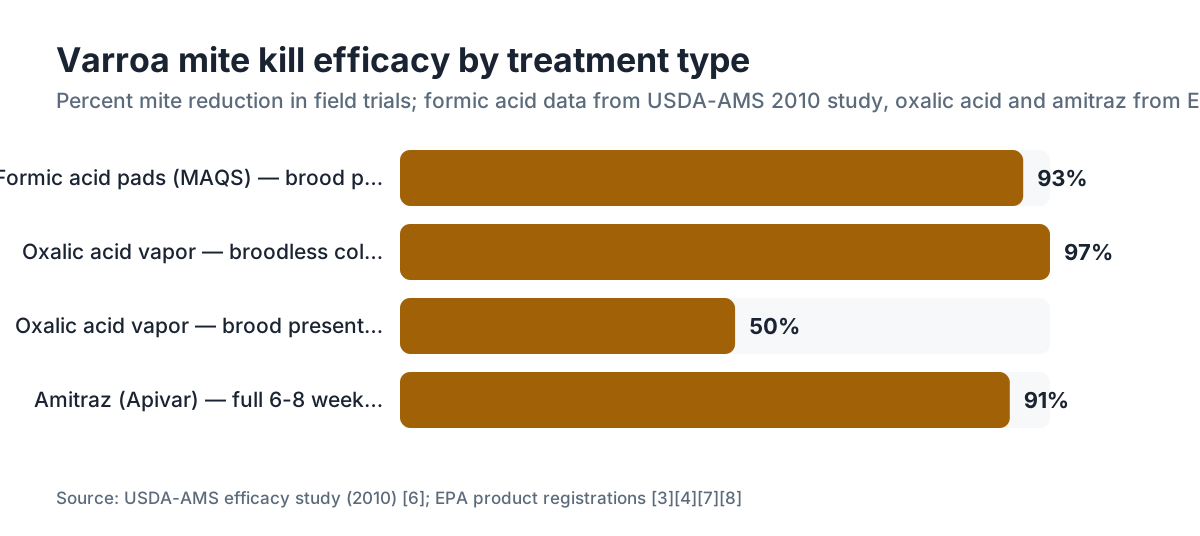
Done right, 65% formic acid pads kill 90 to 95% of mites when you stay inside the label temperature range. A 2010 USDA Agricultural Marketing Service study found MAQS cut mite populations by an average of 93% across 60 test colonies over two seasonal cycles. [6] That ranks it with the best registered treatments, alongside oxalic acid vaporization, which hits similar numbers but only on phoretic mites.
The under-capping kill is what makes 93% mean something. During peak brood-rearing, roughly 80 to 90% of a colony's varroa sit in sealed cells at any moment. A treatment that only reaches phoretic mites is managing maybe 10 to 20% of the population per round. Formic acid takes on the whole population in one treatment.
Efficacy slips when temperature is off, when the colony is huge (the pad-to-hive-volume ratio worsens in a double-deep full of bees), or when the strips are old and half off-gassed from bad storage. Keep unopened strips somewhere cool and mind the expiration date. This is not a product you buy in bulk and forget in a hot garage.
Can you use formic acid during a honey flow?
Yes, and this is one of formic acid's real edges over most synthetic miticides. Both EPA-registered pads, MAQS and Formic Pro, are labeled for use during an active honey flow, so you can treat with supers on. [3][4] The acid doesn't build up in honey beyond what's naturally there.
To be precise: formic acid occurs naturally in honey at 150 to 500 mg/kg. Studies comparing honey before and after treatment found no statistically significant rise tied to MAQS at label rates. The Honey Bee Health Coalition's Varroa Management Guide names this as the reason operations can treat in summer without giving up a honey crop. [2]
Some beekeepers still report a faint flavor shift in honey pulled right after treatment, mostly in hot weather when acid comes off the pad fast. If you sell premium varietal honey, you might treat right after pulling supers instead of just before harvest, out of caution. The residue data doesn't support the flavor worry, but the reports are common enough to know about.
How do you apply formic acid liquid safely, and what's the actual process?
Safety first, and I mean it. Formic acid at 65% burns skin and eyes on contact. Wear nitrile or rubber gloves (skip standard latex, which the acid soaks through), eye protection, and work upwind. Don't lean over the hive as you open the package. The vapor will sting your eyes right away, and at high concentration it irritates the airway. Keep water close to rinse a splash.
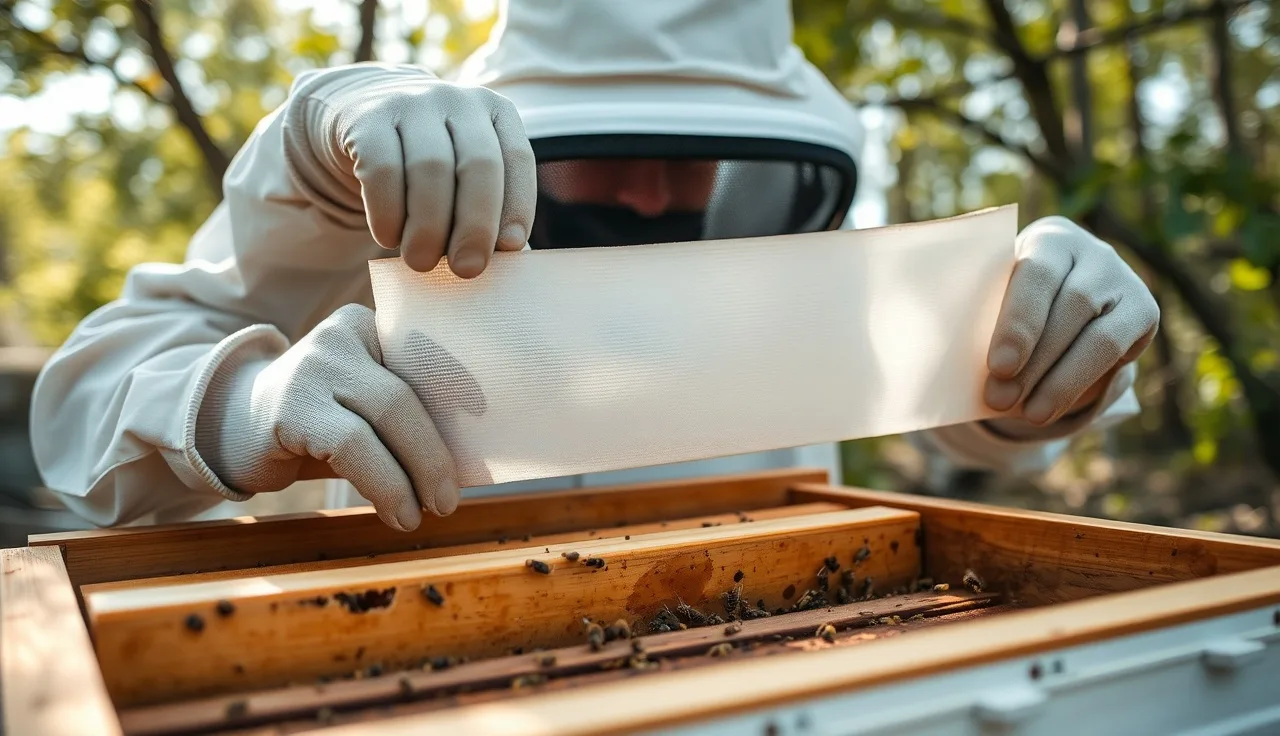
MAQS: pull the wrapper, lay both strips flat across the top bars of the bottom brood box, set the box above back on, close up normal. Leave the entrance fully open. That's the whole job. Don't reopen for 7 days. Every time you crack the lid you break the vapor environment.
Formic Pro: the 14-day protocol uses two strips. Apply both at once for a stronger 14-day treatment, or stagger them per the label if the weather runs warm. The label is specific. Read it.
After treatment, run a mite wash (alcohol wash or sugar roll) 3 to 5 days after you remove the strips to confirm it worked. If the count is still above 2 mites per 100 bees, decide whether to treat again or rotate to a different mode of action.
VarroaVault's free protocol tools help you build a seasonal calendar that lines up formic acid with your other mite tools, so you're planning instead of reacting.
For pads and gear, most regional beekeeping supply companies carry MAQS and Formic Pro, and some offer free shipping on honey bee supply orders above a threshold.
What are the risks: queen loss, brood damage, and bee toxicity?
Queen loss tops the list of reported problems. Label-compliant applications lose queens in roughly 3 to 6% of colonies on average, based on the MAQS registration studies. [3] At higher temperatures that climbs. The likely cause is direct acid exposure to the queen or nearby brood, plus the queen's sensitivity to disruption while she's laying.
Brood damage shows up as spotty brood or larvae that don't cap right during the first two to three days. It usually clears once the initial acid peak drops. If you still see heavy brood loss past day 3, pull the strips and watch whether the colony recovers.
Bee toxicity at label doses stays low. Workers tolerate the vapor far better than mites do, which is the entire point. Some colonies cluster harder at the entrance during the first 48 hours. That's normal. The bees are moving out of the brood area away from the vapor, not dying.
Colonies under 5 frames of bees are poor candidates. The label sets a minimum colony strength, and a small colony concentrates the vapor at a higher per-bee dose. For a weak colony, oxalic acid by dribble or vapor is the safer call.
Nobody has clean long-term data on whether repeated annual formic acid use hurts colony resilience. The closest evidence comes from long-running resistance management work, which shows no meaningful change in bee behavior or queen quality with yearly treatment. That's reassuring, but it isn't a controlled multi-year trial.
How does formic acid compare to oxalic acid and synthetic miticides?
The comparison most beekeepers care about is formic acid versus oxalic acid, because both are organic, both leave no worrying residue, and both are legal with almost no licensing.
Oxalic acid vaporization is cheaper per treatment (roughly $0.50 to $1.00 per colony per application with bulk crystals and a vaporizer) and kills 95 to 99% of phoretic mites. But it never touches mites under cappings. You need a broodless window or 5 weekly treatments to work through the brood cycle. [7] Formic acid clears brood mites in a single 7-day treatment at higher per-treatment cost (MAQS runs about $6 to $10 per colony; Formic Pro is close).
Against synthetics like Apivar (amitraz strips) or Apistan (fluvalinate), formic acid has two clear wins: no summer exclusion from honey supers, and no documented varroa resistance in the U.S. Amitraz resistance shows up in some U.S. varroa populations, and fluvalinate resistance is widespread. [8] Working formic acid into your rotation slows resistance building against the synthetics.
The honest read: if your hive has brood and no heat wave is coming, formic acid is one of the best single treatments you can buy. If the colony is broodless (midwinter or fresh after a split), oxalic acid vapor is cheaper and just as good. Use both across a season.
When in the season should you apply formic acid for best results?
The two best windows are late summer (August across most of North America) and early fall (September). Temperatures usually sit in range, brood is present so you hit the full mite population, and you have time to repeat before winter bees get sealed into cells you can't reach again until spring.
Spring works once temperatures hold above 50°F, but spring weather flips fast in most of the country. A warm week chased by a cold snap is frustrating at best and useless at worst. If you treat in spring, watch the forecast like a hawk.
Summer treatment during a flow is doable with MAQS or Formic Pro, but only if regional highs stay under 85 to 92°F. In the South, that window may simply not exist from June through September. Adjust to your climate.
The Honey Bee Health Coalition recommends an alcohol wash at least monthly from April through October and treating when counts pass 2 mites per 100 bees during the brood season. [2] Don't run on the calendar alone. Let the mite count tell you when to treat. The calendar only tells you which tool fits the season and the temperature.
Is formic acid effective against other hive pests besides varroa?
Varroa control is the registered use, but there's reasonable evidence formic acid has some activity against Aethina tumida (small hive beetles) and Nosema ceranae spores. The small hive beetle side is mostly beekeeper anecdote. No well-powered field study has confirmed real beetle population knockdown from formic acid pads alone.
For tracheal mites (Acarapis woodi), formic acid was one of the main treatments before that pest faded from economic importance in most U.S. regions. The vapor reaches the tracheal system and kills the mites there. In areas where tracheal mites still show up, one formic acid treatment handles varroa and tracheal mites at the same time.
Formic acid does nothing useful against American foulbrood, European foulbrood, chalkbrood, or most other bee pathogens. It's a miticide. Don't expect broad-spectrum coverage from it.
What do you do if the treatment doesn't work: follow-up testing and retreating
Run a post-treatment mite wash 3 to 5 days after the strips come out. Every time. If you count more than 2 mites per 100 bees, something went sideways: temperature was off, the strips were old, or the colony was huge relative to the strip surface area.
Don't just slap on more formic acid. Ask what failed. If it was temperature, wait for better weather and re-treat. If the strips were stored badly, buy fresh ones. A second application within 2 to 4 weeks with the same product is generally fine, but you're also stacking brood and queen stress.
If you can't get the temperature right in your climate window, switch to Apivar (amitraz) for fall. Amitraz tolerates a wider temperature range and works by contact with adult bees carrying mites. The tradeoff is a 6 to 8 week treatment and you have to pull honey supers. [8]
Keep a treatment log: date, product, temperature range, colony strength, and pre- and post-treatment mite counts. That single habit beats every gadget. VarroaVault's free tracking tools make it easy to log and compare colonies over time. By season's end you'll know which treatments actually worked and under what conditions, instead of guessing.
Frequently asked questions
Can I make my own formic acid treatment at home using bulk acid?
In the U.S., putting raw formic acid on hives without an EPA registration violates FIFRA (the Federal Insecticide, Fungicide, and Rodenticide Act). Some beekeepers still run 60 to 65% acid on DIY pads (vermiculite or cardboard). The efficacy data on homemade systems is inconsistent, and handling undiluted formic acid carries real burn risk. If cost is the concern, MAQS and Formic Pro are the safer, legal choice.
Will formic acid harm my honey or make it unsafe to eat?
No. Formic acid occurs naturally in honey at 150 to 500 mg/kg. EPA-registered treatments don't push honey formic acid above that natural background at label doses. The Honey Bee Health Coalition's Varroa Management Guide and the MAQS label both confirm treatment during a honey flow is acceptable with supers on. Your honey is safe to eat.
How long do I leave formic acid strips in the hive?
MAQS strips stay in exactly 7 days, then you remove them. Formic Pro strips stay 14 days total, either as one continuous treatment or staggered as the label directs. Don't leave strips in past the labeled time. There's no extra mite kill once the acid has fully volatilized, and you're only adding stress to the colony.
Can I use formic acid on a queenless colony or a colony with a virgin queen?
No. The label advises against treating queenless colonies or those with virgin queens. Virgin queens are especially vulnerable to formic acid, and loss rates run very high. Wait until a new queen is mated and laying, then treat. A queenless colony gains nothing from brood-penetrating mite kill anyway, since there's no capped worker brood to protect.
How much does formic acid treatment cost per hive?
MAQS runs roughly $6 to $10 per colony per treatment for a two-strip pack. Formic Pro sits in a similar range, about $5 to $9 per colony depending on quantity. Amitraz strips (Apivar) cost roughly $3 to $5 per colony for a two-strip pack, so formic acid costs a bit more but adds honey-flow compatibility and brood-penetrating kill that amitraz doesn't match the same way.
What's the difference between Mite-Away Quick Strips and Formic Pro?
Both use 65% formic acid in a cellulose pad. MAQS is a 7-day treatment with two strips applied together. Formic Pro is a 14-day treatment with two strips you can apply at once or in sequence, and its label allows temperatures up to 92°F versus 85°F for MAQS. Formic Pro usually causes slightly less acute brood stress because the lower peak acid release spreads over more days.
Do I need to remove honey supers before applying formic acid?
No. Both MAQS and Formic Pro are labeled for use with honey supers on during an active flow. That's a main advantage over amitraz and fluvalinate, which both require pulling supers. You still have to check the temperature window before you apply.
How do I know if my formic acid treatment worked?
Run an alcohol wash (300 bees in isopropyl alcohol, count the mites) or a sugar roll 3 to 5 days after strip removal. A good treatment drops counts below 2 mites per 100 bees. If counts stay high, check whether temperature held in range during treatment and whether the strips were stored well. Never skip post-treatment monitoring. It's how you catch a failure before the next brood cycle.
Can formic acid cause my queen to die?
Yes, queen loss is a known risk. Under label-compliant temperatures, loss averages 3 to 6% per application based on registration studies. Above 85°F (MAQS) or 92°F (Formic Pro), the rate climbs sharply. Check that your queen is present and laying 7 to 10 days after strip removal. If she's gone, a late-summer treatment leaves you time to requeen before winter.
Is formic acid safe to use near other hives or in an apiary with multiple colonies?
Yes. Formic acid treatments don't meaningfully affect neighboring colonies in an outdoor apiary. The vapor dissipates fast in open air. You can treat several hives at once without worrying about cross-contamination. Inside a single hive the vapor stays concentrated enough to kill mites; just past the entrance, it dilutes quickly.
Can varroa mites develop resistance to formic acid?
No resistance to formic acid has been documented in Varroa destructor anywhere in the world as of 2025. The toxicity mechanism, broad protein denaturation by a simple organic acid, makes resistance very hard to evolve, unlike the story with synthetic pyrethroids such as fluvalinate. Even so, rotating modes of action across the season is still good practice.
What protective equipment do I need when handling formic acid strips?
At minimum: nitrile or rubber gloves (not thin latex) and eye protection. Work upwind of the hive when you open the packaging to avoid a lungful of concentrated vapor. At 65%, formic acid on bare skin burns within seconds. If you're handling many strips at once, a half-face respirator with organic vapor cartridges is worth it. The strips are safer than liquid acid, but caution still applies.
Sources
- Experimental and Applied Acarology, Rosenkranz et al., Varroa destructor biology and control review: Formic acid is acaricidal to Varroa destructor at concentrations achievable inside a Langstroth hive, and efficacy depends heavily on temperature driving volatilization
- Honey Bee Health Coalition, Varroa Management Guide: Temperature is the primary field reason formic acid treatments fail; the HBHC recommends treating when mite counts exceed 2 mites per 100 bees and confirms honey-flow compatibility of registered formic acid products
- EPA, MAQS (Mite-Away Quick Strips) product registration and label: MAQS is EPA-registered for 7-day treatment using two 65% formic acid strips, labeled for use during honey flow with supers on, with queen loss rates documented in registration studies
- EPA, Formic Pro product label and registration: Formic Pro is labeled for 14-day treatment at temperatures up to 92°F (33°C) and is approved for use during an active honey flow
- University of Guelph, School of Environmental Sciences, apiculture research on MAQS queen loss: University of Guelph trials documented queen loss rates of 8 to 15% with MAQS in high-temperature conditions versus roughly 4% under label-compliant temperatures
- USDA Agricultural Marketing Service, MAQS efficacy field study report: MAQS reduced mite populations by an average of 93% across 60 test colonies over two seasonal cycles in a 2010 USDA-AMS study
- EPA, Oxalic Acid (Api-Bioxal) product registration and label: Oxalic acid is labeled for one-time treatment in broodless colonies or 5 weekly treatments through a brood cycle; it does not penetrate brood cappings
- USDA Agricultural Research Service, varroa resistance to amitraz and fluvalinate documentation: Amitraz resistance has been documented in some U.S. varroa populations and fluvalinate resistance is widespread in domestic colonies
- Penn State Extension, Varroa Mite Treatment Options: Penn State Extension documents formic acid as one of the few treatments effective against mites under brood cappings and usable during a honey flow
- University of Minnesota Extension, Bee Lab, varroa management resources: University of Minnesota Bee Lab recommends monthly alcohol wash monitoring April through October and treating when counts exceed 2 per 100 bees
- EPA, Federal Insecticide Fungicide and Rodenticide Act (FIFRA) overview: Using unregistered pesticide formulations including raw formic acid on bee colonies is a violation of FIFRA
Last updated 2026-07-09