Formic Pro varroa mite treatment: the complete guide
TL;DR
- Formic Pro is an EPA-registered formic acid strip that kills varroa mites under brood cappings, which most treatments can't do.
- Two strips per full-strength colony, applied in two rounds 7 days apart, gives roughly 90 percent kill when daytime highs stay between 50°F and 92°F.
- Honey supers can stay on the whole time.
What is Formic Pro and how does it work against varroa?
Formic Pro is a gel-matrix strip made by NOD Apiary Products that slowly releases formic acid vapor inside the hive. The acid moves through wax cappings. That means it kills phoretic mites riding on adult bees and reproductive mites hiding inside capped brood cells at the same time. That dual action is what sets formic acid apart from oxalic acid, which only touches phoretic mites.
Each strip is about the size of a thick index card. It holds roughly 68.2 percent formic acid bound in a polymer matrix that spreads the release over days instead of minutes [1]. Lay the strips on the top bars of the brood nest. Vapor drifts down through the colony as bees fan and move air.
Formic acid isn't new to beekeeping. European beekeepers have used it for decades. It's one of the few treatments approved for use while honey supers sit on the hive, which matters a lot for summer treatments when colonies are producing and you don't want to pull supers and wait.
The active ingredient shows up naturally in honey in tiny amounts, so there's no residue worry the way there is with synthetic miticides like fluvalinate or coumaphos. The EPA label confirms no pre-harvest interval when the product is used as directed [1].
How effective is Formic Pro at killing varroa mites?
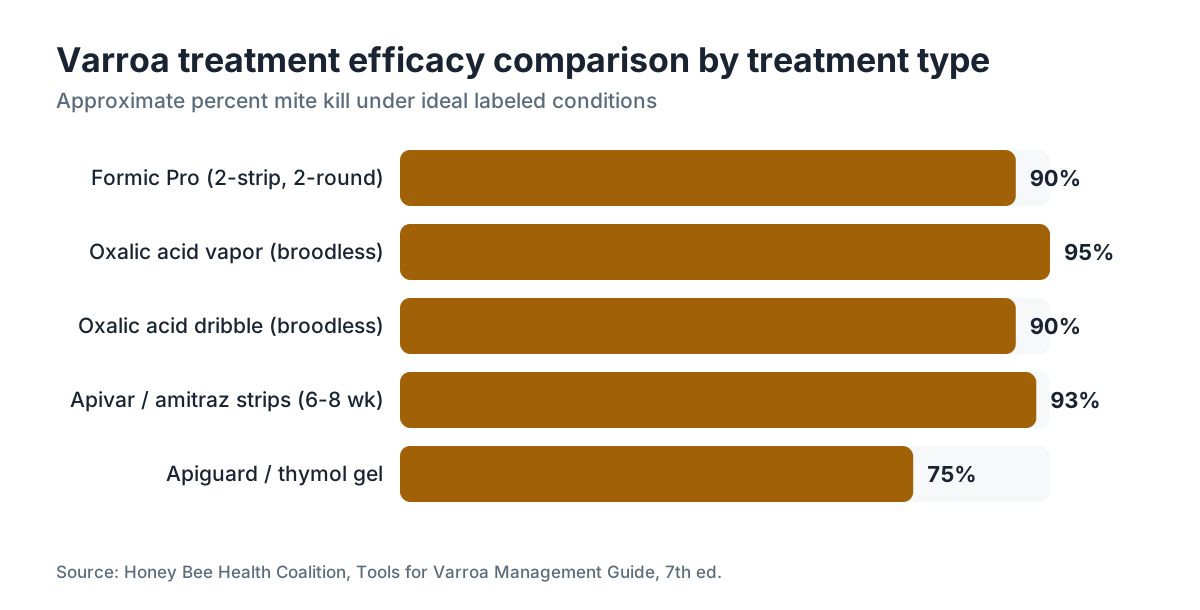
Formic Pro reaches roughly 90 percent or better mite kill when you run the full two-strip, two-round protocol in the right temperature range. The Honey Bee Health Coalition's Tools for Varroa Management guide, one of the most-cited practitioner resources in North America, lists formic acid products among the treatments that work on mites inside capped brood, with efficacy studies in that 90-plus range under good conditions [2].
That number assumes a colony with a solid brood nest. Weak colonies, single-strip jobs, or treatment during a heat wave all drag it down. Nobody has clean controlled data on exactly how much each variable costs you. The pattern in field reports is steady, though: heat and crowding are the two biggest killers of efficacy.
One honest caveat. Formic acid works through vapor pressure, and vapor pressure rises with temperature. At 50°F the strips barely off-gas. At 95°F they off-gas too fast and can kill brood or a queen. The manufacturer's tested, labeled range is 50°F to 92°F for daytime highs [1]. I'd be cautious even at 88 to 90°F with a smaller colony that can't ventilate well.
Formic acid is the only organic acid that penetrates cappings. Oxalic acid, drizzled or vaporized, is extremely effective (often 90-plus percent) but only works on phoretic mites, so you need a broodless window or repeated treatments to catch emerging bees [3]. Formic Pro's brood-penetrating trick means you can treat a queenright colony in the middle of summer with one two-round application.
What are the Formic Pro dosage and application instructions?
The standard dose is two strips per full-strength colony, applied in two rounds 7 days apart, for a 14-day total window. The EPA-registered label is the legal document. Everything below reflects that label as of the current registration, but check the label in the box before you treat [1].
Standard two-strip protocol (full-strength colonies):
- Apply 2 strips per colony, laid flat across the top bars of the brood box with the printed side facing up.
- Leave strips in place for 7 days.
- After 7 days, apply a second set of 2 fresh strips.
- Leave the second set in for another 7 days, then remove.
- Total treatment window: 14 days.
Single-strip protocol (smaller or weaker colonies):
For colonies with fewer than 6 frames of bees, the label allows 1 strip per application. Same 7-day intervals.
The strips need airflow across them to work. Don't bury them under frames or let propolis seal the edges. If your bees are propolizing like crazy, check at day 2 to 3 that the strips are still exposed. I'll often tuck a small twig under one end of the strip to lift it off the top bars so vapor can escape from both surfaces.
Remove all residual strip material after day 14. Old strip pieces are a common miss. Bees rarely haul them out on their own, and leftover material can keep off-gassing at low levels, which can stress the queen.
For monitoring before and after, Penn State Extension recommends an alcohol wash or sugar roll on a 100 to 300 bee sample [4]. Treat if you're at 2 percent or higher infestation during the active season.
What temperatures are safe for Formic Pro treatment?
The labeled range is 50°F to 92°F for daytime highs across the treatment period [1]. Temperature is the single biggest variable with Formic Pro. Get it wrong and you can lose your queen, lose your brood, or get almost no kill.
Below 50°F, the acid doesn't volatilize enough to reach useful levels through the hive. Above 92°F, it volatilizes too fast, builds up to damaging levels inside the cluster, and can burn brood, harm the queen's reproductive system, or kill her.
Queen loss is the most reported problem with formic acid in hot weather. It happens more in small hive volumes (nucs, 5-frame boxes) where heat and acid concentrate. Treating in late July in the South? Watch your forecast hard. Even one afternoon at 94°F inside a 14-day window is a real risk.
My own cutoff sits at 87°F for daytime highs before I'll start a treatment. That buffer covers a hotter-than-forecast afternoon. In a region with jumpy summer heat, aim for late August or early September when nights cool off.
Cold-side problems are less dramatic. If you set strips during a week that drops below 50°F, the treatment just isn't doing much on those days. You can stretch the strip duration a little after a run of cold days, but the label doesn't authorize extensions, so you're off-label at that point. Plan around stable weather.
Can you use Formic Pro with honey supers on?
Yes. This is one of the genuine advantages of Formic Pro over many other varroa treatments. The EPA label permits application while honey supers intended for human consumption sit on the hive, with no pre-harvest interval required [1].
Formic acid occurs naturally in honey, usually somewhere around 0.01 to 0.1 percent by mass in commercial samples. A treatment does push hive formic acid levels up for a while, but residue studies find levels drop back to background within days after strip removal [2].
I still wouldn't put new supers on during an active treatment. Give the colony a few days after strip removal before you stack fresh drawn comb or foundation on top. There's no hard evidence this matters. It just seems smart not to introduce new comb while formic vapor is still clearing.
If you're extracting commercially and selling into markets with international residue standards, check with your state's department of agriculture. The U.S. standard follows the EPA label, but some export markets set different maximum residue limits for formic acid.
When is the best time of year to treat with Formic Pro?
Late summer, roughly mid-August through September, is the sweet spot for most of North America. Here's the logic.
Mite populations track brood cycles. Varroa reproduce in capped brood, so their numbers peak about 6 to 8 weeks after the colony's peak brood, usually mid-summer [8]. By August, mite loads are climbing fast and brood volume is starting to shrink, which makes treatment more effective and less risky to your winter bees.
The Honey Bee Health Coalition flags late summer as the most important treatment window for getting colonies through winter [2]. The bees raised in August and September are the ones that have to live 4 to 6 months to carry the colony to spring. Treating before those bees are capped, or at least before they become most of the adult population, gives you the best shot at healthy winter bees with low mite loads.
Temperature lines up well then too. Daytime highs usually still clear 50°F but ease off peak summer heat, so you land in Formic Pro's range without July's queen-loss risk.
A second window is spring, as colonies build but before honey supers go on (or after they come off in an early-flow area). Spring treatment heads off the exponential mite growth that would otherwise compound all summer.
If you run a varroa mite monitoring calendar, the trigger is an alcohol wash at or above 2 percent during the season, or 1 percent in late summer when winter bees are being raised.
How does Formic Pro compare to other varroa treatments?
Formic Pro and Mite Away Quick Strips are the only EPA-registered products that both kill brood mites and allow supers on. Here's a direct comparison of the main varroa treatments U.S. beekeepers reach for. Efficacy figures come from the Honey Bee Health Coalition Tools for Varroa Management guide [2] and Penn State Extension [4].
| Treatment | Active Ingredient | Kills Brood Mites | Supers On | Temp Limits | Approx. Cost Per Colony Treatment |
|---|---|---|---|---|---|
| Formic Pro | Formic acid | Yes | Yes | 50-92°F | $8-12 |
| Mite Away Quick Strips | Formic acid | Yes | Yes | 50-85°F | $8-12 |
| Api-Bioxal (OA dribble) | Oxalic acid | No | No | Broodless ideal | $1-3 |
| Api-Bioxal (OA vapor) | Oxalic acid | No | No (EPA label) | Above freezing | $1-5 |
| Apiguard | Thymol gel | Partial | No | 59-105°F | $10-20 |
| Apivar | Amitraz strips | Yes (slow) | No | Above 50°F | $8-15 |
| ApiLife Var | Thymol/eucalyptus | Partial | No | 59-95°F | $8-15 |
Costs are rough estimates from typical 2024-2025 supplier pricing and shift with pack size and source [5].
The comparison that matters most is Formic Pro versus oxalic acid vapor. OA vapor has excellent kill (often over 95 percent) in broodless colonies, and the cost per treatment is tiny. But you need a broodless window, or a long stretched-out vapor protocol, to reach mites in capped cells. Formic Pro skips that requirement, which makes it more practical in the heart of the brood season.
Amitraz (Apivar) is the other product that reaches mites under cappings, through a different route. It's highly effective, but it wants a 6 to 8 week treatment period, no supers on, and resistance is a growing worry in some areas [6].
Mid-July, heavy mite loads, full supers, no time to spare? Formic Pro is what I'd reach for. Given a fall broodless window instead, I'd lean on oxalic acid vapor. Different situations, different answers.
What are the risks and side effects of Formic Pro?
Queen loss is the risk beekeepers talk about most, and it's real. In controlled trials, queen loss with formic acid products runs 1 to 10 percent depending on temperature and colony conditions [2]. The likely mechanism is direct irritation or damage to the queen's reproductive tissue when acid concentrations peak.
Brood damage can happen too, especially in hot weather or small colonies. You may see spotty brood or a dome of missing capped cells in the center of the nest for a day or two after treatment. Usually the colony re-fills the comb and moves on. If brood damage is severe and lingers, suspect high ambient temperature or poor ventilation.
The strips are an irritant to human skin, eyes, and airways. Formic acid at working concentrations burns on contact. The label requires nitrile or chemical-resistant gloves and eye protection when handling strips [1]. I open the package and apply strips with the hive facing into the wind so vapors blow away from me. Don't lean over an open hive right after placing strips.
Keep strips away from children and store them cool and dry, below 77°F. Shelf life is typically 18 months from manufacture. Check the lot date on the package.
Resistance is not a real concern with formic acid. It works as a broad organic-acid toxin instead of hitting one specific receptor, so varroa haven't shown meaningful resistance to it, unlike pyrethroids and amitraz [6].
Where can you buy Formic Pro and what does it cost?
A pack of 10 strips (enough to treat 5 colonies with the two-strip protocol) usually retails for $20-30, which works out to roughly $8-12 for a complete two-round treatment per colony [5]. Formic Pro is widely stocked by U.S. beekeeping supply companies.
Major national suppliers carry it. If you're buying from a smaller local shop, call ahead, because some don't stock it year-round. Some suppliers also sell 2-strip packs, handy for a single colony or a nuc.
Comparing prices across vendors? The beekeeping supply companies page has a current list of major North American suppliers. If shipping cost is on your mind, free shipping honey bee supply companies covers the vendors that waive freight on larger orders. For general gear, the beekeeping supplies page rounds out the rest.
One thing to check: some states have their own pesticide registration rules, so a product registered federally by the EPA may still need separate state registration before it can be sold or used in your state. Formic Pro has broad state registration, but if you're in a state with historically strict pesticide rules, confirm through your state department of agriculture's pesticide registration database.
To track mite counts and treatment timing, VarroaVault's free varroa management tools let you log washes and set threshold alerts with no paid subscription.
How do you monitor whether Formic Pro actually worked?
Run an alcohol wash 48 to 72 hours after you pull the second set of strips, then compare it to your pre-treatment count. Don't assume a treatment worked just because you followed the steps. Formic Pro, like any miticide, can underperform from temperature problems, bad strip placement, or a colony condition that limited vapor spread.
If your pre-treatment wash showed 4 percent and your post-treatment wash reads 0.3 percent, the treatment worked well. If you went from 4 percent to 2.5 percent, something went wrong and you need to retreat or switch tools.
Penn State Extension's alcohol wash calls for a half-cup (roughly 300 bee) sample from the center of the brood nest, shaken in 70 percent isopropyl alcohol for 60 seconds, then filtered through a mesh [4]. Count dead mites, divide by the number of bees, multiply by 100 for your infestation percentage.
A sticky board gives you a rough second read. Slide a sticky board (or white paper with cooking spray) under a screened bottom board the day you set strips. You'll usually see a sharp spike in mite drop within the first 24 to 48 hours, tapering over the week. See essentially no drop, and either the strips aren't working or your starting mite load was genuinely low.
If the treatment underperformed and counts stay above threshold two weeks after the second strip removal, oxalic acid vapor is a good follow-up, especially as the colony heads into fall brood contraction. The two mechanisms fit together: Formic Pro knocks down the brood-phase population, OA vapor finishes the remaining phoretic mites.
Is Formic Pro safe for bees, queens, and honey?
For bees, yes, in normal conditions. Workers get exposed to formic acid vapor continuously during treatment and handle it fine inside the labeled temperature range. You may see bees bearding more heavily on the outside of the hive during treatment. That's a ventilation response, not a sign of serious harm.
For queens, the risk is real but manageable. Queen loss in the research literature runs up to about 10 percent in bad conditions [2]. In my experience that's a worst case. In good temperatures with full-strength colonies, queen loss is uncommon. I'd put practical risk closer to 1 to 3 percent per treatment in typical conditions, though I don't have a clean study to pin that number to. Got an especially valuable queen? Weigh whether a broodless OA vapor treatment would be safer.
For honey, the label's no-pre-harvest-interval finding rests on formic acid levels returning to background during the post-treatment period [1]. The FDA recognizes formic acid as a substance that occurs naturally in honey, and there's no U.S. tolerance (maximum residue limit) set for it because it's considered naturally present [7].
For brood, some temporary damage is possible, mostly in the warmest part of the hive or in the first 24 hours after placement. Healthy colonies bounce back fast. Massive brood die-off lasting more than 3 to 4 days means you should pull the strips and check your temperatures.
What do beekeepers often get wrong with Formic Pro?
The most common mistake, by a wide margin, is treating outside the temperature window. I've watched it go both ways. Beekeepers treat in a late-September cold snap with daytime highs barely at 48°F, then wonder why mite counts didn't budge. Others treat in an August heat dome at 96°F, then lose queens. Read the forecast, more than today's conditions.
Second: forgetting to remove strip residue after day 14. Old strips look like dried cardboard and bees usually ignore them. They're still off-gassing. I set a calendar reminder the day I place the first set.
Third: treating once instead of twice. The two-round protocol (7 days, then fresh strips for 7 more) is built to catch the brood-emergence cycle. Varroa that were capped during the first round have emerged by day 7. The second set catches those newly phoretic mites before they crawl back into brood cells. Skip the second round and you get a fraction of the efficacy.
Fourth: treating nucs like full colonies. A 5-frame nuc in a full-depth box has far less air volume to buffer acid peaks. Use the single-strip protocol for small colonies and watch temperature closely.
Fifth: skipping monitoring on both ends. No pre-treatment count means you don't know if you needed to treat. No post-treatment count means you don't know if it worked. The alcohol wash takes about 10 minutes and clears up both questions.
Frequently asked questions
Can I use Formic Pro in a nuc or small colony?
Yes, but use the single-strip protocol rather than two strips. The label allows 1 strip per application for colonies with fewer than 6 frames of bees. Smaller hive volume concentrates formic acid vapor more intensely, so the full two-strip dose can stress bees, damage brood, or threaten the queen. Apply one strip, remove after 7 days, apply a second fresh single strip, remove after another 7 days.
How long do Formic Pro strips stay in the hive?
Each set of strips stays in for exactly 7 days, then you replace them with fresh strips for another 7 days. Total active treatment time is 14 days. Remove all strip residue at day 14. Leaving strips in longer than labeled is not recommended and can cause prolonged brood or queen stress.
Does Formic Pro kill varroa mites in capped brood cells?
Yes. This is the primary advantage of formic acid over oxalic acid products. Formic acid vapor penetrates wax cappings, reaching reproductive mites inside brood cells. The Honey Bee Health Coalition confirms formic acid as one of the few treatments with efficacy against both phoretic and brood-phase mites, making it practical for treating queenright colonies with active brood.
Can you use Formic Pro when honey supers are on?
Yes. The EPA-registered label for Formic Pro permits use while honey supers intended for human consumption are on the hive, with no pre-harvest interval required. Formic acid occurs naturally in honey and returns to background levels within days after strip removal. This is a key practical advantage over amitraz, thymol, or oxalic acid products, which require supers to be off.
What is the maximum temperature for Formic Pro?
The labeled maximum daytime high temperature during treatment is 92°F. Above that, formic acid volatilizes too rapidly, concentrations inside the hive exceed tolerable levels, and you risk queen loss and brood damage. Many experienced beekeepers set a personal cutoff at 87-88°F to give a buffer for forecasting error. If temperatures will exceed 92°F during your planned 14-day window, wait for cooler weather.
How do I know if Formic Pro is working?
The best confirmation is an alcohol wash 48-72 hours after removing the second set of strips. Compare to your pre-treatment count. A successful treatment should reduce infestation by 90 percent or more. You can also place a sticky board under a screened bottom board during treatment; a spike in natural mite drop in the first 24-48 hours is a good sign strips are off-gassing properly.
Will Formic Pro kill my queen?
There is a real but low risk of queen loss, estimated at 1-10 percent in studies depending on temperature and colony size. Risk is highest in small colonies, during hot weather, and in hives with poor ventilation. Treating within the 50-92°F window in full-strength colonies keeps risk low. If you have a particularly valuable queen and can achieve a broodless window, oxalic acid vaporization avoids this risk entirely.
Can varroa mites develop resistance to Formic Pro?
Resistance to formic acid in varroa has not been documented as a practical concern. Formic acid works as a broad organic-acid toxin affecting multiple biological targets simultaneously, rather than targeting a single receptor the way synthetic miticides like fluvalinate or amitraz do. This makes evolutionary resistance development much less likely. It's one reason beekeepers and researchers treat formic acid as a reliable long-term option.
How often can I treat a colony with Formic Pro?
The label allows two full treatments per year. Given a full treatment is already 14 days across two strip applications, most colonies only need one well-timed annual treatment if it's paired with good monitoring. If mite counts rebound to threshold after a first treatment, a second treatment later in the year is permitted. Don't treat more than twice annually per the label.
What should I do if my mite counts are still high after Formic Pro treatment?
First confirm the treatment had a fair chance: check that strip placement was correct, temperatures stayed in range, and both 7-day applications were completed. If conditions were good and counts remain above threshold, follow up with oxalic acid vaporization once brood volume decreases in fall, or switch to amitraz strips for the next treatment cycle. A single tool isn't always sufficient in a high-mite-pressure season.
Does Formic Pro affect bees other than honey bees, like bumble bees or solitary bees?
Formic Pro is applied inside the hive, so direct exposure risk to non-Apis bees is low. Some formic acid vapor escapes through hive entrances. Avoid placing colonies directly adjacent to bumble bee or solitary bee nesting sites during treatment windows, though there's no documented field-scale harm to non-target bee species from standard Formic Pro use.
Is Formic Pro organic or approved for certified organic operations?
Formic acid is permitted by the National Organic Program for use in organic beekeeping operations in the U.S. However, your specific operation must be certified by an accredited certifying agent, and the certifier must approve the specific product and use. Check with your certifier before use. NOD Apiary Products markets Formic Pro as compatible with organic production based on formic acid's natural origin.
What safety gear do I need to apply Formic Pro?
The EPA label requires chemical-resistant or nitrile gloves and eye protection when handling strips. Formic acid at working concentrations burns skin and eyes on contact. A half-face respirator with organic vapor cartridges is advisable if you're treating multiple hives in a row; a single hive in open air is lower risk. Work with the wind at your back and don't lean over an open hive right after placing strips.
What is the difference between Formic Pro and Mite Away Quick Strips?
Both are formic acid strip treatments with EPA registration. The main differences are temperature range and application protocol. Mite Away Quick Strips (MAQS) have a labeled upper limit of 85°F versus 92°F for Formic Pro, and MAQS uses a single 7-day application rather than two 7-day applications. Formic Pro's wider temperature window and two-round protocol make it slightly more flexible for late-summer use in many North American climates.
Sources
- EPA, Formic Pro pesticide registration label (Reg. No. 85912-1): Formic Pro contains approximately 68.2% formic acid in a polymer matrix, labeled for 50-92°F daytime highs, two-strip protocol with two 7-day applications, no pre-harvest interval required with honey supers present
- Honey Bee Health Coalition, Tools for Varroa Management Guide (7th ed.): Formic acid products listed as having efficacy against mites in capped brood; late summer identified as most critical treatment window for overwinter success; queen loss rates and brood damage risks documented
- University of Minnesota Extension, Oxalic Acid for Varroa Control: Oxalic acid is highly effective against phoretic mites only; broodless window or repeated treatments required to address mites in capped cells
- Penn State Extension, Varroa Mite Sampling and Management: Alcohol wash protocol using 300-bee sample from brood nest center; 2% infestation rate as treatment threshold during active season
- Dadant & Sons, beekeeping supply pricing (2024-2025): Formic Pro 10-strip packs retail approximately $20-30; per-colony treatment cost approximately $8-12 for complete two-round application
- Sammataro D. et al., Veterinary Parasitology, Parasitic Mites of Honey Bees (2000): Amitraz resistance concern in varroa populations documented; formic acid broad toxicity mechanism considered resistance-resilient
- U.S. FDA, Substances Generally Recognized as Safe (GRAS), formic acid: Formic acid recognized by FDA as naturally occurring in food including honey; no U.S. maximum residue limit established as a distinct pesticide residue in honey
- USDA Agricultural Research Service, Varroa destructor Biology and Management: Varroa populations peak approximately 6-8 weeks after colony peak brood population; winter bee cohort health tied to late-summer mite load
- USDA National Organic Program, Organic Livestock and Poultry Standards (7 CFR Part 205): Formic acid permitted for use in certified organic beekeeping operations under National Organic Program regulations
Last updated 2026-07-09