Formic acid for bees: how it works, when to use it, and what to watch
TL;DR
- Formic acid is one of the few varroa treatments that reaches mites inside capped brood cells, killing them on developing pupae.
- Applied between 10°C and 29.5°C (50°F to 85°F), it hits 90 to 95% efficacy in studies.
- It's organic, leaves no residue in honey, and is EPA-registered.
- Temperature control and queen safety are the two hard parts.
What is formic acid and why do beekeepers use it on varroa?
Formic acid is a natural organic acid. It's in ant venom, in pine needles, and in small amounts in honey itself. Beekeepers care about it for one reason: it's one of the only registered varroa treatments that kills mites inside capped brood cells. [1]
Varroa destructor spends most of its reproductive life under wax cappings, feeding on developing pupae. Synthetic acaricides like fluvalinate or coumaphos never reach those mites. Oxalic acid knocks down phoretic mites on adult bees beautifully, but it can't get through cappings either. Formic acid turns into a gas at hive temperatures, and that gas diffuses through the capped cell, reaching the mite and its young during their most exposed stage.
That one property changes the math on varroa management. A well-run formic acid treatment during heavy capped brood delivers efficacy in the 90 to 95% range. A single oxalic acid dribble applied with brood present manages 30 to 50%. [3]
It's no silver bullet. The acid is corrosive, temperature-fussy, and hard on queens under the wrong conditions. Used right, it's one of the strongest tools a hobbyist has. Knowing your varroa mites well enough to time the treatment is half the job.
Is formic acid approved and safe to use in beehives?
In the United States, formic acid is registered with the EPA and sold mainly as Formic Pro (formerly Mite-Away Quick Strips, made by NOD Apiary Products). Don't confuse it with Api-Bioxal, which is oxalic acid. Formic Pro is the dominant formic acid product in North America. [4]
EPA registration means the product passed a review of human safety, environmental impact, and efficacy before it could be sold for this use. Follow the label. Under FIFRA (the Federal Insecticide, Fungicide, and Rodenticide Act), the label is the law. Using Formic Pro against its label, whether by exceeding the dose, treating outside the temperature range, or dosing package bees, is illegal pesticide misuse. It's a legal problem, not only a bad-practice problem. [5]
For the bees, formic acid already exists in the hive at low levels, which is part of why it qualifies as organic under USDA National Organic Program rules. Used at label rates it leaves no persistent residue in honey or wax. [8] The Honey Bee Health Coalition's Varroa Management Guide states that formic acid treatments "do not leave harmful residues in hive products when used as directed." [1]
Outside the US, status varies. In Canada, Formic Pro is registered with Health Canada's Pest Management Regulatory Agency. [9] In Europe, formic acid is allowed under EU organic rules, and country-specific products exist (MAQS is common in the UK). Check your national registry before you buy.
How does formic acid actually kill varroa mites?
Formic acid kills varroa through a direct mechanism. At high enough vapor concentration, it disrupts the mite's respiratory and neurological function. Varroa breathe through spiracles (tiny pores on the body surface), and formic acid vapor absorbed through those openings is toxic to the mite at concentrations bees tolerate for short periods. [2]
The kill isn't instant. Mites in capped cells get exposed to vapor that seeps through the wax over the life of the treatment strip. Longer exposure reaches more mites, which is why extended-release strips like Formic Pro beat the old single-gel-pad methods.
There's a real dose-response curve here. Too little vapor, the mites live. Too much too fast, the bees suffer or the queen dies. The sweet spot is a steady release over roughly seven days for a two-strip application. Temperature controls the release rate. Warm hives off-gas faster, giving higher peak concentrations but a shorter total window. Cool hives release slowly, cutting acute toxicity risk but sometimes letting mites survive low exposure.
Penn State Extension has documented that efficacy falls off below 10°C (50°F) because vapor production drops too low to saturate the brood nest. [6] Above 29.5°C (85°F), the fast off-gassing can kill queens and drive bees to abscond. The label range of 50°F to 85°F (10°C to 29.5°C) is not a suggestion.
What are the approved formic acid products and how are they applied?
Formic Pro strips are the current standard in North America. Each strip is a polymer matrix holding 68.5% formic acid by weight. The label application for a full colony (more than six frames of bees) is two strips laid flat on top of the brood frames, parallel, with a small spacer for airflow between them. [4]
For smaller colonies (four to six frames), one strip is the approved dose. Package bees should not be treated. Assess nucs carefully; treating an undersized colony risks losing the queen.
Leave the strips in place the full seven days. Don't pull them early. After seven days, remove and discard them (check your state rules on disposal; standard solid waste disposal applies in most cases). A second round can follow seven days after the first strips come out. That gives you a 14-day window that covers a full brood cycle and catches newly emerged pupae before they reinfest adult bees.
Things that matter in practice:
- Wear nitrile gloves and eye protection. Formic acid at this strength burns skin and can permanently damage eyes.
- Don't breathe the fumes. Work upwind or wear a respirator. The vapor is unpleasant even briefly.
- If the daytime high is forecast above 85°F (29.5°C) for three or more days running during your window, delay until the heat breaks or use something else. High-temp applications are where most queen losses happen.
- A screened bottom board lets some vapor escape and drops efficacy slightly. Some beekeepers close the screen temporarily, though the label doesn't require it.
If you're tracking mite loads and treatment timing across several hives, the free tools at VarroaVault let you log alcohol wash counts and schedule windows off real threshold data instead of guesswork.
What temperature range does formic acid treatment require?
Temperature is the single most important variable in a formic acid treatment. It's where most failures and most colony losses start.
The approved window for Formic Pro is 50°F to 85°F (10°C to 29.5°C). That's the ambient daytime high during the treatment, not a spot reading. [4]
Below 50°F: The acid barely volatilizes. The strip stays mostly inert. Mites survive. You've wasted a $20-plus strip, and worse, the colony carries its mite load into spring.
Above 85°F: Off-gassing takes off. The brood nest can reach acid concentrations high enough to kill the queen, damage brood, and set off absconding. Queen loss climbs sharply past this line. Penn State Extension data found queen loss roughly doubling in colonies treated during sustained temperatures above 90°F compared with colonies treated inside the label window. [6]
Here's the awkward part. In much of the US, the gap between "warm enough to work" and "hot enough to hurt" is thin. Late-summer treatment in the South often can't be done safely with formic acid at all. Oxalic acid vaporization fits better in those climates during peak mite season.
Night-time drops don't disqualify a treatment, since the strips release hardest when hive temperatures peak. What counts is the daytime high across the full seven days. Check the local forecast before you open the package.
How effective is formic acid at reducing varroa mite counts?
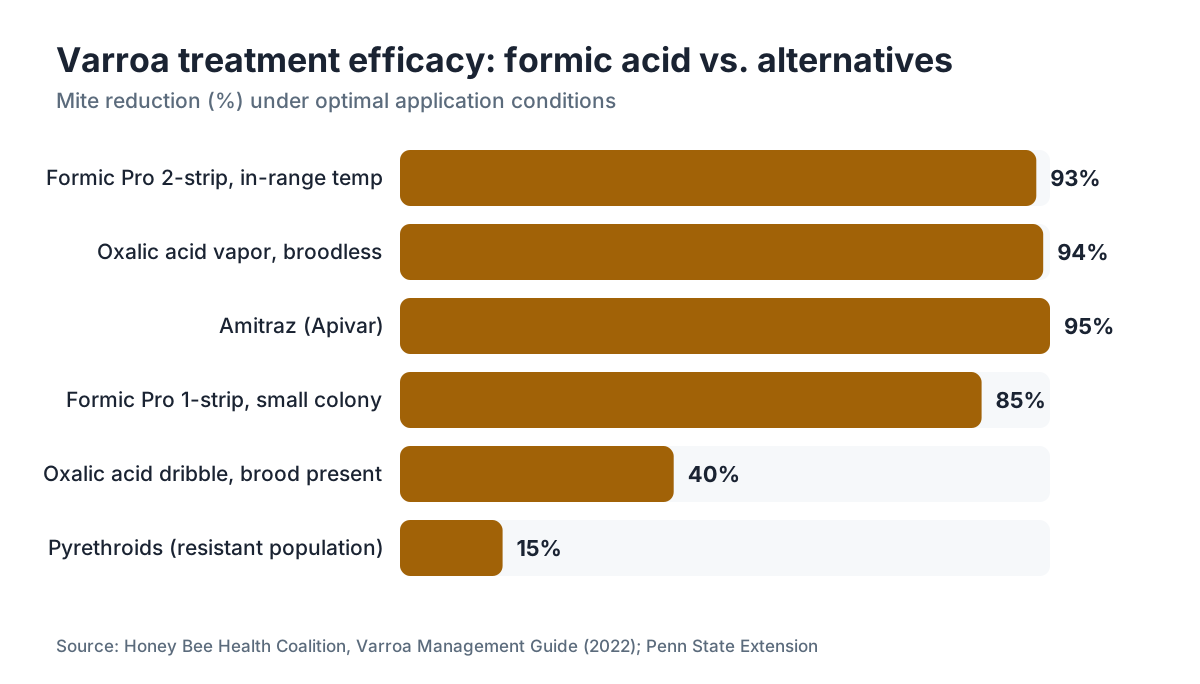
Efficacy depends on application conditions, colony size, and whether you're counting phoretic mites only or total infestation including capped brood. Done right, formic acid is one of the strongest brood-inclusive treatments you can buy.
The table below pulls efficacy numbers from major studies and regulatory submissions:
| Treatment / Condition | Mite Reduction | Source |
|---|---|---|
| Formic Pro (two strips, within temp range) | 90 to 95% | Honey Bee Health Coalition [1][4] |
| Formic Pro (single strip, small colony) | 82 to 88% | PMRA Canada registration data [9] |
| Oxalic acid dribble (brood present) | 30 to 50% | Honey Bee Health Coalition Varroa Guide [1] |
| Oxalic acid vapor (broodless) | 90 to 97% | Penn State Extension field studies [3] |
| Formic acid above 85°F | Reduced, variable | Penn State Extension [6] |
A few things jump out. Applied correctly, formic acid competes with the best-case oxalic acid scenarios, but without needing a broodless window. That's the real advantage in mid-summer, when brood is continuous and mite populations climb fastest.
The 90 to 95% figure means a colony carrying 1,000 mites (a serious load) would have roughly 50 to 100 left after treatment. That usually lands below the 2% economic threshold and buys the colony real relief. A second round seven days later pushes it lower.
Nobody has good long-term resistance data yet. The research community worries that repeated formic acid exposure could select for tolerant mites, but as of 2025 no well-documented field resistance has been confirmed. The closest study found no significant efficacy drop after four straight treatment seasons in Canadian apiaries (Giovenazzo and Dubreuil, 2011, Experimental and Applied Acarology). [7]
What are the risks and side effects for bees and queens?
This is where honest talk beats label marketing. Formic acid can hurt your colony if you're careless.
Queen loss is the most common bad outcome. Field estimates run 3 to 15%, with the high end clustering around hot applications and small colonies. [1] The queen spends her time in the center of the brood nest, right where vapor concentrations peak. She isn't uniquely sensitive to the acid, but her location makes her more exposed than a forager cycling in and out.
Ways to cut the risk:
- Treat in cooler weather, ideally with daytime highs in the 60s or 70s°F.
- Match the dose to colony strength: one strip under six frames, not two.
- Confirm the queen is present and laying before you treat; a queen already stressed by disease or supersedure is more fragile.
- Don't stack formic acid right after pulling a synthetic miticide. Give the colony a week to settle.
Brood mortality at sub-lethal concentrations is documented too. You'll sometimes see open-brood die-off or a shotgun pattern in the week after treatment, especially at higher temperatures. It usually clears within one to two weeks as the colony recovers. It looks alarming when you open the hive. It's rarely catastrophic.
Bee population can dip temporarily because of that brood loss. This is why timing formic acid for early fall (Northern Hemisphere temperate climates) matters: it leaves time for the colony to rebound before winter, while a late-October treatment can leave an already-shrinking cluster dangerously small.
Absconding is rare but real, reported mostly in package bees or tiny nucs treated in warm weather.
When is the best time of year to use formic acid for varroa?
In temperate North America, late summer (August into early September) is the primary formic acid window. Mite populations have built since May or June and are pushing past the 2% threshold (2 mites per 100 bees) in many colonies. Temperatures are high but still inside the label window across most of the country. And the colony still has the population to recover from treatment stress before winter. [6][10]
A late-summer treatment also protects the winter bees, the fat-bodied, long-lived bees raised in August and September that carry the cluster through winter. Those bees develop inside capped cells right now. If mites are in those cells, they rob the pupa of protein (vitellogenin) and shorten the bee's life. Getting mite loads below 1% before the winter bees are raised is arguably the highest-value move in a whole-year varroa program.
Spring is a secondary shot. As colonies expand after winter, mites start from a low base and double roughly every 15 to 20 days under a growing brood nest. A May or June formic acid treatment, temperatures permitting, resets the clock and heads off the summer population explosion.
Mid-summer in hot climates (the Deep South, desert Southwest) is often off the table for formic acid because of sustained heat above 85°F. There, oxalic acid vaporization or Apivar (amitraz strips) is the practical peak-season choice. Don't fight the label because it's convenient. Queen loss and brood damage in 95°F heat aren't worth it.
Can you use formic acid when supers are on the hive?
Yes, and this is one of formic acid's biggest practical edges over synthetic treatments.
Formic Pro's label allows application with honey supers in place. [4] Formic acid occurs naturally in honey and breaks down into carbon dioxide and water, so no artificial residue builds up in supers during a label-rate treatment. The Honey Bee Health Coalition lists this as an advantage of organic acid treatments over synthetic miticides like Apivar, which require super removal. [1]
That said, a few beekeepers report a slight flavor effect in honey made during active treatment, mostly when high temperatures drive heavy off-gassing. The evidence is anecdotal and I wouldn't stake money on it either way. The regulatory position is that label-rate applications leave no harmful or detectable residue, and I'm not aware of a peer-reviewed study showing otherwise. If you sell competition honey or supply a premium market that asks questions, treating after the main flow and before extracting is the conservative play.
For sideliners and commercially minded hobbyists weighing which beekeeping supplies earn their keep, the ability to treat through the flow is a real dollars argument for formic acid over amitraz strips.
How does formic acid compare to other varroa treatments?
Choosing a treatment is always a trade among efficacy, residue, temperature limits, colony impact, and cost. Here's how formic acid stacks up honestly.
Against oxalic acid: Oxalic acid (dribble or vapor) doesn't penetrate capped cells. Applied with brood present, it kills only the roughly 10 to 15% of mites riding adult bees at that moment. Formic acid's in-cell kill during normal brood-rearing is the genuine difference. Oxalic acid wins in a broodless situation (mid-winter, or after a brood break): cheaper, gentler on queens, and 90%-plus effective when nothing's capped. [3]
Against amitraz (Apivar): Amitraz strips are synthetic and need supers off, but they're very effective (often 95%-plus) and far less temperature-sensitive. The catches are residue in wax and honey over repeated use, and documented mite resistance in some populations. Formic acid has no confirmed resistance and no wax residue issue. [1]
Against synthetic pyrethroids (Apistan, CheckMite+): These are largely obsolete across much of North America because varroa resistance to fluvalinate and coumaphos is widespread, sometimes over 90% in tested populations. [12] I wouldn't use them as a primary treatment unless you've tested your local mites and confirmed they still work.
Against biotechnical methods (brood breaks, drone comb removal): Brood interruption followed by oxalic acid is the gold standard in some European systems and can hit very high efficacy. It's labor-heavy and needs a beekeeper on hand that people with day jobs often can't be. Formic acid is the practical middle: good brood-inclusive efficacy without a broodless period.
My honest opinion: a two-round formic acid treatment in late summer, confirmed with alcohol wash counts before and after, is the backbone of a solid varroa season. Not the only tool. But one I'd use every year the temperature window cooperates.
What does formic acid treatment cost, and where do you buy it?
Formic Pro comes in packs of 10 strips (five two-strip treatments) or packs of two (one treatment). As of 2025, a 10-strip pack runs about $35 to $50 depending on the retailer, putting the per-treatment cost around $7 to $10 for a full colony. [4]
That's competitive with Apivar strips ($20 to $25 per colony for a two-strip treatment) and much pricier than a bulk oxalic acid dribble (a few dollars per colony when you buy pharmaceutical-grade oxalic in quantity). You're paying for brood penetration.
Formic Pro is sold by most major beekeeping supply companies, including Mann Lake and Dadant, plus local distributors. It ships legally across state lines as a federally registered pesticide. Some states have pesticide recordkeeping rules; check with your state department of agriculture if you run more than 25 colonies.
The strips have a shelf life of roughly 18 months from manufacture. Buy what you'll use in a season and store it cool and dark, not in the truck during summer. Degraded strips off-gas unpredictably and won't give you reliable efficacy.
What safety precautions do you need when handling formic acid strips?
Formic acid at 68.5% is corrosive and deserves real respect. The risks aren't exotic. They're just real.
Skin: Nitrile or neoprene gloves rated for acid. Standard beekeeping gloves (leather or cotton-backed latex) don't protect against a formic acid spill. If liquid hits skin, flush with water for 15 to 20 minutes. Even brief contact with the concentrate burns.
Eyes: Chemical splash goggles are the right tool. Safety glasses leave gaps. A splash from a compressed or torn strip can cause serious damage. [5]
Inhalation: Vapor off an open strip is immediately pungent and irritates mucous membranes. Work upwind. Don't lean over an open hive with a fresh strip in it. If you have asthma or reactive airways, a half-face respirator with acid-vapor cartridges is worth owning. Short accidental exposures probably won't cause lasting harm to a healthy adult, but repeated inhalation across a season is worth taking seriously.
Disposal: Used strips still hold residual acid. Keep them in a sealed bag until disposal. Don't compost them. Don't leave them where kids or pets can reach them.
Storage: Keep Formic Pro in its original sealed container, away from heat and flame. Formic acid has a flash point around 69°C (156°F). It's not highly flammable at room temperature, but keep it away from ignition sources.
Emergency contact: US Poison Control is 1-800-222-1222. Post it in your beeyard if you treat regularly.
How do you know if the treatment worked?
You count mites before and after. This part is non-negotiable. Skip the wash and you're flying blind.
The standard method is an alcohol wash: take a half-cup sample (roughly 300 bees) from the brood area, shake it in 70% isopropyl alcohol, and count the mites that drop out. Divide by three for mites per 100 bees. Above 2% (6-plus mites in a 300-bee sample) means treat now. A sugar roll works too but reads less accurately. [10]
Take a baseline 2 to 3 days before treatment. Take a follow-up 5 to 7 days after the strips come out. A successful two-strip Formic Pro treatment should drop a 3% infestation below 1%, often below 0.5%. If you're still over 2% afterward, something went wrong: temperature out of range, strips misplaced, colony too small, or heavy reinfestation from neighboring hives.
A sticky board under a screened bottom board gives a qualitative signal (mite drop spikes during treatment as dead mites fall), but it's no substitute for an alcohol wash because it won't give you a population percentage.
VarroaVault's tracking tools let you log these counts across hives and seasons, so you're not straining to recall whether the back-row hive got treated in August or September last year.
If efficacy stays below expectations across several hives after correct application, send a mite sample to a university diagnostic lab for testing. Penn State and the USDA AMS National Science Laboratory both accept samples. [8]
Frequently asked questions
Can formic acid be used when honey supers are on the hive?
Yes. Formic Pro's label explicitly permits application with honey supers in place. Formic acid is a natural compound that breaks down into carbon dioxide and water, leaving no synthetic residue in honey at label rates. This is one of its main advantages over amitraz-based products, which require super removal before treatment. The Honey Bee Health Coalition confirms no harmful residues result from label-rate applications.
What temperature is too hot for formic acid treatment?
The Formic Pro label ceiling is 85°F (29.5°C) daytime high. Above this, off-gassing accelerates enough to risk queen loss, brood mortality, and absconding. If your forecast shows three or more consecutive days above 85°F during your planned seven-day treatment window, delay until temperatures drop or switch to a treatment with a wider thermal range, like Apivar.
Will formic acid kill varroa mites inside capped brood cells?
Yes, and this is formic acid's defining advantage. The acid volatilizes into a gas that diffuses through wax cappings, reaching mites and their offspring inside the cell. Synthetic treatments and oxalic acid dribble do not penetrate cappings. This lets formic acid reduce total mite populations, including the roughly 85 to 90% of mites in capped cells, not only the phoretic mites on adult bees.
How many formic acid strips do I use per hive?
Two strips for colonies covering more than six frames of bees. One strip for colonies of four to six frames. Do not treat colonies smaller than four frames of bees or package bees. The two strips are placed flat on top of the brood frames with a small gap between them for airflow. Leave them in place for seven days, then remove and discard.
Is formic acid organic and safe for honey?
Yes on both counts. Formic acid is approved for use in certified organic beekeeping under the USDA National Organic Program. It occurs naturally in honey at low concentrations. At label-approved doses, it leaves no persistent residue in honey or wax. This is confirmed by EPA registration review and the Honey Bee Health Coalition's Varroa Management Guide.
What is the difference between Formic Pro and Api-Bioxal?
They're two different acids with different modes of action. Formic Pro contains formic acid, penetrates capped brood, and is the subject of this article. Api-Bioxal contains oxalic acid, which kills only phoretic mites on adult bees and is most effective when applied during a broodless period. Both are EPA-registered organic varroa treatments but are not interchangeable.
Can formic acid kill the queen?
It can, though it's not the norm under good conditions. Field queen loss rates range from roughly 3% to 15% depending on temperature and colony size. The queen is at highest risk during high-temperature applications where vapor concentrations spike. Small colonies, already-stressed queens, and applications above 85°F all increase the risk. Check that your queen is actively laying before treatment to establish a baseline.
How do I know if my varroa mites are resistant to formic acid?
No well-documented field resistance to formic acid has been confirmed as of 2025. A 2011 study by Giovenazzo and Dubreuil found no efficacy reduction after four consecutive treatment seasons in Canadian apiaries. If your post-treatment mite counts don't drop as expected, rule out application errors (temperature, strip placement, colony size) before suspecting resistance. You can send mite samples to university diagnostic labs for bioassay testing.
How long after formic acid treatment can I extract honey?
There is no mandatory withdrawal period listed on the Formic Pro label because the product is registered for use with supers in place and leaves no synthetic residue. You can extract honey after removing the strips at day seven. That said, waiting until after the main flow to treat is practical in most operations anyway, since treatment stress can temporarily reduce colony foraging.
Can I use formic acid in cold weather or winter?
Not effectively. Below 50°F (10°C), formic acid barely volatilizes. The strips sit inert and the mites survive. For winter or broodless-period treatment, oxalic acid is the right choice. An oxalic acid dribble or vaporization applied to a broodless cluster can achieve 90 to 97% efficacy with far less temperature sensitivity than formic acid.
How do I dispose of used Formic Pro strips?
Used strips still contain residual formic acid. Seal them in a plastic bag immediately after removal. Dispose of in household solid waste unless your state or county has specific pesticide disposal requirements. Don't compost, bury, or burn them. Don't leave used strips in or near the hive; they can continue to off-gas at reduced concentrations and may stress the colony or attract wax moths.
What should I do if I get formic acid on my skin or in my eyes?
Skin contact: flush immediately with large amounts of water for at least 15 to 20 minutes. Remove contaminated clothing. Eye contact: flush continuously with water for at least 15 minutes and seek medical attention promptly. Eye exposure from concentrated formic acid is a medical emergency. US Poison Control is available 24 hours at 1-800-222-1222 for guidance on exposure management.
How often can I repeat formic acid treatments in one season?
The Formic Pro label allows a second treatment round applied seven days after removing the first set of strips, giving a total 14-day treatment window covering one brood cycle. Additional rounds within the same season are not standard label guidance. Repeated treatments increase colony stress and queen loss risk. Use post-treatment mite counts to determine whether a second round is needed rather than treating on a fixed schedule.
Does formic acid work on Varroa jacobsoni as well as Varroa destructor?
Research on V. jacobsoni, which parasitizes Apis cerana in parts of Asia and has been detected in Papua New Guinea populations of Apis mellifera, is limited compared to V. destructor data. The mechanism (volatile acid exposure) should work on any mite breathing through spiracles, but labeled efficacy claims and dosing data apply specifically to V. destructor in Apis mellifera colonies. Consult current university entomology literature if you're dealing with a different host-mite pair.
Sources
- Honey Bee Health Coalition, Varroa Management Guide (2022 edition): Formic acid treatments do not leave harmful residues in hive products when used as directed; efficacy of oxalic acid dribble with brood present is 30-50%; formic acid achieves 90-95% efficacy under label conditions; queen loss rates 3-15%.
- USDA Agricultural Research Service, Bee Research Laboratory: Varroa mites spend the majority of their reproductive life in capped brood cells; formic acid vapor penetrates wax cappings and reaches mites on developing pupae.
- Penn State Extension, honey bee and varroa management program: Oxalic acid vaporization in broodless colonies achieves 90-97% efficacy; dribble with brood present is substantially lower.
- NOD Apiary Products, Formic Pro EPA Label (Reg. No. 85468-3): Approved temperature range 50°F, 85°F; two strips for colonies over six frames; supers may remain on during treatment; 68.5% formic acid by weight per strip; 10-strip pack pricing.
- US EPA, pesticide registration and FIFRA overview: Under FIFRA, pesticide labels are legally binding; using a registered pesticide in a manner inconsistent with its label is illegal.
- Penn State Extension, varroa mite management in honey bee colonies: Formic acid efficacy drops significantly below 50°F; queen loss rates roughly double in colonies treated during sustained temperatures above 90°F compared to label-range applications.
- Giovenazzo P, Dubreuil P (2011), Experimental and Applied Acarology, 'Evaluation of different formic acid treatments against Varroa destructor in honey bee colonies in Quebec, Canada': No significant reduction in formic acid efficacy was found after four consecutive treatment seasons in Canadian apiaries.
- USDA National Organic Program, National List of Allowed and Prohibited Substances: Formic acid is approved for use in certified organic beekeeping under the USDA National Organic Program; USDA AMS labs accept mite samples for testing.
- University of Minnesota Extension, Bee Squad and pollinator program: Two percent economic threshold (2 mites per 100 bees by alcohol wash); importance of pre- and post-treatment mite counting to verify treatment success.
- EPA, pollinator protection program: EPA registration review for formic acid confirms no harmful residue accumulation in honey or wax at label-approved rates.
- NC State University Extension, honey bee program: Pyrethroid resistance (fluvalinate, coumaphos) in varroa mite populations documented at over 90% in some North American populations, reducing their utility as primary treatments.
Last updated 2026-07-09