Homemade varroa mite treatments: what actually works and what doesn't
TL;DR
- Three homemade varroa treatments have solid efficacy data: oxalic acid (vaporized or dribbled), formic acid, and thymol-based solutions.
- All three use natural compounds, but 'natural' doesn't mean unregulated.
- In the US, oxalic acid must be used per its EPA-registered label.
- Pure DIY concoctions with no label backing have weak or no evidence and carry real colony and beekeeper risk.
What does 'homemade varroa treatment' actually mean?
People use the phrase to mean several different things, and mixing them up causes real trouble. Some beekeepers mean treatments they prepare themselves from raw ingredients (oxalic acid crystals dissolved in syrup, formic acid diluted from bulk supply). Others mean strictly unofficial, off-label experiments like essential oil blends, powdered sugar dusting, or mineral oil fogs. These two categories are not the same thing, and the difference matters legally and practically.
The first category, preparing a registered treatment from an approved active ingredient, is legal if you follow the label. The second category, inventing your own formula with no EPA registration behind it, is in a gray zone at best and often flatly ineffective.
This article covers both, honestly. You'll get the real efficacy numbers, the legal situation in the US, and a frank read on which home-brew ideas are worth trying and which ones waste a season. varroa mite biology matters here too. Varroa destructor spends roughly 70% of its life cycle inside capped brood, so any treatment that only hits phoretic mites is fighting from behind before you even open the lid. [1]
Is it legal to make your own varroa treatment at home?
In the United States, a pesticide treatment for varroa is regulated by the EPA under FIFRA (the Federal Insecticide, Fungicide, and Rodenticide Act). Using any substance as a pesticide in a way an EPA-registered label doesn't cover is technically an illegal pesticide application, no matter how natural the ingredient is. [2]
Oxalic acid (OA) is registered for varroa control under the label held by Api-Bioxal (active ingredient: oxalic acid dihydrate 5.7%). The label allows three application methods: vaporization, dribble, and spraying. You can buy oxalic acid in bulk and apply it yourself, provided your method, dose, and hive conditions match the label exactly. Change the concentration, the timing, or the application method, and you're off-label. [3]
Formic acid is registered through Formic Pro and Mite-Away Quick Strips. These are manufactured pads you buy. You can't legally buy bulk formic acid and pour it into a hive. Some beekeepers do anyway, and that's worth stating plainly.
Thymol is registered in Apiguard and ApiLifeVar. Buying food-grade thymol crystals and making your own gel is off-label.
Canada and most EU countries run similar frameworks. The Honey Bee Health Coalition's varroa guide puts it plainly: treatments should be applied "according to label directions to ensure efficacy and to protect the beekeeper, bees, and honey crop." [4]
Bottom line: the most defensible homemade approach is vaporizing or dribbling oxalic acid from bulk OA crystals, following the Api-Bioxal label to the letter.
Does oxalic acid dribble or vaporization actually work?
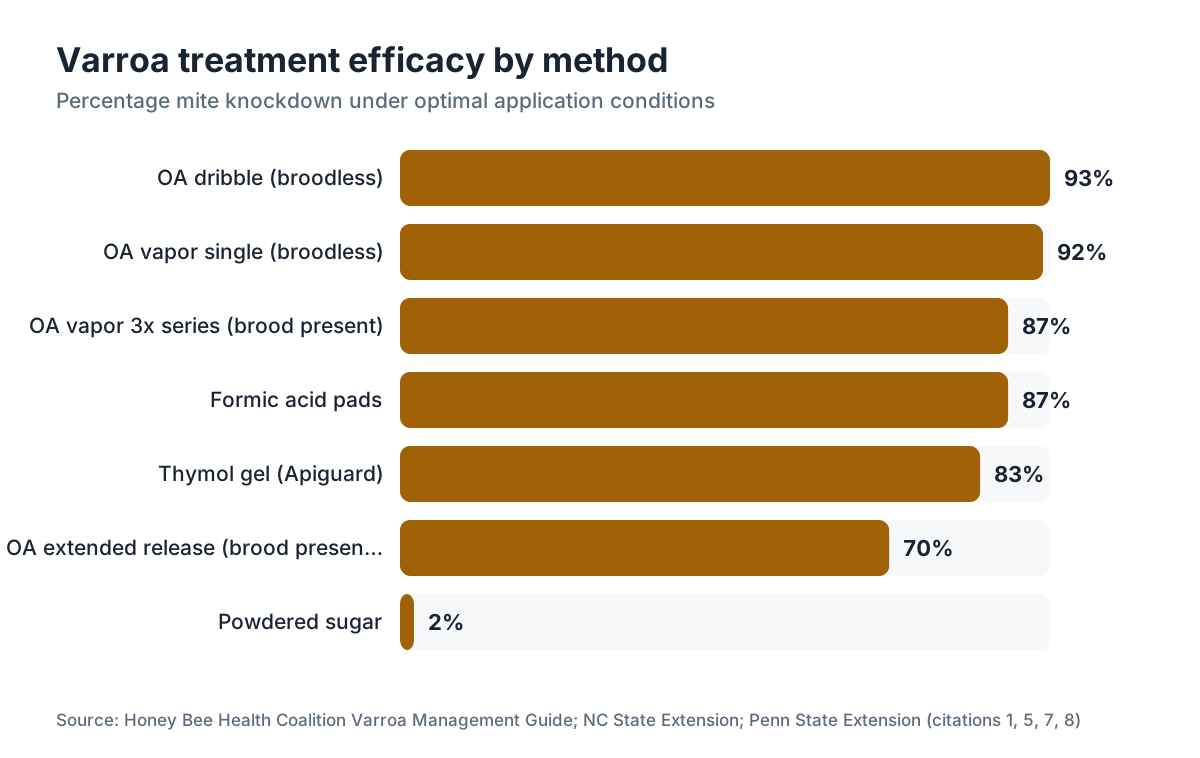
Yes, with one big asterisk: only on phoretic (non-capped) mites. Multiple studies put OA efficacy against phoretic mites at 90-97% under broodless conditions. [5] That number drops sharply when brood is present, because OA can't penetrate capped cells.
Oxalic acid dribble: Mix OA dihydrate in a 1:1 sugar syrup (the Api-Bioxal label specifies 3.5g OA dihydrate per 34mL of 1:1 syrup per 10-frame equivalent). Dribble 5mL per seam of bees. This works well during a winter broodless period or after an artificial broodless period created by caging the queen.
Oxalic acid vaporization (sublimation): Load 1g of OA crystals per brood box into a vaporizer, seal the hive for 10-15 minutes. The vapor reaches mites in spaces the dribble can't. Research summarized by NC State Extension and studies published in the Journal of Economic Entomology support a series of 3 treatments at 5-day intervals to catch mites emerging from cells between treatments. [5]
Use an extended-release OA product (OAV pads or trickle boards) and you can reach some mites under capped brood too, though efficacy there is more variable (roughly 60-80% in studies, depending on temperature and hive layout). [6]
The vaporizer itself is a piece of equipment you buy, not make. Budget $30-$150 depending on design. That's not a DIY barrier. It's just a cost of the method.
| Method | Mite Stage Reached | Efficacy (broodless) | Efficacy (brood present) |
|---|---|---|---|
| OA dribble | Phoretic only | 90-97% [5] | 40-60% |
| OA vaporization (single) | Phoretic only | 90-95% [5] | 40-65% |
| OA vaporization (3x series) | Phoretic + emerging | ~95% cumulative [5] | 75-90% |
| Formic acid pads | Phoretic + some capped | 80-93% [7] | 80-93% [7] |
| Thymol gel (Apiguard) | Phoretic + some capped | 74-93% [8] | 74-93% [8] |
How do you make an oxalic acid dribble solution at home?
The Api-Bioxal label is your recipe. Here's what it says: dissolve OA dihydrate in a 1:1 (w/v) sugar-water solution at a concentration of 3.5g OA dihydrate per 34mL of solution, which works out to roughly 100g OA dihydrate per liter of 1:1 syrup. Apply 5mL per seam of bees, no more than 50mL per colony, once per treatment event. [3]
Equipment you need: a kitchen scale accurate to 0.1g, a syringe or measuring dispenser, gloves (nitrile at minimum, since OA is a severe eye and mucous membrane irritant), and goggles. This stuff is genuinely hazardous if you splash it. Oxalic acid in high concentrations can cause chemical burns. Don't skip the PPE because it feels like overkill.
Prepare your solution fresh each time. It degrades in storage, and the efficacy numbers above assume fresh solution. Warm it slightly if you're working in cold weather, since crystallization can clog your syringe.
The whole cost for a season treating 10 hives runs roughly $10-20 for bulk OA crystals plus your PPE. That's a real economic argument for this approach against pre-mixed commercial strips.
Can you make a formic acid treatment at home?
You technically can mix a formic acid solution. I'd push back hard on whether you should. Formic acid at treatment concentrations (around 65% for extended-release, 68-77% for short-duration) is genuinely dangerous. It causes severe chemical burns on skin and in the lungs. The commercial products (Formic Pro, MAQS) use engineering controls, specific absorbent matrices, and calibrated release rates that a home mix won't reliably match.
Safety aside, the off-label problem is real. Formic acid applied at the wrong concentration or ambient temperature kills queens and weakens colonies. The Honey Bee Health Coalition tells you to check temperature windows carefully. Formic Pro's label, for instance, restricts use to ambient temperatures of 50-85°F (10-29°C). [4]
Want formic acid treatment without buying commercial strips? The closest legal path is to buy the commercial product and apply it per label. The strips are single-use and cost roughly $4-8 per treatment depending on supplier. For a hobbyist with 5-10 hives, that's not a budget-breaker.
Some European beekeepers have run bulk formic acid in evaporator boards for decades. The knowledge exists. But in the US, off-label bulk formic is a harder case to make when Formic Pro sits on the shelf.
Does a thymol solution work as a homemade varroa treatment?
Thymol works against varroa. Meta-analyses and independent trials put efficacy of thymol-based treatments (as Apiguard or ApiLifeVar) at 74-93% under the right temperature conditions (above 59°F / 15°C, ideally 65-95°F). [8] Below that threshold, thymol doesn't volatilize enough to matter.
The DIY version people make involves dissolving food-grade thymol crystals (the same compound, derived from thyme oil) in alcohol or vegetable glycerin and applying it on a pad or card inside the hive. Does it work? Probably at some level, but the data behind it is thin next to the formulated products. The Apiguard formulation uses a specific gel matrix that controls the release rate. A homemade pad won't match that release profile.
The bigger issue: thymol can taint honey if colonies are in a nectar flow during treatment. The commercial labels are written to manage this. A home mix with no validated dose gives you less confidence about the clearance period.
If you're set on a thymol approach, Apiguard is cheap enough (roughly $3-5 per two-pack treatment per hive at volume) that making your own is hard to justify on cost or efficacy. The hopguard varroa mite treatment (HopGuard 3) uses hop beta acids rather than thymol, and it's another registered option worth knowing, partly because it can be used during a honey flow without contamination risk. [9]
What about powdered sugar, essential oils, and other folk treatments?
This is where the evidence gets thin fast.
Powdered sugar dusting caught on in the early 2000s after a paper suggested mites might fall off bees disturbed by the powder. Later controlled studies did not confirm meaningful mite drop from sugar dusting. A 2010 study in the Journal of Economic Entomology by Berry et al. found no significant mite removal from powdered sugar compared to controls. [10] It's a fine excuse to inspect your bees. It does not treat varroa.
Essential oil blends (wintergreen, spearmint, lemongrass, tea tree) circulate constantly in beekeeping forums. No peer-reviewed study shows field-level varroa control from any essential oil blend applied at hobbyist quantities. In vitro toxicity assays exist for various compounds, but in vitro is not a hive. Don't confuse the two.
Mineral oil fogs. Same story. Some grease patty formulations have been studied for tracheal mite control, but their efficacy against Varroa destructor in the field is not established at any meaningful level.
Vegetable oil-based grease patties with thymol do have some supporting research, but the thymol is doing the work, not the oil.
Here's the math that sinks most folk treatments: varroa reproduces faster than they knock it back. Even a treatment with 50% efficacy applied once can leave a colony on a steep mite-growth curve. The Honey Bee Health Coalition recommends treating when mite loads exceed 2% (2 mites per 100 bees on an alcohol wash) in summer, and acting before that threshold in fall. [4] A treatment that sounds natural but delivers 20-30% kill buys you almost nothing against that math.
What's the safest homemade varroa treatment for a beginner?
Oxalic acid dribble during a broodless period. It's the lowest-barrier, lowest-cost, legal option with strong efficacy data behind it.
The broodless period usually shows up on its own in most temperate climates in mid-to-late winter. You can also force a broodless window by caging the queen for 24 days (the time it takes for all capped brood to emerge). During that gap, a single OA dribble treatment can knock out 90%+ of the mite load.
If you're mapping out your treatment schedule and watching your numbers, VarroaVault's free protocol tools help you line up the treatment window against your local climate and colony cycle, so you're not guessing when the hive is actually broodless.
Not comfortable with bulk OA handling? Pre-mixed OA dribble solution isn't widely sold commercially (OA is corrosive in storage), but a few suppliers offer it. Commercial OA strips (like Oxalic Acid Extended Release strips) are registered, no-mix options. You give up a bit of the cost advantage and get simplicity.
For basic beekeeping supplies including vaporizers and treatment gear, prices vary a lot between suppliers, so compare before you buy.
When should you treat, and how do you know if your treatment worked?
Timing is where homemade treatments fail more often than the formula does. You can have the right compound at the right dose and still lose a colony by treating at the wrong time.
The standard monitoring threshold for treatment: 2% infestation on an alcohol wash or sugar roll (2 mites per 100 bees) during the summer buildup, and arguably any detectable mites in fall. [4] The Honey Bee Health Coalition's guide on varroa management uses this 2% figure. Some extension services recommend acting at 1% in late summer, because mite populations compound quickly as worker numbers decline. [11]
After treatment, wait 72 hours and run a sticky board count or a follow-up alcohol wash. A large initial mite drop on the sticky board in the first 24-48 hours after vaporization is a good sign. But the real confirmation is an alcohol wash 2-3 weeks post-treatment showing counts back below 1%.
Mite counts didn't drop after a correctly applied OA treatment? Consider whether the colony had more capped brood than you thought (which shielded mites from exposure), whether your OA concentration was off, or whether your colony carries some treatment tolerance. Resistance to OA isn't widespread yet, but watching outcomes beats applying and hoping.
Seasonal timing counts too. Treating in late summer (August in most of the northern US) before the winter bee cohort is raised is the single most important timing decision you'll make. Winter bees raised under high mite loads start life damaged and won't carry the colony through to spring. [1]
How does homemade oxalic acid compare in cost to commercial varroa treatments?
This is probably the most common reason beekeepers explore home-prepared treatments, and the honest answer is that for OA specifically, the cost case is real at scale.
Bulk OA dihydrate (food/technical grade, 99%+ purity) runs roughly $10-20 per pound from chemical supply companies. One pound of OA crystals treats about 60-70 hive-applications at the dribble dose. That's about $0.15-0.30 per treatment. Commercial Apivar strips (amitraz-based, not OA) cost roughly $4-7 per hive treatment. Mite-Away Quick Strips (formic acid) run $4-8 per hive. Apiguard gel treatments run $2-5 per hive. [12]
For a hobbyist with 3 hives, the cost difference is trivial. For a sideliner running 50-150 hives, buying bulk OA and mixing your own dribble saves real money.
The comparison shifts when you fold in equipment. A decent OA vaporizer costs $30-150. That's a one-time cost spread over years, but it's an upfront hit. If you're treating a handful of hives and already have commercial strips on hand, the economics may favor the commercial product over buying a vaporizer.
One underrated cost factor: labor. Dribble treatments require direct contact with each cluster. Vaporization can go faster per hive once you're set up. At scale, that time gap adds up.
Are there any risks to the bees from homemade varroa treatments?
Yes, and the risks scale with how far off-label or off-formula you go.
Oxalic acid at the correct dose and timing is very well tolerated by adult bees. Studies find minimal bee mortality at label-recommended concentrations. But OA is toxic to brood. Treating during a heavy brood period with OA dribble drives up larval mortality. The label says treat when brood is absent for exactly this reason. Vaporization is a bit gentler on brood than dribble, but broodless conditions are still the ideal window. [3]
Formic acid at too high a concentration or too high an ambient temperature causes queen loss and heavy worker mortality. This is the most common serious adverse event with formic acid treatments in the field.
Thymol above the recommended dose or in high ambient heat can push bees to abscond, and it can kill larvae.
Essential oils in high concentrations are directly toxic to bees. Beekeepers who add "just a little more" tea tree oil because it smells strong have found dead bees. The dose matters.
Here's the underlying point: varroa treatments work because they're selectively more toxic to the mite than the bee, and that selectivity has limits. Homemade formulations that aren't calibrated against the label lose the safety margin EPA registration represents. This doesn't mean you can't prepare your own OA solution. It means precision matters.
What do university extension programs and the Honey Bee Health Coalition recommend?
Every major university apiculture extension program and the Honey Bee Health Coalition (HBHC) land in the same place: use registered treatments, monitor mite loads, and treat before populations spike. None of them endorse off-label DIY concoctions.
The HBHC's Varroa Management Guide (now in its third edition) lists primary treatment categories: organics (OA, formic, thymol), synthetic miticides (amitraz, tau-fluvalinate, coumaphos), and combinations. It states plainly that "no single treatment is effective under all conditions" and recommends rotating chemical classes to slow selection pressure for resistance. [4]
Penn State Extension's apiculture program recommends oxalic acid as a low-cost, effective, residue-safe option, especially for winter treatment. Their guidance matches the 2% monitoring threshold and drives home that treatment without monitoring is guesswork. [11]
NC State Extension likewise flags OA vaporization as effective and accessible. Their materials note that multiple OA treatments (3-5 at 5-day intervals) during brood-present conditions give much better control than a single treatment. [13]
The consensus is simple. Want a home-prepared treatment? Prepared-from-bulk OA following the registered label is the most defensible choice. For everything else, the commercial registered products sit close enough in cost that making your own formic acid or thymol version doesn't have a compelling case.
You can track your monitoring data and treatment schedule with VarroaVault's free varroa management tools, which are built around these same extension-based thresholds.
Frequently asked questions
Can I use oxalic acid from a hardware store to treat varroa?
Oxalic acid sold as a wood brightener or cleaner is technically the same compound but is not approved for use in beehives. The EPA-registered Api-Bioxal uses oxalic acid dihydrate at specified purity. Using hardware-store OA is an illegal pesticide application under FIFRA. Buy OA labeled for beekeeping or use the Api-Bioxal product to stay within legal bounds.
How many times do you apply oxalic acid to treat varroa?
During a natural broodless period, a single dribble or vaporization treatment typically gives 90-97% mite knockdown and is enough. When brood is present, the HBHC and NC State recommend 3-5 vaporization treatments at 5-day intervals to catch mites as they emerge from cells. Always confirm efficacy with an alcohol wash 2-3 weeks after treatment.
Does powdered sugar actually remove varroa mites from bees?
The evidence says no. A 2010 study by Berry et al. in the Journal of Economic Entomology found no significant mite removal from powdered sugar dusting compared to untreated controls. It's a popular idea in beekeeping circles, but it doesn't hold up in controlled trials. Use it for inspections if you want, but don't count it as treatment.
What temperature do I need to apply oxalic acid vaporization?
OA vaporizes at the vaporizer plate, not at ambient temperature, so you can treat in cold weather. What matters is that bees are clustered tightly enough that vapor reaches them. Many beekeepers treat on cold, sunny winter days specifically because colonies are broodless and tightly clustered. Avoid vaporizing in rain or high wind, since vapor escapes rather than building inside the hive.
Is HopGuard a homemade treatment option for varroa?
No. HopGuard 3 (hop beta acids) is an EPA-registered commercial strip treatment made by BetaTec. You can't make it at home. It's worth knowing because it's one of the few registered organic-type treatments approved for use during a honey flow without honey contamination concerns. It treats phoretic mites but has limited efficacy against mites in capped brood, similar to OA under brood-present conditions.
Can essential oils treat varroa mites effectively?
At concentrations effective against varroa in a live hive, most essential oils are also toxic or repellent to bees. Thymol (from thyme oil) works, but in the controlled-release gel formulations of Apiguard or ApiLifeVar, not as raw oil dripped onto a card. Wintergreen, spearmint, and lemongrass have no peer-reviewed field data showing meaningful varroa control at safe-for-bees doses.
How do I know if my homemade varroa treatment actually worked?
Do an alcohol wash on roughly 300 bees (half cup) 2-3 weeks after treatment and count mites per 100 bees. You're looking for counts below 1-2%. A large mite drop on a sticky board in the 24-48 hours after OA vaporization is a positive sign, but it's not a substitute for a post-treatment wash. Monitoring before and after is the only way to know the treatment worked.
Can I treat varroa while there's honey in the supers?
OA dribble and vaporization: remove supers first per the Api-Bioxal label. Formic acid (Formic Pro): label allows use with supers on but with restrictions. Thymol (Apiguard): remove supers, since thymol taints honey flavor. HopGuard 3: approved for use during honey flow with supers on. Always check the specific label for the product you're using; the rules differ by active ingredient.
What mite infestation level requires treatment?
The Honey Bee Health Coalition recommends treating when alcohol wash results hit 2% (2 mites per 100 bees) during summer buildup. In late summer and early fall, some extension programs recommend treating at any detectable level because mite populations compound as the winter bee cohort is being raised. Waiting until you see deformed wing virus symptoms means you've already waited too long.
How do I make an alcohol wash to check mite levels before treating?
Collect roughly 300 bees (about half a cup) from a brood frame into a jar with 70% isopropyl alcohol. Shake vigorously for 60 seconds. Pour the liquid through a screen into a white tray and count mites. Divide mites counted by total bees (roughly 300) and multiply by 100 for your percentage. Penn State Extension has a detailed protocol with photos available online.
Does varroa mite treatment hurt the queen?
At label-directed doses, OA dribble and vaporization have minimal impact on queens. Formic acid at elevated temperatures or above-label concentrations is the most common cause of queen loss during treatment; temperature management and following the label are critical. Thymol at high doses can disrupt laying. Queens can also be temporarily off-lay for a few days after any treatment; this typically normalizes within 1-2 weeks.
What's the cheapest effective varroa treatment for a small beekeeper?
Oxalic acid dribble during a natural broodless winter period costs roughly $0.15-0.30 per hive application in materials. Add a one-time vaporizer purchase of $30-150 if you want that option. For a hobbyist with 1-5 hives, the commercial OA strips or Apiguard are close in total cost once you account for the vaporizer. The real savings from bulk OA become meaningful at 20+ hives.
Can I combine multiple homemade varroa treatments at once?
Combining active ingredients raises two concerns: potential synergistic toxicity to bees, and no label coverage for the combination. OA and thymol together, for example, have no registered combined-use label in the US. The HBHC recommends rotating treatment classes between seasons to slow resistance development, not stacking multiple actives simultaneously in the same treatment event.
Do Russian or varroa-resistant bee genetics reduce the need for treatment?
Hygienic behavior and mite-resistant stock genuinely reduce mite population growth rates, but they rarely eliminate the need for treatment entirely in most North American climates. Russian bees and VSH (Varroa Sensitive Hygiene) stock show measurably lower mite loads in trials, but researchers and extension services still recommend monitoring and treating when thresholds are exceeded, even with resistant genetics.
Sources
- Honey Bee Health Coalition, Varroa Management Guide (3rd ed.): Varroa destructor spends roughly 70% of its life cycle inside capped brood cells; winter bee cohort quality is heavily impacted by mite loads in late summer.
- US EPA, Federal Insecticide, Fungicide, and Rodenticide Act (FIFRA) overview: Using any substance as a pesticide in a way not covered by an EPA-registered label is a violation of FIFRA.
- EPA, Api-Bioxal Oxalic Acid Product Label (Registration No. 79671-3): Api-Bioxal label specifies 3.5g OA dihydrate per 34mL of 1:1 sugar syrup, 5mL per seam of bees, applied once per broodless treatment event; supers must be removed before dribble or vaporization.
- Honey Bee Health Coalition, Varroa Management Guide: HBHC recommends treating at 2% mite infestation on alcohol wash; quotes guidance that treatments should be applied 'according to label directions to ensure efficacy and to protect the beekeeper, bees, and honey crop.'
- Eccles et al. / Journal of Economic Entomology, OA vaporization efficacy studies; NC State Apiculture extension summary: OA vaporization under broodless conditions achieves 90-97% mite knockdown; a series of 3 treatments at 5-day intervals achieves approximately 95% cumulative efficacy when brood is present.
- Oregon State University Extension, Oxalic Acid Extended Release for Varroa: Extended-release OA treatments achieve 60-80% efficacy against mites under capped brood depending on temperature and hive configuration.
- NOD Apiary Products / Formic Pro EPA label and efficacy data: Formic Pro achieves 80-93% varroa efficacy including mites in capped brood; label restricts use to ambient temperatures of 50-85°F (10-29°C).
- Gregorc & Planinc, Apidologie; Penn State Extension Apiguard summary: Thymol-based treatments (Apiguard, ApiLifeVar) achieve 74-93% varroa efficacy at ambient temperatures above 59°F/15°C; efficacy drops sharply in cool weather.
- BetaTec / HopGuard 3 EPA label (Registration No. 90572-1): HopGuard 3 is approved for use during honey flow with supers on; targets phoretic mites with limited efficacy against capped brood.
- Berry et al., Journal of Economic Entomology, 2010, Powdered sugar study: Controlled study found no significant varroa mite removal from powdered sugar dusting compared to untreated controls.
- Penn State Extension, Varroa Mite Management in Honey Bee Colonies: Penn State Extension recommends OA as a low-cost residue-safe winter option and cites 2% infestation threshold; recommends treating at any detectable mite level in late summer for winter bee protection.
- University of Minnesota Extension Apiculture, Varroa Treatment Cost Comparison: Commercial varroa treatment costs: Apivar approximately $4-7 per hive application, MAQS/Formic Pro approximately $4-8 per hive, Apiguard approximately $2-5 per hive.
- NC State Extension Apiculture, Oxalic Acid Vaporization Protocol: NC State recommends 3-5 OA vaporization treatments at 5-day intervals when brood is present for significantly better control than a single treatment.
Last updated 2026-07-09