Why are honey bees dying? Causes, signs, and what to do
TL;DR
- U.S.
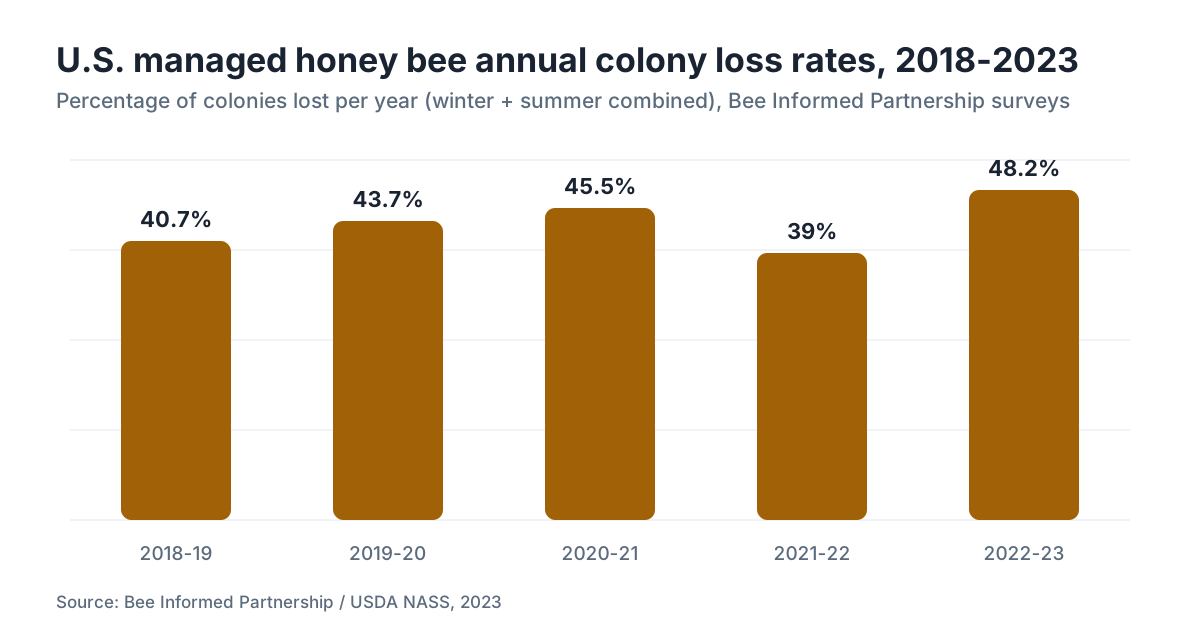
- managed honey bee colonies have averaged roughly 30 to 45% annual losses since 2006, and the 2022-23 season hit 48.2%.
- The leading killers are varroa mites and the viruses they carry, pesticide exposure, poor nutrition, Nosema fungal disease, and small hive beetles.
- Most colony deaths involve more than one cause working together.
- Early detection and a written treatment calendar make the biggest difference.
How bad is honey bee colony loss right now?
Bad. And it has been bad for almost twenty years.
The Bee Informed Partnership, which surveys U.S. beekeepers every year alongside USDA NASS, reported that managed honey bee colonies lost 48.2% of their population between April 2022 and April 2023. [1] That was the highest total annual loss recorded since the survey started in 2006. The year before was 45.5%. These are not rounding errors. They represent tens of millions of colonies dying every year.
Here is some context. A loss rate above roughly 18 to 19% is economically unsustainable for most commercial operators, and hobbyists routinely see worse because they often lack the resources for steady monitoring. The Honey Bee Health Coalition's 2023 Tools for Varroa Management guide states that varroa is the factor most consistently tied to high colony losses across survey cohorts. [2]
Some winter loss is normal. But a colony pushed hard through a honey flow, heading into winter with a bad queen and a mite load nobody counted, is not dying from "winter." It was already dying in September. Winter just closes the lid.
The better news is that losses are not random. The causes are well-characterized, the tests exist, and the treatments have known efficacy. Most hive deaths are preventable with information and timing.
What are the main reasons honey bees die?
No single cause dominates alone, but the research agrees on what shows up most often. Varroa and its viruses lead. Pesticides, poor nutrition, and disease fill out the list, and they usually gang up.
| Cause | How common | Primary mechanism |
|---|---|---|
| Varroa mites + associated viruses | Present in nearly every U.S. apiary | Mites vector Deformed Wing Virus (DWV) and other pathogens; suppress immune function [2] |
| Pesticide exposure | Widespread; acute events most visible | Organophosphates, neonicotinoids, fungicides affect behavior and immunity [3] |
| Poor nutrition / forage loss | Increasingly common in monoculture landscapes | Protein and lipid deficits impair brood development and winter fat bodies [4] |
| Nosema spp. | Moderate prevalence | Gut microsporidian disrupts digestion and shortens adult bee lifespan [5] |
| American Foulbrood (AFB) | Serious when present; reportable in most states | Paenibacillus larvae spores kill brood; spores persist 40+ years in equipment [6] |
| Small Hive Beetle | Mostly southern U.S.; range expanding | Larvae destroy comb, ferment honey, overwhelm weak colonies [7] |
| Queen failure | Very common; often unrecognized | Laying workers, failed supersedure, drone-layer scenarios |
| Starvation | Common late-winter / early-spring | Cluster breaks contact with stores or stores were never adequate |
Varroa and its viruses get their own section next because they operate on a different scale from most other causes. The rest of the article works through each killer, how to recognize it, and what the evidence says about fixing it.
Why do varroa mites kill so many colonies?
Varroa destructor is an external parasitic mite that feeds on the fat bodies of developing and adult honey bees. [10] The fat body is more than a fuel tank. It makes immune proteins, detoxification enzymes, and the vitellogenin that winter bees need to live for months. A bee with a chewed-up fat body is physiologically broken even when it looks fine.
The mite also carries at least nine bee viruses, and Deformed Wing Virus is the worst of them. DWV strains that varroa amplifies produce bees with shriveled wings that cannot forage, cannot regulate hive temperature, and cannot defend the colony. High DWV titers track winter die-off more reliably than mite counts alone, though mite counts stay the best practical proxy you can measure yourself. [2]
Mite populations grow exponentially through the brood-rearing season. A colony that starts spring at 1% infestation can reach 3 to 4% by midsummer and 8 to 12% or more by fall. The Honey Bee Health Coalition sets a treatment threshold of 2 mites per hundred bees from spring through mid-summer and 1 to 2% in late summer through fall, because fall mite loads land directly on the winter bee cohort. [2]
An alcohol wash is the most accurate field method. Powdered sugar rolls are not reliable enough for treatment decisions, and the research backs that up. [2] Take a 300-bee sample from the brood nest, run the wash, count the mites on the bottom of the jar, do the math. One count you act on beats ten sugar rolls you feel good about.
For a full breakdown of the mite's biology and management options, the varroa mite article on this site covers the lifecycle, resistance concerns, and treatment comparison.
How do pesticides kill honey bees?
Pesticide kills come in two forms: acute and sublethal. Acute kills are hard to miss. You find a pile of dead or twitching bees at the entrance, usually within 24 to 48 hours of a spray event, with trembling, paralysis, or odd aggression. If the dead bees still carry pollen loads on their legs, your foragers hit a blooming crop that got treated at the wrong time. [3]
Sublethal effects are the harder problem. Neonicotinoid insecticides (imidacloprid, clothianidin, thiamethoxam) and some fungicides do not kill bees outright at field-realistic doses. They impair navigation, learning, immune function, and queen reproduction instead. USDA Agricultural Research Service work on bee health describes sublethal pesticide exposure as a significant contributor to colony stress when it stacks on top of high varroa loads, poor nutrition, and pathogens. [5]
Fungicides are an underrated threat. They do not kill bees directly, but they disrupt the gut microbiome of the bees and the beneficial fungi that help bees break down other compounds. Bees fed fungicide-treated pollen show higher susceptibility to Nosema and greater mortality when they also meet an insecticide.
The EPA's pesticide registration data and colony loss documentation live on its pollinator protection page. [3] If you suspect an acute kill in a state with a reporting program, collect 100 to 200 dead bees in a sealed bag (no ice, freeze them), and call your state department of agriculture. Move fast. Most residues degrade within days, and samples that sit at room temperature are useless for analysis.
Talking to neighboring farmers before they spray is the cheapest prevention a small beekeeper has. It is awkward the first time. It gets easier.
Can poor nutrition cause a colony to die?
Yes, and it happens more than most hobbyists think. Bees starved of quality pollen in late summer raise weak winter bees, and those colonies die in January while the beekeeper blames the cold.
Honey bees need pollen for protein and fat, and they need variety in that pollen. A 2014 Penn State study found that bees foraging on more diverse pollen sources showed stronger immune gene expression and longer adult lifespans than bees fed monoculture pollen, even at similar total intake. [4] Corn and soybean pollen, which blanket huge stretches of the Midwest, are either nutritionally poor or mostly unavailable to bees given how those crops pollinate.
Late-summer dearth is the window that matters. From roughly late July through mid-August across most of the country, many landscapes have almost nothing blooming. That is exactly when colonies raise the winter bees meant to carry them to March. Underfed colonies in August produce bees with small fat bodies, weak immune systems, and short lives. They collapse in January.
Supplemental feeding with a high-quality pollen substitute helps when natural forage is gone, but the research is clear that substitutes do not fully replace real pollen. Feed something rather than nothing. The beehive pollen resource on this site goes deeper on pollen composition and what to look for in a supplement.
Water matters too. A colony that hauls water from far away will underfeed larvae in hot weather. A clean, shallow water source within 100 to 200 feet of the apiary is cheap insurance.
What does American Foulbrood look like and why is it so serious?
American Foulbrood (AFB) is caused by the spore-forming bacterium Paenibacillus larvae. It kills brood after the cells get capped, so beekeepers often miss it until the infection is advanced. The classic signs are sunken, greasy-looking cappings with small holes pecked through them by nurse bees trying to pull out dead larvae. The dead brood turns brown and ropy: poke it with a toothpick, pull, and the goo stretches into a thread before it snaps. That ropiness test is the standard field diagnostic. [6]
The smell gives it away too. AFB frames smell like rotting fabric or a gym locker. If you open a hive and get hit with that sour-decomposing odor, investigate right then.
Spores are the real problem. They survive in old woodenware for 40 to 70 years in documented cases. A single infected frame moved into a healthy colony, or robbers carrying contaminated honey home, can seed an infection that kills colony after colony on that equipment until you burn or irradiate the woodenware. [6]
Oxytetracycline (Terramycin) does not kill spores. It suppresses vegetative bacterial growth and can keep colonies working, but it does not clear the disease. AFB is a reportable disease in most U.S. states, and inspectors can legally order you to burn infected equipment. That is the right call. Equipment with AFB should never be sold, given away, or left where bees can reach it.
What are signs that a honey bee colony is dying?
The signs depend on the cause, but a few patterns hold. A varroa-virus collapse leaves comb full of pollen, honey, and brood with almost no adult bees. Starvation leaves a dead cluster inches from food. Pesticide leaves a fast pile of foragers at the entrance.
A colony collapsing from varroa and DWV usually shows a fast drop in adult population, shriveled-wing bees crawling at the entrance, and a brood pattern that goes from solid to patchy before the crash. In the final weeks the remaining bees look disoriented or cluster in strange spots. Combs loaded with stores and brood but empty of adult bees are the signature of a varroa-virus collapse. [2]
Pesticide kills usually produce a fast pile-up of dead bees within 24 to 48 hours. The dead are often adult foragers. The brood can look normal.
Starvation looks different again. The cluster sits away from its honey, especially in early spring after it has contracted. You find the bees frozen in place between frames, heads buried in empty cells, in a hive that still holds honey a few frames over. They starved six inches from food because the cluster could not move when the temperature dropped.
Nosema is harder to spot in the field. Dysentery-like spotting on the hive front, a spring dwindle that ignores otherwise good conditions, and weak spring build-up all point toward it. Confirmation needs microscopy or a PCR test. Your state apiary inspector or a land-grant university lab can usually run one for a small fee. [11]
One thing that is not a reliable warning sign: a big pile of dead bees in late winter. Bees die inside the hive all winter, and the colony carries them out on the first warm flight days. A winter cluster shedding a few thousand bees is normal. Ten thousand dead bees and a small cluster that is not growing by April is not.
What is Colony Collapse Disorder and is it still happening?
Colony Collapse Disorder (CCD) was first described after the large-scale die-offs of 2006-2007. It has a specific working definition from USDA: the rapid loss of most adult worker bees from a colony, leaving behind the queen, honey, pollen, and capped brood, but almost no dead bees inside or outside the hive. The cluster essentially vanishes. [8]
CCD reports have dropped sharply since the peak years. Whether that reflects a real decline in the syndrome, better management, or sharper diagnostics is genuinely unclear. What is clear is that large-scale losses continue far above pre-2006 norms, driven by the mix of varroa, viruses, pesticides, and nutrition stress this article works through. Pinning any single colony death on CCD in the strict sense means ruling out every other cause, which most hobbyists and even many researchers cannot do with confidence.
The honest read: CCD pushed federal funding and attention toward bee health. The specific syndrome may have faded. The underlying stressors have not.
How do I know if my bees are dying or just being bees?
This is one of the most common questions new beekeepers ask, and it deserves a straight answer. A lot of alarming-looking behavior is completely normal.
A pile of dead drone pupae at the entrance in late summer is normal fall drone eviction. A few hundred dead bees on the landing board after the first warm February day is normal winter cleanup. Bees fanning at the entrance on hot evenings are cooling the hive, not panicking. Bees flying tight zigzags in front of the hive in the afternoon are young bees taking orientation flights.
Things that are not normal: adult bees with shriveled or missing wings crawling on the ground, unable to fly (varroa-DWV signature); bees trembling, spinning, or convulsing in numbers (pesticide exposure, chronic bee paralysis virus); a sharp drop in adult population over 2 to 4 weeks without an obvious swarm; a foul smell from inside the hive; larvae turning brown or yellow and failing to cap properly (brood diseases); spotty capped brood with sunken or discolored cells.
The most reliable move is to build a baseline. Do a mite wash every 4 to 6 weeks during the brood-rearing season. Photograph your brood pattern from roughly the same spot each inspection. Weigh the hive before and after main nectar flows. Numbers caught early are almost always manageable. Numbers caught in October, when the winter bees are already compromised, often are not.
If you are setting up your monitoring and treatment system, the free protocol tools at VarroaVault help you build a calendar that catches problems before they turn fatal.
What treatments actually work and what is a waste of money?
For varroa, the treatments with solid evidence are oxalic acid (vaporization and dribble), amitraz (Apivar strips), and thymol-based products (Apilife VAR, Apiguard). All are EPA-registered, and all require following the label exactly. [3] The label is a federal document. Ignoring dose, timing, or temperature limits is illegal, and it gets you either weak efficacy or dead bees.
Oxalic acid dribble works well on broodless colonies (winter or fresh splits) because it reaches adult bees but not the capped cells where mites breed. Oxalic acid vaporization has a longer active window and gets some efficacy with brood present. Amitraz strips work over 6 to 8 weeks and are the most practical pick for most hobbyists facing a colony with brood. Thymol products are temperature-sensitive (best at 60 to 85F) and make a reasonable organic option in the right season. [2]
Worth the money: a good alcohol wash kit, a digital scale for hive weight, a refractometer if you harvest honey, and a mite treatment matched to your season and climate.
Waste of money: powdered sugar rolls as a treatment (not effective), essential oil diffusers sold as mite repellents (no registered efficacy data), generic supplements that claim to "boost immune function," and anything that promises to get rid of mites without actually killing them. Resistant field populations are real, so rotate chemical classes. If you run amitraz year after year, test a few colonies for resistance by checking mite fall against expected values. The Honey Bee Health Coalition guide has the current resistance monitoring guidance. [2]
For sourcing supplies and treatments, beekeeping supply companies can help you find what is available in your region and at what price.
Do wild or feral honey bees die at the same rates as managed colonies?
Feral colonies probably turn over faster than the historical baseline for managed bees, but likely die less than a poorly managed apiary. The reason is not genetic magic. Feral swarms in northern climates naturally go broodless in winter, which means oxalic acid or a hard cold snap can hit a broodless mite population harder than it can inside a hive kept warm and brood-heavy in a managed operation.
Tom Seeley's research on the isolated feral population in Arnot Forest, New York, found colonies with limited gene flow from managed apiaries showed higher grooming behavior and smaller colony sizes that may slow mite reproduction. That work has been published and widely discussed among beekeepers, but turning feral traits into practical advice for a standard Langstroth setup is still an open research question. Nobody should bet their bees will survive without mite management because wild bees "handle it."
Africanized honey bee populations in the southern U.S. do show measurably lower varroa infestation in some studies, likely from hygienic behavior and shorter brood cycles. The africanized honey bee article on this site covers those traits and why they do not make those colonies a good choice for most beekeepers.
What seasonal factors make honey bee deaths more likely?
Late summer and early fall are when most colony death sentences get written, even though the bees do not actually die until winter. Miss the mite count in August and you lose the hive in January.
Here is the mechanism. The winter bee cohort, the long-lived bees that carry a colony from November to March, is raised in August and September. Raise those bees in high-mite conditions and they emerge with suppressed fat bodies and high virus titers. They will not live long enough to raise the spring generation. The colony dwindles through January and February, not from cold or hunger, but because the winter bees wore out too fast. [2]
Spring dearth (early spring before major forage) and summer dearth (mid-to-late summer across most of the U.S.) are the two nutritional pinch points. A colony short on pollen during summer dearth is already in trouble for winter.
Swarm season in spring signals a healthy colony, but it can leave that colony queenless for 4 to 6 weeks if the virgin queen fails to mate or return. A colony that loses its queen and needs six weeks to replace her loses a full generation of brood. That is survivable in June. It can be fatal in August, when you should be knocking mites down, not rebuilding population.
Most beekeeper postmortems show the same story: the mite count that was "not that bad yet" in July became devastating by October, and the beekeeper who finally treated in November treated six weeks too late for a winter bee cohort that was already broken.
What can I do right now if my bees seem to be dying?
Assess before you act. Pull frames, look at the brood, run a mite wash. A hive that looks sick from the outside might just be recovering from a warm week, or it might be sitting at 10% varroa with two weeks of normal-looking brood left before it crashes. You cannot manage what you have not measured.
If your mite count is above 2% anywhere from spring through August, treat now with a registered product. If it is above 3% in September, treat immediately and understand you are racing the winter bee window. Get an alcohol wash kit if you do not own one. Nothing else you do matters as much as knowing your mite load.
If the brood pattern looks off, pull that frame in good light and photograph it. Compare it to reference photos of healthy brood versus AFB, European Foulbrood, sacbrood, and chalkbrood. Your state apiary inspector is a free resource and most are genuinely helpful. Call them for anything that looks like foulbrood.
If you found a large die-off at the entrance after a nearby spray, collect bees right away, freeze them, and contact your state department of agriculture pesticide office. Keep notes on the timing, what nearby crops were blooming, and when you last saw normal forager activity.
For the treatment side, VarroaVault's free protocol tools include a mite-count tracking sheet and a seasonal treatment calendar you can adapt to your climate zone.
If the colony has already collapsed and left empty comb, clean stores, and a queen but almost no adult bees, do not reuse the equipment until you know whether it was AFB or a mite crash. Freeze the comb for at least 48 hours to kill wax moth eggs, then inspect carefully before you introduce any new bees.
Frequently asked questions
What is the number one cause of honey bee death in the United States?
Varroa destructor mites, plus the viruses they transmit (especially Deformed Wing Virus), are consistently named as the leading cause of managed colony losses in the U.S. The Honey Bee Health Coalition and USDA survey data both tie high mite loads to the high annual loss rates, averaging over 30%, seen since 2006. Most colony deaths involve more than one stressor, but varroa shows up in almost every case.
How many honey bee colonies die each year in the U.S.?
Bee Informed Partnership data from April 2022 to April 2023 showed a 48.2% loss rate for managed U.S. colonies. With roughly 3 million managed colonies in the country, that implies about 1.4 million or more colony losses in a single year. Commercial beekeepers partly offset losses through splits and package purchases, but the underlying attrition has been economically damaging for over 15 years.
What does it mean when bees are dying at the entrance of the hive?
A pile of dead bees at the entrance can mean several things. In late summer it is often normal drone eviction. After a nearby pesticide application it can signal an acute kill, so look for trembling or convulsing bees. Year-round, bees that die inside get carried out by house bees during warm spells. Crawling bees with shriveled wings are the clearest sign of a varroa-DWV problem and call for an immediate mite count.
Can cold weather alone kill honey bees?
Cold rarely kills a healthy, well-provisioned colony outright. Honey bees cluster and generate heat by shivering, surviving temperatures well below zero Fahrenheit if the cluster is big enough and stores are within reach. What cold does is expose weakness: small clusters, thin stores, and short-lived winter bees compromised by varroa or disease. Most winter deaths trace back to problems that developed in August or September.
What is Colony Collapse Disorder and is it still a problem?
CCD is a specific syndrome defined by rapid adult bee disappearance, leaving behind capped brood, honey, pollen, and the queen but almost no dead bees. It peaked in reports around 2006 to 2010. CCD-specific reports have declined, but total colony loss rates stay far above pre-2006 norms because of the ongoing mix of varroa, viruses, pesticides, and nutrition stress. CCD is one subset of a broader crisis that has not gone away.
Are neonicotinoid pesticides killing honey bees?
Neonicotinoids at field-realistic doses rarely cause acute kills under normal field conditions. The documented harm is sublethal: impaired navigation, reduced learning, lower queen reproductive success, and suppressed immunity that leaves colonies more open to varroa and pathogens. Fungicide co-exposure makes these effects worse. The EPA's pollinator protection program reviews registration data for these compounds on an ongoing basis.
How do I know if my hive has American Foulbrood?
Look for sunken, greasy-looking capped cells with small holes pecked through them, and brown larval remains that stretch into a sticky thread when you touch them with a toothpick (the ropiness test). The smell is distinctive, like rotting fabric. AFB is a reportable disease in most U.S. states. Do not move frames or share equipment if you suspect it. Call your state apiary inspector immediately for confirmation.
Do pesticides or varroa mites cause more bee deaths?
Varroa mites cause more deaths overall based on survey data, but the two interact. Pesticide exposure weakens bee immunity and leaves colonies more open to varroa-transmitted viruses. In landscapes with heavy pesticide use, colonies already under mite stress die at much higher rates than either stressor alone would predict. Both need managing; treating varroa while ignoring pesticide exposure, or the reverse, often fails.
Can I save a dying bee colony?
It depends on why it is dying and how late you catch it. A colony collapsing from varroa in July or August can often be stabilized with immediate treatment, requeening if needed, and feeding. A colony with AFB should be treated as a loss in most cases because spores persist for decades. A colony that has already lost most of its adults by October or November is very hard to save through winter without combining it with a healthy colony.
What is the best way to prevent honey bee colony loss?
Monitor varroa every 4 to 6 weeks with an alcohol wash during the brood-rearing season, treat when counts pass 2% (lower in late summer), keep adequate pollen and nectar forage or supplement during dearths, requeen with locally adapted stock on a schedule, and inspect brood for disease at least monthly. A written seasonal treatment calendar improves outcomes dramatically. Consistent monitoring matters more than any single product.
How long does it take for a honey bee colony to die from varroa?
An untreated colony in a high-mite region usually collapses within 1 to 3 years of initial infestation, but the timeline depends on starting mite load, virus strain, and colony genetics. Colonies can look functional at 3 to 4% infestation in midsummer and be dead by January because the winter bees were raised in September when mites peaked. The lag between the critical exposure and visible collapse makes varroa deceptive.
Are honey bee populations declining globally?
Global managed honey bee colony counts have actually risen over the past 50 years, mostly from expansion in Asia and South America. But losses in North America and Europe are severe enough that commercial beekeepers must constantly replace stock to hold steady. Wild bee populations, including non-Apis native bees, show serious declines linked to habitat loss and pesticide exposure. The managed increase masks real fragility underneath.
What role does queen failure play in colony death?
Queen failure is more common than most hobbyists realize and often gets misdiagnosed as disease. A failing or absent queen produces a spotty laying pattern, then drone-layer syndrome, then population collapse within 4 to 8 weeks. Brood pattern inspection every 3 to 4 weeks catches it early enough to requeen. Many losses blamed on winter are really fall queen failures that left the colony without enough winter bees.
Sources
- Bee Informed Partnership, USDA NASS Honey Bee Colony Loss Survey 2022-2023: U.S. managed honey bee colonies lost 48.2% of their population between April 2022 and April 2023, the highest total annual loss recorded since 2006 surveys began.
- Honey Bee Health Coalition, Tools for Varroa Management Guide (7th edition): Varroa is the factor most consistently linked to elevated colony losses; treatment thresholds are 2% spring through mid-summer, 1-2% late summer through fall; alcohol wash is the most accurate field method.
- U.S. EPA, Pollinator Protection: EPA registers amitraz, oxalic acid, and thymol-based products for varroa control; pesticide labels are federal documents; neonicotinoid registration data and colony loss documentation maintained here.
- Penn State University Extension, Bee Nutrition and Forage: Bees foraging on more diverse pollen sources show stronger immune gene expression and longer adult lifespans than bees limited to monoculture pollen.
- USDA Agricultural Research Service, Honey Bee Health: Nosema spp. is a gut microsporidian that disrupts digestion and shortens adult bee lifespan; sublethal pesticide exposures contribute significantly to colony stress in combination with other stressors.
- University of Florida IFAS Extension, American Foulbrood: American Foulbrood is caused by Paenibacillus larvae; the ropiness test is the standard field diagnostic; spores persist in equipment for 40 to 70 years.
- University of Florida IFAS Extension, Small Hive Beetle Management: Small hive beetle larvae destroy comb, ferment honey, and can overwhelm weak colonies, particularly in the southern U.S. where the beetle range is expanding.
- USDA National Agricultural Library, Colony Collapse Disorder: CCD working definition: rapid loss of majority of adult worker bees from a colony leaving behind queen, honey, pollen, and capped brood but almost no dead bees inside or outside the hive.
- Ohio State University Extension, Varroa Mite Management: Varroa destructor feeds on fat bodies of developing and adult honey bees; fat body suppression impairs immune function, detoxification, and winter bee longevity.
- University of Minnesota Extension, Honey Bee Disease Diagnostics: Nosema infection can be confirmed via microscopy or PCR test; state apiary inspector labs can often run diagnostics for a nominal fee.
Last updated 2026-07-09