How big are varroa mites? Size, shape, and what to look for
TL;DR
- Varroa destructor measures roughly 1.1 mm wide by 1.6 mm long, about the size of a sesame seed.
- It is wider than it is long, reddish-brown, and flat enough to tuck under a bee's abdominal segment.
- At that scale, a mite on an adult bee is visible to the naked eye if you know what you're looking for.
What are the exact dimensions of a varroa mite?
Varroa destructor is 1.1 mm wide and 1.6 mm long on average for an adult female. That is the mite doing all the damage. The male is smaller, roughly 0.8 mm in both dimensions, and it never leaves the brood cell, so you will almost never see one. [1]
Put 1.1 mm in plain terms and it is about the width of a thick human hair or a small sesame seed. You can see it. You do not need a microscope. What you need is good light, a white surface, and some practice recognizing the shape.
Those numbers come from morphological studies of Varroa destructor as the species is now classified. Before 2000, what we called Varroa jacobsoni turned out to be two separate species. V. destructor is the one that spread globally and wrecks European honey bee colonies. V. jacobsoni stayed on Apis cerana in Southeast Asia and largely did not make the jump. [2] The size data in most extension literature refers to V. destructor females.
Why is a varroa mite wider than it is long?
Most mites are longer than they are wide. Varroa is the opposite. The body is flattened top to bottom and stretched side to side, which is a fancy way of saying it is shaped like a tiny crab, wider across than front to back. [1]
That shape is not accidental. It slides into the narrow space between a bee's abdominal sclerites, the overlapping plates of the exoskeleton. A mite hiding there presses flat against the bee's cuticle and feeds on fat body tissue through a soft membrane. A rounder body would get dislodged. This flattened profile is also why alcohol wash and sugar roll counts work: the agitation has to overcome a shape that grips.
The legs extend from the wide axis, which adds to the crab-like look. There are eight of them (varroa is an arachnid, not an insect), and they carry pad-like structures called caruncles that grab the bee's hairs. Under any magnification you will see this right away as the feature that separates a mite from debris or pollen on a sticky board. [1]
Can you see varroa mites with the naked eye?
Yes. At 1.1 mm across, varroa sits well above the limit of human visual acuity, which bottoms out around 0.1 mm under good conditions. The mites show up as reddish-brown dots on adult bees, on white cappings when you open infested cells, and as distinct oval specks on a sticky board.
The challenge is not size. It is color contrast and behavior. On a dark bee, a single mite can hide in the hair layer or under a tergite. On drawn comb under yellow hive light, the reddish-brown color blends with propolis. White-background tools exist for exactly this reason: a white sticky board, a white bin for alcohol wash, a white tray for sugar roll runoff. Against white, the mite's color jumps out. [3]
If you want to confirm what you are seeing, a 10x loupe or jeweler's loupe is enough to see the leg arrangement and the oval body clearly. You do not need a compound microscope for identification, though researchers use scanning electron microscopy to study surface detail. For routine hive monitoring, your eyes plus a white surface plus decent light is the right setup.
How does varroa mite size compare to a honey bee?
An adult worker honey bee is about 15 mm long. A varroa mite at 1.6 mm long is roughly one-tenth of the bee's body length. Scale that up to a human being and it is like carrying a creature the size of a dinner plate on your back.
That picture, dramatic as it sounds, is more than a gimmick. The metabolic load on the bee is real. Varroa feeds on bee fat body (a tissue that handles immune, metabolic, and nutritional work), and a single mite can cut a developing bee's body weight by 3 to 4 percent. [4] Multiple mites per cell multiply the cost and produce adult bees that are smaller, shorter-lived, and immunocompromised.
For inspection, the ratio matters another way. On a 15 mm bee, a 1.1 mm mite is about 7% of the bee's width at the thorax. During a brood frame inspection you are hunting for a dot roughly that scale, on or between abdominal segments. It takes practice, but most beekeepers get reliable at it within a season. The varroa mite overview on this site goes deeper on identification and biology if you want the full picture.
What do varroa mites look like in more detail?
Color runs reddish-brown to mahogany, darkening as the mite ages. Newly emerged females look paler, sometimes cream or light tan. The dorsal shield (the scutum) carries small pits and setae (tiny hairs) that only show clearly under magnification. [1]
From the top the body has no obvious segmentation. What you see is one smooth oval dome. Underneath, the legs and mouthparts are visible, but from above, in the field, the mite looks like a small brown oval blob with legs poking out from the sides.
On a sticky board you may also spot shed exoskeletons (molts from developing mites that end up on the board) and male mites, which are paler and nearly round. These are less common and less diagnostic. If you see a cluster of pale near-circular specks alongside the typical reddish-brown females, you are probably looking at material from recently emerged brood with a heavy infestation.
One thing that trips up new beekeepers: pollen grains on a sticky board can look similar at a glance. Pollen is smaller (usually under 0.1 mm), irregularly shaped, and comes in many colors. Varroa mites have legs. Under a 10x loupe there is no confusion.
How does varroa size affect which monitoring methods work?
The mite is small enough to pass through a standard 8-mesh screened bottom board (openings around 3.2 mm) but large enough to catch on the finer mesh used in sticky boards and monitoring trays, which usually have openings of 1.5 mm or less. That size gap is what makes a screened bottom board plus tray work as a monitoring rig. [1]
Alcohol wash is the most reliable method for counting mites on adult bees, and the mite's size and grip strength are why you need full agitation. A quick swirl leaves some behind. The Honey Bee Health Coalition protocol recommends agitating for at least 30 seconds after adding alcohol or soapy water. [3] The result is a count of mites per 100 bees, which you convert into an infestation rate.
Sugar roll is the other common field method. It coats the bees so the mites lose their grip, then you sieve through a mesh lid. The mesh opening matters: too coarse and the mites fall back in with the sugar, too fine and nothing passes. The standard is 8-mesh hardware cloth, about 2.4 mm openings. A 1.1 mm mite passes through easily; a bee does not. [3]
Drone brood uncapping is another option. It works because drone brood incubates longer and pulls in more mites, so mite density in drone cells often runs 7 to 10 times higher than in worker cells. [6] The mite's color and size make it obvious the moment you uncap and inspect a pupa on a white background.
Building out a full monitoring and treatment protocol? VarroaVault's free varroa management tools help you track counts, calculate thresholds, and time treatments across your apiary.
What is the varroa mite life cycle and how does size change through it?
The foundress female enters a brood cell just before capping. She is already full adult size, 1.6 x 1.1 mm, at this point. Inside the cell she lays eggs on the larva. The first egg is an unfertilized haploid egg that becomes a male. The later eggs are fertilized and become females. [7]
The nymphs go through two stages: protonymph and deutonymph. Protonymphs are tiny, colorless, and have six legs. Deutonymphs are larger and pick up the eight-leg adult count. Development from egg to adult female takes roughly 6 days in worker brood and a little longer in drone brood. At emergence the new daughter mites are adult size. There is no further growth after the final molt.
So varroa has no larval stage you would see getting progressively bigger. It jumps from tiny egg to small nymph to full adult fast, all hidden inside capped brood. That biology is the whole reason brood-phase timing matters. An oxalic acid treatment applied during a broodless window kills phoretic mites (the ones riding adult bees) because the mite has nowhere to hide from the vapor or drizzle. Leave capped brood in the hive and a chunk of the population is protected inside cells, and efficacy drops hard. [8]
How does varroa mite size compare to other common hive pests?
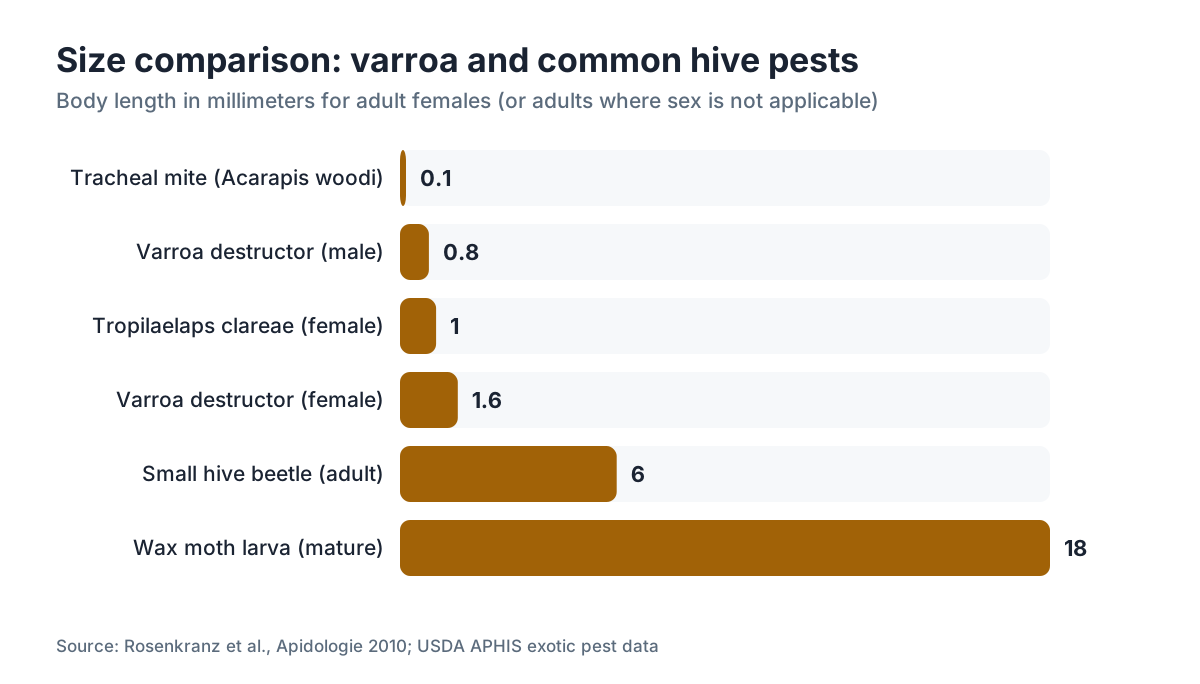
Comparisons make varroa easier to recognize. Here is how it stacks up against the other pests that show up on frames and sticky boards.
| Pest | Approximate size | Shape | Color |
|---|---|---|---|
| Varroa destructor (female) | 1.6 x 1.1 mm | Flat oval, wider than long | Reddish-brown |
| Tropilaelaps clareae (female) | 1.0 x 0.6 mm | Oval, longer than wide | Light brown |
| Acarapis woodi (tracheal mite) | 0.14 x 0.08 mm | Elongated oval | Pale white |
| Small hive beetle (adult) | 5-7 mm long | Oval, domed | Dark brown to black |
| Wax moth larva | 12-19 mm long | Caterpillar | Off-white |
Tropilaelaps is worth flagging because it is a major concern if it ever establishes outside Asia. It is slightly smaller than varroa, longer than wide instead of wider than long, and faster-moving. USDA-APHIS lists it as an exotic pest not present in the continental U.S., but beekeepers who travel internationally or work with imported package bees should know what it looks like. [9]
Tracheal mites are invisible to the naked eye. Finding them means dissecting the thorax of a bee and examining the tracheal tubes under a microscope. Different problem, different protocol. If you can see the mite without magnification, it is not a tracheal mite.
Small hive beetles cause no confusion at all. But they earn a mention because they sometimes share the same sticky board space as varroa, and new beekeepers occasionally send photos asking which is which. Beetles are an order of magnitude bigger.
Does varroa mite size vary between populations or regions?
There is some documented variation in size across V. destructor populations worldwide, but the differences are small and mostly fall inside the range of measurement error in field studies. Haplotypes from Korea and Japan (called K1 and K2) dominate globally and look morphologically almost identical. A 2000 paper in Experimental and Applied Acarology by Anderson and Trueman is the taxonomic work that separated V. destructor from V. jacobsoni and pinned down the species identity of global populations. [2]
The size variation that actually matters to you is between reproductive females and the males described above, and between foundress females (which have been feeding for some time) and newly matured daughters (adults, but sometimes paler and softer-bodied just after the final molt).
Climate and host bee species do not appear to change adult body dimensions in any real way, based on the literature. What climate and management do change is reproductive success inside cells, which sets how fast the population grows. That is a different question from how big an individual mite is.
How does knowing varroa mite size help you manage infestations?
Knowing the physical scale of varroa is practical, not biological trivia. Three reasons it matters day to day.
First, it sets honest expectations for visual inspection. A 1.1 mm mite on a 15 mm bee is visible if you look hard, but you will miss mites hiding under tergites or in the hair coat. Visual inspection alone cannot give you a reliable infestation rate. Wash counts and sticky board counts exist precisely because the mite is small enough to hide even though it is large enough to see.
Second, size drives treatment penetration. Oxalic acid vapor works because the molecule reaches every surface in the hive, including the crevices where mites grip bees. Formic acid works by vapor penetrating into capped cells, though temperature and application rate are make-or-break. The EPA-registered Api-Life VAR thymol label specifies placement on top bars so the vapor spreads through the hive space. None of these treatments require you to reach or see each mite. The chemistry does that. [10]
Third, sticky board debris analysis gets easier when you know the size. Some extension services teach a "mite daily drop" calculation: count the mites on a sticky board after 24 to 72 hours and divide by the number of days. Many U.S. extensions flag a drop of around 2 to 3 mites per day as a signal to run a more precise wash count, though wash count thresholds (typically 2 to 3 mites per 100 bees in spring and fall) are the more reliable basis for treatment decisions. [3][11]
If you want a structured way to track all of this across multiple hives and seasons, the free tools at VarroaVault run on these same protocols.
What does varroa mite size mean for treatment thresholds?
Treatment thresholds are not based on mite size directly, but size is what makes counting possible. Because the mite is big enough to separate from bees mechanically and to see against white, the wash count and sticky board methods work for hobbyists with zero lab equipment.
The most widely cited threshold in the U.S. comes from the Honey Bee Health Coalition's Varroa management guide: treat when infestation tops 2% in spring and summer (2 mites per 100 bees on an alcohol wash), and treat before the colony goes into winter with mite levels above 1 to 2%. [3] Some extension services, including Penn State Extension, use similar numbers and note regional variation. [11]
The practical flow: collect a roughly 300-bee sample (about half a cup of bees from a brood frame), wash or roll, count the mites on a white surface, divide by the bee count, multiply by 100 for percent infestation. A 1.1 mm mite against white paper or a white bin is easy to see and count. The method works because of the mite's size, and the threshold is calibrated to colony population dynamics, not to mite size.
One piece of advice for a first season: do not wait until you see mites crawling on bees in large numbers before treating. By the time mite loads are that obvious, the colony is usually already sliding. Monthly wash counts from spring through fall are the right cadence.
Are varroa mites visible on bees without any tools?
On adult bees, yes, under good conditions. Hold a frame of nurse bees in direct sunlight or under a bright LED panel and look at the abdomens. Reddish-brown ovals between or on the tergites (the dark plates of the abdomen) are mites. You are most likely to catch them on bees that are resting and not grooming.
Brood inspection is another shot. The classic method is drone uncapping: pull a few drone cells, skewer through the wax with a capping scratcher or a fork, and drag the pupae out onto a white surface. Yellow-white drone pupae with reddish-brown mites attached are easy to see. The mite's 1.1 mm width against a pale drone pupa stands out clearly. [6]
For sticky board monitoring, slide a sticky board (or a plain board coated with petroleum jelly over white paper) under a screened bottom board for 24 to 72 hours. Mites that fall off bees naturally get stuck, and you count them. This is the least stressful method for the bees but also the least precise, since drop rate depends on colony size, temperature, and other variables. It still gives you a directional signal and sacrifices no bees.
So the answer to the original question is yes: varroa is large enough to see without tools. But reliable monitoring needs standardized counts, because casual visual inspection misses too many mites to act on.
Frequently asked questions
How big is a varroa mite compared to a human hair?
An adult female varroa mite is about 1.1 mm wide, roughly the width of a thick human hair, or a hair wider than fine mechanical pencil lead. A human hair runs from about 0.06 mm (fine) to 0.18 mm (coarse), so the mite is much wider than any individual hair. That makes it visible to the naked eye with decent light and a white background.
Can varroa mites be seen without a microscope?
Yes. At 1.1 mm wide and 1.6 mm long, varroa mites sit well above the threshold of human vision. Spot them on adult bees by looking between abdominal segments in bright light, on drone pupae during uncapping, or on a white sticky board after 24 to 72 hours. A 10x loupe helps confirm identity and see the legs, but diagnosis does not need a microscope.
What color are varroa mites?
Adult female varroa mites are reddish-brown to mahogany, darkening with age. Newly molted females may look paler or cream-colored. Male mites are paler and nearly round. The reddish-brown color is one of the key visual cues for spotting mites on a sticky board or on bee bodies, especially against a white background.
How many varroa mites fit on a single bee?
Multiple mites can ride a single adult bee, though phoretic mite loads typically average around 1 to 2 mites per infested bee under normal colony conditions. Under heavy infestation you can find 3 or more on one bee. Inside brood cells, researchers have documented as many as 8 to 10 mites in a single drone cell during severe infestations.
Are male varroa mites smaller than females?
Yes, by a lot. Male varroa mites are roughly 0.8 mm in both length and width, making them nearly round and much smaller than the adult female (1.6 x 1.1 mm). Males never leave the brood cell and cannot feed on adult bees. Their only job is to mate with daughter mites inside the cell, after which they die. You will almost never see a male during routine monitoring.
How does varroa mite size compare to Tropilaelaps?
Tropilaelaps clareae, the other major brood-parasitic bee mite, is roughly 1.0 mm long by 0.6 mm wide, slightly smaller than varroa overall and shaped the opposite way (longer than wide rather than wider than long). Tropilaelaps also moves faster. It is not established in the continental U.S. and is considered a top exotic pest threat by USDA-APHIS.
Why does varroa mite size matter for sticky board counts?
Sticky board setups are sized so varroa mites (1.1 mm wide) fall through the screened bottom board (openings around 3.2 mm) and land on the sticky surface below. The mite's size is also what makes it countable against a white surface with the naked eye. Most extension guidelines count all oval reddish-brown specks 1 mm or larger as mites when reading a sticky board.
What does a varroa mite look like under magnification?
Under a 10x loupe you see a flat, oval reddish-brown body with eight short legs coming off the wide sides, an unmistakable crab-like look. The dorsal surface has a smooth shield (scutum) with tiny pits and hairs. The mouthparts (chelicerae and pedipalps) are visible underneath. There is no confusion with pollen, debris, or wax at this magnification.
At what mite count should I treat my hive?
The Honey Bee Health Coalition recommends treating when an alcohol wash shows 2 or more mites per 100 bees during spring and summer brood rearing, and 1 to 2 per 100 bees before winter cluster formation. These thresholds assume a standard 300-bee sample from a brood frame. Regional conditions shift exact timing, so check your local extension service for state-specific guidance.
Do varroa mites grow larger as they age?
No. Varroa mites reach adult size at the final nymphal molt, which happens inside the capped brood cell. Once they emerge as adults there is no more growth. Older mites may look darker, which can make them seem more noticeable, but the dimensions of 1.6 mm x 1.1 mm are fixed at adulthood for females.
Can I identify varroa just from seeing a reddish-brown dot on my bee?
A reddish-brown dot roughly 1 to 1.5 mm wide on the abdomen of an adult bee is almost certainly varroa, especially if it sits between or on top of abdominal tergites. Confirm with a 10x loupe if you have any doubt. Other common hive debris is not that size, that color, and that position all at once. False positives from visual inspection alone are rare with a little practice.
How does varroa mite size affect which treatments are effective?
The mite's size and its habit of hiding under bee tergites mean contact treatments have to reach those spaces. Oxalic acid vapor and formic acid vapor work because they permeate the hive air and reach hiding mites. Amitraz-based strips (Apivar) use slow-release contact chemistry that bees carry through the colony. The mite's hiding ability drives the chemistry requirements more than the raw dimensions do.
How do I tell the difference between a varroa mite and a pollen grain on a sticky board?
Size and shape are the tells. Pollen grains are almost always under 0.1 mm, far smaller than varroa. More telling, a varroa mite has eight visible legs radiating from its sides, a distinct crab-like silhouette under a 10x loupe. Pollen has no legs and tends to be rounded or irregular depending on the plant. Any oval speck 1 mm or wider with legs is varroa.
Is varroa mite size consistent across all honey bee species?
The mite adapts to its host, but V. destructor females keep similar body dimensions whether parasitizing Apis mellifera or Apis cerana. The reproductive biology differs a lot between hosts (V. destructor reproduces poorly on A. cerana, which is why it rarely destroys A. cerana colonies), but that is a behavioral and physiological adaptation, not a change in adult body size.
Sources
- Rosenkranz et al., Apidologie, 2010 - Biology and control of Varroa destructor: Adult female V. destructor dimensions: 1.1 mm wide by 1.6 mm long; males approximately 0.8 mm; flattened, laterally elongated body plan; mite passes through 8-mesh screened bottom board
- Anderson and Trueman, Experimental and Applied Acarology, 2000 - Varroa jacobsoni is more than one species: Taxonomic separation of V. destructor from V. jacobsoni; K1 and K2 haplotypes established as the globally destructive species
- Honey Bee Health Coalition - Varroa Management Guide (latest edition): Alcohol wash protocol requiring 30-second agitation; treatment threshold of 2 mites per 100 bees in spring/summer; 1-2 mites per 100 bees before winter
- Ramsey et al., PNAS, 2019 - Varroa destructor feeds primarily on honey bee fat body tissue: Varroa feeds on fat body tissue, reducing developing bee body weight and compromising immune and metabolic function
- USDA Agricultural Research Service - honey bee and pollinator research: Standard 8-mesh screened bottom board openings of approximately 3.2 mm allow mite fall-through for monitoring
- University of Minnesota Bee Lab - varroa monitoring and drone brood sampling: Drone uncapping method and mite density in drone cells being 7 to 10 times higher than in worker cells
- Honey Bee Health Coalition - Varroa Management Guide, life cycle section: First egg in brood cell is unfertilized male; subsequent eggs are fertilized females; development from egg to adult female takes roughly 6 days in worker brood
- EPA - Pesticide registration (oxalic acid for use in beehives): Oxalic acid treatment efficacy against phoretic mites; reduced efficacy when capped brood is present
- EPA - Pesticide registration (Api-Life VAR thymol label): Api-Life VAR label specifies placement on top bars for vapor distribution through hive space
- Penn State Extension - beekeeping and varroa management: 2 to 3 mites per 100 bees wash count threshold for treatment decisions; sticky board directional but less precise
- University of Minnesota Extension - beekeeping resources: Visual identification of varroa on adult bees and brood; sticky board debris analysis guidelines
Last updated 2026-07-09