How Apivar strips work: the complete guide for beekeepers
TL;DR
- Apivar strips are plastic polymer strips impregnated with amitraz, an acaricide.
- Bees walk across the strips and carry amitraz throughout the colony on their bodies, killing varroa mites by disrupting their nervous system.
- Two strips per brood box, left in for 6 to 10 weeks, typically reduces mite loads by 90 to 99% when applied correctly outside of brood-heavy periods.
What is Apivar and what's actually in it?
Apivar is a registered varroa miticide made by Veto-Pharma. Each strip is a white plastic matrix impregnated with 3.3% amitraz by weight, which works out to roughly 500 mg of amitraz per strip [1]. The active ingredient is amitraz, a formamidine-class acaricide that has been registered for varroa control in the United States since the mid-1990s and is approved by the EPA under registration number 73173-1 [2].
Amitraz itself is not new. It's been used in veterinary medicine for decades against ticks and mites on livestock, and beekeepers in Europe have had access to amitraz-based products for varroa since the 1980s. What Veto-Pharma's matrix technology did was slow the release down so a single treatment lasts weeks rather than hours.
The strip is just a delivery vehicle. Think of it as a slow-release depot that sits in the hive and steadily bleeds amitraz into the colony environment for the entire treatment window. You're not spraying anything or flooding the hive. The chemistry diffuses into wax, propolis, and bee cuticle over time.
How does amitraz actually kill varroa mites?
Amitraz is an octopamine receptor agonist [3]. Octopamine is a neurotransmitter that insects and arachnids use heavily for things like regulating movement and feeding behavior. Mammals use adrenaline instead of octopamine for many of those functions, which is part of why amitraz is relatively selective for arthropods at the concentrations used in hive treatments.
When a varroa mite contacts amitraz, its nervous system goes haywire. Mites stop feeding, fall off bees, lose the ability to find brood cells, and eventually die. At sublethal doses, mites detach from their hosts and drop to the hive floor, which is why monitoring on a sticky board during treatment gives you a visible count of the carnage.
One thing worth knowing: amitraz also has a repellent or detachment effect before outright mortality kicks in. Mites don't have to absorb a lethal dose to fall off a bee. That's actually useful because it means even mites that survive initial contact tend to lose their grip and end up on the bottom board, away from brood.
For bees, octopamine plays a smaller role compared to mites, and at hive-application concentrations the effects on honey bees are minimal. Some research has shown slight behavioral changes in bees at high doses, but at label-compliant concentrations, bees tolerate amitraz well [3].
How do bees spread the treatment through the hive?
This is the clever part of the delivery system. You hang two strips in the brood nest, one between frames two and three, one between frames eight and nine in a ten-frame box (or scaled equivalently for eight-frame or Langstroth equivalents). Bees walk over the strips constantly as they move through the colony doing normal hive work.
Every time a bee contacts a strip, she picks up a small amount of amitraz on her cuticle. She then walks across combs, contacts other bees, grooms nestmates, and distributes the compound through the colony. This bee-to-bee and bee-to-comb contact is the primary distribution mechanism. It's trophallaxis and social grooming doing the work of spreading a miticide colony-wide without you having to do anything more.
Veto-Pharma's efficacy data, submitted as part of the EPA registration, shows that colonies with higher bee traffic across the strips (i.e., strips placed correctly in the middle of the brood nest) achieve significantly better mite knockdown than strips placed at the margins [1]. Placement matters more than most beekeepers realize.
Mites that are under capped brood are shielded from direct contact during their reproductive phase. They're inside the cell. But when those cells emerge and the mites ride out on young bees, those bees walk across strips or contact treated bees, and the mites get exposed. That's why the treatment needs to run 6 to 10 weeks: you need time to cover multiple brood cycles and catch mites as they re-emerge [2].
How do you use Apivar strips correctly?
The EPA-registered label is the legal document. Everything below follows label requirements, but always read your actual product label before treating because label changes do happen [2].
Step 1: Do a mite wash or alcohol wash before treating. You want a baseline count so you know whether treatment worked. The Honey Bee Health Coalition's Varroa Management Guide recommends treating when mite loads reach 2 mites per 100 bees (2%) in spring or summer, or 1 to 2% in late summer/fall before winter bees are raised [4]. Don't treat blind.
Step 2: Put on gloves. Amitraz absorbs through skin. Nitrile gloves work. Some beekeepers also wear a dust mask when opening the packaging, though at typical handling volumes this is more precautionary than strictly necessary.
Step 3: Open the package and suspend the strips in the hive using the built-in tab. The tab hooks over the top bar of a frame. Each strip hangs between two frames, touching neither comb face but sitting inside the bee space. Use two strips per brood box. If you're running two brood boxes, use four strips total (two per box).
Step 4: Keep the strips in for a minimum of 6 weeks, maximum 10 weeks. Do not remove early even if your mite count drops fast. The full duration clears mites as they emerge from capped brood. Removing at 4 weeks leaves you exposed to a rebound from mites that were under capped cells during your early wash.
Step 5: Check a mite wash at week 6 or 7. If counts are still elevated, finish out the full 10 weeks. If counts are down to zero or near-zero, you can remove at 6 weeks, though most beekeepers run the full treatment.
Step 6: Remove strips and dispose of them properly. Used strips still contain residual amitraz. Most extension programs recommend sealing them in a plastic bag and putting them in household trash. Do not burn them.
Step 7: Do another mite wash 2 to 4 weeks after strip removal to confirm treatment efficacy. This is the step most hobbyists skip. It matters.
What temperature range does Apivar work in?
This is one of Apivar's real advantages over oxalic acid vaporization and some other treatments. Amitraz diffuses and distributes at cooler temperatures than many organic acids require. The label specifies use when temperatures are above 50°F (10°C) [2], and most practical experience and manufacturer guidance suggest the sweet spot is 60 to 80°F.
At very high temperatures (above 90°F for sustained periods), amitraz can volatilize faster than the matrix releases it smoothly, potentially shortening effective duration. At temperatures below 50°F, bee cluster behavior slows, bees don't contact the strips as much, and distribution suffers. So Apivar is not well-suited to treating a cluster in the dead of winter.
Fall is the most common treatment window precisely because temperatures are dropping but haven't yet crashed into cluster-season. A September treatment in most of the continental US hits both the temperature window and the timing goal that matters most: knocking mites down before winter bees are raised in August and September.
If you're in a climate with mild winters (parts of California, Florida, the Gulf Coast), you have more flexibility. If you're in Minnesota or Wisconsin, you need to get strips in by early September to have any confidence the treatment runs at effective temperature for the full duration.
Can you use Apivar with honey supers on?
No. The label prohibits application when honey supers intended for human consumption are on the hive [2]. This is a hard legal requirement, not a suggestion.
Amitraz and its metabolites, particularly DMPF (2,4-dimethylaniline) and other breakdown products, can accumulate in beeswax and to a lesser extent in honey. Studies have found amitraz residues in beeswax at levels correlated with treatment history [5]. The label's prohibition on super use is designed to keep these residues out of consumer honey.
In practice this means you plan your Apivar treatment around your honey flow. Most beekeepers in temperate climates pull supers after the main flow ends in July or August, treat through August or September, then remove strips by late September or October. That sequence works well and matches the fall mite control window.
If you're in a year-round-flow region or you're a late-season beekeeper who leaves supers on longer, you need to plan accordingly. Some beekeepers treat in early spring before supers go on, which is a legitimate strategy, though spring treatments miss the fall window that protects your winter bees.
Never treat with supers on. It's a label violation, and it risks putting amitraz residues in honey that people eat.
What efficacy can you realistically expect from Apivar?
Under field conditions with correct placement and timing, Apivar typically achieves 90 to 99% mite reduction [4]. That's a wide range, and the low end tells you something: technique and timing matter a lot.
The Honey Bee Health Coalition's Varroa Management Guide cites efficacy studies showing "greater than 90% efficacy" for amitraz strips when used according to label directions [4]. Independent university trials have generally confirmed this range. Penn State Extension has published data showing similar results in regional trials.
What pulls efficacy below 90%? Incorrect strip placement (too far from the brood nest), short treatment duration, treating during very hot spells when amitraz volatilizes inconsistently, and amitraz resistance. Resistance is real. Amitraz resistance in varroa has been documented in research settings, particularly in Europe and South America, and there are reports from US beekeepers of reduced efficacy over time [6]. If you're rotating treatments (oxalic acid in winter broodless periods, Apivar in fall, maybe formic acid in spring), you're reducing resistance pressure. If you've used Apivar exclusively for years, you may be selecting for resistant mites.
Also worth noting: efficacy is measured against phoretic mites (mites riding on adult bees). Mites inside capped cells during treatment are not directly exposed. The 6 to 10 week window is designed to catch them as cells emerge, but a colony with a very large amount of capped brood at treatment start will see slower knockdown than a colony in a brood break.
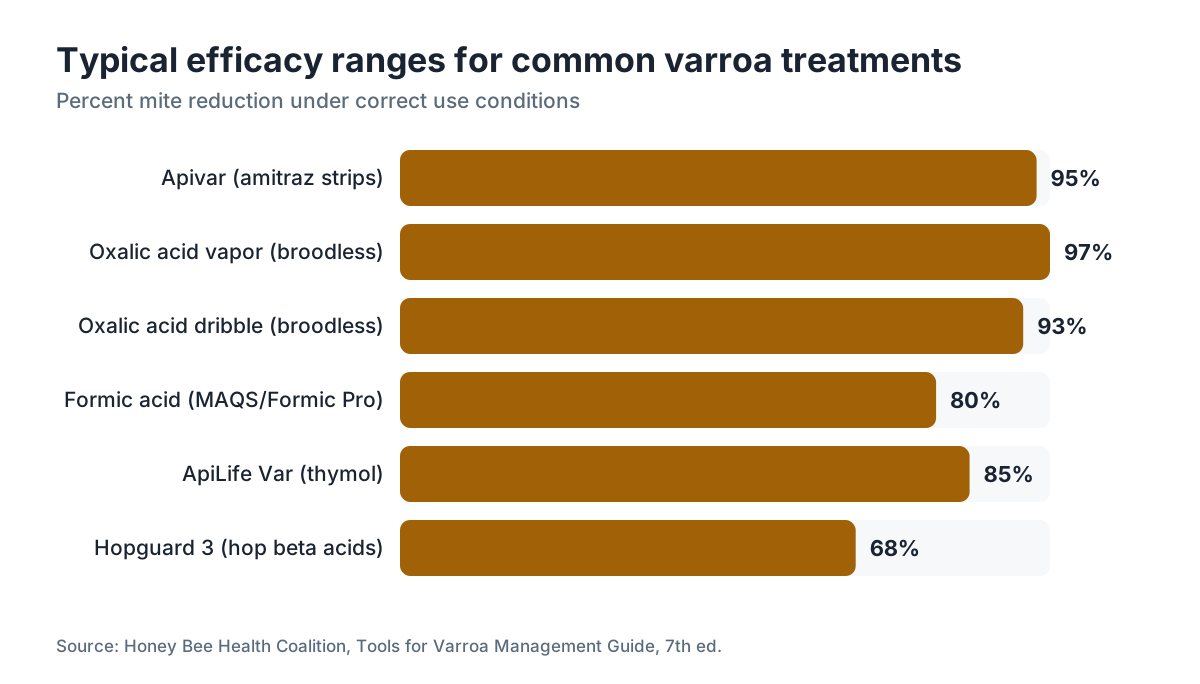
Below is a comparison of common varroa treatments to give you a realistic picture of where Apivar sits:
| Treatment | Active ingredient | Efficacy range | Temperature limits | Super restriction | Brood penetration |
|---|---|---|---|---|---|
| Apivar (amitraz strips) | Amitraz | 90 to 99% | >50°F | Yes, no supers | Phoretic only |
| Oxalic acid dribble | Oxalic acid | 90 to 95% (broodless) | >40°F | No supers | Phoretic only |
| Oxalic acid vapor | Oxalic acid | 90 to 99% (broodless) | >40°F | No supers | Phoretic only |
| Formic acid (MAQS/FAP) | Formic acid | 60 to 95% | 50 to 85°F | MAQS: yes with supers | Some brood penetration |
| ApiLife Var | Thymol blend | 75 to 95% | 59 to 69°F | No supers | Phoretic only |
| Hopguard 3 | Hop beta acids | 50 to 85% | Any | With supers (label varies) | Phoretic only |
How do you know if the treatment worked?
You do a mite wash after treatment. There's no shortcut here.
Wait 2 to 4 weeks after removing the strips, then do an alcohol wash or sugar roll on a 300-bee sample (roughly half a cup of bees) from the brood nest frames. The Honey Bee Health Coalition provides a free wash protocol with detailed instructions [4]. Count the mites in your sample, divide by 300, multiply by 100 to get mites per 100 bees.
Your target post-treatment is under 2 mites per 100 bees, and ideally under 1% heading into fall. If you're still above 2% after a complete 10-week Apivar treatment, something went wrong: possible resistance, possible placement error, possible reintroduction from a nearby feral colony or from beekeeping operations nearby (mite drift and robbing are real).
If treatment failed and you have time before winter, a broodless oxalic acid treatment is your fastest path to knockdown. The two mechanisms are different enough that oxalic acid is genuinely complementary to amitraz, and switching to it after a failed Apivar treatment isn't just plan B, it's arguably best practice.
Tracking your counts over time also tells you about resistance trends in your apiary. If your pre-treatment counts are climbing faster than they used to, or if your post-treatment efficacy is dropping year over year, that's signal worth paying attention to. Free tracking tools from VarroaVault can help you log and compare counts across treatment cycles.
Is amitraz resistance in varroa a real problem?
Yes, and it's been documented in peer-reviewed literature. Resistance to amitraz has been confirmed in varroa populations in parts of Europe and South America, and there is evidence of reduced susceptibility in some US populations [6]. The mechanism involves mutations in varroa that affect the octopamine receptor targeted by amitraz, reducing its binding efficiency.
In practical terms, resistance doesn't mean Apivar stops working entirely overnight. It typically shows up as reduced efficacy: you treat for the full 10 weeks and your mite count drops 70% instead of 95%. That's still meaningful knockdown, but it's not enough to protect a colony heading into winter.
The best strategy is rotation. Use amitraz-based products (Apivar) in the fall. Use oxalic acid in the winter broodless period. Consider formic acid in early spring if counts rebound. Rotating chemical classes keeps resistance pressure distributed across different mechanisms of action.
Some beekeepers go full organic (oxalic acid and formic acid only) to avoid amitraz resistance entirely. That's a legitimate choice. Others use Apivar every year for a decade without obvious resistance problems. Nobody has great long-term resistance-monitoring data at the apiary level for hobbyist operations. The honest answer is: rotate when you can, monitor closely, and if your Apivar efficacy seems to be dropping, switch treatments for a cycle or two.
What are the most common mistakes beekeepers make with Apivar?
Mistake 1: Removing strips too early. Six weeks is the minimum. Many beekeepers pull them at four weeks because the sticky board looks clean. Mites under capped brood at the start of treatment are still emerging, still getting exposed. Removing early invites rebound.
Mistake 2: Wrong placement. Strips hung at the edge of the box, outside the brood cluster, get very little bee traffic. Center frames, in the heart of the brood nest, is where they belong.
Mistake 3: Not removing strips at 10 weeks. Leaving strips in longer than 10 weeks doesn't improve efficacy and may increase residue accumulation in wax. The label says 6 to 10 weeks. Respect the upper limit.
Mistake 4: Treating with honey supers on. Already covered above, but it's the most common label violation and the one with the most direct food safety consequences.
Mistake 5: Not confirming efficacy with a post-treatment wash. Lots of beekeepers treat, feel good about it, and never verify. Then they wonder why their colonies die in January. The wash takes 10 minutes. Do it.
Mistake 6: Using Apivar as the only treatment year after year. This accelerates any resistance already present in local varroa populations and gives you no information about whether efficacy is dropping.
Mistake 7: Not wearing gloves. Amitraz absorbs through skin and can cause symptoms including headache and dizziness at sufficient exposure. Gloves are on the label for a reason.
Where can you buy Apivar strips and what do they cost?
Apivar is sold through most major beekeeping supply companies and some farm supply stores. As of 2024-2025, pricing runs roughly $35 to $55 for a pack of 10 strips (enough for five colonies, using two strips each), and $90 to $130 for packs of 50 strips [7]. Prices vary by retailer and change with supply; check current pricing from beekeeping supply companies before budgeting.
You do not need a veterinarian prescription for Apivar in the US. Amitraz remains over-the-counter for bees as of 2025, unlike several other veterinary-use acaricides. This sets it apart from, say, coumaphos (Checkmite+), which has a different regulatory history.
For hobbyists running fewer than five colonies, the 10-strip pack is the obvious buy. For sideliners with 20 to 50 colonies, the 50-strip pack unit economics are better. Storage between seasons: keep unused strips in their original sealed packaging, away from heat and direct light. Amitraz degrades faster when exposed to heat and UV, so a cool, dark shelf is the right place.
If you're assembling a full treatment toolkit, having both Apivar and oxalic acid on hand covers two different chemical classes and two different seasonal windows. That's a solid foundation for year-round mite management without over-relying on any single mechanism. You can browse what else belongs in your beekeeping supplies rotation.
How does Apivar fit into a full-year varroa management protocol?
Apivar works best as the cornerstone of your fall treatment, not your only tool. Here's how a sensible annual cycle looks for most temperate-climate beekeepers:
Late summer (August): Pull honey supers. Do a mite wash. If mites are at 2% or above, start Apivar immediately. If you're below 2% but above 1%, you can treat now or monitor weekly and treat at the threshold.
September through October: Apivar strips are in. Mites are getting knocked down. Winter bees are being raised in a lower-mite environment, which is what protects colony survival through winter. This is the most important treatment of the year for most beekeepers.
November through December: Remove strips by week 10 at the latest. Do a mite wash 2 to 4 weeks post-removal. If the colony is broodless or nearly broodless and counts are still elevated, treat with oxalic acid dribble or vapor. Oxalic acid is extremely effective against phoretic mites in broodless colonies and uses a completely different mechanism than amitraz.
February through March: Colony is building back up. Do another mite wash when you have a good sample size. If counts are rising fast, consider a spring formic acid treatment (MAQS or Formic Pro) before the main flow and before supers go on.
May through July: Supers on, honey flowing. No Apivar. This is the management gap you cover by having low mite loads going into the season from your fall and winter treatments.
The Honey Bee Health Coalition's Varroa Management Guide maps this kind of integrated approach in detail and is the single best free reference for building your full-year protocol [4]. VarroaVault's free mite tracking tools can help you log counts at each of these decision points and see trends across years.
For more background on what you're dealing with, see our reference on varroa mite biology and lifecycle.
Frequently asked questions
How many Apivar strips do I use per hive?
Two strips per brood box, according to the EPA-registered label. A single-brood-box colony gets two strips. A colony running two full brood boxes gets four strips, two in each box. Place them in the center of the brood nest, not at the edges. More strips than labeled does not improve efficacy and increases residue risk.
Can I leave Apivar strips in longer than 10 weeks?
No. The label maximum is 10 weeks. Leaving strips in beyond that does not improve mite kill, since the amitraz depot is largely exhausted by then, and it extends the window for residue accumulation in wax. Pull strips at 10 weeks at the latest, even if you want to treat again. Wait at least a few weeks before any retreatment.
Does Apivar work in winter?
Not well. Below 50°F, bees cluster tightly and contact the strips far less, so amitraz distribution through the colony is severely reduced. Apivar is a warm-season treatment. For winter mite control in a broodless or near-broodless colony, oxalic acid dribble or vaporization is the standard approach and much more effective at low temperatures.
Will Apivar harm my queen or brood?
At label-compliant concentrations, Apivar has not been shown to harm queens or brood under normal use. Some research has suggested amitraz can affect queen reproductive quality at high concentrations, but the evidence at typical hive-application levels is not strong. Follow label placement and duration guidelines and you're unlikely to see issues.
Can I use Apivar and oxalic acid at the same time?
There's no known dangerous chemical interaction, but using them simultaneously is unusual and not part of any standard protocol. The two treatments target the same pest (phoretic mites) through different mechanisms. Standard practice is to use Apivar in fall as a primary treatment, then oxalic acid in the broodless winter period for any residual mites. Sequential use, not simultaneous, is the norm.
How do I know if varroa mites in my hive are resistant to amitraz?
You won't know definitively without lab testing, but the field signal is a post-treatment mite count that's higher than expected after a full 10-week Apivar treatment done correctly. If you treat and see less than 85 to 90% reduction in mite levels, suspect placement error or resistance. Switching to oxalic acid and rotating treatments going forward is the practical response.
Is Apivar safe for bees?
Yes, at label-compliant concentrations. Amitraz targets octopamine receptors, which are far more significant in mites and other arachnids than in honey bees. Studies show bees tolerate Apivar treatments well when used as directed. Some mild behavioral effects have been observed in research at elevated doses, but these are not typically seen under normal treatment conditions.
Can I treat a nucleus colony or a small colony with Apivar?
Yes, but use one strip for a small nuc rather than two. The key is having the strip in the brood area where bees contact it frequently. A four- or five-frame nuc with one strip placed centrally can be treated effectively. Monitor closely, since small colonies can have volatile mite loads and less buffer if treatment falls short.
What do I do if my mite counts are still high after a full Apivar treatment?
First rule out technique errors: strips placed at brood nest center, full 10-week duration, no temperature extremes during treatment. If technique was right, suspect resistance or heavy reinfestation from nearby feral colonies or neighbors. Do a broodless oxalic acid treatment immediately. Then rotate to a different chemical class for your next full treatment cycle and monitor closely.
How should I dispose of used Apivar strips?
Seal used strips in a plastic bag and dispose of them in household trash. Do not burn them. Amitraz combustion byproducts are not safe to inhale. Do not bury them near water sources. Residual amitraz remains in used strips, so handle them with the same gloves you'd use for application.
Can I use Apivar in a top-bar hive or a Warré hive?
The label is written for Langstroth-style hives with frame spaces. In a top-bar hive, you can hang a strip from a top bar using the built-in tab, positioned so it hangs in the brood area. There's no published efficacy data specifically for top-bar hive use, so monitor carefully. The core mechanism, bees contacting the strip and distributing amitraz, still applies.
How much does Apivar cost per hive treated?
At typical retail pricing in 2024 to 2025, a 10-strip pack costs roughly $35 to $55. Two strips per hive means that pack treats five colonies, putting per-colony cost at $7 to $11. A 50-strip pack ($90 to $130) drops the per-colony cost to $3.60 to $5.20. For most hobbyists, the 10-strip pack is the practical buy unless you're managing 10 or more colonies.
When is the best time of year to use Apivar?
Late summer through early fall, August through September in most of the continental US, is the primary window. This timing knocks mites down before winter bees are raised (winter bees typically develop from brood laid in August and September) and runs the treatment while temperatures are still above 50°F. Spring is a secondary window, before supers go on.
Sources
- Veto-Pharma, Apivar EPA-registered product label (via CDMS label database): Each Apivar strip contains 500 mg amitraz (3.3% w/w) in a polymer matrix; two strips per brood box for 6 to 10 weeks per the label.
- U.S. EPA, Pesticide Registration for Apivar (EPA Reg. No. 73173-1): Apivar is EPA-registered for varroa control; label prohibits use when honey supers are on; approved temperature range above 50°F.
- Enan E. (2001). Insecticidal activity of essential oils: octopaminergic sites of action. Comparative Biochemistry and Physiology, 130(3):325-337.: Amitraz acts as an octopamine receptor agonist, disrupting nervous system function in arthropods including varroa mites.
- Honey Bee Health Coalition, Tools for Varroa Management Guide (7th edition): Amitraz strips achieve greater than 90% efficacy when used according to label; treatment threshold is 2 mites per 100 bees in spring/summer, 1 to 2% in late summer/fall.
- Bogdanov S. (2006). Contaminants of bee products. Apidologie, 37(1):1 to 18.: Amitraz and its metabolites, including DMPF, accumulate in beeswax in proportion to treatment history.
- Milani N. (1999). The resistance of Varroa jacobsoni Oud. to acaricides. Apidologie, 30(2-3):229 to 234.: Amitraz resistance in varroa has been documented in European and South American populations, associated with mutations affecting octopamine receptor binding.
- Penn State Extension, Varroa Mite Treatment and Management: University field trials confirm amitraz strip efficacy in the 90 to 99% range under correct placement and duration; retail pricing and treatment protocols reviewed.
- UC Davis Apiaries and Bee Breeding Group, Varroa Management: Amitraz-based treatments recommended as part of integrated varroa management rotation with oxalic acid to reduce resistance pressure.
- USDA AMS National Honey Bee Survey, Bee Health Report: Varroa remains the leading parasitic threat to managed honey bee colonies in the US; mite management is the primary driver of colony survival.
- University of Minnesota Extension, Varroa Mite Control in Honey Bee Colonies: Integrated mite management using rotating chemical classes (amitraz, oxalic acid, formic acid) recommended to slow resistance development.
Last updated 2026-07-09