How long can a queen be caged for a brood break?
TL;DR
- You can cage a queen safely for 24 to 30 days.
- That window covers one full brood cycle, so all capped worker brood emerges and varroa runs out of cells to hide in.
- Push past 30 days and the colony starts losing foragers faster than it can replace them.
- Most beekeepers target 25 to 28 days for the best balance of mite crash and recovery.
What is a caged brood break and why does it work against varroa?
A brood break is exactly what it sounds like. You stop the queen from laying for a set period, all the capped brood already in the hive emerges, and nothing new gets sealed behind wax. Varroa destructor mites reproduce only inside capped worker and drone cells. No capped brood, no nursery. Any mite that is phoretic (riding on an adult bee) is now fully exposed to treatment or simply ages out without ever reproducing. [1]
The caged method pulls this off without removing the queen. You confine her in a push-in cage, a hair-roller cage, or a commercial queen cage, and she stays physically inside the hive the whole time. The colony never goes queenless. It never starts emergency cells. Workers still touch and feed her through the mesh, so they never feel the panic of true queen loss.
This is one of the oldest varroa tools around, and one of the friendliest for a small operation. It costs almost nothing if you already own a cage. It adds no chemicals by itself. Pair it with oxalic acid vapor and you get a genuinely brutal one-two punch against mites. The Honey Bee Health Coalition recommends brood interruption as a way to get the most out of oxalic acid, because oxalic acid kills phoretic mites but cannot reach through wax cappings. [2]
How long can a queen stay caged before the colony suffers?
The honest answer is 24 to 30 days, with 25 to 28 days as the sweet spot most experienced beekeepers land on. Here is why those numbers hold.
A worker egg takes 21 days from laying to emergence: 3 days as an egg, 6 as a larva, 12 sealed under cappings. So a 21-day cage period clears every worker cell that was capped when you locked her up. Add a few days on top and any slightly late brood finishes emerging, which guarantees every mite that was sealed in a cell is now out in the open. That is the source of the 24 to 25 day minimum. [3]
Why not go longer? Because the adult population is aging the entire time. Summer bees live 30 to 45 days. With the queen caged, no new bees are coming online, so every day past day 25 or so you spend foragers you cannot replace. Push past 30 days and you risk a population crash the colony struggles to climb out of, especially heading into fall. Some beekeepers with monster midsummer colonies stretch to 35 days without disaster, but that is a gamble, and you are almost certainly past the point of any real mite benefit by then. [4]
Season changes the math more than the calendar does. A colony caged in July bounces back faster than one caged in late August, because July bees still have the whole flow ahead of them to rebuild on. Time this protocol to your local season first, the day count second.
What are the mite-reduction numbers you can actually expect?
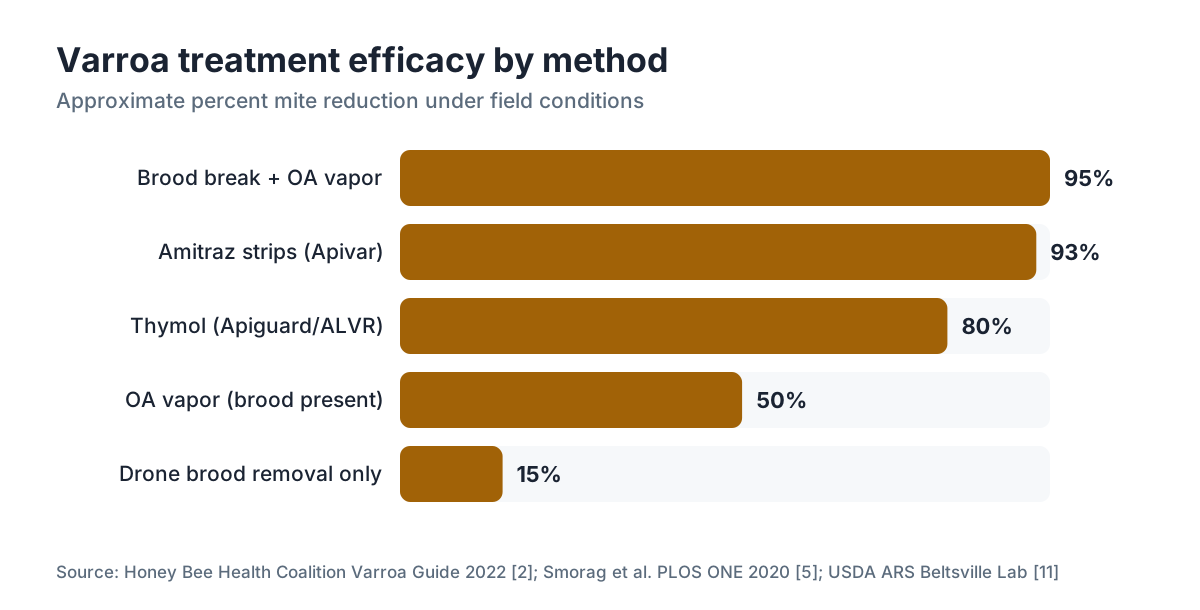
The mite crash from a brood break plus oxalic acid vapor is the most effective non-synthetic treatment you can run. A 2020 study in PLOS ONE (Smorag et al.) found that brood interruption combined with oxalic acid cut Varroa infestation by up to 95% against untreated controls. [5] Ninety-five percent. That is not a typo.
Brood break alone, with no oxalic acid, still produces a big drop, usually 70 to 85%, because the reproductive cycle is snapped. But most beekeepers who bother to cage the queen also run oxalic acid vapor through the brood-free window, and that pairing is where the near-total crashes come from.
For context: Apivar (amitraz strips) typically hits 90 to 95% when used right with brood present, and thymol products like Apiguard or Api Life VAR land at 70 to 90% depending on temperature. A clean brood break with oxalic acid vapor is genuinely competitive with the best synthetics, and it leaves no residue in your wax.
| Method | Typical Efficacy | Residue in Wax | Works with Brood Present |
|---|---|---|---|
| Brood break + OA vapor | 90 to 95% | None | N/A (brood absent) |
| Amitraz strips (Apivar) | 90 to 95% | Yes (long term) | Yes |
| Thymol (Apiguard/ALVR) | 70 to 90% | Minimal | Partial |
| OA vapor alone (brood present) | 40 to 60% | None | Poor penetration |
| OA drizzle/dribble | 90%+ | None | No (brood-free only) |
Source: PLOS ONE 2020 [5], Honey Bee Health Coalition Varroa Guide 2022 [2]
What kind of cage should you use and how do you install it?
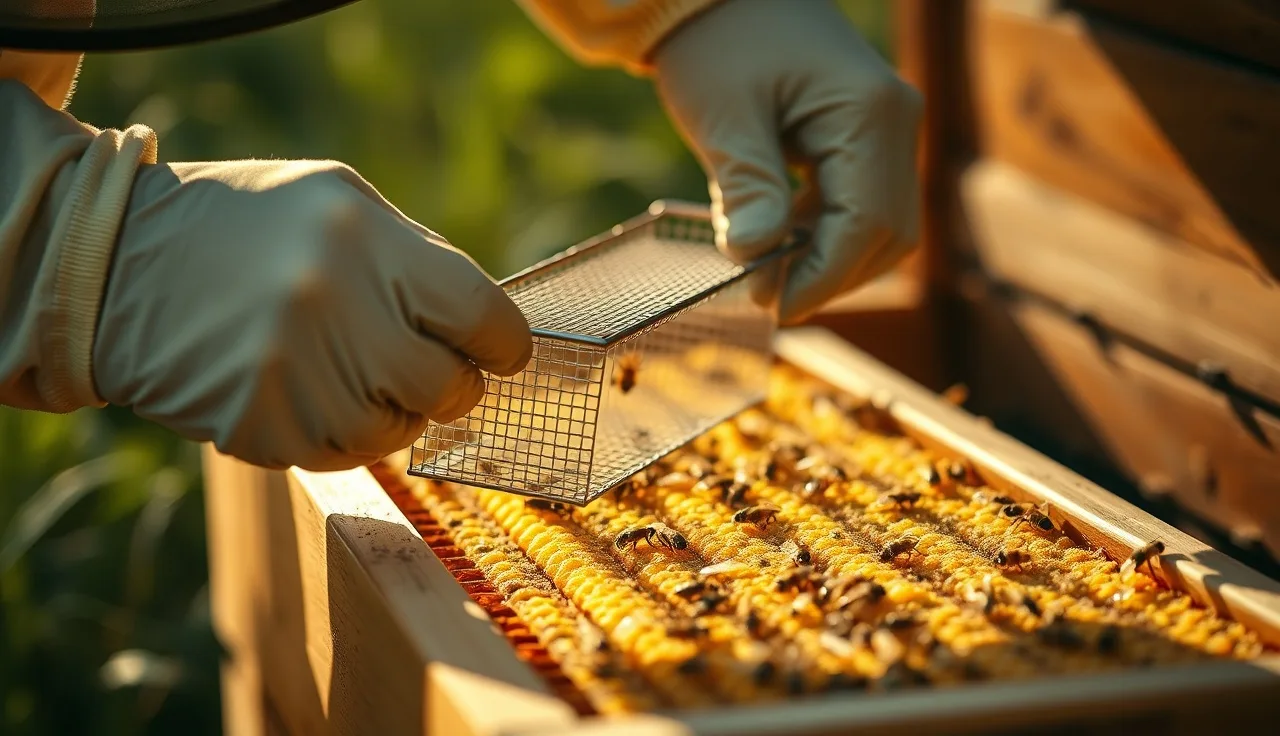
Three cage designs work reliably. The push-in cage is a wire screen box (usually around 3x3 inches) that you press directly into a comb over the queen. She is trapped with a small patch of empty cells she can lay into if she wants, but she cannot leave. The hair-roller cage (a plastic mesh cylinder sold in dollar stores and bee shops) holds the queen by herself with no comb contact. The JZ-BZ or equivalent commercial introduction cage is the one suppliers sell for shipping queens, and it works fine here too.
For a brood break, the push-in cage is the best of the three. The queen stays calmer with comb contact and a little room to move. Workers reach her more easily through the mesh. The colony stays settled. Hair-roller cages work, but they stress the queen more, and you sometimes catch bees chewing hard at the plastic.
Installation is simple. Find the queen on a calm day with smoke. Set her on a frame of empty or emerging comb if you can, not a frame packed with open larvae, because a frame full of larvae stirs up restless nurse bees around the cage. Press the cage in firmly so the edges bite into the comb. Run a finger along every edge and confirm there is no gap she can squeeze through. Mark the date somewhere you will not lose it.
Check on her through the mesh every 5 to 7 days without opening the cage. You want normal behavior: workers grooming her, no aggressive balling. If bees are clustered tight and biting the cage, something is off, and you need to figure out whether the colony has accepted the setup or is in distress.
When in the season should you do a caged brood break?
Timing is where most beginners blow it. A brood break works any time there is brood, but some windows beat others by a mile.
Midsummer, roughly July into early August across most of the US, is the classic window. Colonies are at peak strength. The break finishes with enough runway for the queen to resume and lay the fat winter bees that carry the colony through cold months (those go in the boxes August through September). Mite populations also crest in July and August, so the hit lands when it matters most. [6]
Spring breaks work, but they are risky. Cage a queen in April or May and you cut into the colony's expansion right when it needs numbers for the summer flow. Most beekeepers who run a spring break only do it when mite levels are dangerously high and nothing faster is on the table.
Late August into September is a trap. You might pull off the break and treatment, but now the queen has to lay winter bees fast, and a 25-day cage means she does not restart until mid-to-late September. In the north, that is uncomfortably tight. South of roughly the Mason-Dixon line, later breaks are more forgiving.
A rule of thumb worth writing down: the queen should be released in time to lay at least 4 full rounds of brood before your hard frost date. With a 21-day worker cycle, that means letting her out 84 days before first frost at the absolute minimum, and 90 or more if you want any margin.
Can you combine the caged brood break with oxalic acid treatment?
Yes, and you should if varroa is the target. Vaporized oxalic acid is registered by the EPA under the trade name Api-Bioxal for use in hives with or without brood, but its kill rate against mites inside capped cells is essentially zero. [7] The caged brood break fixes that by clearing capped brood entirely.
The Honey Bee Health Coalition's Varroa Management Guide puts it plainly: "Oxalic acid is most effective when there is no capped brood in the hive, as it only kills mites that are in the phoretic (non-reproductive) phase." [2] That is the whole scientific reason this combination hits so hard.
Here is the protocol most beekeepers run. Cage the queen on day 1. Start oxalic acid vapor around day 5 or 6, once some early brood has emerged and the mite load is shifting onto adult bees. Treat every 3 to 5 days for a total of 3 to 5 rounds across the brood-free window. By the time you release the queen, you have hit wave after wave of newly exposed mites. The Api-Bioxal registration allows up to 3 sublimation applications per brood-free period, though some extension guidance describes longer courses under the same label umbrella using medical-grade or equivalent vaporizers. Read and follow your specific product label. [7]
Want a printable version to track treatment timing, cage days, and alcohol wash results? The VarroaVault tools library has a brood break planning worksheet that walks the whole sequence.
One safety note that is not optional. Oxalic acid vapor is a lung and eye hazard. Wear a P100 respirator and eye protection every single time. Seal the hive entrance with a damp towel during treatment and wait 10 minutes before you pull it. Gear up or do not treat.
How do you monitor mite levels before and after to know if it worked?
Monitoring is the part you cannot skip. Without an alcohol wash or sugar roll before and after, you are guessing.
Before you cage the queen, run an alcohol wash on about 300 bees (roughly half a cup) pulled from a brood frame. The Honey Bee Health Coalition recommends treating once infestation reaches 2% or higher, which works out to 6 or more mites per 300 bees. [2] If you are already at or past that line, do not wait.
After you release the queen, give the colony about 10 days for brood to resume and for the mite level to settle, then run a second alcohol wash. A clean brood break with oxalic acid should put you well under 1%, often near zero. If the post-treatment wash still reads more than 1 mite per 100 bees (3 per 300), you either had a gap in the protocol (some brood was not brood-free, oxalic acid got skipped, the cage had an escape hole) or reinfestation from neighboring hives has already started.
Reinfestation is real and badly underrated. University of Minnesota research found a treated colony surrounded by untreated neighbors can climb back to dangerous mite levels within 6 to 8 weeks. [8] That is why you check again around 6 weeks after release, more than at release. It is also a good argument for getting your local beekeeping club to coordinate treatment timing across everyone's hives.
What can go wrong with a caged brood break?
Plenty, honestly. Here are the usual ones.
The queen escapes. This happens most with a badly fitted push-in cage on old, warped comb. Check on day 2 or 3 by looking for eggs outside the cage. If she is loose, you have to find her and start over, and you have burned days. Fit the cage carefully and check early.
The colony raises an emergency queen. Sounds impossible with the queen right there, but it happens when the cage sits over young larvae and workers decide that patch is queenless because they cannot read her pheromones well enough. Move the cage to a spot with better pheromone spread (center of the cluster, not a corner frame). Check for queen cells every 5 to 7 days.
The colony swarms anyway. A caged queen can still ride out swarm prep if the colony was already in swarm mode before you caged her. Look for charged queen cells the day you cage her. If they are there, you may need to split instead of cage.
The queen dies in the cage. It happens, from stress, age, or rough handling during install. If you check on day 5 and the workers are fanning at the cage entrance while the cluster has drifted away from it, she may be dead. Find her. If she is gone, you now have a queenless brood break, which is a harder and slower problem.
How does a caged brood break compare to other brood break methods?
The main alternatives are full queen removal (splits or walk-away splits), a nucleus method, and repeated drone brood culling without pulling the queen. Each carries a different tradeoff.
A walk-away split forces a brood break in the queenless half while the other half keeps humming. You get two colonies, which is great if you want increase. But the queenless half breaks longer, because it has to raise a new queen, get her mated, and wait for her to start laying (add 16 days for the queen cell plus mating and settling, easily 30 to 40 days total), and its population drops hard in the meantime. [10] If your goal is varroa control in one existing colony without splitting, the caged method is cleaner.
Drone brood culling pulls roughly 10 to 15% of the mite population per culled frame. [9] That helps, but it is not a treatment. On its own it will not carry you to a safe mite level. Use it as a season-long suppression tool alongside other protocols.
Nucleus transfers (pulling the queen into a nuc to force a break in the original colony) work well, but you need the extra equipment on hand and you are now managing another colony. The caged method wins for the beekeeper who wants the fewest moving parts.
For beekeepers picking through beekeeping supplies and methods, the cage approach comes out ahead on simplicity and reversibility.
What is the right protocol for releasing the queen after the brood break?
Release is almost always boring if the colony stayed queenright the whole time. Lift or open the cage right off the comb. The queen should walk out calmly and start inspecting cells within a few minutes. Workers groom her and feed her.
Watch for balling. If workers instantly cluster into a tight knot around her and start pulling her legs, the colony may have quietly raised a new queen behind your back. Stop. Find your queen, put her somewhere safe (back in the cage), and search the brood frames for any capped or freshly emerged virgin queens. Remove them, wait a day, then release the original queen again.
Give the colony about 5 days after release before you go hunting for eggs. Queens often need a day or two to rev back to full laying speed after confinement. Do not panic if day 1 is empty. By day 5 or 6 you should see a solid, consistent pattern.
After release, run your second alcohol wash around day 10 to 14 (see the monitoring section above) to confirm the treatment landed. The VarroaVault treatment tracker helps you log these dates and results so each colony has a season-long record.
Does a caged brood break cause long-term harm to the queen?
Most of the time, no. Queens caged for 25 to 30 days and then released generally resume normal laying within a few days and keep performing. The thing that matters is that she had enough food and worker contact through the cage during confinement. Workers push food through the mesh to feed her, and in a healthy colony they do it without any prompting.
There is some evidence that very long confinement (45 days or more) can start to degrade a queen's spermatheca, but nobody has solid published data on the 24 to 30 day window and long-term queen performance. The closest signal is that queen banks, where queens sit for weeks under similar conditions, run successfully for months when managed right, which suggests short confinement is not acutely harmful.
Age matters more than the cage. An older queen (3 years plus) may not snap back as hard as a young one. If your queen already showed spotty brood before the cage, the cage will not fix that, and you should think about whether requeening is the smarter long-term move.
Here is a simple test. Within 2 to 3 weeks of release, the brood pattern should look as good as or better than it did before caging. If it looks worse, rule out laying problems (poor acceptance, disease, a failing spermatheca) before you blame the cage.
Frequently asked questions
How long does a caged queen brood break need to be to eliminate all capped brood?
Worker brood takes exactly 21 days from egg to emergence, so a 21-day cage period clears every worker cell that was capped on day 1. In practice, beekeepers target 24 to 25 days to cover any late-emerging cells and to guarantee a fully brood-free window for oxalic acid. Stretching to 28 days adds safety margin without meaningful harm to the colony.
Can you cage a queen for 30 days without harming the colony?
Yes, most healthy colonies handle 30 days without lasting damage, especially in midsummer when the adult population is large. Beyond 30 days the colony loses foragers faster than it can replace them, and recovery drags. A 25 to 28 day window gives you the full mite-control benefit with less population risk than a 30-plus-day stretch.
What type of cage is best for a queen brood break?
A push-in cage (a small wire mesh box pressed into comb) is the most commonly recommended option. It allows pheromone exchange through the mesh, keeps the queen calmer than a bare hair-roller cage, and is easy to check without disturbing the colony. Hair-roller cages and standard introduction cages work too, but they give the queen less space and no comb contact.
How many oxalic acid treatments should you do during a brood break?
The EPA-registered Api-Bioxal label allows up to 3 sublimation applications during a brood-free period. Many extension services recommend 2 to 3 treatments spaced 5 days apart once the hive is clearly brood-free. Always follow the current label, which is the legal document for any registered pesticide. Wear a P100 respirator and eye protection every time you vaporize.
What happens if you release the queen too early during a brood break?
Release her before all capped brood has emerged, roughly before day 21, and the mites still sealed in those cells finish their reproductive cycle uninterrupted. You lose a big chunk of the efficacy. Any oxalic acid vapor during that window is also weaker because of the remaining cappings. Stick to at least 24 days for a reliable result.
Will the colony raise emergency queen cells while the queen is caged?
Occasionally, yes. If the cage sits over young open larvae and pheromone spread is poor, workers may read that zone as queenless and start emergency cells. Check every 5 to 7 days during the cage period. If you find charged queen cells, destroy them. Placing the cage in the center of the cluster, where pheromone flow is strongest, cuts this risk down.
Is a brood break better than Apivar for varroa control?
For residue-free honey or wax, a brood break plus oxalic acid vapor is the better pick. Efficacy runs comparable to Apivar at 90 to 95% when done right. Apivar (amitraz) is easier to run and works with brood present, but it leaves residues that build up in wax over years. Both are legitimate tools. The right one depends on your goals and local mite pressure.
Does the time of year affect how long you should cage the queen?
The biological minimum (24 to 25 days for a full brood cycle) does not change with the season, but the safe maximum does. In midsummer, 28 to 30 days is reasonable because colonies are large and recovery is fast. In late summer or early fall, stay near 24 to 25 days, since the colony needs to resume laying winter bees before cold weather shuts brood rearing down.
How do you know the brood break actually worked against varroa?
Run an alcohol wash on 300 bees before caging and again about 10 to 14 days after release. Before treatment, a 2% or higher infestation (6 or more mites per 300 bees) warrants action. After a clean brood break with oxalic acid, you should see well under 1 mite per 100 bees, often zero or near it. If results still read above 1%, hunt for protocol gaps.
Can you do a caged brood break in a two-queen or multi-queen hive?
You have to cage every laying queen at the same time for the break to work. In a two-queen setup, caging one while the other keeps laying defeats the whole point. The complexity jumps fast, and most beekeepers running varroa control in multi-queen systems use splits or staggered treatment timing rather than a simultaneous multi-cage approach.
Does a caged brood break work for small hive beetle or other parasites too?
No. Small hive beetle breeds in pollen and honey stores, not capped brood, so a brood break does nothing to beetle numbers. The break works against Varroa destructor because its entire reproductive cycle depends on capped bee brood. For small hive beetle, physical traps and beetle-blaster-type oil traps are the main non-chemical tools.
What mite level should trigger a caged brood break?
The Honey Bee Health Coalition recommends treating at a 2% alcohol wash threshold, which equals 6 or more mites per 300-bee sample. Many beekeepers treat earlier in late summer (at 1% or even lower) to protect the winter bee cohort. If you hit 3% or higher in August, a brood break with oxalic acid is one of the fastest, most effective responses you have.
Can a new or beginner beekeeper do a caged brood break?
Yes, with caveats. You need to find and handle your queen confidently, which takes practice. The cage install itself is easy once you have done it once. The monitoring (alcohol washes before and after) is a skill worth learning before you need it. Many club mentors will walk a new beekeeper through a first brood break to build confidence with queen handling.
Sources
- Honey Bee Health Coalition, Varroa Management Guide (2022): Varroa destructor reproduces only inside capped worker and drone brood cells; phoretic mites are fully exposed between reproductive cycles.
- Honey Bee Health Coalition, Varroa Management Guide (2022): Oxalic acid is most effective when there is no capped brood in the hive, as it only kills mites in the phoretic (non-reproductive) phase; treatment threshold is 2% infestation (6 mites per 300-bee alcohol wash).
- University of Minnesota Extension, Honey Bee Research: Worker bee development from egg to emergence takes 21 days (3 egg, 6 larval, 12 capped), establishing the minimum brood break duration for a full brood cycle.
- Penn State Extension, Varroa Mite Management: Summer worker bees live 30 to 45 days; caging the queen stops new bee production, so extended cage periods risk population decline.
- Smorag et al., PLOS ONE (2020), Brood Interruption and Oxalic Acid Efficacy: Brood interruption combined with oxalic acid treatment reduced Varroa infestation rates by up to 95% compared to untreated controls.
- University of California Agriculture and Natural Resources, Varroa Mite Management: Varroa populations typically peak in late July and August in the US, making midsummer the highest-impact window for brood break interventions.
- EPA, Api-Bioxal Product Label (Reg. No. 81422-9): Api-Bioxal oxalic acid is EPA-registered for use in bee hives; the sublimation method allows up to 3 applications per brood-free treatment period per label instructions.
- University of Minnesota, Bee Squad / Spivak Lab Research on Varroa Reinfestation: Treated colonies in areas with high mite pressure from untreated neighboring hives can reinvest to dangerous levels within 6 to 8 weeks of treatment.
- North Carolina State University Extension, Integrated Pest Management for Varroa: Drone brood removal captures approximately 10 to 15% of the varroa population per culled frame; not sufficient alone as a primary treatment.
- Virginia Cooperative Extension, Varroa Mite Biology and Management: Walk-away splits create a queenless brood break of 30 to 40 days total in the queenless half, accounting for virgin queen rearing and mating time.
- USDA ARS Beltsville Bee Laboratory, Varroa Research Overview: Amitraz (Apivar) and oxalic acid brood break protocols both deliver 90 to 95% efficacy against Varroa under field conditions when applied correctly.
Last updated 2026-07-09