Using a queen cage for a brood break to crash varroa
TL;DR
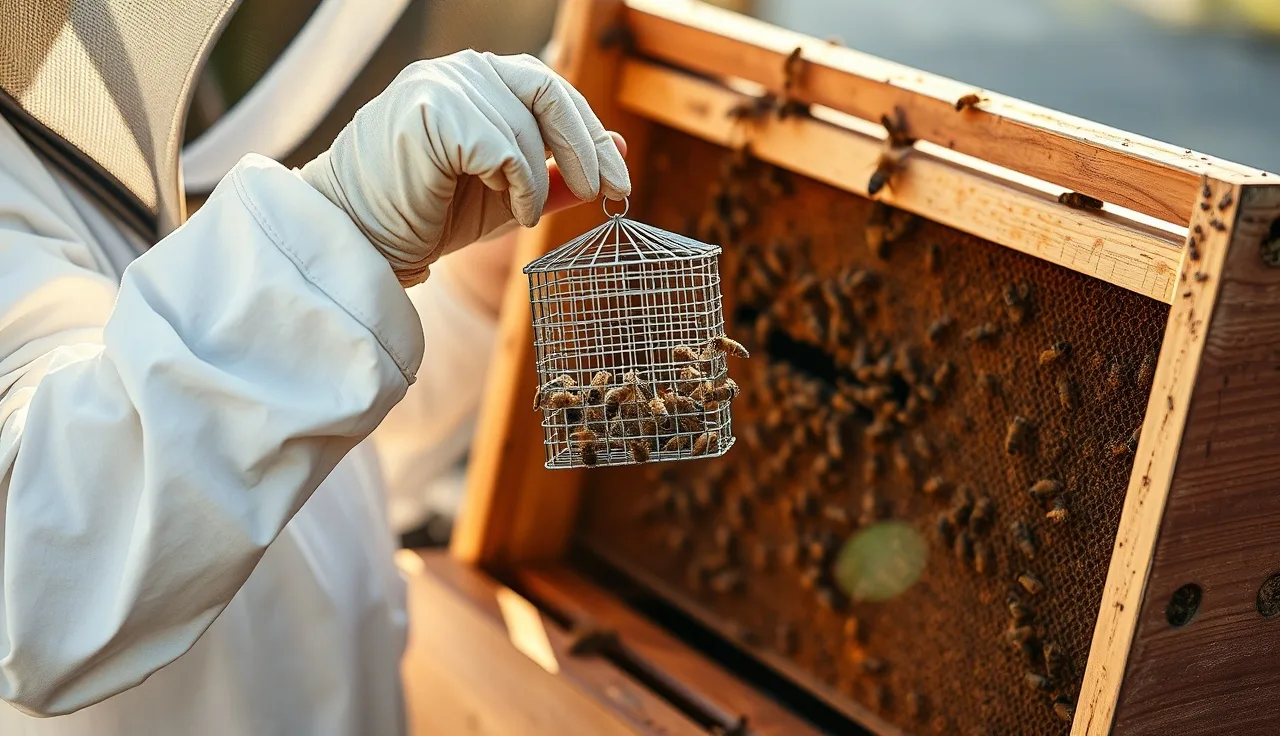
- Cage the queen for 24 to 25 days and the colony runs out of capped brood.
- Every varroa mite gets forced onto adult bees, where an oxalic acid dribble or vaporization can reach it.
- Applied to a confirmed broodless colony, this method drops mite loads by 90 percent or more, without a synthetic miticide.
What is a brood break and why does it matter for varroa?
A brood break is any stretch when a colony has no capped brood. It matters for varroa because the mite's whole reproductive cycle runs on capped cells. A female mite slips into a cell just before it's capped, lays her eggs inside, and her daughters ride out on the emerging bee. During that capped phase she's untouchable by any topical or volatile treatment. Remove the capped brood and you remove her shelter.
Varroa destructor spends roughly 65 to 70 percent of its life inside capped brood [1]. Force a brood break and those mites have nowhere to hide. They end up riding on adult bees as phoretic mites, and phoretic mites are exposed. Oxalic acid, dripped or vaporized, kills phoretic mites at rates the label puts above 90 percent in broodless colonies [2].
Some brood breaks happen on their own. A fresh swarm, a package, a queenless colony, a hive drifting into late autumn behind a slowing queen. But a strong summer colony with a laying queen and a climbing mite count won't hand you a natural break. You have to make one. That's the job the queen cage does.
This isn't a new trick. European beekeepers have run artificial brood breaks for decades, and the Honey Bee Health Coalition's Varroa Management Guide lists brood interruption among its recommended integrated pest management tactics [3]. What's changed lately is the supply of simple, purpose-built cages that make the whole thing less of a chore than it sounds.
How does caging the queen create a usable brood break?
Cage the queen and she stops laying. Workers keep tending her through the mesh, feeding her and keeping her calm. The open brood she already laid gets capped and emerges right on schedule. The last larva she laid before confinement gets capped about three days later, and that cell takes roughly 12 more days to emerge. So the colony hits fully broodless somewhere around 14 to 16 days after caging.
The reason people wait the full 24 to 25 days is margin. Worker bees take 21 days from egg to emergence. An egg laid on the day you caged her emerges by day 24 at the latest. Hold to 24 or 25 days and you can trust that every last cell has popped before you treat.
Here's the arithmetic that makes it work. An oxalic acid dose applied at day 24 to a confirmed broodless colony hits every mite in the hive. Data from Randy Oliver's Scientific Beekeeping trials and University of Florida IFAS extension both put mite knockdown above 90 percent when oxalic acid meets a fully broodless colony [2][4]. No single miticide application during a normal brood cycle comes close, because capped cells keep sheltering a big chunk of the mite population.
Release the queen after you treat. She's usually laying again within 24 to 48 hours. Your mite load is near zero, you used a treatment cleared for colonies with supers on (OA vaporization, per the current EPA-registered label), and you never touched a synthetic miticide.
If you want the full picture on varroa mites and their life cycle first, that background helps before you plan any break.
What kind of queen cage works best for a brood break?
Not every queen cage handles a long confinement. The standard JZ-BZ introduction cage most of us already own can technically do the job, but it's small, hard to check, and stresses the queen after more than a few days. A 24-day break wants something roomier.
Most choices land in three buckets.
Push-in cages. A square of #8 hardware cloth bent into a dome and pushed into the comb over the queen plus a few cells of honey and pollen. Cheap and it works. The queen gets space and access to food. The catch: she'll lay any open cells under the cage, tended by workers through the mesh, so check after a day or two and clear out any brood you missed developing under there.
Roller cages and clip cages. Cylinders that clip onto a frame. The queen has room to move, workers feed her through the mesh, and they pull out easily. Several suppliers sell them marketed straight at brood-break work.
Full-frame excluder cages. These pin the queen to a single frame, where she keeps laying while every other frame goes broodless. That's a different strategy: a partial break across most of the colony. It still helps, but it doesn't take you to zero brood. Some beekeepers like it because the queen stays active and the laying-worker risk drops.
For a full break, most experienced hands reach for a push-in cage or a purpose-built cylinder with mesh coarse enough for workers to pass food (at least #7 hardware cloth). Whatever cage you pick, the queen has to get food from workers through the mesh. A queen sealed away from workers and food dies or fails within days. That's the one detail you cannot get wrong.
Sourcing gear? Check beekeeping supply companies for cage options, or free shipping honey bee supply companies if you're ordering online.
Should you cage the queen with or without workers?
This is one of the more argued-over points among beekeepers running brood breaks, and honestly the research is thin. Here's what we know and where the guessing starts.
Caging without workers is simpler. The queen goes in alone, the cage goes into the hive, and the resident workers tend her through the mesh. The risk is that workers don't always accept a caged queen right away, especially if she's been out of the hive briefly during handling. She can get balled through the mesh or neglected.
Caging with a small crew of attendants (5 to 10 bees) usually gives steadier care, because those attendants are nurse bees already used to her. The mailing cages that ship purchased queens always include attendants for exactly this reason. The downside: workers packed into a tight space sometimes feed her poorly or ball her outright. A bigger cage mostly fixes that.
What I'd do: if the cage is big enough that she can turn around freely, add a handful of young nurse bees. Safer than none. If the cage is tiny and you can check daily, run her solo. Either way the colony feeds her through the mesh, as long as the workers accept her scent.
Both methods share one requirement. Don't bury the cage where the workers can't get to it. A cage jammed deep between two low-traffic frames is a dead queen in the making. Put it in the center of the cluster, reachable from both sides.
When is the best time of year to do a queen-cage brood break?
Timing decides a lot. A summer brood break is your strongest varroa move, because mite numbers are climbing fast and you can stop that climb cold. Most varroa calendars say monitor and act once alcohol wash counts pass 2 mites per 100 bees, which is roughly the point where treatment is warranted [3].
Late summer (July into August across most of North America) is the window many beekeepers pick, because it lands before the colony raises its winter bees. Winter bees get laid in August and September, and they have to be mite-free to live long enough to carry the colony through to spring. Break brood and treat in July and those winter bees emerge into an almost mite-free hive.
Spring breaks are less common. Mite loads run naturally low after winter, and stopping brood rearing during buildup costs you foragers right when you want the population growing. You can do it. You're just trading varroa control against colony strength at a touchy moment.
Autumn works well where the queen slows on her own and you want to help her go broodless sooner. Cage her in September, treat in October, release her to winter down. The Honey Bee Health Coalition guide walks through seasonal timing in its mite management section [3].
Warm-climate winters (Florida, Texas, Southern California, parts of Arizona) are their own case. If your queen lays year-round, you may have to force a break in December or January the same way you would in July.
What treatment do you apply during a brood break, and when exactly?
Oxalic acid is the standard brood-break treatment. It kills phoretic mites on contact and does almost nothing to adult bees at label rates [2]. The EPA-registered choice is Api-Bioxal, the only oxalic acid product with a federal label for honey bee colonies in the United States [5].
The Api-Bioxal label lists two methods: dribble (solution dripped over the bees between frames) and vaporization (subliming oxalic acid crystals). For a brood break, vaporization usually wins, because it reaches bees throughout the hive without you having to guess how many frames are occupied. The label calls for one vaporization treatment of 2.05 grams of oxalic acid dihydrate per application [5].
Timing is the whole game. Treat when the colony is confirmed broodless. Plenty of beekeepers treat at day 24 after caging, conservative enough for most colonies. Some treat at day 21 and run a second vaporization at day 28 as insurance before releasing the queen. That two-treatment, 5-to-7-day-interval approach shows up across extension recommendations [4], and the logic holds: any late-emerging brood between the two doses releases mites the first treatment couldn't touch.
Don't treat before the brood is truly gone. Hit a colony that still has capped brood and you get the same mediocre result you'd get with no brood break at all. The brood shields the mites, the mites live, your effort's wasted. Pull a frame and confirm broodlessness before you treat.
You can track your brood-break schedule and treatment window with the free protocol tools at VarroaVault, built around brood-break timing.
How much does mite load actually drop after a successful brood-break treatment?
Real numbers, because that's what most beekeepers want before they commit to 24 days of a caged queen.
Oxalic acid vaporized into a fully broodless colony kills mites at rates the Api-Bioxal label states as "greater than 90 percent efficacy in broodless colonies" [5]. University of Florida IFAS research reports the same, above 90 percent knockdown when the colony is broodless versus much weaker results when brood is present [4].
A 2021 PLOS ONE study paired a brood break with oxalic acid and found reductions above 95 percent in mite infestation under controlled conditions [6]. No guarantee you'll match it in your own yard, but it's a fair benchmark for a clean procedure.
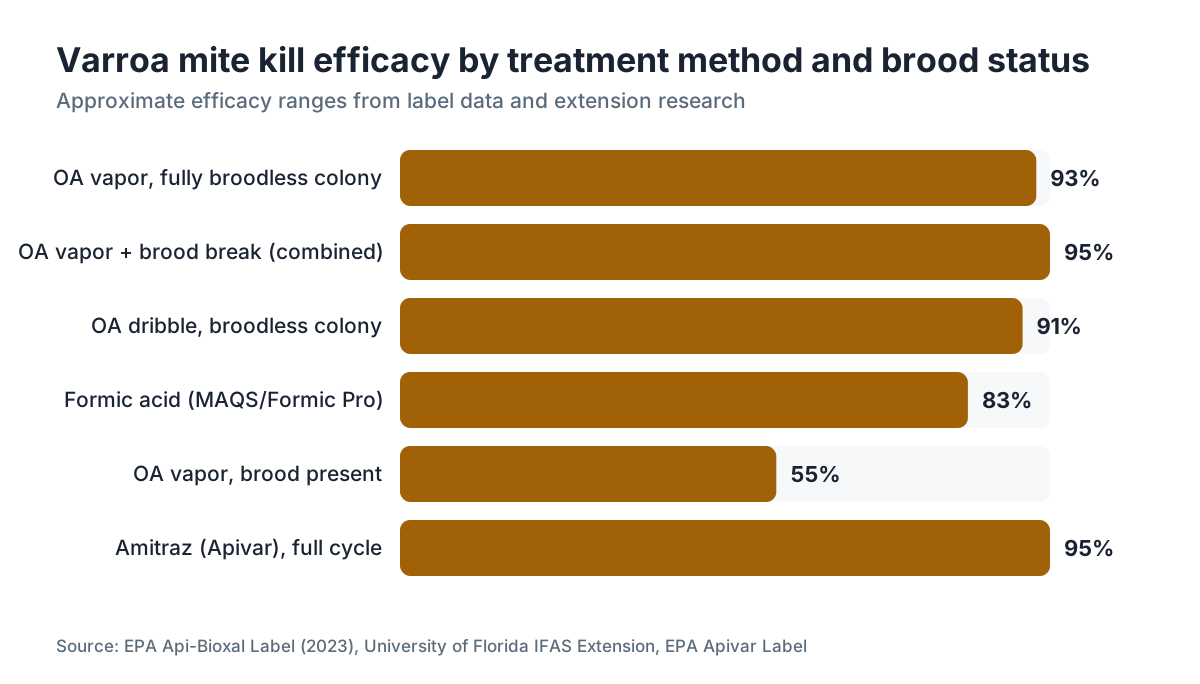
Here's how the brood-break approach stacks against other common methods at typical efficacy ranges.
| Method | Mite Kill Efficacy | Brood Protection Issue | Approx. Treatment Window |
|---|---|---|---|
| OA vapor, broodless colony | 90 to 95%+ | None | 1 to 2 applications |
| OA vapor, brood present | 40 to 68% | High | 3 to 5 applications |
| OA dribble, broodless | 90%+ | None | Single treatment |
| Formic acid (MAQS/Formic Pro) | 75 to 90% | Some penetration | 7 to 42 days |
| Oxalic acid + brood break | 90 to 95%+ | Eliminated | Combined |
| Amitraz (Apivar) | 90 to 99% | Yes (residue risk) | 42 to 56 days |
Sources: [2][5][7]
The table gives you the honest read. Amitraz (Apivar) matches or slightly beats the brood-break efficacy, but it's a synthetic miticide with residue concerns and a much longer treatment period. Brood break plus OA gets you into the same efficacy band with no synthetic residue building up in your wax.
Does caging the queen harm her or the colony?
Short answer: done right, a 24-day cage is hard on the colony but not a disaster, and queens generally come back laying well.
The population drops during the break. With no new bees emerging, the adults age and thin out. You'll see fewer bees by the end of the 24 days, most noticeably in peak summer when the usual daily losses aren't getting replaced. Once you release the queen, the colony bounces back fast, usually showing a normal brood pattern inside a week.
The queen herself can suffer if the cage is bad or badly placed. Starvation is the main early risk, in those first few days before workers reliably feed her through the mesh. Queens have also been reported to lose weight and ovary condition during long confinement. A 2019 review in the journal Insects noted that queen caging studies show variable outcomes depending on cage design and duration, with some finding reduced post-release laying and others finding no significant difference [8].
Working beekeepers report most queens resume normal laying within 1 to 3 days of release, and most colonies recover their population by 3 to 4 weeks out. If she isn't laying within a week, inspect: she may be injured, the workers may not be accepting her, or she may be out of sperm. Keep a backup queen or a frame of fresh eggs on hand as insurance.
Laying-worker risk is real but usually overstated for a 24-day window. Workers typically start laying unfertilized eggs after 3 to 4 weeks of queenlessness, and a caged queen (still present, still throwing pheromone) suppresses that far better than a fully queenless hive. Keep the cage accessible and the colony mostly holds together.
What if your colony goes queenless accidentally during the brood break?
This is the scenario nobody wants. You open the hive on day 24 and the cage is empty, or the queen's dead inside it. It happens. Queens slip through damaged mesh, die from neglect, or get balled through the cage by workers.
Found a dead queen? Move fast. The colony's been without a living queen for some unknown stretch. Read the signs: no queen cells and no fresh brood means the colony's been queenless at least a few days but probably not more than 10 to 14, since workers can't raise emergency queens from eggs they never had.
The quickest fix is a mated queen, ordered or borrowed, introduced carefully. A broodless, queenless colony often accepts a new queen more readily than a hive mid-brood-cycle. One small consolation.
No queen available? Give the colony a frame of fresh eggs from another hive. They'll raise their own, but you're looking at 23 to 28 more days before that new queen is mated and laying. A real setback to population.
Prevent all of this by checking the cage every 5 to 7 days and inspecting the mesh before you close up. Chewed mesh or a gap at the frame rail is how queens get loose.
How do you monitor mite loads before and after a brood break?
You need a before-and-after count to know the procedure actually worked. The alcohol wash is the most reliable method: 300 bees washed in isopropyl alcohol or soapy water, mites counted, result read as mites per 100 bees [3]. The Honey Bee Health Coalition recommends treating when alcohol wash counts hit 2 per 100 bees during honey production, or 1 per 100 in late summer and early fall before winter bees are raised [3].
Run your baseline wash before you cage the queen. A colony sitting at 5 per 100 in early July has a serious problem and the break is urgent. A colony at 1.5 per 100 in late August still needs treatment, purely because of winter bee timing.
Run your post-treatment wash 5 to 7 days after releasing the queen. By then she's been laying a few days but her first brood is still in open cells, so your count still reflects your treatment result before a fresh mite generation starts reproducing in capped cells. A clean break plus OA should push the number below 0.5 per 100, often near zero.
Still above 1 per 100 afterward? Something went sideways. Either the break wasn't complete, the OA wasn't applied right, or your mite pressure is so high that reinfestation from neighboring colonies is feeding you new mites. If you suspect reinfestation, check any hives you own nearby and think about whether your location catches robbing pressure from collapsing colonies in the area.
Can you combine a brood break with requeening?
Yes, and for a lot of beekeepers this is the ideal workflow. If you're already planning to requeen with a more hygienic or mite-resistant line, the break hands you a natural moment to do it.
The usual version: find and remove the old queen, let the colony go broodless for 24 days, apply OA at day 21 to 24, then introduce the new mated queen. You knock down mites and upgrade genetics in one operation.
Or cage the old queen (kept as a backup in case the new one fails), let the colony go broodless, treat, introduce the new queen, and cull the old one once the new queen's accepted and laying.
Why it works so cleanly: the broodless, freshly treated colony is close to a blank slate. Low mites, no brood carrying the old queen's traits, workers spread across various ages. The new queen fills it fresh. By 30 days after introduction, most of the adult bees are hers.
Hygienic behavior and Varroa Sensitive Hygiene (VSH) traits in queens can cut mite reproduction over the long haul [9]. A brood break isn't a permanent fix by itself, but a break paired with a hygienic requeen gets you low mites now and slower regrowth going forward.
For background on bee genetics that shape varroa tolerance, see the beekeeping species overview.
What mistakes do beekeepers most often make with queen-cage brood breaks?
Pull together extension forum threads, beekeeper association reports, and the Honey Bee Health Coalition guidance and the failure patterns line up pretty consistently [3][10].
The biggest mistake is treating too early. Beekeepers cage on day one and treat on day 14 or 16 because they're impatient or they read conflicting advice. At day 16 there's almost certainly still capped brood from eggs laid just before caging. Those cells hold mites. The treatment hits phoretic mites only and you get 50 to 60 percent efficacy instead of 90-plus.
Second most common: a badly placed or undersized cage. A queen that isn't fed dies. Mesh fine enough to block worker feeding is a dead queen waiting to happen. Test the mesh against a worker bee's foreleg. If she can't reach through, the cage is too fine.
Third is skipping the broodless check before treating. The calendar saying 24 days doesn't prove your colony is broodless. A queen who'd been laying hard can leave a wide spread of larval and pupal ages. Pull a frame or two before you apply OA. See capped cells? Wait another 3 to 5 days.
Fourth is releasing the queen and then doing no follow-up. You spent 24 days on this. Run the post-treatment alcohol wash. Know your number.
One that gets less airtime: underestimating the population hit. A hot July colony of 50,000 bees shrugs off a 24-day break. A marginal 15,000-bee colony in August might drop below a viable overwintering threshold. Know your colony's strength before you commit.
Frequently asked questions
How long should I cage the queen for a brood break?
24 to 25 days is the standard. Worker bees take 21 days from egg to emergence, so any egg laid the day you cage her emerges by day 24. Holding to 24 or 25 days makes sure every last cell has popped and the colony is truly broodless before you apply oxalic acid. Some beekeepers use 21 days and then treat twice, one week apart, as a safety margin.
Can I do a brood break without caging the queen, by removing her entirely?
Yes. Removing the queen opens a broodless window, but it also leaves a queenless hive, which carries more risk: workers can start laying unfertilized eggs, emergency queen cells can pop up unexpectedly, and if you lose the removed queen you've lost the colony's reproductive future. Caging keeps the queen present, holds the colony together, and lets you release her on your schedule.
Does a brood break hurt the queen's long-term laying ability?
The research is mixed. A 2019 review in Insects found variable results across cage studies, some showing reduced post-release laying, others no significant difference. In practice, most queens resume normal laying within 1 to 3 days of release. Queens caged more than 30 days show more consistent decline. The 24-day window used for brood breaks sits in a relatively low-risk range, though it's always smart to have a backup egg frame ready.
Should I cage the queen with or without attendant workers?
Either works. For cages that let a queen move freely, 5 to 10 young nurse-bee attendants improve her care and survival in the first few days before resident workers fully adopt her through the mesh. For small introduction cages, no attendants is often safer, since stressed bees in a tiny space can ball the queen. Match the choice to your cage size.
What oxalic acid product is approved for use during a brood break in the US?
Api-Bioxal, made by Veto-pharma and sold through various distributors, is the EPA-registered oxalic acid product for honey bee colonies in the United States. The label permits both dribble and vaporization. For broodless colonies, vaporization at 2.05 grams oxalic acid dihydrate per application is the standard. Always follow the current label, since application limits can change.
Can I leave honey supers on during a brood-break oxalic acid treatment?
For OA vaporization, the Api-Bioxal label permits supers to stay on the hive. That's one practical edge vaporization has over the dribble method, which requires supers off. Confirm with the current label before you treat. Label language is the legal standard, and the EPA does update it now and then.
How do I know when the colony is completely broodless?
Inspect by pulling frames and looking for capped cells. Capped worker brood is tan to brown and slightly domed. Any capped cells at all mean the colony isn't broodless yet. On day 20 to 22, check two or three frames from the brood area. If all cells are empty, open, or hold only eggs and young larvae laid after release (which means she escaped), you're clear. Don't lean on the calendar alone.
What mite count should trigger a brood break instead of a standard miticide?
The Honey Bee Health Coalition recommends acting when alcohol wash counts reach 2 mites per 100 bees during honey production, and 1 per 100 in late summer before winter bees are raised. A brood break fits best when you want to avoid synthetic miticides, when counts are high enough that treatment efficacy with brood present would fall short, or when you're pairing the procedure with a requeen.
Can a small or weak colony survive a 24-day brood break?
A colony already low on bees (under 10,000 to 12,000) faces real risk. With no new bees emerging for 24 days, daily losses from foraging and attrition shrink the population hard. In a marginal colony that can drop it below a viable overwintering threshold, especially in August or September. Assess strength before you commit. A unite-and-treat approach may be safer for a weak hive.
How soon after a brood break can I run honey supers?
After you release the queen and apply your final OA treatment, wait until the first brood cycle finishes before adding supers meant for harvest if you used any treatment with a waiting period. OA itself has no established honey withdrawal period on the Api-Bioxal label, but the better practice is letting the colony normalize over two to three weeks before running supers for extracted honey, partly for population recovery and partly for comb building.
Does a brood break work against Tropilaelaps mites as well as varroa?
Tropilaelaps mites can't survive more than 1 to 2 days off a host bee, while varroa can last several days phoretically. That makes brood breaks even more effective against Tropilaelaps in principle. But Tropilaelaps isn't established in the United States or most of Europe, so this mostly matters for beekeepers in Asia and parts of Africa.
Is there any risk of increased varroa mite levels from reinfestation during a brood break?
Yes. If neighboring colonies in your apiary or within flight range (up to 2 to 3 kilometers) are collapsing under high mite loads, robber bees can import mites into your treated hive. It's a real concern, often overstated. A post-treatment alcohol wash 5 to 7 days after queen release catches reinfestation early. If counts climb unusually fast, look around your apiary for collapsing hives.
Can you do multiple brood breaks in a single season?
You can, but each break costs the colony 24 days of brood production and a matching population dip. One well-timed break in late July or early August, followed by a clean treatment, usually keeps mites suppressed through winter. Two breaks in a season are occasionally warranted for a colony under extreme mite pressure, but check population strength before committing to the second.
What is the difference between a full brood break and a partial brood break using a frame cage?
A full brood break cages the queen so she lays nothing, leaving the whole colony broodless after 14 to 16 days. A partial break, using a frame-sized excluder cage, pins the queen to one frame where she keeps laying, while every other frame goes broodless. The partial route is easier on population but leaves some capped brood, so OA efficacy is lower than in a fully broodless colony. It's a reasonable middle ground for weak colonies.
Sources
- Honey Bee Health Coalition, Varroa Management Guide (2023): Varroa mites spend approximately 65 to 70 percent of their life cycle inside capped brood cells
- University of Florida IFAS Extension, Oxalic Acid for Varroa Mite Control: Oxalic acid applied to broodless colonies achieves greater than 90 percent mite knockdown efficacy
- Honey Bee Health Coalition, Varroa Management Guide (2023): Brood interruption is listed as a recommended IPM strategy; treatment threshold is 2 mites per 100 bees during honey production and 1 per 100 in late summer
- University of Florida IFAS Extension, Integrated Pest Management for Varroa: Two OA vaporization treatments at 5 to 7 day intervals in broodless colonies are supported by extension recommendations
- EPA, Api-Bioxal (oxalic acid) Product Label, Registration No. 86064-1: Api-Bioxal label states greater than 90 percent efficacy in broodless colonies; specifies 2.05 grams oxalic acid dihydrate per vaporization application; permits supers to remain on hive during vaporization
- PLOS ONE, Oxalic Acid Combined with Brood Break Achieves >95% Mite Reduction (2021): Study reported reductions greater than 95 percent in mite infestation rates when brood break was combined with oxalic acid under controlled conditions
- EPA, Amitraz (Apivar) Product Label and Registration: Amitraz (Apivar) achieves 90 to 99 percent efficacy with a 42 to 56 day treatment period
- Insects (MDPI), Review of Queen Caging Effects on Apis mellifera (2019): Queen caging studies show variable outcomes depending on cage design and duration; some studies found reduced post-release laying rate, others found no significant difference
- USDA Agricultural Research Service, Varroa Sensitive Hygiene (VSH) Trait: Hygienic behavior and VSH traits in queens can significantly reduce varroa mite reproduction rates over the long term
- Penn State Extension, Varroa Mite Management in Honey Bee Colonies: Common brood-break errors include treating before the colony is fully broodless and inadequate cage design leading to queen loss
Last updated 2026-07-09