How many mites can a colony tolerate before collapsing?
TL;DR
- Most research and extension guidance puts the treatment threshold at 2% mite infestation (about 2 mites per 100 bees in a wash sample).
- Colonies begin taking serious damage below that.
- In late summer and fall, even 1% can start a collapse before winter.
- The 2% number is not a tolerance ceiling.
- It is the last safe moment to act.
What is the varroa mite threshold that triggers treatment?
The number you'll see cited most often is 2 mites per 100 adult bees, a 2% infestation rate [1]. That figure comes from decades of field research and anchors the treatment guidelines in the Honey Bee Health Coalition's widely used Varroa Management Guide [1]. The logic: a colony under 2 mites per 100 bees in an alcohol wash has a reasonable shot at outrunning its mite population for the season, while a colony above that line is losing ground faster than it can recover.
But 2% is a treatment threshold, not a survival ceiling. It marks the point where you intervene if you want a real chance of success, not the point where the colony is guaranteed to die. That distinction matters. Plenty of beekeepers misread the number as a tolerance limit and wait far too long.
The guide states the economic threshold for adult bee sampling this way: 'Colonies should be treated when mite levels reach or exceed 2% (2 mites per 100 bees) during the honey production season or when populations are building in late summer and fall.' [1] That phrase about late summer is carrying a lot of weight, and we'll get to why in a moment.
For most of the active season, 2% holds up. A healthy colony in May or June with 50,000 bees can carry 1,000 mites and still raise enough healthy young bees to dilute the ratio if conditions cooperate. Put that same mite load in an August colony that's shrinking toward winter prep, and you have a very different animal.
Does the threshold change by season, and why does fall matter so much?
Yes, and this is where colonies die every year. The 2% threshold applies during peak brood season. In late summer (roughly August through October across most of North America), many extension services and the Honey Bee Health Coalition recommend dropping the action threshold to 1% [1][2]. The reason has a name: the winter bee problem.
Honey bees raise a special cohort of physiologically distinct bees in late summer and fall. These winter bees have enlarged fat bodies, slowed vitellogenin turnover, and are built to live five to six months instead of the usual six weeks [3]. Varroa mites reproduce in capped brood, and the viruses they carry, especially Deformed Wing Virus (DWV), damage a developing bee's fat bodies and hypopharyngeal glands before it ever emerges [3]. A winter bee raised in a cell with a reproducing mite is not a real winter bee. It looks the part and dies in December instead of February.
Suppose your mite load hits 2% in August and you treat right away. You have maybe four to six weeks of treatment window before the bulk of your winter bee cohort is capped. That's tight. If the load hits 2% in September, you're already late across most of the north. The 1% fall threshold buys back that lost time.
Here's a way to hold it in your head. The Purdue Extension apiculture program recommends monitoring every month during the active season and stepping up to every two weeks in August and September, because mite populations can double in as little as three to four weeks during peak reproduction [2]. Miss one monitoring window in late summer and you can miss the gap between a colony that overwinters and a box of dead bees you find in February.
For the biology under all of this, the varroa mite overview covers the mite's reproductive cycle and why its timing hurts bees so badly.
How do you actually measure mite infestation rate?
Three methods do the work: alcohol wash, powdered sugar roll, and sticky board counts. Alcohol wash is the most accurate and the one the research rests on [1][4].
For an alcohol wash, collect about 300 adult bees (roughly half a cup) off a brood frame, where nurse bees carry the most mites. Drop them in a jar with a mesh lid, add isopropyl alcohol or windshield washer fluid, shake for 60 seconds, and count the mites that fall through. Divide the mite count by the bee count (weigh the sample: 100 grams of bees runs about 300 bees, though real counts vary) and multiply by 100 for your percentage [4].
| Method | Accuracy | Bees needed | Kills bees? | Best use |
|---|---|---|---|---|
| Alcohol wash | High | ~300 | Yes | Threshold decisions, research |
| Sugar roll | Moderate | ~300 | No | Quick field check |
| Sticky board (24h) | Low (indirect) | None | No | Trend monitoring only |
The sugar roll undercounts by 20 to 40% against alcohol wash, because mites cling to bees harder when no solvent breaks them loose [4]. Sticky board counts tell you whether mites are present and let you watch trends, but daily mite drop does not translate cleanly into an infestation percentage without correction factors that shift by colony size, season, and brood area. Don't make a treatment decision on a sticky board alone.
A 300-bee sample from a 60,000-bee colony is statistically adequate for threshold decisions [4]. The Honey Bee Health Coalition's guide walks through the math and offers downloadable data sheets for tracking results over time [1].
At what mite level does a colony actually collapse?
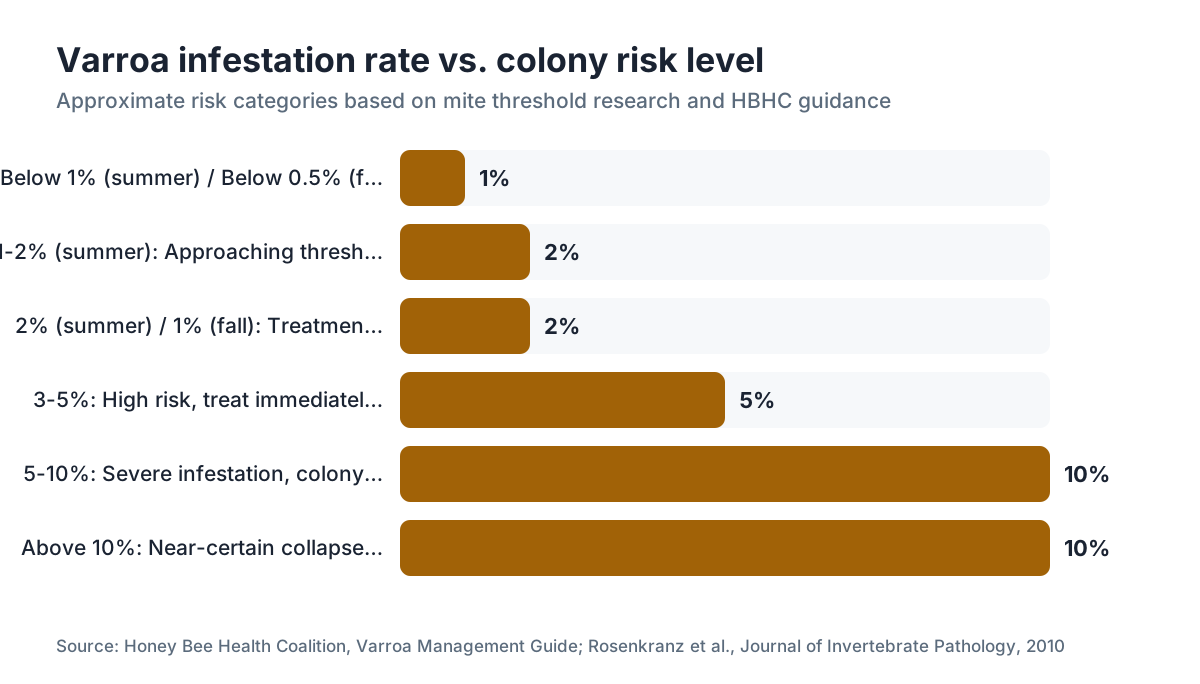
Here honest uncertainty is the only fair answer, because 'collapse' is not one event with a clean numeric trigger. The research does not hand us a precise death threshold the way a toxicology study hands you an LD50. What the literature shows is a probability curve: higher mite loads make decline, dwindling, and death progressively more likely, and the curve steepens sharply above certain levels.
Studies tracking untreated colonies in Europe and North America show that sustained infestation above 5 to 6% collapses within one to two brood cycles in most cases [5]. Above 10%, collapse is nearly certain and usually fast. Below 2%, a healthy colony with good genetics can sometimes hold its own mite population down through hygienic behavior or brood breaks, but that's not reliable enough to bank on.
The hard part is that damage runs weeks ahead of visible collapse. DWV titers start climbing while mite levels are still at 1 to 2%, and by the time you spot bees with crumpled wings on the landing board, the viral load has been compounding for weeks or months [3]. The dying bees you see are the symptom. The real harm happened in the brood earlier. That's why waiting for clinical signs is almost always waiting too long.
Ryabov and colleagues, writing in PLOS Pathogens in 2014, found that varroa-mediated transmission selects for a virulent DWV strain that dominates the colony's viral population [3]. Later colony-mortality work builds on the same theme: two colonies both sitting at 1.5% mites in October can meet very different ends depending on what their mite history looked like back in July and August.
There's also a population-dynamics trap. A mite population growing at roughly 35 to 50% per month (a common modeling estimate) inside a shrinking fall colony is geometrically worse than the same growth rate inside a booming spring colony [5]. The colony's power to dilute the mite load with fresh healthy bees fades right as the mite population peaks. That's the 'mite bomb' dynamic that flattens colonies in September and October.
How fast can mite populations grow inside a hive?
Fast. New beekeepers picture mites as a slow, creeping problem, and that picture gets colonies killed. Under good reproductive conditions, a varroa population roughly doubles every 30 to 40 days during peak brood season [5][6]. Start with a seemingly harmless 100 mites in early June, add no treatment and no brood interruption, and you can reach 800 to 1,200 mites by late August. On a colony that shrank from 60,000 bees to 30,000, that's an infestation rate above 3% from a starting point that felt fine.
Varroa's reproductive rate turns on a few things. Mites strongly prefer drone brood over worker brood, roughly 8 to 1 in attraction [6]. Drone cells stay capped longer (24 days versus 12 for workers), so a foundress mite gets more time to raise offspring. A single founding mite in a worker cell produces about 1.2 to 1.5 daughters per cycle. In a drone cell, that climbs to around 2.6 [6]. Colonies raising heavy drone brood in spring can see their mite numbers spike earlier than colonies that don't.
Cutting out capped drone brood works modestly as one non-chemical suppression tool inside a broader plan, but it does not replace monitoring and treatment once thresholds are crossed [1].
Do some bee genetics tolerate mites better than others?
Yes, meaningfully. Varroa-resistant and varroa-tolerant honey bee stocks exist and have been bred seriously for decades. The main traits tied to lower mite impact are Suppressed Mite Reproduction (SMR, also called Varroa Sensitive Hygiene or VSH), where bees detect and pull out mite-infested capped cells, plus hygienic behavior more broadly [7].
Colonies with strong VSH can hold mite populations below treatment thresholds without intervention under some conditions. USDA-ARS research at the Baton Rouge lab has documented VSH bees keeping mite levels under 1% for whole seasons in field trials with no treatment, which conventional stock simply cannot do [7]. A few caveats, though. Pure VSH stock is hard to hold in open-mating settings, because queens mate with local drones and dilute the trait. Commercial VSH queens are for sale but vary in how strongly the trait shows up, depending on which drones mated with them. And even VSH colonies need monitoring. The trait is not absolute.
Russian honey bees, another USDA-developed line, show moderate mite tolerance through both VSH and a habit of cutting brood rearing during low nectar flow, which interrupts the mite's reproductive cycle [7]. They're also harder for beginners to manage because their behavior runs different.
For most hobbyist and sideliner beekeepers on locally adapted stock, mite-tolerant genetics are a useful tool, not a substitute for monitoring and treatment. Treat them as a way to raise your colony's baseline resilience, not a way to stop managing mites.
What happens to a colony between the threshold and collapse?
The decline is quiet until it isn't. A colony crossing 2% doesn't start visibly struggling. The first changes are invisible: virus loads climb, individual bee lifespan shortens, forager recruitment drops, and immune competence falls [3]. From the outside the hive looks fine. Maybe a touch less busy than your best colony. Nothing alarming.
Over the next four to eight weeks the population shrinks faster than it should. The queen keeps laying, but fewer larvae reach healthy adulthood, and the adults that do emerge live shorter lives. You might notice spotty brood, a few bees with shriveled wings out front, or a small dip in honey stores. Those are late-stage signs.
By the time most beekeepers notice trouble, the colony sits at 5 to 8% infestation or higher. Treatment can still save it if you do it right and the population hasn't dropped below a viable floor of roughly 10,000 to 15,000 adult bees. Below that floor, the colony usually can't hold brood temperature, feed larvae well, or fend off robbers from neighboring hives, which may themselves be mite-loaded.
Robbing is one of the ways mites move between colonies. A collapsing, mite-heavy colony gets robbed out by neighbors who carry mites home. That's why one varroa collapse in an apiary can drive mite loads up across all your colonies inside a few weeks [1].
Which varroa treatments work once you know your mite count is too high?
Treatment choice comes down to three things: current mite level, time of year, and whether honey supers are on the hive. Here's a working summary.
Oxalic acid (OA) is the most widely used treatment among hobbyists and sideliners. It comes as dribble, vaporization, and extended-release (glycerin-soaked strips). EPA-registered formulations demand exact label compliance; the Api-Bioxal label specifies dose, timing, and number of applications [8]. OA hits phoretic mites (the ones riding adult bees) but does little to mites inside capped brood. That's why a single winter dribble, when the colony is broodless or nearly so, works so well, while summer treatments need multiple rounds or vaporization [8].
Amitraz (Apivar strips) works right through the brood season because the active ingredient stays in the colony for six to eight weeks, killing mites as they emerge from cells [9]. Not approved with honey supers on. Amitraz resistance has been documented in some US populations, so rotating treatment modes is worth doing [9].
Formic acid (Formic Pro, Mite Away Quick Strips) kills mites inside capped brood, its big edge over OA. It can be used with supers on under specific label conditions. Temperature limits apply (not above 92 degrees F or below about 50 degrees F), which cuts its usefulness in hot climates or late fall [10].
Thymol products (Apiguard, ApiLife Var) work in moderate temperatures with supers off, best between roughly 60 and 105 degrees F [1].
Don't pick a treatment on price or convenience without checking the label requirements for your situation first. The EPA maintains registered product information, and most state departments of agriculture list approved treatments [8].
If you want help matching a treatment to your mite count and the calendar, VarroaVault's free protocol tools run the decision tree from your location, colony status, and monitoring results.
How does colony size affect mite tolerance?
A bigger colony tolerates a given mite count better than a small one, but the infestation rate (mites per 100 bees) already bakes in colony size, so in percentage terms the thresholds stay fairly consistent across sizes [1][4].
Size really shows up in recovery after treatment. A colony of 50,000 bees at 3% (1,500 mites) that gets treated well has the population to bounce back. A colony of 12,000 bees at 3% (360 mites) that gets treated can still dwindle, because it lacks the bees to hold brood temperature, regulate the nest, and rebuild all at once.
Nucs and splits are the most exposed. A 5-frame nuc with 10,000 bees can be pushed to a tipping point by a mite load a full colony would shrug off in the short term. Monitor nucs more often than production colonies, and treat at the low end of the threshold range.
A colony already collapsed under 10,000 bees from mites is a hard call. Treating a tiny October cluster rarely yields a colony that reaches April. Sometimes the right move is combining it with a stronger hive, treating the receiver colony first, and eating the loss of one queen. Not a pleasant decision. Better than dragging a dying colony through winter and losing both boxes.
What are the signs a colony is already collapsing from varroa?
The most visible late-stage sign is Deformed Wing Virus: shriveled, crumpled, or stub wings, usually on bees crawling on the landing board or in front of the hive rather than flying [3]. See more than a few of those on any inspection and your mite load is almost certainly well over threshold.
Other signs stack up. A shrinking adult population with no matching drop in brood area (bees dying faster than they emerge). A sudden fall in foraging on a good-weather day. Spotty or shotgun brood (which has other causes, but combined with the rest points at varroa stress). Bees with bloated abdomens or odd lethargy.
In the final stages you'll find very few adults covering the brood, a queen that may still be laying into near-empty cells, and sometimes small hive beetles or wax moths moving in because the colony can't defend itself anymore. At that point the colony is functionally finished regardless of treatment.
See these signs in fall and do a mite wash immediately. If the count is high, treat aggressively, combine the colony with a stronger one if the population is very low, and note the failure so you tighten monitoring next year. Don't skip treatment because the colony looks too weak to bother. An untreated collapsing colony is a mite reservoir that damages every other hive in your apiary through robbing and drifting bees.
How often should you monitor mites throughout the year?
The Honey Bee Health Coalition recommends monitoring at least once a month during the active season and stepping up to every two weeks in August and September [1]. That's a sound baseline. In practice, many experienced beekeepers monitor monthly March through July, every two weeks August through October, then do one last check before the colony settles into its winter cluster.
A monitoring log earns its keep. A single count tells you where you are today. A series of counts over weeks tells you whether the mite population is growing, holding, or falling. A colony at 1.5% in June that was 0.5% in May is climbing fast and may need attention sooner than a colony sitting at 1.5% that read 1.8% two weeks back after a treatment.
Some beekeepers run sticky boards for trend monitoring between formal alcohol washes, which is fine as a supplement. A natural mite drop above 10 to 15 mites per day on a sticky board (with no treatment confounding it) is a rough flag for a population worth watching closely, though the rule of thumb has wide variance and should never replace a wash [4].
Keep your monitoring data somewhere you'll actually revisit. Paper notebook, spreadsheet, or a purpose-built tool like the monitoring tracker at VarroaVault. The point is a record you can look back at when fall treatment decisions come due.
Can a colony recover from high mite loads on its own without treatment?
Rarely, and not reliably enough to bet on. The only scenarios where untreated colonies have shown sustained low mite levels are colonies with strong VSH or hygienic genetics, colonies that hit a natural extended broodless period (like a swarm that lost its queen for a stretch), and isolated colonies with no mite immigration from neighbors [7].
For most managed colonies in an apiary, the honest answer is no. Mite immigration from neighboring colonies is constant pressure, worst in late summer when other colonies are collapsing and their mites scatter through robbing and drifting bees [5]. Even a colony that manages its own mites reasonably well can get shoved over threshold by imported mites from next door.
The 'let them die and see who survives' approach has been tried in research settings, and it produces exactly what you'd expect: high mortality in the first year or two, with survivors that sometimes (not always) carry trait profiles that cope better [5]. Even its advocates admit it needs isolation, large starting numbers, and a willingness to lose most of the bees. For a hobbyist with four to twenty hives, it's not a workable strategy.
Treat based on monitoring. That's the clearest takeaway from 30 years of varroa research in managed honey bee populations.
Frequently asked questions
What is the mite threshold for treating a colony in summer?
The widely used summer threshold is 2 mites per 100 adult bees, a 2% infestation rate measured by alcohol wash. The number comes from the Honey Bee Health Coalition's Varroa Management Guide and is backed by university extension programs. Above 2%, mite populations usually outpace the colony's ability to compensate with new healthy bees, and treatment is recommended before the problem compounds.
Is the mite threshold different in fall versus summer?
Yes. Most extension services and the Honey Bee Health Coalition recommend dropping the action threshold to 1% in late summer and fall, roughly August onward. The reason is winter bee production: mite-damaged bees raised in that window cannot survive winter adequately, and the damage is locked in once those bees are capped. Catching a 1% load in August leaves time to treat before the winter bee cohort is at risk.
How many mites in a 300-bee sample means I need to treat?
Six or more mites in a 300-bee alcohol wash equals a 2% infestation rate and triggers treatment under summer thresholds. From August through October, three or more mites (1%) is the recommended action point. Always do the math: count your actual mites, count or estimate your bees, and calculate the percentage rather than leaning on a fixed mite count that ignores sample size.
Can a colony with a 5% mite infestation survive?
Possibly, if treated immediately and aggressively while the adult population is still large enough to sustain a brood nest. But 5% is well past the safety margin, and colonies there have already taken significant viral damage. Recovery is possible, not guaranteed, and winter survival odds drop sharply even after successful treatment if the load reached 5% during the late summer window.
How quickly can varroa mite populations grow inside a hive?
Under peak brood conditions, a varroa population doubles roughly every 30 to 40 days. A colony with 100 mites in June could reasonably reach 800 to 1,200 mites by late August with no intervention. Growth speeds up when drone brood is available, because drone cells stay capped longer and give mites more reproductive cycles. That's why monthly monitoring is the floor and two-week checks in late summer are strongly recommended.
What is the difference between a treatment threshold and a tolerance threshold?
A treatment threshold is the point where you act to prevent serious damage. A tolerance threshold would be the point where a colony genuinely can't survive, which is higher but far less predictable and heavily season-dependent. Waiting for the tolerance threshold means waiting until the colony is already badly damaged. The 2% treatment threshold exists precisely because it precedes the tolerance limit by enough time to intervene effectively.
Does the time of year affect how much damage mites cause at the same percentage?
Significantly. The same 1.5% mite level does far more harm in August than in May because of the winter bee problem. Mites infesting brood in late summer produce DWV-damaged bees that were supposed to carry the colony through winter. Those bees are compromised and die early, leaving the winter cluster too small to survive. A 1.5% load in May is a problem to monitor; the same load in September may already be too late to fix winter.
Can I rely on powdered sugar rolls instead of alcohol wash to check mite levels?
Not for threshold decisions. Sugar rolls undercount mites by roughly 20 to 40% against alcohol wash, because mites grip bees harder without a solvent to release them. Sugar rolls confirm that mites are present and give a rough trend, but if you're deciding whether to treat, an alcohol wash is the right tool. Using a sugar roll to spare bees can mean missing a treatment window that costs the whole colony.
How do mites spread from a collapsing colony to healthy hives?
Mostly through robbing and bee drift. When a colony weakens from a high mite load, it can't defend its entrance from robbers. Bees from other hives enter, steal honey, and leave carrying varroa on their bodies. Those mites then reproduce in the robbing colony. Drifting bees (workers returning to the wrong hive) carry mites too. That's why a collapsing, untreated colony is an active threat to every other hive on the property.
What mite levels are found in colonies that die over winter?
Post-mortem analyses of winter-dead colonies consistently show high mite infestation rates. A common pattern in US and European survey data is that colonies dead by spring frequently had fall mite counts well above 3 to 5%, though the relationship is probabilistic, not a clean cutoff. Even colonies that died with apparently moderate fall counts often carried high mite loads earlier in the season that damaged the winter bee cohort before the final count.
Are there bee breeds that tolerate higher mite loads without collapsing?
Yes. Bees with Varroa Sensitive Hygiene (VSH), developed through USDA-ARS breeding programs, detect and remove mite-infested cells and keep mite populations low without chemicals under some conditions. Russian honey bees show moderate tolerance through similar mechanisms plus reduced brood rearing during dearth. Neither trait removes the need for monitoring, and trait expression fades in open-mating environments where queens mate with non-VSH drones.
How do I know if it is too late to save a colony with high mite levels?
If the adult population has dropped below roughly 10,000 to 15,000 bees, the colony can't reliably hold brood temperature, feed larvae, or defend against robbing, and treatment alone rarely saves it. Visible signs like large numbers of deformed-wing bees, a badly shrunken cluster, and abandoned brood frames are late-stage indicators. At that point, combining the remaining bees with a stronger hive after treating both is often the most practical option.
How does a broodless period affect mite treatment effectiveness?
It makes oxalic acid dramatically more effective. OA kills mites on adult bees but not inside capped cells. During the winter broodless period, all mites are phoretic, and a single OA dribble or vaporization can hit 90 to 95% mite kill or better. During the brood season, only 15 to 30% of mites are phoretic at any moment; the rest sit protected in capped cells, which is why multiple treatments or longer products like Apivar are needed.
Should I treat a nuc or split at a lower mite threshold than a full colony?
In practice, yes. Nucs and splits have smaller populations and less buffer against mite-driven decline. A 1.5% infestation in a 5-frame nuc warrants immediate attention even though the same rate in a full production colony might still sit within summer tolerance. Monitor nucs every two weeks during the active season and treat at the low end of the threshold range to account for their reduced resilience.
Sources
- Honey Bee Health Coalition, Varroa Management Guide (current edition): Treatment threshold of 2 mites per 100 bees during honey production season; 1% threshold recommended in late summer and fall; monthly monitoring minimum recommendation
- Purdue University Extension, Apiculture Program: Recommendation to increase monitoring frequency to every two weeks in August and September due to rapid mite population doubling potential
- Ryabov et al., 'A virulent strain of deformed wing virus (DWV) of honey bees (Apis mellifera) prevails after Varroa destructor-mediated, or in vitro, transmission', PLOS Pathogens, 2014: Deformed Wing Virus damages fat bodies and hypopharyngeal glands in developing bees; varroa-mediated transmission selects for a virulent DWV strain that dominates the colony's viral population
- Oregon State University Extension, Sampling Bees for Varroa Mites: Alcohol wash described as most accurate monitoring method; sugar rolls undercount mites by 20-40% compared to alcohol wash; 300-bee sample statistically adequate for threshold decisions
- Seeley, T.D. and Smith, M.L., 'Crowding honeybee colonies in apiaries can increase their vulnerability to the deadly ectoparasite Varroa destructor', Apidologie, 2015: Mite immigration from collapsing colonies via robbing and drifting is a continuous pressure in apiaries; untreated colony trials result in high mortality in the first one to two years
- Rosenkranz, P., Aumeier, P., and Ziegelmann, B., 'Biology and control of Varroa destructor', Journal of Invertebrate Pathology, 2010: Mites prefer drone brood at roughly 8:1 ratio; foundress mite averages 1.2-1.5 daughters per worker cell cycle, 2.6 per drone cell cycle; varroa population can roughly double in 30-40 days during peak brood season
- USDA-ARS Bee Research Laboratory, Varroa Sensitive Hygiene (VSH) breeding program: VSH bees can maintain mite levels below 1% for entire seasons in field trials without treatment; Russian honey bees show moderate tolerance through VSH and reduced brood rearing behavior
- U.S. Environmental Protection Agency, Pesticide Product Label System, Api-Bioxal (oxalic acid) label: EPA-registered oxalic acid formulations require label compliance for dose, timing, and number of applications; effective on phoretic mites; label specifies approved application methods
- U.S. Environmental Protection Agency, Pesticide Product Label System, Apivar (amitraz) label: Amitraz strips remain active for 6-8 weeks; not approved for use with honey supers; amitraz resistance documented in some US varroa populations
- U.S. Environmental Protection Agency, Pesticide Product Label System, Formic Pro (formic acid) label: Formic acid kills mites in capped brood; temperature restrictions apply (not above 92°F or below approximately 50°F); can be used with honey supers under specific label conditions
- University of Minnesota Extension, Honey Bee Research and Extension Lab, Varroa Management: Practical guidance on treatment thresholds by season and colony type for upper Midwest beekeepers; monitoring frequency recommendations
- Pennsylvania State University Extension, Varroa Mite Management: Treatment threshold guidance and seasonal monitoring protocols for eastern US beekeepers; sticky board interpretation limitations noted
Last updated 2026-07-09