How many mites in a hive before you see symptoms
TL;DR
- Most colonies show nothing obvious until varroa hits roughly 2-3% of the adult bee population, which is about 500-1,000 mites in an average summer colony.
- By then the viral damage is already stacking up.
- The Honey Bee Health Coalition says treat at 2% in summer and 1% before the winter cluster forms, well before any symptom shows up.
What mite level actually causes visible symptoms?
You almost never see obvious symptoms before the infestation is already serious. That's the honest answer. Varroa mites hurt bees mostly by carrying viruses, especially Deformed Wing Virus (DWV), and that damage shows up on adult bees that have already left their cells. By the time a crumpled-wing bee crawls across your landing board, the colony has been building viral load for weeks or months.
Symptoms become reliably visible somewhere around 2-3% infestation on adult bees [1]. In a summer colony of 40,000-60,000 bees, that's 800 to 1,800 mites riding adults alone, plus several times more reproducing inside capped brood. That is a big infestation. Waiting for symptoms before you treat is, bluntly, waiting too long.
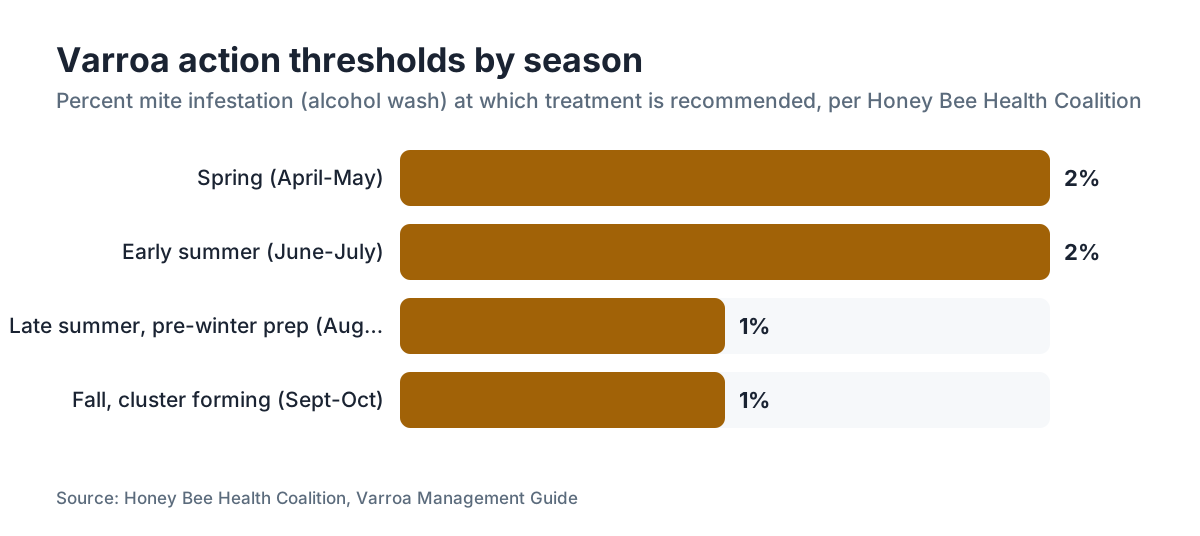
The Honey Bee Health Coalition's Varroa Management Guide sets the economic injury threshold for summer colonies (roughly May through August) at 2% mites per adult bee on an alcohol wash or sugar roll [1]. The winter prep threshold is lower: 1% or higher by late summer (around August across most of the continental US) is the point to treat before the colony raises its winter cluster [1]. Those are action thresholds, not symptom thresholds. The whole point is to move before you can see the problem.
Why don't you see symptoms at lower mite counts?
Below about 1-2%, a healthy colony absorbs the hit. Hygienic behavior in some colonies suppresses mite reproduction in brood [2]. The bees' immune response handles a share of the viral exposure. Worker turnover in summer runs fast enough that badly parasitized bees die and get replaced before anything looks wrong. You notice nothing.
Above 2%, the math turns against the colony hard. Mite populations can double every month under good conditions [3]. A 2% load in July becomes 4% in August and a dead-out in October. That exponential curve is why bee scientists and extension services keep pushing monitoring instead of symptom-watching.
Virology makes it worse. Mites suppress bee immune function directly and inject DWV while feeding on developing pupae [4]. A single mite feeding during the pupal stage can produce an adult with crippled wings, a shortened abdomen, and a cut-short lifespan. So the deformed bee you spot in August reflects an infection that happened in the capped cell three weeks earlier, back when mite counts were lower. You are always looking backward.
What are the actual visible symptoms of a high varroa load?
Deformed wing bees are the clearest sign. These adults emerge with wings crumpled, stunted, or held at odd angles. They can't fly. You'll sometimes find them crawling in the grass out front. Spot more than two or three on a single inspection and your mite load is almost certainly above 3% [4].
Other signs:
- Spotty, sunken, or discolored cappings on brood (this can also point to other diseases)
- Shrunken, pale pupae or larvae when you uncap suspicious cells
- Bees with stubby, shortened abdomens
- A colony dwindling in late summer when it should still be building
- Heavy winter loss with dead bees scattered across the combs and stuffed headfirst into cells, a classic starvation-after-collapse pattern that often started with varroa
None of these are early warnings. They confirm damage that's already done. Spotty brood trips up new beekeepers most: they assume American Foulbrood or a failing queen, when in a high-mite colony it usually means varroa killing pupae after capping. The only way to know your mite load is to count mites.
How do you measure mite levels before symptoms appear?
Three methods do the job: alcohol wash, sugar roll, and sticky board. The alcohol wash gives you the most reliable percent infestation figure [1].
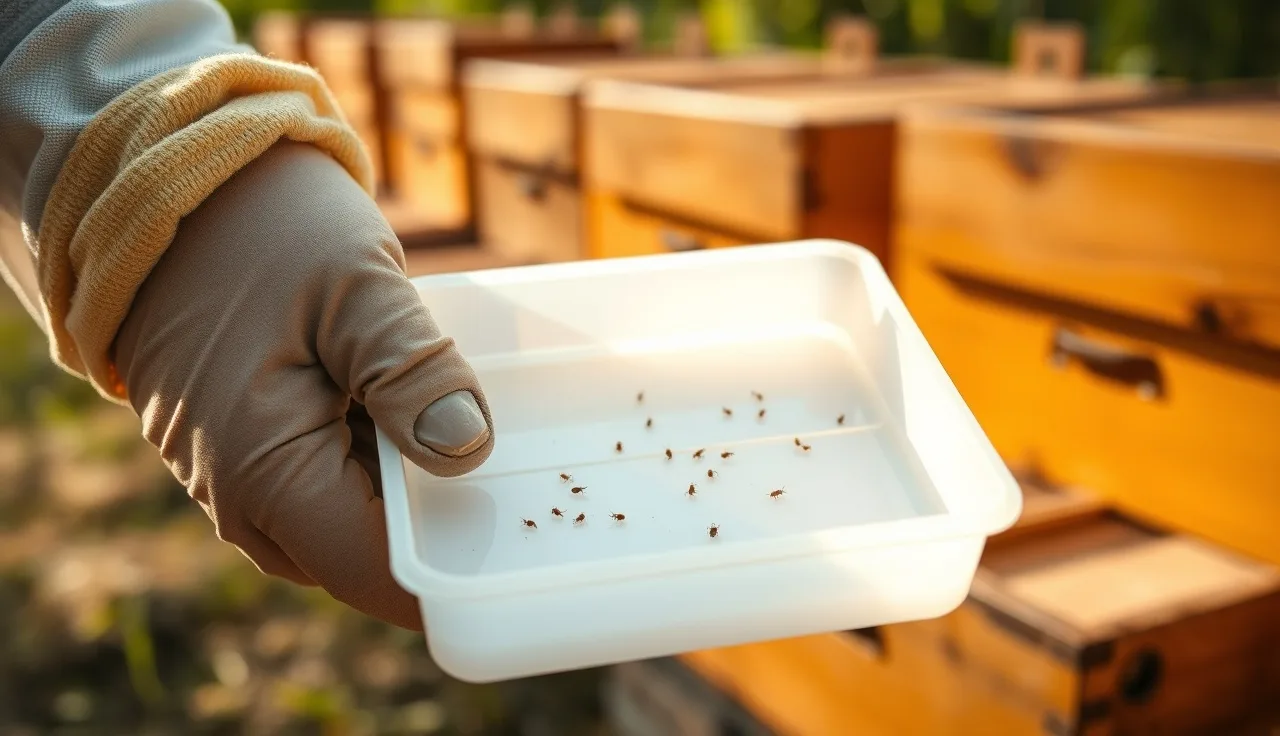
Alcohol wash: Scoop about 300 adult bees (roughly half a cup) from the brood nest, never from a honey super. Shake them into a jar with 70% isopropyl alcohol, agitate for 30-60 seconds, then pour through a mesh screen into a white tray. Count the mites and divide by the bees. Nine mites from a 300-bee sample is 3%. University of Minnesota Extension favors this over the sugar roll because it's more accurate: sugar rolls can undercount mites by 30-40% [5].
Sugar roll: Same sample size, same math, but powdered sugar instead of alcohol, and the bees live. Less accurate, but handy if you can't stomach sacrificing 300 bees. A 40,000-bee colony can spare them easily, so most experienced beekeepers just use alcohol.
Sticky boards: Slide a screened bottom board insert in for 24-72 hours and count the mite fall. Turning that daily drop into a percent infestation needs conversion factors that shift with season, colony size, and brood area, and the variance runs wide [1]. Sticky boards track a trend (going up or down?) better than they hit a precise threshold.
Monitor at least four times a year: late spring, midsummer, late summer (August is the window that matters most), and after any fall treatment [1]. Plenty of beekeepers with more than a handful of colonies wash every 3-4 weeks during build-up season. If you'd rather follow a set calendar than juggle the math yourself, the free tools at VarroaVault are built around this exact workflow.
For the biology behind these numbers, the varroa mite article on this site walks through the mite's reproductive cycle.
What's the research basis for the 2% and 1% thresholds?
These numbers come from decades of field research, first out of European studies in the 1990s and 2000s and confirmed by North American work since. The Honey Bee Health Coalition pulls its Varroa Management Guide from peer-reviewed literature and practitioner data, and sets these as the consensus action thresholds [1].
The framing traces back to colony-level damage studies: colonies that enter winter above 2% mites show much higher mortality by spring [6]. The threshold isn't where symptoms show up, it's the highest load a colony reliably survives winter from. Treat it as a tolerance limit, not a symptom cue.
The Honey Bee Health Coalition's guidance puts it plainly: "Colonies with more than 2% mites (2 mites per 100 bees) in the brood nest in summer months... are at significant risk and should be treated" [1]. That is a direct quote, and it's the clearest operational line you'll find from a consensus body.
Nobody has a precise figure for the exact mite count where the first deformed bee appears. Pinning that down would mean knowing each colony's viral pre-load, the specific DWV strains present, the degree of hygienic behavior, and the temperature during pupal development. The 2% threshold is derived from population outcomes, not symptoms. It's the point past which colony survival data turns bad [6].
How fast do mite populations grow from low to symptomatic levels?
In summer with a big brood nest, varroa can double every 2-4 weeks [3]. The rate rides on how much sealed brood is around (more brood, faster mite reproduction) and the temperature.
Here's the concrete version. A 1% infestation in a 50,000-bee colony is roughly 500 mites. At a two-week doubling time, that's 1,000 mites in two weeks and 2,000 in four. Now the colony starts sliding into fall (fewer bees, same or more mites), so that 2,000-mite load quickly reads as a 4-5% infestation as the denominator shrinks.
This is the mite bomb dynamic that kills so many colonies in October. The bees looked fine in July. Nobody was sampling. By September the colony was too weak to raise a winter cluster.
Winter bees are the crux. Bees raised in September and October have to live until March or April. Raise them in cells with mites reproducing inside and their fat bodies come out depleted and their lifespans clipped. A colony can look healthy from the outside in October and still fail by January because the long-lived winter bees were compromised during development.
Does colony size change when symptoms appear?
Yes, a lot. A big summer colony of 60,000 bees can carry a 1.5-2% mite load and still look vigorous, because there are enough healthy bees to cover for the damaged ones. That same absolute count (say 900 mites) in a 15,000-bee fall colony is a 6% infestation, and it shows symptoms plainly.
This is why percent infestation, not raw mite count, is the metric that matters. It's also why the summer-to-fall transition is so dangerous. As the colony naturally shrinks after its summer peak, the infestation percentage climbs even when the actual mite population is growing slowly or holding flat.
A package or nuc set up in spring starts with very low mite counts, sometimes zero if the source was treated well. But those colonies have no cushion. The mite population builds through that first summer, and with no monitoring, first-year beekeepers often lose the colony the next winter without ever knowing why.
What do mites look like on bees, and can you see them without tools?
Adult female varroa mites are reddish-brown, oval, and about 1.5mm wide by 1.1mm long [7]. They're visible to the naked eye if you know the shape, roughly a sesame seed. On a dark bee, spotting one is reasonable. On a bee dusted with pollen, they hide.
At low infestation you will not casually notice them during a routine inspection. At 1%, one bee in a hundred carries a mite, and mites often tuck under the thorax or along the abdomen where you're not looking. You'd have to examine individual bees carefully to find them.
At 4-5%, they start showing up during inspection. Look at bees on the comb face under direct light, especially nurse bees around open brood. Still, this never replaces measuring. "I didn't see any mites on inspection" is not evidence of a clean colony.
Uncapping drone brood is a decent informal check. Varroa prefer drone brood, infesting it 5-8 times more often than worker brood because the longer capping time buys more reproductive cycles [8]. Pull capped drone cells with an uncapping fork and look at the pupae. Reddish-brown oval shapes in the cell mean mites. If every third or fourth drone cell has them, you likely have a real infestation. This detects presence well. It won't give you a number.
When should you treat regardless of what you can see?
Treat when your alcohol wash hits 2% from spring through late summer, or 1% from late summer through fall. Those are the Honey Bee Health Coalition consensus thresholds [1]. Don't wait for symptoms.
In a region with heavy mite pressure where you skipped the previous fall treatment, treat in early spring no matter what your wash says. A colony that limped through winter with an untreated fall load may show low adult mite counts in March simply because the mite population crashed alongside the bees. The percentage can read fine while the absolute numbers are still high enough to blow up once brood-rearing restarts.
Timing has hard constraints. Temperature matters (oxalic acid vaporization wants no capped brood, and label temperatures vary by product [9]). Honey supers matter (most organic acids and synthetic miticides can't go on with supers in place [9]). Local resistance matters. The EPA registers several active ingredients for varroa control in the US, with oxalic acid, formic acid, thymol, amitraz, and fluvalinate as the main ones [9]. Each carries label requirements that are legally binding. Read the label and follow it.
For the full treatment breakdown, the varroa mite article covers each option with timing and efficacy data.
Can a colony recover from a high mite load on its own?
Rarely, and not reliably. Some colonies with strong hygienic or VSH (Varroa Sensitive Hygiene) genetics suppress mite reproduction enough to hold populations below damaging levels without help [2]. Researchers have documented colonies in isolated populations (notably Gotland Island in Sweden and some feral colonies in Europe) holding stable low mite loads with no treatment [10].
But for a managed colony with typical genetics in a populated beekeeping area, betting on self-recovery from a 3%+ infestation is a bad bet. Viral damage stacks up. The winter bee cohort is already compromised. Even if a colony knocks its mite population down through natural attrition, the bees carrying it through winter were raised in high-mite conditions.
Some beekeepers run brood breaks (caging or removing the queen for 3-4 weeks to clear all capped brood) to break the mite reproductive cycle and make oxalic acid work better. That works. It's a management move, though, not natural recovery. The colony succeeds because you interrupted the mite's life cycle.
Short version: don't count on natural recovery. Monitor and treat.
How do beekeeper-caused delays worsen symptom timing?
Most varroa collapses follow the same script, and it always includes a monitoring gap. The beekeeper inspects in June, the colony looks strong, no sample gets taken. Mites build through July and August. By September the symptoms are here: patchy brood, dwindling numbers, deformed bees. Treatment now might save the colony or might not, depending on the shape of the winter bee cohort already being raised.
The delay costs the most in the August-September window. That's when the winter cluster bees are raised, and it's when mite populations usually peak in temperate climates [3]. Treat in August, before brood cappings seal in the next mite generation, and you give yourself the best shot at clean winter bees. Treat in October, when the symptoms are obvious, and you're treating bees already compromised during development.
Buying beekeeping supplies for a new season? Get an alcohol wash kit (a jar, some rubbing alcohol, a mesh strainer) before you spend on anything else. It's cheap and it's the single most useful diagnostic tool in varroa management.
New beekeepers should also check free shipping honey bee supply companies for monitoring and treatment supplies, since materials add up fast once you're running several colonies.
What's a realistic mite monitoring and action plan for a hobbyist?
Here's what works for most hobbyists running 1-10 hives.
Spring (April-May): Alcohol wash every colony. Anything above 1% gets treated right away. Write down your baseline.
Early summer (June-July): Wash again. Above 2% means treat now, before honey supers go on or after they come off. Don't skip this if June ran warm.
Late summer (August): Your most important wash of the year. Above 1% here warrants treatment before winter bees are raised. This one wash probably saves more colonies than any other single move.
Post-treatment (3-4 weeks after treatment ends): Verify with another wash. A working treatment shows a clear drop. Still at or above threshold? Switch active ingredients (resistance is real, especially fluvalinate and coumaphos in some regions [11]).
The free protocol tools at VarroaVault run you through this calendar with threshold reminders and do the percent infestation math from your raw wash counts. The arithmetic isn't hard, but building it into a workflow means you don't skip it during a busy summer.
For a connected read on what your bees are actually up against biologically, see the varroa mite overview.
Frequently asked questions
How many mites is too many in a beehive?
Any count at or above 2% on an adult bee alcohol wash during summer (May through August) is too many and warrants immediate treatment, per Honey Bee Health Coalition guidelines. Before winter cluster formation in late summer, the threshold drops to 1%. In a 50,000-bee colony, 2% equals roughly 1,000 mites on adult bees alone, with far more in capped brood.
Can you see varroa mites without a microscope?
Yes. Adult female varroa mites are about 1.5mm wide, roughly the size of a sesame seed, and reddish-brown. You can see them on bees with the naked eye if you look closely under good light, especially on the thorax or abdomen. You won't reliably notice them during casual inspection at low mite counts, though. An alcohol wash is the only way to get an accurate count.
What do deformed wing bees look like?
Bees with Deformed Wing Virus, carried by varroa, emerge with wings that are shriveled, crumpled, or held at an unnatural angle. They're often smaller than normal bees, with shortened abdomens. They can't fly and usually die within days. Spotting even a few per inspection is a red flag for elevated mite loads, almost certainly above 2-3% by the time visible cases appear.
How often should you check mite levels in a hive?
At minimum four times a year: spring, early summer, late summer (August is the window that matters), and 3-4 weeks after any treatment to verify it worked. Beekeepers running multiple hives or sitting in high mite-pressure areas often wash every 3-4 weeks during the active season. The Honey Bee Health Coalition recommends at least monthly monitoring during peak brood-rearing season.
Is the sugar roll as accurate as the alcohol wash for counting mites?
No. University of Minnesota research and other field studies show sugar rolls can undercount mites by 30-40% compared to the alcohol wash. Sugar tends to clump around mites without dislodging them all, while alcohol plus agitation releases them more completely. Sugar rolls beat nothing and let the bees live, but the alcohol wash is the standard for a reliable percent infestation figure.
What's the difference between mite count and mite infestation percentage?
Mite count is the raw number of mites in a sample. Percent infestation is mites divided by bees in that sample, times 100. Percent infestation drives treatment decisions because it accounts for colony size. Nine mites in a 300-bee wash is 3% whether the colony holds 30,000 or 60,000 total bees, and 3% triggers treatment.
Do varroa mites kill bees directly, or is it the viruses they carry?
Both, but viruses do most of the damage. Varroa mites feed on developing bee fat bodies and hemolymph, which weakens individual bees and suppresses immune function. Far more damaging is their role as vectors for Deformed Wing Virus and other bee viruses. A mite feeding during the pupal stage injects viral particles that cause deformities and a dramatically shortened adult lifespan, collapsing colony population over time.
Will a colony die if you don't treat for varroa?
In most managed beekeeping situations, yes, within 2-3 years. Studies of untreated colonies in North America and Europe consistently show collapse inside that window. Rare exceptions exist in isolated populations selected over many generations for varroa resistance, but typical commercial or hobbyist stock lacks that selection history. Annual monitoring and timely treatment is the practical standard of care.
What mite level should you have going into winter?
Below 1% by late summer, ideally before September across most of the continental US. The Honey Bee Health Coalition recommends treating at 1% or above during late summer to protect the winter bee cohort. Winter bees raised in August and September need to survive 5-6 months; if those bees developed in mite-infested cells, their fat bodies are depleted and winter survival drops sharply.
How do you count mites in a hive with no brood (after a brood break)?
A broodless period is ideal for treatment because all mites ride adult bees instead of hiding in capped cells. An alcohol wash is still the right method. With no brood, oxalic acid dribble or vaporization is highly effective since nearly 100% of mites are exposed. Efficacy from a single oxalic acid treatment during a brood break can top 95%, per university and EPA label data.
Can you tell by looking at the brood pattern that mites are high?
Sometimes, but not reliably in the early stages. Spotty or sunken cappings, discolored pupae in uncapped cells, and deformed-wing bees emerging from brood frames all link to high mite loads. But these signs appear after significant damage. Spotty brood also suggests American Foulbrood, sacbrood, or poor queen genetics, so visual diagnosis alone can't confirm a mite problem.
Are some bee breeds more resistant to varroa?
Yes. Bees selected for VSH (Varroa Sensitive Hygiene) behavior detect and remove mite-infested pupae, slowing mite reproduction significantly. Russian honey bees also show some varroa tolerance. Even VSH colonies need monitoring, though: they slow mite growth but usually don't wipe mites out entirely. Most hobbyist stock in the US is Italian or Carniolan with limited hygienic selection.
What's the earliest stage in a colony's development when varroa becomes a problem?
A package or nuc installed in spring starts with low or zero mites if sourced responsibly. But mite buildup begins the moment the queen lays brood. By mid-summer of year one, a colony can hit the 2% threshold if it came from mite-carrying stock or picked up mites from drifting bees. Monitor first-year colonies starting 6-8 weeks after installation.
Sources
- Honey Bee Health Coalition, Varroa Management Guide (current edition): Action thresholds of 2% in summer and 1% in late summer before winter; alcohol wash methodology and monitoring frequency recommendations
- USDA Agricultural Research Service, Bee Research Laboratory: VSH (Varroa Sensitive Hygiene) bee genetics and their capacity to suppress varroa reproduction in capped brood
- Penn State Extension, Varroa Mite Management: Varroa population can double every 2-4 weeks under summer brood-rearing conditions; populations typically peak in late summer
- Nazzi, F. & Le Conte, Y. (2016). Ecology of Varroa destructor, the Major Ectoparasite of the Western Honey Bee. Annual Review of Entomology, 61, 417-432: Deformed Wing Virus vectored by varroa during pupal feeding; visible deformed wing bees associated with infestation rates of 2-3% and above
- University of Minnesota Extension, Varroa Mite Monitoring Methods: Alcohol wash is more accurate than sugar roll; sugar rolls can undercount mites by 30-40%
- vanEngelsdorp, D. et al. (2008). 'A Survey of Honey Bee Colony Losses in the U.S.' PLoS ONE 3(12): e4071: Colonies entering winter with mite loads above 2% show significantly higher mortality through to spring
- University of Florida IFAS Extension, Varroa Mite, ENY-168: Adult female varroa mite dimensions: approximately 1.5mm wide by 1.1mm long, reddish-brown
- Danka, R.G. et al. (2016). Varroa-resistance mechanisms in honey bees. Apidologie, as summarized in USDA ARS bee research: Varroa preferentially infests drone brood at rates 5-8 times higher than worker brood due to longer capping period
- US EPA, Pesticides: Varroa Mite Control: EPA-registered active ingredients for varroa control include oxalic acid, formic acid, thymol, amitraz, and fluvalinate; label requirements are legally binding
- Fries, I. et al. (2006). Survival of mite infested honey bee colonies in a Nordic climate. Apidologie 37, 564-571: Isolated Gotland Island colony population maintained stable low mite loads over multiple generations without treatment, attributed to natural selection
- Sammataro, D. et al. (2005). Resistance to fluvalinate and coumaphos in varroa mites. International Journal of Acarology 31(2), 119-125: Documented resistance to fluvalinate and coumaphos in varroa populations in several US regions
- Michigan State University Extension, Varroa Mite Sampling and Treatment Thresholds: August monitoring described as most critical sampling window; late summer treatment timing importance for protecting winter bee cohort
Last updated 2026-07-09