How to apply oxalic acid to bees: drip, vaporize, or extend
TL;DR
- Oxalic acid kills varroa on adult bees at roughly 90-95% efficacy when a colony is broodless.
- Apply it three ways: dribble a 3.5% sugar syrup solution at 5 mL per bee seam, vaporize 1 g of crystals per brood box, or place a glycerin-soaked extended-release strip.
- Each method has its own best season and brood-state requirement.
- Timing beats technique.
What is oxalic acid and why do beekeepers use it for varroa?
Oxalic acid (OA) is a natural organic acid found in rhubarb, spinach, and honey itself at low levels. Varroa destructor mites are vulnerable to it because the acid damages their cuticle and gut. Bees shrug it off at label doses. That gap is the whole reason it works.
The EPA registered oxalic acid for use on honey bee colonies under section 3 of FIFRA, and the label rules the day. Api-Bioxal is the only EPA-registered OA product for bees in the U.S., and its label is the law you have to follow [1]. You can buy Api-Bioxal from most beekeeping supply companies, and some run free shipping honey bee supply companies deals worth watching.
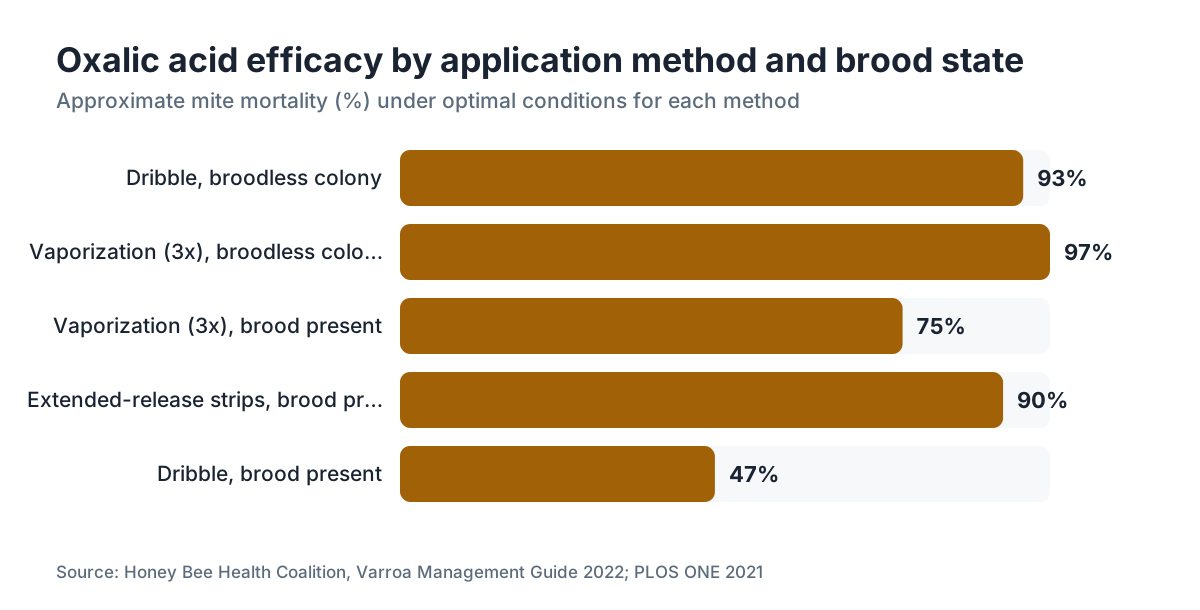
Here is the fact that governs everything else. OA kills mites riding on adult bees and does almost nothing to mites sealed inside capped brood cells. A broodless colony treated once by vapor or dribble can lose 90% or more of its mites. Run that same treatment on a colony packed with capped brood and you might cut the mite load by 40 to 50%, because the protected mites survive in their cells and pile back onto bees the moment they hatch [2].
What are the three approved methods for applying oxalic acid to bee colonies?
The Api-Bioxal label approves three application methods, each built for a different situation [1]. Dribble is cheapest to start. Vapor is fastest per hive once you own the gear. Extended-release strips are the only method that keeps working while brood is present.
Dribble (trickle): You mix a 3.5% oxalic acid solution in 1:1 sugar syrup and pour it between the frames right onto the bees. Best when the colony is broodless, usually mid-winter.
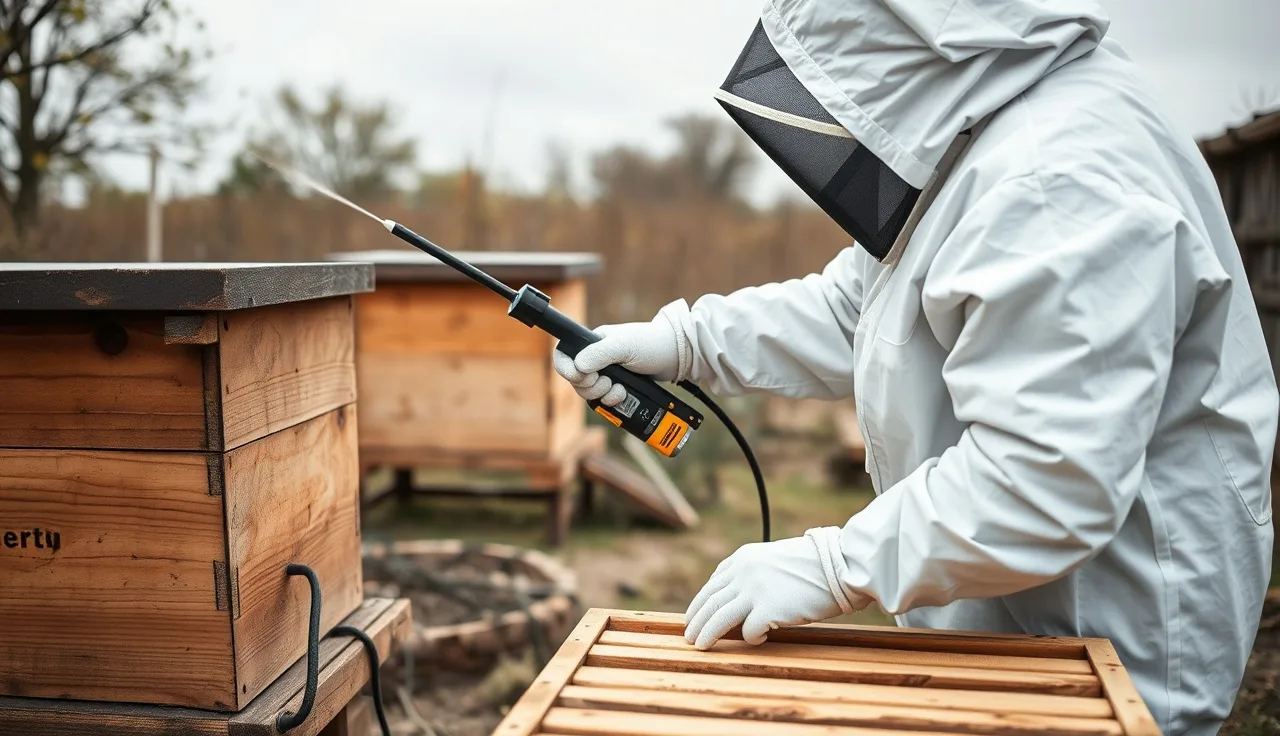
Vaporization (sublimation): Crystalline Api-Bioxal goes into a vaporizer wand and gets heated until it sublimates into a gas that coats every bee and surface. Works in winter, and the multi-dose schedule handles colonies that still carry some brood.
Extended-release (glycerin-soaked strips): Cellulose sponge material soaked in OA and glycerin sits between frames and releases acid over weeks. It reaches mites emerging from brood because bees keep contacting the strips day after day.
Here is how the three methods stack up.
| Method | Brood state needed | Active ingredient per hive | Treatments allowed | Efficacy (broodless) |
|---|---|---|---|---|
| Dribble | Broodless preferred | 5 mL per occupied seam, max 50 mL | 1 per year | ~90-95% [2] |
| Vaporization | Works with or without brood | 1 g per brood box, max 2 g total | 3 per year (at 5-day intervals) | ~95%+ broodless [3] |
| Extended-release strips | Works with brood present | Per strip count on label | 1 treatment (multiple strips) | ~90% over full course [4] |
None of these need a prescription. OA is over the counter. But you have to use the registered Api-Bioxal product, not raw bulk oxalic acid, which is not legal for bee treatment in the U.S. [1].
How do you mix oxalic acid for bees (dribble method)?
Dissolve 35 g of Api-Bioxal in 1 liter of 1:1 sugar syrup (one part sugar, one part water by weight). That gives you a 3.5% OA solution, which is the label formula [1]. Make the syrup, let it cool, then add the crystals. Weigh, do not eyeball.
Step by step:
- Make your 1:1 syrup first. Dissolve 500 g of table sugar into 500 mL of warm water. Let it cool to room temperature before adding OA.
- Weigh out 35 g of Api-Bioxal crystals on a kitchen or postal scale. Accuracy matters here. Guessing is how you kill bees.
- Stir the crystals into the cooled syrup until they fully dissolve. The solution should be clear. If it turns cloudy, the syrup is probably too cold. Warm it gently and stir again.
- Store any leftover solution in a sealed, labeled, non-food container out of reach of children and pets. The label sets a limited shelf life. Check your product label for the number.
The biggest mistake beekeepers make is mixing it too strong, figuring more acid means more dead mites. It does not. Overdosing kills bees and can harm queens. Stick to 35 g per liter, exactly [1].
Vaporization needs no mixing. You load dry Api-Bioxal crystals straight into the vaporizer cup. That is one reason vapor wins with people running a lot of hives.
How do you apply the oxalic acid dribble treatment to bees?
Dribble is the cheapest way in. You need the mixed solution, a 60 mL syringe or a purpose-built OA dribble applicator, and basic protective gear [3]. The whole job takes a couple of minutes per hive.
- Get the timing right. The colony should be broodless or close to it, and clustered. Across most of the U.S., that window runs late November through January. If you are in the South or working a late-fall swarm, confirm broodlessness by inspecting or by knowing your local seasonal pattern.
- Wear nitrile gloves and eye protection. OA is a moderate irritant. Goggles, not glasses.
- Pull the outer and inner covers. You do not need to pull frames. You just need to see the seams (the gaps between top bars) where bees are clustered.
- Dribble about 5 mL of solution into each occupied seam. A seam with bees visible in it counts. A gap with no bees gets nothing. Solution poured there does no good and the wetness chills the cluster.
- Max dose is 50 mL per colony, no matter the size [1]. A tight winter cluster on five or six frames might take 25 to 30 mL. A large colony across ten seams goes up to 50 mL.
- Put the covers back on fast to hold the cluster's heat.
- Dispose of leftover solution per label instructions. Do not pour it down a drain without checking local rules.
One dribble per year is the label limit. If your mite load is still high afterward, you switch methods or change your schedule. You do not dribble again [1].
How do you apply oxalic acid by vaporization?
Vaporization is faster per hive once you own the equipment, and it allows up to three treatments a year, which makes it more flexible than dribble for colonies that still carry brood. The Varrox wand and similar tools heat OA crystals to around 157°C (315°F), turning the solid straight into a gas that spreads through the hive [3].
Equipment you need: an EPA-registered vaporizer (battery or corded), Api-Bioxal crystals, a power source, nitrile gloves, a respirator (N95 at the absolute minimum, but a half-face respirator with organic vapor and P100 cartridges is what you actually want), eye protection, and tape or foam to seal hive entrances.
Procedure:
- Seal every hive opening except the bottom entrance. Tape any gaps between boxes to hold the vapor in.
- Measure 1 g of Api-Bioxal crystals per brood box. A single deep gets 1 g. A double deep gets 2 g. Never exceed 2 g per colony [1].
- Load the crystals into the vaporizer cup.
- Slide the wand in through the bottom entrance and keep it toward the center of the brood nest.
- Heat per the manufacturer's instructions. The Varrox wand usually takes 2.5 to 3 minutes to fully sublimate 1 g. Do not pull the wand until the crystals are gone. Pulling early dumps OA into the air around your face.
- Keep the entrance sealed for at least 10 minutes so the vapor settles onto the bees.
- Walk at least 10 feet upwind before you take off your respirator.
The label allows up to 3 vaporization treatments per year, spaced at least 5 days apart [1]. That schedule is built to catch mites that were sealed in brood during the first dose as they emerge over the following week. Treating a broodless colony? One pass is usually enough.
If you want the biology behind why capped-cell mites survive OA, read the varroa mite overview before you plan your schedule.
How does the extended-release oxalic acid strip method work?
Extended-release strips are cellulose pads soaked in Api-Bioxal and glycerin, placed between the frames. The glycerin releases OA slowly over several weeks as bees walk across the strips, coating themselves and spreading the acid through the colony by contact [4]. It was the last of the three methods to earn U.S. label approval.
This method earns its place because it keeps working while brood is present. Mites emerging from cells run into treated bees and pick up a lethal dose. A 2021 study in PLOS ONE reported roughly 90% mite mortality over a multi-week course in colonies with brood [4]. Nobody has a clean head-to-head test of all three methods under identical conditions. Efficacy shifts with colony size, brood state, and temperature, so read published percentages as directional, not gospel.
Strip placement: the label sets the strip count against the number of frames covered with bees. Read your specific product label, because that number changes by formulation. Strips generally go in the lower brood box, alternating between frame spaces so bees have to cross them.
The downside is time in the hive. Strips stay in for weeks, and you cannot harvest honey until the treatment period ends and the label's pre-harvest interval passes. Check your label for that interval. It is there for a reason [1]. Strips also cost more in material per hive than vapor if you run a lot of colonies, though you skip the vaporizer purchase entirely.
When is the best time of year to apply oxalic acid?
Timing separates a treatment that flattens your mites from one that barely dents them. Broodless is the target. For dribble and single-dose vaporization, a broodless colony is the gold standard.
Across most U.S. climates, broodlessness runs late November through January. The Honey Bee Health Coalition's Varroa Management Guide notes that this timing shifts a lot by region and that southern beekeepers may need to induce broodlessness or lean on the extended-release method instead [2].
For vaporization on a 3-treatment schedule, you can treat in fall even with some brood present. The first pass kills phoretic mites. The next passes, five days apart, catch mites emerging from cells. This works well in September or October, before winter bees are reared, because you want those winter bees hatching into a low-mite hive.
Do not treat during a honey flow if you plan to sell or eat that honey. The Api-Bioxal label carries a zero-day pre-harvest interval for supers already on the hive, but that permission is not the same as it being smart to vaporize OA while bees are ripening honey. Read your label's language carefully [1].
Temperature matters. Dribble when ambient temps sit above 40°F (4°C) so the cluster is loose enough to spread the solution, and below roughly 60°F (15°C) because warm weather means brood [3]. Vaporization tolerates colder temps. Extended-release strips need bees moving across them, so a very cold, tight cluster cuts contact and cuts efficacy.
What safety precautions do you need to take when using oxalic acid on bees?
Oxalic acid is corrosive to skin and mucous membranes and a moderate respiratory hazard, worse when vaporized [5]. The EPA label is not paperwork. These are real hazards.
For dribble: nitrile gloves and splash goggles are the floor. Solution on your skin is not an emergency, but rinse it fast. In your eyes, flush with water for 15 minutes and call poison control (1-800-222-1222 in the U.S.).
For vaporization the respiratory risk is the serious one. OA vapor deposits in lung tissue and, at high exposure, causes pulmonary edema. Do not vaporize without respiratory protection. A dust mask does nothing against vapor. You need at least a half-face respirator with the right cartridges (OV/P100 combination) [5]. Work upwind. Never lean over a hive during or right after treatment. Keep people and pets back at least 25 feet until you have sealed the entrance and moved off.
Mix and store solutions away from food. Label every container. The crystals and the syrup both look harmless. Neither is.
OA is not classed as a bee-toxic pesticide at label doses, but it can hurt bees if you overdose or treat a very small colony in cold weather. A nuc with a few hundred bees and no stores can take real losses from even a correctly dosed dribble. For nucs, skip treatment, use a very small dose scaled to the seams covered, or pick another method.
How effective is oxalic acid compared to other varroa treatments?
Honest answer: oxalic acid is one of the best tools you have when you use it right, and it carries a real limitation the others do not. It cannot reach mites in capped brood.
Amitraz (Apivar strips) works no matter the brood state, which gives it an edge for colonies loaded with brood. Formic acid (Mite-Away Quick Strips or Formic Pro) penetrates capped cells and kills mites inside, which OA never does. Thymol products (Apiguard, ApiLifeVar) come with temperature limits.
The Honey Bee Health Coalition's Varroa Management Guide, probably the single most useful free reference on this whole subject, lays these treatments out side by side with efficacy data and pushes rotating modes of action to slow resistance [2]. The HBHC publishes and updates it periodically. The 2022 edition is current as of this writing.
One line worth remembering. The Honey Bee Health Coalition states that "oxalic acid treatments are most effective when colonies are broodless," and efficacy drops sharply once significant sealed brood is present [2]. That is not a knock on OA. It is the biology. Plan around it.
Want a structured way to track mite loads, mark treatment windows, and record what actually worked in your apiary? The free protocol tools at VarroaVault are built for exactly that kind of seasonal planning. A mite count before and after each treatment is the only way to know if your approach is working.
Cost separates the methods once you run multiple colonies. Vaporization has a high upfront equipment cost (a good wand runs $150 to $250) but a tiny per-hive cost after. Dribble solution costs roughly $1 to $3 per hive per treatment at current Api-Bioxal prices. Strips cost more per treatment but need no special equipment [6].
Can you use oxalic acid when honey supers are on the hive?
The Api-Bioxal label permits application with honey supers present, and the pre-harvest interval on current labels is zero days, because OA already occurs naturally in honey [1]. So the answer is technically yes. But read your actual label, because the language varies by application method and has been revised over the years.
Always download the current label from the EPA's pesticide registration database or the manufacturer's site before you treat [1]. Your specific product lot's label is what governs, not a blog post and not a forum thread.
Most experienced beekeepers still skip treatment during an active flow, for three plain reasons. Opening and sealing hives disrupts foraging. Vaporizing OA inside a super-loaded hive drives acid into honey that is actively being processed. And you rarely have a mite crisis during a strong flow anyway, because the high brood-to-adult ratio temporarily suppresses phoretic mite counts. Treat in fall or winter, when the trade-off is clearest.
What do you do if your mite count is still high after oxalic acid treatment?
If an alcohol wash or sticky board count two weeks after treatment is still over your threshold (most extension guidelines set the action threshold at 2 to 3% of a 300-bee sample, or roughly 6 to 9 mites per 100 bees), you have options [2]. Do not wait and hope.
Start by figuring out why the treatment fell short. The usual culprit is brood. Mites in capped cells survived and re-infested bees as they hatched. If you ran a single dribble in summer or early fall, that is almost certainly your answer.
Then switch methods. If you dribbled once and mites are still high, move to a vaporization series (3 treatments at 5-day intervals) or to amitraz strips for a brood-penetrating option. The Honey Bee Health Coalition guide has a decision tree for exactly this spot [2].
Also check how you are counting. Alcohol washes beat sticky boards for threshold decisions. If you have only used sticky boards, run a wash to confirm the real infestation level.
High fall mite counts are the leading predictor of winter colony loss. A colony carrying 5% or higher infestation heading into October is in serious trouble. Treat and recount. For detailed counting protocols, university extension services like the Penn State Extension Apiary and the University of Minnesota Bee Lab publish step-by-step instructions with photos [7][8].
Where can you get reliable protocols and beekeeping supplies for oxalic acid treatment?
The Api-Bioxal label is your legal baseline, and the EPA pesticide registration page is where the current version lives [1]. Past that, the Honey Bee Health Coalition's Varroa Management Guide is a free PDF and probably the most cited practical reference among U.S. beekeepers [2].
University extension apiculture programs publish region-specific treatment calendars. Penn State, the University of Minnesota, and North Carolina State all keep updated OA resources [7][8][9]. Your state department of agriculture apiarist (most states have one) can tell you whether any state-level restrictions apply. That is rare for OA, but worth a check if you are in a regulated state.
For gear and supplies, most major beekeeping supply companies carry Api-Bioxal and vaporizers. If you are comparing prices and shipping, the free shipping honey bee supply companies roundup can save you a trip.
VarroaVault keeps free downloadable treatment calendars and mite-counting worksheets built around these same protocols, if you want something structured to work from season to season.
Frequently asked questions
How do you mix oxalic acid for bees using the dribble method?
Dissolve 35 g of Api-Bioxal crystals in 1 liter of 1:1 sugar syrup (equal parts sugar and water by weight). That gives you a 3.5% oxalic acid solution. Make the syrup first, let it cool to room temperature, then stir in the crystals until fully dissolved. Do not mix it stronger than 35 g per liter. Label the container clearly and store it away from food.
How much oxalic acid solution do you dribble per hive?
Dribble 5 mL per occupied bee seam (the gap between two adjacent top bars where you can see bees). The label maximum is 50 mL per colony regardless of size. A typical winter cluster spread across six frames would receive roughly 25-30 mL. Do not pour solution into gaps where no bees are present; it chills the cluster and does nothing for mite control.
How many times a year can you treat bees with oxalic acid?
The Api-Bioxal label allows one dribble treatment per year, up to three vaporization treatments per year (spaced at minimum 5 days apart), and one extended-release strip treatment per year. Exceeding these limits is an off-label use and illegal under FIFRA. If a single treatment leaves mites high, switch methods or rotate to a different mode of action rather than repeating beyond label limits.
Does oxalic acid work when there is brood in the hive?
Oxalic acid does not penetrate capped brood cells. Mites inside sealed cells survive a single OA treatment and re-emerge with the hatching bees. In broodless colonies, a single treatment can hit 90-95% of mites. With significant brood present, efficacy of a single treatment drops substantially. Extended-release strips or a multi-dose vaporization schedule help, but broodless timing is still the most reliable approach.
What respirator do you need for oxalic acid vaporization?
A dust or surgical mask is not adequate for OA vapor. You need at minimum a half-face respirator fitted with combination OV/P100 cartridges (organic vapor plus particulate filter). OA vapor at exposure concentrations found near hives during treatment can damage lung tissue. Work upwind, keep the entrance sealed for 10 minutes after treatment, and move away from the hive before removing your respirator.
Can you apply oxalic acid in winter when bees are clustered?
Yes, and for dribble or vaporization, winter is often the ideal time because colonies are more likely to be broodless. For dribble, aim for ambient temperatures above 40°F so the solution flows into the cluster rather than chilling a too-tight ball of bees. Vaporization works at lower temperatures. Extended-release strips are less effective in very cold weather because bees may not move across them enough.
Is oxalic acid safe for honey supers on the hive?
The current Api-Bioxal label lists a zero-day pre-harvest interval because oxalic acid occurs naturally in honey. Treating with supers present is technically permitted under label terms. Most experienced beekeepers still avoid vaporizing during an active honey flow to avoid distributing acid into ripening honey and disrupting the colony. Always read your specific product label, because language has been revised over time.
What is the best temperature to apply oxalic acid by dribble?
Between 40°F (4°C) and 60°F (15°C) is the practical window most extension programs recommend for dribble treatments. Above 60°F there is likely brood present, which reduces efficacy. Below 40°F the cluster is too tight for the solution to spread through adequately, and cold liquid can stress or chill the bees. For vaporization the lower temperature threshold is less strict.
How long does it take oxalic acid to kill varroa mites after treatment?
Mites on adult bees typically die within a few days of OA contact. Sticky board drop is often visible within 24-72 hours after vaporization. Full assessment of treatment efficacy should happen about 72 hours after a broodless vaporization or about two weeks after a dribble (to allow any mites emerging from late-stage brood to be counted). A post-treatment alcohol wash gives the most reliable mite-load picture.
Can you make your own oxalic acid syrup from bulk OA crystals instead of Api-Bioxal?
Not legally in the U.S. The EPA requires use of the registered product, Api-Bioxal, for oxalic acid treatments on bee colonies. Bulk or lab-grade oxalic acid is not registered for this use and applying it would violate FIFRA regardless of the concentration you mix. Api-Bioxal and bulk OA are both oxalic acid, but only the labeled product is legal for bee treatment in the United States.
How do you know if your oxalic acid treatment worked?
Conduct an alcohol wash on a sample of at least 300 bees (about half a cup) from the brood nest area roughly two weeks after treatment. Count mites in the wash and calculate the percentage. An effective treatment in a broodless colony should bring you below 1-2 mites per 100 bees. If you are still above the 2-3% action threshold, reassess your brood state at the time of treatment and consider a follow-up with a different method.
What is the difference between Api-Bioxal and other oxalic acid products for bees?
Api-Bioxal is currently the only EPA-registered oxalic acid product for honey bee varroa treatment in the U.S. Other oxalic acid products, including bulk OA sold for wood bleaching or other purposes, are not registered for this use. In Canada and Europe, other registered OA products exist under different brand names and labels, so the specific dose and method instructions differ. U.S. beekeepers must use Api-Bioxal and follow its label exactly.
Does oxalic acid harm the queen?
At label doses, oxalic acid should not harm a healthy laying queen. Overdosing, applying solution directly onto a tight cluster of a very small nuc, or applying in extreme cold can stress the colony enough to put the queen at risk indirectly through cluster disruption. There are occasional beekeeper reports of queen loss following OA treatment, but this is typically associated with off-label doses or treatment of small, struggling colonies rather than standard application.
How do extended-release oxalic acid strips differ from dribble and vapor?
Extended-release strips (cellulose saturated with OA and glycerin) sit in the hive for weeks, slowly releasing acid as bees walk across them. Unlike dribble or vapor, strips work against mites in colonies that still have brood, because mites emerge from cells into a treated environment repeatedly over the treatment period. A 2021 PLOS ONE study found roughly 90% mite mortality over the full treatment course. Strips require more material cost but no specialized equipment.
Sources
- EPA, Api-Bioxal Pesticide Registration Label: Api-Bioxal is the only EPA-registered oxalic acid product for varroa treatment in U.S. honey bee colonies; label specifies 35 g per liter syrup, 5 mL per seam, 50 mL max per colony, 1 dribble or 3 vapor treatments per year.
- Honey Bee Health Coalition, Varroa Management Guide (2022): OA treatments are most effective when colonies are broodless; action threshold commonly cited at 2-3 mites per 100 bees; guide presents multi-method efficacy comparison and decision framework.
- Pennsylvania State University Extension, Oxalic Acid for Varroa Control: Vaporization heats OA crystals to approximately 315°F (157°C) to sublimate the acid; dribble recommended at ambient temperatures above 40°F; efficacy in broodless colonies described as 90% or higher.
- PLOS ONE, Extended-Release Oxalic Acid Treatment Study (2021): Extended-release OA glycerin strip treatments produced approximately 90% mite mortality over a multi-week course in colonies with brood present.
- CDC/NIOSH, Oxalic Acid Occupational Safety Summary: Oxalic acid vapor is a respiratory hazard capable of causing pulmonary edema at high exposures; OV/P100 respirator recommended; corrosive to skin and mucous membranes.
- University of Minnesota Bee Lab, Varroa Treatment Cost Comparison: Vaporization wand equipment costs approximately $150-250 upfront; per-hive dribble solution costs roughly $1-3 at current Api-Bioxal retail prices.
- Penn State Extension Apiary Program, Mite Sampling Protocols: Alcohol wash of at least 300 bees recommended for threshold assessment; step-by-step counting instructions published with photographs.
- University of Minnesota Bee Lab, Varroa Management Resources: Region-specific treatment calendars and mite-counting guidance for northern U.S. beekeeping conditions.
- North Carolina State University Apiculture Program: State extension publishes updated OA treatment protocols and timing recommendations for southeastern U.S. beekeeping conditions.
- USDA Agricultural Research Service, Honey Bee Research: Varroa destructor is the primary pest of managed honey bee colonies in the United States; mite management is the leading factor in overwinter colony survival.
Last updated 2026-07-09