How to dispose of Apivar strips safely and legally
TL;DR
- Used Apivar strips must be disposed of as pesticide waste per the EPA label: wrap in paper, place in household trash (never burn, compost, or pour down drains).
- Some states require more.
- Each strip contains amitraz, a regulated acaricide, so the label is the legal floor.
- This article walks through every step.
Why does Apivar strip disposal actually matter?
Apivar strips are more than cardboard soaked in sugar syrup. Each plastic strip is impregnated with amitraz, an acaricide registered by the EPA under registration number 76169-1 [1]. Amitraz is toxic to humans, dogs, cats, and aquatic invertebrates at relatively low doses. The label is a federal document, and following it is a legal requirement under FIFRA (the Federal Insecticide, Fungicide, and Rodenticide Act) [2]. Tossing strips carelessly is more than sloppy beekeeping. It can expose pets or wildlife, contaminate groundwater, and put you in violation of federal pesticide law.
For most hobbyist beekeepers, the practical risk from a handful of strips is low. But the legal obligation is real regardless of hive count, and a few disposal shortcuts (burning, composting, leaving strips on the ground) are specifically prohibited by the label and carry genuine hazard.
What does the Apivar label actually say about disposal?
The current Apivar label (EPA Reg. No. 76169-1, published by Véto-Pharma) includes this verbatim direction under the Pesticide Disposal section: "Wastes resulting from the use of this product may be disposed of on site or at an approved waste disposal facility." [1] For strip materials specifically, the label instructs users to wrap used strips in newspaper or place them in a sealed plastic bag, then dispose of them in household trash.
The label also prohibits burning strips (amitraz decomposition products include toxic formamide compounds), composting them, leaving them exposed on soil or vegetation, or disposing of them in a way that contaminates water bodies including ponds, streams, or drainage ditches [1].
One thing the label does not require for hobbyist quantities: hazardous waste facility disposal. That threshold kicks in at commercial or agricultural scale under EPA guidelines, not for someone managing five hives. Still, check your state. California, for example, has its own pesticide waste rules administered by CDPR that can be stricter than the federal floor [3].
Step-by-step: how to dispose of used Apivar strips
Here is exactly what to do from the moment you pull strips out of the hive.
Step 1. Wear gloves when removing strips. Amitraz absorbs through skin. Nitrile gloves work fine. Do not handle bare strips for extended periods even though acute toxicity from brief contact is low.
Step 2. Do not shake or scrape the strips. Residual amitraz can fall onto the hive floor or ground. Pull them out intact and handle them as a unit.
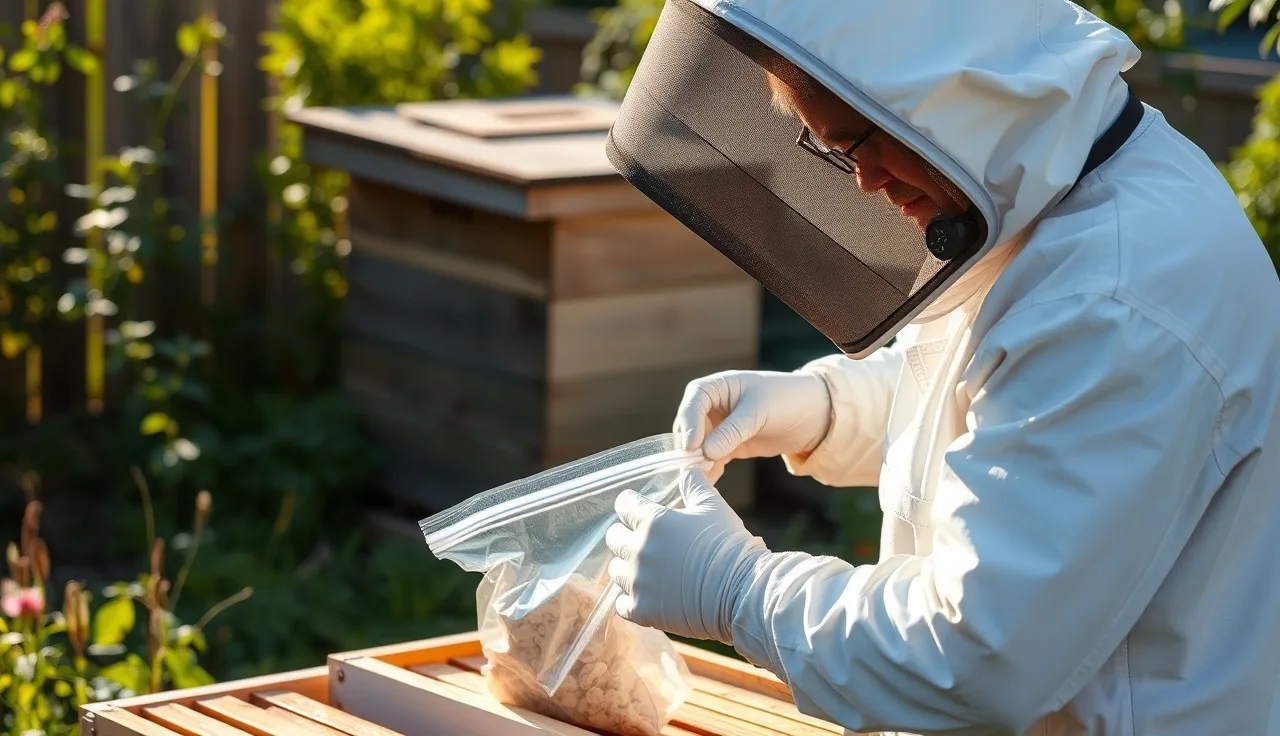
Step 3. Place each strip flat into a resealable plastic bag or wrap in a double layer of newspaper. The goal is containment: no loose residue reaching soil, groundwater, or curious pets.
Step 4. Seal the bag or newspaper bundle and place it in your household trash bin. This is explicitly permitted by the EPA label for non-commercial quantities [1]. The strips go to a municipal solid waste landfill, which is equipped to handle low-level pesticide residues.
Step 5. Wash your hands thoroughly with soap and water. Even after glove use. Amitraz is an endocrine disruptor and monoamine oxidase inhibitor, so routine hygiene matters.
Step 6. Record the disposal date. This is not legally required for hobbyists but is good practice if you ever face a neighbor complaint or need to document your management calendar. Some beekeeping associations recommend a simple hive log for exactly this reason.
That's it. Six steps. Most of them take under two minutes total.
Can you throw Apivar strips in the regular trash?
Yes, for home and small-scale beekeeping use, household trash is the label-approved disposal method [1]. The EPA label does not route hobbyist quantities to a hazardous waste facility because the per-strip amitraz load (roughly 1.75 mg amitraz per cm of strip according to published formulation data) is low enough that municipal landfill handling is considered acceptable [4].
The practical answer: bag them, bin them, done. The only caveat is that some municipalities have local ordinances about pesticide disposal in curbside bins. This is rare for low-residue materials like used Apivar strips, but worth a 30-second check with your local waste authority if you manage more than 10 or 15 hives and are pulling strips in bulk.
What about burning or composting used strips? Are those safe?
No. Both are prohibited by the label and carry real hazard.
Burning amitraz-laden material produces formamide and N-methylformamide decomposition products, which are irritants and potential carcinogens [1]. The EPA label prohibits incineration unless done in a permitted commercial incinerator. Your backyard burn barrel does not count.
Composting is equally off-limits. Amitraz and its breakdown metabolite 2,4-dimethylaniline persist in soil and can leach into groundwater or be taken up by plants [5]. Using strip-contaminated compost in a vegetable garden is a bad idea on multiple levels. The Honey Bee Health Coalition's Varroa management guide also notes that off-label pesticide use or disposal can contribute to residue buildup in hive wax and soil, creating problems well beyond the current season [6].
How long do Apivar strips stay in the hive, and does that affect disposal timing?
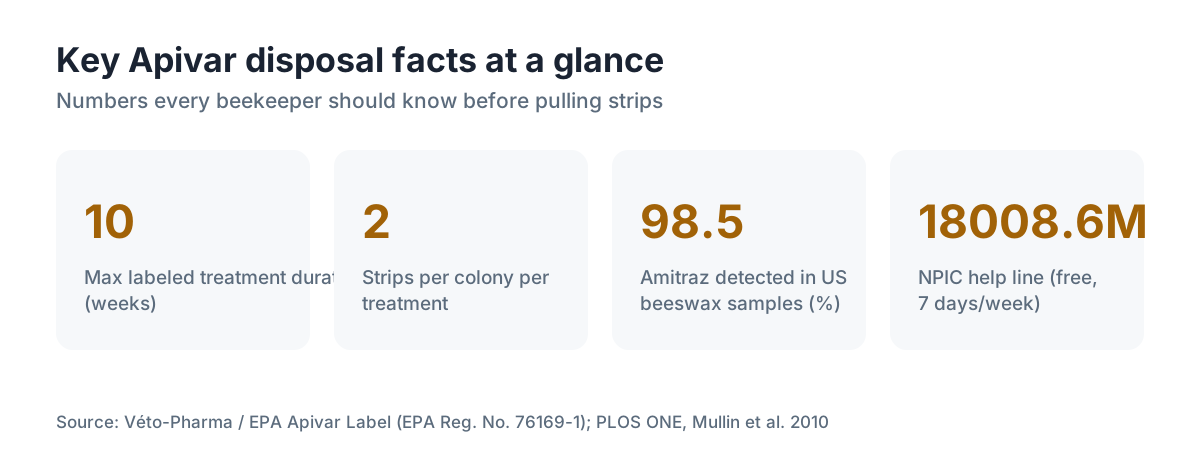
Apivar strips stay in the colony for 6 to 10 weeks. The label recommends 6 to 8 weeks for most applications, with a hard maximum of 10 weeks [1]. Strips pulled within that window still carry residual amitraz; the active ingredient does not exhaust itself fully during treatment. Strips left longer than 10 weeks risk promoting amitraz-resistant mite populations and are an off-label use [4].
From a disposal standpoint, timing matters because you want to remove strips before honey supers go on in spring, and you want to dispose of them promptly rather than leaving them in a pile in the bee yard. Leaving pulled strips on the ground is a label violation and a hazard to foraging bees, birds, and small mammals.
For a quick overview of how disposal considerations fit into the full treatment window, see the data table below.
Do state regulations add requirements beyond the EPA label?
Some do. The EPA label is the federal minimum. States can layer additional requirements on top under their own pesticide statutes.
California requires that all pesticide waste, including used strips, be managed in compliance with CDPR regulations, and county agricultural commissioners may have specific guidance [3]. Washington, Oregon, and New York run active pesticide stewardship programs that accept agricultural chemicals including used strips at periodic collection events. Florida's Department of Agriculture runs a similar program.
The safest approach: look up your state's department of agriculture pesticide waste page or call your county extension office. The National Pesticide Information Center (1-800-858-7378) can also walk you through state-specific rules at no charge [7].
For beekeepers in the European Union, disposal rules differ. Apivar is authorized across much of the EU but member-state veterinary medicine waste regulations apply. UK beekeepers post-Brexit follow VMD guidance, which similarly points to licensed waste contractors for veterinary medicinal product waste.
For a complete view of your varroa management toolkit and how Apivar fits relative to other treatments, varroa mite is the clearest starting point on this site.
What if you have unused, leftover, or expired Apivar strips?
Unused strips are a different category from used ones. Unopened packaging with active product is more strictly regulated because the amitraz concentration is higher and the material has not yet been applied.
For unused or expired strips, the label points to a licensed pesticide disposal facility or a household hazardous waste (HHW) collection event [1]. Most counties run HHW collection at least twice a year. Earth911.com (run by a nonprofit, not government) has a locator tool at earth911.com that maps nearby HHW sites. The EPA's own waste collection page offers state-by-state links [8].
Do not pour liquid formulations down the drain, but Apivar is a solid strip, so the drain concern is moot. The core rule: unused product with its original label intact should go to an HHW event. Used strips from completed treatments go in the household trash, properly wrapped.
If you manage a sideline operation and regularly have bulk unused strips, contact your state department of agriculture. Some states allow licensed pesticide applicators to use commercial waste contractors for agricultural pesticide disposal, which may be cheaper at volume than repeated HHW trips.
Can Apivar strips contaminate your hive products if not removed on time?
This is a real concern and worth taking seriously. Amitraz and its metabolite 2,4-dimethylaniline accumulate in beeswax. A 2010 study published in PLOS ONE found amitraz residues in 98.5% of 122 beeswax samples tested from US colonies, reflecting decades of widespread use across the beekeeping industry [9]. This does not make honey unsafe at current exposure levels, but it is a plain reason why keeping strips in longer than labeled is a bad practice.
Honey supers must be off the hive during Apivar treatment. The label prohibits application when honey supers are present [1]. If strips are removed on schedule and no supers were on during treatment, residue in honey is not a documented problem at label-compliant use. The concern lives in wax, not finished honey, and it accumulates over years of repeated treatment, not from a single application.
This residue picture is part of why some beekeepers rotate treatments or use oxalic acid for winter mite knockdown rather than stacking Apivar treatments year over year. For a practical look at supplies and options across treatment categories, beekeeping supplies and beekeeping supply companies cover the commercial side of what's available.
What happens if you accidentally leave strips in too long or forget to remove them?
First: pull them as soon as you realize. The label violation is in the continued exposure, not in the delayed removal itself. Dispose of them per the standard steps above.
Second: document when they went in and when they came out. If you used a hive management app or log, note the extended exposure. This matters if you're ever selling bees, nucs, or wax commercially and need to disclose treatment history.
Third: consider an amitraz resistance monitoring cycle. Prolonged sub-optimal amitraz exposure is one pathway to resistance development in Varroa destructor populations. The Honey Bee Health Coalition recommends alcohol wash or sugar roll monitoring before and after any treatment to verify efficacy [6]. If your post-treatment mite counts are higher than expected, that's data, not a reason to add more strips.
VarroaVault's free treatment tracker helps you log strip insertion and removal dates so this specific mistake is easier to avoid. Tracking is unglamorous but it's how you catch a forgotten strip before it becomes a three-month problem.
Is amitraz dangerous to dogs, cats, or other animals if strips are not disposed of properly?
Yes. Amitraz toxicity in dogs is well documented. Dogs are unusually sensitive to amitraz because they lack the metabolic pathway that clears it efficiently in most mammals. Clinical signs in dogs include vomiting, sedation, ataxia, and in severe cases, seizures and coma [10]. The ASPCA Animal Poison Control Center lists amitraz (found in tick collar products as well as Apivar) as a significant veterinary toxin.
Cats and small ruminants are also sensitive. Horses are at lower risk at strip-level doses but amitraz exposure is still undesirable.
A single used strip left on the ground, in a trash bag a dog can tear into, or in an accessible compost pile is a plausible exposure scenario on a farm or backyard with dogs present. This is not theoretical. The veterinary literature has case reports of amitraz poisoning from dogs chewing tick collars, which have lower amitraz concentrations than Apivar strips [10].
Seal. Bag. Bin. That's the entire risk mitigation.
Where can you find official disposal guidance for Apivar?
The authoritative sources are:
- The current Apivar label (EPA Reg. No. 76169-1). Always download the current version directly from the EPA's pesticide label database at cdms.net or from Véto-Pharma's website, since labels can be updated between print runs [1].
- The EPA's pesticide disposal guidance page [8].
- The Honey Bee Health Coalition's Varroa Management Guide, which addresses treatment stewardship including disposal considerations [6]. The HBHC guide is free to download at honeybeehealthcoalition.org.
- Your state's department of agriculture pesticide program. Every state has one, and most have a phone line staffed by people who know local requirements.
- The National Pesticide Information Center at npic.orst.edu, a cooperative between Oregon State University and the EPA that answers disposal questions for free [7].
Nobody keeps a single definitive database of state-level strip disposal rules. The patchwork is real. But calling your state ag department takes five minutes and gives you a defensible answer if you're ever questioned.
Frequently asked questions
Can I burn used Apivar strips in a fire pit or burn barrel?
No. The Apivar label prohibits burning strips except in a permitted commercial incinerator. Burning amitraz produces formamide decomposition products that are respiratory irritants and potentially carcinogenic. A backyard fire pit does not qualify as a permitted incinerator. Bag the strips and put them in your household trash instead.
Can I compost used Apivar strips with other hive debris?
No. Composting is prohibited by the label. Amitraz and its metabolite 2,4-dimethylaniline can persist in soil and be taken up by plants. Putting strips in a compost pile also risks exposure to pets, wildlife, and beneficial soil insects. Wrap used strips and dispose of them in your regular household trash bin.
How many strips come in an Apivar package and how many hives do they treat?
Standard Apivar packages contain 10 strips, treating 5 hives at 2 strips per colony. Larger packages (50 strips, treating 25 hives) are available for sideline operators. Each colony gets 2 strips placed between brood frames. The disposal steps are identical regardless of pack size: bag used strips and bin them.
Do used Apivar strips need to go to a hazardous waste facility?
Not for typical hobby or sideline quantities. The EPA label permits disposal of used strips in household trash when properly contained in a bag or newspaper wrapping. Unused or expired product with higher active ingredient concentration should go to a household hazardous waste collection event. Check your state agriculture department for any stricter local rules.
How long does amitraz residue stay active on a pulled Apivar strip?
Pulled strips still carry residual amitraz; the active ingredient does not fully exhaust during a treatment cycle. The exact residual load depends on hive temperature, strip age, and how long they were in. Treat all pulled strips as containing active pesticide. The sealed-bag disposal protocol is not optional just because the strip has been used.
Can I leave old Apivar strips on the ground near the hive?
No. Leaving strips on soil is a label violation. Residual amitraz can be picked up by foraging bees, contact-exposed to ground-nesting insects, and can leach into soil with rain. Small mammals and birds may also contact the strips. Remove them promptly when the treatment window ends and dispose of them in sealed household trash.
What should I do with leftover unused Apivar strips I won't use this season?
Store them per label directions (cool, dry, away from food and feed) and use them next season if within the expiration date. If expired or if you're exiting beekeeping, take them to a household hazardous waste collection event. Do not pour anything down drains (though Apivar is solid), burn them, or place them in regular trash without sealing them in the original or replacement packaging.
Is it safe to handle used Apivar strips without gloves?
The label recommends protective gloves. Brief bare-hand contact from a single strip is unlikely to cause acute harm, but amitraz absorbs through skin and is an endocrine disruptor. Regular bare-hand handling over multiple hives and multiple seasons is not a good practice. Nitrile gloves cost almost nothing and remove the question entirely. Wash hands after removal regardless.
My dog chewed on a pulled Apivar strip. What should I do?
Call your veterinarian or the ASPCA Animal Poison Control Center (888-426-4435) immediately. Dogs are particularly sensitive to amitraz. Symptoms can include vomiting, sedation, incoordination, and in serious exposures, seizures. Bring the strip or packaging with you to the vet. Do not wait to see if symptoms develop before calling; amitraz poisoning in dogs can escalate quickly.
Do I need to report Apivar strip disposal to any government agency?
For hobbyist and small sideliner quantities disposed of in household trash per the label, no reporting is required under federal law. Commercial-scale operations generating bulk pesticide waste may have reporting obligations under state solid waste or agricultural pesticide regulations. When in doubt, call your state department of agriculture or the National Pesticide Information Center at 1-800-858-7378.
Can Apivar strips go in a dumpster or commercial bin at a farm supply store?
Not without confirming that dumpster is permitted to accept pesticide waste. Commercial dumpsters at retail locations are not household trash and may not be authorized for pesticide disposal. Putting strips there without permission could violate FIFRA and state waste rules. Stick to your own household trash bin for used strips or a licensed HHW facility for unused product.
Does it matter how I dispose of strips if I only have one or two hives?
The legal obligation is the same regardless of hive count. The EPA label does not have a volume threshold below which disposal rules stop applying. In practice, one or two hives means a handful of strips twice a year, which is trivially handled with a sealed bag in your regular trash. Scale does not change the rules; it just makes compliance easier.
Sources
- Véto-Pharma / EPA, Apivar Label EPA Reg. No. 76169-1: Apivar label disposal instructions: wrap strips in newspaper or sealed bag, place in household trash; prohibits burning, composting, and water body contamination
- EPA, Federal Insecticide Fungicide and Rodenticide Act (FIFRA): Following pesticide label directions is a legal requirement under FIFRA
- California Department of Pesticide Regulation, Pesticide Disposal: California has pesticide waste rules administered by CDPR that can exceed the federal minimum
- University of Florida IFAS Extension, Varroa Mite Management: Apivar label maximum treatment duration is 10 weeks; extended exposure risks promoting amitraz-resistant mite populations
- EPA, Amitraz Pesticide Fact Sheet: Amitraz and its breakdown metabolite 2,4-dimethylaniline persist in soil and can leach into groundwater
- Honey Bee Health Coalition, Varroa Management Guide (5th edition): Off-label pesticide use or disposal contributes to residue buildup in hive wax; recommends pre- and post-treatment mite monitoring via alcohol wash or sugar roll
- National Pesticide Information Center, Oregon State University / EPA: NPIC provides free state-specific pesticide disposal guidance via 1-800-858-7378
- EPA, Pesticide Waste Disposal: EPA guidance routes unused pesticide products to household hazardous waste collection events; provides state-by-state disposal links
- Mullin et al., PLOS ONE, 2010, 'High Levels of Miticides and Agrochemicals in North American Apiaries': Amitraz residues were detected in 98.5% of 122 beeswax samples tested from US colonies
- ASPCA Animal Poison Control Center, Amitraz Toxicity in Dogs: Amitraz is a significant veterinary toxin in dogs; symptoms include vomiting, sedation, ataxia, seizures, and coma
- Pennsylvania State University Extension, Integrated Pest Management for Varroa Mites: Apivar strips contain amitraz as active ingredient; guidance on application timing relative to honey supers
Last updated 2026-07-09