How to get rid of varroa mites: a practical treatment guide
TL;DR
- Varroa mites are the leading cause of honey bee colony loss worldwide.
- You can control them with oxalic acid, formic acid, or synthetic miticides, but treatment timing, temperature, and whether brood is present all determine which product works.
- Monitor before treating, hit the 2-3% threshold as your trigger, and repeat treatments to break the mite reproduction cycle.
Why varroa mites are so dangerous to your hive
Varroa destructor is a parasitic mite that feeds on the fat bodies of honey bees, both adult bees and developing pupae in capped cells [1]. It doesn't just weaken individual bees. It vectors deformed wing virus and a handful of other bee pathogens, and those viruses do as much damage as the feeding itself. A colony can go from healthy to collapsing in a single season if mites aren't managed.
The numbers are sobering. Research from the Honey Bee Health Coalition puts the average winter colony loss rate in the United States at around 30% annually, and varroa and the viruses it carries are consistently identified as the top contributing factor [2]. If you've ever gone to open a hive in March and found a cluster of dead bees and a queen who stopped laying in November, varroa was probably involved.
For a deeper look at the biology driving all of this, the varroa mite article on this site covers the mite's life cycle in detail, which is worth reading before you choose a treatment strategy. Understanding that mites reproduce almost exclusively inside capped brood cells is the single piece of information that shapes every treatment decision you'll make.
The mite population doubles roughly every month during the summer brood season. A colony that sits at 1% infestation in June can be at 5% or higher by August. That's why beekeepers who check once a year, in autumn, are usually already behind.
How do you measure varroa infestation levels?
You can't make a good treatment decision without knowing your mite load. Visual inspection of bees doesn't cut it. You need an alcohol wash or a sugar roll on a sample of roughly 300 bees (about half a cup) from the brood nest.
The alcohol wash is more accurate and is what most researchers use. The sugar roll doesn't kill bees, but it consistently undercounts mites by 20-30% compared to alcohol wash [3]. If you're making treatment decisions, I'd go with alcohol wash and accept the small sacrifice of 300 bees.
Here's how to do an alcohol wash:
- Scoop half a cup of bees from a frame in the brood nest (not the honey super, not the entrance). Try to get nurse bees.
- Pour them into a jar with roughly 70% isopropyl alcohol or windshield washer fluid.
- Shake for 30-60 seconds.
- Pour the liquid through a mesh lid into a white bowl.
- Count the mites in the bowl, divide by the number of bees (roughly 300), multiply by 100. That's your percentage.
The Honey Bee Health Coalition's Varroa Management Guide recommends treating when your mite level reaches 2% (2 mites per 100 bees) during the summer brood season, and 1-2% in late summer before winter bees are being raised [2]. Some researchers and extension programs use a 3% threshold for summer action, and honestly the difference between 2% and 3% is less important than actually checking. Check monthly during the active season.
Sticky boards under a screened bottom board can give you a rough daily mite drop count, but they're harder to interpret and shouldn't replace a wash. Use them to watch trends between washes.
What are the main varroa treatment options?
Treatments fall into two categories: organic acids and essential oils (sometimes called "soft" treatments) and synthetic miticides. Both categories have EPA-registered products labeled for varroa in the US [4]. You should only use products with a registered label; unlabeled treatments put your honey and your bees at legal and safety risk.
| Treatment | Active Ingredient | Brood Needed? | Temp Range | Honey Super OK? | Approx. Cost (10 colonies) |
|---|---|---|---|---|---|
| Oxalic acid dribble | Oxalic acid | No (broodless only) | >40°F | Remove supers | ~$15-25 |
| Oxalic acid vaporization | Oxalic acid | Partial effect with brood | >40°F | Remove supers | ~$15-25 + vaporizer |
| Formic Pro / Mite-Away Quick Strip | Formic acid | Works with brood | 50-85°F | Remove supers | ~$30-50 |
| ApiLife Var / Apiguard | Thymol | Works with brood | 60-105°F | Remove supers | ~$20-40 |
| Apivar | Amitraz | Works with brood | Any (above freezing) | Remove supers | ~$60-90 |
| Apistan / CheckMite+ | Fluvalinate / Coumaphos | Works with brood | Any | Remove supers | ~$20-60 |
Cost estimates are rough ranges based on retail pricing as of 2024-2025; prices shift by supplier and quantity. For supply sourcing options, the beekeeping supply companies page has a current list of vendors.
Resistance is real with the synthetic miticides. Fluvalinate (Apistan) and coumaphos resistance has been documented in varroa populations across the US and Europe [5]. Rotating between chemical classes, and including organic acid treatments in your rotation, is the practical defense against resistance building up in your apiary.
How does oxalic acid treatment work and when should you use it?
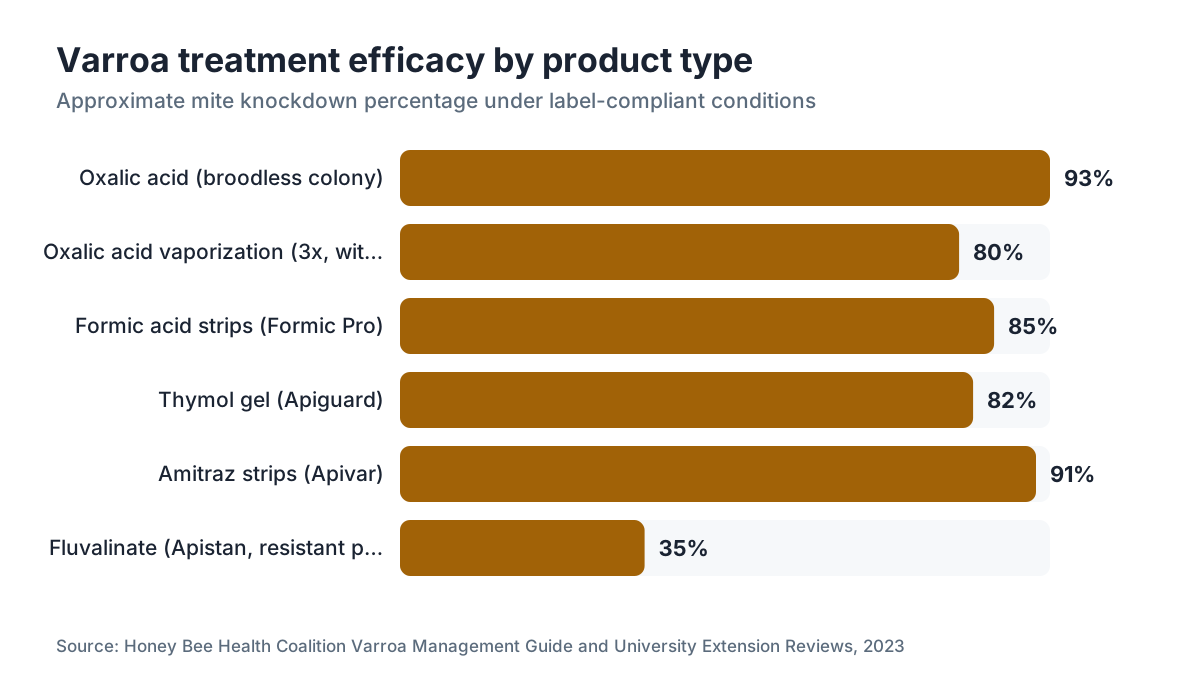
Oxalic acid is, by a wide margin, the most commonly recommended treatment for broodless colonies, and for good reason. It kills mites on adult bees at roughly 90-95% efficacy in a broodless colony when applied correctly [6]. It leaves no residue that matters in honey. It's cheap.
The catch: it does almost nothing to mites inside capped brood cells. This is why the broodless window matters so much. In most temperate climates, that window is late November through early January, when the queen has stopped or nearly stopped laying. That's your best shot at a single-treatment knockdown.
There are two approved methods in the US under the EPA label for Api-Bioxal, which is the registered oxalic acid product [4]:
Dribble method. Mix Api-Bioxal at the labeled rate (3.5 grams per liter of 1:1 sugar syrup), then dribble 5 ml per seam of bees, up to 50 ml total per colony. This is inexpensive and needs no special equipment beyond a syringe. It works well in winter clusters.
Vaporization. Heat the crystals in a vaporizer wand until they sublimate into a gas that permeates the hive. Vaporization is faster per hive, requires a vaporizer (costs $100-300 depending on the unit), and can be done repeatedly. With brood present, the label allows multiple treatments spaced 7 days apart, which lets you catch mites as they emerge from cells between applications.
If you're using oxalic acid vaporization with brood present, plan on at least three treatments, seven days apart. That sequence is your practical workaround for the brood-cell limitation. Efficacy per treatment drops with brood present, but repeated application makes up for it.
Wear a P100 respirator and eye protection when vaporizing. Oxalic acid vapor is genuinely bad for your lungs and eyes.
When should you use formic acid treatments?
Formic acid is the one treatment that penetrates capped cells and kills mites on pupae. That's a real advantage. Formic Pro and Mite-Away Quick Strips (MAQS) are the registered strip-based products in the US. They can be used with honey supers on (check the specific label; MAQS has that allowance, Formic Pro does not) [4].
The temperature window is strict. Both Formic Pro (extended release, two 14-day pads) and MAQS (faster release, 7-day strips) call for daytime highs in the 50-85°F range. Outside that window, you either don't get enough vapor release to be effective, or you release too much and risk queen loss and brood die-off. Take that temperature window seriously.
Formic acid is my first choice in late summer when there's still brood in the hive and I need to knock down mites before winter bees are raised. Applied in August across most of the northern US, the timing fits the temperature window and hits mites before the colony raises the bees that need to survive until spring.
Some queens are sensitive to formic acid. Queen loss rates in published trials run from roughly 2-5% with MAQS [7]. That's not nothing. If you have a queen you really don't want to risk, it's worth considering a different approach or splitting the colony first.
Store strips in the freezer until use. They lose efficacy once opened and exposed to air.
What about thymol and synthetic miticide strips?
Thymol-based treatments (Apiguard, ApiLife Var) work well between about 60-105°F. They vaporize slowly from a gel or block placed above the brood nest. Efficacy against varroa runs roughly 70-93% in trials, and they're a reasonable choice in late summer in warmer climates where the temperature window fits [2]. Below 60°F they barely volatilize and you get minimal effect. Don't bother with thymol in the spring in cool climates.
Apivar (amitraz) is the synthetic miticide with the best current efficacy profile, partly because resistance to amitraz in the US is still relatively limited compared to fluvalinate and coumaphos [5]. Apivar strips go directly in the brood nest for 42-56 days. The label is specific: remove honey supers before treatment and follow the removal timing before adding them back.
Coumaphos (CheckMite+) and fluvalinate (Apistan) have documented widespread resistance in varroa populations and I'd consider them a last resort, or use them only after confirming local efficacy with mite washes before and after treatment.
One thing worth saying plainly: synthetic miticides leave residues in wax. A 2010 study found amitraz metabolites and fluvalinate in comb samples from apiaries across the US [8]. Those residues persist for years and may affect brood. This isn't a reason to refuse all synthetics if your colony is dying, but it's a real reason to rotate and not rely on them exclusively.
For planning supplies across a season, having a look at what you'll need in terms of beekeeping supplies before treatment windows open can save a last-minute scramble.
What is an integrated varroa management plan?
The Honey Bee Health Coalition's Varroa Management Guide describes integrated pest management (IPM) for varroa as combining monitoring, cultural controls, and chemical treatments rather than relying on any single approach [2]. In practice, that means a yearly calendar built around your local climate and the treatments available to you.
A reasonable plan for a hobbyist in the mid-Atlantic US might look like this:
- April-May: Alcohol wash. If above 2%, treat. A broodless split or a brood break before treating with oxalic acid can be very effective here.
- July: Alcohol wash. This is often the check that catches a summer mite explosion early.
- August: Treat if at or above threshold. Formic acid or oxalic acid vaporization are the tools with the right timing here. This treatment is arguably the most important of the year because it protects the winter bees.
- November-January (broodless window): Oxalic acid dribble or vaporization for a hard knockdown.
Cultural controls are worth stacking on top of chemical treatment. Brood breaks (removing the queen for a period, or caging her, so the hive goes broodless) let oxalic acid work at maximum efficacy. Drone brood removal, where you put a frame of drone foundation in the brood nest and pull it when capped (mites prefer drone cells at roughly 8:1 over worker cells), can cut mite load by 30-40% as a mechanical tool [2].
VarroaVault's free protocol tool lets you build a calendar-based IPM plan around your zip code and colony setup, which is worth bookmarking if you manage more than a couple of hives.
No single treatment is a permanent fix. Mite populations rebound. Reinfestation from neighboring apiaries happens constantly, especially in the late summer when robbing is active. Plan to check and treat on a cycle, not once and done.
Does a mite-resistant bee strain actually help?
Yes, meaningfully, but not as a replacement for monitoring and treatment. The most studied resistance traits are VSH (Varroa Sensitive Hygiene) and hygienic behavior. Bees with strong VSH detect and remove mite-infested pupae from capped cells, which disrupts the mite reproductive cycle and keeps natural population growth slower [9].
The USDA Baton Rouge lab has done decades of work on VSH selection. Commercially available VSH and Russian bee stock shows measurably lower mite population growth rates in field trials, though performance varies with local conditions and how well the VSH trait is maintained through open mating [9].
Buying VSH queens or locally-bred hygienic queens isn't a substitute for monitoring. It's a way to reduce how often you need to treat. In practice, even VSH colonies need monitoring and occasional treatment. I've seen VSH colonies crash from varroa, usually when queens have mated with local drones and diluted the trait.
Small cell comb as a varroa control has not held up under replicated scientific scrutiny. Multiple studies found no significant reduction in mite levels compared to standard cell comb [10]. I wouldn't spend money or time on it as a primary strategy.
Can you treat varroa without chemicals?
Partly. No purely chemical-free method keeps a colony healthy indefinitely without exceptional genetics and constant management, but several mechanical strategies reduce mite load enough to matter.
Brood breaks are the most effective non-chemical approach. Caging or removing the queen for 21-24 days (the duration of worker brood capping) results in a hive with no capped brood, at which point a single oxalic acid treatment reaches maximum efficacy. This technique is also useful for requeening, so you're combining two management goals.
Drone brood trapping works because mites preferentially enter drone cells. A frame of drone comb in the brood nest, pulled and frozen when 80-90% capped, removes a disproportionate number of mites. Do it consistently every 3-4 weeks during the season and you can measurably slow mite population growth, though it won't control a severe infestation alone.
Powdered sugar rolls do not knock mites off bees in meaningful numbers. This is a persistent myth. Multiple university trials found no significant mite reduction from sugar treatment [10]. Don't waste your time.
For hobbyists managing a handful of hives without access to a vaporizer or commercial treatments, the oxalic acid dribble during a broodless period remains the simplest, cheapest, most effective option available. A $25 bag of Api-Bioxal and a $5 syringe will handle several colonies.
What mistakes do beekeepers make when treating for varroa?
Treating too late is the biggest one. By the time you see bees with deformed wings crawling at the entrance, you already have a crisis-level infestation. Deformed wing virus symptoms become visible when mite loads are high, and the bees expressing symptoms are the ones who were pupae during peak mite pressure. You're seeing the past, not the present state of the colony.
Ignoring temperature requirements is common, especially with formic acid. A strip applied at 48°F does almost nothing. A strip applied at 88°F can cook your queen and roast your brood. Thymol in a hive at 55°F just sits there. Match the product to the season.
Not removing honey supers before treatment is both a label violation and a food safety problem. Every registered varroa product in the US requires super removal before treatment, with the exception of MAQS used strictly per label. Honey contaminated with miticides is a real outcome of skipping this step.
Single-product reliance drives resistance. Using Apivar every year, year after year, is how you end up with a mite population that Apivar doesn't touch. Rotate. Use organic acids in at least some treatment cycles.
Trusting the candy board or the sugar roll instead of the alcohol wash leaves you with uncertain numbers. Imprecise monitoring leads to treating when unnecessary, or missing a threshold that needed action two months ago.
How do you know your varroa treatment worked?
Do a mite wash 48-72 hours after a short-contact treatment, or at the end of the treatment period for extended-release products. Compare the post-treatment number to your pre-treatment number. If you treated correctly and caught the infestation before it got severe, you should see a meaningful drop, typically below 1%.
A follow-up wash at 30 days tells you whether reinfestation is happening from neighboring colonies or whether your treatment window was incomplete. In areas with high beekeeper density or a lot of feral colonies nearby, reinfestation through robbing and drifting bees can rebuild mite loads fast, sometimes within 6-8 weeks of a successful knockdown [11].
If your post-treatment mite count is barely lower than before, a few things may have happened: the treatment was outside its effective temperature range, the colony still had brood and you used a brood-sensitive product without repeating it, or you're dealing with a resistant mite population. In the resistance scenario, switch chemical classes.
Keep a simple log: date, colony ID, pre-wash count, treatment used, post-wash count. That record is the difference between actually knowing your mite management works and guessing. If you manage multiple hives, the pattern across colonies often tells you something about local mite pressure that any single colony wouldn't.
Frequently asked questions
What is the fastest way to get rid of varroa mites?
In a broodless colony, a single oxalic acid treatment (dribble or vaporization) can knock mites down by 90-95% within a day or two. For a colony with brood, oxalic acid vaporization applied three times, seven days apart, is the fastest organic acid approach. Apivar strips also work quickly in brood-present colonies, but require 42-56 days of contact per the label.
Can varroa mites kill a bee colony?
Yes. Varroa mites and the viruses they vector, especially deformed wing virus, are the leading cause of colony death in the US and Europe. A colony at 5% infestation in August is at serious risk of collapse before spring. The Honey Bee Health Coalition estimates varroa-related factors contribute to the majority of the roughly 30% annual winter loss rate reported in US surveys.
Is oxalic acid safe to use in a hive with honey supers?
No. The EPA label for Api-Bioxal requires removal of honey supers before treatment. Oxalic acid is naturally present in honey at low levels, but you cannot apply it to a colony with supers on and then sell or consume that honey without violating the label. Wait until honey supers are off before treating, or plan treatment cycles around your honey harvest.
How often should you check for varroa mites?
Monthly alcohol washes during the active brood season (roughly April through October in most of the US) are the standard recommendation from the Honey Bee Health Coalition. At minimum, check in spring before buildup, in midsummer when mite populations peak, and in late summer before winter bees are raised. That late-summer check matters most for colony survival.
What temperature do you need to treat for varroa?
It depends on the product. Oxalic acid dribble works above 40°F. Formic acid products (Formic Pro, MAQS) require 50-85°F. Thymol-based treatments (Apiguard, ApiLife Var) need 60-105°F to volatilize properly. Apivar strips work across a broader temperature range, including cooler conditions, which makes them useful in early spring and late fall when other options are limited.
What is the varroa mite treatment threshold?
The Honey Bee Health Coalition recommends treating when mite levels reach 2% (2 mites per 100 bees) during the summer brood season, measured by alcohol wash. The threshold drops to 1-2% in late summer because those bees will be the winter cluster. Some extension programs use 3% as a summer action threshold. The exact number matters less than having a consistent monitoring practice.
Do varroa mites affect humans?
No. Varroa destructor parasitizes honey bees and is not known to affect humans or other animals. The mites cannot survive or reproduce off a bee host. There is no health risk to beekeepers from mite exposure during hive inspections. The concern is entirely about bee health and colony loss, not human exposure.
Can you treat varroa mites in winter?
Yes, and the broodless winter window is often the best time for oxalic acid treatment. When the queen stops laying, typically November through January in northern states, there are no mites protected inside capped cells. A single oxalic acid dribble or vaporization at that point reaches all mites on adult bees and can achieve 90-95% efficacy. Treat when cluster temps allow safe access, not during a hard freeze.
How do varroa mites spread between hives?
Primarily through bee movement: robbing behavior (bees raiding weaker colonies), drift (bees entering the wrong hive), and swarms. Mite-carrying bees from collapsing colonies are particularly dangerous because those colonies send out desperate robbers late in the season when mite loads are highest. Maintaining good colony strength, reducing robbing opportunities in late summer, and keeping buffer distance between apiaries all reduce spread somewhat.
Are there varroa-resistant bee breeds?
Several strains show meaningful resistance. VSH (Varroa Sensitive Hygiene) bees, developed through USDA research, detect and remove mite-infested brood, which slows mite population growth. Russian honey bees also show suppressed mite reproduction in field trials. Resistance traits dilute through open mating with local drones, so results in working apiaries are variable. Resistant stock reduces treatment frequency but doesn't eliminate the need for monitoring.
What happens if you don't treat varroa mites?
Most untreated colonies in the US collapse within 2-3 years, and many die within a single season once mite levels cross 5-10%. The colony doesn't just weaken gradually; it can crash quickly in late summer or fall as deformed wing virus devastates the winter bee crop. The collapsing colony also sends out mite-laden robbers that spread varroa to neighboring apiaries.
Can you use essential oils to treat varroa mites?
Thymol, derived from thyme oil, is the one essential oil-based ingredient with registered products (Apiguard, ApiLife Var) and meaningful documented efficacy at 70-93% in trials. Other essential oils like tea tree oil, wintergreen, and various homemade preparations have not shown reliable efficacy in controlled studies and don't have EPA registration for varroa in the US. Thymol products work; improvised oil treatments generally don't.
How do you do a varroa mite alcohol wash?
Collect roughly 300 nurse bees (half a cup) from a brood frame into a jar, cover with 70% isopropyl alcohol or windshield washer fluid, seal and shake for 60 seconds, pour through a mesh lid into a white pan, count the mites. Divide mite count by bee count (approximately 300), multiply by 100 to get your percentage. A result above 2% in summer signals it's time to treat.
Sources
- USDA Agricultural Research Service, Varroa destructor biology page: Varroa destructor feeds on the fat bodies of honey bees and vectors deformed wing virus and other pathogens
- Honey Bee Health Coalition, Varroa Management Guide (4th ed.): Treatment threshold of 2% during summer brood season; average US winter colony loss around 30%; description of IPM approaches including drone brood removal efficacy; thymol efficacy 70-93%
- Journal of Apicultural Research, comparison of sugar roll and alcohol wash sampling: Sugar roll consistently undercounts varroa by roughly 20-30% compared to alcohol wash
- EPA, Api-Bioxal (Oxalic Acid) Registration and Label: Api-Bioxal is the EPA-registered oxalic acid product; label requires honey super removal; dribble rate 3.5 g/L in 1:1 sugar syrup at 5 ml per seam; vaporization approved for repeated application; MAQS allows use with supers on, Formic Pro does not
- Journal of Economic Entomology, Resistance to acaricides in Varroa destructor: Fluvalinate and coumaphos resistance documented in varroa populations across the US and Europe; amitraz resistance still relatively limited in US populations as of recent surveys
- Journal of Apicultural Research, oxalic acid efficacy trials in broodless colonies: Oxalic acid achieves roughly 90-95% mite kill on adult bees in a broodless colony when applied correctly
- Honey Bee Health Coalition, Formic Acid Product Profiles (Varroa Management Guide appendix): Queen loss rates in MAQS trials approximately 2-5%
- Apidologie, Pesticide residues in comb wax from US apiaries (Mullin et al. 2010): Amitraz metabolites and fluvalinate found in comb wax samples from apiaries across the United States; residues persist for years
- USDA Agricultural Research Service, Baton Rouge Honey Bee Breeding lab (VSH selection): VSH and Russian bee stock show measurably lower mite population growth rates in field trials; trait dilutes through open mating
- American Bee Journal / University trial reviews, Small cell comb and powdered sugar efficacy: Multiple replicated studies found no significant varroa reduction from small cell comb or powdered sugar treatments compared to controls
- Cornell University Cooperative Extension, Integrated Pest Management for Varroa: Brood break combined with oxalic acid treatment described as highly effective cultural control; reinfestation can rebuild mite loads within 6-8 weeks
Last updated 2026-07-10