How to install Apivar strips: step-by-step guide for beekeepers
TL;DR
- Apivar strips (amitraz 3.3%) hang between brood frames, one strip per five frames of bees, for a minimum of six weeks and a maximum of ten.
- Wear nitrile gloves.
- Position each strip against the cluster so bees walk on it.
- Pull every strip before you harvest honey.
- Beekeepers who follow the protocol usually see mite drops above 90%.
What is Apivar and how does it kill varroa mites?
Apivar is a plastic strip impregnated with amitraz, registered with the EPA to control Varroa destructor in honey bee colonies. Each strip holds 500 mg of amitraz at a 3.3% concentration [1]. Bees walk across the strips, pick up tiny amounts of the active ingredient, and carry it through the colony by way of ordinary bee-to-bee contact. The amitraz attacks the nervous system of mites riding on adult bees and kills them before they reproduce.
The compound doesn't reach mites sealed inside capped brood. That single fact drives the whole protocol. The treatment window has to span at least two full brood cycles. At 21 days per worker brood cycle, six weeks (42 days) is the label minimum. Ten weeks is the label maximum [1].
Amitraz has a long track record. It was first registered for use in U.S. bee colonies in 2013, and it remains one of the most effective hard-chemical options for hobby and sideliner beekeepers. Resistance is a real concern in some apiaries, especially where amitraz has been the only tool for many years, but it isn't yet widespread in North America the way it is in parts of Europe [9]. If your counts don't drop the way they should after a full treatment, put resistance on the list of suspects.
Apivar is not an organic acid. It leaves residues in wax at detectable levels, and those residues build with repeated use [2]. That doesn't make it unsafe at label rates. It's just a reason to rotate your chemistry and to keep an eye on comb in hives with long treatment histories.
When should you install Apivar strips?
Timing beats technique. The two best windows are late summer (after your main honey flow, before populations contract) and early spring (before the flow starts, when mite loads are low and populations climb).
Late summer is usually the priority window. Mite populations peak in late summer right alongside colony population peaks, and every mite you carry into fall breeds more phoretic mites that shorten the lives of your winter bees. The Honey Bee Health Coalition's Varroa Management Guide recommends treating in late summer once mite levels hit or pass 2% (2 mites per 100 bees on an alcohol wash) [3]. Some beekeepers pull the trigger at 1% in late summer because the cost of getting it wrong is a dead colony by February.
Spring treatment targets colonies coming out of winter with elevated loads, before drone brood ramps up and mite reproduction speeds up. If your spring counts sit at or above 2%, treat before the main flow or you'll drag a growing mite population straight through the honey season [6].
Apivar has a temperature edge over formic acid and oxalic acid vapor in one way: the label sets no temperature floor the way formic products do [1]. You can install strips in cool weather when other treatments are off the table. Bees still need to be active enough to walk the strips, so below roughly 50°F you get less contact and less kill.
Never install Apivar during a honey flow if you plan to harvest that honey. The label bars strip installation when honey supers are on the hive [1]. Amitraz can move into honey at low but detectable levels.
How many Apivar strips do you use per hive?
The label rate is two strips per hive for a colony covering up to ten frames of bees [1]. If your colony is stronger than that, add one strip for every five additional frames.
Here's the practical breakdown:
| Colony size (frames of bees) | Strips needed |
|---|---|
| Up to 5 frames | 1 strip |
| 6 to 10 frames | 2 strips |
| 11 to 15 frames | 3 strips |
| 16 to 20 frames | 4 strips |
Most single-story colonies in a standard ten-frame Langstroth box get two strips. A two-box winter colony covering both deeps might need three or four. Count frames of bees, not frames of comb. That distinction trips people up every fall.
Underdosing is a real resistance risk. Running one strip in a large colony doesn't buy you half the protection. It buys you incomplete exposure, which lets partially resistant mites survive and breed. Use the right number [3].
What do you need before you start?
The supply list is short, but a couple of items matter for safety.
Required: Apivar strips (buy only what you'll use in one season), nitrile or latex gloves (worn every single time you handle the strips), a hive tool, and a marker or pencil to date your records.
Strongly recommended: a dedicated pair of disposable gloves kept in the box with the strips, so forgetting isn't an option. Amitraz can absorb through skin, and it's been linked to toxicity in dogs exposed to amitraz-containing tick collars [4]. Treat the gloves as non-negotiable.
Not necessary: a smoker for the install itself, though keeping one lit for normal hive work is fine. You don't need to run a mite count at the moment of installation, but you should have done one in the prior week to confirm the colony actually needs treating.
If you need supplies, beekeeping supply companies can ship Apivar alongside your other gear. Some run free shipping honey bee supply companies offers once you clear a minimum order.
Store unopened Apivar at room temperature, out of direct sun, and away from children and pets. Shelf life on most packages runs two to three years from manufacture. Check the expiration date on the box.
Step-by-step: how to install Apivar strips
This takes about ten minutes per hive once you're set up.
Step 1: Put your gloves on before you open the package. Not after. Skin contact with amitraz is worth avoiding, and it's easiest to avoid before your hands ever touch a strip.
Step 2: Confirm no honey supers are on the hive. If supers are present, pull them and store them off the hive before you go further. This is a label requirement, not a suggestion [1].
Step 3: Open the hive and find the brood nest. In a single-story colony, brood usually sits in the center frames. In a two-story colony, check both boxes.
Step 4: Remove strips from the package. Each strip has a hook at the top. Some beekeepers score the strip lightly with a hive tool to add surface area and exposure. The label doesn't ask for this, and the evidence that it improves kill at standard contact times is mixed.
Step 5: Hang one strip between two adjacent brood frames. The hook catches on the top bar so the strip drops into the gap between frames. Position it so it touches or nearly touches the cluster. A strip dangling in empty space away from bees does almost nothing.
Step 6: For a two-strip treatment, place the second strip on the opposite side of the brood nest. In a ten-frame box with brood centered on frames 4 through 7, hang one strip between frames 3 and 4 and the other between frames 7 and 8. That sandwiches the cluster.
Step 7: Record the installation date. Write it on a hive marker, a piece of tape on the box, or your records. You need it to hit your minimum and maximum removal dates.
Step 8: Close the hive normally. Apivar needs no special ventilation setup, unlike some formic acid products.
Check the strips around the four-week mark to confirm they're still in place and still inside the brood area. If the colony has shifted its cluster (common in fall as bees contract), move the strips to stay in contact with the bees.
Where exactly should you place the strips in the hive?
Placement matters more than most beekeepers think. Apivar works by direct contact: bees walk the strip, pick up amitraz, and spread it. A strip hanging between empty comb or honey frames is wasted plastic [10].
Always set strips inside the brood nest, between frames carrying active brood and nurse bees. Nurse bees stay on those frames constantly and hit the strips more than any other bees in the colony.
In a two-box colony, put one strip in the lower box and one in the upper if brood is in both. Don't stack both strips in one box when bees fill both.
Avoid the edge of the cluster. Outer frames carry fewer bees, so contact drops off. Aim for the third frame in from each side of the brood nest as a rough rule.
Nucs and splits follow the same logic: one strip per five frames of bees, seated inside the cluster. A four-frame nuc gets one strip.
How long do you leave Apivar strips in?
The label says six weeks minimum, ten weeks maximum [1]. Six weeks covers roughly two brood cycles, the least you need to catch mites as they emerge from capped cells and turn phoretic.
Most beekeepers land on six to eight weeks. Eight weeks gives you a buffer without wandering into territory where residue buildup becomes a bigger worry.
Don't leave strips in past ten weeks. The label prohibition is real, and long exposure pushes more residue into wax and comb [2].
Here's the mistake I see most: strips go in during late summer, life gets busy, and they sit through fall. Set a phone reminder the day you install. A strip installed August 1 comes out no later than October 10.
How do you remove Apivar strips safely?
Removal matters as much as installation, and it's the step beekeepers most often skip or put off.
Gloves back on. Open the hive, find the strips (they may have shifted as the bees walked them around, which is normal), and pull them out by the hook. Each strip will likely be crusted in propolis with chewed edges. That's fine.
Dispose of used strips in household trash, sealed in a plastic bag. Don't burn them; amitraz combustion products are a health concern [4]. Don't leave them on the ground near the hive either. Dogs are highly sensitive to amitraz, and a strip in the grass is a serious hazard to a curious dog.
After removal, run a mite wash (alcohol wash or sugar roll) three to five days later to check your work. You want a count below 1% (under 1 mite per 100 bees). If you're still above 2%, something went wrong: the strip placement was off, the window was too short, or your mites may have reduced amitraz susceptibility [3].
Honey supers can go back on once the strips are out and you're past the label's treatment period. Amitraz residue in adult bees clears fairly quickly after the strips leave the hive.
Can you use Apivar with honey supers on?
No. The label is blunt: honey supers must be off during Apivar treatment [1]. Installing strips with supers in place breaks federal pesticide law (FIFRA) and risks amitraz in honey meant for people [7].
Say your colony still has a honey super on when counts cross a threshold. You have two moves. Pull the super, harvest or store it, and treat right away. Or reach for an oxalic acid dribble or vapor method that some labels permit with supers on (read each product label, since restrictions vary).
Most beekeepers plan their Apivar timing around the harvest schedule to dodge this conflict entirely. Treating the moment your last super comes off in late summer is the standard play.
What are the safety precautions for handling Apivar?
Amitraz is a pesticide. Handle it with respect.
Wear nitrile or latex gloves every time you handle strips. Wash your hands thoroughly after the gloves come off. If you get amitraz on your skin, wash the area with soap and water right away. Keep your hands off your eyes and mouth while you work.
The EPA signal word on Apivar is "Caution," the lowest tier [1]. That doesn't license casual handling. Overexposure in humans can bring on drowsiness, a slowed heart rate, and low blood pressure. If someone swallows amitraz or gets significant skin exposure, call Poison Control at 1-800-222-1222 in the U.S. [4].
Dogs are especially sensitive to amitraz. Store and dispose of strips where dogs can't reach them. This is a genuine hazard, not fine print.
Pregnant beekeepers should talk to their physician before handling amitraz-containing products. Human reproductive toxicity data is limited [4].
How do you know if your Apivar treatment worked?
Counting mites after treatment is the only way to know. Installing strips without a follow-up wash is like treating an infection and never checking whether the patient got better.
Run an alcohol wash three to five days after strip removal. Scoop roughly 300 bees (about half a cup) from a brood frame and count the mites that wash out [3][8]. Divide mites by bees, multiply by 100, and there's your percentage.
Target post-treatment level: below 1%.
Still sitting at 2% or higher after a full six-to-eight-week treatment with correct placement? Work through the causes in this order: the strips weren't seated in the brood nest, the window didn't cover enough brood cycles, or amitraz resistance has shown up in your mites. If you suspect resistance, switching to oxalic acid or a formic acid product for your next treatment makes sense.
To plan treatment windows well, it helps to know how the varroa mite reproduces inside capped cells, because that biology is exactly what determines your minimum treatment length.
VarroaVault has a free treatment planning tool that maps your treatment windows against your local nectar flow calendar. It makes hitting the right timing a lot easier.
Does Apivar work in cold weather or winter?
Apivar tolerates lower temperatures than formic acid products, but cold still cuts efficacy. When bees cluster tightly below about 50°F, movement across the strips drops off and contact-based distribution stalls.
Start Apivar while daytime temperatures still reach 50°F or higher on a regular basis, so bees stay active enough to spread the compound. Across most of the northern U.S. and Canada, that means getting strips in by September if you're aiming for fall treatment [6].
Beekeepers in mild climates sometimes install strips in late October or early November and get decent results. The window just has to cover enough brood (if any remains) and keep enough bee activity to move amitraz around.
Winter treatment of a broodless colony isn't an approved or standard use for Apivar. Oxalic acid, applied as a dribble or vapor, is the go-to for broodless winter work. It hammers phoretic mites when there's no brood to shield them [3].
How does Apivar compare to other varroa treatments?
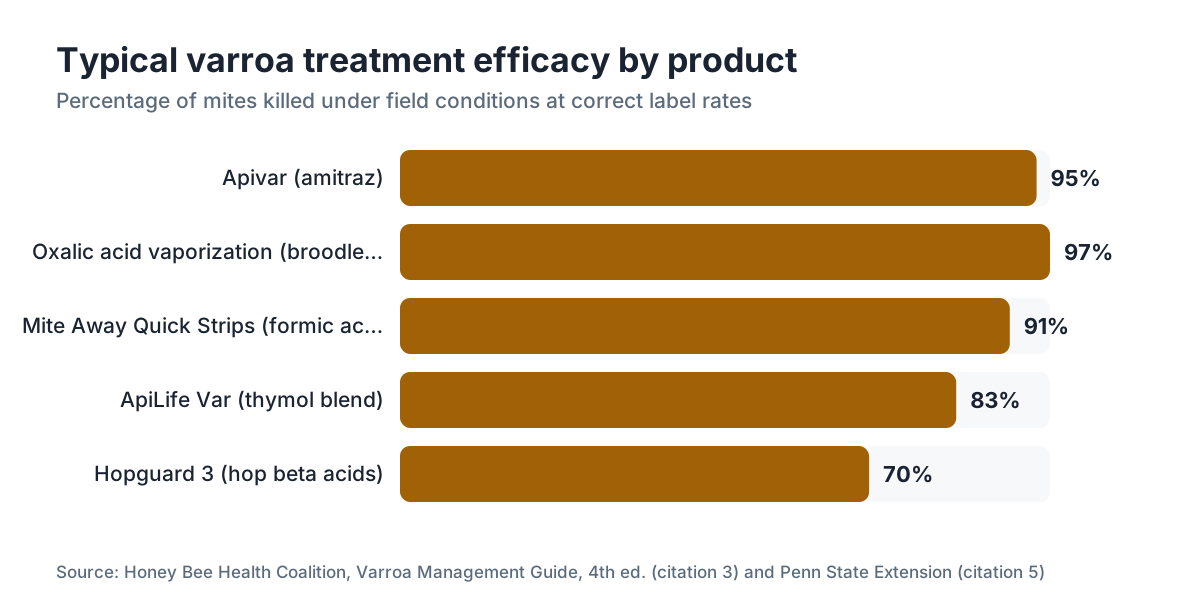
Here's an honest comparison of the major registered treatments. Efficacy figures come from the Honey Bee Health Coalition's Varroa Management Guide and published university trials [3][5].
| Treatment | Active ingredient | Efficacy (typical) | Temp requirements | Honey super restriction | Brood cycle needed |
|---|---|---|---|---|---|
| Apivar | Amitraz | 90-99% | None specified | Yes, supers off | Yes (6-10 weeks) |
| Mite Away Quick Strips | Formic acid | 85-97% | 50-85°F | Yes, supers off | Partial |
| Oxalic acid vaporization | Oxalic acid | 90-99% (broodless) | Above freezing | Check label | No (broodless best) |
| Hopguard 3 | Hop beta acids | 60-80% | None specified | No restriction | Yes |
| ApiLife Var | Thymol blend | 74-91% | 59-69°F | Yes, supers off | Yes |
Apivar's strengths: high kill across a wide temperature range, a simple install, and a long window that spans multiple brood cycles. Its weaknesses: wax residue that stacks up with repeated use, resistance risk when it's the only tool, and no treating during a honey flow.
For most hobby and sideliner beekeepers treating twice a year, rotating Apivar with oxalic acid vapor in a broodless fall or winter window is a solid, evidence-backed protocol [3].
The right pick depends on your climate, your honey calendar, and your history with each product. If you're pricing products across vendors, check beekeeping supply companies for current numbers before you buy in bulk.
What mistakes do beekeepers most often make with Apivar?
Read through the extension publications and the questions beekeepers ask online and a clear pattern of errors shows up.
Leaving strips in too long is the single most common one. The ten-week ceiling exists for a reason: residue builds, and bees start hauling strips out as propolis-covered debris. Set a reminder and pull them on time.
Skipping the pre-treatment mite count is second. Install strips in a low-mite colony that didn't need chemical treatment and you build needless residue in your wax while spending money you didn't have to. Count first.
Hanging strips in empty comb instead of the brood cluster is third. It sounds obvious, but in a busy inspection it's easy to slap a strip on whatever frame is in your hand. Find the brood frames on purpose before you place anything.
Treating once and never following up with a mite count is fourth. A wash three to five days after removal is the only reliable feedback you get on whether the treatment worked.
Skipping gloves because "it's only a couple of minutes" is fifth. Amitraz residue on your hands adds up across a multi-hive yard. Wear them every time.
Frequently asked questions
How many Apivar strips per hive for a single deep?
Two strips for a standard single-deep colony of five to ten frames of bees. If your single deep is only lightly populated, with fewer than five frames of bees, one strip is technically enough per the label. Most beekeepers with a healthy single deep still run two to keep distribution even across the cluster.
Can I install Apivar without removing honey supers?
No. The EPA-registered label flatly prohibits installing Apivar when honey supers meant for harvest are on the hive. Doing it breaks federal pesticide law and risks amitraz in harvestable honey. Remove the supers, treat, and wait until the strips are out before putting supers back.
How long do Apivar strips stay in the hive?
The label minimum is six weeks (42 days) and the maximum is ten weeks. Most beekeepers target six to eight. Under six weeks doesn't cover enough brood cycles to catch mites emerging from capped cells. Over ten weeks adds wax residue without improving kill and violates the label.
Do I need to wear gloves when installing Apivar?
Yes, always. Apivar contains amitraz, a pesticide that absorbs through skin. Nitrile or latex gloves are required. Wash your hands after the gloves come off. This isn't safety theater: amitraz overexposure causes real symptoms, and repeated low-level skin contact across a season adds up.
Can Apivar be used in a nuc or split?
Yes. Use one strip per five frames of bees. A four- or five-frame nuc gets one strip. A six- to ten-frame split gets two. Seat the strip in the center of the brood nest where nurse bees have the most contact. The same six- to ten-week window applies.
What temperature is too cold for Apivar?
Apivar has no stated temperature floor on the label, unlike formic acid products. In practice, kill drops when bees cluster tightly below about 50°F because contact-based distribution slows. Start treatment while daytime temperatures still reach 50°F or higher on a regular basis for the best results.
How do I dispose of used Apivar strips?
Seal used strips in a plastic bag and put them in household trash. Don't burn them (combustion produces harmful byproducts) and don't leave them on the ground near the hive. Dogs are highly sensitive to amitraz and can be seriously harmed by contact with a used strip.
Can mites become resistant to Apivar?
Yes. Amitraz resistance in Varroa destructor is documented in parts of Europe and emerging in some U.S. apiaries where amitraz has been the only tool for years. If your post-treatment count stays above 2% despite correct placement and a full window, resistance is a possibility. Rotating to oxalic acid is a reasonable response.
Can I use Apivar at the same time as oxalic acid?
No label bars sequential use, but simultaneous use isn't well studied for interactions. Most extension recommendations suggest finishing your Apivar treatment, checking efficacy with a mite wash, then using oxalic acid vapor in a later broodless window if counts are still high, rather than layering both at once.
Where exactly in the hive should Apivar strips hang?
Hang strips between frames inside the active brood nest, where nurse bees are densest. In a ten-frame box, that's usually between frames 3-4 and 7-8 when brood is centered on frames 4-7. Skip empty comb and honey storage. The strip needs physical bee contact to do anything.
Do I need to do a mite count after Apivar treatment?
You should. An alcohol wash three to five days after strip removal is the only reliable way to confirm the treatment worked. Target a post-treatment count below 1% (under 1 mite per 100 bees). Skip the follow-up and you could miss a failure and head into winter with a heavy mite load.
How soon after removing Apivar can I add honey supers?
The label sets no mandatory waiting period after strip removal before supers go back on, but the intent is clear: supers stay off during treatment. Once strips are fully out and the treatment period is over, supers can return. Some beekeepers wait a few days to a week as a conservative buffer.
Is Apivar safe for queen bees?
At label rates, Apivar doesn't cause queen loss in healthy colonies under normal conditions. Some research and anecdotal reports suggest a small risk, especially in weak colonies or when strips sit very close to the queen. No large controlled trial has found significant queen mortality at correct dosing rates.
Sources
- Véto-pharma, Apivar EPA-registered label (EPA Reg. No. 86064-3): Two strips per colony of up to ten frames, minimum six-week and maximum ten-week treatment window, no honey supers during treatment
- USDA Agricultural Research Service, Beeswax contamination from miticides: Amitraz and its breakdown product DMPF accumulate in beeswax with repeated Apivar use
- Honey Bee Health Coalition, Varroa Management Guide (4th edition): Treatment threshold of 2% mites on adult bees; recommendation to use Apivar for 6-10 weeks; post-treatment mite wash protocol
- National Pesticide Information Center, Amitraz technical fact sheet: Amitraz exposure symptoms, dog sensitivity, and Poison Control contact guidance for human exposure
- Pennsylvania State University Extension, Varroa mite management: Comparative efficacy data for registered varroa treatments including Apivar, formic acid, oxalic acid, and thymol-based products
- University of Minnesota Extension, Managing Varroa mites in honey bee colonies: Timing recommendations for fall and spring Apivar treatment windows relative to brood cycles and mite population peaks
- EPA, FIFRA pesticide label compliance requirements: Federal requirement that pesticides be used only in accordance with their registered label
- Honey Bee Health Coalition, Varroa Management Guide, alcohol wash instructions: Alcohol wash methodology: approximately 300 bees from a brood frame; target below 1% post-treatment
- North Carolina State University Apiculture, Integrated pest management for varroa: Amitraz resistance in Varroa destructor documented in European apiaries and emerging in some U.S. populations
- Virginia Cooperative Extension, Varroa mite control in honey bees: Placement of Apivar strips within the brood cluster for maximum bee contact and amitraz distribution
Last updated 2026-07-09