How to use Apiguard in a Langstroth hive (step-by-step)
TL;DR
- Apiguard is a thymol gel you apply in two 50 g doses, placed right on top of the brood frames, two weeks apart.
- The hive needs a spacer rim so the tray sits flat and vapor builds up.
- Temperatures have to stay between 59°F and 105°F (15°C to 40°C) for the full four-week window.
- Peer-reviewed trials show mite kill from 74% to 93%.
What is Apiguard and how does it kill varroa mites?
Apiguard is a slow-release thymol gel made by Vita Bee Health. Thymol comes from thyme oil, and it kills Varroa destructor by disrupting the mite's nervous system through vapor contact. The gel matters because it releases thymol slowly over roughly two weeks per tray. A single short burst of vapor would never reach mites sealed inside capped brood cells.
The active ingredient is 25% thymol by weight [1]. Bees spread the gel around through normal hive traffic, pushing thymol vapor through the cluster. Mites in the phoretic phase (riding on adult bees) are the most exposed. Mites tucked in with capped pupae get a much lighter dose. That's the whole reason you run two cycles, and it's why the treatment works best when brood levels are already dropping in late summer or fall.
Thymol is on the EPA's minimum-risk ingredient list, and Apiguard carries a full EPA registration (Reg. No. 66916-1) [2]. That registration means the product has been reviewed for honey residue limits. You still can't apply it with honey supers on the hive.
Want the biology of the pest before the treatment mechanics? The varroa mite article walks through its life cycle.
When is the right time of year to apply Apiguard?
Late summer through early fall, roughly August through September across most of North America. That timing hits two biological facts at once: brood volume falls after the main nectar flow ends, and the colony is raising the long-lived winter bees that need to enter cold weather with low mite loads.
Temperature is the constraint that decides everything. The Apiguard label sets a minimum ambient temperature of 59°F (15°C) for the gel to volatilize properly [2]. Below that, the gel barely releases thymol, so you burn two trays while mites keep breeding. The ceiling is 105°F (40°C); above it, the release rate spikes and bees may abscond. Practically, you want daytime highs sitting in the 60s or 70s Fahrenheit for the whole four weeks.
Starting too late is the most common mistake I see. Begin in mid-October where nights already dip below 50°F, and your second tray will limp. Pull up your local frost-date calendar and count backward four weeks plus a buffer. That's your latest safe start.
The Honey Bee Health Coalition's Varroa guide recommends late-summer treatment specifically to protect winter bees before they're sealed as pupae, because mite damage to those bees is permanent [3]. One well-timed treatment beats a late scramble every time.
What equipment do you need before opening the hive?
You need the Apiguard trays (two per box, each pre-filled with 50 g of gel), a hive tool, your usual protective gear, and a spacer rim. The spacer rim is the part most people forget to buy ahead of time.
The spacer rim sits between the top brood box and the inner cover, opening up about 1 inch (2.5 cm) of headspace. Without it, the inner cover or outer cover presses down on the tray and chokes off vapor movement. An empty shallow super does the same job, as long as it's clean and dry.
You don't need chemical protective gear beyond your normal bee suit. Thymol irritates skin and mucous membranes, so wear gloves and eye protection when you handle the trays directly. It's nowhere near the caution level of oxalic acid vapor or Apivar's amitraz.
Quick checklist before you start:
- Two Apiguard trays (one box)
- Spacer rim or empty shallow super
- Hive tool
- Marker or tape to write the start date on the hive
- Mite wash or alcohol wash kit for pre- and post-treatment counts
For trays and spacer rims, check beekeeping supply companies that stock Vita Bee Health products. Some run free shipping honey bee supply companies deals when you buy in bulk for multiple hives.
How do you set up a Langstroth hive for Apiguard treatment?
Start by removing every honey super. This is non-negotiable. Thymol taints honey at levels harmless to bees but easy for people to taste, and the label bans application when supers are on [2]. Pull all supers, harvest what's ready, and store the rest away from the hive.
Next, do a mite wash before you treat. Alcohol wash or sugar roll a sample of roughly 300 adult bees off a brood frame. At 2 mites per 100 bees or higher, treatment is warranted. Write the count down so you can compare at the end. The Honey Bee Health Coalition sets its treatment trigger at 2% (2 mites per 100 bees) in late summer [3].
Now the spacer. Set it right on top of your uppermost brood box. Peel the foil lid on the tray back about halfway, exposing the gel. Do not strip the foil off completely. Place the tray gel-side up, centered on the top bars. The partial foil acts as a slow-release membrane; the bees chew through it gradually, and that paces the release.
Set your inner cover and outer cover on top of the spacer, notched side of the inner cover facing down for a little ventilation. Close up. Write the start date on a strip of painter's tape and stick it to the hive body. You won't open this hive again for two weeks.
One note on screened bottom boards: Apiguard works fine with a screen, but closing the insert during treatment may bump efficacy a little by holding vapor concentration higher. The data on this is mixed and the label doesn't require it, so make your own call based on how hot your apiary runs.
What happens after the first tray, and when do you add the second?
Come back after 14 days. Open up and check the first tray. It should be mostly or entirely gone, maybe a thin film left on the foil. If more than about a quarter of the tray remains, the temperature was probably too low for good volatilization. Note that and plan for it.
Remove the first tray and dispose of it. Don't compost it and don't leave it where livestock can reach it. Set the second fresh tray in the same spot, gel-side up, foil peeled halfway. Close the hive back up.
The second tray runs another 14 days. It targets a fresh cohort of bees that emerged from capped cells during the first treatment period. This is the entire point of two doses: brood that was sealed when you placed the first tray has now emerged, carrying mites the vapor couldn't reach. The second tray catches them.
After the second tray has been in place 14 days (four weeks total from your start date), pull it. Do your post-treatment mite wash. A drop of 74% or more is a good outcome. A University of Georgia trial found efficacy from 74% to 93% depending on temperature and brood level at treatment [4]. If your post-treatment count is still above 2%, follow up with something like oxalic acid dribble or vaporization, especially if a lot of capped brood remains.
What mite kill rate should you realistically expect from Apiguard?
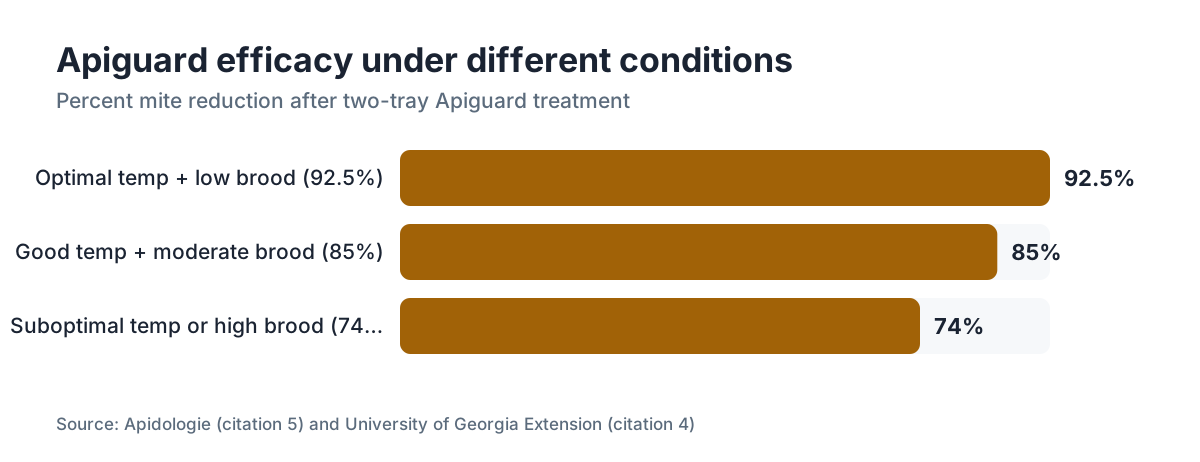
The honest answer: it varies more than the box suggests. Published efficacy runs from about 74% to over 90%, with the high end showing up in colonies that have low to moderate brood and steady daytime temperatures in the 70s Fahrenheit [4][5].
Here's a summary of the variables that push efficacy up or down.
| Variable | Higher efficacy | Lower efficacy |
|---|---|---|
| Temperature | 65°F to 85°F daytime | Below 60°F or above 95°F |
| Brood level | Low (late summer, post-flow) | High (heavy laying queen) |
| Colony size | Medium to large | Very small (can't distribute gel) |
| Spacer present | Yes | No spacer, cover pressing on tray |
| Timing | Two full 14-day cycles | Single tray or shortened second cycle |
A peer-reviewed study in Apidologie reported 92.5% efficacy under optimal temperature and brood conditions, compared to 74% in suboptimal ones [5]. Nobody has pinned down one clean number because hive-to-hive variation runs large.
Apiguard is not the strongest tool you own when mite loads are very high (say 4% or more) heading into winter. In that spot I'd reach for Apivar or oxalic acid vapor for faster knockdown. Apiguard earns its place for moderate loads and for beekeepers who want a naturally derived option with zero risk of amitraz or pyrethroid resistance.
Are there situations where Apiguard won't work well in a Langstroth hive?
Yes, a few.
Cold climates with short summers are the biggest problem. If your reliable warm-weather window is under six weeks, you may not finish two full cycles before temps drop below 59°F. In that case oxalic acid vaporization fits better because it works at lower temperatures.
Very large colonies packed with brood also lose efficacy. Heavy brood means more mites sealed away from the vapor at any moment. Splitting the hive to cut brood before treating is one fix, but it adds management complexity.
Small colonies (fewer than four or five frames of bees) may not spread the gel well. The bees move thymol through contact and fanning; too few bees means patchy distribution and weak vapor in parts of the hive.
Apiguard also falls short if the colony is already stressed by disease, queenlessness, or starvation. A sick colony can't process and distribute the gel properly, and thymol at treatment strength can add stress to bees that are already struggling. Diagnose and fix the underlying problem before you treat.
Is Apiguard safe for your bees, the beekeeper, and honey consumers?
For bees: at label rates, healthy colonies tolerate Apiguard well. Some brood reduction and a temporary population dip can happen, mostly in hot weather when thymol releases faster. That's normal and bees bounce back. I've watched beekeepers panic over a few cups of bees on the landing board in the first few days. It's usually foragers leaving to dodge the smell, not a toxicity event. Mass mortality (several thousand dead bees) means something else is wrong or temps spiked well past 95°F.
For queens: there's a documented risk of queen loss if the gel sits too close to the cluster during cold snaps, or in very small colonies where the queen can't move away from the vapor. Keep the tray on the top bars rather than pushed against the cluster, and the risk stays low.
For the beekeeper: thymol irritates eyes, skin, and airways. Handle the trays with gloves and keep your face out of the open gel. It isn't acutely toxic at these concentrations, but it isn't pleasant either.
For honey: the EPA registration review found that thymol residues in honey treated to label are within safe limits [2]. The ban on treating with supers on is the control that makes that true. A study in the Journal of Agricultural and Food Chemistry found thymol residues in honey from Apiguard-treated colonies ran from trace levels to about 1.0 mg/kg, far below the 10 mg/kg maximum residue level set by some European regulators [6].
How does Apiguard compare to other varroa treatments for Langstroth hives?
Here I'll be direct about tradeoffs instead of listing options.
Apivar (amitraz strips) is faster and harder-hitting for high mite loads. It works across a wider temperature range and kills more consistently through the brood cycle thanks to a longer exposure window. The downsides are amitraz resistance in some mite populations and a longer residue concern for wax. In a panic with a colony collapsing in August, Apivar is probably the call.
Oxalic acid (dribble or vapor) is the standard for broodless colonies. Kill on phoretic mites lands around 97% to 99% when there's no capped brood [7]. The catch is that it needs broodless conditions or repeated vapor treatments (every 5 days for about 5 rounds) to work through a brood cycle. Vaporization also needs a specific applicator and ventilation care.
Apiguard sits in the middle: naturally derived, decent efficacy across most colony sizes, no special gear beyond a spacer rim, and a clean honey safety profile. It's my go-to first treatment in late summer before switching to oxalic acid for a late-fall or winter broodless treatment.
Mite Away Quick Strips (formic acid) are also naturally derived and penetrate capped brood, which beats Apiguard on that front. But formic acid has a tighter temperature window (50°F to 85°F for the quick strips) and kills more bees in hot weather.
For a full side-by-side with costs and timing, a tracking tool like the one at VarroaVault helps you plan which treatments to stack across the season.
What does the Apiguard label actually require you to do, legally?
The EPA-registered Apiguard label (Reg. No. 66916-1) is the legal document governing use in the United States [2]. The binding requirements, in plain language:
You must remove honey supers before application. Treating with supers on breaks federal pesticide law (FIFRA). This applies even to supers you don't plan to harvest that season.
You must run the full two-tray protocol (two 50 g doses, 14 days apart). A single tray at a lower dose is off-label use.
You must not apply when temperatures sit consistently below 59°F or above 105°F.
You must not replace honey supers on the hive until at least two weeks after the second tray comes off. In practice, most beekeepers leave supers off for the rest of the season by that point anyway.
The label also states Apiguard is for managed bee colonies only. You can't legally use it on feral colonies you don't manage.
State registration matters too. A handful of states require separate state-level pesticide registration on top of the federal EPA label. Check with your state department of agriculture before using any varroa treatment for the first time. The National Pesticide Information Center maintains links to state pesticide offices [8].
For supplies including Apiguard and spacer rims, see our beekeeping supplies resource.
How do you monitor whether the treatment actually worked?
Post-treatment monitoring isn't optional. It's the only way to know if you need a follow-up before winter. Do a mite wash (alcohol wash or sugar roll) two to three days after removing the second tray. Compare it to your pre-treatment count.
Start at 3% and end at 0.5%, and the treatment worked. Start at 3% and end at 2%, and something limited it, whether temperature, brood level, or a spacer problem. In that case a round of oxalic acid vapor (every 5 days, 3 to 5 rounds) can clean up the stragglers before the colony forms its winter cluster.
The Honey Bee Health Coalition recommends keeping mite levels below 2% going into winter, and 1% or lower if you can hit it [3]. Some researchers argue the threshold should sit closer to 0.5% for colonies facing severe winters where the cluster won't break for months.
Keep records. Treatment start date, pre-count, post-count, temperature notes, whether the tray got fully consumed. This sounds tedious, but it takes five minutes per hive and it changes how well you decide the following year. A notebook works. So does a spreadsheet or a treatment log in a varroa management app.
Can you use Apiguard alongside other varroa treatments?
Generally no, not at the same time. Combining varroa treatments simultaneously is off-label, raises residue concerns, and the evidence that it improves efficacy enough to justify the added stress on bees is thin.
What beekeepers do succeed with is sequential treatment: Apiguard in late summer (August to September), then oxalic acid vaporization in late fall or winter when the colony is broodless or nearly so. That combination covers the full mite life cycle across two windows and lines up with the Honey Bee Health Coalition's integrated pest management framework [3].
If Apiguard underperformed because of cold or heavy brood, switching to Apivar strips right after the Apiguard cycle is an option. Wait a few days after removing the final tray before placing Apivar. It's not a hard label requirement, but it gives the colony a brief rest.
Don't run Apiguard and formic acid products together. Both are volatile and combining them stresses bees more than either alone. This isn't spelled out as prohibited on the Apiguard label, but no trial data I've seen supports it, and it's a bad idea in practice.
Frequently asked questions
Do I need to remove the queen before applying Apiguard?
No. You don't need to remove the queen. The main queen-related risk is that she may slow laying briefly because of the thymol scent. Keep the tray on the top bars, not jammed against the cluster, and in a healthy full-sized colony this rarely causes a problem. Very small colonies with queens that can't move away from the vapor carry higher risk; feed and strengthen them first.
Can I use Apiguard in a nuc or a small colony?
You can, but efficacy drops in colonies with fewer than four or five frames of bees. Small colonies struggle to spread the gel, so vapor concentration is uneven. For a nuc, use half a tray (about 25 g) as the Apiguard label states for small colonies, and keep a spacer in place. A post-treatment mite wash matters even more after treating small colonies.
What do I do if my bees beard heavily or seem agitated after I place the Apiguard tray?
Some bearding and extra outside activity in the first 24 to 48 hours is normal. Bees dislike the thymol smell and many will hang outside the entrance. This usually settles by day three. If you see mass mortality or thousands of dead bees on the landing board, check that temperatures didn't spike above 95°F and that the tray is gel-side up. True toxicity events at label rates are rare.
How long after the last Apiguard tray can I put honey supers back on?
The Apiguard label requires waiting at least two weeks after removing the second tray before replacing honey supers. In most late-summer timelines the fall nectar flow hasn't started yet anyway, so this rarely constrains you. If you live where a real fall flow happens, set your start date so the four-week treatment plus two-week wait clears before that flow begins.
Does Apiguard leave residues in beeswax?
Thymol does accumulate in beeswax at low levels. Studies have found residues typically between 0.01 mg/kg and 0.1 mg/kg in wax from treated hives, far below levels that harm bees [6]. Unlike amitraz or pyrethroids, thymol doesn't build up in wax over multiple seasons to problem concentrations. For beekeepers who care about wax purity, thymol-based treatments are among the safest options going.
Why does Apiguard say to peel the foil back only partway?
The foil is a release-rate control. Peel it fully off and thymol volatilizes too fast, which stresses bees and causes more brood and queen disruption. Peel it halfway and the bees chew through the rest at their own pace, spreading exposure across the full two weeks. Follow this exactly as the label describes. It's one of those small details that genuinely changes the outcome.
Can Apiguard be used in a top-bar or Warré hive, more than Langstroth?
Apiguard is registered for managed honey bee colonies and doesn't specify hive type, but the tray format is built for Langstroth-style top bars. In a top-bar hive you can rest the tray on the bars near the cluster and tent a piece of cardboard above it to hold vapor. That's an off-label improvisation, not a formally tested approach, so results vary. Langstroth hives are the most straightforward application.
What if I forget to add the second tray at exactly 14 days?
A day or two either side of 14 days won't ruin the treatment. If you're at 12 days and the first tray is nearly empty, go ahead and swap it. Delayed to day 16 or 17? Still complete the second tray. The two-tray protocol is based on the worker brood capping cycle running roughly 12 days; the point is that the second tray catches mites from the first brood cohort that emerged during treatment.
Is Apiguard approved for organic beekeeping?
In the United States, thymol is generally accepted for use in certified organic beekeeping, but approval depends on your certifying agency. The USDA National Organic Program lists thymol as allowed, though individual certifiers may add requirements [10]. Always check with your specific certifier before applying any treatment to hives you plan to market as producing organic honey. Documentation of the product, date, and colony is typically required.
How much does Apiguard cost and how many hives does one box treat?
One box holds two trays and treats one hive for the full four-week protocol. US retail prices for single boxes typically run $12 to $18; larger packs (10-tray or 20-tray) drop the per-hive cost to $8 to $12. Prices vary by supplier and year. Buying in bulk at the start of the season is almost always cheaper than grabbing one box at a time when you spot a problem mid-season.
Can Apiguard resistance develop in varroa mites?
No confirmed thymol resistance has been documented in Varroa destructor in peer-reviewed literature through the most recent surveys. That's one reason naturally derived treatments like thymol are valued: their mode of action is less specific than synthetic acaricides, which makes resistance harder to build. This doesn't mean resistance is impossible, but it hasn't been observed in practice, unlike the well-documented amitraz and tau-fluvalinate resistance in parts of the US and Europe.
Should I treat every hive in my apiary at the same time?
Yes, treat all colonies simultaneously. If you treat some and skip others, mites from untreated colonies drift into treated ones on returning foragers and robbers, reinfesting hives you just cleaned. The Honey Bee Health Coalition specifically recommends coordinated apiary-wide treatment for this reason [3]. If you run multiple apiaries, try to treat them in the same season window, understanding you may have to stagger by a few days.
What mite count triggers the need for a follow-up treatment after Apiguard?
If your post-treatment alcohol wash shows 2% or more (2 mites per 100 bees) within a week of finishing the second tray, follow up before winter. The Honey Bee Health Coalition recommends entering winter below 2%, with 1% or less the safer target [3]. Oxalic acid vaporization is the most common follow-up because it works when temperatures drop below what Apiguard needs.
Sources
- Vita Bee Health, Apiguard product page: Apiguard contains 25% thymol as the active ingredient in a slow-release gel formulation
- EPA, Apiguard product label (Reg. No. 66916-1): Apiguard EPA registration number 66916-1; label requires removal of honey supers, two 50 g doses 14 days apart, temperatures between 59°F and 105°F
- Honey Bee Health Coalition, Tools for Varroa Management Guide (7th edition): HBHC recommends a 2% mite threshold (2 mites per 100 bees) as treatment trigger in late summer; recommends treating all colonies simultaneously; recommends late-summer treatment to protect winter bees
- University of Georgia Cooperative Extension, Varroa mite management: University of Georgia trials found Apiguard efficacy ranging from 74% to 93% depending on temperature and brood level at time of treatment
- Apidologie, thymol efficacy against Varroa destructor: Peer-reviewed Apidologie study reported Apiguard efficacy of 92.5% under optimal temperature and brood conditions, 74% in suboptimal conditions
- Journal of Agricultural and Food Chemistry, thymol residues in honey from Apiguard-treated colonies: Thymol residues in honey from Apiguard-treated colonies ranged from trace to approximately 1.0 mg/kg, well below the 10 mg/kg maximum residue level; thymol accumulation in beeswax typically 0.01 to 0.1 mg/kg
- USDA Agricultural Research Service, oxalic acid efficacy in broodless colonies: Oxalic acid treatment of broodless colonies achieves mite kill rates of 97% to 99% on phoretic mites
- National Pesticide Information Center, state pesticide regulatory agencies: NPIC maintains links to state pesticide regulatory offices for verifying state-level pesticide registrations
- Penn State Extension, Varroa mite management for honey bee colonies: Penn State Extension describes the Apiguard two-tray protocol and spacer rim requirement for Langstroth hives
- USDA National Organic Program, allowed materials list: Thymol is listed as an allowed substance under the USDA National Organic Program for use in organic beekeeping
Last updated 2026-07-09