How to use varroa mite strips: a practical step-by-step guide
TL;DR
- Varroa mite strips suspend a miticide (amitraz, tau-fluvalinate, or hops beta acids) in a slow-release carrier hung between brood frames.
- Bees pick it up by contact and spread it.
- Place the label-specified number of strips for your colony size, leave them in for the full duration (6-8 weeks for Apivar), then remove them all.
- Test with an alcohol wash before and after.
What are varroa mite strips and how do they work?
Varroa mite strips are thin plastic or cardboard carriers soaked in a miticide. As bees walk across them, they pick up the active ingredient on their bodies and carry it through the colony by contact. A mite dies when it feeds on a treated bee or touches the chemical directly. The whole system runs on bee traffic, which is why placement next to the brood matters so much.
Three active ingredients cover almost every strip product sold in the U.S. right now. Amitraz is in Apivar and Apitraz. Tau-fluvalinate is in Apistan. Hops beta acids are in HopGuard 3. Fluvalinate shows up in older or imported products. Each works through a different mechanism, which matters for resistance and for knowing which hives you can treat when. [1]
Strips do not fix everything on their own. Amitraz products need the colony to cycle through brood, because mites sealed inside capped cells sit protected during the treatment window. The strip kills phoretic mites on adult bees very well. The ones tucked inside capped brood stay safe until they emerge. That is why the Apivar label runs a 6-week minimum: the colony has to hatch out enough brood for those mites to walk into contact with the strip. [2]
Want the biology behind all of this? The varroa mite article walks through the full reproductive cycle.
Which varroa strip product should you choose?
The right product depends on what you used last, your colony's resistance history, the season, and whether honey supers are on. Here is a plain comparison:
| Product | Active ingredient | Treatment duration | Honey super restriction | Resistance risk |
|---|---|---|---|---|
| Apivar | Amitraz 3.3% | 6-8 weeks | Remove supers during treatment | Moderate; resistance documented in some apiaries [3] |
| Apistan | Tau-fluvalinate 10% | 6-8 weeks | Remove supers during treatment | High; widespread resistance in many U.S. regions [4] |
| HopGuard 3 | Hops beta acids | 3 strips per brood cycle, up to 3 cycles | Can be used with honey supers on (per label) | Low; no resistance documented yet |
| Oxalic acid (Api-Bioxal dribble/vapor; extended-release strips pending wider EPA registration) | Oxalic acid | Per label | Check current label | Very low |
Never tested for fluvalinate resistance? Skip Apistan. University of Florida IFAS Extension documented fluvalinate-resistant mite populations across Florida and the southeast by the early 2000s, and the problem has spread since. [4] Amitraz resistance is real but patchier. Rotate away from it if you have run Apivar exclusively for three or more years.
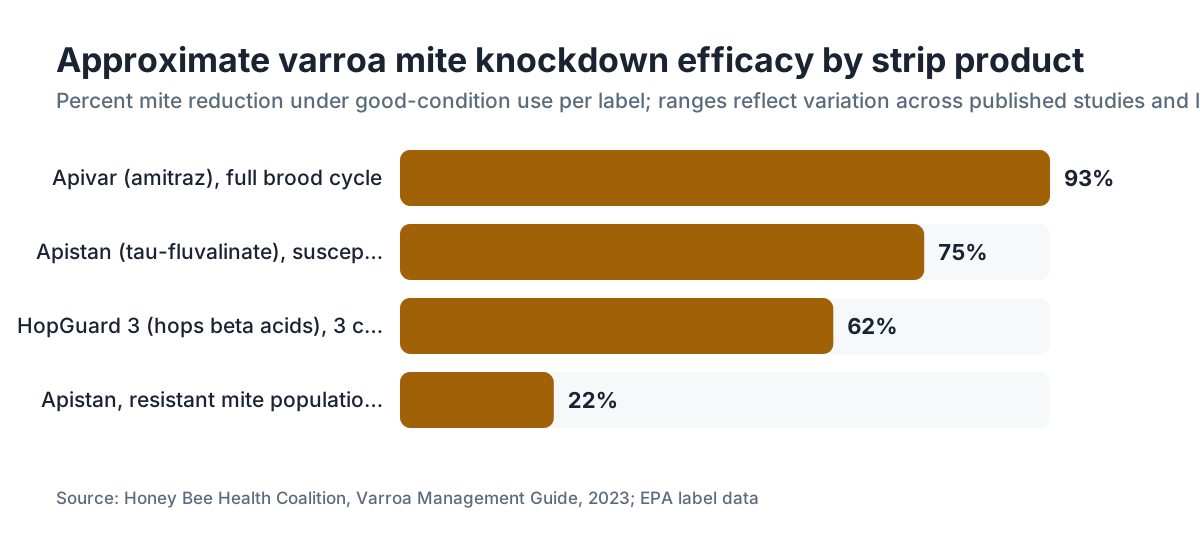
HopGuard 3 is the clean pick when honey supers are on and you still need to treat. The label allows it with supers in place, which no amitraz or fluvalinate product does. Efficacy runs lower than Apivar in a heavy infestation (figure 50-70% knockdown versus 90%+ with Apivar under good conditions), so treat it as a suppression tool between main treatments, not a rescue for a collapsing colony. [5]
One honest note. If your mite load is above 3% on an alcohol wash in midsummer, that is not the moment to experiment with a weaker option. Use Apivar, pull the supers, drive the mites down, then think about rotation.
What mite level actually requires treatment?
The Honey Bee Health Coalition's Varroa Management Guide gives the most widely accepted U.S. thresholds. During honey season (spring through midsummer), treat when mites hit 2% on an alcohol wash, meaning 2 mites per 100 bees. In late summer through fall, when winter bees are being raised, that threshold drops to 1%. [6]
Some extension programs use 2-3 mites per 100 bees as their spring and summer action threshold and note that below 1% you can monitor and hold. Above 3% in late summer is an emergency. A colony building its winter bee population under a heavy mite load rears bees infected with deformed wing virus straight through those weeks, and those bees will not survive winter no matter how good your setup is.
Alcohol wash beats sugar roll on accuracy. The Honey Bee Health Coalition puts alcohol wash recovery at roughly 95% against sugar roll's 60-70%. [6] Take a half-cup sample (roughly 300 bees) from a frame next to the brood, where phoretic mite loads run highest.
Want help tracking counts across the season? VarroaVault's free monitoring tools let you log washes and flag the moment you cross a threshold.
How do you install varroa mite strips correctly?
Read the label the day you treat. I mean that literally. The EPA-registered label is the law, and strip products carry specific requirements on strip count, placement, and timing that differ by product. [7]
For Apivar (amitraz), the label calls for 2 strips per colony up to 5 frames of bees, and 4 strips for colonies larger than 5 frames. Hang them vertically in the brood area, one on each side of the main cluster, touching the frames. Bees need maximum contact with the strip surface.
Here is the step-by-step for any strip product:
- Run an alcohol wash 48-72 hours before treatment for your baseline count. Write it down.
- Remove all honey supers if the label requires it. For Apivar, that is mandatory.
- Put on gloves. Amitraz absorbs through skin and is a mild toxin under repeated exposure. Nitrile gloves work.
- Open the package. Most strips come scored or pre-cut. Do not fold or bend them before placing.
- Find the brood frames. You want the strips hanging in the space between frames that hold brood, not out in empty comb.
- For a single brood box, place one strip between frames 3 and 4 from one wall, another between frames 7 and 8 (roughly). For double brood, add a strip to each box.
- Hook or hang the strip so it touches bees as they move through the hive. Apivar strips have a small hook at the top. Use it.
- Close up and record the treatment date and product name.
Do not drop a strip in the honey super by mistake. That is an adulterant contamination problem and a legal violation under FIFRA. [7]
HopGuard 3 goes in differently. The strips fold over the top bars instead of hanging vertically. Use 1 strip per 5 frames of bees, and the label allows up to 3 strips per box. Make sure the strip drapes down both sides of the top bar so bees touch it from below.
How long do you leave varroa strips in the hive?
Duration is not negotiable. Pulling strips early is one of the most common treatment failures.
Apivar (amitraz): minimum 6 weeks, maximum 8 weeks per label. Leave strips in past 8 weeks and you raise the risk of amitraz residue building in wax. Amitraz has been detected in wax at levels that can affect brood in later seasons when treatments run long. [8]
Apistan (tau-fluvalinate): 6-8 weeks. Same reasoning.
HopGuard 3: each application lasts one brood cycle, roughly 3 weeks. The label allows up to three consecutive applications, so a full course can run 9 weeks.
A practical tip. Write the removal date on painter's tape and stick it to the outside of the hive body when you put the strips in. Simple. It works. You will thank yourself when you have 10 hives and a bad memory in week 7.
Run a second alcohol wash 48 hours after removal. If your mite load dropped below threshold, you are done. If it did not fall by at least 50-60%, you have a problem: the treatment failed (possible resistance, poor placement, strips fell off frames), or reinfestation from nearby colonies is already underway. [6]
Can you use varroa strips when honey supers are on?
For amitraz and fluvalinate products, no. Full stop. Both Apivar and Apistan labels flatly prohibit use with honey supers in place. Amitraz residues in honey carry a very low tolerance under FDA guidelines, and fluvalinate residues in beeswax are already a chronic background problem in managed colonies worldwide. [8]
HopGuard 3 is the exception. The EPA label allows use while supers sit on the hive. It is the only widely available strip option with that permission in the U.S. as of 2025.
So your treatment calendar has to account for honey flow timing. Plenty of beekeepers in the northeast and midwest run a June-July honey flow that collides with the late-spring mite surge. The standard move: pull supers, treat with Apivar for 6-8 weeks through July, re-super in August for any late goldenrod or clover. That timing also lines up with the late-summer mite reduction you need before winter bees come on.
If you truly cannot pull supers and mites are climbing, HopGuard 3 beats no treatment. Go in with realistic expectations about efficacy.
How do you remove and dispose of used varroa strips?
Remove strips on schedule. Used strips still carry residual active ingredient. They are pesticide waste, and you handle them as such.
Wrap used strips in the original packaging or a sealed plastic bag. The EPA recommends disposing of pesticide waste at a hazardous waste collection facility where one exists, or following your state's pesticide disposal guidelines. Do not compost used strips, toss them on a brushpile, or leave them in the hive. [7]
Amitraz strips especially: some beekeepers find colonies chewing on old strips left behind. That risks concentrated toxic exposure. Remove them.
After you pull Apivar strips, look at the frames where they hung. Beeswax buildup on the strip surface is normal and does not hurt efficacy during the treatment window, but it is a reminder of why wax residue matters over multiple treatment years.
Glove up for removal the same way you did for placement. If your gloves touched the strip surface, dispose of them with the strips.
What mistakes cause varroa strip treatments to fail?
Treating without knowing your mite load first. No pre-treatment count means no way to tell whether the treatment worked. This is the single most common error.
Poor placement. Strips hanging in empty comb away from the brood cluster get almost no traffic. The colony has to walk across the strip constantly for weeks. If your bees shift to one side of the box, move the strip to follow the cluster.
Strips falling off the frames. This happens in small colonies or after a split, when frame count drops. Check at week 2 to confirm strips are still in position.
Treating during a nectar flow with a packed brood nest. A booming colony in a June flow can hold so much capped brood that the share of exposed phoretic mites is tiny. You get some knockdown, far less than you would after a brood break or in fall. That is one reason late summer and early fall is the most important treatment window of the year.
Reinfestation. When neighboring colonies collapse with mite loads above 10%, their bees drift and rob into your hive and haul mites along. You treat, mites drop, then climb again in three weeks. The fix is coordinated treatment across your apiary (and ideally your neighbors') in the same window. The Honey Bee Health Coalition calls this the "mite bomb" problem and recommends treating all colonies in an apiary at once. [6]
Ignoring resistance. Run the same product three or more years and keep seeing weak knockdown (under 50% reduction)? Test for resistance or just rotate products. Iowa State University Extension has a useful resistance monitoring protocol built on comparing alcohol wash counts with and without treatment. [9]
How should you rotate varroa strip treatments to prevent resistance?
Resistance in Varroa destructor to synthetic acaricides is well-documented and picking up speed in some regions. The mechanism is simple. You treat a population, the few mites with natural resistance survive and breed, and within a few generations the population skews toward resistance. Every treatment cycle adds to that selection pressure.
The rule most extension programs give: do not use the same active ingredient class more than two years running before you rotate to a different mode of action. [9]
Amitraz (Apivar) and fluvalinate (Apistan) are different classes. Oxalic acid (vaporization, dribble, or extended-release strip-type formats) is a third class with a completely different mode of action and essentially zero documented resistance as of 2025. HopGuard runs on hops beta acids, also distinct.
A simple three-year rotation for a beekeeper using strips:
- Year 1: Apivar (amitraz)
- Year 2: Oxalic acid extended release or vaporization (brood-free period if you can manage one)
- Year 3: Apivar again, or HopGuard 3 if you need to treat during a flow
Skip Apistan unless you have tested your local mites and confirmed they are still susceptible. Across much of the U.S., fluvalinate resistance is effectively universal, and using Apistan wastes money and burns a treatment slot.
For buying strips and other supplies at fair prices, the beekeeping supply companies roundup lists vendors carrying the full range of EPA-registered products.
Are varroa strips safe for bees, the beekeeper, and honey?
Used per label, strip treatments have an acceptable safety profile for the colony. That caveat carries weight.
Amitraz can trigger queen loss or brood disruption at high temperatures. The Apivar label warns against use when hive interior temperatures regularly top 100 degrees Fahrenheit (38 degrees Celsius). In hot climates, treat in the morning or in fall rather than midsummer. [2]
For you, amitraz is a formamidine insecticide and mild neurotoxin. Exposure from normal strip handling is low, but chronic skin contact is worth avoiding. Wear gloves. Wash your hands. Do not handle strips in a closed space without ventilation.
Tau-fluvalinate (Apistan) has a favorable bee-safety profile because it was picked for low toxicity to Apis mellifera at these doses, though it is toxic to other pollinators at higher doses.
Honey contamination with amitraz is possible if strips stay in during a nectar flow with supers on, which is exactly why the label bans that use. Mullin and colleagues, in their 2010 PLOS ONE survey of North American apiaries, found amitraz and its metabolite DMPF in honey and beeswax from treated hives. [8] Follow the label and this is not a practical risk.
Beeswax contamination with fluvalinate is a chronic background issue that label compliance does not fully solve. Fluvalinate is lipophilic and accumulates in wax over years of treatment. That is an argument both for rotating away from Apistan and for replacing old brood comb on a schedule.
When is the best time of year to use varroa mite strips?
There are two treatment windows you do not skip and one optional cleanup round.
Late summer (August through early September across most of the U.S.) is the big one. This is when you knock mites down before the colony starts raising winter bees. Winter bees live for months, and any raised under a heavy mite load carry deformed wing virus damage and die before spring. Penn State Extension names late summer, roughly August through early September in northern states, as the most important treatment window precisely because mite loads then shape the health of the winter bees. [10]
Spring (April-May) is the second window. Colonies grow fast, mite populations start to climb, and treating before the curve gets steep saves you from a crisis in June or July.
Fall, after your summer treatment is out: some beekeepers add a light oxalic acid treatment (dribble or vaporization during a brood-free stretch) once Apivar is pulled, as a cleanup round. That is not a strip treatment, but it pairs well with a strip program.
What you want to dodge is treating during a major nectar flow with a product that needs the supers off, because then you either lose honey or skip the treatment. Plan your treatment calendar in January, before the season starts, so you are not making reactive calls in July.
The varroa mite article has a fuller breakdown of the mite population growth curve through the season if you want the timing biology.
Do varroa strips work in small colonies or nucs?
Yes, but adjust the count and placement. Apivar labels call for 1 strip in nucs or very small colonies (under 3 frames of bees). A full 2-strip dose in a 3-frame nuc can cause queen problems, especially in heat.
For HopGuard 3 in nucs, drop to 1 strip per 5 frames of bees per the label, which in a 4-5 frame nuc means 1 strip.
Small-colony placement matters more than in a full hive because the cluster is smaller and the strip has to sit right where the bees are. A strip against the outside wall of a 4-frame nuc gets almost no contact. Center it.
Splits and freshly hived packages often carry low mite loads, since you start with a small population and no brood history. Still worth an alcohol wash 2-3 weeks after hiving to set your baseline. Mites from the mother colony or from local drift can establish fast.
Frequently asked questions
How many varroa strips do I need per hive?
Apivar labels call for 2 strips in colonies up to 5 frames of bees and 4 strips in larger colonies. HopGuard 3 uses 1 strip per 5 frames of bees. Always default to the current product label for the exact count, since formulations and registrations change. Adding extra strips does not improve results and can stress smaller colonies.
Can I use varroa strips while honey supers are on?
Only HopGuard 3 is labeled for use with honey supers in place. Apivar (amitraz) and Apistan (tau-fluvalinate) both require supers off before treatment. Using amitraz or fluvalinate with supers on is a label violation and risks honey contamination above FDA tolerances. Plan your treatment calendar around your local nectar flow to sidestep the conflict.
How long do you leave Apivar strips in the hive?
The Apivar label requires a minimum of 6 weeks and a maximum of 8 weeks per treatment. Removing strips before 6 weeks is a common cause of failure, because mites reproducing inside capped brood have not yet emerged for full contact exposure. Leaving strips past 8 weeks raises the risk of amitraz residue building up in beeswax.
What mite count triggers treatment?
The Honey Bee Health Coalition recommends treating when an alcohol wash shows 2% or more mites (2 per 100 bees) in spring and summer, and 1% or more in late summer and fall when winter bees are being raised. Below 1% you can monitor and hold. Above 3% in August is an emergency requiring immediate treatment regardless of honey flow timing.
Do varroa strips kill mites inside capped brood?
No. Strip miticides kill phoretic mites on adult bees by contact. Mites sealed inside capped brood cells stay protected during treatment. That is why duration matters: the colony has to cycle through enough brood for all mites to eventually emerge into contact with the strip. A summer brood cycle takes roughly 21 days, so a 6-week minimum covers multiple cycles.
Can varroa mites become resistant to Apivar strips?
Yes. Amitraz resistance in Varroa destructor has been documented in some U.S. apiaries, though it is not yet as widespread as fluvalinate resistance. Watch for mite loads that barely drop after a full Apivar course. Rotating to oxalic acid or HopGuard 3 every second or third year eases the selection pressure. Do not run Apivar as your only product year after year.
Are Apistan strips still effective?
In many U.S. regions, no. Fluvalinate resistance in Varroa destructor was well-documented by the early 2000s and has spread broadly since. University of Florida IFAS Extension and other programs have found near-universal resistance in some southeastern populations. Before using Apistan, check with your state apiarist or local extension service about resistance rates in your region.
How do I know if my varroa strip treatment worked?
Run an alcohol wash 48 hours after removing strips and compare it to your pre-treatment count. A successful treatment should cut mite load by at least 50-60%, ideally more. If you started at 3% and ended at 2.5%, something went wrong: poor placement, strips fell out, possible resistance, or fast reinfestation from neighboring colonies. Investigate before you blame the product.
What do I do with used varroa strips after removal?
Seal used strips in the original packaging or a zip-lock bag. They are pesticide waste. Dispose at a household hazardous waste collection site, or follow your state's pesticide disposal guidance. Do not compost them or leave them in the hive. Amitraz left on an old strip can cause toxic exposure if bees chew on it, and disposal rules under FIFRA apply.
Can I treat a queenless colony with varroa strips?
You can, but results are better in queenright colonies, because active brood rearing creates more traffic across the strips. A queenless colony also has a natural brood break, which cuts the mite population anyway since reproduction stops. If you are requeening, treat after the new queen is laying to get the benefit of both the brood break and the strip working on emerging mites.
How do HopGuard 3 strips differ from Apivar strips?
HopGuard 3 uses hops beta acids instead of amitraz. It is approved for use with honey supers on, has no documented mite resistance, and folds over the top bars rather than hanging vertically. Efficacy in heavy infestations runs lower than Apivar (roughly 50-70% knockdown versus 90%+). It works well as a mid-season suppression tool or when you cannot pull supers.
Is it safe to use varroa strips in a hive I will harvest honey from?
It depends on the product. HopGuard 3 is labeled for use with supers on and needs no honey withholding period. Apivar and Apistan require supers off before treatment; once strips are out and supers go back on, honey produced after that point is not under the label restriction. Never treat with amitraz or fluvalinate when supers holding harvestable honey are on the hive.
What temperature is too hot for Apivar strips?
The Apivar label warns against use when hive interior temperatures regularly top 100 degrees Fahrenheit (38 degrees Celsius). Amitraz breaks down faster in heat, which shortens effective exposure, and there are reports of increased queen loss in very hot conditions. In hot climates, treat in fall or early morning during cooler stretches rather than at midsummer peak heat.
How do I find where to buy varroa strips?
Most beekeeping supply companies stock Apivar, Apistan, and HopGuard 3. Mann Lake, Dadant, and Kelley Bees all carry the major products. Buying from a supplier that also stocks alcohol wash cups and sticky boards lets you grab your full monitoring kit at once. Apivar typically runs $18-25 for a pack of 10 strips as of 2025, enough for 2-5 colonies depending on size.
Sources
- EPA, Pesticide Registration: EPA-registered varroa strip products include amitraz (Apivar), tau-fluvalinate (Apistan), and hops beta acids (HopGuard 3), each with distinct label requirements for use, timing, and honey super restrictions.
- Elanco Animal Health, Apivar Label (EPA Reg. No. 92277-1): Apivar label specifies 2 strips per colony up to 5 frames, 4 strips for larger colonies, minimum 6-week maximum 8-week treatment, supers must be removed, and caution against use above 100 degrees Fahrenheit.
- Honey Bee Health Coalition, Varroa Management Guide (2023): Amitraz resistance has been documented in some U.S. apiaries and the coalition recommends rotating active ingredients to slow resistance development.
- University of Florida IFAS Extension, Honey Bee Varroa Mite Management: Fluvalinate (tau-fluvalinate) resistance in Varroa destructor was documented in Florida and southeastern U.S. populations by the early 2000s and has spread broadly.
- BetaTec Hop Products, HopGuard 3 Label (EPA Reg. No. 87073-4): HopGuard 3 is labeled for use with honey supers in place, applied as 1 strip per 5 frames of bees for up to 3 consecutive brood cycles; efficacy is lower than amitraz-based products in heavy infestations.
- Honey Bee Health Coalition, Varroa Management Guide (2023): Recommended alcohol wash treatment thresholds: 2% mites per 100 bees in spring/summer, 1% in late summer/fall; alcohol wash recovers approximately 95% of mites vs. 60-70% for sugar roll; colonies in an apiary should be treated simultaneously to prevent mite bomb reinfestation.
- EPA, Safe Disposal of Pesticides: Pesticide products, including used miticide strips, are regulated under FIFRA; EPA recommends disposal at hazardous waste collection facilities or per state guidance, and prohibits off-label use.
- Mullin, C.A. et al., 'High Levels of Miticides and Agrochemicals in North American Apiaries', PLOS ONE, 2010: Amitraz metabolite (DMPF) and fluvalinate residues have been detected in honey and beeswax from treated colonies; fluvalinate is lipophilic and accumulates in beeswax over multiple treatment years.
- Iowa State University Extension and Outreach, Integrated Pest Management for Varroa Mites: Extension programs recommend rotating varroa treatment active ingredients and not using the same chemical class more than two consecutive years to reduce resistance selection pressure; resistance monitoring using pre- and post-treatment alcohol wash comparisons is recommended.
- Penn State Extension, Varroa Mite Management in Honey Bee Colonies: Late summer (August through early September in northern states) is the most critical varroa treatment window because mite loads directly affect the health of winter bees being raised during that period.
- USDA Agricultural Research Service, Bee Research Laboratory: Varroa destructor mites reproduce inside capped brood cells and are protected from contact miticides while capped; only phoretic mites on adult bees are exposed to strip-based treatments.
Last updated 2026-07-09