How varroa mites disrupt bee development and shorten bee lifespan
TL;DR
- Varroa mites slip into brood cells just before capping and feed on the developing bee's fat body, the organ that runs immunity and winter survival.
- Infested workers emerge lighter, immunocompromised, and often with crumpled wings.
- Their lifespan drops 40 to 50% versus healthy bees, and the colony's workforce collapses faster than most beekeepers expect.
What does varroa actually do inside a capped brood cell?
A foundress mite slips into a cell hours before the bees cap it, hides under the larval food, and starts reproducing within the first 60 to 70 hours after capping. That timing is deliberate. The mite needs the cell sealed before she lays, then she lays in a fixed sequence: one male egg, then up to five or six female eggs, each spaced roughly 30 hours apart along the cell wall.[1]
For years beekeepers were told mites feed on bee "blood" (hemolymph). That was wrong, and the correction changes how you should think about the damage. A 2019 study by Ramsey et al. in PNAS found varroa's main feeding site is the bee's fat body tissue, not the hemolymph.[2] The fat body does the job of a liver and an immune hub at once. It stores lipids, proteins, and vitellogenin, and it decides whether a bee can overwinter and fight off pathogens. Every mite that feeds on fat body tissue leaves a wound the bee carries for life.
The damage stacks because more than one mite can breed in a single cell. Worker cells stay capped about 12 days from sealing to emergence, long enough for the foundress to raise one or two reproductive daughters that make it to adulthood.[1] Drone cells stay capped roughly 14 to 15 days. That extra window is why drone brood carries mite rates three to eight times higher than worker brood, and why drone comb removal is a real management tool.[3]
By the time an infested bee chews through her capping, she has already lost a measurable chunk of her fat body mass, she carries a lifelong immune deficit, and she may show the start of wing deformity if the mite injected deformed wing virus (DWV) during a feeding bout.
How does varroa change the normal bee development timeline?
Honey bee development runs on a fixed clock. A worker egg hatches in three days, spends about six days as an open larva, then develops for 12 days under capped wax before it emerges. The capped pupal stage is exactly where varroa does its worst work.
The table below shows normal versus varroa-affected milestones for a worker bee:
| Stage | Normal timing | Effect of varroa infestation |
|---|---|---|
| Egg | Day 0 to 3 | No direct mite effect (cell open) |
| Open larva | Day 3 to 8 (post-hatch) | Foundress mite enters 15 to 20 hours before capping |
| Capped larva | Day 1 to 2 post-capping | Mite lays first (male) egg on cell wall |
| Pre-pupa | Day 2 to 4 post-capping | Mite begins feeding on fat body tissue |
| Pupa | Day 4 to 12 post-capping | Daughter mites feed; virus injection; wing tissue damaged |
| Emergence | Day 20 to 21 from egg | Bee emerges lighter, immunocompromised, possibly with deformed wings |
The mite's breeding schedule is locked to the bee's clock. The first daughter mite reaches sexual maturity around day 6 post-capping and mates with her male sibling inside the cell.[1] If that worker cell gets uncapped early for any reason, the mite's reproduction fails. That failure is the biological reason hygienic behavior works as a resistance trait.
Here is what beekeepers rarely account for: the cumulative hit to colony demographics. A summer colony raises a fresh generation of workers every 21 days. If 10% of cells carry breeding mites, the emerging workforce is more than 10% damaged. Because infested bees die young and pass virus to their nestmates, the real injury to colony function runs well above the raw infestation percentage.
How much does varroa shorten a bee's lifespan?
The number is stark. The Honey Bee Health Coalition's Varroa Management Guide reports that bees emerging from mite-infested cells live 40 to 50% shorter than their healthy sisters.[4] A summer worker that would normally last six weeks might survive three to four. A winter bee, which has to live five to six months to carry the colony to spring, may fail by January.
The mechanism is the fat body depletion described above. Fat body mass tracks directly with longevity, immune function, and the ability to make vitellogenin, the protein winter bees run on during broodlessness. A bee that emerges short on fat body mass is running on empty from day one.
Virus loading makes it worse. Varroa is the main transmission vector for deformed wing virus, and DWV titers in mite-infested bees can run ten thousand to one million times higher than in uninfested bees from the same colony.[5] High DWV loads shorten lifespan even in bees that emerge with normal-looking wings. You can have a bee that looks fine and is already broken.
There is a behavioral piece too. Infested bees tend to start foraging earlier than healthy bees, a pattern called precocious foraging. Foragers die faster than nurse bees under any conditions, so a cohort that heads out at five days instead of the usual 14 to 21 burns through its lifespan fast. The colony loses seasoned foragers, and it loses the wax production, brood feeding, and heat regulation that young nurse bees provide.
What is deformed wing virus and how does varroa transmit it?
Deformed wing virus is a single-stranded RNA virus in the picornavirus family. It sits at low, latent titers in nearly every managed colony on earth. Without varroa, it rarely causes visible disease. With varroa, it becomes the dominant pathogen in collapsing colonies.[5]
Transmission is mechanical. When a mite feeds on fat body tissue, it opens a wound in the cuticle, and saliva or gut contents carrying viral particles drop straight into the bee's hemolymph. That bypasses the gut's immune filtration, which is why mite-vectored DWV titers dwarf what oral exposure produces.
The visible symptom is crumpled, shortened wings, the result of viral interference with wing disk development during the pupal stage. But the wings are only the part you can see. Bees with high DWV titers and normal-looking wings show impaired learning, sloppier waggle dances, weakened immune gene expression, and shorter lives.[5] A colony where even 1 to 2% of bees show visibly deformed wings is already well past the point where mite loads were safely low.
The Honey Bee Health Coalition calls varroa-vectored DWV "the primary driver of colony losses associated with varroa" in temperate climates.[4] Varroa also moves sacbrood virus and acute bee paralysis virus, but DWV is the one that decides whether a colony survives.
Why does varroa damage accelerate so fast in late summer?
Varroa populations grow exponentially because each breeding cycle feeds the mite pool while the brood that hosts them stays roughly flat. Under good brood conditions the mite population can double every four to six weeks.[4]
In spring and early summer, big brood volumes dilute the mites. The ratio of mites to cells stays workable. Late summer flips it. The queen throttles back egg-laying as days shorten, brood volume drops, and the same mite count crams into fewer cells. Infestation per cell spikes.
The bees emerging in August and September are the bees that carry the colony through winter. Raise those bees in heavily infested cells and the colony enters winter with a workforce of short-lived, immunocompromised bees that cannot hold cluster temperature or rear enough spring brood to rebuild. That is why colonies that look fine in October die in February. The damage was done in August.
This is why extension apiculture programs, including Penn State and North Carolina State University, push an oxalic acid or other mite treatment in late summer specifically to protect the winter bee cohort.[3][6] Treating in October is too late for the bees that actually matter.
To track your mite loads through this window, the free protocol tools at VarroaVault help you build a monitoring calendar keyed to your local forage and brood cycle, so you catch the August threshold before it becomes a February funeral.
How does varroa affect drone development differently from workers?
Drones are varroa's preferred host, and the developmental math explains it. Drone brood stays capped 14 to 15 days versus 12 days for worker brood.[1] Those extra two to three days give the foundress mite time to raise more viable daughters, so mite reproductive success runs higher in drone cells. Studies consistently find mite rates in drone brood three to eight times higher than in worker brood from the same colony.[3]
Drones also drift between colonies and visit multiple hives, which turns them into carriers that spread infestations across apiaries. A mite-loaded drone from an untreated colony can drop mites into your hive when he tries to enter.
For the drone himself, the damage mirrors the worker's: fat body depletion, virus injection, lower viability. Heavily infested drones may emerge with deformed wings, reduced sperm viability, or both. Colonies under high mite pressure often produce lower-quality drones at exactly the time of year when virgin queens need to mate, which drags down the genetics of the next queen generation.
Drone comb removal exploits this preference. Put a drone-sized foundation frame in the hive, let the bees fill and cap it, then pull and freeze it. You physically lift out a concentrated mite load before those mites finish breeding and re-enter the worker population. It takes labor and it is not enough on its own, but it is a legitimate adjunct.
Does varroa affect queen development and queen quality?
Queen cells stay capped only about 8 days, shorter than worker cells. That compressed window cuts the risk of varroa infestation but does not erase it. Mite reproductive success in queen cells is low because the timeline is so tight, but a mite present during queen development can still cause fat body damage and pass virus.
More often, varroa hits queen quality indirectly. A colony under heavy mite pressure raises emergency queens from compromised larvae. Those larvae already carry elevated virus titers and reduced fat body mass. The resulting queens can look normal but live shorter lives, lay at lower rates, or store sperm poorly.
There is a second indirect path through the nurse bees. Queen larvae eat royal jelly made by nurse bees. If those nurses are varroa-damaged, their hypopharyngeal glands, the glands that make royal jelly, may run at reduced capacity. Queen larvae fed nutritionally thin royal jelly during the sensitive early days grow into smaller, weaker queens.
Nobody has clean controlled data on exactly how much varroa cuts queen quality in the field, because too many variables tangle together. But the circumstantial case from colony loss patterns is strong: colonies going into winter with high mite loads often report queen failure as the proximate cause of spring collapse, even when nobody is still measuring the mite load itself.
What mite infestation level is actually dangerous for the colony?
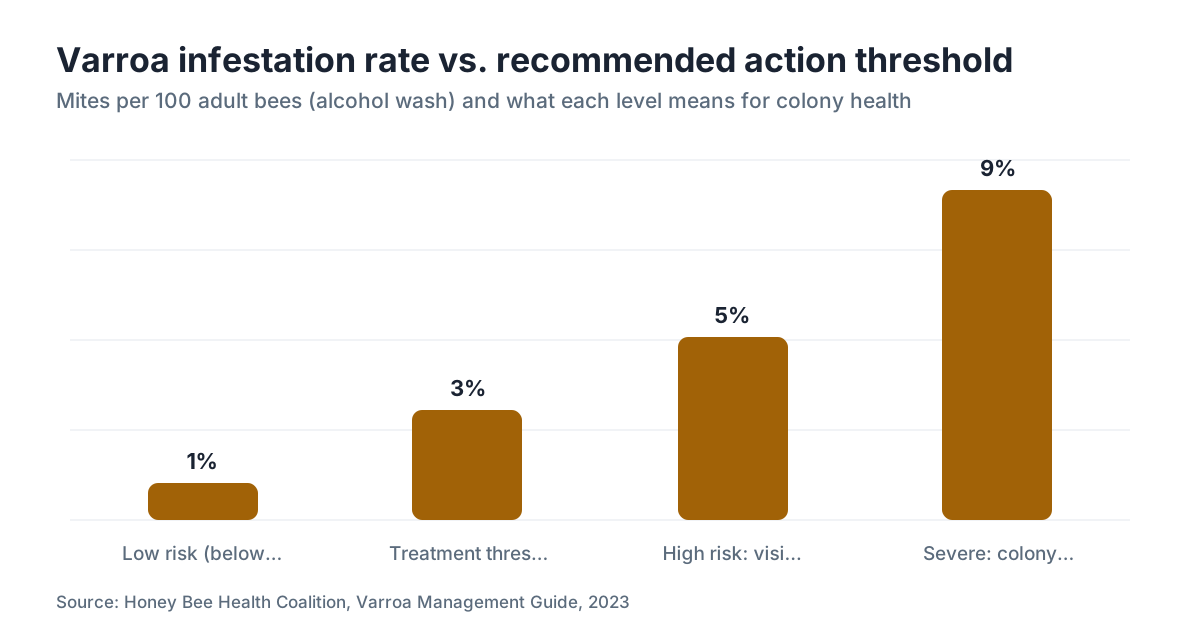
The standard threshold across most U.S. extension programs is 2 to 3 mites per 100 adult bees (2 to 3%) during the brood-rearing season, measured by alcohol wash or sugar roll.[4][6] Above that line, colony health trajectories worsen measurably.
That threshold is a treatment trigger, not a safety guarantee. The Honey Bee Health Coalition's Varroa Management Guide notes that colonies can take economic damage below 3% if the mite population is climbing fast or the colony is already stressed by poor forage or pesticide exposure.[4]
In late summer, some programs drop the threshold to 1 to 2% because the bees getting infested right then are winter bees, and each infested cell costs more. Penn State Extension recommends beekeepers in the northeastern U.S. aim for mite levels below 1% going into September.[6]
A single wash number tells you less than a trend line. A colony at 1.5% in July that read 0.5% in June is heading for 4 to 5% by August without intervention. A colony at 1.5% that read 2.5% three weeks earlier, post-treatment, is recovering. Testing every three to four weeks through the active season is the only way to read the direction.
To track seasonal mite data and connect it to treatment timing, tools like those at VarroaVault give you structured monitoring logs alongside the published protocols from the Honey Bee Health Coalition.[4]
Can bees develop any resistance to varroa on their own?
Yes, but it takes time and selection pressure, and most commercial and hobbyist stock has not had either. The traits that produce varroa resistance fall into a few documented categories: hygienic behavior (detecting and removing infested capped brood), suppressed mite reproduction (SMR, where mites in the cell fail to produce viable offspring), and recapping behavior, where bees open, inspect, and reseal cells in ways that break the mite's breeding cycle.
Populations of Apis mellifera that have lived with varroa untreated for many generations show measurably lower mite population growth. The Gotland study in Sweden, running since the 1990s, documented feral bees stabilizing their mite loads over roughly a decade of natural selection.[7] The Arnot Forest population in New York and the Bienwald population in Germany show the same pattern.
The catch: natural selection runs through colony death. Colonies without resistance traits die, and only the resistant ones reproduce. For a hobbyist who cares about their bees, letting colonies die untreated to select for resistance is ethically messy and hard to pull off at small scale. The workable path for most beekeepers is buying queens bred from hygienic or SMR stock, which several commercial breeders now sell.
The varroa mite biology page goes deeper on resistance genetics if you want to know what traits to look for in queen selection.
How do you know if your colony's problems are varroa-related?
The clinical signs of varroa-driven development damage point you toward a diagnosis, but none prove it alone. Here is what to watch for.
Visible deformed wing virus: bees near the entrance or on the landing board with crumpled, shrunken wings that cannot fly. Even one or two per inspection is a red flag at the population level.
Spotty brood with sunken or perforated cappings: healthy colonies lay solid brood patterns. Skipped cells, discolored cappings, or cells where the bees chewed holes (a sign they detected a problem) can mean hygienic behavior at work, but high mite loads often produce this pattern.
A shrinking cluster with no clear queen failure: if the colony is declining in late summer with enough food and a laying queen, mite-driven lifespan reduction is the likely culprit.
An actual mite count: none of the above replaces an alcohol wash. The wash kills about 300 bees and gives you a direct count. At 3% or above during the summer brood season, the colony is in trouble.[4][6]
You can also open brood. Pull capped worker cells and look for white or tan oval objects (mites) on the pupal body or cell wall. Multiple mites per cell means severe infestation. Finding mites during a casual brood inspection tells you the share of infested cells is high enough to hit without looking hard.
To rule out lookalikes, learn to separate varroa-related brood problems from foulbrood and chalkbrood. Penn State Extension has a brood disease identification guide worth bookmarking.[6]
What treatments actually stop varroa from damaging developing bees?
No single treatment stops mite reproduction inside capped cells at 100% efficacy within one brood cycle. The treatments that reach best into capped brood are the synthetic miticides: fluvalinate (Apistan) and coumaphos (CheckMite+), both of which hit mites as they emerge from cells onto adult bees. Amitraz strips (Apivar) work the same way and are registered by EPA for use in the U.S.[8]
Oxalic acid is highly effective against phoretic mites (mites riding adult bees outside cells) but barely penetrates capped brood. That is why oxalic acid works best during a natural broodless window in winter, during an artificially induced broodless period, or as repeated low-dose vapor over several weeks to catch mites as they leave the cells.[9]
HopGuard (hop beta acids) is labeled for use with capped brood present and shows some efficacy against mites in cells, though generally lower than the synthetic options.[8]
The Honey Bee Health Coalition's Varroa Management Guide states plainly that "no single treatment eliminates all mites" and recommends Integrated Pest Management that combines monitoring, treatment timing, and resistance management.[4] Rotating active ingredients cuts the risk of resistance in the mite population, which is a real and documented problem with fluvalinate and coumaphos in parts of the U.S.
Temperature drives efficacy too. Many organic acid treatments have narrow windows: oxalic acid vaporization works best above 50 degrees F, and formic acid (Mite-Away Quick Strips) needs ambient temperatures between 50 and 85 degrees F to work safely.[9][10]
If you are sourcing treatments and gear, check with established beekeeping supply companies on current label requirements and regional registration status, since EPA registration for some products has shifted in recent years.
Frequently asked questions
At what point in bee development does varroa enter the cell?
The foundress mite enters a worker brood cell 15 to 20 hours before the bees cap it, hiding under the larval food. She waits for capping, then starts laying eggs within 60 to 70 hours of the cell being sealed. For drone brood the timing is similar, but the longer capping period (14 to 15 days versus 12 for workers) lets more daughter mites reach reproductive maturity before emergence.
How many mites typically infest a single brood cell?
One foundress mite enters most infested worker cells, but under heavy colony-level infestation two or more foundress mites can share a cell. Each foundress produces one to two viable reproductive daughters in a worker cell, so a cell with two foundresses can yield four or more new mites when the bee emerges. This multiplicative effect is why mite populations grow exponentially when untreated.
Does varroa affect how long a bee lives even if it has no visible deformity?
Yes. Bees that emerge from infested cells but look physically normal still show reduced fat body mass, elevated deformed wing virus titers, weakened immune gene expression, and shorter lifespan, 40 to 50% shorter on average than uninfested bees. Visible wing deformity is one possible outcome; the internal damage runs consistent across infested bees whether or not the wings show it.
Why are winter bees more vulnerable to varroa damage than summer bees?
Winter bees need working fat bodies to survive months without brood, hold cluster temperature, and rear the first spring cohort. Varroa-damaged bees that emerge in late summer and fall start with depleted fat body mass and cannot make it up over winter. Summer workers with shortened lifespans get replaced in weeks; a winter cohort that dies early leaves the cluster below minimum viable size with no way to replace bees until spring queens lay again.
Can a colony recover from high varroa infestation without treatment?
Rarely, and not reliably. A small number of colonies with strong hygienic behavior or suppressed mite reproduction genetics can stabilize mite loads without help. Most cannot. Above 3% infestation in midsummer, mite population growth outpaces the colony's ability to compensate, and collapse usually follows within 8 to 12 weeks. Waiting to see if a colony recovers on its own is a gamble that usually ends in colony death and reinfestation of neighbors via drifting mite-loaded bees.
How does varroa get from one colony to another?
Drifting bees and robbing bees are the main routes. Phoretic mites (mites riding on adult bees) travel with bees that enter the wrong hive by accident or rob honey from a weakened colony. Mite-loaded drones that visit multiple colonies are another vector. Colonies placed near untreated feral or managed colonies face constant reinfestation, which is why treating one hive in a multi-colony yard without treating the rest often fails.
What is the difference between phoretic mites and reproductive mites?
Phoretic mites ride on adult bees between brood cycles. They feed on the bee's fat body, transmit viruses, and wait for a new brood cell. Reproductive mites are inside capped cells, laying eggs and raising daughters. Most treatments work mainly against phoretic mites; very few reach into capped brood. During peak brood season roughly 80% of a colony's mites sit inside capped cells, largely shielded from treatment.
How often should I test for varroa to catch problems before they affect bee development?
Every three to four weeks during the active brood season, and always before and after any treatment. Testing monthly from April through September gives you enough data points to see whether the mite population is growing, holding, or falling. A single test is a snapshot; a series is a trend line, and the trend line tells you whether to act. Many extension programs recommend at minimum a spring test, a late July test, and an early September test.
Is drone brood removal an effective treatment for varroa?
It is an effective supplement, not a standalone treatment. Removing capped drone brood physically lifts out a concentrated mite load, since infestation rates in drone cells run three to eight times higher than in worker cells. Studies suggest it can cut overall mite population growth by 20 to 40% when done consistently through the season. It works best inside an Integrated Pest Management program combined with a registered miticide treatment.
Does varroa affect bee learning and navigation ability?
Yes. Bees with high deformed wing virus titers, the primary virus varroa transmits, show impaired olfactory learning, sloppier waggle dances, and compromised navigation. These deficits drive forager loss even in bees that emerge without visible wing deformity. A colony with high mite loads effectively runs a less competent foraging force, on top of any raw drop in forager numbers.
How do I know if bees with deformed wings are definitely caused by varroa?
Deformed wing virus is the confirmed cause of the small, crumpled wings, and varroa is the primary vector that amplifies DWV to disease-causing titers. Without varroa, DWV sits at latent levels that rarely show symptoms. If you see deformed-wing bees, run an alcohol wash right away. If your mite count is at or above 2 to 3%, varroa-vectored DWV is almost certainly the cause. Other conditions that affect wing development are much rarer.
What percentage of bees with deformed wings should trigger alarm?
Any visible deformed-wing bees are a warning. Even 1% of emerging bees showing wing deformity means the mite load has been high enough, long enough, to amplify DWV to disease-causing levels. At that point your alcohol wash count is likely already at or above the 2 to 3% treatment threshold. Do not wait to confirm with a wash; treat promptly and wash at the same time to get a baseline number.
Can oxalic acid treatments protect developing brood from varroa?
Oxalic acid barely penetrates capped brood regardless of application method. It kills phoretic mites on adult bees well but leaves breeding mites inside cells largely untouched. Extended-release oxalic acid treatments (vaporization repeated over several weeks, or glycerin-based strips) work by catching mites again and again as they emerge and turn phoretic. For protecting a specific brood cohort during development, the mites inside those cells stay mostly beyond oxalic acid's reach.
Does varroa affect the development of the queen differently than workers?
Queen cells stay capped only about 8 days, which limits mite reproductive success there specifically. But varroa can still transmit viruses to developing queens during feeding, and colonies under high mite pressure raise nutritionally compromised nurse bees whose royal jelly quality may drop. Queens from mite-stressed colonies can have shorter lifespans or reduced egg-laying capacity without any direct mite infestation of their own development cell.
Sources
- Rosenkranz et al., Apidologie, 'Biology and control of Varroa destructor' (2010): Foundress mite enters cell 15 to 20 hours before capping; first male egg laid on cell wall; reproductive daughters reach maturity around day 6 post-capping; drone cells capped 14 to 15 days vs. 12 for workers
- Ramsey et al., PNAS, 'Varroa destructor feeds primarily on honey bee fat body tissue' (2019): Varroa's primary feeding site is fat body tissue, not hemolymph; fat body is the organ controlling immunity and winter survival
- NC State University Apiculture, Varroa Mite Management: Drone brood infestation rates three to eight times higher than worker brood; drone comb removal as adjunct management technique
- Honey Bee Health Coalition, Varroa Management Guide (2023 edition): Varroa-infested bees have 40 to 50% shorter lifespan; 2 to 3% threshold for treatment; varroa-vectored DWV is primary driver of colony losses; no single treatment eliminates all mites; mite population can double every 4 to 6 weeks
- Wilfert et al., Science, 'Deformed wing virus is a recent global epidemic in honeybees driven by Varroa mites' (2016): DWV titers in mite-infested bees can be 10,000 to 1,000,000 times higher than in uninfested bees; varroa is primary transmission vector for DWV globally
- Penn State Extension, Varroa Mite Management for Honey Bee Colonies: Treatment threshold 2 to 3% mites per 100 adult bees; late-summer treatment to protect winter bee cohort; aim for below 1% going into September in northeastern U.S.
- Fries et al., Apidologie, 'Natural selection for resistance to Varroa destructor in a population of Apis mellifera' (Gotland study): Gotland feral bee population stabilized mite loads over roughly a decade of natural selection without treatment
- U.S. EPA, Pesticide Product Label System, Apivar (Amitraz) and Apistan (Fluvalinate) registrations: EPA registration status for Apivar (amitraz strips) and Apistan (fluvalinate strips) for use against varroa in the U.S.
- U.S. EPA, Oxalic Acid Pesticide Tolerances and Registrations: Oxalic acid registered for varroa treatment; minimal penetration into capped brood; temperature window requirements for vaporization
- USDA Agricultural Research Service, Honey Bee Research: Formic acid treatments require 50 to 85°F ambient temperature window for safe and effective use against varroa
Last updated 2026-07-09