How varroa spreads within an apiary: a map of the routes
TL;DR
- Varroa spreads inside an apiary mainly through two routes: drifting worker bees (and drones) that carry mites from colony to colony, and robbing behavior where bees from low-mite hives raid a collapsing high-mite colony and return home loaded with hitchhikers.
- Swarms, package bees, and shared equipment matter too.
- Understanding which route is active at any moment tells you where to treat and when.
Why does varroa spread so fast between hives in the same yard?
If you treat one hive perfectly and ignore the others, the mite count climbs right back. Most beekeepers blame treatment failure. The real culprit, most of the time, is reinfection from neighboring colonies.
Varroa destructor cannot fly and cannot survive long off a bee host. But it does not need to. Honey bees do the moving for it. Every mechanism that shuffles adult bees between colonies, drift, robbing, swarming, also shuffles mites. The Honey Bee Health Coalition's Varroa management guide calls this "mite immigration" and notes it can reinfest treated hives within weeks during the active foraging season [1].
The speed of spread depends on apiary density and the mite load gradient between colonies. When one colony reaches what researchers call a "mite bomb" state (typically 6-10% infestation or higher late in the season), it becomes a net exporter of mites to every colony within foraging range, roughly 1-3 km but most heavily within 100-300 m [2]. A yard with six hives in a row, all within a few feet of each other, is a nearly ideal mite-redistribution network.
What are the main routes varroa uses to move from hive to hive?
There are five routes worth knowing. They do not all carry equal weight, and the mix changes by season.
1. Drifting workers
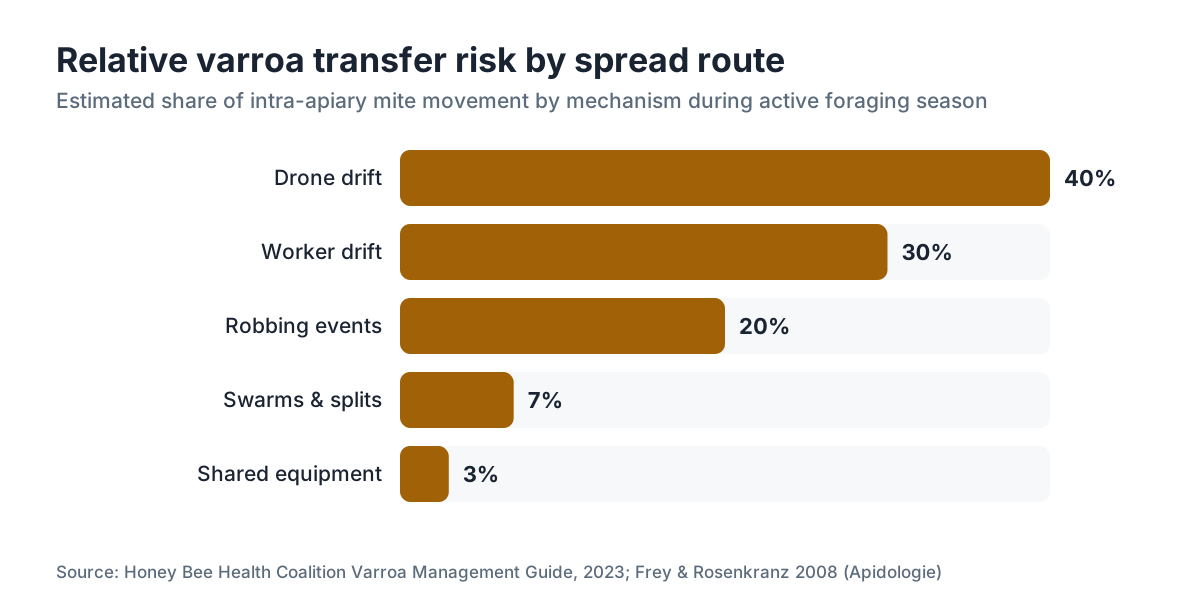
Worker bees routinely return to the wrong hive, especially in apiaries where hives face the same direction, sit in a line, or look identical. Studies at the USDA Beltsville Bee Laboratory found that worker drift in standard apiaries can run 5-15% of foragers on any given day, higher for hives at the ends of rows [3]. Each drifting bee that came from a high-mite colony can carry one or more phoretic mites on her body. Those mites detach inside the new hive, find nurse bees, and wait for an open brood cell.
2. Drifting drones
Drones drift at far higher rates than workers. They are accepted by any colony that has not gone queenless, so they roam freely across an entire apiary and even between apiaries. A 2008 study by Frey and Rosenkranz confirmed that drones are a primary vector for varroa movement between colonies, with some estimates suggesting drones account for 30-50% of intra-apiary mite transfer in summer [4]. Drone comb is also the preferred reproduction site for Varroa, so a colony with heavy drone production is both a mite incubator and a mite broadcaster.
3. Robbing
This is the most dramatic and fastest route. When a colony weakens, often because varroa has already devastated it, guard bees can no longer defend the entrance. Strong colonies from the same yard or neighboring yards break in, steal the honey, and pick up hundreds or thousands of phoretic mites in a single afternoon. The robbers carry those mites home. A true robbing event can transfer enough mites to push a healthy colony from a safe mite level to a dangerous one in days, not weeks. Watch for it in late summer and fall when nectar flow ends.
4. Swarms
A swarm that leaves a high-mite colony takes mites with it. The swarm typically lands nearby first, then scouts for a cavity, often within your apiary or a neighbor's. The mite load in a fresh swarm is lower than in the parent colony (most mites stay in the capped brood left behind), but it is not zero. More importantly, the cast-off parent colony, suddenly without much brood, has a surge of phoretic mites on adult bees and becomes a mite bomb itself [1].
5. Beekeeper-caused transfer
Sharing frames of brood between colonies for equalization, moving combs, splitting hives, and sharing equipment all move mites directly. This is the one route entirely within your control. If you move a frame of capped brood from a colony you have not recently tested, you are moving whatever mites are reproducing inside those cells.
How far can varroa spread outside my own apiary?
Foraging bees routinely travel 1-3 km from the hive, and robbing bees can target colonies at similar distances when the local forage crashes. Research published in Apidologie found that mite movement between apiaries located up to 1.5 km apart was detectable and statistically significant during summer, primarily attributed to drone drift and robbing [2].
This has a depressing implication: you can do everything right and still get reinfested from an abandoned colony, a feral hive in a tree, or an undertreated neighbor's apiary. Nobody has clean data on how often this is actually the dominant source versus within-apiary drift, but the Honey Bee Health Coalition's position is that local apiary management is still your highest-leverage point because you cannot control the neighborhood [1].
Feral colonies and varroa mite biology interact in a specific way here: feral colonies in Europe and North America typically maintain high mite loads without treatment, making them chronic mite reservoirs within foraging range of any managed yard.
What does a varroa spread map actually look like in a typical apiary?
Think of your apiary as a directed graph, not a simple layout map. Each colony is a node. The edges are the bee-traffic routes between nodes, and the edge weight is roughly proportional to how much bee traffic flows that way.
In a standard 10-hive linear apiary:
| Hive position | Drift-in rate (estimated) | Drift-out rate (estimated) | Notes |
|---|---|---|---|
| End hives (position 1, 10) | Highest | Lowest | Bees returning from the field overshoot and land here |
| Inner hives (positions 2-9) | Moderate | Moderate | More symmetric drift in both directions |
| Hives near dominant flight path | Higher | Lower | Bees converge toward visual cues along the corridor |
The practical result: end-position hives accumulate drifting bees and the mites they carry. If your apiary has a persistently hot hive, check whether it sits at the end of a row, faces the primary flight corridor, or has some visual feature that attracts drifting bees.
Reducing drift with visual hive differentiation (painting entrances different colors, staggering hive placement, pointing hives in varied directions) is supported by extension guidance from Penn State's apiculture program, which found that color and shape differentiation reduced worker drift measurably in trial apiaries [5].
For tracking which colonies are net exporters versus net importers of mites, regular alcohol wash or sugar roll monitoring on every colony is the only reliable tool. VarroaVault's free mite tracking tools let you log counts across your whole yard and spot the gradient before it becomes a crisis.
How does robbing season change varroa spread dynamics?
Late summer and fall are when varroa spread accelerates most sharply, and robbing is the main reason.
When the main nectar flow ends, foragers pivot from gathering to raiding. Weak colonies that had marginal defenses during the flow lose them entirely. A collapsing mite-bomb colony in your yard in August is more than a tragedy for that colony. It is an active threat to every other hive within range.
The sequence tends to go like this: varroa weakens a colony over spring and summer. The colony's population drops. The bees cannot defend a full-width entrance. Robbers from stronger colonies, your own or a neighbor's, begin probing. Within days they break through. They strip the honey in 24-72 hours and leave carrying phoretic mites. Those robbers return to their home colony, where the mites transfer to nurse bees and enter brood cells. Within 2-3 mite generations (roughly 3-4 weeks), the previously healthy colony shows a detectable mite spike.
The practical response is to treat your whole apiary synchronously rather than treating individual colonies reactively. The Honey Bee Health Coalition explicitly recommends treating all colonies in an apiary at the same time, and at the same time as nearby beekeepers where possible, specifically because of this reinfection dynamic [1].
If you have a colony that looks like it is collapsing, check it immediately. If the mite load is over 3% (3 mites per 100 bees on an alcohol wash), treat or combine it before robbing starts. Closing the entrance down to one bee-width buys you a little time but is not a substitute for action.
Do drone bees spread varroa differently than worker bees?
Yes, and this distinction matters for spring management.
Workers drift primarily between nearby hives and are somewhat corralled by visual cues and hive color. Drones ignore all of that. They leave the hive, visit drone congregation areas, fly back, and may or may not return to their birth colony. Colony guards accept drones from any colony as long as the colony is queenright, so a single drone can visit three or four different hives in a day.
The Frey and Rosenkranz 2008 paper tracked mite-carrying drones using molecular markers and found that drone movement was the most consistent inter-colony transfer mechanism across seasons, more reliable than robbing (which is episodic) and more wide-ranging than worker drift [4].
For practical apiary management, this means that a colony producing heavy drone comb in spring is simultaneously a mite incubator (Varroa reproduces 8-10 times more successfully in drone brood than in worker brood) [6] and a drone broadcaster that visits your other colonies all summer. Drone comb removal as a trapping strategy reduces the reproductive rate and, indirectly, the number of mite-carrying drones launched from that colony.
How do swarms and splits move varroa to new locations?
A natural swarm from a high-mite colony leaves with a mite load, but it is lower than you might expect. Most of the mites are locked inside capped brood at the moment of swarming, so they stay behind with the parent colony. Studies have estimated that a swarm carries roughly 20-40% of the colony's phoretic mites but less than 10% of the total mite population [1].
That said, a swarm from a colony at 5% infestation might still land with a meaningful mite load, and if it moves into a new location in your yard or a neighbor's, it seeds a new infestation point.
Artificial splits are more controllable but carry the same risk. When you move frames of capped brood to a new box, every capped cell potentially contains a reproducing mite. The standard advice from university extension programs is to treat the split within 1-2 weeks of the queen being accepted and brood production ramping up, not to wait until the next seasonal treatment window [7].
Packages are a separate concern. A package sourced from a region with high mite pressure can arrive with already-detectable phoretic mites, even without brood. Test your package bees within the first week and again at 30 days to establish a baseline before they integrate into your apiary's mite ecology.
What apiary layout changes actually reduce varroa spread?
You cannot stop spread entirely, but you can slow it down enough that treatment windows stay open.
Spacing is the first lever. Hives placed at least 1-2 meters apart with distinct visual markers at each entrance (different colors, shapes, nearby shrubs) show measurably lower drift rates than hives in tight rows [5]. If your yard is small and hives are close together, point alternating hives in different directions. Even a 45-90 degree rotation of entrance direction reduces drift significantly.
Avoid perfectly symmetrical rows of identical white boxes. This is essentially asking bees to drift. Research from multiple European apiculture institutes, summarized in a 2019 review in Apidologie, found that hive differentiation by entrance color reduced worker drift by up to 40% in some configurations [2].
Entrance reducers during dearth periods limit robbing access and buy time. They will not stop a determined robbing event, but they raise the cost of entry enough that robbers often move on to easier targets.
Keep a mite count log for every colony in the yard. A simple spreadsheet or the tracking tools at VarroaVault can show you the mite-load gradient across your apiary at a glance. When one colony's count is 3-4x the others, it is already broadcasting mites. That colony needs attention before it infects the rest.
If you run more than a few hives, consider grouping your strongest, best-treated colonies together and keeping any known problem colonies (or newly acquired colonies of unknown history) separated by at least 50-100 meters until you have established their mite status.
How should you time varroa treatments across the whole apiary to block spread?
Treating one colony while ignoring the others is a documented path to treatment futility. The Honey Bee Health Coalition's varroa management guide states directly that "treating all colonies in an apiary simultaneously is strongly recommended to prevent reinfection from untreated colonies" [1].
The timing logic works like this. Treat all colonies at the same time. This drops the phoretic mite load across the whole yard at once, eliminating the gradient that drives mite export from hot colonies. Then monitor all colonies 30 days later with an alcohol wash. Any colony that rebounds fast is either a treatment failure (check your technique and the label conditions) or is getting heavy reinfestion from outside the apiary.
For oxalic acid treatments, the EPA-registered dribble and vaporization methods both have label-specified conditions. The Api-Bioxal label (the only EPA-registered oxalic acid product in the US) specifies treatment when colonies are broodless or nearly broodless for best efficacy, because oxalic acid does not penetrate capped brood [8]. Timing your whole-apiary treatment to coincide with a natural broodless period (late fall after first hard frost in most of the US) maximizes impact across all colonies simultaneously.
For in-season treatment when brood is present, extended-release oxalic acid or soft chemical options like formic acid (Mite-Away Quick Strips) or thymol (ApiLife Var, Apiguard) have different temperature and timing windows. Check the specific label for your product and match treatment timing across all hives in the same application window [9].
Neighborhood coordination matters too. If your neighbor's hives are untreated and within foraging range, coordinating treatment timing with them, even informally, reduces the mite pressure your bees face from outside the yard. Some state apiculture extension offices offer resources and sample letters for exactly this kind of neighbor outreach [10].
How do you identify which hive in your apiary is the mite source?
You need data on every colony, more than the one that looks sick.
The workflow is: alcohol wash (or sugar roll, though alcohol wash is more accurate) every colony in the yard on the same day or within a 3-day window. Use 300 bees per sample, count mites, and calculate percent infestation. A threshold of 2% (2 mites per 100 bees) is the common action threshold during the brood-rearing season, per the Honey Bee Health Coalition's recommendations [1].
Map the results spatially. Draw your apiary layout. Write the mite percentage next to each hive. The colony with the highest count is your most likely mite exporter. If that colony is also the largest, most active forager, it has the most drift traffic going out and is broadcasting more mites than a weak colony would.
Look for the gradient: a high-mite colony surrounded by medium-mite neighbors, all of which are adjacent to lower-mite hives farther away. That pattern is the spatial fingerprint of intra-apiary spread from a single source. One colony at 8% with its nearest neighbor at 4% and the far end of the apiary at 1.5% is a textbook spread gradient.
If all colonies are uniformly high, you likely have either a systemic treatment failure or heavy external reinfestion from feral colonies or neighbors. If counts are patchy and unpredictable, robbing events are a likely driver.
For supplies and monitoring equipment, sourcing from established beekeeping supply companies ensures you get calibrated alcohol wash kits and the right mesh sizes for accurate counts.
Can bees develop resistance to varroa, and does that change spread dynamics?
Some honey bee populations show measurable varroa-sensitive hygiene (VSH) and grooming behaviors that suppress mite reproduction without chemical treatment. These traits are real, documented in research at the USDA Baton Rouge Bee Lab, and available in commercially bred VSH queens [11].
But VSH does not change the spread routes. It changes what happens when a mite arrives. A colony of VSH bees still receives drifting bees, still gets robbed, and still has drones visiting from other colonies. The difference is that mites entering a VSH colony reproduce at a much lower rate, so the colony is less likely to become a mite bomb and less likely to export mites back to its neighbors.
In practical terms, requeening your worst-performing colonies with VSH or mite-resistant stock lowers the overall mite density gradient in your yard over time. It does not replace treatment in an already-infested apiary, but it does reduce the background pressure. Extension resources from Louisiana State University AgCenter cover VSH queen selection in detail [11].
Note that africanized honey bees show some enhanced grooming behavior that appears to help suppress varroa compared to European honey bee populations, though this is not a reason to seek out africanized genetics. The defensive behavior creates separate management challenges that outweigh the mite-suppression benefit for most hobbyist and sideliner beekeepers.
Frequently asked questions
How quickly can varroa spread from one hive to another in the same yard?
Fast. After a robbing event, detectable mite spikes in the robber colony can show up within 2-4 weeks, roughly one varroa reproductive cycle. Drift-based spread is slower and continuous, but a heavily infested colony can push neighboring hives from safe to dangerous mite levels within a single foraging season if left untreated. This is why the whole-apiary treatment approach matters.
What percentage of varroa infestation makes a colony a mite bomb?
There is no single agreed threshold, but most researchers and extension programs use 6-8% infestation (6-8 mites per 100 bees on an alcohol wash) as the point where a colony shifts from struggling to actively redistributing mites at high rates. At that level, robbing and drift together can measurably raise counts in neighboring hives within weeks. Treat before you reach that point, ideally at 2-3%.
Does hive placement in my yard affect how much varroa spreads?
Yes. Linear rows of identical-looking hives create high drift rates, especially for hives at the ends of rows. Staggering hive positions, pointing entrances in varied directions, and painting entrances different colors can reduce worker drift by up to 40% according to European apiculture research. Lower drift means fewer mite transfers per day between colonies, which slows the spread gradient across your yard.
Do I need to treat all hives at the same time, or can I treat the worst ones first?
Treat all hives at the same time. The Honey Bee Health Coalition explicitly recommends simultaneous whole-apiary treatment because untreated colonies keep donating mites to treated colonies, erasing your gains. If resource or logistics constraints force a staggered approach, prioritize the highest-mite colonies first and follow up with remaining hives within days, not weeks.
Can a swarm I caught in my apiary bring varroa into my other hives?
Yes, though the mite load on a fresh swarm is lower than in the parent colony because most mites are locked in capped brood at the moment of swarming. Swarms carry roughly 20-40% of the parent colony's phoretic mites. Still, always test a caught swarm with an alcohol wash within the first 1-2 weeks and treat if the count exceeds 2%, before integrating it into your yard's management cycle.
How far away do neighboring apiaries need to be to avoid cross-contaminating varroa?
Mite transfer between apiaries up to 1.5 km apart has been documented in published research, primarily via drone drift and robbing. There is no safe distance that guarantees isolation. Coordinating treatment timing with neighbors within 2-3 km of your yard significantly reduces the mite reinfestion load your hives face throughout the season, even if you cannot control their treatment choices.
Why do my end hives always seem to have higher varroa counts?
End hives in a linear apiary receive the most drifting bees because returning foragers that overshoot the row end up there. Each drifting bee from a high-mite colony can carry one or more phoretic mites. Over a full foraging season, that adds up to a significant mite advantage for end-position hives. Rotating hive positions or adding visual markers at the ends reduces this effect.
Is robbing or drifting a bigger source of varroa spread?
It depends on the season. Drifting is a constant, year-round, low-level transfer mechanism. Robbing is episodic but can transfer vastly more mites in a single event, sometimes hundreds or thousands of phoretic mites in a 24-48 hour period. During dearth periods (late summer, fall), robbing is almost certainly the dominant short-term spread mechanism. During active nectar flow, drift dominates because robbing is suppressed.
Do package bees I buy come with varroa already on them?
They can. Packages have no brood, so mite levels are lower than in an established colony, but phoretic mites on adult bees are still possible depending on the source apiary's management practices. Always ask suppliers about their testing protocols. Run your own alcohol wash on the package bees within the first 7-10 days of installation to establish a baseline count for that colony.
How do I stop robbing to prevent varroa spread in my yard?
Reduce all entrances to one-bee width during dearth periods, especially late summer and fall. Remove entrance reducers only during active nectar flows when defense is less of a burden. Avoid spilling honey or sugar syrup near hives. If you see active robbing, close down the robbed hive's entrance and reduce surrounding hives too. Do not try to intervene by spraying water. It does not stop robbing and stresses the bees.
Can I use drone brood removal to reduce how much varroa spreads between my hives?
Drone comb trapping reduces the reproductive rate of varroa in your apiary (mites reproduce 8-10 times more successfully in drone brood than worker brood) and reduces the number of mite-carrying drones your colonies broadcast to neighboring hives. It is a useful suppression tool, not a standalone solution. Used alongside regular monitoring and timely treatment, it lowers the overall mite density gradient that drives spread.
What is the best way to monitor varroa spread across an entire apiary?
Alcohol wash all colonies in the yard within the same 3-day window every 30 days during the active season. Record counts in a consistent format, ideally spatially mapped to your apiary layout. This lets you see the mite gradient across hives, identify the exporting colony, and track whether treatment is reducing spread or if reinfection is occurring. Sugar rolls are acceptable but less accurate; alcohol wash is the gold standard.
Does moving hives to a new location reset the varroa spread problem?
Moving a mite-bomb colony at least 3 km away from your main apiary breaks the foraging-range connection and stops it from donating mites via drift and robbing. This is a legitimate management move if you have one severely infested colony and cannot treat it in place quickly. Below 3 km, foragers from the moved colony can still drift back to the original yard, so the distance needs to be meaningful.
Sources
- Honey Bee Health Coalition, Varroa Management Guide (2023 edition): Mite immigration can reinfest treated hives within weeks; treating all colonies in an apiary simultaneously is strongly recommended to prevent reinfection from untreated colonies.
- Apidologie (Springer), varroa inter-apiary spread review: Mite movement between apiaries up to 1.5 km apart was detectable and statistically significant; hive differentiation by entrance color reduced worker drift by up to 40%.
- USDA Agricultural Research Service, Beltsville Bee Laboratory: Worker drift in standard apiaries can run 5-15% of foragers on any given day, higher for hives at the ends of rows.
- Frey & Rosenkranz (2008), drone-mediated varroa transfer study, Apidologie: Drone movement was the most consistent inter-colony varroa transfer mechanism across seasons; drones may account for 30-50% of intra-apiary mite transfer in summer.
- Penn State Extension, Apiculture Program: Color and shape differentiation at hive entrances reduced worker drift measurably in trial apiaries.
- Honey Bee Health Coalition, Varroa Management Guide: drone brood reproduction: Varroa reproduces 8-10 times more successfully in drone brood than in worker brood.
- University of Minnesota Bee Lab, Extension resources on splits and varroa: Extension guidance recommends treating splits within 1-2 weeks of queen acceptance and brood production ramping up, not waiting for the next seasonal treatment window.
- EPA, Api-Bioxal (oxalic acid) pesticide registration and label: Oxalic acid is the only EPA-registered oxalic acid product for varroa in the US; the label specifies treatment when colonies are broodless or nearly broodless for best efficacy because oxalic acid does not penetrate capped brood.
- EPA, Mite-Away Quick Strips (formic acid) label and registration: Formic acid products have temperature-specific application windows; treatment should be applied within label-specified seasonal conditions.
- Oregon State University Extension, Varroa mite management in Oregon apiaries: State apiculture extension offices provide resources and outreach templates for coordinating varroa treatment with neighboring beekeepers.
- Louisiana State University AgCenter, VSH honey bee breeding program: VSH (varroa-sensitive hygiene) traits are documented and available in commercially bred queens; VSH bees show suppressed mite reproduction rates without chemical treatment.
Last updated 2026-07-09