Identifying varroa mites: what they look like and how to find them
TL;DR
- Varroa destructor mites are reddish-brown, oval, and about 1.1 mm wide by 1.6 mm long, wider than they are long.
- You can spot them on adult bees with the naked eye, but an accurate infestation count needs an alcohol wash or sugar roll.
- The widely used treatment threshold is 2 mites per 100 bees (2%), and you should act sooner heading into late summer.
What does a varroa mite actually look like?
Varroa destructor is small, but it is not invisible. An adult female measures roughly 1.1 mm wide and 1.6 mm long, which makes her wider than she is long. That flattened, crab-like shape is the first thing you notice when you see one for real. The color is a reddish-brown, somewhere between rust and dried blood. [1]
Males are smaller, paler, and nearly white. You will almost never see one. They die inside the capped cell shortly after mating. The female is the one that matters for identification, for counts, and for treatment decisions.
The body has eight legs, which tells you right away this is an arachnid, not an insect. Under a hand lens or jeweler's loupe you can see the legs clearly, arranged in two pairs on each side of the front half of the body. The dorsal surface (the top, the side facing you when a mite sits on a bee) is smooth and slightly shiny. The ventral side holds the mouthparts and leg attachments and looks busier.
On a dark bee the mite is easy to spot. On a yellow bee it is less obvious but still visible once you know what you're hunting for. The mite almost always attaches between the abdominal segments, or on the soft tissue between thorax and abdomen, because that is where the cuticle is thinnest and the feeding is easiest. [2]
How big is a varroa mite compared to a honey bee?
A worker honey bee is about 15 mm long. A varroa female is 1.6 mm long. Scale that up to human terms and you get roughly a grape sitting on a basketball. Large enough to see, small enough to miss on a fast inspection.
The width is the memorable dimension: 1.1 mm wide against 1.6 mm long. Most parasites run longer than they are wide, so the squat disc shape is a real tell. Pick up a bee, tilt her in good light, and a mite looks like a tiny reddish freckle that doesn't belong.
New beekeepers often mistake pollen loads for mites at first glance. Pollen is yellow, orange, or white and rides on the hind legs in the corbiculae. Mites are reddish-brown and clamp onto the abdomen or the thorax-abdomen junction. See one real mite in person and you won't confuse the two again. [1]
For scale, a single mite weighs about 0.3 micrograms. That's functionally nothing. The species was first described in detail by Anderson and Trueman in 2000, and later work has confirmed the 1.1 by 1.6 mm dimensions hold up across global Varroa destructor populations. [3]
Where on a bee does varroa attach, and why?
The mite doesn't sit just anywhere. It has preferred feeding sites, and knowing them helps you spot infested bees during an inspection.
On adult bees (the phoretic phase), varroa feeds on fat body tissue, not on hemolymph as beekeepers assumed for decades. A 2019 PNAS paper by Samuel Ramsey and colleagues rewrote the textbook, concluding that "Varroa destructor feeds primarily on the fat body" of the honey bee. [2] That is why the mite parks itself on the soft intersegmental membrane of the abdomen, where it can clamp down and feed without getting groomed off.
The preferred spot is between the third and fourth abdominal tergites, on the underside of the bee. Look at a bee from above and you may see nothing even when a mite is riding along. Roll the bee over, or watch bees resting quietly on comb. Mites on moving foragers are harder to catch because those bees fight to shake them loose.
Inside capped brood cells (the reproductive phase), the female hides in the brood food before capping, then starts laying eggs after the cell is sealed. A single cell can produce one male and up to five females, though the average number of viable mated daughters runs lower. Drone brood is preferred because the longer development gives the mite more time to reproduce. [4]
What are the signs of varroa infestation in a hive?
Visible mites on bees are a late-stage sign. By the time you routinely see mites during a casual inspection, the count is already high. Don't lean on eyeballing adult bees as your main monitoring method.
Early signs to watch for:
- Deformed wing virus (DWV) symptoms: bees with crumpled, shriveled, or missing wings crawling at the entrance. Varroa is the main vector for DWV, and even a few of these bees is a serious warning. [5]
- Sunken or perforated cappings, sometimes called snot brood: varroa-associated pathogens can produce irregular brood patterns. This looks a lot like American foulbrood, so sample carefully before you panic.
- Bees with shortened, misshapen abdomens. Fat body damage during development leaves adults looking stunted.
- White mite feces inside open cells. Uncap suspect cells and you may find tiny white specks on the walls. That is mite excrement.
The most reliable behavioral sign is crawling bees at the entrance in late summer and fall. See a dozen or more crawlers on a warm afternoon and run an alcohol wash that day. The Honey Bee Health Coalition's Varroa Management Guide says colonies tolerate low mite levels but collapse once the population crosses critical thresholds, usually in fall when the bee population is already shrinking. [6]
For the full biology and lifecycle, see our varroa mite overview.
How do you count varroa mites accurately?
Three methods work. One is the standard. One is nearly as good. One tells you something, but not enough to act on.
Alcohol wash (the standard)
Collect roughly 300 bees (about half a cup) from a brood frame into a jar, add isopropyl alcohol at 70% or higher, shake for 60 seconds, and pour through a mesh strainer into a white basin. Count the mites, divide by the number of bees, multiply by 100. That gives you mites per 100 bees as a percentage. [6]
The USDA and the Honey Bee Health Coalition both point to the alcohol wash as the most accurate method for hobbyists. Sample from brood frames, because that is where the nurse bees are, and nurse bees carry the heaviest mite loads. A sample pulled from the entrance or from honey frames will undercount.
Sugar roll (non-lethal, less accurate)
Same sample size, same math, but powdered sugar instead of alcohol. The sugar coats the bees and mites lose their grip. It's less precise than alcohol because sugar doesn't knock every mite loose. Dietemann and colleagues found sugar rolls consistently undercount against alcohol washes. [7] Use it when you don't want to sacrifice bees from a small colony, but treat the result as a floor, not a true count.
Sticky board (incomplete picture)
A screened bottom board with a sticky insert catches mites that fall off naturally. You can express results as mites per day. But natural fall doesn't convert cleanly to percentage infestation without correction factors, and those factors shift by season. Sticky boards are better for watching trends than for making a treatment call. [6]
Building your first monitoring kit? Our guide to beekeeping supplies covers where to source wash jars and sticky boards.
What is the treatment threshold for varroa mites?
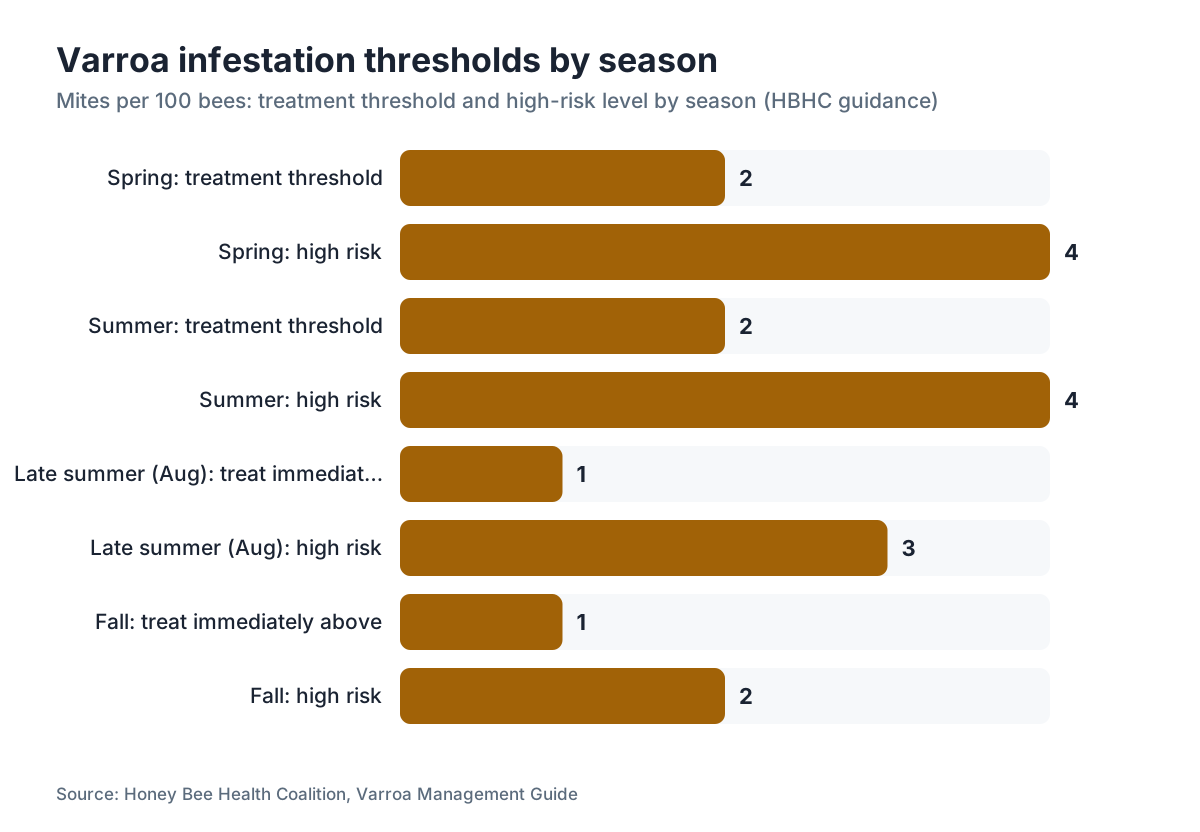
The Honey Bee Health Coalition sets the treatment threshold at 2 mites per 100 bees (2%) from spring through late summer, and it says act sooner in late summer and fall because the mites you count now will breed on the winter bees being raised in August and September. [6]
That 2% figure is not a law. It's a working consensus from extension apiculturists and USDA researchers. Some programs use 3% in spring. The logic holds either way: a 2% infestation in June becomes 10% or higher by September without treatment, because varroa grows exponentially while the bee population starts to fall.
Put numbers to it. A colony of 30,000 bees at 2% carries roughly 600 phoretic mites. Each reproductive cycle in capped brood adds one to two new mated females on average. Over eight weeks with no treatment, that colony can reach 2,000 to 3,000 mites or more. The mite population roughly doubles every four to six weeks under good breeding conditions. [4]
Early spring is the safest time to treat a borderline count. Brood volume is low, mites are concentrated on adult bees, and oxalic acid vapor hits that phoretic population with high efficacy. Don't wait for 3% or 4% if you're heading into the main nectar flow.
How do you identify varroa mites in capped brood cells?
The reproductive female slips into a brood cell just before capping, hides under the larval food, and stays hidden until you open the cell. To check for reproductive mites, you uncap and pull the pupa.
Uncap 50 to 100 drone or worker cells over a white tray. Pull the pupae with a capping fork or tweezers. Mites show up on the pupa as reddish-brown specks, or cling to the cell wall or the wax cappings. A mother mite is easy to see because she's the biggest body in the cell. Juvenile mites (deutonymphs) are paler and smaller but still visible against the white pupa in good light.
Drone brood tells you the most. Varroa prefers drone cells at roughly 8 to 1 over worker cells [4], so you'll find more mites there per cell sampled. Some beekeepers run a drone comb trap on purpose: insert a frame of drone foundation, let it fill and cap, then freeze or cut it out before the drones emerge, mites and all.
One caution. Brood inspection tells you about reproduction in one spot at one moment. It doesn't give you a colony-level rate. Use the alcohol wash for that. Brood inspection is a good supplement, a way to confirm a high-risk read or verify that mites are actively breeding when you suspect they are.
Can you see varroa mites without a microscope?
Yes. Adult female varroa are visible to the naked eye in good light. They are not microscopic.
A 10x hand lens or jeweler's loupe makes it much easier, especially if you want to confirm what you're seeing or check the leg structure. A $15 loupe from a jeweler supply is a better buy than any fancy hive gadget for this job.
A microscope earns its keep for one thing: separating mite species. Varroa destructor parasitizes Apis mellifera, the Western honey bee. Varroa jacobsoni is a close relative that historically fed on Apis cerana, the Asian honey bee, and was long assumed harmless to Western bees. Reports from Papua New Guinea show it has started to parasitize Apis mellifera in some populations. [3] The two species look almost identical and need microscopy or DNA work to tell apart with certainty. For management in North America, Europe, and Australia, any varroa-type mite on your bees is almost certainly V. destructor.
After a wash, spread the mites on a white paper plate in good light. The reddish-brown color pops against white, and counting gets simple.
How does varroa spread between hives and apiaries?
Spread is part of identification in a wider sense. If your counts jump suddenly, knowing how varroa moves tells you why.
Drifting and robbing are the two main natural routes. Foragers drift between hives all the time, and a mite-carrying drifter drops mites into a clean colony. Robbing is faster and uglier. When a colony collapses from varroa in late summer, healthy colonies strip its honey and haul mites home in the bargain. A single robbing event can move hundreds of mites into a previously low-count hive in days. [6]
Beekeepers spread varroa too, by moving equipment, splitting colonies with infested brood, and buying packages or nucs without testing them. Run an alcohol wash on any new bees within two weeks of install. Don't assume packages are clean.
Swarms carry mites as well. A swarm often shows a lower infestation rate for a while because the cluster has no brood for the mites to breed in, but the phoretic mites ride along on the adults. Catch a swarm late in the season and test it before you trust it.
Neighbors count. Share a bee yard, or keep apiaries within 3 km of each other, and a heavily infested neighboring yard is a steady reinfestation source. That's why treating your hives while your neighbor does nothing only buys temporary relief.
How do you tell varroa apart from other bee pests or mites?
A few other organisms get mistaken for varroa by new beekeepers.
Tropilaelaps mites are a serious threat in Asia and the Middle East, and a regulated pest in the US and Europe. They're smaller than varroa (about 1 mm long) and more elongated, reddish-brown to brown. They move much faster across the bee's body than varroa does, which is the easiest visual tell. Tropilaelaps has not established in North America as of 2025, but any unusually fast-moving mite on your bees should go to your state apiarist. [8]
Pollen mites (Tyrophagus species) turn up in hive debris or pollen stores. They're much smaller, pale, and live in pollen or decaying organic material, not on the bees themselves.
Bee lice (Braula coeca) aren't mites at all. They're wingless flies. They perch on the bee's thorax and look like a mite at a glance, but they have six legs (not eight), run more elongated, and are rare in modern apiaries because varroa treatments kill them off too. [9]
Find something you can't identify? The National Honey Bee Survey and your state apiarist are real resources. State apiarists can send samples to the USDA Beltsville Bee Lab for a definitive ID, free in many states. [10]
VarroaVault has free monitoring worksheets and threshold calculators to track your counts over time and flag anything odd in the data.
When is the best time of year to monitor for varroa mites?
Monitor at least four times a year: early spring, late spring or early summer, late summer (August is the window that matters most), and fall before the cluster forms. Most colony losses trace back to a missed late-summer count. [6]
August is the single most important monitoring window. The reason is timing. The mite population peaks in August and September across most of North America. At the same moment, the colony raises the long-lived winter bees that carry it through to spring. Mite feeding during the development of those winter bees shortens their life and drains their fat body reserves. A colony that goes into winter with heavy mites on its winter bees often dies in February or March, and the beekeeper blames "winter loss" when the real cause was varroa.
The Honey Bee Health Coalition's guide says colonies above 2% in August should be treated before September 1 in most US climates to protect that winter bee cohort. [6]
Spring monitoring matters because it catches whatever mite population survived winter and is now breeding fast in the expanding brood nest. A colony that looks fine in April can cross the threshold by June if it carried even a moderate winter load.
After any treatment, do a follow-up wash four to six weeks later to confirm it worked. A treatment that failed on resistance, applicator error, or temperature leaves you with a fast-growing population you thought you'd already handled.
Where can you get your varroa mite identification confirmed?
New and unsure? You have several real options.
Your state apiarist or department of agriculture can identify a mite sample from a preserved bee or an alcohol wash. Most states do this free. Contact information for every state apiarist runs through the Apiary Inspectors of America. [10]
The USDA-AMS National Science Laboratory in Beltsville, Maryland offers bee pest identification. Submit preserved samples and get a species-level answer. [12]
University extension programs are another door. Land-grant universities in most states keep apiculture specialists who publish monitoring guides and will sometimes answer an email identification question. Penn State Extension, the UC Davis bee program, and the University of Minnesota Bee Lab all post free monitoring resources online. [11]
Local bee clubs often have experienced members who'll look at your alcohol wash sample at a meeting. That in-person confirmation beats a photo shown to a stranger on social media.
As you build out your monitoring practice, knowing which beekeeping supply companies carry quality alcohol wash kits and sticky boards saves time chasing the right gear.
Frequently asked questions
What do varroa mites look like to the naked eye?
Adult female varroa mites look like tiny reddish-brown discs on a bee's body. They measure about 1.1 mm wide and 1.6 mm long, wider than they are long, which gives them a crab-like silhouette. In good natural light you can spot them between the abdominal segments of adult bees with no magnification, though a 10x loupe makes counting much easier.
How do I tell if my hive has varroa mites?
The most reliable method is an alcohol wash: collect 300 bees from a brood frame, shake them in 70% isopropyl alcohol for 60 seconds, strain the liquid into a white basin, and count the mites. Divide mites by bees and multiply by 100 for the percentage. Visual signs like deformed wings or sunken brood cappings suggest a high load, but they show up too late for early action.
Can varroa mites infest brood cells?
Yes. The reproductive phase happens entirely inside capped brood cells. The female enters just before capping, lays eggs after the cell is sealed, and her offspring mate inside before emergence. Drone cells are preferred at roughly 8 times the rate of worker cells because the longer development allows more reproductive cycles. Each successful cell produces about one to two new mated females on average.
What is the treatment threshold for varroa mites?
The Honey Bee Health Coalition recommends treating at 2 mites per 100 bees (2%) from spring through late summer. In August and September the effective threshold drops because mites are infesting the winter bees being raised. Many apiculturists treat if counts exceed 1 to 2% in late summer to protect the overwintering population. Always follow up with a post-treatment wash four to six weeks later.
Is a sugar roll as accurate as an alcohol wash for counting varroa?
No. Studies show sugar rolls consistently undercount mites against alcohol washes because sugar doesn't dislodge every attached mite. The alcohol wash is the standard. Sugar rolls are reasonable for small or fragile colonies where you don't want to sacrifice 300 bees, but treat the result as a minimum and add a margin when deciding whether to treat.
Do varroa mites jump or fly between bees?
No. Varroa mites cannot jump or fly. They transfer by direct contact, usually when bees brush against each other in the hive. They also move from infested brood cells onto young emerging bees. Between hives they spread through drifting, robbing, and beekeeper movement of equipment or bees. That's why a heavily infested neighboring apiary stays a reinfestation risk even after you treat.
How fast do varroa mite populations grow?
Under good breeding conditions (plenty of capped brood, warm temperatures), the population roughly doubles every four to six weeks. A colony at 1% in June can reach 5 to 10% by September without treatment. That exponential curve is the main reason beekeepers are told to treat early rather than wait for obvious symptoms.
What damage does varroa do to bees?
Ramsey and colleagues established in 2019 that varroa feeds mainly on the fat body, not hemolymph as long assumed. The fat body stores proteins, lipids, and immune factors. Feeding during larval development leaves adult bees with reduced reserves, shorter life, and weaker immunity. Varroa also vectors multiple bee viruses, most notably deformed wing virus, which causes the wing deformities you see in heavily infested colonies.
Can you see varroa mites in an alcohol wash jar before straining?
Sometimes. In a clear jar with pale bees, you may see mites floating in the alcohol. But the standard practice is to strain the liquid into a white basin and count there. Mites are far easier to see against white than floating in amber alcohol with debris. A white enamel dish or a white plastic bin works well.
Is Varroa jacobsoni a problem in North America?
Not as of 2025. Varroa jacobsoni primarily parasitizes Apis cerana and has not established in North American Apis mellifera populations. It has shown the ability to jump to Apis mellifera in Papua New Guinea. Regulators and researchers watch for it, but for practical management in North America you can assume any varroa-type mite on your hives is Varroa destructor. Report any unusual or fast-moving mites to your state apiarist.
How do I tell a varroa mite from a bee louse (Braula coeca)?
Bee lice have six legs and are wingless flies, not arachnids. They're more elongated and tend to sit on the bee's thorax near the head. Varroa mites have eight legs, run wider than long, and attach to the abdomen. Bee lice are rare in modern apiaries because varroa treatments wipe them out too. Count the legs: if you see six, it's not varroa.
What color are varroa mites at different life stages?
Adult females are reddish-brown. Adult males are small and nearly white or pale yellow, and you almost never see them outside a capped cell because they die there after mating. Juvenile mites (protonymph and deutonymph stages) inside cells are also pale and much smaller than adults. The reddish-brown adult female is what you'll see during visual inspection or in an alcohol wash sample.
How many times per year should I monitor for varroa?
At minimum four times: early spring, early summer, late summer (August is critical), and fall before the colony clusters. The Honey Bee Health Coalition recommends monthly monitoring if counts sit near the threshold. August is the single most important window because mites peak while the colony raises winter bees. Colonies that enter winter with high loads on their winter bees often fail in late winter or early spring.
Do all honey bee species get varroa mites?
No. Varroa destructor evolved as a parasite of Apis cerana, the Asian honey bee, which carries defenses including stronger hygienic behavior and shorter brood development. When varroa jumped to Apis mellifera it found a host with far weaker natural defenses. Bumblebees and solitary bees are not parasitized by varroa. For more on the species used in beekeeping, see our overview of beekeeping species.
Sources
- USDA Agricultural Research Service, Varroa destructor biology: Adult female Varroa destructor measures approximately 1.1 mm wide by 1.6 mm long, reddish-brown, with eight legs.
- Ramsey et al., PNAS 2019, "Varroa destructor feeds primarily on honey bee fat body tissue": Varroa destructor feeds primarily on the fat body of its host, not hemolymph as previously believed; preferred attachment site is on the intersegmental membrane of the abdomen.
- Anderson & Trueman, Experimental and Applied Acarology 2000, Varroa jacobsoni species description and revision: Varroa destructor and Varroa jacobsoni are morphologically similar; the 1.1 x 1.6 mm dimensions are consistent across global V. destructor populations; V. jacobsoni has shown host jump to Apis mellifera in Papua New Guinea.
- Rosenkranz et al., Journal of Invertebrate Pathology 2010, Varroa reproductive biology: Varroa mites prefer drone brood at roughly 8:1 over worker brood; each successful reproductive cycle produces one male and up to five female offspring with an average of 1 to 2 new mated females; population roughly doubles every 4 to 6 weeks.
- Martin & Brettell, Annual Review of Virology 2019, Deformed Wing Virus and Varroa: Varroa destructor is the primary vector for Deformed Wing Virus in Apis mellifera; visible wing deformities indicate active mite-virus co-infestation.
- Honey Bee Health Coalition, Varroa Management Guide (latest edition): Alcohol wash is recommended as the most accurate monitoring method; 2% (2 mites per 100 bees) is the treatment threshold spring through late summer; August treatment before September 1 is critical to protect winter bees; robbing can move hundreds of mites between colonies.
- Dietemann et al., Journal of Apicultural Research 2013, Varroa monitoring methods evaluation: Sugar rolls consistently undercount mite infestations compared to alcohol washes in controlled comparisons.
- Penn State Extension, Honey Bee Pests and Diseases (Braula coeca description): Braula coeca is a wingless fly (six legs), not a mite; it is rare in modern apiaries because varroa treatments incidentally eliminate it.
- Apiary Inspectors of America, state apiarist contact directory: State apiarists offer mite identification services; many states provide this free to beekeepers and forward samples to federal labs.
- Penn State Extension, Varroa Mite Monitoring and Management: University extension programs including Penn State, UC Davis, and University of Minnesota publish free varroa monitoring and identification guides.
- USDA-AMS National Science Laboratory, Beltsville Bee Lab, bee pest identification program: The USDA National Science Laboratory in Beltsville offers species-level bee pest identification from preserved samples submitted by beekeepers.
Last updated 2026-07-09