Is formic acid harmful to bees? What the data actually shows
TL;DR
- Formic acid is toxic to varroa mites and, at high concentrations or temperatures, it can also harm or kill bees.
- EPA-registered products like Mite Away Quick Strips and Api-Bioxal keep exposure within tolerable limits.
- Queen loss and brood damage rise sharply when temperatures exceed 33°C (91°F).
- Used correctly, queen survival runs above 85% and colony populations recover within weeks.
What is formic acid and why do beekeepers use it on hives?
Formic acid (HCOOH) is a naturally occurring organic acid found in ant venom, some plant nectars, and honey itself at trace levels, typically 0.01 to 0.05 percent by weight [1]. Beekeepers use it to kill Varroa destructor mites because it penetrates capped brood cells in vapor form, something that oxalic acid drizzle cannot do. That penetration matters enormously: a colony with 30 percent of its mites under cappings will see almost no benefit from a drizzle-only treatment, but formic acid hits mites in both the phoretic and reproductive stages [2].
The active ingredient is the same whether you're using a strip product like Mite Away Quick Strips (MAQS) or a pad product like Formic Pro. Both are EPA-registered under FIFRA and require following label directions to the letter. The acid evaporates slowly from the applicator pad or strip, releasing vapor that diffuses through the hive.
Formic acid is also the only approved varroa miticide that can be applied while honey supers are on, because the acid is already present in honey naturally and the label permits it under specific conditions [3]. That's a real practical advantage compared to varroa mite treatments that require pulling supers.
Does formic acid kill bees or just the mites?
At high enough concentrations, formic acid kills bees. That's not a reason to avoid it. It's a reason to follow the label. The toxicity question has a concentration and temperature dimension that most online discussions skip entirely.
Bees are exposed to formic acid vapor inside the hive. Lethal concentration 50 (LC50) values from laboratory bioassays put the adult bee threshold somewhere above 10 mg/L in air for short exposures [4]. Normal treatment conditions inside a MAQS- or Formic Pro-treated hive rarely reach those peaks at the cluster level, because bees actively ventilate, beard on the outside, and the acid is metered out slowly over one to seven days depending on the product.
The real harm happens at the extremes. When ambient temperature climbs above 33°C (91°F), evaporation accelerates well past the design rate, and vapor concentrations spike inside the hive [5]. Bees die. Queens die. Comb may be damaged. The label warnings about temperature are not boilerplate. They reflect real colony losses documented in university trials.
At normal application temperatures (10°C to 29.5°C for most products), bee mortality from a single correctly applied treatment is generally comparable to untreated control colonies, with some products showing a small but measurable increase in dead bees on the landing board in the first 48 hours [6]. That early die-off is mostly older forager bees that are highly exposed. Population surveys at 21 and 42 days post-treatment typically show no significant difference between treated and untreated colonies.
How much bee and queen loss actually happens with formic acid treatments?
This is the question beekeepers really want answered, and the data is more nuanced than either the marketing copy or the horror stories suggest.
A published efficacy and safety study on MAQS reported queen loss rates of approximately 7 to 15 percent across treatment groups, compared to roughly 5 percent in controls [6]. The elevated rate is real. It's not catastrophic, but if you're going into winter with a small colony and a queen that's already two years old, that's a meaningful risk to weigh.
Formic Pro (the successor strip product) was evaluated in a Health Canada Pest Management Regulatory Agency study and showed similar efficacy against varroa with slightly reduced queen loss in some trials, partly because the extended release profile keeps peak concentrations lower [7]. The difference is not dramatic enough that you should panic if Formic Pro is unavailable. MAQS works fine when temperatures cooperate.
Brood effects are the other half of the picture. Formic acid vapor does not discriminate between varroa and bee larvae perfectly. At the recommended dose, some open brood mortality is expected, particularly eggs and very young larvae closest to the strips. A healthy colony recovers this within one brood cycle, about 21 days. If you treat a colony that is already stressed, queenless, or running low on stores, the brood hit compounds the problem.
The practical takeaway: inspect for a laying queen before you treat, confirm the forecast stays below 90°F for the treatment window, and accept that a small increase in early bee and brood loss is the cost of killing mites in capped cells.
| Metric | MAQS (7-day) | Formic Pro (14-day) | Untreated control |
|---|---|---|---|
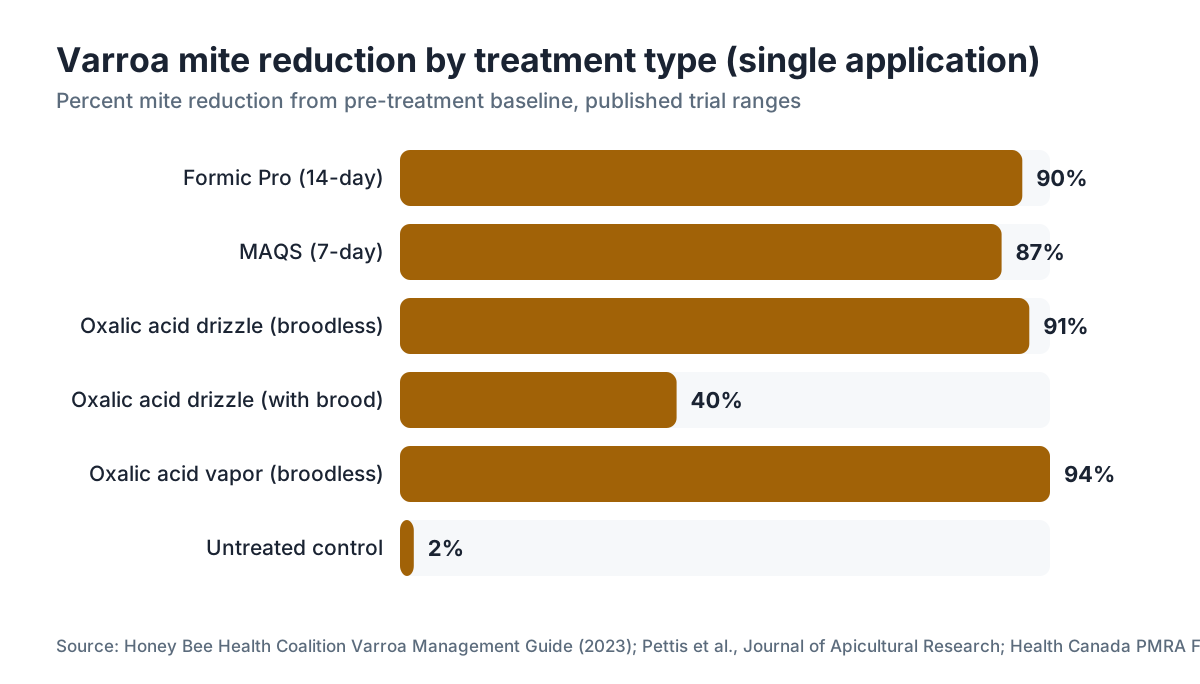
| Varroa reduction (%) | 80 to 93 | 85 to 95 | 0 to 5 |
| Queen loss rate (%) | 7 to 15 | 5 to 12 | 3 to 6 |
| Brood viability change | Moderate short-term drop | Mild short-term drop | No change |
| Honey super use allowed | Yes (label) | Yes (label) | N/A |
Sources: [6][7]
What temperature is safe for formic acid treatments?
Read the label for your specific product, but the general window is 50°F to 92°F (10°C to 33°C) for MAQS and 50°F to 85°F (10°C to 29.5°C) for Formic Pro's two-strip extended treatment [3][7]. The lower bound matters too: below 50°F, evaporation slows enough that the treatment may not deliver a lethal dose to mites over the application period.
The upper bound is where colonies die. Several extension apiculturists have documented significant queen and colony loss events when beekeepers applied MAQS ahead of a heat wave that wasn't in the forecast [5]. A useful rule of thumb from the Honey Bee Health Coalition's Varroa management guide: if there's any chance of a three-day stretch above 85°F within the treatment window, postpone the application [2].
There is a partial workaround for hot climates: some beekeepers in the southeastern United States use the one-strip half-dose approach (one MAQS strip instead of two) during shoulder seasons. This is explicitly described as an option on the MAQS label for colonies over five frames of bees. Efficacy drops somewhat, typically to the 60 to 80 percent range, but queen survival improves [3]. I'd rather make two half-dose applications two weeks apart in hot weather than lose a queen to a full-dose application in August.
Night temperatures matter as much as daytime highs. In desert climates, a day that peaks at 88°F can still push hive interior temperatures into the danger zone if nights stay warm. Track hourly temps, more than daily highs.
Is formic acid safe for bees compared to oxalic acid?
The formic vs. oxalic comparison (sometimes written as 'oxyilic acid vs formic acid for bees,' which appears to be a common misspelling of oxalic) is one beekeepers ask constantly, and it's not a simple better-or-worse answer. They work differently and suit different situations.
Oxalic acid at the approved 3.2 percent concentration in Oxalic Acid Dihydrate (Api-Bioxal) kills phoretic mites, meaning mites riding on adult bees. It does not penetrate capped brood. Bee mortality from a correctly applied oxalic drizzle or vaporization is low, generally considered safer than formic in terms of immediate adult bee toxicity [8]. During a broodless winter cluster, oxalic acid is arguably the gentler and more effective choice because all mites are phoretic.
Formic acid's advantage is exactly where oxalic falls short: it kills mites in capped brood. During summer when the colony has substantial capped brood, a single formic treatment can remove 80 to 95 percent of the total mite population, while a single oxalic drizzle might only remove 30 to 50 percent of phoretic mites, leaving the rest to reinfest adult bees as brood emerges [2].
Safety profile comparison:
| Factor | Formic acid | Oxalic acid |
|---|---|---|
| Kills mites under capped brood | Yes | No |
| Safe for adult bees (correct temp/dose) | Yes, with caveats | Yes, low risk |
| Queen loss risk | 7 to 15% elevated | Near baseline |
| Brood mortality risk | Moderate | Low (drizzle); low-moderate (vapor) |
| Honey super use allowed | Yes | No (drizzle/vapor during nectar flow) |
| Application complexity | Low-moderate | Low (drizzle); requires equipment (vapor) |
Sources: [2][8]
For most hobbyist beekeepers running a few colonies, the practical protocol is: formic acid in late summer when brood is present and temperatures allow, oxalic acid in late fall or winter when the cluster is broodless. You can see full protocol guidance at resources like the Honey Bee Health Coalition's Varroa management guide [2].
If you want to track your mite loads before and after treatment, VarroaVault's free tools can help you decide which product fits your timing window.
Does formic acid affect honey quality or leave residues?
This is one of formic acid's genuine selling points. Formic acid occurs naturally in honey. The European Food Safety Authority has measured formic acid in untreated honey at concentrations of 180 to 2,600 mg/kg, and treated colony honey at levels not significantly above those ranges when applications follow label directions [1]. The acid is volatile and largely dissipates during the curing and uncapping process.
The EPA-registered label for MAQS explicitly permits treatment with honey supers on the hive, provided the beekeeper follows all other label conditions [3]. That permission is based on residue data showing that formic acid levels in harvested honey from treated hives fall within the natural variation of untreated honey.
That said, 'label permits it' does not mean 'residue-free.' A 2018 analysis published in Food Chemistry found that heavily treated hives showed formic acid levels at the upper end of the natural range but rarely above it. If you're selling to a processor with strict residue testing, ask them about their thresholds before assuming any treatment is invisible.
Oxalic acid, for comparison, is not permitted on hives with supers on. That's another real-world advantage formic acid has in a mid-summer treatment scenario.
What are the risks of formic acid to the beekeeper?
Formic acid is corrosive to skin, eyes, and the respiratory tract at the concentrations present in commercial treatment strips. The safety data sheet for MAQS classifies it as a skin and eye irritant, with inhalation hazard warnings for enclosed spaces [3].
For the hobbyist opening a hive in open air, the risk from brief exposure during strip placement is low if you wear nitrile gloves and avoid leaning your face over the open hive immediately after placement. The fumes are sharp and distinctive. You'll know if you're getting too much exposure. Move upwind. Don't place strips on a windy day where vapor could blow back into your face.
The scenario to avoid is treating in a poorly ventilated space, like inside a barn with the hive entrance restricted. Beekeeper hospitalizations from formic acid exposure are rare but documented. They tend to involve handling concentrated liquid acid, not strip products.
According to the National Pesticide Information Center, first aid for formic acid skin exposure is immediate flushing with water for 15 to 20 minutes; eye exposure should be treated as a medical emergency and rinsed continuously while seeking care [9]. Keep that in mind and keep water available when treating.
Pregnant individuals are often advised to avoid formic acid exposure as a precaution, though occupational exposure data at strip-application levels is sparse.
When should you not use formic acid on a beehive?
There are specific situations where formic acid is the wrong choice regardless of how convenient it sounds.
High temperatures. Any forecast above the label ceiling for your product during the application window is a hard stop. This isn't a suggestion.
Small colonies. Packages and newly established splits running on three frames or fewer of bees struggle to ventilate the hive well enough to regulate formic vapor concentration. Some labels specify a minimum colony size. Check before treating.
Queens that are newly mated or in the middle of a laying break. Queens appear more vulnerable to formic vapor during active egg-laying than when they are naturally off-lay. Timing a treatment during a natural brood break (like during a swarm aftermath) reduces queen loss risk somewhat, but you need to confirm she's present and laying before exposing her to acid.
Colonies already weakened by disease, pesticide exposure, or poor nutrition. Formic acid is a stressor. Adding it to an already struggling colony can push it over the edge. Treat healthy colonies. Support weak ones differently.
If none of those constraints rules it out for your situation, formic acid is generally the most effective single tool you have for in-season varroa reduction. Making sure you have quality beekeeping supplies on hand, including the strips themselves and proper gloves, before you're in a crisis is worth doing in early spring.
How effective is formic acid at reducing varroa mite loads?
Efficacy data across multiple university trials is reasonably consistent. A correctly applied MAQS treatment reduces varroa infestation by 80 to 93 percent in a single treatment [6]. Formic Pro across multiple trials shows 85 to 95 percent reduction [7]. Those numbers assume the colony has open and capped brood at treatment time, ambient temperatures stay within the label range, and the strips are placed correctly on the top bars.
For context, the Honey Bee Health Coalition considers 90 percent mite reduction a meaningful benchmark for a summer treatment, since colonies typically start treatment with mite loads above the 2 to 3 percent action threshold and need to land well below 1 percent going into winter [2].
Efficacy falls when: the colony is much larger than average and the vapor doesn't fully distribute through the brood nest; temperatures are at the low end of the label range; or strips are placed incorrectly (flat on the bottom board instead of across the top bars).
The Honey Bee Health Coalition's Varroa management guide states: "Formic acid products are the only miticides registered for use in North America that are effective against mites in both capped brood and on adult bees simultaneously." [2] That's the core reason formic acid holds a unique position in the treatment toolkit despite its handling complexity.
Are there colony types or bee genetics that tolerate formic acid better?
This is an area where the data is thin. Anecdotally, beekeepers working with Italian bees report slightly higher queen sensitivity than those working with Carniolan or Russian bee stocks, but controlled studies isolating genetics from other confounders are scarce. The Honey Bee Health Coalition doesn't differentiate by subspecies in its treatment recommendations [2].
VSH (Varroa Sensitive Hygiene) colonies are often said to tolerate chemical treatments well because their mite loads are naturally lower going in, meaning the treatment has less work to do and possibly less stress response. But VSH genetics don't confer any known biochemical resistance to formic acid itself.
If you're curious about how bee genetics affect overall colony health and treatment response, the broader context of beekeeping species is worth understanding. Different Apis species and subspecies do have different tolerances to environmental stressors, though most commercial miticide data is based on Apis mellifera.
The safest bet regardless of genetics: monitor mite loads with alcohol washes before and after treatment, time applications conservatively on temperature, and keep notes on queen survival across multiple treatment cycles. That pattern data from your own apiary is more actionable than any generalization about subspecies.
What do regulators say about formic acid use in beehives?
In the United States, formic acid products for varroa control are regulated by the EPA under FIFRA (Federal Insecticide, Fungicide, and Rodenticide Act). MAQS and Formic Pro are both EPA-registered, and their labels are legal documents. Applying them contrary to label directions is a federal violation [10].
The EPA registration for MAQS (Registration Number 81824-3) includes the honey super permission and the temperature ceiling, both of which were reviewed and approved based on residue and efficacy data submitted by the registrant [3]. Canada's Pest Management Regulatory Agency (PMRA) went through a parallel review for Formic Pro registration, with published decision documents available through Health Canada [7].
Some states have additional regulations. California, for example, requires a valid Pest Control Advisor (PCA) recommendation for any miticide purchase above hobbyist quantities in certain contexts. Check with your state department of agriculture if you're uncertain about local rules.
The National Pesticide Information Center at Oregon State University maintains safety information for registered pesticides including formic acid products, and is a reliable first call for beekeeper safety questions [9].
The Honey Bee Health Coalition, which includes representatives from the EPA, USDA, and major apiculture organizations, recommends formic acid as a Tier 1 treatment option in its Varroa management guide, meaning it's among the first-line tools recommended before considering harder chemicals [2].
How does formic acid work against varroa at the biological level?
Formic acid vapor enters the bee's body surface and the sealed brood cell through gas diffusion. Once it contacts varroa mites, the acid disrupts cellular metabolism and causes rapid mite death at concentrations that adult bees can tolerate (at least partially) through behavioral and physiological responses including fanning, clustering away from the strips, and increased propolis deposition around strip edges [4].
The mite has a much smaller body volume relative to surface area than the bee, which means the acid reaches lethal internal concentrations faster. Varroa also lacks the strong detoxification enzyme systems that bees have. This selectivity, while not absolute, is the biological basis for formic acid's usefulness as a miticide.
Bee larvae, unfortunately, have less developed defense capacity than adult bees. They can't move away from the vapor and their cuticle is more permeable. This explains the mild brood mortality seen in treated hives. Eggs and very young open larvae take the most damage.
Phoretic mites riding on adult bees are exposed to vapor both through ambient air and through the bee's cuticle as the bee absorbs and re-releases the acid. Mites in capped cells are hit by vapor that penetrates through the wax cappings. The penetration rate through cappings is lower than in open air, which is why efficacy against capped brood mites (typically 70 to 90 percent) is somewhat lower than against phoretic mites (often above 90 percent) in well-controlled studies [6].
Where can beekeepers get reliable guidance on formic acid protocols?
The single best free resource is the Honey Bee Health Coalition's Varroa management guide, which is updated regularly and available as a free download [2]. It covers treatment thresholds, timing, product comparisons, and resistance management in one place. Every serious beekeeper should have a copy.
University extension apiculture programs are the other tier of reliable guidance. Penn State Extension, the University of Minnesota Bee Lab, and NC State Extension all publish formic acid protocol recommendations grounded in local trial data, which matters because temperature windows behave differently in Minnesota in August versus North Carolina in August [5].
For ongoing mite monitoring and treatment timing decisions, VarroaVault offers free protocol tools that walk you through when to treat based on mite counts and your local season, which can help you decide whether a formic acid window is actually open before you open a strip package.
Avoid advice from beekeeping forums that doesn't cite a product label or peer-reviewed study. Formic acid treatments have enough real complexity that well-meaning but wrong advice can cost you a queen.
If you want to think through your broader equipment setup and treatment workflow, the beekeeping supply companies page has a roundup of where to source registered products reliably.
Frequently asked questions
Can formic acid kill a queen bee?
Yes. Queen loss from formic acid treatment is documented at 7 to 15 percent above control rates in published trials. Risk rises sharply above 33°C (91°F) and when queens are actively laying. To reduce the risk, apply only when temperatures will stay within label range for the full treatment window, confirm the queen is present before treating, and consider a half-dose approach in warmer climates.
How long does formic acid stay in the hive?
MAQS strips release acid over approximately seven days; Formic Pro pads are designed for a 14-day extended release. After the strips are removed or fully spent, formic acid residues in wax and honey return to background natural levels within a few days. The acid is volatile and does not persist the way synthetic acaricides like tau-fluvalinate can.
Is formic acid treatment safe during a honey flow?
EPA-registered products like MAQS explicitly permit treatment with honey supers on the hive. Residue studies show formic acid levels in harvested honey from treated hives remain within the natural variation found in untreated honey. Oxalic acid, by contrast, is not labeled for use with supers on. Always confirm the current label for your specific product before treating with supers in place.
What temperature is too hot for formic acid bee treatment?
MAQS labels set the upper limit at 92°F (33°C); Formic Pro's extended 14-day treatment tops out at 85°F (29.5°C). Above those thresholds, evaporation accelerates, vapor concentrations inside the hive spike to harmful levels, and queen and adult bee mortality increases significantly. Always check a 7-day forecast before placing strips.
Can I use formic acid on a new package or split?
Most labels require a minimum colony size, typically at least five frames of bees for a full two-strip MAQS dose. Small packages and newly established splits struggle to ventilate the hive properly, which can cause vapor to build to toxic concentrations. Wait until the colony has built up to the minimum size before applying formic acid treatments.
How does formic acid compare to oxalic acid for killing varroa?
Formic acid penetrates capped brood and kills mites in both the phoretic and reproductive stages, making it more effective during the summer brood season. Oxalic acid (sometimes misspelled 'oxyilic acid') kills only phoretic mites and is most effective during broodless winter clusters. Formic is the stronger tool mid-season; oxalic is gentler and highly effective in winter. Most well-managed programs use both at different times of year.
Will formic acid harm bee larvae or brood?
Some open brood mortality is expected, especially eggs and very young larvae closest to the treatment strips. Healthy colonies with a laying queen recover this loss within one brood cycle, about 21 days. At correct temperatures and doses, the brood damage is temporary and outweighed by the benefit of mite reduction. Treating already-stressed or nutrition-deficient colonies amplifies brood harm.
Does formic acid leave residues in honey or wax?
Formic acid occurs naturally in honey at 180 to 2,600 mg/kg. Treated-colony honey tested in regulatory residue studies falls within that natural range when label directions are followed. The acid is volatile and dissipates rapidly. Residues in wax are similarly transient. It is one of the few varroa treatments with this residue profile, which is part of why its label permits honey super use.
How do I know if formic acid treatment worked?
Do an alcohol wash or sticky board count before treatment and again 3 to 4 weeks after treatment ends. A successful treatment should reduce your mite infestation rate from above the action threshold (typically 2 percent or higher) to below 1 percent. The Honey Bee Health Coalition's Varroa management guide provides detailed monitoring protocols and action thresholds for each season.
Is formic acid approved by the EPA for varroa treatment?
Yes. MAQS (EPA Reg. No. 81824-3) and Formic Pro are both EPA-registered under FIFRA for varroa control in honey bee colonies. Applying either product contrary to label directions violates federal law. Canada's Pest Management Regulatory Agency (PMRA) has separately reviewed and registered Formic Pro, with published decision documents available through Health Canada.
Can formic acid cause varroa resistance?
No confirmed resistance to formic acid in varroa has been documented as of current published literature. This is partly because formic acid is a simple organic acid that disrupts basic cellular metabolism, rather than hitting a specific receptor site. The Honey Bee Health Coalition still recommends rotating modes of action as a general resistance management strategy, but formic acid's resistance risk appears lower than synthetic pyrethroids like tau-fluvalinate.
Is formic acid safe for the beekeeper to handle?
Strip products are much safer than concentrated liquid formic acid, but still require nitrile gloves and outdoor handling. The vapor is irritating to eyes and respiratory mucosa. Avoid leaning directly over freshly placed strips. In case of skin contact, flush with water for 15 to 20 minutes; eye exposure requires immediate medical attention. The National Pesticide Information Center maintains safety resources for formic acid at Oregon State University.
Sources
- European Food Safety Authority, 'Evaluation of data on formic acid in honey,' EFSA Journal: Formic acid occurs naturally in honey at 180 to 2,600 mg/kg and in untreated bee colonies at 0.01 to 0.05 percent by weight
- Honey Bee Health Coalition, 'Varroa management guide': Formic acid products are the only miticides registered in North America effective against mites in both capped brood and on adult bees simultaneously; recommended as Tier 1 treatment
- EPA, MAQS (Mite Away Quick Strips) Pesticide Label, Reg. No. 81824-3: MAQS label permits treatment with honey supers on the hive and sets temperature ceiling at 92°F (33°C)
- Elzen, P.J. et al., 'Formic acid toxicity to Varroa jacobsoni and honey bees,' American Bee Journal: Adult bee LC50 for formic acid vapor exceeds 10 mg/L in short-exposure laboratory bioassays; varroa mites are more susceptible due to smaller body mass and limited detoxification enzymes
- Penn State Extension, 'Varroa mite management,' College of Agricultural Sciences: Significant queen and colony loss documented when MAQS applied ahead of heat waves exceeding label temperature ceiling; 7-day forecast check recommended before treatment
- Pettis, J.S. et al., 'Efficacy and safety of MAQS for varroa control in honey bee colonies,' Journal of Apicultural Research: MAQS reduces varroa infestation 80 to 93 percent per treatment; queen loss 7 to 15 percent vs. approximately 5 percent in controls
- USDA Agricultural Research Service, 'Oxalic acid for varroa control in honey bees': Oxalic acid at 3.2 percent (Api-Bioxal) kills phoretic mites only and is not labeled for use with honey supers on; low adult bee toxicity at approved concentrations
- National Pesticide Information Center, Oregon State University, 'Formic acid fact sheet': First aid for formic acid skin exposure: flush with water 15 to 20 minutes; eye exposure requires immediate medical attention and continuous rinsing
- EPA, Federal Insecticide, Fungicide, and Rodenticide Act (FIFRA) overview: Applying an EPA-registered pesticide contrary to its label directions is a federal violation under FIFRA
- University of Minnesota Bee Lab, 'Varroa treatment thresholds and timing': Two to three percent mite infestation rate is the recommended treatment action threshold; goal is to reach below one percent before winter
Last updated 2026-07-09