Male varroa mites: what they do and why they can't be treated
TL;DR
- A male varroa mite lives inside a capped brood cell for about 5 to 6 days, never touches an adult bee, can't feed, and dies when the cell opens.
- He doesn't spread infestation and no treatment targets him.
- He matters for one reason: he fertilizes the daughter mites that ride out and drive your colony toward collapse.
- Knowing that tells you exactly when treatments work.
What is a male varroa mite and what does it look like?
A male varroa mite is the reproductive partner to the female foundress, and in almost every way that counts he's the lesser animal. The female is a reddish-brown, shield-shaped, eight-legged creature roughly 1.1 mm wide by 1.6 mm long. The male is smaller, paler (nearly whitish to light tan), and different enough that researchers treat him almost as a separate organism [1]. Under magnification his body looks more rounded, and his mouthparts (chelicerae) are built for sperm transfer, not for piercing and feeding. He can't feed on a host bee at all.
The taxonomy is simple. Varroa destructor (and the less damaging Varroa jacobsoni) sit in the family Varroidae, order Mesostigmata. The species wrecking Western honey bee (Apis mellifera) colonies worldwide is almost entirely V. destructor [1]. When beekeepers say "varroa," they mean V. destructor, and within that species the male is a stage most people never consciously see, because he never exits the capped brood cell alive.
Size matters here for one practical reason. Alcohol wash and sugar roll monitoring catch female mites clinging to adult bees. Males are never on adult bees. So every mite you count in a wash is female, and your threshold decisions rest entirely on the female population [2].
What is the lifecycle of a varroa mite and where does the male fit?
The whole varroa lifecycle plays out inside capped brood cells, and the male exists only during that hidden phase. He's born in the cell, mates in the cell, and dies in the cell.
Here's how it works. A mature female (the foundress) slips into a larval cell just before capping, usually 15 to 20 hours before the cell is sealed [3]. She hides under the larval food at the bottom. Once the cell is capped, she waits about 60 hours, then lays her first egg. That first egg is always unfertilized and always becomes a male. Every egg after that, laid roughly every 30 hours, is fertilized and becomes a female [3].
The male hatches first and matures before his sisters do. His one job is to mate with each sister as she matures inside the cell. He transfers sperm through a structure called the spermatophore, and the daughters carry that sperm for the rest of their lives outside the cell (potentially months).
When the bee emerges, the mated daughters ride out on the young bee. The male stays behind. He can't survive outside the cell, can't feed, and dies within hours of the cell being opened [3]. He never leaves.
Compare the timeline in worker brood versus drone brood:
| Stage | Worker cell (capped ~12 days) | Drone cell (capped ~14-15 days) |
|---|---|---|
| Foundress enters | ~20 hrs before capping | ~20 hrs before capping |
| First egg laid (male) | ~60 hrs post-capping | ~60 hrs post-capping |
| Male reaches maturity | ~day 5-6 post-capping | ~day 5-6 post-capping |
| First female egg hatches | ~day 7-8 post-capping | ~day 7-8 post-capping |
| Cell opens | day 12 (worker emerges) | day 14-15 (drone emerges) |
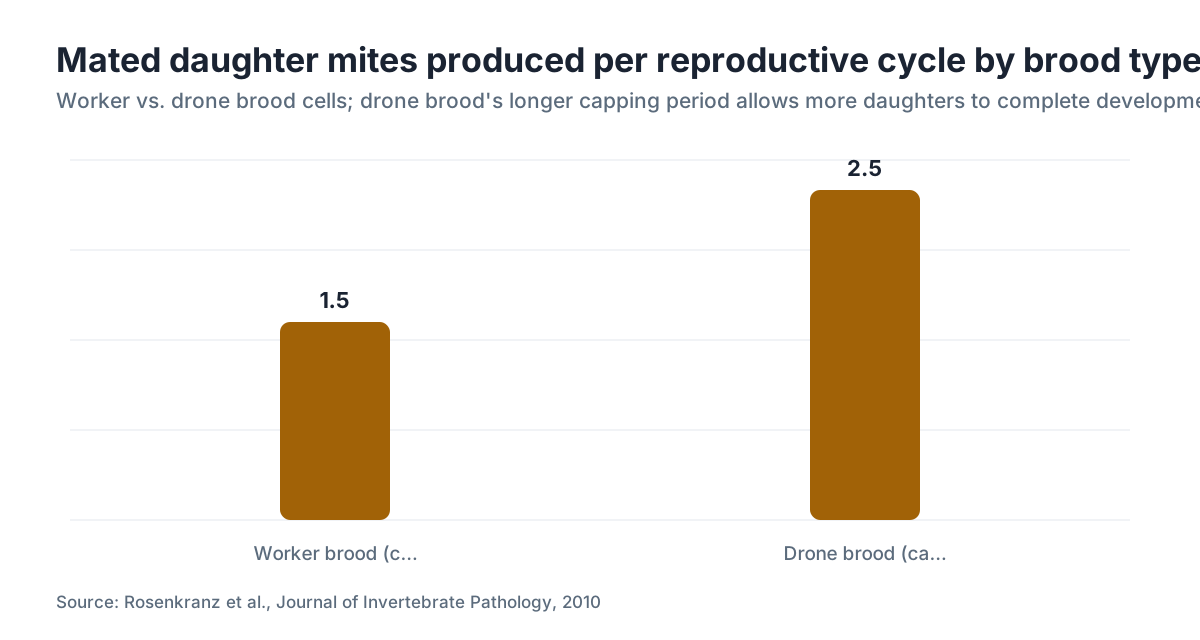
| Successful mated daughters per cycle | ~1-2 | ~2-3 [3] |
Drone brood gives varroa more time and yields more mated daughters per cycle. That's exactly why drone brood removal is a real (if labor-heavy) management tool [4].
Can male varroa mites infest or spread to other hives?
No. Males never spread anywhere.
Spread needs mobility on adult bees, the phoretic phase, and males never enter it. Varroa moves between colonies through drifting bees, robbing, and beekeepers shuffling frames. In every one of those pathways the vector is a phoretic female clinging to an adult bee [5]. Males die in the cell they were born in.
This changes how you read a mite spike. When your count jumps in late summer, that's mated females arriving on robbing bees from collapsing colonies nearby. It's never males. Every varroa control you'll ever apply (oxalic acid, formic acid, amitraz, screened bottom boards) targets phoretic and reproducing females. Males are exempt from all of it, not because treatments miss them, but because they're dead before the treatment question even comes up [6].
For the full mite biology and how each lifecycle phase ties to treatment timing, see the varroa mite overview on this site.
Do male varroa mites feed on bees?
They don't. The male varroa mite has no working feeding apparatus, and that's one of the stranger facts in mite biology.
The female feeds on the fat body tissue of the developing larva and pupa. Not hemolymph, as textbooks claimed for decades. A 2019 study by Ramsey and colleagues in PNAS corrected that old assumption [7]. Her chelicerae pierce and feed. The male's chelicerae are reshaped into organs for sperm transfer, so he can't puncture a bee's cuticle.
So what does he eat? Probably very little. Some researchers think he may take small amounts of the nutrient-rich material inside the cell (larval secretions, wax debris), but there's no strong evidence he needs much of anything for his short life. His job is to be sexually mature when his sisters emerge, mate with them, and die. He does all of it in about five to six days without ever harming a bee directly [3].
The damage to the colony comes entirely from what the mated females do next: parasitizing developing bees, suppressing immune function, and carrying viruses. Deformed Wing Virus (DWV) is the big one, and it shortens bee lifespan and wrecks flight ability [5].
How many male mites are produced per reproductive cycle?
One. Exactly one per reproductive cycle, assuming the foundress survives to lay her first egg.
That lopsided ratio isn't an accident. The one-male-per-cell rule holds across Varroa destructor everywhere, and it makes evolutionary sense. One male who can mate multiple sisters beats several males competing for the same daughters. The foundress usually lays 5 to 6 eggs total in a worker cell (first unfertilized, then 4 to 5 fertilized), though the cell's short duration limits how many daughters actually reach maturity and mate before the bee emerges [3].
In worker brood the math is tight. The bee emerges around day 12 post-capping, so a foundress has time to produce roughly one to two mated daughters per cycle. In drone brood the longer capping window lets two to three daughters finish development and mate. That's why a colony with drone brood grows its mite population faster than one without [4].
The male's contribution is indirect but absolute. No male, no fertilized daughters, no mated females riding out. He's the genetic linchpin, and he's produced at the lowest possible rate.
Why does understanding male mite biology matter for treatment timing?
Treatment timing and male mite biology connect through one rule: every effective varroa treatment works on mites outside capped cells.
Oxalic acid, the most widely used treatment in the U.S. (registered by the EPA under labels including Api-Bioxal), kills phoretic females. It does almost nothing to mites inside capped brood, male or female [6]. Same story for most synthetic miticides like amitraz (Apivar). Formic acid (Mite-Away Quick Strips, an EPA-registered miticide) is the partial exception because it penetrates some cappings, but its effect on sealed brood mites is inconsistent [11].
The Honey Bee Health Coalition's Varroa management guide puts it plainly: "Treatments are most effective when applied during broodless periods." During a broodless window the phoretic mite load peaks and no mite can hide inside a sealed cell [8]. The male is never the target. But knowing males exist only inside capped cells shows why a broodless or low-brood window is so powerful. Strip away the capped brood and every mite in the colony is a female out in the open.
Building or reviewing a seasonal protocol? Tools at VarroaVault map treatment windows against your local brood cycle so you're not guessing when the colony is most treatable.
For sourcing treatments and gear, see our beekeeping supply companies guide.
Does drone brood removal kill male mites along with females?
Yes, though killing the male is almost beside the point.
Drone brood removal (also called drone comb trapping) works by handing varroa a preferred nursery, drone comb, then pulling and freezing or destroying that capped drone brood before the drones emerge. Every mite inside dies: the foundress, all developing daughters, and the male [4].
The male is a casualty here, not the target. The real payoff is wiping out the 2 to 3 mated daughters per cell that would otherwise emerge on adult bees and restart the cycle. Studies show drone brood removal can cut mite loads meaningfully with consistent effort (roughly every 21 to 24 days to catch each cycle), but on its own it rarely holds mites below economic thresholds during peak season [4].
Treat drone brood removal as a supplement, not a solo act. It works best inside an integrated plan: handy during spring buildup when chemical treatments might slow colony growth, and useful in organic programs. The Honey Bee Health Coalition's guide covers how to sequence it with other tools [8].
One honest limitation. You have to provide and manage drone comb on a schedule, and that's labor. If your apiary time is already thin, ask yourself whether you'll actually pull those frames every three weeks. If not, pick a tool you'll stick with.
Can you see male varroa mites during a hive inspection?
Almost never under normal conditions. To spot a male, you'd have to uncap a brood cell by hand and look at the contents under magnification.
Beekeepers who do brood dissections for research or IPM monitoring run into males this way. The male shows up as a smaller, paler, rounder mite next to the reddish-brown foundress. In a routine inspection you'll never see one.
Your standard monitoring methods (alcohol wash, sugar roll, sticky board counts) capture only phoretic females [2]. That's not a gap in the methods. It's exactly what you want. The phoretic female count drives infestation spread and tells you whether your colony is nearing the 2 to 3% threshold (roughly 2 to 3 mites per 100 bees) that most extension recommendations use as a late-summer treatment trigger [2][8].
The University of Minnesota Bee Lab recommends the alcohol wash as the most accurate monitoring method, and its protocols rest entirely on female phoretic counts [2]. New to monitoring? The varroa mite article walks through an alcohol wash step by step.
What happens to male mites when a treatment is applied?
Males inside capped brood during a treatment usually walk away untouched, for the same reason sealed females do: the wax capping is a physical wall.
Oxalic acid by vapor, dribble, or sublimation works by contacting mites directly on bee bodies or on wax surfaces where phoretic mites travel. Sealed brood, whether it holds a male, a foundress, or developing daughters, is mostly protected [6]. That's why one oxalic acid treatment during a brood-present period never gets full control. You kill the phoretic females but leave the whole reproductive cycle running inside every capped cell.
Here's the practical part. Don't get discouraged if a mid-season oxalic acid treatment drops a pile of mites on the sticky board but your next alcohol wash still reads high. The females sealed inside brood cells (plus the males mating them) re-infest your phoretic bees within two to three weeks as those bees emerge [6].
That's the whole case for repeated treatments timed to the brood cycle, or a single treatment during a natural or induced broodless period. One-and-done rarely works.
Are male varroa mites present in all honey bee species?
Males exist in every Varroa species, but their success swings sharply by host.
V. destructor reproduces well in Apis mellifera (the Western honey bee most beekeepers run) and does far more economic damage there than in its original host, Apis cerana (the Eastern honey bee). In A. cerana the mite's reproductive success collapses: females often fail to reproduce, and infestations stay low and stable. The leading explanation is the shorter capping period in A. cerana worker brood, which doesn't give the male enough time to mature and finish mating [9].
So the male's developmental clock is varroa's weak spot in A. cerana. That host evolved a worker capping period just slightly too short for the mite's cycle to finish reliably [9]. It's one reason some researchers chase Apis mellifera lines with shorter post-capping development as a path to varroa-tolerant bees.
Curious how host species shapes mite pressure? The beekeeping species article covers A. cerana, A. mellifera, and others in broader context.
Does the male mite's genetics influence colony-level mite resistance?
This is an open research question, and the honest answer is: probably yes, but the data are thin.
Variation in varroa reproductive success across colonies is well documented. Some colonies show suppressed mite reproduction (SMR) or the related hygienic behavior, where workers detect and remove infested brood [10]. Whether the male's genetics feed that variation is less clear. Male varroa are haploid (from unfertilized eggs), and since the daughters carry sperm from that single male for life, he's genetically the father of every daughter in a given cycle. His genes shape the next generation's fitness.
Selective breeding programs for varroa-resistant bees (including work at the USDA's Baton Rouge bee lab) focus on the bee side: picking colonies where mite reproduction runs low [10]. But the mite population carries its own heritable variation too. Nobody has good large-scale data yet on whether targeting mite-side genetics is a workable resistance strategy for practical beekeepers. The closest work sits in academic breeding experiments, not field management.
What this means for you right now: don't let interesting biology become an excuse to skip monitoring and treatment. The genetics angle is a research frontier, not a tool you can hold in your hand yet.
What should every beekeeper know about male mites in plain terms?
Here's the short version for anyone who skipped the biology above.
The male varroa mite exists for one thing: fertilizing his sisters inside a capped brood cell. He lives about five to six days, never touches an adult bee, never spreads between hives, never responds to any treatment, and dies when the bee emerges. He is not the enemy. The mated females riding out on those emerging bees are.
Knowing he exists does three useful things. First, it explains why broodless-period treatments hit so hard: with no capped brood, every mite in the colony is a phoretic female with no backup sealed away. Second, it confirms your monitoring data (alcohol washes, sugar rolls) reflect the real infestation pressure, because you're counting the only population that matters. Third, it demystifies the math: one male per cell, one foundress per cell, one to two mated daughters per worker cell cycle. That's the engine pushing your mite load up through summer.
For a treatment protocol built on this biology, the VarroaVault seasonal protocol tools are free and use the same lifecycle timing described here.
And if you want the right gear for monitoring and treatment, our beekeeping supply companies guide lists reputable vendors with current stock and pricing.
Frequently asked questions
Can male varroa mites survive outside a brood cell?
No. Male varroa mites die within hours of a brood cell being opened. They have no feeding apparatus, can't survive on an adult bee, and are restricted to the microenvironment inside a capped cell. Their only function is to mate with their sisters before the host bee emerges. Once that cell opens, the male's life is effectively over.
Do male varroa mites bite or harm bees?
No. Male varroa mites can't bite or feed on bees. Their mouthparts are modified for sperm transfer, not for piercing a bee's cuticle. All direct harm to developing bees (fat body consumption, immune suppression, viral transmission) comes exclusively from female mites. The male contributes to colony damage only indirectly, by fertilizing the females who do the damage.
How long do male varroa mites live?
Roughly five to six days under normal conditions inside a capped brood cell. That's enough time to reach sexual maturity and mate with each sister as she develops. After the host bee emerges and the cell opens, the male dies quickly. His entire lifespan fits inside a single brood capping cycle.
Why do varroa prefer drone brood over worker brood?
Drone brood is capped for 14 to 15 days versus about 12 days for worker brood. The longer capping period gives the foundress more time to finish reproductive cycles, usually 2 to 3 mated daughters versus 1 to 2 in worker brood. The male's development timeline is the same in either cell, but the extra days in drone brood let more daughters mature and mate before the bee emerges.
Does oxalic acid kill male varroa mites?
Oxalic acid can contact a male mite only if it's exposed, but males stay sealed inside capped brood cells their entire brief lives, and oxalic acid doesn't penetrate cappings well. In practice the question is moot: males die when the cell opens anyway. Oxalic acid targets phoretic female mites on adult bees, which is where the real infestation pressure sits.
Can I monitor male varroa mite levels to assess infestation?
No practical method captures male mites. Alcohol wash, sugar roll, and sticky board counts all reflect only phoretic female mites on adult bees. Males never leave capped cells, so they're invisible to standard monitoring. Your threshold decisions (typically 2 to 3% in late summer) rest entirely on female phoretic counts, which is exactly the population that matters for management.
How many mites are typically inside one capped brood cell?
A single foundress usually lays 5 to 6 eggs per cell: one unfertilized (male) and 4 to 5 fertilized (female). In a worker cell, usually only 1 to 2 daughters reach maturity before the bee emerges. In a drone cell, 2 to 3 daughters may finish development. So at peak you might find a foundress, one male, and 2 to 3 daughters in a drone cell, for a total of 4 to 5 mites.
Is the male varroa mite present in all varroa species?
Yes. Male mites exist in Varroa destructor, V. jacobsoni, and related species. But in Apis cerana (Eastern honey bee), the male's developmental timeline often can't finish before the shorter-capped brood cell opens, which is one reason V. destructor reproduces so poorly in A. cerana. In Apis mellifera colonies, the capping period runs long enough that reproduction succeeds consistently.
What is the sex determination mechanism for varroa mites?
Varroa uses arrhenotoky: unfertilized eggs become haploid males, fertilized eggs become diploid females. The foundress lays her first egg unfertilized (always male) and later eggs fertilized (always female). That makes the male the genetic father of every daughter he mates inside the cell, since those daughters carry his sperm for their entire reproductive lives.
Do mite-resistant bee breeds eliminate male mites faster?
Not exactly. Hygienic bees and VSH (varroa-sensitive hygiene) lines detect and remove infested brood cells, which kills every mite inside, including the male. The resistance mechanism is on the bee side, not the mite side. These lines hold lower mite populations, but they still need monitoring and often benefit from supplemental treatments, especially when mite immigration from neighboring colonies runs high.
Can drone brood removal alone control varroa?
Rarely as a standalone strategy. Drone brood removal wipes out one reproductive cycle per pull, destroying the foundress, male, and daughters inside. Studies show meaningful mite reduction with consistent 21 to 24 day cycling, but it almost never holds mite levels below treatment thresholds during peak summer buildup. Most integrated programs use it to supplement, not replace, chemical or oxalic acid treatments.
How does knowing about male mites help me choose a treatment timing?
The male's confinement to capped brood is exactly why broodless-period treatments work so well. When no capped brood is present, every mite in the colony is a phoretic female, fully exposed to oxalic acid or other treatments. Knowing males exist only inside capped cells makes clear why treating during a broodless window (natural or induced) is the highest-efficacy moment in your annual calendar.
Do beekeeping beginners need to worry about male mites specifically?
No. Beginners should focus on monitoring phoretic female mite counts and treating when those counts hit thresholds. The male mite is biologically interesting but not actionable. Understanding the lifecycle explains why treatment timing matters, but the practical system (monitoring, threshold-based treatment, timing to the brood cycle) works the same whether or not you've read the male mite biology.
Sources
- USDA Agricultural Research Service, Bee Research Laboratory (Varroa destructor biology): V. destructor morphology: female ~1.1 mm wide, 1.6 mm long; male smaller, paler, with chelicerae modified for sperm transfer
- University of Minnesota Bee Lab, Varroa monitoring and management resources: Alcohol wash captures only phoretic female mites; treatment threshold ~2-3% in late summer
- Rosenkranz P, Aumeier P, Ziegelmann B, 'Biology and control of Varroa destructor', Journal of Invertebrate Pathology, 2010: Foundress enters cell 15-20 hrs before capping; first egg (male) laid ~60 hrs post-capping; male matures in 5-6 days and dies at cell opening
- Penn State Extension, honey bee and varroa management resources: Drone brood capped 14-15 days yields 2-3 mated daughter mites per cycle vs 1-2 in worker brood; removal every 21-24 days reduces mite loads
- Honey Bee Health Coalition, 'Tools for Varroa Management' guide: Varroa spread between colonies occurs via phoretic female mites on drifting and robbing bees; DWV vectored by female mites shortens bee lifespan
- EPA, Pollinator protection and oxalic acid/miticide registration information: Oxalic acid kills phoretic mites; does not penetrate capped brood effectively; most effective during broodless periods
- Ramsey SD et al., 'Varroa destructor feeds primarily on honey bee fat body tissue and not hemolymph', PNAS, 2019: Female varroa feeds on fat body tissue, not hemolymph; male chelicerae are modified for sperm transfer and cannot feed on host
- Honey Bee Health Coalition, 'Tools for Varroa Management' guide (broodless timing and drone brood removal): 'Treatments are most effective when applied during broodless periods'; drone brood removal covered as supplemental IPM tool
- Rosenkranz P, Aumeier P, Ziegelmann B, 'Biology and control of Varroa destructor', Journal of Invertebrate Pathology, 2010 (host adaptation in Apis cerana): Shorter capping period in A. cerana worker brood limits V. destructor male maturation time, suppressing reproductive success
- USDA Agricultural Research Service, Honey Bee Breeding, Genetics and Physiology Research (Baton Rouge, VSH breeding): VSH bee lines remove mite-infested brood, lowering mite reproduction rates; USDA selective breeding programs focus on bee-side genetics
- EPA, Pollinator protection and formic acid (Mite-Away Quick Strips) registration information: Formic acid has some penetration into capped cells but efficacy against sealed brood mites is inconsistent; registered EPA miticide
- University of Minnesota Bee Lab, varroa biology resources (sex determination): Arrhenotokous sex determination in varroa: unfertilized eggs = haploid males; fertilized eggs = diploid females; male is genetically father of all daughters in cycle
Last updated 2026-07-10