Mann Lake varroa mite treatments: what works and what to skip
TL;DR
- Mann Lake carries most of the major EPA-registered varroa treatments: oxalic acid (Api-Bioxal), thymol-blend (ApiLife Var), fluvalinate (Apistan), amitraz strips (Apivar), and formic acid pads (Formic Pro).
- The right choice turns on your temperature window, brood status, and local resistance history.
- For small hive counts, oxalic acid by dribble or vapor is the smartest place to start.
What varroa treatments does Mann Lake actually sell?
Mann Lake is one of the larger beekeeping supply distributors in North America, and their treatment catalog covers nearly every EPA-registered varroa product a hobbyist or sideliner would need. As of 2025, the lineup includes Api-Bioxal (oxalic acid dihydrate), ApiLife Var (thymol plus essential oils), Apistan (fluvalinate strips), Apivar (amitraz strips), and Formic Pro (formic acid pads). They also stock oxalic acid vaporizers and dribble syringes.
That's basically the full toolkit the U.S. EPA has approved for varroa management in honey bee colonies [1]. None of it is a silver bullet. Each product sits in a different chemical class, works in a different temperature range, and hits the mite at different life stages.
Comparing suppliers? Our guide to beekeeping supply companies has a broader look at who stocks what and at what price. Mann Lake's prices run competitive but rarely the absolute lowest. What you're paying for is reliability and stock depth.
Here's a quick-reference table of the products, their active ingredients, and their EPA registration numbers:
| Product | Active Ingredient | Chemical Class | EPA Reg. No. |
|---|---|---|---|
| Api-Bioxal | Oxalic acid dihydrate | Organic acid | 69603-11 |
| ApiLife Var | Thymol, eucalyptol, menthol, camphor | Essential oil blend | 81824-1 |
| Apistan | Fluvalinate (tau) | Synthetic pyrethroid | 432-1442 |
| Apivar | Amitraz | Formamidine | 68048-2 |
| Formic Pro | Formic acid | Organic acid | 87972-1 |
All five are real, registered products. The EPA registration numbers above are consistent with publicly available label data [1][2].
How does oxalic acid (Api-Bioxal) work, and when should you use it?
Oxalic acid is the most widely recommended varroa treatment for small operations right now, and Api-Bioxal is the only EPA-registered oxalic acid product for bees in the U.S. [1]. It kills by direct contact. The acid is toxic to varroa, but at the doses used in hives it's well-tolerated by adult workers and queens.
The catch decides everything: oxalic acid only kills mites riding on adult bees, the phoretic mites. It does nothing to mites sealed inside capped brood. That single fact drives when and how you use it.
The Api-Bioxal label allows three application methods.
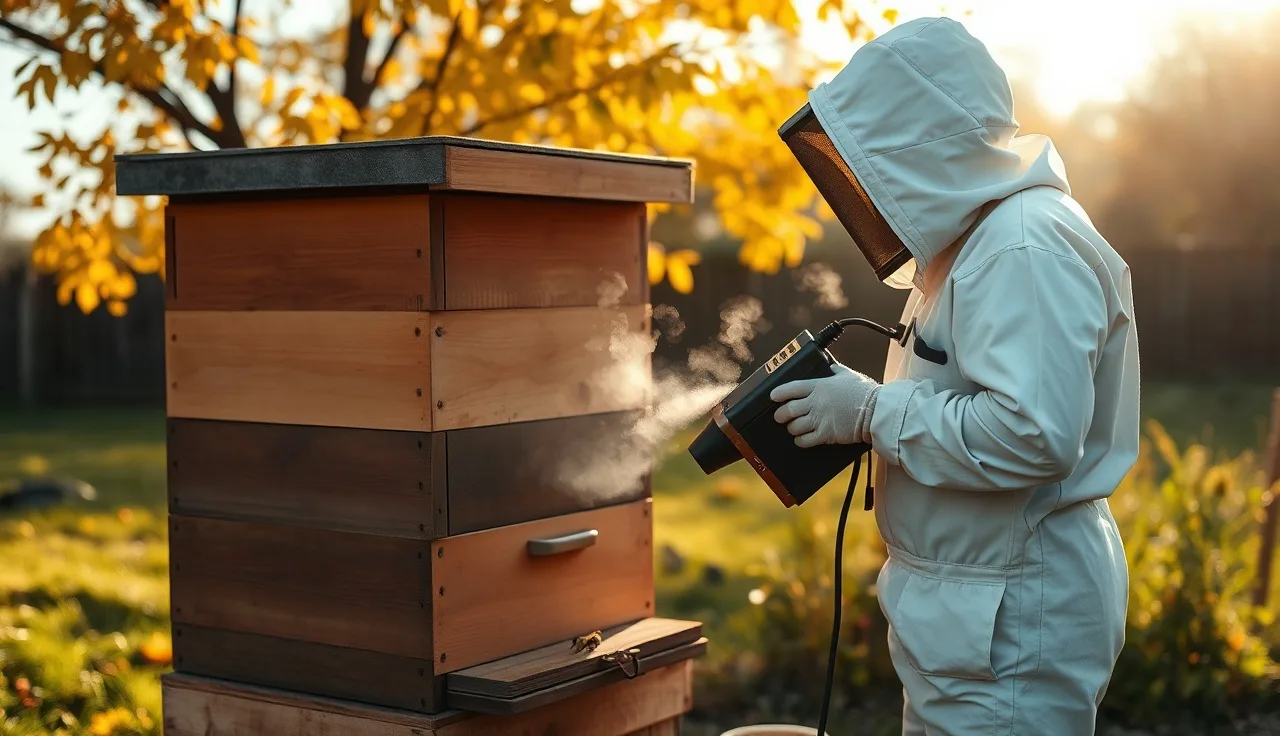
- Vaporization (sublimation). You load oxalic acid crystals into a vaporizer and heat them into a gas that spreads through the hive. It's faster per hive than dribble and often preferred by sideliners. A single brood-free treatment usually knocks down more than 90 percent of mites [3].
- Dribble. You mix the oxalic acid into 1:1 sugar syrup and drizzle 5 mL per seam of bees, not per frame. Most hobbyists start here because it needs no electrical gear.
- Extended-release sponge strips. The 2022 label expansion added a sponge-strip method for use with or without brood, spreading contact time over several weeks. Efficacy on the strip method has run more variable than the single-dose broodless treatments [3].
The best window is a broodless period: the winter cluster in cold climates, or a broodless state you create yourself by caging the queen. The Honey Bee Health Coalition's varroa guide puts it plainly: "treatments applied when colonies are broodless are more effective than those applied when brood is present" [3].
Temperature matters less here than for thymol or formic acid. You can vaporize down into the 30s Fahrenheit, which keeps it practical through most of winter. Just keep the colony sealed for at least ten minutes after vaporization.
What is ApiLife Var and how effective is it against varroa?
ApiLife Var is a thymol-based treatment. Each wafer holds thymol, eucalyptol, menthol, and camphor. Thymol does the real work. It volatilizes in warm temperatures and disrupts the mite's respiratory and nervous systems. It also has some antibacterial activity, which is a bonus, not the reason you buy it.
The constraint is temperature. ApiLife Var needs ambient temperatures between roughly 59°F and 77°F (15°C to 25°C) for the thymol to volatilize properly [4]. Too cold and the active ingredient never fully off-gasses. Too hot and you risk queen loss and heavy bee mortality. That narrow band makes it a spring or early fall treatment across most of North America, and it shuts you out of midsummer in many regions.
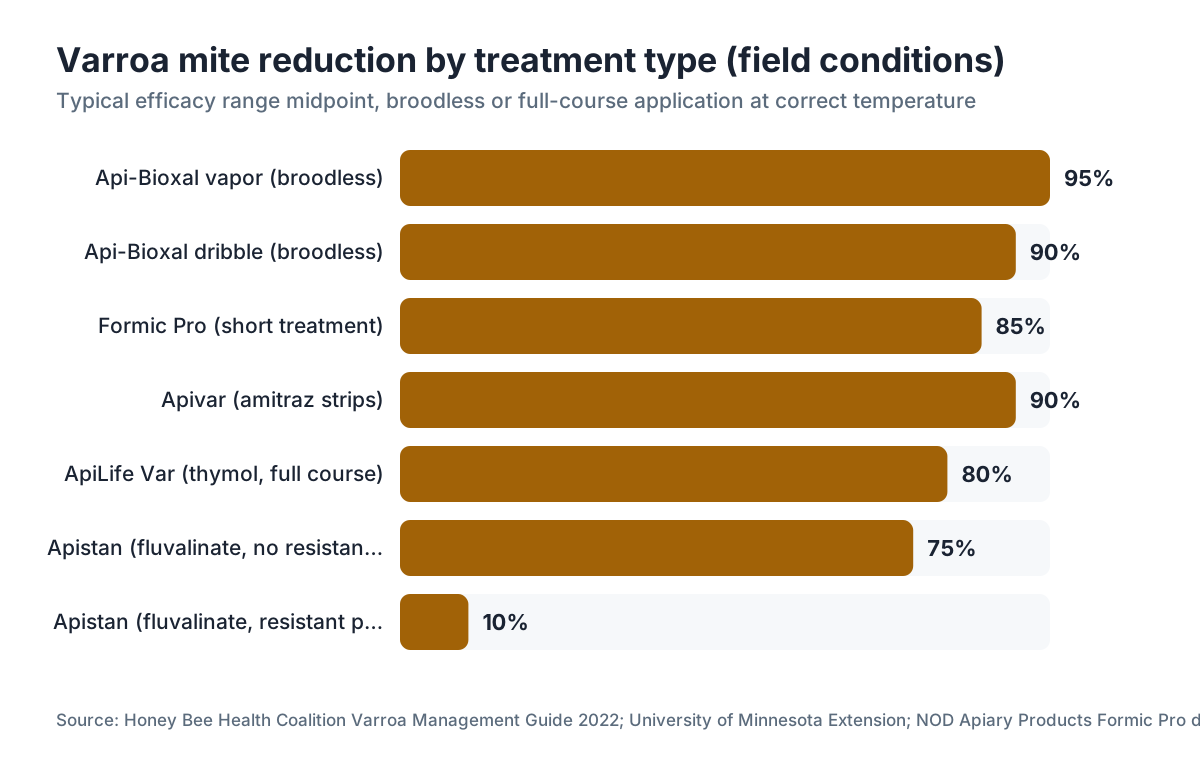
Used right, efficacy is respectable. European field trials and extension-reviewed data generally show 70 to 90 percent mite reduction over a full course, meaning three wafer changes across roughly 28 days [4]. That's below a well-timed oxalic acid broodless treatment, but it works through brood and has residual activity.
Here's one thing ApiLife Var does that oxalic acid can't: it reaches mites reproducing inside capped cells, to a degree, because thymol vapor penetrates the cappings. The effect is partial. But it's real.
To apply, break the wafer in half and set the two pieces on the top bars near the edge of the cluster. After 7 to 10 days, pull them and drop in a fresh wafer. Three applications total. Always remove ApiLife Var before adding honey supers, because thymol taints honey at detectable levels [4].
Still working through the varroa mite biology before you choose? That background explains why temperature-dependent volatilization is such a practical headache.
Should you still use Apistan (fluvalinate) given mite resistance concerns?
I'll be blunt: across most of the United States, Apistan is a poor first-line choice in 2025.
Fluvalinate resistance in varroa mites was first confirmed in the late 1990s and has since turned up across the U.S., Europe, and beyond [5]. It develops when the same synthetic pyrethroid gets used again and again in the same apiaries over years. In regions with a long fluvalinate history, a big share of the local mite population carries resistance mutations that leave Apistan nearly useless.
The EPA label still allows it, and Mann Lake still sells it. That's fine. But the Honey Bee Health Coalition names fluvalinate resistance as a real practical concern and pushes beekeepers to rotate chemical classes to keep their tools working [3].
So when does Apistan still make sense? If you're in a genuinely isolated spot with no nearby beekeeping history, or you can confirm through your state apiarist or university extension that resistance hasn't shown up locally, it's a legitimate option. The strips are easy to use and effective where resistance hasn't taken hold.
The standard protocol is two strips per brood chamber for 6 to 8 weeks, then removal. Never leave strips in past the label window. That's one of the main drivers of resistance selection [5].
Do a wash or sugar roll count before treatment and again 2 to 3 weeks after. If you dose with Apistan and the mite load doesn't fall, you've got resistant mites. Switch chemical classes right away.
How does Apivar (amitraz) compare to other Mann Lake treatments?
Apivar is amitraz in a plastic strip, and right now it's one of the more reliable synthetic treatments available in the U.S. Amitraz works through a different mechanism than fluvalinate (it's a formamidine, not a pyrethroid), so there's no cross-resistance between Apistan and Apivar. If your mites are fluvalinate-resistant, amitraz can still work.
The efficacy data is strong. University of Minnesota and other extension research has documented consistent reductions above 90 percent in the field when Apivar is used correctly [6]. The strips release amitraz slowly across the 6 to 8 week window, and the compound reaches mites even inside capped cells by moving through the wax on attending nurse bees.
The downsides are real. Amitraz residues build up in beeswax over repeated treatments. USDA Bee Research Lab sampling has found detectable amitraz and its breakdown products in most commercial wax pulled from operations that treat with amitraz regularly [7]. That doesn't make amitraz unsafe at label doses. It's a reason not to make it your only treatment year after year.
Some beekeepers also report queen loss, especially when treating in hot weather. Keep Apivar strips out of honey supers. Amitraz is not approved for use when supers are on.
My honest take: Apivar is a very good fallback when organic acids aren't practical, and a good rotation partner to slow resistance to either class. I wouldn't run it as my primary treatment every cycle.
What is Formic Pro and how does it differ from other formic acid products?
Formic Pro comes from NOD Apiary Products and sells through Mann Lake and others. It's a formic acid treatment on a slow-release pad. The formic acid penetrates capped brood cells and kills the mites underneath, which is exactly what oxalic acid cannot do as a single dose.
That's the whole point of Formic Pro. It's one of the few treatments that meaningfully cuts mites in capped brood in one application cycle. For colonies packed with brood, that changes the math.
Temperature bites harder here than with anything else on this list. The Formic Pro label calls for 50°F to 85°F (10°C to 29°C), with the sweet spot around 59 to 79°F. Above 85°F, released formic acid concentrations climb high enough to risk queen loss and adult bee mortality. Lose one queen to formic acid and you'll respect that ceiling for life [8].
Two protocols exist. The short treatment is a single pad for 10 days, used when temperatures stay below 79°F. The extended treatment runs two pads back to back over 20 days. Field efficacy for the short treatment lands around 75 to 95 percent depending on conditions [8].
Formic Pro is an organic acid, so it leaves no lasting residue in wax. If you're trying to keep your comb cleaner over the years, that's worth something.
You can also run Formic Pro with honey supers on, which is unusual. The label permits it, and formic acid doesn't leave residue that taints honey at detectable levels. That opens a summer treatment window most other products can't touch.
Which Mann Lake treatment is best for a hobbyist with just a few hives?
If I were keeping 1 to 10 hives and deciding what to buy from Mann Lake right now, I'd build around Api-Bioxal.
Here's the reasoning. Oxalic acid is the cheapest per treatment of anything on the list. It leaves no problem residue in wax. No field resistance to oxalic acid has been documented [3]. And a single well-timed vaporization during a broodless stretch can strip more than 90 percent of mites off your bees in one session.
The upfront cost is the vaporizer, roughly $150 to $250 for a plug-in electric model from Mann Lake or other suppliers. After that, Api-Bioxal runs around $25 to $35 for a 35-gram packet, enough for many treatments. Compare that to Apivar at roughly $18 to $22 per pack of 10 strips (one two-strip treatment per colony), or Formic Pro at roughly $25 to $35 for a two-pad pack.
For a small operation, the vaporizer pays for itself fast. Can't swing the vaporizer yet? Start with the dribble method over a broodless winter cluster. It's less efficient per treatment, but it costs almost nothing to run.
The varroa tools at VarroaVault help you track mite wash results and time treatments around your local brood cycle, which is the single biggest variable in whether a treatment works.
For the full picture of gear you need alongside treatments, the beekeeping supplies overview is worth a read.
When is the right time of year to apply each type of treatment?
Timing is where most hobbyists lose colonies. No product saves a hive if it lands at the wrong point in the mite cycle.
Here's a seasonal framework for a temperate Northern Hemisphere climate (shift it roughly a month earlier for the South, a month later for Canada):
Late summer (July-August): The most important window of the year. Mite loads usually peak in late summer as colony populations start shrinking. A mite that infests an August bee's brood is infesting your winter bees. Formic Pro, Apivar, or ApiLife Var all fit here, depending on your temperature window. Formic Pro and ApiLife Var both reach mites in brood, which counts because late-summer colonies still have plenty of it.
Fall (September-October): As brood rearing slows and temperatures drop, your options narrow. Formic Pro gets unreliable below 50°F. ApiLife Var stops working below 59°F. Apivar (amitraz) still runs at cooler temperatures and stays useful through October. An oxalic acid vaporization after the last brood seals up is highly effective here.
Winter (November-February): The oxalic acid window. A broodless cluster is a perfect target for one vaporization or dribble treatment. A single winter treatment at a mite load of 3 percent or higher can be the line between a colony that survives spring and one that collapses.
Spring (March-May): Treat again if spring monitoring shows 2 or more mites per 100 bees before the summer buildup starts. Formic Pro or Apivar are practical picks for brood-right spring colonies.
The Honey Bee Health Coalition recommends treating at least twice a year: once in late summer, once in late fall or early winter [3]. Plenty of sideliners serious about colony retention treat three times.
How do you monitor mite levels before and after using any Mann Lake treatment?
Picking a treatment without monitoring first is like prescribing antibiotics with no diagnosis. Get a baseline count.
The two accepted methods are the alcohol wash and the sugar roll [3]. Alcohol wash is more accurate. You collect roughly 300 bees in a jar with rubbing alcohol, shake for 60 seconds, strain, and count the fallen mites. Sugar roll uses powdered sugar instead. It's kinder to the bees but a touch less precise.
The action threshold most extension programs use is 2 to 3 mites per 100 bees during the spring and summer brood-rearing season, and roughly 1 to 2 mites per 100 bees heading into fall [3][6]. At or above those numbers, treat. Below them, monitor again in 30 days.
After treatment, run another wash 2 to 3 weeks out (or after strips come out, for Apivar). If the mite load hasn't dropped at least 90 percent, you've got one of three problems: you applied the treatment wrong, the temperature window was off, or you have resistant mites. Each one has a different fix.
The University of Minnesota Extension publishes a detailed alcohol wash protocol online for free [6]. Mann Lake sells the hardware too: mesh-bottom jars, alcohol wash kits, sticky boards. Sticky boards are fine for rough trending but not for calculating precise infestation rates, since they can't account for colony size.
Monitor before every treatment. Monitor after. Keep records. That one habit separates the beekeepers who know what's happening from the ones who are always guessing.
Are there any risks or legal requirements I should know about for these treatments?
Every Mann Lake varroa treatment is an EPA-registered pesticide. Using them according to the label is a federal legal requirement in the United States, not a suggestion. The label language, backed by the Federal Insecticide, Fungicide, and Rodenticide Act (FIFRA), governs every application [11].
In practice, the label means this:
- Use only the approved application methods.
- Don't exceed the dosage or frequency the label specifies.
- Don't apply with honey supers on unless the label explicitly permits it (Formic Pro is the exception).
- Wear the personal protective equipment the label lists. For oxalic acid vaporization, that's a full-face respirator, well beyond a dust mask.
- Dispose of used strips and packaging as directed.
Oxalic acid vaporization earns its own safety note. The vapor is an irritant to mucous membranes and airways. Cornell Cooperative Extension recommends a full-face respirator rated for acid vapors, not a paper dust mask, plus sealed protective clothing [9]. Some beekeepers wave this off. Don't.
On residue: the synthetics (Apistan and Apivar) leave detectable residues in wax that build up over years of use. The organics (oxalic acid, formic acid) don't accumulate in any meaningful way. If you sell or give away comb honey or comb sections, factor that into your rotation.
Some states pile on extra pesticide requirements. Check with your state department of agriculture. Many states have an apiary inspector or state apiarist who can walk you through local rules and resistance patterns. That's a free resource most hobbyists never call.
How does mite resistance affect which treatment you should choose?
Varroa mites evolve. Every time you hit a mite population with a sublethal dose, you select for the survivors. Those survivors reproduce and pass on whatever kept them alive. Enough treatment cycles later, you've got a population that shrugs off that whole chemical class.
Fluvalinate (Apistan) resistance is the most documented and widespread. Multiple studies have confirmed it across the U.S. and Europe since at least 1999 [5]. Amitraz resistance has turned up in some European populations and gets watched closely in the U.S., though through the mid-2020s it's not considered as widespread domestically [7].
No documented field resistance to oxalic acid exists. The way oxalic acid kills varroa (direct contact toxicity at the cellular level) may make resistance less likely to develop, though nobody can guarantee that indefinitely.
Thymol resistance also isn't widely documented. But heavy reliance on any single treatment class puts selection pressure on the population.
What to actually do about resistance:
- Rotate chemical classes. Don't run Apistan treatment after treatment. Alternate with an organic acid or amitraz.
- Never leave synthetic strips in past the labeled window. Extended exposure at declining concentrations is precisely what selects for resistance.
- If a treatment shows less than expected efficacy, switch immediately. Don't repeat the same one hoping for a better result.
- Talk to your local university extension or state apiarist about what's working and failing in your region. Resistance is local.
The University of Florida's bee lab publishes accessible summaries of resistance mechanisms for beekeepers [10].
What do real mite reduction numbers look like for each product?
Here's where I have to level with you about data quality. Most efficacy figures come from field trials with real variables: colony strength, brood levels at treatment time, whether the temperature stayed in range, and whether the beekeeper followed the label. All of it moves the outcome. The numbers below are ranges from published or extension-reviewed sources, not lab ideals.
| Treatment | Brood penetration | Temperature range | Typical efficacy range | Residue in wax |
|---|---|---|---|---|
| Api-Bioxal (vapor, broodless) | None (phoretic only) | No lower limit to ~50°F | 90-99% [3] | Negligible |
| Api-Bioxal (dribble, broodless) | None (phoretic only) | Above freezing cluster | 85-95% [3] | Negligible |
| Api-Bioxal strips (extended) | Partial | Above freezing | 60-90% (variable) [3] | Negligible |
| ApiLife Var | Partial | 59-77°F | 70-90% [4] | Low |
| Apistan | Partial | Wide range | 0-95% (resistance-dependent) [5] | Yes, accumulates |
| Apivar | Partial | Above 50°F | 85-95% [6] | Yes, accumulates |
| Formic Pro (short) | Good | 50-85°F | 75-95% [8] | Negligible |
The Apistan range is that wide because in resistant populations efficacy drops toward zero. Treat it as a conditional product.
For sideliners running 50-plus colonies, efficacy per hour of labor matters too. Vaporizing Api-Bioxal on a broodless yard can treat 30 to 50 colonies in a morning with a good generator-powered rig. Apivar strips go in fast. ApiLife Var, with its multi-step wafer changes over four weeks, is the most labor-heavy option on the list.
Frequently asked questions
Does Mann Lake sell oxalic acid for varroa treatment?
Yes. Mann Lake stocks Api-Bioxal, the only EPA-registered oxalic acid product for varroa in U.S. honey bee colonies. They also sell vaporizers and dribble application kits. Api-Bioxal comes in 35-gram packets and larger sizes for sideliners. EPA registration number 69603-11 covers its use for both vaporization and dribble methods.
How much does oxalic acid treatment cost at Mann Lake?
As of 2025, a 35-gram packet of Api-Bioxal from Mann Lake runs roughly $25 to $35. That packet covers many treatments depending on method. The bigger cost is the vaporizer, typically $150 to $250 for a reliable electric model. The dribble method needs only a syringe and sugar syrup, so it's nearly free to run once you own the Api-Bioxal.
Can I use Mann Lake varroa treatments with honey supers on?
Only Formic Pro explicitly allows use with honey supers on, and only when temperatures and application rates stay within label guidelines. Apistan, Apivar, ApiLife Var, and oxalic acid applications should all happen with honey supers off. Thymol (ApiLife Var) and synthetic strip residues can taint honey or build up in wax at detectable levels. Always read the current EPA label before treating.
Is Apistan still effective against varroa mites?
In many U.S. regions, no. Fluvalinate resistance in varroa has been documented since the late 1990s and is widespread. If you apply Apistan and your mite load doesn't drop at least 90 percent within the treatment window, assume resistance. Switch to a different chemical class, either an organic acid or amitraz, and contact your state apiarist to report possible resistance in your area.
What temperature do I need to apply ApiLife Var?
ApiLife Var needs ambient temperatures between roughly 59°F and 77°F for effective thymol volatilization. Below 59°F the active ingredient doesn't off-gas enough. Above 77°F, and especially above 85°F, you risk queen loss and heavy bee mortality. That limits ApiLife Var to spring and early fall across most of North America. Check nighttime lows, more than daytime highs.
How many times a year should I treat for varroa?
The Honey Bee Health Coalition recommends at least two treatments per year: once in late summer (July-August) before winter bee rearing begins, and once in late fall or early winter during a broodless or low-brood period. Many serious sideliners treat three times, adding a spring treatment when monitoring shows 2 or more mites per 100 bees. Monitor before and after every treatment.
What's the safest varroa treatment for a beginner?
Oxalic acid by dribble during a winter broodless period is the friendliest starting point. No vaporizer needed, minimal equipment, no honey super timing worries, and no known resistance risk. The only requirement is that the colony is broodless or nearly so. Follow the Api-Bioxal label: 5 mL of prepared solution per seam of bees, one treatment only per broodless period.
Does Apivar (amitraz) leave residue in beeswax?
Yes. USDA Bee Research Lab sampling has found detectable amitraz and breakdown products in commercial beeswax from operations that treat with amitraz regularly. That's one reason rotating chemical classes matters. At label doses amitraz isn't considered acutely harmful to bees, but cumulative wax contamination is a reason to alternate it with organic acids instead of leaning on it year after year.
Can I use Formic Pro in summer when it's hot?
Only if daytime temperatures stay consistently below 85°F. The Formic Pro label sets 85°F as the ceiling. Above it, formic acid release rates climb to levels that can kill queens and cause heavy adult bee mortality. In the deep South in July, that rules Formic Pro out for weeks at a time. Watch forecasts closely. If a heat wave is coming, wait.
Where can I compare Mann Lake to other beekeeping supply companies for varroa treatments?
Our beekeeping supply companies guide covers the major North American distributors, what they stock, and rough price comparisons for common treatments. Mann Lake is one of the more complete options for varroa-specific products, but Dadant, Brushy Mountain, and BetterBee carry most of the same EPA-registered treatments too. Prices generally land within 10 to 15 percent of each other across major suppliers.
What mite level requires treatment?
The widely cited action threshold during spring and summer is 2 to 3 mites per 100 bees on an alcohol wash sample. Heading into fall (August-September), most extension programs recommend treating at 1 to 2 mites per 100 bees, because high mite loads during winter bee rearing cause outsized long-term harm. Below threshold, monitor again in 30 days. At or above threshold, treat promptly.
Do I need a pesticide license to use Mann Lake varroa treatments?
For most of these products, no. Api-Bioxal, Apistan, Apivar, ApiLife Var, and Formic Pro are all available to beekeepers without a general pesticide applicator license. Some states, though, have extra registration or notification requirements for pesticide use, even for beekeepers. Check with your state department of agriculture or state apiarist. Using any of these off-label in any way violates federal FIFRA law.
Is thymol (ApiLife Var) safe for bees and honey?
At label doses and inside the approved temperature range, thymol treatments have an acceptable safety profile for adult bees and brood. The main risk is queen loss at high temperatures. For honey, thymol can leave detectable residues at concentrations that affect flavor, which is why the label requires pulling ApiLife Var before honey supers go on. Thymol occurs naturally in honey at trace levels, but treatment-level exposure pushes those higher.
What PPE do I need for oxalic acid vaporization?
The Api-Bioxal label and Cornell Cooperative Extension both recommend a full-face respirator rated for acid vapors (not a dust mask), nitrile gloves, and protective clothing that covers skin. Oxalic acid vapor is a serious respiratory and mucous membrane irritant. Seal all hive entrances and cracks before vaporizing, stand upwind, and don't open the hive for at least ten minutes post-treatment. Take it seriously.
Sources
- U.S. EPA, Pesticide Product Label System (PPLS): EPA registration requirements and label authority under FIFRA for all varroa treatments including Api-Bioxal (69603-11), Apistan (432-1442), Apivar (68048-2)
- U.S. EPA, Api-Bioxal Registration: Api-Bioxal is the only EPA-registered oxalic acid product for use in honey bee colonies in the United States
- Honey Bee Health Coalition, Varroa Management Guide (2022 edition): Treatments applied when colonies are broodless are more effective than those applied when brood is present; action thresholds of 2-3 mites per 100 bees; oxalic acid broodless vaporization achieves 90-plus percent reduction; no documented field resistance to oxalic acid; two annual treatments recommended
- Penn State Extension, ApiLife Var treatment guide: ApiLife Var requires temperatures between 59°F and 77°F; three-wafer application protocol over approximately 28 days; thymol taints honey at detectable levels; efficacy range 70-90 percent
- Elzen PJ et al., Journal of Apicultural Research, fluvalinate resistance in varroa: Fluvalinate resistance in varroa mites documented in the U.S. since the late 1990s; extended sublethal exposure selects for resistant populations
- University of Minnesota Extension, Varroa Mite Management: Apivar (amitraz) achieves 90-plus percent mite reduction in field conditions when used correctly; fall action threshold of 1-2 mites per 100 bees; alcohol wash protocol described
- USDA Agricultural Research Service, Bee Research Laboratory: Detectable amitraz and breakdown products found in commercial beeswax sampled from operations using regular amitraz treatments; amitraz resistance documented in some European varroa populations
- NOD Apiary Products, Formic Pro label and application instructions: Formic Pro temperature range 50-85°F with sweet spot 59-79°F; short treatment single pad 10 days, extended two pads over 20 days; field efficacy 75-95 percent; risk of queen loss above 85°F
- Cornell Cooperative Extension, Oxalic Acid Vaporization Safety: Full-face respirator rated for acid vapors required for oxalic acid vaporization; sealed protective clothing recommended; oxalic acid vapor is a significant respiratory and mucous membrane irritant
- University of Florida IFAS Extension, Honey Bee Varroa Mite Management: Resistance mechanisms in varroa for synthetic acaricides including fluvalinate and amitraz; regional variation in resistance prevalence
- U.S. EPA, Federal Insecticide, Fungicide, and Rodenticide Act (FIFRA): Using EPA-registered pesticides according to label directions is a federal legal requirement under FIFRA; off-label use is a federal violation
Last updated 2026-07-09