Maximum residue limit for oxalic acid in honey: what beekeepers need to know
TL;DR
- The European Union sets a maximum residue limit of 10 mg/kg for oxalic acid in honey.
- The US EPA sets no numerical limit, granting an exemption from tolerance because oxalic acid occurs naturally in honey.
- Honey from treated hives stays well below the EU threshold when you follow label directions and pull supers before treating.
What is the maximum residue limit for oxalic acid in honey?
The short answer depends on where you sell your honey.
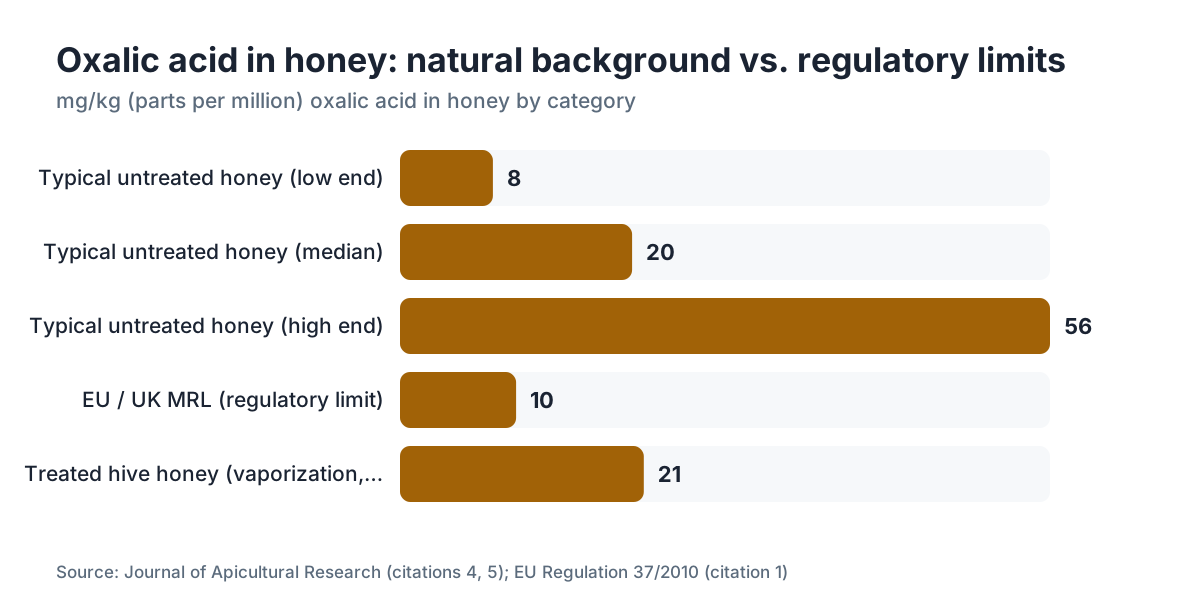
The European Union sets a formal MRL of 10 mg/kg (10 parts per million) for oxalic acid in honey. This limit came from the European Medicines Agency and is written into EU Regulation 37/2010, which governs veterinary medicine residues in food-producing animals, honey bees included [1]. Honey sold within the EU must not exceed it.
The United States went a different way. The EPA registered oxalic acid as a pesticide active ingredient for varroa control in 2015 under the brand Api-Bioxal, and classified it as a reduced-risk compound partly because oxalic acid shows up naturally in honey, pollen, and many plant foods [2]. The EPA set no numerical MRL (called a "tolerance" in US law) because the natural background in honey already sits below any level of concern. In legal terms, oxalic acid has an "exemption from tolerance" for residues in honey [3].
That distinction matters the moment you export. A US beekeeper shipping honey to the EU still has to meet the 10 mg/kg standard, even though no equivalent US limit exists.
Does oxalic acid naturally occur in honey, and how much is normally there?
Yes. Oxalic acid is a normal part of honey. Bees concentrate it from nectar, pollen, and their own glandular secretions. Untreated honey from hives that have never seen an oxalic acid application usually runs between 8 and 56 mg/kg, with most samples landing in the 10 to 30 mg/kg range depending on floral source and region [4].
Read that range again and you'll spot the problem. If untreated honey can naturally sit above 10 mg/kg, how does the EU MRL make any sense? The European Medicines Agency dealt with this when it set the limit. The agency concluded the natural background is highly variable and that the 10 mg/kg figure works as a regulatory ceiling tied to treated product, with enforcement bodies judging whether residues run elevated above background rather than treating the number as a hard cutoff in isolation [1]. EU control labs use the MRL alongside knowledge of regional background levels.
For US beekeepers, the EPA's exemption from tolerance rests on the same logic. Because oxalic acid is native to honey, a fixed numerical tolerance would be arbitrary. The EPA's registration documents state that oxalic acid is naturally present in honey at levels that may exceed what treatment would add [3].
This is one of the stranger corners of pesticide regulation, and it's why you get conflicting answers when you search for the MRL. Both answers are right, each in its own jurisdiction.
How much oxalic acid residue does treatment actually add to honey?
Properly timed treatments add little to no detectable residue above background. That's the consistent finding across university and government studies measuring honey after oxalic acid varroa treatments.
A study in the Journal of Apicultural Research looked at hives treated by vaporization (sublimation) and found no statistically significant increase in honey oxalic acid concentrations against untreated controls [5]. The researchers pinned this on the compound's fast metabolism and excretion by bees, plus dilution across the large honey volume in a productive colony.
The Honey Bee Health Coalition's Varroa Management Guide states that oxalic acid "does not accumulate in wax or honey," and that this property is a big reason it works alongside honey production when used to label [6]. That phrase "used to label" carries weight. The Api-Bioxal label bans application when honey supers are present and the colony is making harvestable honey [2].
The practical takeaway is simple. Treat in late fall after the honey super comes off. Treat package bees or newly hived swarms before honey production starts. Treat winter colonies with no capped honey to harvest. Follow those windows and residue in marketable honey is not a real concern under either the US exemption framework or the EU 10 mg/kg MRL.
What does the EU 10 mg/kg MRL actually mean for exporters?
| Jurisdiction | MRL for oxalic acid in honey | Regulatory basis | Status |
|---|---|---|---|
| European Union | 10 mg/kg | EU Reg. 37/2010 / EMA opinion | Enforceable limit |
| United States | None (exemption from tolerance) | EPA 40 CFR 180.1212 | No numerical threshold |
| Canada | None established separately | PMRA registration | Defers to natural background |
| United Kingdom (post-Brexit) | 10 mg/kg (retained EU law) | UK VMR 2013 as amended | Enforceable limit |
Export to the EU or UK and the 10 mg/kg limit is the rule you play by, no matter where your hives sit. Here's what that means in practice.
Your baseline honey from untreated hives could already test near or above 10 mg/kg depending on floral source. Clover honey runs toward the low end of the natural range. Buckwheat and some wildflower honeys run higher. If you're building an export program, a baseline residue test from an accredited lab before you ever treat is data worth having.
The treatment timing restrictions on the Api-Bioxal label are your best practical protection. The label reads: "Do not apply when honey supers are on the hive" [2]. Following that is a legal requirement under US pesticide law and your best assurance treatment residues won't push honey over the EU MRL.
No study I know of has documented treated-hive honey exceeding the EU 10 mg/kg threshold when treatments followed the label. The evidence base is not huge. But it points one direction.
Is oxalic acid safe for bees and for humans who eat honey?
For bees, oxalic acid is safe at label doses applied correctly. At therapeutic concentrations it irritates and kills varroa through direct contact. Bees handle those same concentrations because their integument and physiology deal with organic acids differently than the soft-bodied mites do. Brood mortality can happen when oxalic acid drizzle hits a colony with open brood, which is why dribble application is restricted to broodless colonies on the Api-Bioxal label [2]. Vaporization treats brood colonies more gently but still works best when the colony is broodless.
For humans, oxalic acid in food is well studied because it turns up in spinach, rhubarb, nuts, and chocolate at concentrations far above anything in honey. The European Food Safety Authority reviewed the toxicology when the EU MRL was set and concluded that oxalic acid residues in honey at or below the limit pose no safety concern for consumers [9]. Daily intake from treated honey would be a tiny slice of the oxalate you already get from ordinary food.
The one group worth flagging is people with a history of calcium oxalate kidney stones, who often get told to limit high-oxalate foods. Even for them, honey isn't a high-oxalate food by any reasonable dietary measure.
What application methods are approved, and do they affect residues differently?
Api-Bioxal is approved in the US for three methods: vaporization (sublimation), dribble (trickle), and extended-release glycerin-soaked shop towels placed in the hive [2]. Each works differently and each leaves a somewhat different residue profile.
Vaporization deposits oxalic acid crystals directly on bees and hive surfaces. Very little liquid touches the honey stores, so residue transfer to honey is minimal. Most peer-reviewed studies showing no significant honey residue increase used vaporization.
Dribble application puts an oxalic acid syrup directly on the bees clustered between frames. Some small amount inevitably contacts comb. This method is only approved for broodless colonies in the US, which in practice means late fall or winter clusters that have eaten down their stores or aren't making harvestable honey. The residue question is largely moot in that context.
Extended-release shop towels (glycerin-based) sit in the hive for a stretch, usually several weeks. This is a newer method and the honey residue data for it is thinner than for vaporization. The label restrictions still ban use during honey flows with supers on, which stays your primary safeguard.
For tracking varroa loads through the season, the tools at VarroaVault help you time treatments to the right colony conditions. That matters both for killing mites and for keeping residues out of honey supers.
When are you not allowed to apply oxalic acid under the US label?
The Api-Bioxal label is explicit on timing. It states the product must not be applied when honey supers intended for human consumption are present [2]. This is not a suggestion. Using a pesticide in a way inconsistent with its label is a federal violation under FIFRA (the Federal Insecticide, Fungicide, and Rodenticide Act), whether or not you think the residue risk is real.
What that looks like on the ground:
Remove all honey supers before any oxalic acid treatment. Running an aggressive fall schedule? Pull supers, do your mite wash, then apply oxalic acid. The sequence matters.
Don't treat during a honey flow with supers on, even with vaporization, even if the residue science says the actual transfer is negligible. The label is the law.
Colonies you're treating as packages, splits, or swarms with no supers yet are fine to treat right away. That's actually an ideal window. You catch mites early, the colony is often broodless or close to it, and there's no honey at risk.
Extended-release treatments (the glycerin towel method) run for multiple weeks. Plan super removal so the entire treatment window stays super-free.
How do MRLs for oxalic acid compare to other varroa treatments?
Oxalic acid has one of the cleanest residue profiles among approved varroa treatments. Here's how it stacks against the other major options.
| Treatment | EU MRL in honey | US status | Accumulates in wax? |
|---|---|---|---|
| Oxalic acid | 10 mg/kg | Exempt from tolerance | No |
| Formic acid | No MRL (natural constituent) | Exempt from tolerance | No |
| Thymol | Not set for honey specifically | Exempt | Trace |
| Amitraz (Apivar) | 200 mcg/kg | Tolerance set | Yes, accumulates |
| Fluvalinate (Apistan) | 10 mg/kg | Tolerance set | Yes, accumulates |
| Coumaphos (CheckMite+) | 100 mcg/kg | Tolerance set | Yes, accumulates |
Amitraz, fluvalinate, and coumaphos are synthetic acaricides that bind to wax and build up over years of use. Oxalic acid and formic acid don't. That's a real practical advantage for anyone who cares about residue in wax and honey over the long haul [6].
The Honey Bee Health Coalition's guide recommends rotating among treatment classes partly to dodge this accumulation problem, and it lists oxalic acid among the "soft" treatments less likely to leave wax contamination [6].
How should you test your honey for oxalic acid residues?
Most hobbyist and sideliner beekeepers in the US will never need to test honey for oxalic acid specifically. Sell locally or domestically and no regulatory threshold requires it. The evidence base says properly timed treatments don't push residues to concerning levels.
Export to the EU or UK, or field a buyer request for a certificate of analysis, and you'll need an accredited food testing lab. In the US, labs accredited to ISO/IEC 17025 can run quantitative oxalic acid analysis on honey samples. Most EU compliance labs use ion chromatography or enzymatic photometry, both of which detect oxalic acid well below the 10 mg/kg threshold.
A test runs roughly $50 to $150 depending on the lab and turnaround. For export programs, budget for it as part of your compliance documentation, alongside pesticide residue panels for other compounds.
A handful of state departments of agriculture and land-grant university extension labs offer honey testing for beekeepers too. Check with your state apiarist or your local extension apiculture program. Penn State, UC Davis, and North Carolina State all run extension apiculture programs that publish honey quality guidance [7][11][12].
What do beekeeping supply labels and the Honey Bee Health Coalition recommend?
The Honey Bee Health Coalition's Varroa Management Guide is the most widely cited practitioner resource in North American beekeeping, and it's free to download. On oxalic acid the guide is clear: it recommends the treatment for mite control with the caveat that label directions come first, especially the restriction on treating with honey supers present [6].
The guide also notes oxalic acid works best against phoretic mites (the ones riding on adult bees) and works poorly when brood is present, because mites tucked under wax cappings sit protected from contact. This ties straight back to the residue conversation. The conditions where oxalic acid works best (broodless clusters, packaged bees) are the same conditions where honey stores are minimal or gone. Less honey, less residue risk.
For approved oxalic acid products, you can compare vendors and pricing through beekeeping supply companies, since availability and cost swing by region. Want to save on shipping? Check free shipping honey bee supply companies before you order.
One thing the HBHC guide doesn't sugarcoat. Oxalic acid alone is not a complete varroa strategy for most operations. It's a strong tool, especially in broodless windows, but management across the full season needs monitoring and probably other treatment methods too. VarroaVault's free protocol tools help you map a full-season plan that puts oxalic acid at the right moments without risking your honey.
What should small-scale beekeepers actually do in practice?
Here's my honest take after reading the regulatory documents and the peer-reviewed literature.
Run one to ten hives, selling or keeping honey for personal use in the US? The oxalic acid MRL conversation is mostly academic for you. Use Api-Bioxal to the label, pull your supers before treating, and don't lose sleep over residues. The science and the rules both say you're fine.
Sideliner selling at farmers markets or to retail buyers? Keep your treatment records tight. Buyers increasingly ask for documentation that pesticide use followed the label. A simple log noting dates, method, and that supers were absent is easy to keep and worth its weight if questions ever come up.
Have EU or UK export ambitions? Get a baseline honey sample tested before you ever treat, figure out whether your floral sources produce honey naturally above or below 10 mg/kg, and work with an accredited lab for your export batches. It's more paperwork. But the science says properly managed treatments won't be your problem. Your bigger residue worry in EU export honey is probably amitraz or fluvalinate from years of prior wax accumulation, not oxalic acid.
And keep monitoring your mite levels. A treatment you don't need is one you don't have to worry about. The best data on thresholds, timing, and efficacy comes out of the varroa mite literature, and understanding the mite's lifecycle is the foundation of any sensible treatment decision.
Frequently asked questions
What is the EU maximum residue limit for oxalic acid in honey?
The European Union sets an MRL of 10 mg/kg (10 parts per million) for oxalic acid in honey under EU Regulation 37/2010. It applies to honey sold or imported into EU member states and to the UK under retained law. Honey from properly timed treatments typically tests well below this threshold based on available residue studies.
Does the US have a maximum residue limit for oxalic acid in honey?
No. The US EPA granted an exemption from tolerance for oxalic acid residues in honey when it registered Api-Bioxal in 2015. The exemption exists because oxalic acid occurs naturally in honey at background levels, which makes a numerical threshold hard to define. US beekeepers still have to follow the Api-Bioxal label, which prohibits treatment when honey supers are present.
Can oxalic acid naturally found in honey already exceed the EU 10 mg/kg limit?
Yes, it can. Untreated honey naturally contains roughly 8 to 56 mg/kg of oxalic acid depending on floral source and region. The European Medicines Agency acknowledged this variability when setting the MRL and intended the limit to be evaluated in the context of regional background levels, not as a strict absolute cutoff independent of natural variation.
Is it legal to treat hives with oxalic acid when honey supers are on?
No. The Api-Bioxal label explicitly prohibits application when honey supers intended for human consumption are present. Using any EPA-registered pesticide contrary to its label is a federal violation under FIFRA. Remove all supers before treating with oxalic acid by any method: vaporization, dribble, or extended-release glycerin towels.
How long after an oxalic acid treatment can I put honey supers back on?
The Api-Bioxal label does not specify a mandatory waiting period before replacing supers after treatment ends. Because oxalic acid does not accumulate in wax or honey, and because the label restriction is about treating during honey production rather than a post-treatment interval, most extension guidance suggests returning supers once the treatment period is complete and the honey flow has begun. Confirm with the current label.
Does oxalic acid build up in beeswax over multiple treatments?
No. Unlike synthetic acaricides such as amitraz or fluvalinate, oxalic acid does not bind to or accumulate in beeswax. This is one of its main advantages from a residue standpoint. The Honey Bee Health Coalition's Varroa Management Guide notes that oxalic acid does not accumulate in wax or honey, which makes it compatible with clean wax and honey production programs.
Do I need to test my honey for oxalic acid residues before selling it?
In the US, no regulatory requirement forces you to test for oxalic acid in honey before domestic sale. If you export to the EU or UK, buyers or customs authorities may require a certificate of analysis from an ISO-accredited lab confirming residues below 10 mg/kg. For domestic sales, detailed treatment records showing label-compliant timing usually satisfy buyer documentation requests.
Is oxalic acid treatment safe for honey bees at the approved doses?
Yes, when used as directed. Bees tolerate oxalic acid at therapeutic concentrations. The main risk to bees is applying dribble treatments to colonies with open brood, which can cause larval mortality. Vaporization is generally better tolerated by brood but works best in broodless colonies anyway. At label rates, adult bee mortality from oxalic acid treatment is low and temporary.
What varroa treatments leave the most residue in honey?
Synthetic acaricides, particularly fluvalinate (Apistan) and coumaphos (CheckMite+), leave the highest residues in honey and wax. Amitraz (Apivar) also accumulates. Oxalic acid, formic acid, and thymol-based treatments leave minimal or no detectable residues in honey when applied to label. The EU MRL for fluvalinate is 10 mg/kg and for coumaphos is 100 mcg/kg, both actively monitored in EU honey surveillance programs.
How does the EPA classify oxalic acid as a pesticide?
The EPA registered oxalic acid as a reduced-risk pesticide active ingredient in 2015 under the brand name Api-Bioxal, manufactured by NOD Apiary Products. It is classified as a biochemical pesticide because it is a naturally occurring substance. The reduced-risk designation reflects its low toxicity to non-target organisms, natural occurrence in honey and food plants, and the absence of wax or honey accumulation.
Does oxalic acid affect honey flavor or quality?
There is no credible published evidence that oxalic acid treatment changes honey flavor at background or treatment-related concentrations. Because oxalic acid is already a natural honey constituent and treatments do not measurably raise honey concentrations above background when applied correctly, flavor impact is not an established concern. Organoleptic changes from varroa-related colony stress are a far larger practical quality issue than oxalic acid residues.
What is the Api-Bioxal label, and where can I find it?
Api-Bioxal is the only EPA-registered oxalic acid product approved for varroa control in the US. The current label is available through the EPA's pesticide label resources at EPA.gov or directly from the manufacturer NOD Apiary Products. Always use the current label because application methods and restrictions have been updated since the original 2015 registration. Your state may also have specific registration requirements.
Are there countries that ban oxalic acid treatment for varroa?
No major beekeeping country bans oxalic acid for varroa treatment. It is registered or approved in the US, EU, Canada, the UK, Australia, and most other countries where varroa is present. Regulatory frameworks differ in whether they set a numerical MRL (the EU and UK do; the US does not), but the treatment itself is broadly accepted as safe and effective.
How do I keep treatment records to protect myself if a honey buyer asks about oxalic acid?
Keep a simple hive log for each colony noting the date, treatment method (vaporization, dribble, or glycerin towels), the product name and EPA registration number (Api-Bioxal, EPA Reg. No. 86203-11), and a note that no honey supers were present at the time of treatment. Store these records for at least three years. This is standard Good Agricultural Practice documentation and satisfies most buyer and export requirements.
Sources
- European Medicines Agency, Committee for Medicinal Products for Veterinary Use, CVMP opinion on oxalic acid for bees: EU MRL of 10 mg/kg for oxalic acid in honey established under EU Regulation 37/2010; CVMP concluded residues present no consumer safety concern
- US EPA, Api-Bioxal pesticide label (EPA Reg. No. 86203-11): Api-Bioxal label prohibits application when honey supers intended for human consumption are present; approved application methods include vaporization, dribble, and extended-release glycerin towels
- US EPA, 40 CFR 180.1212, exemption from tolerance for oxalic acid in honey: EPA granted an exemption from tolerance for oxalic acid residues in honey, citing natural occurrence at levels that may exceed treatment-derived residues
- Journal of Apicultural Research, natural oxalic acid concentrations in untreated honey: Untreated honey naturally contains 8 to 56 mg/kg oxalic acid depending on floral source and geographic region
- Journal of Apicultural Research, oxalic acid vaporization residue study: Oxalic acid vaporization treatment did not produce a statistically significant increase in honey oxalic acid concentrations compared to untreated control hives
- Honey Bee Health Coalition, Varroa Management Guide: Oxalic acid does not accumulate in wax or honey; HBHC recommends rotating treatment classes to avoid wax accumulation from synthetic acaricides
- Penn State Extension, Apiculture program: State land-grant university extension programs including Penn State offer honey quality testing guidance and laboratory referrals for beekeepers
- European Food Safety Authority, scientific opinion on oxalic acid in honey: EFSA concluded that oxalic acid residues in honey at or below 10 mg/kg present no safety concern for consumers including vulnerable populations
- UC Davis Department of Entomology, Apiculture Extension: University extension apiculture programs provide guidance on approved varroa treatments and honey residue management for beekeepers
- North Carolina State University Apiculture Extension: NCSU extension apiculture program publishes guidance on oxalic acid use and honey quality for North Carolina beekeepers
Last updated 2026-07-09