Mite Away Quick Strips temperature requirements: what you need to know
TL;DR
- Mite Away Quick Strips (MAQS) must go on when ambient temperatures stay between 50°F and 85°F (10°C and 29°C) across all 7 treatment days.
- Below 50°F the formic acid barely volatilizes.
- Above 85°F it can kill brood and queens.
- The 7-day window sits on the EPA-registered label, and that label is legally binding under FIFRA.
What is the required temperature range for MAQS application?
Mite Away Quick Strips need ambient air temperatures between 50°F and 85°F (10°C and 29°C) for the entire 7-day treatment period. That range isn't a suggestion. It's printed on the EPA-registered product label, so applying outside it puts you out of compliance with federal pesticide law under FIFRA (7 U.S.C. § 136j) [1].
The active ingredient is formic acid. At cool temperatures it won't vaporize fast enough to reach mites under the brood cappings, which is the entire point of using it. At high temperatures it volatilizes too aggressively, and the concentration inside the hive can climb to levels that damage eggs, young larvae, and sometimes the queen.
The label from MAQS manufacturer NOD Apiary Products directs use when "daytime temperatures are between 50°F (10°C) and 85°F (29.4°C)" [2]. Daytime means the outdoor ambient high. Not shade temperature. Not inside-the-hive temperature. That distinction trips up a lot of beekeepers.
Why does temperature control formic acid volatilization?
Formic acid is a liquid at room temperature. It evaporates continuously from the gel-impregnated strips, and heat drives the rate almost entirely. Vapor pressure for formic acid rises sharply above 50°F and roughly doubles every 10°C, so the gap between a 55°F week and a 90°F week is not a small tweak. It's a completely different exposure dose for your bees.
Below 50°F, the acid sits in the strip and barely moves. University extension work confirms that efficacy against phoretic mites drops off when temperatures are cold, and efficacy against mites under capped brood drops even more, because the vapor never builds to threshold concentration inside those cells [3].
Above 85°F, the strip releases acid faster than the colony's ventilation can moderate. Bee mortality climbs. Queen loss increases. Brood damage (bald brood patterns, collapsed larvae) becomes common. The Honey Bee Health Coalition's Varroa management guide flags high-temperature applications as one of the most frequent causes of queen loss tied to formic acid treatments [4].
Here's the fact most people miss. Hive body temperature can run 10°F to 20°F warmer than outside ambient on hot days, because bees generate heat and direct sun warms the equipment. So when ambient hits 80°F in full sun, the inside of a brood box may already sit above 90°F.
What happens if you apply MAQS when it's too hot?
Queen loss is the main risk. Published efficacy data and beekeeper reports both put queen mortality higher during heat events. The MAQS label itself tells you to monitor colonies for brood and queen acceptance during treatment and for two weeks afterward [2].
Brood damage is the other common outcome. You'll see dead or discolored larvae, sunken cappings, and a scattered brood pattern in the days after a too-hot application. That looks a lot like European foulbrood or chilled brood, so misdiagnosis is easy. If your window included days above 85°F and you see this pattern, temperature stress is the first thing to rule in.
Adult bee mortality above normal is also documented. Bees in direct contact with the strips sometimes die in larger numbers. On a hot day that can look like a pesticide kill.
Here's the practical part. If a heat wave arrives mid-treatment, nothing on the label tells you to pull the strips early, but many experienced beekeepers do exactly that. Nobody has good published data on how many degree-hours above 85°F it takes to trigger queen loss, so you're making a judgment call. If I had strips in hives and a forecast suddenly showed three days at 92°F, I'd pull them.
What happens if you apply MAQS when it's too cold?
Efficacy collapses. The strips sit in the hive doing almost nothing, because formic acid needs heat to move into vapor phase.
The bigger problem is what you've spent to get nothing. You've still exposed the colony to some acid (cold slows volatilization, it doesn't stop it), used up your strips, and burned the treatment opportunity. MAQS strips run roughly $15 to $20 per two-strip packet depending on supplier [5], so a failed cold-weather treatment costs real money.
Worse, if mite levels are high and you thought you treated, you'll miss the window when intervention could still save the colony. Mite population growth is exponential. A month of delay at high infestation pressure can be the difference between a colony that recovers and one that collapses.
Extension guidance from Penn State stresses checking a 10-day forecast before applying any formic acid treatment, more than the day you plan to open the package [3].
How do you check the temperature window accurately before applying?
Use a 7- to 10-day forecast, not a 3-day one. The entire treatment period has to stay in range, so you're reading the full window, more than application day.
Watch two numbers: daily high and overnight low. The 85°F ceiling is about the high. The 50°F floor is about whether the lows drop so cold that the strip can't even start working. A week where highs reach 83°F and lows fall to 48°F is borderline and uncomfortable to commit to.
A min-max thermometer near the apiary (in shade, at hive height) beats weather station data if you're more than a few miles from the reporting station. Digital data loggers are better still and run $15 to $30. Some beekeepers put a logger inside the hive during treatment to see what the bees actually experienced, which helps if you find unexpected brood damage afterward.
Regional variation matters enormously. Mountain apiaries can swing 30°F in 24 hours. Coastal sites may stay locked in a 65°F to 75°F band for weeks. Know how your location behaves, more than what the calendar says.
For tracking treatment timing alongside mite counts and colony notes, a structured tool helps. VarroaVault's free protocol tools let you log treatment dates and flag temperature conditions so you can look back and correlate outcomes [see varroa-mite].
When is the right season to use MAQS given temperature limits?
In most of the continental United States, the MAQS window opens twice a year: late summer (August through September) and spring (April through May). Those are the stretches when temperatures typically stay below 85°F but above 50°F for a full week straight.
Late summer usually matters more. Mite populations peak as colony population shrinks and the mite-to-bee ratio climbs. Treating in August or early September, before the winter bees are raised, gives colonies the best shot at going into winter with low mite loads.
Spring treatments help colonies that entered winter with borderline loads or that show an early mite spike. But spring weather is erratic in many regions, and you may chase that 7-day window for several weeks before it shows up.
Summer applications during heat waves are essentially impossible in the South and Southwest. Beekeepers in Florida, Texas, Arizona, and similar climates often find MAQS impractical from June through September and reach for oxalic acid dribble or vaporization instead during those months.
Winter application of MAQS is not feasible in cold climates. Below 50°F the treatment doesn't work, and below 40°F colonies cluster in ways that further cut vapor distribution.
| Season | Typical MAQS window in most US regions | Main risk |
|---|---|---|
| Spring (Apr, May) | Yes, weather-dependent | Cold snaps, erratic highs |
| Summer (Jun, Aug) | Often no in South/Southwest | Heat above 85°F |
| Late summer (Aug, Sep) | Yes, best window in most regions | Occasional heat waves |
| Fall (Oct, Nov) | Borderline, northern states no | Low temps reduce efficacy |
| Winter | No | Below 50°F floor |
Does the 7-day treatment period mean all 7 days must stay in range?
Yes. The label sets a 7-day treatment period, and the temperature requirement covers the whole period, more than the day you apply [2].
This is where a lot of mistakes happen. A beekeeper checks the forecast, sees five days of good temperatures, applies the strips, and then a heat dome rolls in on day four. Now you're stuck in the hard spot described above.
The conservative move is to apply only when a 10-day forecast (not a 5-day forecast) shows the entire window in range, with some buffer. Aiming for 55°F to 80°F gives you a reasonable margin against forecast error.
The Honey Bee Health Coalition's Varroa management guide recommends checking forecasts several days before planned treatment specifically because formic acid products need sustained temperature compliance [4].
Some beekeepers ask whether they can remove the strips early if conditions go bad. Nothing in the label prohibits early removal, but label-directed treatment is 7 full days. Pull the strips at day 4 for heat and your efficacy is unknown, so recheck your mite counts.
Can you use MAQS in a single-story hive or does it require a specific configuration?
MAQS is labeled for single and multi-story hives. The label directs placing each strip across the top bars of the bottom brood box, one strip per side, for two strips total per colony in a standard application [2].
Hive configuration shifts internal temperature more than people realize. A tall stack of supers creates more insulated airspace, which can trap heat above the brood nest on warm days. A single deep in direct sun on an 80°F day may run hotter inside than a two-deep stack in partial shade at the same ambient temperature.
Super removal for honey production supers isn't required by the label, but MAQS does carry restrictions on treating colonies with honey intended for human consumption. Label editions have changed the precise super guidance over time, so read your current label carefully rather than trusting memory or an older package [1][2].
For equipment options and sources for min-max thermometers or data loggers, the beekeeping supply companies roundup covers vendors who stock apiary monitoring tools.
How does the temperature window for MAQS compare to other formic acid treatments?
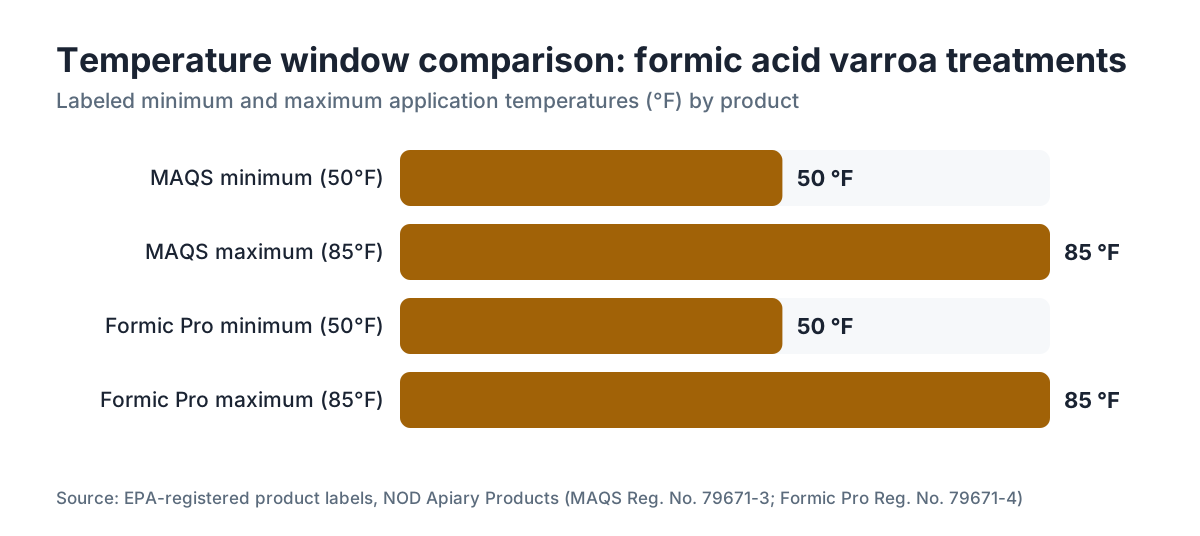
Formic Pro is the main competitor in the formic acid space in North America, and it comes from the same maker (NOD). Their labeled temperature ranges differ.
Formic Pro carries a label allowing use between 50°F and 85°F for the standard 14-day protocol, with a shorter split option and specific handling for warmer conditions [6]. Beekeepers often reach for Formic Pro in late summer heat because its extended-release matrix spreads the acid dose over more days.
MAQS releases faster by design. The gel matrix volatilizes more quickly than Formic Pro's extended-release formula, which is why it runs a tighter, faster 7-day cycle. Higher release rate means higher risk of hive damage if heat amplifies it.
| Product | Temp floor | Temp ceiling | Treatment duration | Release profile |
|---|---|---|---|---|
| MAQS | 50°F (10°C) | 85°F (29.4°C) | 7 days | Faster |
| Formic Pro | 50°F (10°C) | 85°F (29.4°C) | 14 days (or split 2×10) | Slower, extended |
Neither product wins in the abstract. MAQS is faster. Formic Pro spreads the dose. Your choice should follow your forecast, region, and tolerance for queen loss. Confirm both temperature ranges against the current registered labels, since NOD has revised these products over the years.
For a full overview of varroa biology and why treatment timing matters as much as product selection, the varroa mite reference page is a good starting point.
What does the EPA-registered MAQS label actually say about temperature?
The current EPA-registered MAQS label (EPA Reg. No. 79671-3) directs application "when daytime temperatures are between 50°F (10°C) and 85°F (29.4°C)" [2]. That single sentence is the formal basis for the whole temperature requirement.
Everything else, including advice about monitoring queens and watching brood patterns, flows from that one constraint.
Under FIFRA, using a pesticide inconsistent with its label is a federal violation. That applies to beekeepers exactly as it applies to commercial applicators. The practical risk isn't EPA enforcement (vanishingly unlikely for a hobby beekeeper). It's that you void any performance expectation and, worse, you may seriously harm your colony.
EPA's Office of Pesticide Programs runs the national system where registered labels are publicly available [1]. If you have an older package of MAQS, compare the label in the box to the current registered label online, because the guidance has been updated at least once since initial registration.
What should you do if a heat wave arrives mid-treatment?
No label fully addresses this scenario, and experienced beekeepers disagree on the right call.
Option one: pull the strips. Removing them stops the acute risk of queen loss and brood damage. The downside is that 4 or 5 days of treatment may not have cleared mites under capped brood, so you'll need to recount and possibly retreat when temperatures allow.
Option two: leave them in and monitor. If your hive is shaded, well-ventilated, and the heat event is forecast to last only 1 to 2 days, some beekeepers accept the risk and watch closely. Heavy bearding, dead larvae at the entrance, or a sudden spike in dead bees is your cue to pull.
Option three: improve ventilation. Screened bottom boards left open, entrance reducers removed, and shade cloth over the hive can drop internal temperature 5°F to 10°F on hot days. That won't bring a 92°F day into compliance, but on an 87°F day it might matter.
VarroaVault's varroa management protocol tools include a treatment log where you can record these decisions and outcomes, useful for your own reference and for figuring out what happened if a colony struggles afterward.
My personal practice: if I see two or more days above 85°F in the forecast after day 3 of treatment, I pull the strips, document the partial treatment, and plan a full retreat when the weather cooperates. A partial treatment beats a dead queen.
Does the temperature inside the hive differ from ambient temperature, and does that matter?
Yes, and yes. Bees hold the brood nest at roughly 93°F to 95°F regardless of outside temperature [7]. That internal target is largely fixed by bee behavior. But the spaces outside the brood cluster, where the strips actually sit, track much closer to ambient conditions.
On a 75°F day, the area between the top bars and the inner cover may run 85°F to 90°F. On a 90°F ambient day, that same space can hit 100°F or above, especially in direct sun. That's why the 85°F ambient ceiling is actually fairly conservative. The label writers understood that ambient and hive-interior temperatures are not the same number.
Here's the practical takeaway. If you're applying MAQS on a day the ambient forecast says 83°F, and your hives sit in full sun on dark-painted equipment, you may already be exceeding label conditions inside the box. Shade matters more than most beekeepers account for.
Research from the USDA-ARS Bee Research Laboratory has characterized hive microclimate in detail, confirming that hive temperatures in direct sun run well above ambient on warm days [7].
Frequently asked questions
Can I apply MAQS if nights drop below 50°F but days stay warm?
The label's 50°F floor refers to daytime temperatures, not overnight lows. If your days stay consistently above 50°F and below 85°F, a cold night doesn't automatically disqualify the treatment. But very cold nights slow volatilization during those hours and can reduce overall efficacy. If overnights run regularly below 45°F, you're at the edge of the season and oxalic acid vaporization may fit better.
How long should I wait after removing MAQS before adding honey supers?
The MAQS label does not specify a re-entry interval for honey supers, but general guidance from university extension programs recommends allowing 2 weeks after strip removal before adding supers intended for harvest. Formic acid dissipates quickly from hive materials. Check the current registered label for any updated language, since the honey super guidance has been revised in past editions.
Can MAQS be used on nucleus colonies or packages?
The label is written for full colonies. Nucleus colonies (4 to 5 frames) have a smaller cluster and less ventilation capacity, which concentrates formic acid vapor more than in a full box. Many beekeepers avoid MAQS on nucs and use oxalic acid dribble instead. Packages without established brood often don't need MAQS at all in the first weeks. Check extension guidance for your situation before treating small colonies.
Is a screened bottom board required when using MAQS?
No, a screened bottom board is not required by the label. Some beekeepers use one in summer to increase hive ventilation during MAQS treatment, which can moderate internal temperatures on warmer days. A solid bottom board is fine under label conditions. If temperatures sit near the 85°F ceiling, improving airflow through a screened bottom is a reasonable precaution.
What is the queen loss rate with MAQS under normal temperature conditions?
Published data shows queen loss in the range of 3% to 9% under label-compliant temperatures, depending on the study and population tested. The MAQS efficacy and safety data submitted to EPA during registration reported acceptably low queen mortality at correct temperatures. Above 85°F, reported queen loss in field observations climbs substantially higher, though no large controlled trial has published a precise figure for heat-event applications.
Can I use MAQS on a hive that is queenless or has a newly mated queen?
The label does not prohibit use on queenless colonies, but with no queen to lose, the risk calculus changes. The brood-damage risk stays. For colonies with a newly mated or recently introduced queen, many beekeepers wait until she has laid consistently for 2 to 3 weeks before any formic acid treatment, because young queens may be more vulnerable to chemical stress. That's a precautionary practice, not a label requirement.
How do I know if MAQS is actually working during treatment?
You won't see a visible sign during the 7 days. After treatment ends, an alcohol wash on roughly 300 bees gives you an efficacy check. University extension programs recommend a pre-treatment wash and a post-treatment wash 1 to 2 weeks after strip removal to calculate knockdown percentage. A well-timed MAQS treatment at correct temperatures typically achieves 90%+ efficacy against phoretic mites plus meaningful reduction under brood.
Does MAQS work on mites under capped brood?
Yes, and that's the main advantage over oxalic acid dribble, which doesn't penetrate capped cells. Formic acid vapor diffuses through wax cappings to reach mites in the reproductive phase [8]. Efficacy against brood-phase mites is lower than against phoretic mites but still meaningful, typically documented at 50% to 80% reduction depending on temperature and hive configuration. That's why MAQS gets used during brood-rearing season while oxalic acid dribble is reserved for broodless periods.
How many MAQS strips does a standard colony need?
The label specifies two strips per colony for a standard Langstroth 10-frame hive, one strip on each side of the brood box across the top bars. Using a single strip is off-label and likely to reduce efficacy. Using more than two strips is also off-label and raises the risk of bee and brood damage. Follow the label rate exactly.
Can I treat multiple hives with the same package of MAQS, or must strips be used all at once?
MAQS strips begin volatilizing the moment the package is opened. The label instructs that all strips be used immediately upon opening. You can't open a package, use two strips, reseal it, and apply the rest days later. Plan your treatment to use the entire package the same day. If you have an odd number of hives, buy the right number of packages in advance or coordinate with a fellow beekeeper for the extras.
Where can I find the current MAQS label to verify temperature requirements?
EPA maintains a searchable pesticide label database keyed to registration numbers (MAQS is EPA Reg. No. 79671-3). You can also find the current label on the NOD Apiary Products site and through most licensed beekeeping supply retailers. Always confirm you have the current version, since labels are legally binding and can be revised between print runs of the physical product.
Does elevation affect whether the temperature requirements apply?
Elevation itself isn't mentioned in the label. What matters is actual ambient temperature at your apiary, regardless of elevation. A mountain apiary at 7,000 feet may rarely see 85°F and may have a shorter treatment season than a valley apiary 20 miles away. The label conditions apply wherever you are. Use a thermometer at your actual apiary site rather than trusting valley or town readings.
Are there any states where MAQS has additional restrictions beyond the federal label?
Yes. Some states have registration requirements that add restrictions or require separate state registration before the federal label is valid. California in particular has historically imposed extra conditions on formic acid products. Contact your state department of agriculture or state apiarist to confirm MAQS is fully registered for use in your state and to check for additional state-level conditions.
How does MAQS efficacy compare to oxalic acid for late-summer treatment?
MAQS has a real edge in late summer: it works on mites under capped brood, and late-summer colonies still carry substantial brood. Oxalic acid dribble at that point only kills phoretic mites and misses brood-phase mites entirely. Studies consistently show formic acid treatments during brood-rearing reduce total mite loads more effectively than oxalic acid dribble on the same colony [9]. Oxalic acid vaporization competes better because vapor reaches some phoretic mites, but formic acid still outperforms it when brood is present.
Sources
- EPA, Office of Pesticide Programs, pesticide registration and FIFRA (Federal Insecticide, Fungicide, and Rodenticide Act) overview: Using a pesticide inconsistent with its label is a federal violation under FIFRA 7 U.S.C. § 136j
- NOD Apiary Products / EPA Reg. No. 79671-3, MAQS product label (verify via EPA pesticide registration site): MAQS label requires application when daytime temperatures are between 50°F (10°C) and 85°F (29.4°C) for the 7-day treatment period
- Penn State Extension, honey bee and pollinator resources: Extension guidance recommends checking a 10-day forecast before applying formic acid treatments and confirms cold-temperature efficacy reduction
- Honey Bee Health Coalition, Tools for Varroa Management guide: High-temperature formic acid applications are among the most frequent causes of queen loss associated with formic acid treatments; forecasts should be checked before treatment
- Mann Lake Ltd., MAQS product listing (representative supplier pricing): MAQS strips retail in the range of $15 to $20 per two-strip packet depending on supplier
- NOD Apiary Products / EPA Reg. No. 79671-4, Formic Pro product label (verify via EPA pesticide registration site): Formic Pro uses a 14-day protocol (or a split 2×10-day option) with an extended-release formic acid matrix; confirm current labeled temperature range on the registered label
- USDA-ARS Bee Research Laboratory, honey bee hive microclimate research: Brood nest temperature is maintained at approximately 93°F to 95°F; hive temperatures in direct sun exceed ambient on warm days
- University of Minnesota Bee Lab, varroa and formic acid treatment resources: Formic acid vapor diffuses through wax cappings to reach mites in the reproductive phase; efficacy against brood-phase mites is documented in treatment studies
- University of Florida IFAS Extension, EDIS varroa mite biology and management: Late-summer mite population peaks drive colony collapse risk; formic acid treatments during brood-rearing reduce total mite loads more effectively than oxalic acid dribble
- Honey Bee Health Coalition, Tools for Varroa Management guide, treatment comparison section: MAQS efficacy against phoretic mites typically 90%+ at correct temperatures; formic acid outperforms oxalic acid dribble when brood is present
- EPA, pesticide registration and product label search: Current registered MAQS label (EPA Reg. No. 79671-3) is publicly available for verification of temperature and application requirements
- Michigan State University Extension, pollinators and beekeeping resources: Summer and late-summer treatment windows and seasonal timing recommendations for formic acid products in northern US climates
Last updated 2026-07-09