Mite wash in a queenless hive: how to interpret your results

TL;DR
- A queenless hive has no capped brood, so mites that normally hide in cells get forced onto adult bees.
- Your alcohol wash reads artificially high compared to a queenright colony at the same true infestation.
- Treat at or above 2 mites per 100 bees no matter what, but read the queenless context before you panic or pick a treatment.
Why does being queenless change your mite wash result?
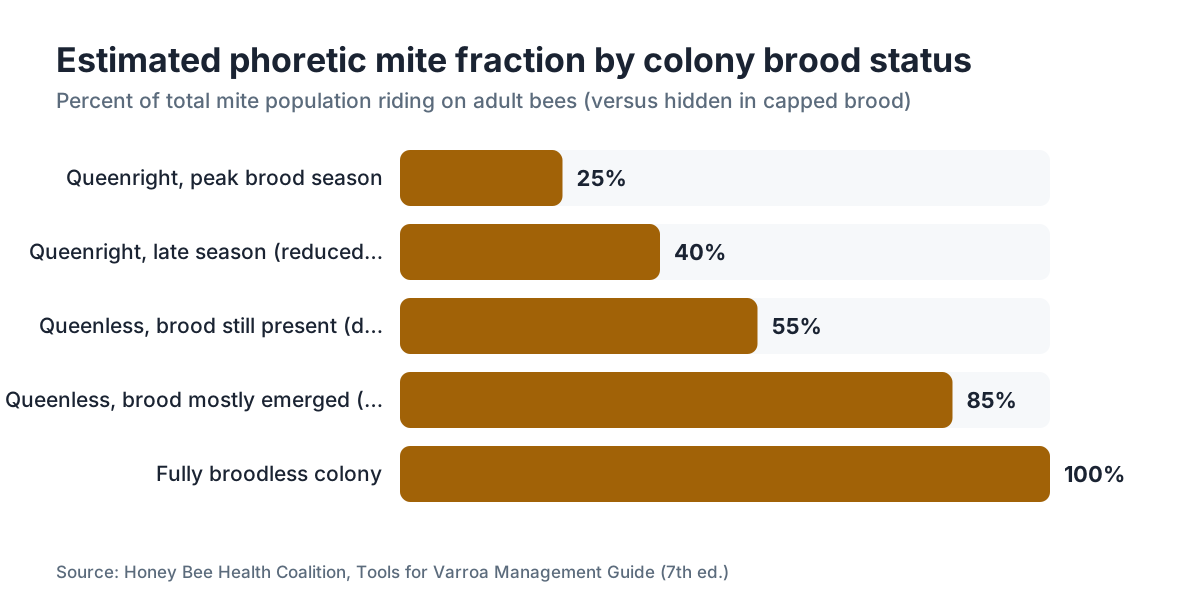
Varroa mites spend most of their reproductive life inside capped brood cells, not on adult bees. When a hive has a laying queen, roughly 70 to 80 percent of the total mite population sits hidden in capped brood at any given moment [1]. Those mites never show up in an alcohol wash. The wash only counts phoretic mites riding on adult bees.
Pull the queen and let the brood cycle run out, and every mite tucked into a capped cell eventually emerges with its host bee. There is nowhere else for them to go. No new brood to invade. So they pile onto the adult population, and the phoretic load spikes.
A colony that measured 1.5 mites per 100 bees while queenright can read 4 or 5 mites per 100 bees two to three weeks into a broodless stretch, even though not a single new mite entered the hive. The infestation did not get worse. The math changed.
This is one of the most common misreads hobbyists make. They pull a sample during a queenless split or a requeening, see a frightening number, and either panic-treat with the wrong product at the wrong time or write the colony off as doomed. Neither reaction is usually right once you understand what the number is telling you.
What is a normal mite wash count for a queenless colony?
There is no separate published threshold for queenless colonies. The Honey Bee Health Coalition's Varroa management guide, the closest thing U.S. beekeeping has to an official standard, sets the general treatment threshold at 2 mites per 100 bees (2 percent) for most of the year, tightening to 1 mite per 100 bees (1 percent) going into late summer and fall when winter bees are being raised [2].
Those thresholds still apply to a queenless hive. What changes is how you read a count above them.
If your queenless colony reads 3 mites per 100 bees three weeks after you removed the queen, treat. But do not assume the colony sat at 3 percent while queenright. The true queenright load was probably 1 to 2 percent, with the rest of the mites emerging from what was left of the brood nest. That distinction matters for two reasons. It tells you whether the colony had a real problem before the queen came out, and it sets your expectations for how the colony looks after treatment.
A rough working rule, and nobody has published a precise correction factor for hobbyist use: if the colony has been broodless for two to three weeks, expect the wash to run one and a half to two times higher than the true queenright population rate would suggest. If the colony went queenless only days ago, the count sits closer to the queenright reality because most mites are still in cells.
How does the brood break affect where mites are in the hive?
Varroa's reproductive cycle is tied entirely to honey bee brood. A female mite enters a cell just before capping, lays eggs, and her offspring mate inside the cell before emerging with the adult bee [3]. Through a normal queenright season this cycle runs nonstop, and the 70-to-80-percent hidden fraction holds fairly steady.
Once a hive goes queenless and the last capped brood emerges, usually ten to twelve days after the final eggs were laid, that reservoir empties out. Every mite in the colony is now phoretic. The alcohol wash, which counts phoretic mites on adult bees, suddenly measures 100 percent of the population instead of the usual 20 to 30 percent.
This is a strategically useful window. A fully broodless colony is the one situation where a single treatment with oxalic acid vaporization or dribble can reach every mite in the hive, because no capped brood shields any mites from the active compound [4]. Beekeepers who get this use planned brood breaks to force a clean treatment. The high wash count at that point is not a crisis. It is an opening.
The timeline matters. Eggs hatch in about three days. Larvae are capped around day nine. Worker cells stay sealed for roughly twelve days. So the last capped brood in a queenless colony emerges about twenty-one days after the queen was removed or stopped laying, give or take a day depending on temperature and colony behavior [3].
When should you actually treat after a queenless hive shows a high count?
Treat immediately if the count is at or above 2 mites per 100 bees and you are past the brood-emergence window, meaning all brood has hatched and the colony is fully broodless. This is the best treatment scenario there is. Oxalic acid in any approved form reaches every mite in one application [4].
If the count is high but capped brood is still present, you have a decision. Oxalic acid dribble and vaporization are both approved for queenless use in the U.S. under the EPA label, but efficacy drops sharply with brood present because sealed cells protect the mites [4]. You can wait out the brood (do nothing, recheck in ten to fourteen days) or use a longer-acting treatment like oxalic acid extended-release gel (Api-Bioxal extended release, label-approved with brood present) or a miticide strip.
Do not dribble oxalic acid over and over hoping to make up for the brood. The EPA label permits one treatment per brood break, not repeat applications in quick succession. Stacked dribble treatments stress the bees and kill some of them without improving mite kill in proportion [4].
The Honey Bee Health Coalition recommends checking mite levels every thirty days during the active season, and that holds for queenless situations too [2]. A second wash two weeks after treating a broodless colony tells you whether the treatment worked, because you are again measuring essentially the full mite population.
How do you do the alcohol wash correctly in a queenless hive?
The mechanics of the wash do not change because the hive is queenless. You still need about 300 adult bees, still shake them into 70 percent isopropyl alcohol or windshield washer fluid, swirl for sixty seconds, and count the mites in the liquid [2].
What changes is where you collect the sample. In a queenright hive you take bees off a frame of open brood, because nurse bees there carry higher mite loads than foragers and give a truer read of the whole hive [2]. In a fully queenless, broodless colony there are no brood frames to target. Collect from wherever the cluster is densest, usually the center of the hive.
Stay away from the entrance. Foragers coming back from outside carry lower-than-average mite loads because they spend less time near the brood nest. Sample only foragers and you get a low reading that hides the problem.
Count your bees. A common error is assuming a jar is full enough. Three hundred bees is roughly a half-cup by volume. If you have well under that, adjust the math: divide the mite count by the actual number of bees sampled, then multiply by 100 for the percentage. Fifty mites in 200 bees is 2.5 percent. Fifty mites in 300 bees is 1.7 percent. Same mites, different story.
For hobbyists who want a ready-made worksheet to track wash results over time alongside treatment records, VarroaVault's free mite tracking tools help organize the data and flag when you cross a threshold.
Can you compare your queenless wash result to the 2 percent threshold at all?
Yes. Compare to the 2 percent threshold and act on it. The threshold still applies. Treat at or above 2 percent.
What you cannot do is back-calculate a precise queenright equivalent from a queenless reading. The literature gives us no validated correction formula for the field. What we know is directional: the queenless phoretic count runs higher than the true infestation would appear in a queenright colony, and the gap widens the longer the colony stays broodless.
A few university extension programs note this dynamic in their varroa guides without assigning a multiplier. The University of Minnesota Bee Lab and Penn State Extension both explain that broodless conditions raise phoretic mite loads and should be factored into interpretation, even as they stop short of a conversion number [5][6].
The honest practical answer: use the threshold as your action trigger regardless of queen status. Above 2 percent, treat. Below 2 percent in a fully broodless colony, you are in good shape, but recheck in three to four weeks once the new queen (if you introduced one) starts laying and mites move back into brood. That re-entry is exactly when your visible count drops while the population quietly recovers and grows. It is the number that lulls people.
What happens to mite counts after a new queen starts laying in a previously queenless hive?
This is the trap. A new queen starts laying. Mites rush back into fresh brood. Your next alcohol wash looks great, maybe 0.8 percent, and you exhale.
But the total mite population in the hive has not dropped. The mites redistributed. They moved from adult bees back into capped cells, which is what they always do when brood is available. Your wash is now measuring only 20 to 30 percent of the total again. If that fraction reads 0.8 percent, the total population-level rate could sit at 2.5 to 4 percent.
This rebound pattern shows up clearly in the research on drone brood removal and brood breaks [7]. When the brood break ends, the apparent improvement in the wash is partly real (treatment cut the total population during the broodless window) and partly optical (mites went back into cells). Keeping a treatment log and comparing counts pre-brood-break, post-treatment broodless, and four weeks after requeening gives you the full picture.
If you treated with oxalic acid during the broodless window and got a clean kill, you should see a genuinely low count four to six weeks post-requeening, because you knocked down the total population while it was fully exposed. If you skipped treatment or treatment failed, the count four weeks after requeening reveals it.
Does a queenless hive need mite treatment even if no new queen is coming?
If a colony is queenless with no viable queen cells and no replacement planned, the practical question is whether treatment is even worth doing. The answer depends on what happens next.
Combining the queenless colony with another hive? The mite load travels with the bees. Treating before you combine is almost always worth it, especially above 2 percent. You do not want to import a mite bomb into a healthy colony [8].
If the queenless colony is declining and will likely die on its own, and you have made peace with that, treatment is your call. Varroa mites do not survive long without bee hosts, so a dying colony is not a lasting mite reservoir the way a thriving one would be. That said, bees from a collapsing colony drift and rob neighboring hives, carrying mites along. If you have other hives nearby, treating or quickly removing the failing colony limits the spillover.
The Honey Bee Health Coalition specifically flags collapsing or dying colonies as a mite transmission risk to nearby healthy hives [2]. Take that seriously if you run multiple colonies or have beekeeping neighbors.
What treatment options are approved for queenless colonies in the U.S.?
The main options approved under EPA-registered labels for varroa in the U.S. are oxalic acid (vaporization, dribble, and extended-release), amitraz strips (Apivar), and fluvalinate strips (Apistan), along with formic acid products (Mite-Away Quick Strips) and thymol products (Api Life VAR) [4][9].
For a fully broodless queenless colony, oxalic acid vaporization is the strongest single-treatment option. The EPA-registered Api-Bioxal label permits vaporization when the colony is broodless. One to three treatments on seven-day intervals are common practice, though a single treatment in a fully broodless hive hits very high efficacy because every mite is exposed [4].
Amitraz strips (Apivar) work fine in queenless colonies and do not require broodlessness. The label calls for two strips per colony across the full eight-week treatment [9]. Reasonable choice if you are requeening and do not want to wait for all the brood to hatch.
Formic acid products carry temperature restrictions (typically 50 to 92 degrees Fahrenheit for most labels) and can be hard on queens. In a queenless colony the queen risk is moot, but you still respect the temperature window and do not treat a colony that is already stressed [10].
Fluvalinate (Apistan) resistance is widespread in many U.S. varroa populations. I would not run it as a first-line treatment. Resistance surveys consistently show reduced efficacy next to oxalic acid and amitraz [11].
Read the current EPA-approved label before you treat. Labels are the law, and they get updated. The Honey Bee Health Coalition's Varroa management guide has a clear side-by-side treatment comparison too [2].
| Treatment | Brood present OK? | Queenless use | Typical efficacy (broodless) |
|---|---|---|---|
| OA vaporization | No (best broodless) | Yes | 90-97% [4] |
| OA dribble | No (one treatment) | Yes | 90-93% [4] |
| OA extended-release | Yes | Yes | 70-85% [4] |
| Amitraz strips (Apivar) | Yes | Yes | 85-95% [9] |
| Formic acid (MAQS) | Yes | Yes | 70-90% [10] |
| Fluvalinate (Apistan) | Yes | Yes | Variable, often 40-60% due to resistance [11] |
How often should you recheck mite levels in a queenless hive?
Recheck fourteen days after treatment if the colony is still fully broodless. That gives you a clean efficacy read, because you are still measuring the full phoretic population.
Recheck again four to six weeks after a new queen begins laying. By then you have a queenright colony with an established brood nest, and any mites left in cells have had time to expand if treatment was incomplete. This is the check that tells you whether you actually solved the problem or just caught a flattering number during the broodless window.
The Honey Bee Health Coalition recommends monthly monitoring through the active season as standard [2]. For a colony going through a requeening event, I run that schedule tighter: wash at the start of the broodless window, fourteen days post-treatment, and again at four to six weeks post-requeening. Three data points across roughly eight weeks gives you a real picture of what happened.
If you manage multiple colonies, keeping a simple log of the date, colony ID, queen status, brood status, and wash result makes it far easier to spot trends and dodge the misinterpretation problem this article describes. VarroaVault offers free tracking templates built around exactly this workflow if you want a ready-made format.
Can a high mite count in a queenless hive cause the colony to fail to accept a new queen?
Yes, indirectly. A very high mite load damages adult bee health through the viruses that ride along with heavy infestation, especially deformed wing virus (DWV) [12]. Bees with compromised health are more likely to reject or fail to properly care for an introduced queen. A colony full of short-lived, virus-stressed bees also has trouble rearing queen cells.
This is not a direct attack on the queen or her cell. It is a population health issue. If the adult bees forming the cluster are heavily parasitized and carrying viral loads, the colony's overall fitness drops and queen acceptance turns erratic.
The practical takeaway: introducing a mated queen or a queen cell into a queenless colony with a high mite count, treat first if you can. Even a quick oxalic acid vaporization before introduction, since the colony is broodless, cuts the mite and virus burden on the adult bees. Give the new queen the healthiest population you can hand her.
For more on varroa's biology and its effects on colony health, the varroa mite article on this site covers the parasite's life cycle and virus transmission in detail.
What mistakes do beekeepers most often make when interpreting queenless mite washes?
The biggest mistake is treating a high queenless count as equal to a high queenright count, then either panicking or making a poor treatment choice off a misread. A 4 percent count in a colony three weeks into a broodless stretch is alarming on paper but often represents a moderate underlying infestation that was hidden while the queen was laying.
The second mistake is the opposite: seeing a low queenless count after the brood break ends and calling the colony clean. Mites re-enter brood fast once laying resumes, and the phoretic count drops even while the total population stays high.
A third common error is treating a queenless colony with a miticide strip, then re-treating with oxalic acid a week later because the beekeeper forgot what was already in the hive. Amitraz strips need the full eight-week contact period to work. Layering treatments without tracking what is in the box is both ineffective and hard on the bees.
And some beekeepers skip the wash entirely during queenless periods, figuring the situation is temporary and will sort itself out once a new queen lays. That is a missed shot. The broodless window is the easiest time to get a clean, actionable count and the most effective time to treat if you need to. Skipping it is like getting handed a perfect diagnostic window and choosing not to look.
Frequently asked questions
What counts as a high mite wash result in a queenless hive?
The treatment threshold is the same as any colony: 2 mites per 100 bees (2 percent) during the active season, tightening to 1 percent in late summer when winter bees are being raised. A queenless colony often reads higher than a queenright colony at the same true infestation because phoretic mites that were in capped brood are now all on adult bees. Treat at or above 2 percent regardless of queen status.
How long after going queenless will all the mites be on adult bees?
About twenty to twenty-one days after the queen stops laying. The last eggs hatch in three days, larvae are capped around day nine, and those worker cells stay capped for roughly twelve more days. Once the last capped cell opens, every mite has emerged. Temperature and colony size can shift this by a day or two, so checking at three weeks is a reasonable target.
Should I do a mite wash before or after introducing a new queen?
Do it before, while the colony is still broodless. That gives you the most accurate picture of total mite burden and the most effective treatment window. Once a new queen starts laying, mites move back into capped brood and your wash undercounts the total population. Treat, verify with a second wash fourteen days later, then introduce or let the queen start laying.
Is the alcohol wash more or less accurate in a queenless hive?
More accurate for representing total mite load, actually. In a queenright hive the wash measures only the 20 to 30 percent of mites that happen to be phoretic. In a fully broodless queenless hive, phoretic mites represent essentially 100 percent of the population. The count is a better proxy for total colony infestation during a brood break than at any other time.
Can I use oxalic acid dribble in a queenless hive that still has some brood?
The EPA-registered Api-Bioxal label permits one dribble treatment per brood break, but efficacy drops significantly with capped brood present because sealed cells protect the mites inside. If you have remaining capped brood, either wait until it all hatches (ten to fourteen more days) for a single highly effective treatment, or use an amitraz strip or oxalic acid extended-release product that works with brood present.
Will a mite wash hurt the bees in a struggling queenless colony?
An alcohol wash kills the roughly 300 bees in the sample. In a healthy colony of 40,000 to 60,000 bees, that loss is negligible. In a very small, struggling queenless colony of only a few thousand bees, losing 300 is proportionally bigger. In that case, consider a sugar roll instead, which is less accurate but does not kill the sampled bees, or reduce sample size and adjust your math.
How do I know if the mites in my queenless hive came from nearby collapsing colonies?
You generally cannot distinguish mites by origin in the field. If your count spikes suddenly in a colony that had clean counts before, robbing from a collapsing colony nearby is a plausible explanation. Watch for robbing behavior (aggressive flight activity, fighting at the entrance) and reduce the entrance if it shows up. The treatment decision is the same regardless of mite origin: treat if you are at or above 2 percent.
What if my queenless colony reads below 1 percent on the mite wash?
That is a genuinely good result, even accounting for the queenless-inflated count. If the colony is fully broodless and every mite is phoretic, a count below 1 percent means your total population is very low. You might still do a single oxalic acid treatment to get as close to zero as possible before requeening, since this is the easiest moment to do it, but it is not urgent.
Does the type of queenlessness matter, such as planned split versus emergency queenlessness?
Not for interpreting the wash result. The mite math is the same regardless of why the colony is queenless. What differs is the timeline: in a planned split, you know exactly when the queen came out. In an emergency queenless colony where the queen died at an unknown time, you may not know whether the brood break has run two days or two weeks, which makes interpretation less precise. Check for capped brood to estimate where you are in the cycle.
Can I use a sticky board count instead of an alcohol wash in a queenless hive?
Sticky board (natural mite drop) counts are less reliable than alcohol washes in any situation and do not map cleanly to treatment thresholds. They are even harder to read in a queenless hive because drop rates vary with colony size, temperature, and behavior in ways that are tough to account for. The Honey Bee Health Coalition does not recommend sticky boards as a primary diagnostic tool. Use an alcohol wash for any treatment decision.
How do I sample correctly if my queenless colony is very small?
If the colony has fewer than about 5,000 bees, pulling a full 300-bee sample removes a meaningful share of the population. Reduce your sample to 100 to 150 bees, count the mites, and calculate the percentage as (mites divided by bees sampled) times 100. Accuracy is slightly lower with a smaller sample, but the directional result is still actionable. Note the actual sample size in your records.
What is the fastest way to confirm whether my queenless hive has capped brood remaining?
Pull the central frames and look for the shiny, slightly convex cappings of worker brood. They are darker and puffier than honey cappings, which are lighter and flatter. If you see any capped worker cells, brood is still present. Also note whether you see eggs or very young larvae, which tells you the colony is not as far into the broodless window as you thought, or that a laying worker may have started.
Will mite counts drop naturally if I just leave a queenless hive alone without treating?
The phoretic count rises while brood is hatching, then plateaus in a fully broodless colony. Counts will not drop meaningfully on their own without a queenright colony for mites to reproduce in, but the mites already present survive on adult bees for weeks. The bee population declines through normal attrition, and as total bee numbers fall the mite-per-bee ratio can actually worsen even without new reproduction. Treating during the broodless window beats waiting.
Sources
- Honey Bee Health Coalition, Tools for Varroa Management Guide (7th ed.): Approximately 70 to 80 percent of varroa mites are in capped brood at any time in a queenright colony during peak season.
- Honey Bee Health Coalition, Tools for Varroa Management Guide: Treatment threshold of 2 mites per 100 bees, tightening to 1 per 100 before winter bee rearing; monthly monitoring recommended; alcohol wash preferred; sampling from nurse bee frames advised.
- USDA Agricultural Research Service, Varroa destructor biology overview: Varroa reproductive cycle: mite enters cell before capping, worker brood capped for approximately 12 days; full bee development cycle from egg to emergence is 21 days.
- EPA, Api-Bioxal (oxalic acid) registered label, Reg. No. 84318-3: Api-Bioxal label approves vaporization and dribble for broodless queenless colonies; one dribble treatment per brood-free period; efficacy in broodless colonies 90 to 97 percent for vaporization.
- University of Minnesota Extension, Bee Lab varroa management resources: Broodless conditions increase phoretic mite loads and should be factored into interpretation of alcohol wash results.
- Penn State Extension, Varroa Mite Management for Honey Bees: Brood breaks and queenless conditions alter phoretic mite distribution and affect interpretation of monitoring results.
- Medina-Flores et al., Journal of Apicultural Research, drone brood removal and mite redistribution: When a brood break ends and laying resumes, mites rapidly move from adult bees back into capped cells, causing phoretic counts to drop even if total population remains elevated.
- Honey Bee Health Coalition, Tools for Varroa Management Guide, colony combination guidance: Collapsing or dying colonies are a varroa transmission risk to nearby healthy hives through robbing and drifting bees.
- EPA, Apivar (amitraz) registered label, Reg. No. 64771-1: Apivar label requires two strips per colony for the full eight-week treatment period; approved for use with or without brood present.
- EPA, Mite-Away Quick Strips (formic acid) registered label: Formic acid (MAQS) label restricts use to ambient temperatures of 50 to 92 degrees Fahrenheit; efficacy range 70 to 90 percent.
- Sammataro et al., Annual Review of Entomology, fluvalinate resistance in Varroa destructor: Fluvalinate resistance is widespread in U.S. varroa populations; field efficacy often 40 to 60 percent compared to 85 to 97 percent for oxalic acid and amitraz.
- Nazzi and Le Conte, Annual Review of Entomology, Varroa and deformed wing virus: Heavy varroa infestation dramatically increases deformed wing virus (DWV) titers in adult bees, compromising colony health and bee longevity.
Last updated 2026-07-09