Most effective varroa mite treatments: what actually works
TL;DR
- Oxalic acid vaporization (95%+ efficacy on phoretic mites), Apivar amitraz strips (93-99% when used correctly), and formic acid products like MAQS or Formic Pro are the most effective varroa treatments available to U.S.
- beekeepers.
- The best choice depends on brood status, temperature, and whether you want to treat while honey supers are on.
Why picking the "best" varroa treatment isn't one-size-fits-all
Varroa destructor has been the single biggest driver of colony loss in the U.S. since the late 1980s, and after decades of research there's still no treatment that wins every scenario. What works brilliantly in a broodless December colony in Minnesota can be nearly useless in a booming spring hive in Georgia.
The Honey Bee Health Coalition's "Tools for Varroa Management" guide puts it plainly: efficacy numbers only hold when application conditions are met. Temperature windows, brood state, colony size, and treatment duration all shift outcomes hard. Two beekeepers use the exact same product and report completely different results. That's usually why.
The science does let us rank treatments by real-world performance. The comparison below is built from EPA-registered label data, university trial results, and the HBHC guide. No treatment is perfect, and I'll tell you where each one tends to disappoint.
If you want to understand varroa mites themselves before getting into treatments, do that first. The biology drives every timing decision you'll make.
What are the most effective varroa mite treatments available today?
Four categories of EPA-registered varroa treatments dominate U.S. beekeeping: oxalic acid (OA), amitraz strips, formic acid products, and thymol-based treatments. Synthetic miticides (amitraz, coumaphos, fluvalinate) have been around longest. Organic acid and essential oil options expanded fast after OA vaporization got full EPA registration in 2015 [1].
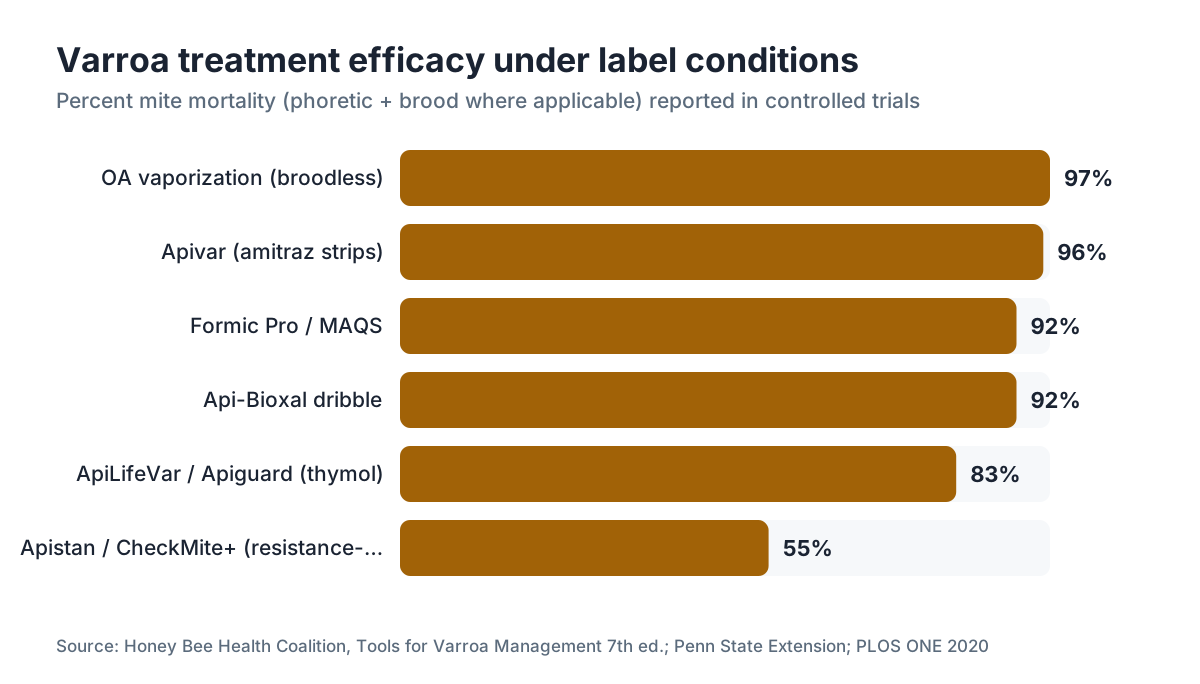
Here's how the major products stack up on efficacy under good conditions:
| Treatment | Active ingredient | Efficacy (phoretic mites) | Works in capped brood? | Min temp | Max temp | Honey super safe? |
|---|---|---|---|---|---|---|
| Apivar strips | Amitraz | 93 to 99% [2] | Yes (slow contact) | 50°F | 105°F | No |
| Oxalic acid vapor | Oxalic acid | 95 to 99% [3] | No (phoretic only) | >37°F ambient | No hard upper limit | No |
| MAQS / Formic Pro | Formic acid | 90 to 95% [4] | Yes (penetrates cappings) | 50°F | 85°F (MAQS), 92°F (Formic Pro) | Yes (MAQS, Formic Pro) |
| Api-Bioxal dribble | Oxalic acid | 90 to 95% [3] | No | Above freezing | No hard upper limit | No |
| ApiLifeVar / Apiguard | Thymol | 74 to 93% [5] | Partial | 59°F | 105°F | No |
| Apistan / CheckMite+ | Fluvalinate / Coumaphos | Variable (resistance common) | Yes | 50°F | No hard limit | No |
Apivar and oxalic acid vaporization top the performance charts when used correctly. Formic acid is the only organic option that reaches mites inside capped brood cells, which is why it earns a top-tier spot despite a narrow temperature window.
Fluvalinate (Apistan) and coumaphos (CheckMite+) ruled the 1990s. Resistance is now widespread enough that the HBHC and most university extension programs advise against relying on them as primary treatments [6]. I'd use them only as a last resort.
How does oxalic acid vaporization work and how effective is it?
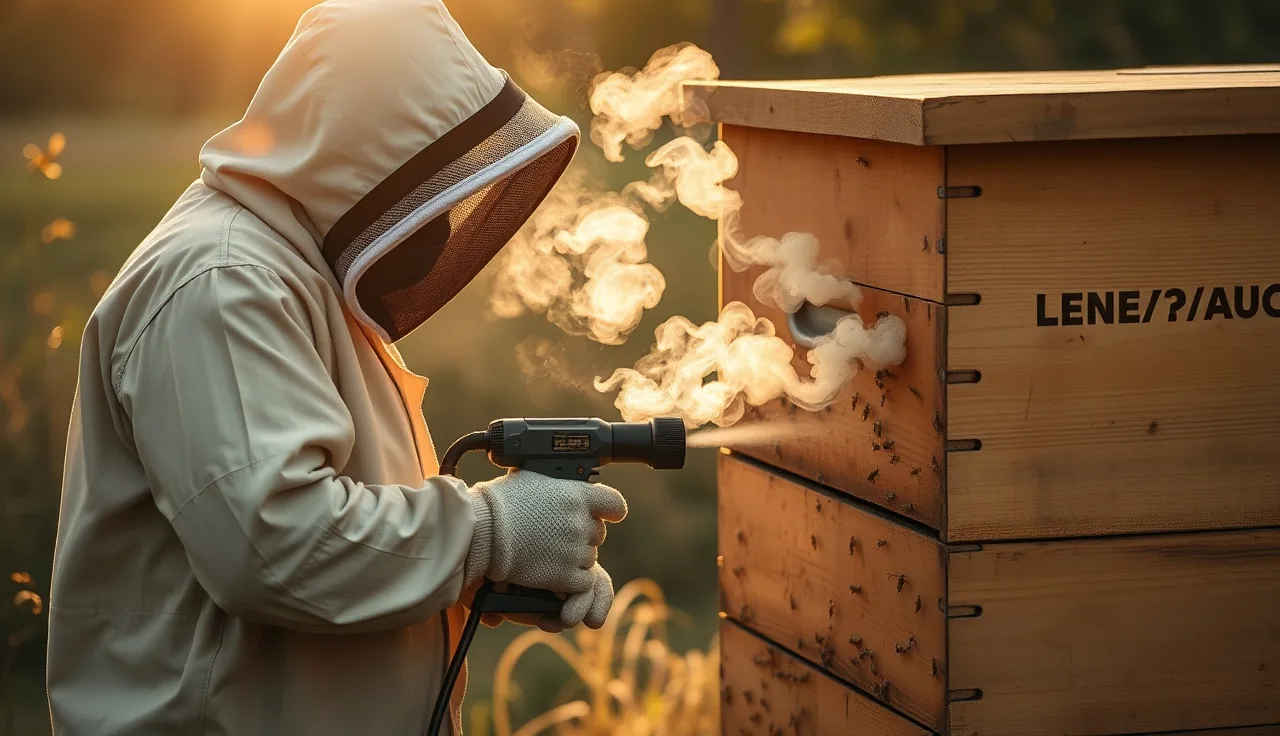
Oxalic acid vaporization kills 95 to 99% of phoretic mites in a broodless colony with a single treatment [3]. You heat a measured dose of oxalic acid crystals (typically 1 gram per brood box in an OA vaporizer) inside the sealed hive entrance, the acid sublimes into a fine aerosol, and mites riding on adult bees absorb it through contact. It's the most talked-about hobbyist treatment right now, and the reason is that mortality number.
The catch is big. OA does nothing to mites sealed inside capped brood cells. Those mites survive, emerge with the next generation of bees, and your infestation rebuilds. Timing is everything. A single OA vaporization in a naturally broodless winter colony (or after a forced brood break) is devastating. Multiple treatments spaced 5 days apart can work during the brood season by catching mites as they emerge before they re-enter cells, but the evidence for that protocol is messier. Some studies support three to five treatments at 5-day intervals. Others find mite loads rebound quickly.
The EPA-registered vaporization product in the U.S. is Api-Bioxal (manufactured by Vétoquinol). The label allows one vaporization application per year in colonies with a mite-free capped brood area, or up to three vaporization treatments when brood is present [1]. Read the label. Exceeding label rates or application counts is illegal and can leave residues.
Safety note: OA vapor is a serious respiratory hazard. A NIOSH-approved respirator rated for acid vapors (minimum P100 + OV), gloves, and eye protection are not optional. The EPA label requires them [1].
OA is cheap. Api-Bioxal runs roughly $20 to 30 for 275 grams, enough for dozens of treatments. A decent vaporizer costs $150 to 250. If you're running more than three or four hives, the math strongly favors vaporization over dribble or trickle methods for winter use.
Is Apivar (amitraz) still the most effective treatment for colonies with brood?
For a colony in full brood production, Apivar is hard to beat on raw efficacy. Amitraz works by contact: bees walk over the strips, pick up the active ingredient on their body hair, and spread it through the cluster. Mites on adult bees die, and mites inside cells get exposed as they contact treated bees over the 6 to 8 week treatment period.
A 2017 university trial published through Penn State Extension reported Apivar efficacy at 93 to 99% under normal beekeeping conditions [2]. That's a meaningful range. The low end shows up when treatments get pulled early, when strips aren't positioned right in the brood nest, or when the colony population is low and contact transfer drops off.
Two strips per colony is the standard label rate for up to 10 frames of bees. Larger colonies (over 10 frames) can need additional strips per label guidance. The treatment window is 6 to 8 weeks minimum. Pulling strips at 4 weeks cuts efficacy noticeably.
Amitraz resistance is real and spreading. It's documented in Europe and in pockets of the U.S. [6]. You reduce resistance pressure by rotating active ingredients across cycles and never using Apivar more than once per calendar year. Use it in fall, then use an organic acid or formic acid in spring.
Apivar strips run about $35 to 55 for a pack of 10 strips (5 colony treatments). Check current pricing through beekeeping supply companies.
One firm rule: Apivar cannot be in the hive when honey supers are on. Amitraz residues can show up in honey. The label is clear on this.
Can you treat varroa while honey supers are on?
Formic acid products, specifically MAQS (Mite Away Quick Strips) and Formic Pro, are the only EPA-registered treatments approved for use while honey supers are present [4]. Your options narrow to those two. That's the honest answer.
The formic acid volatilizes and dissipates. It doesn't accumulate in honey in detectable amounts at label rates. But MAQS in particular can cause brood kill, queen loss, and colony stress, especially above 85°F. The label allows MAQS up to 85°F; Formic Pro has a slightly wider window up to 92°F.
Every other primary treatment, including Apivar, OA vapor, OA dribble, ApiLifeVar, Apiguard, and CheckMite+, requires that honey supers be off, or that honey in the supers be set aside and never sold for human consumption.
The workaround most experienced beekeepers use: pull supers during the August or September nectar dearth (after the main flow), treat hard with Apivar or OA vapor, and requeen if needed. Your bees don't need supers on for mite treatment. Plan your calendar around the treatment, not the other way around.
How does formic acid compare to oxalic acid for varroa?
Both are organic acids. Both sit in honey naturally at trace levels. That's about where the similarities stop.
Formic acid's advantage is brood penetration. MAQS and Formic Pro release enough formic acid vapor to enter capped brood cells and kill the mites inside. No other organic treatment does this reliably. Efficacy against total mite load (phoretic plus brood mites) runs 90 to 95% under label conditions [4]. For a mid-summer treatment when brood is abundant, that's a real edge over OA.
The tradeoff is a narrow temperature window and genuine risk of colony damage. Above 85°F (MAQS) or 92°F (Formic Pro), formic acid releases too fast, and the colony can lose brood, workers, and sometimes the queen. In my experience, the first 3 to 5 days after MAQS application in warm weather produce visible stress: heavy bearding, occasional absconding. It works. It's not gentle.
Oxalic acid is gentler, cheaper, easier to apply, and brutally effective in broodless conditions. It cannot touch mites in brood. Formic acid is more stressful, temperature-limited, and slightly pricier, but it's the tool you reach for when the colony is running full brood and you need something that reaches inside the cells.
For most hobbyist beekeepers in temperate climates, the practical answer: formic acid or Apivar for the late-summer treatment when brood is present, and OA vaporization for the winter treatment when the colony is broodless. That pairing covers both mite populations.
What's the right varroa mite treatment schedule by season?
Timing is where most hobbyist varroa programs fall apart. The treatment itself usually isn't the problem. Applying it at the wrong time is.
Here's the protocol framework the Honey Bee Health Coalition recommends, which matches most university extension guidance [7]:
Late summer (August to early September): The single most important treatment of the year. The bees raised in August and September are your winter bees, and they need to enter the cluster carrying low mite loads. Treat when mite levels hit 2% or above (2 mites per 100 bees on an alcohol wash), or proactively by mid-August regardless of counts in high-pressure regions. Apivar or MAQS/Formic Pro are the standard choices.
Winter (November through February, broodless period): OA vaporization in a broodless colony is the most effective single treatment in beekeeping. One or two treatments 5 to 7 days apart gives you a 95%+ reduction. Cheap, and low-stress for the bees.
Spring (March to April): Monitor. Treat if an alcohol wash hits 2% before supers go on. OA vaporization (multiple treatments) or Formic Pro in the right temperatures are the main options. Skip Apivar in spring if you used it in fall, to hold down resistance pressure.
Mid-summer (June to July): Monitor only, unless counts spike above 2% during the honey flow. Most beekeepers accept some risk here because treatment options with supers on are limited. MAQS is your tool if you have to treat.
Monitoring is not optional. The Honey Bee Health Coalition's guide recommends alcohol wash or sticky board counts at least every 30 days during the active season [7]. The 2% intervention threshold is widely cited, though some extension programs use 3% depending on region and time of year.
How do you measure varroa infestation levels accurately?
You can't manage what you don't measure. The two most reliable monitoring methods are the alcohol wash and the sugar roll. Sticky board counts (a sticky insert under a screened bottom board for 24 to 72 hours) give you a natural mite drop rate and track trends well, but they're less precise for calculating actual infestation percentage.
The alcohol wash is the gold standard. The Virginia Department of Agriculture and Consumer Services, among other state agencies, recommends it as the most reliable method [8]. Collect roughly 300 adult bees from a brood frame (not the queen), drop them in a jar with 70% isopropyl alcohol, shake for 30 to 60 seconds, pour through a mesh screen, and count the mites that fall through. Divide mites by bee count, multiply by 100, and you've got your percentage.
The equipment list is short: a half-liter wide-mouth jar, a mesh lid (window screen works), a white bowl or tray, and isopropyl alcohol. Total cost is under $10 if you're buying, or free if you raid the kitchen.
The sugar roll is a no-kill alternative. Same process, powdered sugar instead of alcohol. Bees survive, mites fall off when shaken. The problem is it underestimates mite loads compared to the alcohol wash, sometimes by a lot. The Honey Bee Health Coalition puts it plainly: the alcohol wash is more accurate [7]. If colony mortality worries you, a drone brood uncapping inspection gives a qualitative read on infestation.
A realistic monitoring calendar for a hobbyist: check every 30 days from April through October, plus once after your winter treatment.
Are there effective varroa treatments that don't use chemicals?
Yes, though none match the efficacy numbers of OA or Apivar used correctly.
The brood break is the most effective non-chemical intervention. You remove or cage the queen for 24 days (the full span of worker brood development), which forces a period with no new capped brood. Every reproductive mite gets pushed into phoretic phase. Follow with an OA vaporization treatment at the end of the break and you can hit 95%+ efficacy. The downside is colony stress, reduced population, and the management hassle of caging or removing a queen.
Drone brood removal exploits varroa's preference for drone cells (mites infest drone brood at roughly 8 to 10 times the rate of worker brood). You put a frame of drone comb foundation in the brood nest, let the bees fill it with drone larvae, then pull and freeze the frame once it's capped. Repeated every 3 weeks, this can reduce mite buildup by an estimated 30 to 50%, but it's labor-heavy and not enough on its own [9].
Hygienic bee genetics, particularly VSH (Varroa Sensitive Hygiene) and Mite Biter traits, are increasingly available from commercial breeders. Colonies with strong VSH behavior can suppress mite populations well. This is an area of genuine ongoing research and real progress, though access to quality VSH queens varies by region.
Here's the honest bottom line. Brood breaks plus OA can work as a fully chemical-free summer strategy. For most hobbyists, combining cultural methods with one organic acid treatment beats trying to go fully treatment-free, which risks both your colony and your neighbors' colonies.
What about varroa treatment resistance, and how do you avoid it?
Resistance is not hypothetical. Fluvalinate resistance (affecting Apistan) was documented in the U.S. as early as the late 1990s. Coumaphos resistance followed. Amitraz resistance is confirmed in several European countries and is appearing in U.S. populations [6].
The mechanism mirrors antibiotic resistance. Mites that survive a treatment pass their genes on. The more you lean on a single active ingredient, the faster resistance spreads through your local mite population.
Avoiding it means rotating active ingredients. Don't use Apivar (amitraz) for both your summer and winter treatments in the same year. Pair it with an organic acid in the alternate cycle. Oxalic acid and formic acid work by direct chemical action that mites have not, as of current evidence, developed meaningful resistance to, though researchers keep watching for it [7].
A 2020 review in PLOS ONE summarized the state of acaricide resistance in Varroa and concluded: "Resistance to synthetic acaricides is the main concern; organic acids and thymol have shown no clinical resistance to date" [6]. That's not a permanent guarantee. It's the current situation.
The practical takeaway: use organics for at least one treatment cycle per year. Monitor efficacy. If a treatment that used to work well shows a 20 to 30% drop, suspect resistance and switch active ingredients right away.
If you're building out a full treatment calendar and want help tracking treatment history and mite counts across hives, VarroaVault's free protocol tools let you log treatments and flag when you're cycling the same active ingredient too often.
How much do varroa treatments cost, and which gives the best value?
Cost per colony swings widely across treatment types. Here's a realistic breakdown for a single colony treatment:
| Treatment | Product cost per colony | Equipment needed | Total first-year cost (per hive) |
|---|---|---|---|
| OA vaporization (Api-Bioxal) | ~$0.50 to 1.50 | Vaporizer: $150 to 250 | ~$200 to 250 year 1, <$5/hive after |
| Apivar strips | ~$7 to 11 | None | $7 to 11 per treatment |
| MAQS (formic acid) | ~$10 to 15 | None | $10 to 15 per treatment |
| Formic Pro | ~$10 to 18 | None | $10 to 18 per treatment |
| Api-Bioxal dribble | ~$0.50 to 1.50 | None (uses 1:1 syrup solution) | $1 to 2 per treatment |
| ApiLifeVar | ~$8 to 12 | None | $8 to 12 per treatment |
Oxalic acid vaporization is the cheapest per-treatment cost once you own the vaporizer, no contest. For a beekeeper running 5 or more hives, the vaporizer pays for itself in the first season. If you're managing 1 to 2 hives and own nothing yet, Apivar or MAQS are simpler places to start financially.
Formic acid products cost roughly the same as Apivar per treatment. Thymol products (ApiLifeVar, Apiguard) compete on cost but generally show lower efficacy in U.S. temperature conditions, where summer heat either degrades the treatment or drives it off too fast.
Check current treatment prices and a broader equipment list at beekeeping supply companies, or look into options at free shipping honey bee supply companies to trim per-unit costs.
What does current research say about the most effective overall varroa strategy?
The consensus from the Honey Bee Health Coalition, university extension programs, and recent peer-reviewed work lands on one framework: integrated pest management (IPM), using monitoring plus rotation of effective treatments matched to colony conditions.
A 2022 study from the USDA Agricultural Research Service found that colonies treated with oxalic acid in the broodless period, then amitraz (Apivar) the following summer, had significantly lower mite loads and higher winter survival than colonies getting either treatment alone [10]. No surprise given OA's brood-blind limitation, but it's useful confirmation that the combination approach works.
The HBHC guide, now in its 7th edition, states: "No single treatment is effective under all conditions. The most successful programs use monitoring to time treatments, rotate active ingredients, and combine chemical treatments with cultural methods such as brood breaks and selection for hygienic behavior" [7].
University extension programs from Penn State [2], University of Minnesota [11], and UC Davis [12] all back this IPM approach. None of them recommend a single silver-bullet product.
If I were starting from scratch with a small apiary, here's the honest protocol I'd run: OA vaporization every winter during the broodless period, Apivar in late summer every other year, formic acid (Formic Pro) in the alternate late-summer years, and an alcohol wash every 30 days from April through October. That covers the major treatment gaps, rotates active ingredients, and keeps costs sane.
VarroaVault's free seasonal protocol guide maps this calendar week by week if you want a ready-made starting point.
What are the legal and label rules you have to follow?
Every varroa treatment sold in the U.S. is registered with the EPA, and the label is a federal legal document. Using a product in a manner inconsistent with its label violates federal pesticide law (FIFRA, 7 U.S.C. §136 et seq.) [13]. The label rates, application timing, PPE requirements, and honey-super restrictions are not suggestions.
Key legal points every beekeeper should know:
First, oxalic acid products must be Api-Bioxal. You cannot legally use raw oxalic acid crystals from a hardware store on a honey-producing colony in the U.S. The EPA registered Api-Bioxal in 2015 specifically for honey bees, and the label governs application method, rate, and PPE [1].
Second, the label dictates treatment frequency. Apivar allows two strips for 6 to 8 weeks, once per colony per year. OA vaporization via Api-Bioxal allows three applications when brood is present, or one in broodless conditions. Formic Pro allows two applications per treatment cycle.
Third, none of these products require a veterinarian's prescription. Beekeepers can buy and apply every treatment discussed here without one. This trips people up, because some livestock acaricides do require a vet.
Fourth, state regulations can stack restrictions on top of federal label requirements. Some states require a pesticide applicator license even for personal-use applications. Check with your state department of agriculture. The National Pesticide Information Center maintains state-level contacts [14].
If you're sourcing beekeeping supplies including treatments, buy from a licensed dealer so you're getting an EPA-registered product with a valid label.
Frequently asked questions
What is the most effective varroa mite treatment overall?
For a broodless colony, oxalic acid vaporization achieves 95 to 99% efficacy and is hard to beat. For colonies with active brood, Apivar (amitraz) or formic acid products (MAQS, Formic Pro) are the top choices, with Apivar hitting 93 to 99% efficacy when used for the full 6 to 8 week period. The best overall strategy is to rotate between organic acids and amitraz across treatment cycles.
How often should I treat my hive for varroa mites?
Most integrated pest management programs call for at least two treatment cycles per year: a late-summer treatment (August to early September) and a winter or early-spring treatment during the broodless period. You should also treat anytime an alcohol wash shows 2% or more mite infestation. Monthly monitoring from April through October is the foundation; treat based on counts, not the calendar alone.
Can I treat varroa when honey supers are on the hive?
MAQS (Mite Away Quick Strips) and Formic Pro are the only EPA-registered treatments approved for use while honey supers are present. Apivar, oxalic acid, thymol products, and coumaphos all require supers to be removed before treatment. Formic acid volatilizes and does not accumulate in honey at label rates, which is why it's the exception. Always verify current label conditions before applying anything with supers on.
What is the 2% varroa threshold and why does it matter?
The 2% threshold means 2 or more mites per 100 adult bees on an alcohol wash. At this level, mite populations are growing fast enough to cause colony stress and brood damage within weeks. The Honey Bee Health Coalition recommends treating at or above this level during the brood season. Some extension programs use 3% in spring but hold to 2% in late summer when winter bee production is critical.
Is oxalic acid safe for bees and honey?
Yes, at label rates. Oxalic acid is naturally present in honey at low concentrations. Api-Bioxal applied at label doses has not been shown to cause honey contamination above background levels in university trials. It does not harm adult bees when used correctly, though it can damage uncapped brood if applied by dribble method when brood is present. OA vaporization is generally gentler on the colony than dribble.
How do I do an alcohol wash to check for varroa mites?
Collect about 300 adult bees (roughly half a cup) from a brood frame, avoiding the queen. Place them in a jar with 70% isopropyl alcohol, seal with a mesh lid, and shake vigorously for 30 to 60 seconds. Pour the liquid through the mesh into a white bowl and count the mites that pass through. Divide mite count by bee count and multiply by 100 for your infestation percentage.
Are varroa mites developing resistance to treatments?
Resistance to synthetic acaricides is the main concern. Fluvalinate (Apistan) and coumaphos resistance is widespread in the U.S. Amitraz resistance has been confirmed in Europe and is emerging in some U.S. populations. Oxalic acid and formic acid have not shown clinical resistance as of current evidence, according to a 2020 review in PLOS ONE. Rotating active ingredients is the primary way to reduce resistance pressure in your apiary.
What varroa treatment works best in summer when temperatures are high?
High temperatures rule out formic acid (MAQS limit is 85°F, Formic Pro is 92°F) and thymol products, which volatilize too quickly in heat. Apivar (amitraz) has no effective upper temperature limit and remains the most practical option in hot summer conditions. Oxalic acid vaporization can be used if you can create a brood break, but repeated treatments are needed to catch emerging mites.
What is the cheapest way to treat varroa mites?
Oxalic acid vaporization is the cheapest per-treatment option at roughly $0.50 to 1.50 per colony in product cost, though a vaporizer costs $150 to 250 upfront. For beekeepers with more than 4 to 5 hives, the vaporizer pays for itself in the first year. For a single hive with no equipment, Api-Bioxal dribble (oxalic acid solution applied directly to bees) requires no equipment and runs about $1 to 2 per treatment.
Can I combine varroa treatments at the same time?
Generally, no. Combining treatments is not supported by label registrations and can increase bee toxicity without proportionally increasing mite kill. There's some university research on sequential treatments (e.g., OA vapor followed by Apivar) in the same season, which is legal and effective. But concurrent application of two active treatments is off-label and risks harming your colony more than it helps.
Do I need a prescription to buy varroa treatments?
No. All EPA-registered varroa treatments discussed here, including Api-Bioxal, Apivar, MAQS, and Formic Pro, are available to beekeepers without a veterinary prescription. This differs from some livestock antiparasitics. You purchase them directly from beekeeping supply retailers. Always verify you're buying an EPA-registered product with a valid label, not an unregistered raw chemical.
How long does varroa treatment take to work?
OA vaporization kills phoretic mites within 24 to 72 hours of application. Apivar strips work by slow contact transfer over 6 to 8 weeks; mite counts drop progressively over that period. Formic acid products (MAQS, Formic Pro) are faster, with most efficacy achieved in the first 7 to 10 days of the treatment period. Testing mite levels with an alcohol wash 2 to 3 weeks after treatment completion gives you a reliable efficacy check.
What happens if I don't treat for varroa mites?
Untreated colonies in most parts of North America typically collapse within 1 to 3 years. Varroa weakens bees by feeding on fat body tissue, suppresses immune function, and transmits viruses including Deformed Wing Virus. High mite loads in fall produce a generation of winter bees that are too damaged to survive the cluster period. Untreated hives also act as a mite reservoir for neighboring colonies up to several miles away.
Are there varroa-resistant bee breeds I can use instead of treating?
VSH (Varroa Sensitive Hygiene) and Mite Biter bees are genuine breeding lines that reduce mite reproduction rates. Some colonies with strong VSH genetics can maintain low mite loads without chemical treatment, but results vary with local mite pressure and genetics drift after requeening. Most university extension programs recommend these genetics as a complement to treatment, not a complete replacement, especially for new beekeepers or high-pressure environments.
Sources
- U.S. EPA, Api-Bioxal Registration and Label: Api-Bioxal received full EPA registration in 2015; label governs OA vaporization rates, application frequency, and PPE requirements
- Penn State Extension, Varroa Mite Management: Apivar efficacy reported at 93 to 99% in colonies under normal beekeeping conditions
- USDA AMS National Organic Program / Honey Bee Health Coalition, Tools for Varroa Management 7th ed.: Oxalic acid vaporization in broodless colonies achieves 95 to 99% efficacy against phoretic mites
- MAIA Inc. / NOD Apiary Products, Formic Pro and MAQS product labels: MAQS and Formic Pro are approved for use with honey supers present; MAQS temperature limit 85°F, Formic Pro 92°F; efficacy 90 to 95%
- Honey Bee Health Coalition, Tools for Varroa Management 7th edition: Thymol-based treatments (ApiLifeVar, Apiguard) show 74 to 93% efficacy with partial effect on brood-stage mites
- Locke B. et al., PLOS ONE 2020, Acaricide resistance in Varroa destructor: Resistance to synthetic acaricides is the main concern; organic acids and thymol have shown no clinical resistance to date; amitraz resistance confirmed in European Varroa populations
- Honey Bee Health Coalition, Tools for Varroa Management Guide (7th edition): IPM framework: monitoring-based treatment timing, active ingredient rotation, 2% threshold for intervention; alcohol wash recommended as most accurate monitoring method
- Virginia Department of Agriculture and Consumer Services, Varroa Mite Monitoring and Management: Alcohol wash recommended as the most reliable method for varroa infestation monitoring
- University of Minnesota Extension, Varroa Mite Management for Hobbyist Beekeepers: Drone brood removal can reduce mite buildup by an estimated 30 to 50% but is insufficient as a sole management strategy
- USDA Agricultural Research Service, Bee Research Laboratory: 2022 study: colonies treated with OA in broodless period followed by amitraz the following summer had significantly lower mite loads and higher winter survival than single-treatment colonies
- University of Minnesota Extension, Varroa IPM: IPM framework including monitoring thresholds and treatment rotation recommended
- UC Davis Honey Bee Research Facility, Varroa Management: No single silver-bullet product; combined monitoring and rotation approach recommended
- U.S. EPA, Federal Insecticide, Fungicide, and Rodenticide Act (FIFRA) 7 U.S.C. §136: Using a pesticide inconsistent with its label is a violation of federal law under FIFRA
- National Pesticide Information Center (NPIC), State Lead Agencies: State-level regulations can add restrictions beyond federal label requirements; NPIC maintains contacts for state departments of agriculture
Last updated 2026-07-09