Nebulizer application of oxalic acid for varroa mite control
TL;DR
- Nebulizing oxalic acid turns a liquid OA solution into a fine mist inside the hive, killing varroa on contact with adult bees.
- It is legal in the US only when the device fits the Api-Bioxal label as a vaporization method.
- Applied correctly to a broodless colony, it drops roughly 90 to 95% of mites in one treatment and leaves honey at near-background residue levels.
What is nebulization of oxalic acid and how is it different from vaporization?
Nebulization and vaporization both put oxalic acid (OA) into a hive as airborne particles. The physics behind them are completely different. Vaporization heats solid OA crystals or a dripped solution until they sublimate into a gas, which then re-deposits as fine crystals on bees and hive surfaces. Nebulization pushes a liquid OA solution through a pressurized nozzle or an ultrasonic transducer and makes a wet aerosol, a fog of tiny droplets that drift through the hive air and land on mites and bees directly.
Particle size drives most of the difference. Vaporized OA re-crystallizes into particles roughly in the 1 to 10 micrometer range once it cools inside the hive. Nebulized droplets, depending on the device, run about 5 to 50 micrometers. Bigger droplets settle faster and drop more OA per unit area. Smaller droplets hang in the air longer and reach between frames and into corners a vaporizer might miss. Neither wins in every case. Each trades something.
Nebulization needs no heat source. That one fact changes the equipment, the safety profile, and the legal picture, and all three are worth understanding before you spend a dime.
Is nebulized oxalic acid EPA-registered and legal to use?
Here is the plain answer beekeepers keep asking for. As of mid-2025, the only EPA-registered oxalic acid product for honey bee colonies in the United States is Api-Bioxal, registered by Veto-pharma [1]. That label lists three permitted methods: trickle (dribble), vaporization, and sponge (extended-release patty). Nebulization is not written on the label as its own separate method.
The EPA and several state apiculturists have read certain nebulization devices, the ones that make a hot aerosol at or near vaporization temperatures, as falling inside the "vaporization" method on the label. The Heilyser has come up in that discussion at extension services, always with the same caveat: you have to follow the Api-Bioxal concentration exactly [2]. Run a cold-aerosol device with an OA solution mixed to some custom concentration and you are off-label, which is a violation of FIFRA, the Federal Insecticide, Fungicide, and Rodenticide Act [3].
So what does that mean for you? Use a hot-aerosol device with Api-Bioxal mixed to label concentration and you are likely within the spirit of the label, and most state apiculturists will leave you alone. Run a cold-mist ultrasonic nebulizer at a homemade concentration and you are off-label. Confirm with your state department of agriculture first, because enforcement is all over the map.
The Honey Bee Health Coalition's Varroa Management Guide puts the principle simply: treatments "must be applied according to label directions," which protects both the beekeeper and the honey buyer [4].
How effective is nebulized OA at killing varroa mites?
Efficacy data specific to nebulization is thinner than the vaporization record, and I would rather say that outright than pretend otherwise. Most published work lumps "vaporization" together loosely, and device-to-device variation is real.
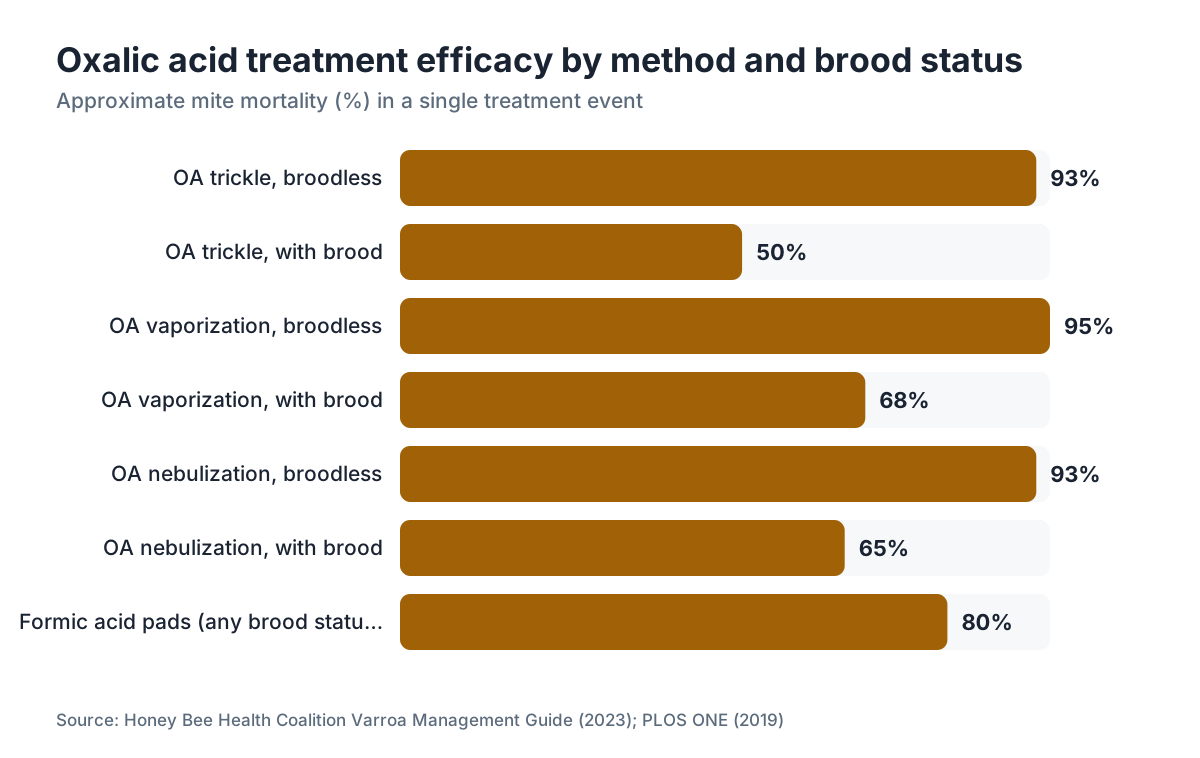
For OA vaporization broadly, the field data cited most often show 90 to 97% mite mortality in broodless colonies and 60 to 75% in colonies with capped brood, because OA does not get through cappings [5]. European nebulization studies report similar broodless numbers, roughly 90 to 95% knockdown in a single treatment cycle, though how many treatments you need to hit that depends heavily on how broodless the colony is when you treat [6].
A 2019 study in PLOS ONE compared OA application methods and found vaporization and nebulization produced statistically similar mite drops in broodless colonies. Vaporization held a slight edge where some brood was present, probably because vaporized OA re-deposits on surfaces and stays in contact longer inside the hive [5].
One rule governs every OA method, this one included. Brood status is the single biggest variable. Treat during a natural or managed broodless period, or repeat treatments to catch mites emerging from cells, and you can realistically push infestation below the roughly 2% action threshold [4].
| Method | Broodless efficacy | With brood efficacy | Treatments needed (broodless) |
|---|---|---|---|
| OA trickle | 90-95% | 40-60% | 1 |
| OA vaporization | 90-97% | 60-75% | 1 (repeat 3x over 3 weeks with brood) |
| OA nebulization | 90-95% | ~60-70% (limited data) | 1 (repeat 3x over 3 weeks with brood) |
| Formic acid pads | 70-90% | 70-90% | 1-2 (temp dependent) |
What equipment do you need to nebulize oxalic acid in a hive?
Two device categories reach hobby and sideliner beekeepers. Pick based on how many hives you run and how strict your state is about the label.
Hot-aerosol nebulizers (sometimes called thermal foggers adapted for OA) heat the liquid solution fast and make a fog at or near sublimation temperatures. The Heilyser Oxabee is the example that shows up most in North American extension literature [2]. These can pull from a reservoir, which makes treating many hives faster than loading individual vaporizers. They run on 12V power from a car battery or a dedicated pack, same as a standard OA vaporizer.
Cold-mist or ultrasonic nebulizers use a vibrating mesh or ultrasonic transducer to break liquid into micro-droplets without heat. They are common in European hobby beekeeping and are, in theory, gentler on the OA molecule since nothing gets hot enough to break it down. Their US legal footing is murkier, as covered above, because no cold-nebulization device sits on the Api-Bioxal label.
Whatever device you pick, you also need:
- Proper OA solution: Api-Bioxal mixed per label to 3.5% (w/v) oxalic acid in a 1:1 sugar syrup [1]
- A full respirator with an OA-rated cartridge (P100 plus acid gas). A dust mask does nothing here.
- Chemical-resistant gloves (nitrile at minimum, butyl rubber for extended use)
- Sealed safety goggles, not glasses, because OA aerosol punishes eyes
- A way to seal the hive entrance during treatment, usually a foam plug
- A timer, since most label-compliant protocols keep the hive sealed 10 to 15 minutes after application [1]
VarroaVault's free varroa management tools include a treatment timing calculator that factors in your colony's brood cycle, so you can schedule nebulization rounds without guessing at the calendar.
How do you actually apply nebulized OA to a hive, step by step?
The steps below follow the general shape of the Api-Bioxal label's vaporization section, adapted for a hot-aerosol nebulizer. Cold-mist users in states that allow it run the same sequence and skip the warm-up step.
- Check colony status. Confirm broodlessness if you want the best single-treatment result. Treat every colony in the apiary at once, because varroa rides in on drifting bees and reinfests treated hives.
- Mix the solution fresh. Api-Bioxal calls for dissolving the packet in a 1:1 (by weight) sucrose syrup to reach a 3.5% OA solution. Mix only what you will use that day. It degrades, and crystals clog nozzles [1].
- Suit up completely before you load the device. OA aerosol is in the air within seconds of the trigger.
- Warm up the device per the manufacturer. For the Heilyser, that is roughly 60 to 90 seconds of pre-run before you insert the wand.
- Seal the entrance and any big gaps with foam or a damp cloth.
- Insert the wand into the lower entrance or a small access hole in the bottom board. Leave the hive closed.
- Trigger the device and move the wand slowly if it allows directed application. With reservoir systems the fog flows through on its own. Typical active fog time is 30 to 60 seconds per hive body [2].
- Pull the wand, reseal the entry point, and leave the hive shut for 10 to 15 minutes for contact time.
- Open the entrance, step back, and let the colony air out for at least 10 minutes before you take off your respirator.
- Log the date, product lot number, concentration, and hive ID. The Api-Bioxal label requires this for commercial operations, and it is good practice for hobbyists.
No treating during nectar flow with honey supers on the hive. Pull the supers first, per the label [1].
What are the safety risks of nebulized oxalic acid and how do you manage them?
OA aerosol is more acutely hazardous than OA vapor in one specific way. The droplets are wet, so they land on eyes, skin, and the lining of your airway more readily than re-crystallized solid particles do. The NIOSH immediately dangerous to life and health (IDLH) level for oxalic acid is 500 mg/m3 [7]. Inside a hive mid-treatment, local concentrations run far above that. Outside the sealed hive they drop fast, but you are standing right at the entrance.
Inhalation is the main danger. OA aerosol causes respiratory irritation and coughing, and repeated high-dose exposure can damage the lungs. The correct PPE is a half-face respirator with P100 particulate filters plus an acid-gas cartridge (OV/AG). The P100 catches particles, the acid-gas cartridge handles the vapor phase. This part is not negotiable.
Skin contact causes irritation and, over prolonged exposure, chemical burns. Wear gloves. OA also eats stainless steel nozzles over time, so rinse your equipment with warm water after every use.
Bee safety gets skipped over too often. Nebulization at the label concentration and duration does not kill meaningful numbers of adult bees if you ventilate the hive afterward [1]. Over-treat, run the concentration too high, or repeat more than three times in a broodless stretch, and losses climb. Follow the label dose and timing. The instinct that more is better costs you bees.
Do not treat in wind above about 5 mph. Aerosol blows back at you and thins out before it reaches the inside of the hive.
Does nebulized oxalic acid leave residues in honey?
Oxalic acid already lives in honey. It is a natural compound in honey, pollen, and plant tissue, and background levels in untreated honey run from 8 to 58 mg/kg depending on the floral source [8]. Studies on OA vaporization, and by extension nebulization at the same dose, show residues rise briefly after treatment and settle back to or near background within weeks, staying well under any regulatory limit.
The European Food Safety Authority set a maximum residue limit (MRL) for OA in honey at 50 mg/kg [8]. The United States sets no separate MRL for OA in honey because it counts as a naturally occurring substance, but the EPA registered Api-Bioxal on the understanding that a properly applied treatment stays inside that range.
The label's rule to pull honey supers before treatment is the safeguard that matters. Treating with supers on risks aerosol OA landing straight on honey you plan to harvest, and that is the scenario that could push residues past background, not the treatment itself [1].
So pull the supers, treat, let the colony air out, and put supers back only after the treatment window closes. Do that and residue is not a real-world worry.
When should you use nebulization instead of vaporization or the trickle method?
Vaporization is still the best-documented OA method in North America and carries the deepest efficacy record. If you have a reliable OxaVap or Varrox-style vaporizer and it works for you, there is no reason to switch.
Nebulization earns its place in a few specific spots. Run a lot of hives and find vaporization's 2 to 3 minute heat cycle per hive a bottleneck? A reservoir-fed nebulizer treats a hive in under 60 seconds, and that adds up over a yard. Work in conditions where an open propane or electric heating element is a fire risk, like dry summer grassland? A hot-aerosol nebulizer that reaches temperature fast and leaves no glowing element sitting in a hive is genuinely safer. Some beekeepers also find the aerosol spreads more evenly through tall or horizontal hive designs where a floor-level vaporizer struggles to reach the top boxes.
The trickle method still wins for treating packages or small clusters in early spring, when the bees are already sitting in the dribbled solution. It needs nothing but a syringe and is the cheapest way in. Its weakness is that it soaks the cluster and irritates bees more per treatment than vapor or aerosol at the same mite knockdown [4].
For a sideliner running 50 to 200 hives, nebulization deserves a hard look if you can confirm label compliance with your state apiculturist. For a 5-hive hobbyist, a standard OA vaporizer is almost certainly the smarter buy. The varroa mite overview on VarroaVault shows how all these methods fit into a full-year mite plan.
How many times can you repeat nebulization treatments in one season?
The Api-Bioxal label allows up to three treatments per application event for the vaporization method, spread over a roughly 3-week window when brood is present [1]. That accounts for mites emerging from capped brood the first treatment could not touch. In a broodless colony (a winter cluster, a fresh split, or an intentional brood break) one treatment usually drives infestation below threshold.
The label sets no annual cap beyond that three-per-event guidance. University extension apiculturists generally recommend two treatment events a year: one in late summer after you pull honey supers, and one in winter when the colony is broodless [2][4]. More than twice a year is rarely needed if your summer timing is good and you monitor with an alcohol wash or sticky board to confirm the treatment took.
If your mite counts are still above 2% after a finished treatment series, do more than pile on more treatments. Recheck your method first: seal quality, concentration accuracy, timing against the brood cycle. OA resistance has not been documented in the literature as of the most recent Honey Bee Health Coalition guide [4], so weak efficacy is almost always a method problem, not a resistance problem.
Can you nebulize oxalic acid when brood is present?
Yes, but efficacy drops and the strategy shifts. OA in any form does not get through capped brood cells. Mites in the phoretic stage, riding on adult bees, die. Mites breeding under cappings survive. With capped brood present, the Honey Bee Health Coalition recommends three treatments spaced 5 to 7 days apart to catch mites as they emerge and before the next batch caps over [4].
Some European researchers have tested higher-concentration OA nebulization aimed at brood nest penetration. There is some evidence that certain aerosol particle sizes improve brood-mite contact, but this is not on the Api-Bioxal label and the data is preliminary. In the US, assume nebulized OA hits phoretic mites only and plan your repetitions around that.
A managed brood break paired with OA is one of the strongest tools a small-scale beekeeper has. Cage the queen for 21 to 24 days or make a split, wait until the break is complete, then apply a single OA nebulization treatment. The combination can reach 95 to 99% mite reduction, better than any single chemical treatment on its own [4].
To track your varroa mite load before and after treatment, alcohol wash is the standard, run on a sample of at least 300 bees from the brood nest area.
What does a nebulizer cost and is it worth buying?
Prices move around, so treat these as 2024 to 2025 ranges, not exact figures. A basic OA vaporizer (Varrox Eddy, ProVap 110, or similar) runs roughly $150 to $280 depending on power source and brand. Hot-aerosol nebulizers built for beekeeping, like the Heilyser Oxabee, have listed in the $400 to $600 range. Cold-mist ultrasonic nebulizers adapted from industrial or medical use can be cheaper, $80 to $200, but carry the label-compliance problems noted above.
For a hobbyist under 10 hives, the math does not favor a premium nebulizer over a standard vaporizer. The per-hive time savings are real but too small to justify a $300-plus premium. For a sideliner with 50 to 150 hives running multiple treatment rounds a year, the time savings and the reservoir feed that skips reloading can pay back the difference in one season.
If you are shopping for beekeeping supplies, price the whole system, device plus power source plus OA product plus PPE, before you decide. A respirator with OA-rated cartridges adds $30 to $80 no matter which device you buy, so budget for it from day one.
VarroaVault's free protocol tools help you model treatment timing and estimate product use across your operation, which is handy when you are deciding whether a higher-capacity device pays off.
How do you monitor to confirm nebulization actually worked?
Never assume a treatment worked. Check.
The easiest post-treatment confirmation is a sticky board mite drop. Slide a sticky board or an oiled insert under a screened bottom board 24 to 48 hours after treatment and count the mites. A big drop is a good sign, but a sticky board gives you a raw count, not an infestation rate, and reading it depends on colony size and time of year.
Alcohol wash (sometimes called a sugar roll done with alcohol) is the reliable quantitative method. Wash a sample of about 300 adult bees in 70% alcohol, count the mites released, and do the math: (mites counted / bees sampled) x 100 equals infestation percentage. Run it before treatment and again 2 to 3 weeks after to measure the real knockdown [4].
Most extension services use this threshold: post-treatment counts below 2% in summer and below 1% heading into winter mean the treatment worked [4]. If your count is still above those numbers, investigate before you treat again. Was the hive well sealed? Was the solution mixed right? Was there more brood than you expected?
New to mite monitoring? The Honey Bee Health Coalition's Varroa Management Guide is free, detailed, and the best single reference for it [4]. The University of Minnesota Bee Lab has clear step-by-step monitoring guides too [9].
Frequently asked questions
Is nebulized oxalic acid safe for bees?
At label concentrations and durations, nebulized OA does not kill meaningful numbers of adult bees if you ventilate the hive afterward. Queen safety is the main concern. Some beekeepers report occasional queen loss after any OA application, and the Api-Bioxal label flags this as a risk across all methods. Treating above 50F and avoiding over-treatment keeps colony stress down.
Can I use a medical or industrial ultrasonic nebulizer for bees?
You can adapt one technically, and beekeepers in Europe do. In the US, running a cold-mist ultrasonic nebulizer with OA solution is off-label under FIFRA unless a future label amendment or a state registration permits it. The concentration and device have to match the Api-Bioxal label. Check with your state department of agriculture before using any unlisted device.
What concentration of oxalic acid should I use for nebulization?
The Api-Bioxal label specifies 3.5% (w/v) oxalic acid in a 1:1 sucrose syrup for the vaporization method. Device-specific instructions may call for a more dilute reservoir mix, but 3.5% is your starting point for any label-compliant use in the US. Do not scale up concentration hoping to improve efficacy. Higher concentrations just raise bee toxicity.
How long does nebulized OA stay active inside the hive?
Aerosol droplets settle within minutes of entering the hive, which is why a 10 to 15 minute sealed period follows application. OA does not linger as a fumigant the way some synthetic miticides do. Once deposited and dried on surfaces it can give some residual contact kill for days, but the main kill happens inside the sealed window. Slow-release formic acid pads behave very differently.
Do I need to remove honey supers before nebulizing oxalic acid?
Yes. The Api-Bioxal label explicitly requires removing honey supers before any OA application. Nebulization makes a wet aerosol that deposits onto surfaces, including exposed honey, at higher rates than dry vapor. Treating with supers on risks OA residues in harvestable honey above background and is a label violation. Pull supers, treat, let the colony air out, and replace supers only after the treatment window closes.
How is nebulization different from fogging with oxalic acid?
The terms often get used interchangeably, and in beekeeping they usually mean the same thing: turning an OA liquid into fine airborne droplets sent into the hive. Fogging sometimes implies a thermal process like agricultural pesticide fogging machines. Nebulization more often implies ultrasonic or pressure-driven aerosol without heat. The chemistry reaching the bees is similar. The legal status and equipment differ.
Can I nebulize oxalic acid in winter?
Yes, and winter is the ideal window, since a broodless or nearly broodless colony gives you the best single-application efficacy. Most nebulizer devices work in the cold as long as the solution does not freeze. Treat on a calm day above about 40F so bees stay clustered but the hive is not cold enough to condense the aerosol before it reaches the cluster. Seal and leave. The 10 to 15 minute contact time holds year round.
How many hives can a nebulizer treat per hour?
A hot-aerosol nebulizer with a continuous reservoir treats a hive in roughly 60 to 90 seconds of active fogging plus the 10 to 15 minute sealed wait. In practice, a two-person team (one treating, one sealing and timing) can move through 15 to 25 hives per hour by staggering the start times. A single operator working sequentially lands closer to 10 to 15 hives per hour including walking time.
Does varroa mite resistance to oxalic acid exist?
As of the most recent Honey Bee Health Coalition Varroa Management Guide, resistance to OA in field populations of Varroa destructor has not been confirmed. OA kills mites through direct acidic tissue contact rather than by hitting a specific biochemical receptor, which is the mechanism behind synthetic miticide resistance. Weak OA results in the field almost always trace to method problems: brood present, poor sealing, or wrong concentration.
What PPE do I need when nebulizing oxalic acid?
At minimum: a full-face respirator, or a half-face respirator plus goggles rated for acid mist, with P100 particulate filters and an OV/AG (organic vapor/acid gas) cartridge combination; chemical-resistant gloves (nitrile minimum, butyl rubber preferred); and long sleeves. A dust mask or plain N95 will not protect you from OA aerosol. The NIOSH IDLH for oxalic acid is 500 mg/m3, and concentrations near the hive entrance during treatment can approach it.
How soon after nebulization can I inspect the hive?
After the 10 to 15 minute sealed period and a full ventilation period of at least 10 more minutes with the entrance open, you can open the hive while still wearing your respirator. Wait until any visible fog or haze has cleared from the entrance before removing PPE. For routine inspection, coming back a few hours later once the aerosol has fully dispersed is the most conservative and practical approach.
Is nebulized oxalic acid effective for small hive beetles or other pests?
No meaningful data supports nebulized OA against small hive beetles or wax moths. OA works on Varroa destructor because of the mite's thin integument and its direct contact exposure on adult bees. Beetles and wax moths spend most of their hive life in corners, under debris, and inside walls, where aerosol barely reaches. Do not expect OA in any form to control those pests.
Can I nebulize oxalic acid into a Langstroth hive without removing the boxes?
That is the whole point. Nebulization goes in through the entrance or a small access port without opening the hive, which makes it faster and less disruptive than treatments that need disassembly. The aerosol rises through the frames by convection and the bees' own air movement. A tall, congested stack may see slightly less uniform distribution than open-bottom vaporization, but coverage is adequate for broodless colony treatment.
Sources
- EPA, Api-Bioxal Oxalic Acid product label (Registration No. 84170-4): Api-Bioxal is the EPA-registered OA product for honey bee colonies; label permits trickle, vaporization, and sponge application at 3.5% (w/v) OA in 1:1 sucrose syrup; honey supers must be removed before treatment; up to three treatments per application event.
- Michigan State University Extension, Oxalic Acid Vaporization for Varroa Mite Control: Extension guidance discussing hot-aerosol nebulizer devices such as the Heilyser and their relationship to the vaporization method on the Api-Bioxal label; recommended treatment protocol timing.
- EPA, Federal Insecticide, Fungicide, and Rodenticide Act (FIFRA) overview: Using a pesticide in a manner inconsistent with its label is a violation of FIFRA; off-label device use for OA nebulization falls under this restriction.
- Honey Bee Health Coalition, Varroa Management Guide (2023 edition): Treatments must follow label directions; recommended mite thresholds of 2% in summer and 1% before winter; three-treatment protocol for colonies with brood; alcohol wash as preferred monitoring method; OA resistance not confirmed in field populations.
- PLOS ONE, 'Efficacy of different oxalic acid application methods for the control of Varroa destructor in honey bee colonies' (2019): Vaporization and nebulization produced statistically similar mite drops in broodless colonies; vaporization had slight efficacy advantage in colonies with brood; OA vaporization broadly achieves 90-97% mite mortality in broodless colonies.
- Julius Kuhn Institute (JKI), Germany, Research on oxalic acid aerosol application in honey bee colonies: European nebulization studies reporting approximately 90-95% mite knockdown in broodless colonies in a single treatment cycle.
- NIOSH, Pocket Guide to Chemical Hazards: Oxalic Acid: NIOSH IDLH (immediately dangerous to life and health) for oxalic acid is 500 mg/m3; recommended PPE includes acid-gas respirator cartridges.
- European Food Safety Authority (EFSA), Scientific Opinion on oxalic acid residues in honey: Background OA concentrations in untreated honey range from 8 to 58 mg/kg; EFSA maximum residue limit for OA in honey set at 50 mg/kg; OA treatment residues return to near-background levels within weeks.
- University of Minnesota Bee Lab, Varroa mite monitoring and treatment resources: Step-by-step alcohol wash monitoring protocol requiring a minimum 300-bee sample from the brood nest area.
- USDA AMS National Organic Program, Oxalic Acid as a livestock treatment: Oxalic acid is allowed under the National Organic Program for use in organic honey bee operations when applied per the approved label.
- Pennsylvania State University Extension, Honey Bee Pest Management: Varroa Mites: OA efficacy with brood present is approximately 60-75%; repeat treatments spaced 5-7 days apart recommended when capped brood is present; brood break combined with OA treatment can achieve 95-99% mite reduction.
Last updated 2026-07-10