Norroa varroa treatment: what it is and does it work?
TL;DR
- Norroa is a Canadian-registered oxalic acid dihydrate gel for varroa mites in honey bee colonies.
- It kills mites the same way Api-Bioxal does: contact kill on phoretic mites, with no documented resistance.
- It is not EPA-registered in the United States as of mid-2025, so US beekeepers cannot legally use it.
- Use Api-Bioxal or a registered generic instead.
- Same ingredient, same result.
What is Norroa and how does it work against varroa mites?
Norroa is an oxalic acid dihydrate (OAD) gel made for varroa mite control in honey bee colonies. Vita Bee Health registers it in Canada. The active ingredient, oxalic acid, is an organic acid found in rhubarb, spinach, and plenty of other plants. That plant origin is part of why oxalic acid treatments are allowed in certified organic operations in several countries.
The kill mechanism is contact toxicity. Varroa mites feed by piercing the soft tissue between bee body segments and drinking hemolymph. Oxalic acid disrupts that at a physiological level, probably by denaturing proteins on mite contact surfaces, though the exact molecular pathway is still argued over in the literature [1]. What nobody argues about: it kills phoretic mites, meaning mites riding on adult bees rather than hiding inside capped brood cells.
That last point is the ceiling on every oxalic acid treatment, Norroa included. Mites inside capped brood are completely protected. You apply the gel by dribbling or syringing it between frames, and the bees spread it through normal contact and grooming. No fumigant action. No vapor phase. Contact only.
For a broader look at what varroa mites actually are and why they wreck colonies, see our varroa mite overview.
Is Norroa approved and legal to use in the United States?
No. As of mid-2025, Norroa holds no EPA registration in the United States [2]. Putting any pesticide on a hive without an active EPA registration (or a valid state Section 18 emergency exemption) is illegal under FIFRA, the Federal Insecticide, Fungicide, and Rodenticide Act.
US beekeepers already have legal oxalic acid options. Api-Bioxal (Bayer) holds EPA registration number 83923-1 and is the flagship registered oxalic acid product in the US [2]. It comes as a powder you mix with sugar syrup or glycerin depending on the method. Several generic oxalic acid products have also cleared EPA approval in recent years.
If you're in Canada, Norroa is registered and legal there per the label. Canadian registration and label rules differ from EPA rules, so the approved application methods and timing on the Norroa label apply in Canada and not necessarily anywhere else.
Heard about Norroa and want to try it in the US? Just use Api-Bioxal or a registered generic. You get the same active ingredient at the same concentration. The treatment is the ingredient, not the brand on the jar.
How does Norroa compare to Api-Bioxal and other oxalic acid products?
At the chemistry level these products are functionally identical. Every oxalic acid treatment registered for honey bees uses oxalic acid dihydrate as the active ingredient, typically at 3.5% in the final applied solution [2]. The differences are in formulation, application method, and what the label legally lets you do.
| Product | Active Ingredient | Form | EPA Registered | Application Methods Allowed |
|---|---|---|---|---|
| Api-Bioxal | Oxalic acid dihydrate (3.5%) | Powder (mix yourself) | Yes (83923-1) | Dribble, vaporization, extended-release sponge (per label) |
| Norroa | Oxalic acid dihydrate | Ready-to-use gel | Canada only | Dribble/gel per Canadian label |
| Generic OAD products | Oxalic acid dihydrate (3.5%) | Varies | Some have EPA reg | Per individual label |
| Oxalic acid crystals (wood bleach) | OAD, variable purity | Bulk crystals | No bee-label | Illegal for bee use in US |
One real difference: Norroa and some other gel formulations come ready to use, which removes the mixing step and the error that comes with it. Mix Api-Bioxal wrong (bad sugar syrup ratio, wrong water temperature) and you end up with a solution that's either under-strength or hot enough to hurt bees. A pre-formulated gel takes that variable off the table. Whether that convenience buys you anything depends on your operation size and how comfortable you are at the mixing bucket.
Vaporization (sublimation) is a different animal. You heat OAD crystals until they sublimate into a vapor that fills the hive. Vaporization reaches mites better when brood is present because the vapor gets into cells to a degree, though it still won't reliably kill mites inside sealed cells. Shopping for a vaporizer? Check beekeeping supply companies for registered units.
When should you use an oxalic acid treatment like Norroa?
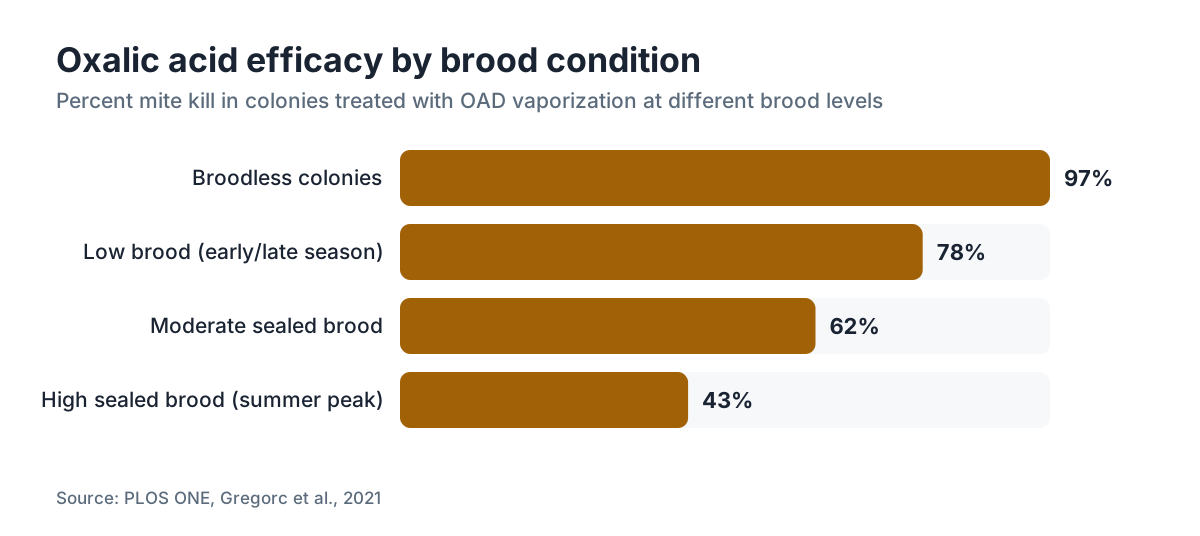
Timing decides everything with OAD. The window that matters most is a broodless or near-broodless period, because that's when nearly all the mites are phoretic (on bees, not in cells) and exposed to the treatment [3].
In temperate climates, that window usually opens in late fall or early winter, after the queen stops laying and the last brood hatches out. A single dribble or vaporization treatment during a broodless period can knock mite loads down by 90% or more in some studies [4]. That's the sweet spot.
With brood present, a single OAD treatment falls off hard, sometimes to 30-50% efficacy depending on brood area and mite distribution [4]. You can run multiple treatments several days apart to catch mites as they emerge from cells, but you're fighting the biology. Extended-release formulations (glycerin-soaked sponge strips, approved under some Api-Bioxal labels) try to fix this by keeping oxalic acid present over weeks instead of hours.
Spring works too if mite loads climb before the summer honey flow. Run an alcohol wash or sugar roll to confirm your count is above threshold. The Honey Bee Health Coalition's Varroa guide sets the action threshold at 2% during the season [3]. Don't treat on a hunch.
Summer treatment mid-flow is the hard case. You can't use treatments that require pulling supers if you have supers on. OAD leaves no honey residue concern at label rates, but read your specific label for restrictions. Never treat hives with supers on using products that aren't labeled for it.
What mite infestation level justifies treatment?
The Honey Bee Health Coalition's Varroa management guide, one of the most cited documents in US beekeeping, sets an economic threshold of 2 mites per 100 bees (2%) during the active season [3]. Above that, colonies face real risk of population collapse and rising virus loads, deformed wing virus in particular.
The threshold drops to roughly 1% or below during the fall buildup (about August through September in the northern US). Mites reproduce fast against long-lived winter bees, and a mite load that looks fine in summer can spiral before the cold sets in [3].
Alcohol wash is the gold standard for measuring mite load. Take a sample of about 300 bees from the brood nest (not the top of the hive), drop them in 70% isopropyl alcohol, shake for 60 seconds, and count mites in the wash. Divide mites by bees, multiply by 100, and you have your percentage. Sugar rolls are less accurate but non-lethal if you want the bees back. Sticky boards give you a drop rate that's hard to turn into a reliable action threshold [3].
Don't skip monitoring. Treating without a mite count is medicating without a diagnosis.
Does varroa develop resistance to oxalic acid?
This is one of the better questions in varroa management, and the honest answer is that resistance has not been documented in the field in the current literature. The kill mechanism (contact toxicity from a non-specific chemical stressor) is considered low-resistance-risk [1].
Varroa has shown alarming resistance to synthetic miticides. Tau-fluvalinate (Apistan) resistance is widespread worldwide, and coumaphos (CheckMite+) resistance shows up in multiple US populations [5]. Both hit specific receptor targets, which makes them easier for mites to evolve around.
Oxalic acid has no single clean receptor target, which is why resistance hasn't shown up the way it did with the synthetics. A 2021 review in PLOS ONE found no evidence of field-evolved resistance to organic acids (oxalic and formic) across multiple studies [1]. Reassuring, but not proof that resistance stays impossible over decades of selection pressure and heavy use.
Rotating treatment types is still smart. Use OAD during broodless periods, reach for formic acid (MAQS, Formic Pro) during brood-present periods when temperatures allow, and monitor after every treatment to confirm it worked.
How do you apply oxalic acid gel, and what safety precautions do you need?
Applying OAD gel (Norroa in Canada, or the glycerin sponge method with Api-Bioxal in the US) is simple: you set the gel between frames so bees contact it and spread it through grooming. Rates and frame intervals live on the product label, and you follow them exactly, because that's both the legal requirement and the tested efficacy protocol.
For dribble application of Api-Bioxal solution (the US method), you mix the powder with sugar syrup, then apply 5 mL per seam of bees, capped at 50 mL per colony. That limit exists because excess oxalic acid harms brood and adult bees [2].
Safety matters here. Oxalic acid is a mild organic acid, but it irritates mucous membranes, eyes, and respiratory tissue. The EPA label requires [2]:
- Chemical-resistant gloves
- Eye protection (goggles, more than glasses)
- For vaporizing: a NIOSH-approved respirator for acid vapors (more than a dust mask)
Never vaporize in a confined space without ventilation and respiratory protection. Oxalic acid vapor is not benign. Chronic low-level exposure is linked to kidney oxalate deposits in occupational settings.
Store oxalic acid products away from children, away from food, in a cool dry place. Mixed solution has a short shelf life (check the label). Unmixed powder keeps for years if you keep it dry.
What does oxalic acid treatment cost, and is it worth the investment?
Api-Bioxal runs roughly $25-35 for a 35-gram packet, which treats about 10 colonies at the dribble rate or up to 87 colonies at the vaporization rate, depending on method [6]. Generic EPA-registered OAD products often cost less per gram. VarroaVault's free protocol tools can calculate treatment quantities and track costs across a season without spreadsheet gymnastics.
If you're vaporizing, the vaporizer is the real upfront cost. Battery or propane units run from about $160 to over $300 depending on brand and build. Spread across many treatments over years, the per-colony cost drops to almost nothing.
Now price out a dead colony. A nucleus colony in 2024 ran $150-250 in most US markets, a package $150-200, a mated queen $30-50. One colony lost to varroa-driven virus load and winter collapse costs more than a full season of oxalic acid for your whole apiary.
Oxalic acid, timed right, is one of the most cost-effective varroa tools you can buy. Formic acid (MAQS pads) costs more per treatment and comes with temperature limits. Amitraz (Apivar strips) works well but carries resistance concerns and costs more. OAD during broodless periods is hard to beat on cost per efficacy for a hobbyist or sideliner. You can find treatment supplies through free shipping honey bee supply companies to cut per-item cost further.
How does oxalic acid treatment fit into a full-season varroa management plan?
No single treatment handles varroa year-round. A sound calendar layers several approaches across the season, timed to biology instead of convenience.
A workable structure for temperate climates (shift north or south for your region):
Late winter / early spring (Feb-March): Monitor mite loads as colonies start building. If you're above threshold, use any late broodless window for OAD before the queen ramps up laying.
Spring buildup (April-May): Monitor monthly. If counts pass 2%, your options depend on brood presence and honey supers. OAD extended-release or formic acid if temperatures allow. Formic acid runs roughly 50 to 85 degrees F for MAQS label compliance [7].
Summer (June-July): Monitor every 2-4 weeks. Avoid treatments during honey flow if you can. If mite load is over threshold, pull supers and treat. Amitraz strips (Apivar) get used here a lot because they work continuously over 6-8 weeks regardless of brood [8].
Late summer / fall (Aug-Sept): The most important window. Winter bees are being raised now. High mite loads in this stretch lead straight to weak winter bees and dead colonies. Treat aggressively if you're over threshold. Formic acid or OAD depending on method and conditions.
Winter broodless period (Nov-Jan in most of the northern US): A single OAD treatment, dribble or vaporization, to crush the leftover mite population before spring.
The Honey Bee Health Coalition's Varroa management guide has regional timing tables and downloads free [3]. Read it. It's the best single document on this topic in US beekeeping.
For managing several hives across a season, a tool like the one at VarroaVault can track mite counts, flag colonies over threshold, and log treatment dates so you never blow past a label-mandated treatment limit.
Are there hive conditions where you should not use oxalic acid?
Yes, a few. Read the label, because it spells these out.
Lots of open brood: OAD at label rates is not acutely toxic to adult bees, but it can harm larvae. Dribble applied to colonies with heavy open brood has shown brood mortality in some studies [9]. That doesn't mean you can never treat with any brood present. It means you shouldn't drench a colony mid spring explosion, packed with uncapped larvae. Vaporization during brood-present periods hits brood less than dribble does.
Weak or queenless colonies: Treating an already-stressed colony piles on more stress. A colony with fewer than 4 frames of bees is marginal for any chemical treatment. Ask yourself whether you should be combining it with a stronger colony instead.
Deep cold: Bees packed in a tight winter cluster don't move dribble solution around well between frames. Dribble falls off when bees can't move. Some beekeepers vaporize in cold weather and get good penetration into the cluster because the vapor moves on its own. Down to about 20-25 degrees F is workable for vaporization in many practitioners' experience, though the literature on lower temperature limits is thin.
Oxalic acid is not labeled for use inside honey supers meant for human consumption in the US (Api-Bioxal label). Remove supers before treating, or confirm your specific label allows treatment with supers on.
What other varroa treatments should you know about besides oxalic acid?
Oxalic acid is one tool. Here are the main alternatives and where each fits.
Formic acid (MAQS, Formic Pro): The edge over OAD is brood penetration. Formic acid vapor kills mites inside sealed brood cells to some extent, which makes it useful mid-season when brood is present. Efficacy in studies runs 60-90% depending on conditions [7]. Tight temperature requirements (roughly 50 to 85 degrees F) shrink its usable window. It can harm queens in some colony conditions. Not trivial to run.
Amitraz strips (Apivar, amitraz-based generics): Synthetic, highly effective across brood cycles, 6-8 week treatment period. Known efficacy 90%+ in well-managed conditions [8]. Resistance is documented in some populations but not as widespread as pyrethroid resistance. You leave strips in for the full labeled period. It has maximum residue limits (MRLs) for honey, so follow label timing to avoid harvest during treatment.
Thymol (Apiguard, ApiLifeVar): Essential-oil-based, temperature-dependent (best 60-80 degrees F), moderate efficacy. Used more in Europe than the US. Works best in warm conditions with capped brood present.
Synthetic pyrethroids (Apistan, CheckMite+): Resistance is common enough that these are no longer a first-line choice in most US apiaries [5]. If you haven't tested your local mite population's susceptibility, don't assume they'll work.
Mechanical methods (drone brood removal, brood breaks): Can cut mite populations without chemicals, but they need precise management and fall short alone against high loads.
For supplies, compare current pricing and availability across the registered options through beekeeping supply companies.
What does the research actually say about oxalic acid efficacy?
The data on OAD during broodless periods is solid. Multiple peer-reviewed studies and the University of Florida IFAS Extension report 90-97% efficacy in broodless colonies treated with oxalic acid dribble or vaporization [4].
Brood-present colonies are messier. A 2021 review in PLOS ONE measured OAD vaporization efficacy across colonies with different brood levels and found it ran from around 43% in colonies with high sealed brood to over 90% in colonies close to broodless [1]. Extended-release OAD formulations (gel or glycerin sponge) built to stay active over several weeks performed better with brood present in some trials, though the evidence base for these newer formulations is still thinner than for traditional dribble or vaporization.
The University of Minnesota Bee Lab and the Honey Bee Health Coalition's Varroa guide both recommend monitoring after treatment (7-10 days for vaporization, 10-14 days for dribble or extended-release) to confirm efficacy [3]. If mite loads don't drop below threshold, retreat or switch methods. A treatment that cuts mites 50% when you needed 90% is a failure dressed up as progress.
"Oxalic acid is highly effective against phoretic mites" is the Honey Bee Health Coalition's stated assessment in their Varroa guide, with the qualifier that brood presence sharply limits that effectiveness [3]. Keep that phrasing in your head before you reach for any OAD product mid-summer.
Frequently asked questions
Is Norroa the same as Api-Bioxal?
Both use oxalic acid dihydrate as the active ingredient at similar concentrations, so the chemistry is the same. They're different commercial products with different registrations: Api-Bioxal holds EPA registration for US use, while Norroa is registered in Canada. In Canada, Norroa is a pre-formulated gel that skips the mixing step Api-Bioxal powder requires. In the US, use Api-Bioxal or a registered generic. You get the same active ingredient.
Can I use Norroa in the US legally?
No. Norroa holds no EPA registration as of mid-2025. Using a pesticide on a beehive without EPA registration violates FIFRA, the federal pesticide law. US beekeepers have legal oxalic acid options including Api-Bioxal (EPA reg. 83923-1) and several approved generics. The practical difference between Norroa and Api-Bioxal is zero, because the active ingredient is identical. Don't import or use Norroa in the US.
Does oxalic acid work when brood is present in the hive?
It works, but much less effectively. Mites inside sealed brood cells are completely protected from OAD contact treatments. In colonies with high brood levels, a single OAD treatment may hit only 40-60% efficacy. During broodless periods, efficacy routinely tops 90%. If you must treat with brood present, consider formic acid (which penetrates brood cells to a degree) or extended-release OAD, and always monitor results afterward.
How many times can you treat a hive with oxalic acid per year?
The Api-Bioxal label limits the dribble method to one application per year, while the vaporization method label allows up to three treatments per year with a specific interval between applications. Check your specific product label, because this is a legal limit tied to EPA registration, not a loose guideline. Extended-release formulations carry their own labeled limits. Never exceed label rates or frequency.
What is the best time of year to treat with oxalic acid?
The broodless window in late fall or early winter is the most effective timing for a single OAD treatment. With no sealed brood to hide in, nearly all mites ride on adult bees and stay exposed. In many northern US climates, that window falls between November and January. Confirm broodlessness by inspecting or using an infrared camera before treating, rather than assuming based on the calendar.
Is oxalic acid safe for bees?
At label doses, oxalic acid is not acutely toxic to adult honey bees. It does have some negative effect on larvae, which is why the broodless window is preferred and why you shouldn't overdose. Bees treated with OAD during broodless periods show no meaningful mortality against untreated controls in well-designed studies. Overdosing or treating colonies with heavy open brood carries real risk of brood damage. Follow the label exactly.
Does varroa ever become resistant to oxalic acid?
Field-evolved resistance to oxalic acid has not been documented as of 2024-2025. The contact-kill mechanism lacks a single specific receptor target, which makes it inherently low-resistance-risk compared to synthetic miticides like fluvalinate or coumaphos, where resistance is widespread. That doesn't make resistance impossible, but it isn't a documented practical problem right now. Rotating treatment types is still sensible management.
What is the mite threshold that tells you to start treating?
The Honey Bee Health Coalition recommends treating at 2 mites per 100 bees (2%) during the active season, and closer to 1% during the fall buildup when winter bees are being raised. These thresholds come from research linking mite loads to winter colony survival. Always monitor with alcohol wash or sugar roll before treating. Never treat on a fixed calendar schedule without knowing your actual mite count.
Can you treat with oxalic acid when honey supers are on?
The Api-Bioxal label in the US does not permit treatment with honey supers in place that are meant for human consumption. Remove supers before treating. Some beekeepers leave supers on during winter treatment, arguing there's no nectar to contaminate, but following the label is the legally required approach. If supers are on during peak flow and mite loads are over threshold, pull them, treat, and wait the labeled interval before replacing them.
How do you measure mite load accurately before and after treatment?
Alcohol wash is the most accurate method. Take about 300 bees from the brood nest frames (not the top bars), drop them in 70% isopropyl alcohol in a jar, shake for 60 seconds, and pour through a mesh to count mites. Divide mites by bees and multiply by 100 for the percentage. Sugar rolls are non-lethal but less accurate. Sticky boards measure mite drop, which is hard to translate to a colony-wide percentage without conversion factors. Monitor 10-14 days after treatment to confirm efficacy.
Where can Canadian beekeepers buy Norroa?
Norroa is distributed through Canadian beekeeping supply retailers and some veterinary channels, depending on province. Vita Bee Health is the manufacturer, and their Canadian distributors are listed on their website. Canadian beekeepers should confirm the current registration status and label requirements in their province, since provincial regulations can add requirements beyond the federal registration. Always buy from a licensed retailer and keep the label with your treatment records.
What personal protective equipment is required when applying oxalic acid?
At minimum: chemical-resistant gloves and eye protection (goggles). For vaporization specifically, the EPA label requires a NIOSH-approved respirator for acid vapors, more than a dust mask. Oxalic acid vapor irritates the respiratory tract and mucous membranes. Work in well-ventilated outdoor spaces. Position the vaporizer so vapor moves away from you. Treat eye or skin contact with thorough water rinsing and contact a poison control center if exposure is significant.
Is Norroa organic or approved for certified organic beekeeping?
Oxalic acid is permitted in certified organic beekeeping in the US under National Organic Program rules, provided it is applied per label and from a registered source. Api-Bioxal is the US product with this status. Whether Norroa specifically qualifies under Canadian organic certification depends on the certifying body's approved input list. Check with your certifier before using any product on certified organic hives, because approval can vary by program.
How does Norroa or any OAD gel differ from vaporization (sublimation)?
Gel or dribble methods apply liquid OAD solution directly between frames, and bees spread it through contact and grooming. Vaporization heats OAD crystals until they become a vapor that fills the hive space and coats bees and surfaces. Vaporization reaches more of the hive volume, works in cold weather without disturbing the cluster, and penetrates better toward the cluster. Dribble is simpler and needs no vaporizer, but it's generally less effective at very cold temperatures and relies on bees to move the treatment themselves.
Sources
- PLOS ONE, Gregorc et al., 2021 - oxalic acid efficacy and resistance review: No field-evolved resistance to organic acids (oxalic and formic) documented; efficacy of OAD vaporization ranged from ~43% in high-brood colonies to over 90% in near-broodless colonies
- US EPA - Api-Bioxal pesticide registration and label (Reg. No. 83923-1): Api-Bioxal is the flagship EPA-registered oxalic acid dihydrate product for varroa in the US; requires gloves, eye protection, and NIOSH respirator for vaporization; 5 mL per bee seam, max 50 mL per colony for dribble
- Honey Bee Health Coalition - Varroa Management Guide (current edition): Treatment threshold is 2% during active season, ~1% in fall; 'oxalic acid is highly effective against phoretic mites'; monitoring recommended 10-14 days post-treatment
- University of Florida IFAS Extension - Honey Bee Varroa Mite Management: OAD efficacy in broodless colonies reported at 90-97%; single treatments during brood-present periods may achieve only 30-50% efficacy
- USDA AMS National Honey Report / peer-reviewed resistance literature - tau-fluvalinate and coumaphos resistance in Varroa: Tau-fluvalinate (Apistan) resistance is widespread globally; coumaphos (CheckMite+) resistance documented in multiple US Varroa populations
- University of Florida IFAS Extension - Honey Bee Varroa Mite Management (treatment coverage per package): A 35-gram Api-Bioxal packet treats approximately 10 colonies at the dribble rate or up to 87 colonies at the vaporization rate depending on method
- NOD Apiary Products / Montana Dept of Agriculture - MAQS (formic acid) label and efficacy data: Formic acid (MAQS) efficacy ranges 60-90% depending on conditions; labeled temperature range approximately 50-85°F; provides brood-cell penetration unlike OAD
- Veto-pharma - Apivar (amitraz) label and efficacy summary: Apivar amitraz strips achieve 90%+ efficacy over a 6-8 week treatment period regardless of brood presence
- Penn State Extension - Varroa Mite Management in Pennsylvania: OAD dribble in colonies with heavy open brood has shown brood mortality at label rates; broodless period preferred for dribble application
- University of Minnesota Bee Lab - Varroa monitoring and treatment recommendations: Post-treatment monitoring recommended at 7-10 days for vaporization, 10-14 days for dribble, to confirm efficacy and determine if retreatment is needed
- USDA National Organic Program - allowed and prohibited substances for organic livestock: Oxalic acid is permitted under National Organic Program rules for certified organic beekeeping when applied per label from a registered source
Last updated 2026-07-09