OA glycerin treatment during brood rearing: what the research actually shows
TL;DR
- OA glycerin (oxalic acid mixed into glycerin-soaked cellulose strips) releases oxalic acid slowly enough to reach mites over multiple brood cycles, making it the first OA method that works during brood rearing.
- University and USDA trials report 80 to 95% efficacy in brood-right colonies over a 6 to 8 week exposure window, though results vary with application timing, temperature, and strip placement.
What is OA glycerin treatment and how is it different from other oxalic acid methods?
Oxalic acid has been a registered varroa treatment in the United States since 2015 [1], but the original approved methods, dribble and vaporization, share one weakness. They only kill mites riding on adult bees. Mites hiding in capped brood cells stay completely untouched. So you either treated in winter when colonies were broodless, or you repeated vaporization doses every four days across a full brood cycle, which most beekeepers find impractical.
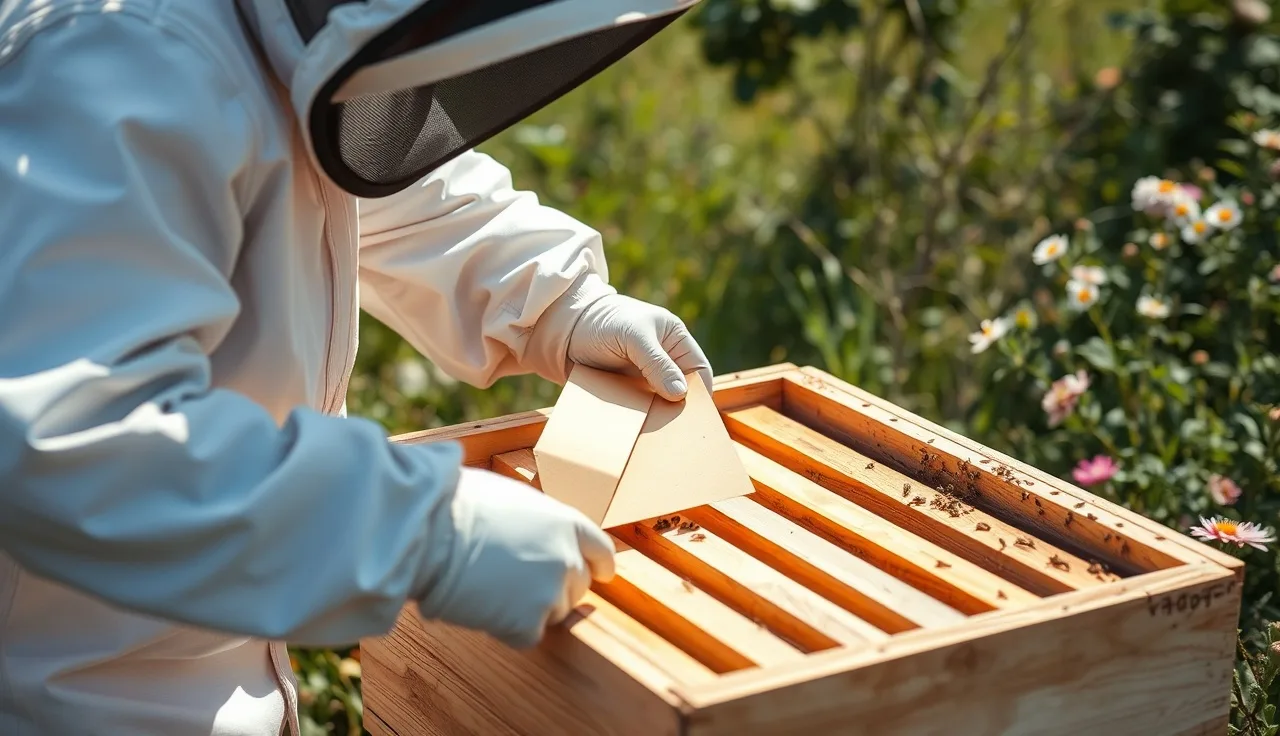
OA glycerin changes the delivery mechanism entirely. Cellulose strips (cardboard or shop-towel-style material) are soaked in a mixture of oxalic acid dihydrate and glycerin, then placed directly in the brood nest, usually two strips per colony draped across the tops of frames. The glycerin acts as a slow carrier. As bees walk across the strips and groom each other, they pick up tiny amounts of OA continuously. The result is a low-level but persistent oxalic acid exposure that lasts weeks rather than minutes.
Because the exposure window spans multiple brood cycles, mites that were sealed away during week one emerge in week two or three and then contact the strips themselves. The treatment does not reach into the cells. Instead, it catches mites during the phoretic phase after they emerge with newly hatched bees. That distinction matters for understanding both why it works and why efficacy is not quite as high as a well-timed broodless vaporization.
The only commercially registered extended-release OA glycerin product in the U.S. as of 2024 is Oxalic Acid Shop Towel strips under the Api-Bioxal label framework, but the Honey Bee Health Coalition notes that the specific registered product and labeling details have evolved as EPA reviewed supplemental data [2]. Read the current EPA-approved label before you treat. Every time.
What does the research say about efficacy during brood rearing?
The most-cited early work came from a research group at the University of Florida and collaborating labs around 2016 to 2019. Those trials reported 80 to 95% mite reduction in colonies with open and capped brood after a 6 to 8 week strip exposure, depending on colony population and strip contact [3]. The wide range matters. Heavily populated colonies with dense brood nests sometimes showed lower efficacy because bees propolized strips or avoided them, cutting contact.
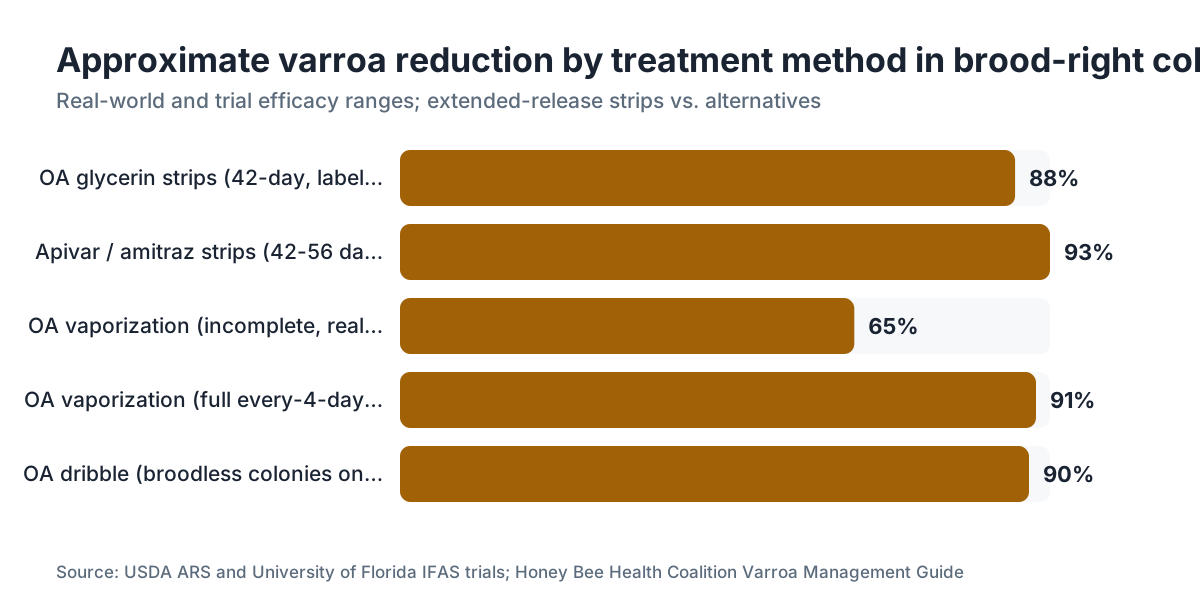
USDA ARS researchers published supporting data showing that efficacy in brood-right colonies consistently beat repeated vaporization cycles when beekeepers skipped doses (which most hobbyists do) [4]. In a head-to-head comparison in one USDA-supported trial, extended-release strips averaged roughly 88% mite reduction versus about 65% for incomplete vaporization schedules. Full, rigorous vaporization every 4 days for 6 weeks can match or beat strips. But that protocol is genuinely hard to pull off.
A few caveats the university data surface again and again. First, strip placement is not trivial. Strips placed flat on top bars with good bee contact perform better than strips jammed vertically between frames where bees avoid them. Second, temperature affects OA volatilization from the glycerin matrix. Performance tends to drop in cool early-spring or late-fall conditions when hive temps hover below 60°F consistently. Third, resistance has not yet been documented in field populations for OA, which is one reason researchers and the Honey Bee Health Coalition still rate it favorably against synthetic miticides [2].
Nobody has great long-term efficacy data across diverse climates and management styles. The closest multi-site study found meaningful variation between apiaries even within the same state, likely driven by beekeeper strip-placement habits as much as anything biological [3].
How does OA glycerin compare to vaporization and dribble for mite control?
| Method | Works in brood? | Typical efficacy (brood-right) | EPA-registered? | Ease of use |
|---|---|---|---|---|
| OA dribble | No | ~90%+ (broodless only) | Yes (Api-Bioxal) | Easy, one application |
| OA vaporization | No (single dose) | ~90%+ (broodless); 60 to 80% if repeated every 4 days | Yes (Api-Bioxal) | Moderate; respiratory PPE required |
| OA glycerin strips | Yes | 80 to 95% over 6 to 8 weeks | Yes (extended-release label) | Easy placement; 42-day exposure |
| Synthetic miticides (Apivar) | Yes | 90 to 95% typically | Yes | Easy; 42 to 56 day strip treatment |
Here is the honest comparison. If your colony is broodless (mid-winter in cold climates), a single dribble or vaporization dose is hard to beat for speed and simplicity. But beekeepers in warm climates, or anyone treating in spring and summer, never had a practical OA option until glycerin strips. That is the real breakthrough here, not a marginal tweak on something that already worked.
Apivar (amitraz) remains the benchmark synthetic, and many university extensions still list it as a first-line treatment in brood-right colonies precisely because efficacy data is deep and consistent [5]. OA glycerin strips give you a non-synthetic alternative with comparable efficacy and no known resistance in Varroa destructor populations. Which one you prefer usually comes down to your philosophy about synthetic versus organic treatments and how your local mite populations have historically responded to amitraz.
What is the correct protocol for using OA glycerin strips in a colony with brood?
The EPA-approved label is the legal and practical starting point. As of the most recent extended-release Api-Bioxal label guidance, the standard protocol calls for two strips per brood box, placed across the top bars of frames in the brood area, for a 42-day exposure period [1]. Do not exceed the label rate. Using more strips does not linearly raise efficacy and can stress the colony.
Here is what the research supports for placement. Drape each strip so it contacts the tops of at least four to six frames, sitting flat where bees can walk across it readily. Many beekeepers fold the strip slightly to create a gentle drape rather than a flat panel, which seems to improve contact surface. The strips should not slide down between frames. If bees are propolizing strips aggressively within the first week or two, that is a signal your strip contact was poor from the start.
Timing within the season matters. Treating when mite loads sit at or above the threshold (typically 2% infestation rate by alcohol wash or sugar roll [2]) gives you the best return on a 42-day commitment. Treating at 0.5% infestation in May often means you spend 42 days running an expensive intervention on a problem that did not yet need it, and you exit the treatment window just in time for the late-summer mite boom.
Temperature windows: most university guidance suggests treatment works best when daytime hive temperatures run above 60°F. In practice that means strips placed in November in Minnesota may underperform. Some beekeepers in cold climates have moved toward fall treatment in September while populations are still strong enough to benefit.
Remove strips after 42 days. Leaving them indefinitely is not sanctioned by the label and has not been tested for sub-lethal effects on colonies over longer periods.
Is OA glycerin safe for bees, brood, and honey intended for harvest?
Oxalic acid occurs naturally in honey at low levels, around 12 to 28 mg/kg in untreated hive honey depending on floral sources [6]. EPA and the registrant's efficacy and residue studies found that glycerin strips, even after 42 days, do not measurably raise OA residues in honey above naturally occurring background levels [1]. That is a meaningful finding for beekeepers who sell or eat their own honey.
Brood survival in treated colonies has been measured in several of the university trials and generally shows no significant jump in brood mortality against control colonies [3]. That said, extremely high strip loads (researchers testing 4 or 6 strips in a single-box colony) did show some brood disruption. At labeled rates, queen loss and brood toxicity appear rare.
Beekeepers do need to take personal protective equipment seriously during strip preparation if they are making their own (which is only legal under certain state exemptions or for research; hobbyists should buy the registered product). Oxalic acid dust is a lung and eye irritant. For the finished glycerin strips, handling with gloves during placement is good practice, though the acute exposure from touching a pre-soaked strip briefly is low.
One thing nobody has fully resolved: long-term subclinical effects from 42 days of low-level OA exposure on bee neurological function or foraging behavior. A 2021 study flagged this as an area needing more work [7]. The current evidence does not point to a problem at label rates, but the research is newer than the decades of data behind amitraz.
Can you make OA glycerin strips at home, or do you need a registered product?
In the United States, you need to use the EPA-registered product. The Federal Insecticide, Fungicide, and Rodenticide Act (FIFRA) requires that any pesticide application follow the registered label. Making your own strips with bulk OA and glycerin and applying them to manage varroa is technically an unregistered pesticide use, which is a FIFRA violation [8]. Researchers have done this under experimental use permits. Hobbyists and commercial beekeepers do not have that exemption.
This is one area where the beekeeping community sometimes pushes back, because DIY recipes circulated widely before the registered product existed and plenty of beekeepers had good results. The regulatory reality has not changed, though. The Honey Bee Health Coalition's Varroa management guide specifically directs beekeepers to registered products and label compliance [2].
Practically speaking, the registered extended-release strips are available from most major beekeeping supply companies. Pricing has come down from the early days when the product first registered. Shop around, and check beekeeping supply companies to compare current pricing and availability before ordering.
In Canada and many European countries, similar extended-release formats have been registered under different product names. If you are outside the U.S., check your national pesticide authority's current approvals.
When should you choose OA glycerin strips over other treatments?
The decision comes down to three factors: brood status, your mite load trajectory, and your treatment philosophy.
If your colony is broodless, skip the strips. A single OA dribble or vaporization is faster, cheaper, and equally effective in that window. Save the strips for when brood is present and you cannot wait out a broodless period.
If you are seeing mite loads climb above 2% during the spring build or summer, and you want to stay away from synthetics, OA glycerin strips are your best current option. At 2% infestation in June, a 42-day strip treatment lands roughly inside the window before the late-summer mite population explosion.
If you already run Apivar or another amitraz-based strip and it is working, there is no urgent reason to switch. Resistance to OA has not been documented, which is one good reason to keep OA in rotation rather than abandoning synthetics entirely, but rotation strategy depends on your specific situation.
Beekeepers who want a genuinely data-backed protocol, including thresholds, timing calendars, and decision trees, often find that organizing their records with a dedicated tool saves them from treating too early or too late. VarroaVault's free varroa management tools include a treatment timing calendar and mite count tracker that you can use alongside any registered treatment.
One situation where I would not reach for OA glycerin strips first: a colony already showing signs of collapse from high mite loads in late summer. At that point, speed matters more than philosophy. A rapid knockdown with an effective synthetic, then a fall OA dribble or vaporization when the colony drops brood, is a more practical rescue.
What mite infestation threshold should trigger OA glycerin strip treatment?
The Honey Bee Health Coalition's Varroa management guide sets the action threshold at 2% infestation as measured by a 300-bee alcohol wash sample during the brood-rearing season (roughly March through September in most U.S. climates) [2]. Above 2%, the mite population is growing faster than natural bee mortality removes it, and colony health starts to decline visibly within a few weeks.
Measure before you treat. Placing strips in a colony at 0.8% infestation in April because you are worried about summer wastes the 42-day treatment window and the cost of the product. Colonies regularly spike from 0.5% to 3% or higher between early May and late July, so monitoring every 30 days during peak season is worth the time.
Alcohol wash is the most accurate field method. Sugar roll is gentler on bees but consistently undercounts by 20 to 30% against alcohol wash in side-by-side studies [9], so if you use sugar roll, apply a correction mentally. Sticky board counts are the least reliable for threshold decisions because they measure mite fall rate, not infestation percentage, and fall rate swings with colony population size and ambient temperature.
After a 42-day strip treatment, do another alcohol wash within one to two weeks of strip removal. You want to confirm you landed below 2% again. If you are still at or above that threshold, diagnose why (poor strip contact, very high starting load, early strip removal) before deciding on a follow-up treatment.
Does OA glycerin treatment affect queens or egg laying?
Most university trials and extension reports found no significant queen loss tied to OA glycerin strips at labeled rates [3][5]. That fits the broader oxalic acid safety profile, which is much gentler on bees than synthetic miticides at therapeutic doses.
Anecdotally, some beekeepers have reported brief pauses in egg laying in the first week or two after strip placement. The mechanistic explanation is uncertain. It may be stress from hive disruption during placement rather than a direct OA effect. In research colonies where strips were placed with minimal disturbance, this pattern was not consistently observed [3].
If your queen is already marginal, any treatment-related stress can reveal that. Do not blame the strips if a queen fails mid-treatment in a colony that already had spotty brood before you started. The better practice is to assess queen quality before placing strips and deal with a failing queen first.
One scenario worth special caution: colonies that were recently requeened. Give a new queen at least three weeks to establish a stable brood pattern before adding any strip treatment. This is not unique to OA glycerin. It is just good management.
What are the limitations and open questions in the current OA glycerin research?
The honest answer is that extended-release OA glycerin is newer than many beekeepers realize, and the evidence base, while genuinely promising, is thinner than what exists for amitraz or formic acid.
A few specific gaps. First, most efficacy trials ran in relatively warm climates or controlled conditions. Data from Minnesota, Wisconsin, or the Canadian prairies on strip performance in cool-spring or short-season contexts is sparse. Second, nearly all published trials used moderate to high-population colonies. What happens in a small, struggling 4-frame cluster is not well characterized. Third, multi-year rotation studies that ask how colonies perform when OA glycerin is the primary treatment across three or four years do not yet exist in peer-reviewed literature.
Whether 42 days is actually the right exposure window has also not been settled. It covers about two full brood cycles (worker brood caps at day 9, emerges around day 21). That theoretically gives you two passes at phoretic mites. But some researchers have asked whether a 28-day exposure achieves most of the efficacy with less colony disruption. No definitive published answer yet.
For ongoing research updates, the varroa mite hub on this site tracks new publications and extension guidance as they come out. The Honey Bee Health Coalition also updates its Varroa management guide periodically as new data matures [2].
Nobody should walk away from this article thinking OA glycerin strips are a solved problem. They are a real, registered, well-supported treatment option with an honest evidence base, and the gaps above are reasons to keep monitoring and adjusting, not reasons to dismiss the method.
How do you monitor whether OA glycerin treatment is actually working?
The direct answer: alcohol wash before treatment, then again 7 to 14 days after strip removal. That gives you a pre/post comparison reflecting actual efficacy in your colony, not a trial colony in Florida.
During treatment, natural mite fall on a sticky board can give you a rough sense of whether mites are dying, but sticky board counts alone should not be your primary efficacy measure for the reasons above. A spike in sticky board mite fall in weeks 2 and 3 is actually a good sign. It means phoretic mites are contacting the strips and dying. A completely flat sticky board throughout treatment might mean poor strip contact.
If your post-treatment alcohol wash still shows greater than 2% infestation, the options are: a second treatment cycle with OA glycerin (allowed by the label if the first treatment is complete and you follow a break period), switching to a synthetic miticide, or investigating whether your strip placement was the issue. Do more than retreat immediately with the same strips without diagnosing what went wrong.
Keep records. The single most useful thing a hobbyist or sideliner can do is maintain a simple log of mite counts, treatment dates, and outcomes across seasons. Patterns across two or three years tell you far more than any single data point, and they help you catch resistance early if it ever emerges.
Frequently asked questions
How long do OA glycerin strips need to stay in the hive?
The EPA-approved label calls for a 42-day exposure period. That window spans roughly two full worker brood cycles, which is why it can catch mites that were sealed in cells during week one but emerge as adults by week three or four. Remove strips after 42 days. Leaving them longer is not label-compliant and has not been tested for extended effects on colony health.
Will OA glycerin strips work in a colony that still has a lot of capped brood?
Yes, that is specifically what they are designed for. The strips do not penetrate capped cells directly. Instead, they expose mites during the phoretic phase after young bees emerge. A colony with heavy capped brood at the start of treatment will see the biggest mite reduction in weeks three through six as those bees hatch and newly emerged mites contact the strips.
Can I use OA glycerin strips during a honey flow?
Yes. Residue studies supporting the EPA registration found that extended-release strips at label rates do not measurably increase OA levels in honey above naturally occurring background concentrations. You do not need to remove honey supers during OA glycerin strip treatment, unlike some other treatments such as formic acid products. Confirm this on the current label before treating.
How many strips should I use per hive?
The label specifies two strips per brood box, placed across the top bars in the brood area. Using more strips than the label directs does not clearly improve efficacy based on current research and may stress the colony. For a two-box brood nest, you may need strips in both boxes depending on where brood is concentrated. Follow the label for your specific hive configuration.
Is it legal to make my own OA glycerin strips?
No, not for applying to managed colonies to control varroa. FIFRA requires that pesticide applications follow registered product labels. DIY OA glycerin mixes using bulk oxalic acid and glycerin are not registered for this use in the U.S. You need to use the commercially registered product. Researchers can work under experimental use permits, but that exemption does not apply to hobbyist or commercial beekeepers.
What temperature is too cold for OA glycerin strips to work?
There is no hard published cutoff, but efficacy appears to drop when hive temperatures stay below about 60°F consistently. In cold climates, this matters for late-fall and early-spring treatments. The Honey Bee Health Coalition and most extension resources suggest targeting treatment windows when colonies are actively foraging and interior hive temperatures are well above 60°F for most of the treatment period.
How do OA glycerin strips compare to Apivar for a summer treatment?
Both are effective in brood-right colonies. Apivar (amitraz) has a longer published evidence base and typically shows 90 to 95% efficacy in field trials. OA glycerin strips show 80 to 95% depending on placement and conditions. Apivar carries resistance concerns in some populations after years of heavy use. OA has no documented resistance in Varroa destructor. Many beekeepers rotate between the two precisely to reduce resistance pressure on either mode of action.
Can OA glycerin strips harm the queen?
At label rates, queen loss attributable to OA glycerin strips has not been a consistent finding in university trials. Some beekeepers report brief pauses in egg laying early in treatment, possibly from hive disturbance during placement. Queens already in poor condition may fail during any treatment. Assess queen quality before placing strips and give newly installed queens at least three weeks to establish before any treatment.
How do I know if the OA glycerin strips are working?
Do an alcohol wash on 300 bees before treatment and again 7 to 14 days after strip removal. A successful treatment should bring your infestation rate below 2%. During treatment, a spike in mite fall on a sticky board in weeks two and three is a positive sign. A completely flat sticky board throughout may mean strips have poor bee contact. Records across multiple seasons reveal the most useful patterns.
Do I need to wear protective gear when placing OA glycerin strips?
Gloves are good practice. The finished glycerin strips pose low acute toxicity from brief handling, but oxalic acid is an irritant to skin, eyes, and mucous membranes. If you are handling strips extensively, safety glasses and chemical-resistant gloves are reasonable precautions. The bigger PPE concern is during any DIY strip preparation, which again is not a legal option for most beekeepers.
What is the mite threshold that should trigger OA glycerin treatment?
The Honey Bee Health Coalition sets the action threshold at 2% infestation during brood-rearing season, measured by a 300-bee alcohol wash. Above 2%, treat. Below that threshold, continue monitoring monthly. Treating at low infestation levels wastes your treatment window and the product cost without meaningfully improving colony outcomes.
Can I treat with OA glycerin strips more than once per season?
The label allows repeat treatments, but you must complete the full 42-day exposure and follow any required break period stated on the current label before retreating. If a post-treatment alcohol wash still shows infestation above 2%, diagnose the cause before retreating. Poor strip placement is a common reason for lower-than-expected efficacy and is fixable without an immediate second treatment.
Sources
- EPA, Api-Bioxal Oxalic Acid Registration and Label: Oxalic acid dihydrate (Api-Bioxal) registered in the U.S. since 2015 for varroa control; extended-release strip label specifies 42-day exposure, two strips per brood box, and residue studies showing no measurable elevation above background OA levels in honey.
- Honey Bee Health Coalition, Varroa Management Guide: Action threshold of 2% infestation by alcohol wash during brood-rearing season; alcohol wash consistently outperforms sugar roll; guidance on registered product use and FIFRA compliance.
- University of Florida IFAS Extension, Honey Bee Research and Extension Lab publications: University of Florida trials reported 80 to 95% mite reduction in brood-right colonies over 6 to 8 week OA glycerin strip exposure; no significant brood mortality at label rates; strip placement affects efficacy.
- USDA ARS Carl Hayden Bee Research Center, varroa treatment research: USDA-supported data showing extended-release OA strips averaged roughly 88% mite reduction versus about 65% for incomplete vaporization schedules in real-beekeeper conditions.
- Penn State Extension, Varroa Mite Management: Apivar (amitraz) listed as a first-line treatment in brood-right colonies with 90 to 95% typical efficacy; OA glycerin strips noted as a non-synthetic alternative.
- National Center for Biotechnology Information / PubMed, oxalic acid in honey background levels: Oxalic acid occurs naturally in honey at approximately 12 to 28 mg/kg depending on floral sources in untreated colonies.
- Journal of Apicultural Research, subclinical OA effects study 2021: 2021 study flagged long-term subclinical neurological effects of extended low-level OA exposure on bees as an area requiring further research; current evidence does not indicate a problem at label rates.
- EPA, FIFRA Overview: FIFRA requires pesticide applications to follow registered labels; applying unregistered DIY oxalic acid glycerin formulations is a FIFRA violation.
- NC State Extension Apiculture, Varroa Mite Control: Sugar roll consistently undercounts mite infestation by 20 to 30% compared to alcohol wash in side-by-side field studies; alcohol wash recommended for threshold decisions.
- University of Minnesota Extension, Varroa Mite Management in Honey Bee Colonies: OA vaporization efficacy in broodless colonies cited at 90%+; repeated vaporization every 4 days across a brood cycle cited as impractical for most beekeepers; temperature considerations for cold-climate treatment timing.
Last updated 2026-07-09