Off-label varroa treatments: risks, legality, and what's actually at stake

TL;DR
- Applying any pesticide to a beehive in a way that contradicts its EPA-approved label is a federal violation under FIFRA, no matter how common the practice is.
- Off-label varroa treatments can kill queens, leave illegal residues in honey, void your insurance, and cost you fines.
- A legal, registered option exists for nearly every situation that tempts beekeepers to go off-label.
What does 'off-label' actually mean for varroa treatments?
'Off-label' means using a registered pesticide in any way the EPA-approved label doesn't specify: wrong dose, wrong timing, wrong application method, wrong colony type, or treating during a honey flow when the label says not to. The label is not a suggestion. Under the Federal Insecticide, Fungicide, and Rodenticide Act (FIFRA), 7 U.S.C. § 136j(a)(2)(G), it is a federal violation to use any pesticide "in a manner inconsistent with its labeling" [1]. That binds every beekeeper in the United States, hobbyist or commercial.
The distinction bites harder in beekeeping than almost anywhere else in agriculture. You're treating inside a food-producing system. Honey, wax, and pollen soak up treatment chemicals. The EPA label sets the doses and timing that keep residues below the tolerances the agency has established for human safety. Step outside those limits and you're doing more than breaking a rule. You may be producing adulterated food under the Federal Food, Drug, and Cosmetic Act too [2].
Here are the off-label moves beekeepers make most: oxalic acid vaporization when brood is present (early Api-Bioxal labels prohibited it), Apivar strips at double the recommended dose, MAQS (formic acid pads) run at ambient temperatures above 85°F, oxalic acid dribble more than once per broodless period, and homemade miticides mixed from essential oils or other compounds with no EPA registration at all. Each one carries its own risk. Each is covered below.
Which federal law actually prohibits off-label pesticide use?
FIFRA is the statute that governs this [1]. Section 12(a)(2)(G) makes it unlawful for any person to "use any registered pesticide in a manner inconsistent with its labeling." The EPA enforces at the federal level. State lead agencies, usually departments of agriculture, enforce at the state level. Most of the day-to-day work is state-level, done by inspectors who can show up at an apiary, check your treatment records, and test your honey.
The penalties are real. Under FIFRA Section 14, a private individual can face civil penalties up to $1,000 per violation per day, and criminal penalties for knowing violations can reach $25,000 and up to one year in prison [1]. Few hobbyists have ever been prosecuted. The statute still doesn't excuse you because your operation is small. State penalties vary, and some states run stricter than the federal floor.
One carve-out is worth knowing. The EPA's label interpretation policy allows "any dilution or mixture of a pesticide with water or another substance in accordance with label directions" [3]. That does not mean you can dilute differently than the label says. It means that when the label tells you to dilute, doing so correctly is fine. Narrow exemption, not a loophole.
The Honey Bee Health Coalition's Varroa management guide tells beekeepers plainly to read and follow labels, noting that label compliance protects both the bees and the beekeeper's legal standing [4]. They're not being cautious for nothing.
What are the real risks of using varroa treatments off-label?
The risks fall into three buckets: biological, legal, and economic. They tend to arrive together.
Biological risks
Queen loss is the most common immediate harm. Formic acid (MAQS/Formic Pro) is temperature-sensitive for good reason. A study by Underwood and Currie in the Journal of Apicultural Research found that queen and brood mortality with formic acid rose sharply as application temperatures climbed past recommended thresholds [5]. Run MAQS on a hot day because you're anxious about mites and you can lose the queen, leaving a mite-loaded colony that's also now a laying-worker mess.
Amitraz (Apivar) at double dose does kill mites faster in the short term. It also speeds resistance and leaves higher amitraz residues in wax. A 2021 PLOS ONE study found amitraz and its metabolite DMPF in over 90% of U.S. beeswax samples tested, with concentrations that track treatment intensity [6]. Wax residues don't clear. They stack up across years of foundation reuse.
Homemade treatments, especially essential oils at unvalidated concentrations, cause direct brood toxicity, adult bee die-off, and queen failure. Thymol works at the concentrations in Apiguard and ApiLife Var because those formulations were tested for both efficacy and safety. A hand-mixed thymol solution has no validated dose-response curve behind it.
Legal and economic risks
Sell honey, have an inspector test it, find residues outside tolerance, and your crop can be condemned and destroyed. You could face fines. Your state apiary registration could be pulled. Beekeeping liability insurance, where it exists at all, usually excludes losses from illegal pesticide use. So if your off-label treatment drifts to a neighbor's hive or contaminates a shared water source, you carry that with no coverage.
For sideline operations selling to local stores, grocers, or farmers markets, one failed residue test can end the buyer relationship for good.
Is using oxalic acid outside the label a common mistake?
Yes, and it's one of the most misunderstood situations in hobby beekeeping. Oxalic acid (OA) is effective, gentle on bees at label doses, and leaves minimal honey residue. But the label carries specific limits, and plenty of beekeepers don't know all of them [7].
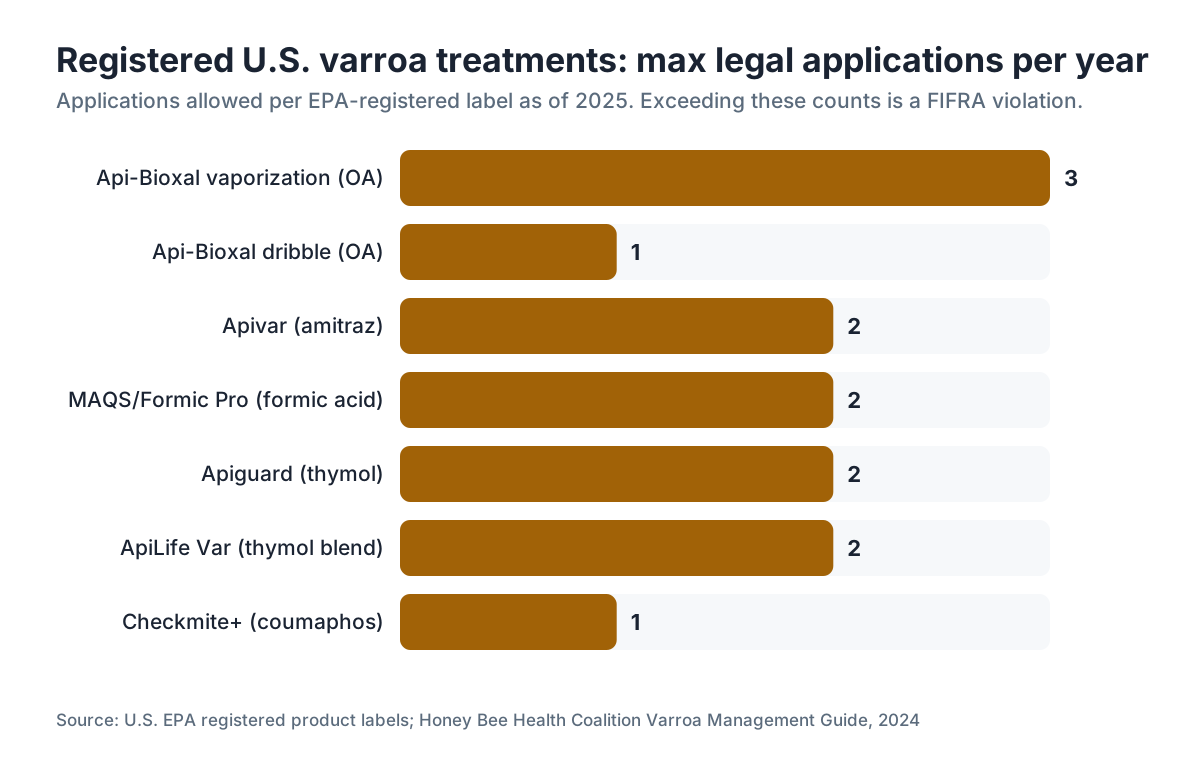
The Api-Bioxal label (the only EPA-registered OA product in the U.S. as of this writing) sets: one treatment per year for the dribble/trickle method, a maximum of three treatments per year for vaporization, specific per-colony dose rates, and restrictions around honey supers. The label has changed over the years. What was off-label in 2015 (vaporization with brood present) has since been added to the label in amended form. That's the right way to expand a practice: through an EPA label amendment, not through informal community consensus that "everyone does it" [7].
Vaporizing OA more than three times a season, dosing above the label rate, or treating with honey supers in place is still off-label and still a FIFRA violation. The fact that oxalic acid occurs naturally in honey doesn't erase the requirement to follow the label [7].
To keep your treatment calendar inside label limits, a tracker like the one at VarroaVault helps you log application dates so you don't blow past the per-season maximum by accident.
The varroa mite life cycle matters here too. Knowing when brood is present versus when a colony goes broodless changes which treatments are both legal and effective.
What are the risks of homemade varroa treatments with no EPA registration?
Homemade treatments, meaning any substance you put in a colony that isn't an EPA-registered product applied per its label, are unregistered pesticide use. FIFRA prohibits both distributing and using unregistered pesticides. For a single hobbyist the enforcement risk is low, but the biological risk is high and the legal exposure gets real fast if anything goes wrong.
The usual improvisations: raw thymol crystals (not the same as Apiguard or ApiLife Var), wintergreen oil, assorted plant extracts, and household-grade oxalic acid (not Api-Bioxal, which is pharmaceutical grade). None of these carry EPA-reviewed efficacy or safety data for beehive use.
Raw thymol is the clearest example of why this matters. Concentration and vapor pressure are hard to control by hand. At high concentrations, thymol is directly toxic to adult bees and brood. The commercial formulations meter the release rate through a gel or an absorbent matrix. Dumping crystals in a hive skips that control entirely.
Organic beekeepers sometimes assume "natural" compounds are exempt from FIFRA. They're not. The EPA registers organic-compatible pesticides (oxalic acid, formic acid, thymol products) through the same process as synthetic ones. A non-registered natural substance in a hive is still an unregistered pesticide application [3].
Nobody has good large-sample data on how often improvised treatments cause colony loss because of the treatment rather than despite it. The closest evidence comes from extension surveys comparing treatment outcomes, and they consistently show higher queen loss and brood damage in colonies where application methods weren't standardized [8].
How do varroa treatment residues in honey and wax create food safety problems?
Honey is food. Wax goes into cosmetics, candles, and food-grade coatings. Both absorb lipophilic compounds, and most varroa miticides are lipophilic to some degree.
The EPA sets maximum residue limits (tolerances) for pesticides in food commodities. For honey, current tolerances include 200 ppb for amitraz and its metabolites (set under 40 CFR Part 180) and an exemption from tolerance for oxalic acid at the concentrations Api-Bioxal use produces [7]. Coumaphos (Checkmite+) carries a 100 ppb tolerance in honey. These numbers exist precisely because off-label doses can push residues past what the tolerance allows.
A 2017 study in Scientific Reports analyzed 259 honey samples from around the world and found at least one pesticide in 75% of them, with neonicotinoids leading in field-exposed honey [9]. Looking at apiary treatments specifically, amitraz metabolites and coumaphos showed up at higher concentrations in honey from operations carrying heavier treatment loads. The study didn't pin causation on off-label use, but the link between treatment intensity and residue level lines up with other literature.
Wax is the longer problem. Beeswax collects lipophilic compounds over years of reuse. One off-label treatment with elevated amitraz can leave wax contaminated enough to hurt brood development in later seasons, even if you never touch amitraz again. The 2021 PLOS ONE study [6] found some commercial wax samples with amitraz-family residues above levels tied to sublethal larval effects.
Sell honey commercially and you're on the hook for making sure it meets tolerance limits. Not knowing your own treatment history isn't a defense under FDA food safety rules.
Buying equipment from beekeeping supply companies? Ask suppliers whether their commercial foundation wax has been tested for residues, especially if you run an operation where residue control matters.
Does the law treat certified organic beekeeping differently?
Organic certification under the USDA National Organic Program (NOP) restricts which substances you can use in a certified organic apiary [10]. But NOP rules don't replace FIFRA. You still must use only EPA-registered products per their labels. As an organic beekeeper you're just further limited to the National Organic Program's approved materials list.
Oxalic acid (as Api-Bioxal) and formic acid (as MAQS or Formic Pro) are both allowed for certified organic use when applied per their labels. Amitraz and coumaphos are not. That's the NOP restriction sitting on top of the FIFRA label requirement.
Some certified organic beekeepers believe that because they avoid synthetic chemicals, their practices are automatically safer and more compliant. Not always true. Applying formic acid at too high a dose is still an off-label violation in an organic operation. Using non-registered essential oil preparations is still unregistered pesticide use, even when the compounds started out organic-compatible.
The USDA Agricultural Marketing Service (AMS) oversees NOP compliance, and certification bodies audit treatment records. If your certifier finds prohibited substance use, you lose certification. If an EPA inspector finds a label violation, you face FIFRA penalties. Two independent enforcement paths that can run at the same time [10].
When are beekeepers most tempted to go off-label, and what should they do instead?
Four situations drive most off-label decisions.
1. Mite counts are high and brood is present, but the only legal option feels weak. Oxalic acid vaporization during a brood cycle underperforms because mites under cappings are shielded. The label-compliant answer is Apivar (amitraz strips), MAQS/Formic Pro (which can reach under cappings to some degree), or Apiguard (thymol) if temperatures allow, all per their labels. Caging the queen for a 21-day brood break, then vaporizing OA legally once the cycle clears, is also highly effective and fully compliant.
2. It's late fall and you realize you undertreated. The temptation is an extra OA dose. For vaporization the label allows up to three treatments per year, spaced per label instructions. Count where you are before you assume you're out of options. Dribble is one treatment per broodless period, full stop.
3. You found a treatment in a forum post or YouTube video that's cheaper or supposedly better. This is where most homemade treatment use starts. The Honey Bee Health Coalition's Varroa guide [4] is the best free reference for what's actually registered and effective. It gets updated regularly and includes efficacy data by treatment type.
4. A commercial operation wants to treat faster than the label allows. Pressure to turn hives over fast leads to early super placement after treatment or shortened treatment windows. Neither is compliant. The cost of a condemned honey crop dwarfs the short-term efficiency gain.
The free protocol tools at VarroaVault help you map a season's treatment calendar before you're in a crisis. That's the surest way to kill the urge to improvise.
What does resistance have to do with off-label use?
Resistance is the long-game risk that gets ignored in most off-label conversations. Using miticides at sub-label doses, treating for shorter periods than the label specifies, or rotating treatments wrong all speed up resistance in local mite populations.
Amitraz resistance in Varroa destructor is documented in the United States. A 2019 PLOS ONE study detected amitraz-resistant mite alleles in apiaries in Florida, Texas, and California [11]. The mechanism involves mutations in the mite's octopamine receptor, the target amitraz acts on. Sub-lethal exposure, which happens when strips come out before the label's minimum period or when the dose is too low, is a textbook driver of resistance selection.
The same holds for coumaphos. Coumaphos-resistant Varroa has turned up in Europe and the United States. The label sets treatment duration for a reason. It's calibrated to hit kill rates high enough that resistant survivors stay rare enough to avoid dominating the next mite generation.
This is why the broader beekeeping community has a stake in each individual's label compliance. A resistant mite population spreads through drone drift, swarms, and robbing. Your off-label treatment in year one can feed a regional resistance problem that costs other beekeepers their colonies three years later.
The Honey Bee Health Coalition recommends rotating treatment classes (pyrethroids, organic acids, and thymol) as the main resistance strategy, and that only works if each class gets used correctly per label [4].
How do state apiary inspectors and regulators actually enforce this?
Most beekeepers never meet an inspector. But the enforcement pathway is there and it has been used.
State departments of agriculture run apiary inspection programs, and most states require hive registration. Inspectors can examine hives, request treatment records, and collect honey and wax samples for residue testing. In states with active programs (California, Florida, and Minnesota all run well-staffed ones), inspections happen more often and records get reviewed more.
Complaint-driven enforcement is more common than random inspection. A neighbor who suspects pesticide misuse, a co-op partner in a dispute, or a honey buyer sitting on a failed residue test can each trigger an inspector visit. Commercial operations hauling hives across state lines may get inspected at the border.
For residue violations the usual path runs: test result showing exceedance, notice of violation, chance to respond, civil penalty assessment. For willful or repeated violations, the EPA can act directly. State penalties range widely, and some states have their own pesticide statutes layered on top of FIFRA.
Records matter here. Show an inspector exactly what you applied, when, at what dose, and that it matched the label, and you're in far better shape than someone with no documentation. Keep treatment logs with the product name, lot number, colony ID, date, dose, and who applied it.
What are the legal, registered options for every major treatment scenario?
Here's a plain comparison of the currently registered U.S. options as of 2025, with the label constraints beekeepers violate most.
| Treatment | Active ingredient | When brood present? | Honey supers on? | Max applications/year | Temp range |
|---|---|---|---|---|---|
| Api-Bioxal dribble | Oxalic acid | No | No | 1 (broodless period) | Above 40°F |
| Api-Bioxal vaporization | Oxalic acid | Yes (amended label) | No | 3 | Above 40°F |
| Apivar strips | Amitraz | Yes | No | 2 (one spring, one fall) | 50-85°F |
| MAQS/Formic Pro | Formic acid | Yes | Short-term restriction | Per label | 50-85°F max |
| Apiguard | Thymol | Yes | No | Per label | 60-105°F |
| ApiLife Var | Thymol blend | Yes | No | Per label | 65-95°F |
| Checkmite+ | Coumaphos | Yes | No | Per label | Above 50°F |
Sources: EPA-registered product labels [7], Honey Bee Health Coalition Varroa guide [4].
Checkmite+ (coumaphos) is rarely a first-line pick anymore because of wax residue buildup and documented resistance, but it stays registered. Temperature is the constraint people break most for thymol and formic acid products. If the forecast shows a week of 95°F days, MAQS is not a safe or legal choice no matter what your mite count says.
To source registered products, many beekeeping supply companies carry the full range. Confirm you're getting the registered product (Api-Bioxal, not bulk oxalic acid from a wood-stripping supplier) before you buy.
Can I legally treat a hive that isn't mine?
This is a real question for bee clubs, co-op apiaries, and mentors. The legal answer: only if you apply a registered product per its label, and only if the hive owner authorized you to do it. FIFRA applies to any person who applies a pesticide. "I was just helping" is no defense when you apply something incorrectly.
For co-ops where several people share apiary management, put a written treatment protocol in place, signed by everyone, specifying which products get used and how. If something goes wrong, that paper shows intent to comply.
Applicator licensing is the other wrinkle. Most states exempt "private applicators" (people treating their own property) from licensing for the products on these labels. But applying pesticides to someone else's property or bees can trigger a commercial applicator license requirement in some states. Check your state department of agriculture's rules. The National Pesticide Information Center (NPIC) keeps a state-by-state directory of lead pesticide agencies [12].
Frequently asked questions
Is it illegal to use oxalic acid from a hardware store instead of Api-Bioxal?
Yes. Api-Bioxal is the only EPA-registered oxalic acid product for beehive use in the United States. Hardware-grade oxalic acid, sold for wood bleaching or metal cleaning, is not registered for this use. Applying it to a hive is an unregistered pesticide application under FIFRA regardless of the chemical similarity. It may also carry impurities never tested for hive or honey safety.
What happens if my honey tests positive for pesticide residues above the legal limit?
If a state inspector or buyer tests your honey and finds residues above EPA tolerances, the honey can be condemned and destroyed. You may face civil penalties under FIFRA and potentially action under FDA food adulteration rules. You won't be compensated for the destroyed product. Honey sold commercially is subject to these tests; honey you eat yourself is not, but the risks to bees and wax persist either way.
Can I use Apivar strips for longer than the label says to get better mite kill?
No, and it creates two problems. Leaving Apivar strips in past the 6-to-8-week label period raises amitraz residues in wax and honey beyond what the tolerance accounts for, and it increases selection pressure for amitraz-resistant mites. The label duration is calibrated for efficacy. If mite counts are still high at the end of a full cycle, test again and decide whether to start a new treatment cycle after the required interval.
Are formic acid treatments like MAQS legal to use during a honey flow?
The MAQS label allows short-term honey super presence with specific restrictions. Formic Pro's label differs slightly. Read the current label for the exact product you have, because these details matter and labels get updated. Generally both products require the colony to be closed up without supers for some portion of the treatment period. Off-label use during a full honey flow risks formic acid residues in marketable honey.
Do the same off-label rules apply in Canada or the EU?
Each jurisdiction has its own pesticide law. In Canada, the Pest Control Products Act governs label compliance much like FIFRA. In the EU, Regulation (EC) No 1107/2009 governs plant protection products, and EU countries add national veterinary medicine rules for substances used on bees. Operating outside the U.S. means checking the applicable national and regional regulations. The principle holds everywhere: the label is the law.
Is treating a hive with essential oils like thymol or peppermint oil legal?
Only if you use an EPA-registered product (Apiguard or ApiLife Var for thymol) per its label. Raw thymol crystals in your own mixture, peppermint oil, tea tree oil, or other essential oils used as miticides are unregistered pesticide applications. The EPA hasn't reviewed efficacy or safety for these formulations at the hive level, and they aren't exempt from FIFRA just because they come from plants.
What's the difference between off-label use and extra-label drug use in veterinary medicine?
Extra-label drug use (ELDU) is a recognized legal category in U.S. veterinary medicine, letting licensed veterinarians prescribe FDA-approved animal drugs outside their label in some cases. No equivalent exists for pesticides under FIFRA. There is no beekeeper or veterinarian exemption that makes off-label varroa treatment legal. The ELDU framework covers FDA-regulated animal drugs, not EPA-regulated pesticides.
Will my beekeeping insurance cover colony losses from an off-label treatment?
Almost certainly not. Standard beekeeping liability and mortality policies exclude losses from illegal acts or intentional misuse of pesticides. Apply a treatment off-label and kill your own colonies, and that loss is typically uninsured. If your treatment drifts and damages a neighbor's hives, you may face liability with no coverage. Check your specific policy language. This is one of the most underappreciated financial risks of improvising treatments.
How do I find the current EPA-registered label for a varroa treatment product?
The EPA's Pesticide Product Label System (PPLS) at iaspub.epa.gov/apex/pesticides lets you search registered products and download current labels. You can also find current labels on the manufacturer's website. Always use the physical label that came with your product and confirm it matches the current registered version, because labels get amended over time and an older printout may not reflect current requirements.
Does it matter if other beekeepers in my area are all doing the same off-label practice?
Legally, no. Community norms don't override FIFRA. A practice being widespread in a region doesn't make it compliant. Inspectors have cited beekeepers for violations that were common regional habits. On resistance, widespread off-label use is worse than isolated incidents, because it puts broad selection pressure on local mite populations that hits everyone's colonies.
Can I report a beekeeper who I know is using unregistered treatments?
Yes. Reports can go to your state department of agriculture's pesticide regulatory program or to the EPA regional office. The National Pesticide Information Center can point you to the right agency. Most inspectors would rather educate than penalize, especially for hobbyists who didn't know the rules. Commercial operations or repeated willful violations get treated more seriously.
What's the safest legal option if I'm in a warm climate where thymol and formic acid are often too hot to use?
Amitraz (Apivar) is your most reliable legal option in hot climates because it has no effective upper temperature cutoff the way formic acid and thymol do. Oxalic acid vaporization (Api-Bioxal) is also temperature-tolerant and effective during broodless periods. A brood break combined with OA vaporization is fully legal and works especially well where the queen can be induced to stop laying. The Honey Bee Health Coalition's Varroa guide covers warm-climate treatment calendars in detail.
Are there any varroa treatments currently under EPA review that might expand legal options soon?
EPA registration decisions aren't predictable from the outside, and pipeline products change status often. The best real-time source is the EPA's pesticide registration notices and the Honey Bee Health Coalition, which tracks new registrations. As of 2025, the registered product list for varroa has been fairly stable for several years, with label amendments more common than entirely new active ingredients reaching registration.
Sources
- U.S. EPA, Federal Insecticide, Fungicide, and Rodenticide Act (FIFRA), Sections 12 and 14: FIFRA 7 U.S.C. 136j(a)(2)(G) makes it a federal violation to use any registered pesticide in a manner inconsistent with its labeling; Section 14 establishes civil penalties up to $1,000/day and criminal penalties up to $25,000 and one year imprisonment.
- U.S. FDA, Laws Enforced by FDA (Federal Food, Drug, and Cosmetic Act): Off-label pesticide application that produces residues above EPA tolerances can constitute adulteration of food under the Federal Food, Drug, and Cosmetic Act.
- U.S. EPA, Pesticide Registration and Label Review guidance: EPA's label interpretation policy on dilution and the principle that FIFRA applies to all pesticide applications including unregistered substances.
- Honey Bee Health Coalition, Tools for Varroa Management guide (current edition): HBHC recommends rotating treatment classes for resistance management and directs beekeepers to read and follow product labels; guide covers registered treatments and efficacy data.
- Underwood, R. & Currie, R., Journal of Apicultural Research, formic acid temperature effects on queen and brood mortality: Queen and brood mortality with formic acid treatments increased significantly when ambient temperatures exceeded recommended label thresholds.
- Traynor et al., PLOS ONE, 2021, pesticide residues in honey bee colonies: Amitraz and its metabolite DMPF detected in over 90% of U.S. beeswax samples tested; concentrations correlated with treatment intensity.
- U.S. EPA, Api-Bioxal (oxalic acid) registered product label and tolerance exemption: Api-Bioxal is the only EPA-registered oxalic acid product for beehive use in the U.S.; label specifies one dribble treatment per broodless period and up to three vaporization treatments per year; oxalic acid has an exemption from tolerance in honey at Api-Bioxal label rates.
- Pennsylvania State University Extension, apiculture and varroa treatment resources: Extension surveys comparing treatment outcomes show higher queen loss and brood damage rates in colonies where application methods were not standardized to label requirements.
- Mitchell et al., Scientific Reports, 2017, worldwide survey of pesticides in honey: At least one pesticide was found in 75% of 259 honey samples analyzed globally; amitraz metabolites and coumaphos appeared at higher concentrations in honey from operations with heavier treatment histories.
- USDA Agricultural Marketing Service, National Organic Program: NOP restricts certified organic apiary treatments to approved materials list; oxalic acid (Api-Bioxal) and formic acid are allowed; amitraz and coumaphos are not. NOP rules do not replace FIFRA label compliance requirements.
- Tauber et al., PLOS ONE, 2019, amitraz resistance in Varroa destructor: Amitraz-resistant Varroa alleles detected in apiaries in Florida, Texas, and California; mechanism involves mutations in the mite's octopamine receptor.
- National Pesticide Information Center (NPIC), state lead pesticide agency directory: NPIC maintains state-by-state contact information for lead pesticide regulatory agencies, relevant for reporting violations and understanding state licensing requirements.
- University of Minnesota Extension Bee Lab, varroa mite management: University extension guidance on registered varroa treatment options, application timing, and label compliance for hobbyist and commercial beekeepers.
Last updated 2026-07-09