Oxalic acid bulk purchasing for a small apiary: is it worth it?
TL;DR
- For a hobbyist with 2 to 20 hives, buying oxalic acid in bulk (Api-Bioxal or equivalent EPA-registered product) typically cuts cost-per-treatment from $2 to 4 down to $0.40 to 0.80.
- The tradeoff is upfront spend, a 2 to 3 year shelf life once opened, and storage requirements.
- Whether bulk makes sense depends on how many treatments you run per year and whether you can split an order with nearby beekeepers.
What is oxalic acid and why do beekeepers use it for varroa?
Oxalic acid (OA) is a naturally occurring organic acid that kills varroa mites on adult bees. It does not kill mites inside capped brood cells, which is why timing matters enormously. Used correctly during a broodless period or on a package, it can knock mite loads down by 90 to 95% in a single application [1].
The Honey Bee Health Coalition's Varroa management guide puts it plainly: oxalic acid "is most effective when no capped brood is present, because the acid only contacts mites on adult bees" [1]. Hold onto that quote when you're tempted to treat mid-summer and skip the brood break.
In the United States the only EPA-registered oxalic acid product for honey bees is Api-Bioxal (ammoniated oxalic acid dihydrate formulation at 98.8% a.i.) [2]. You cannot legally use technical-grade or lab-grade oxalic acid on a managed colony. That's not a technicality. EPA registration is what makes the application data valid and keeps your honey marketable.
OA can be applied three ways: dribble (trickle), vaporization, and extended-release sponge pads (the shop-towel method, now registered). Each has different dosing, equipment, and brood-timing requirements. Most bulk buyers vaporize, because the quantity consumed per treatment is small and the economics of bulk scale up fastest there.
What forms of oxalic acid can you legally buy in bulk in the US?
Only EPA-registered products can legally be used on honey bee colonies. Api-Bioxal (EPA Reg. No. 86922-1) is that product. Bayer/Elanco sells it in two pack sizes in the US: a 35-gram packet (roughly $20 to 25 retail) designed for hobbyists, and a 275-gram bottle (~$50 to 80 retail) aimed at larger operations [2].
There is no separate bulk container of Api-Bioxal sold in the 500g or 1kg sizes common in European markets. The 275g bottle is the "bulk" option in the US as of 2024 to 2025.
Some beekeepers buy "oxalic acid" from industrial chemical suppliers or pool supply stores at much lower prices. This is a federal violation. The EPA label is what defines legal use on a food-producing colony. Using an unregistered OA product can void your state registration, result in a fine, and jeopardize the food-grade status of your honey [3].
Canada runs a different regulatory path. Health Canada's Pest Management Regulatory Agency (PMRA) registers oxalic acid under DIN/PCP rules, and some Canadian products are sold in larger formats. If you're a US beekeeper near the border, importing is still a violation unless the product carries a US EPA number.
So your legal bulk option in the US is the Api-Bioxal 275g bottle. It's not "bulk" in the industrial sense, but the math still works against 35g packets.
How much does oxalic acid cost per treatment at different purchase sizes?
Let's run the actual numbers. Vaporization uses roughly 1 to 2 grams of Api-Bioxal per hive per application [2]. Dribble uses about 5 mL of a 3.5% solution per seam of bees (roughly 4.5 grams of Api-Bioxal dissolved per 100 mL water, per label directions).
Here's a cost comparison across retail pack sizes at typical 2024 to 2025 prices. Prices vary by supplier, so read the table as an order-of-magnitude guide.
| Format | Approx. retail price | Grams of OA | Cost per gram | Treatments (vapor, 1.5g avg) |
|---|---|---|---|---|
| Api-Bioxal 35g packet | $22 | 35 | $0.63/g | ~23 |
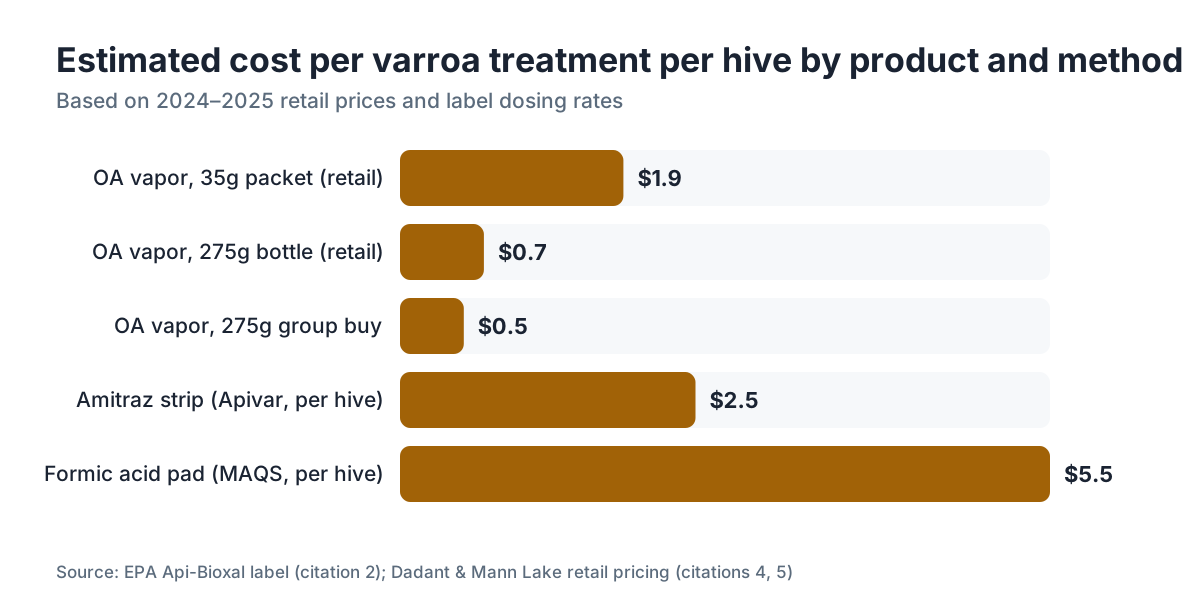
| Api-Bioxal 275g bottle | $65 | 275 | $0.24/g | ~183 |
| Api-Bioxal 275g (group buy, ~10 bottles) | ~$50 | 275 | $0.18/g | ~183 |
Take a 10-hive apiary running 4 vapor treatments per year (2 fall rounds plus 2 winter broodless checks). That's roughly 60 grams per year. At 35g packet pricing that's $37.80/year. At 275g bottle pricing it's $14.40/year. The 275g bottle pays for itself in under two years for most hobbyists, assuming OA is stored correctly and the remainder stays viable.
For a sideliner with 30 to 50 hives running the same protocol, the 275g bottle becomes nearly a consumable. Group-buying 10 bottles at a time with other local beekeepers pushes the math even further in your favor.
Many beekeeping supply companies carry the 275g size. Some offer case pricing (6 to 12 bottles) with meaningful discounts, and a few run periodic free or flat-rate shipping promotions [4]. Check free shipping honey bee supply companies before ordering, since shipping heavy bottles can add $10 to 15 to a single order.
Does oxalic acid have a shelf life, and does bulk make sense given that?
Yes, and this is the question most bulk-curious hobbyists don't ask early enough.
Api-Bioxal's EPA label lists an expiration date on each container [2]. The product is dry crystalline oxalic acid dihydrate. In an opened container the main degradation risk is moisture absorption, which causes clumping and inconsistent dosing in a vaporizer. Unopened, the product is stable for at least 3 years from manufacture under normal storage conditions (cool, dry, away from light). Once opened, most commercial beekeepers report reliable performance for 1 to 2 seasons if kept in a sealed, airtight container in a cool location.
For a 10-hive hobbyist using 60g per year, a 275g bottle lasts roughly 4.5 years of treatments. You're likely to hit the expiration window before you use it up. Splitting a bottle with one or two other beekeepers solves this cleanly.
Oxalic acid is corrosive to metals and reactive with some plastics. Store it in its original container or in HDPE plastic with a tight seal. Keep it away from iron tools, which it will pit over time. Don't store it with your vaporizer if the vaporizer has bare steel components.
The EPA label also requires you to keep the original label with the product. If you transfer OA to a different container for portability, you technically need to bring a copy of the label with it. Few inspectors check this in practice, but it's the rule.
How many hives do you need before bulk purchasing makes financial sense?
There's no hard cutoff, but here's a reasonable framework.
With 2 to 4 hives and 4 vapor treatments per year, you use roughly 12 to 24 grams of Api-Bioxal annually. A 35g packet covers you for about one year at that usage. A 275g bottle would sit on your shelf for over a decade. That's not bulk purchasing. That's buying enough product to outlive your hobby.
At 5 to 10 hives on the same protocol, you're using 30 to 60g/year. A 275g bottle lasts 4 to 9 years. This is where splitting makes sense. Two beekeepers with 5 to 8 hives each can split a 275g bottle, each pay around $30 to 35, and each get a 2 to 3 year supply. That beats retail packet pricing every time.
At 15 to 30 hives running heavier OA protocols (more treatments per year, possibly dribble plus vapor combined), you consume 90 to 300g per year. One 275g bottle per year is reasonable, and case pricing starts to pencil out.
The Varroa Management Guide from the Honey Bee Health Coalition recommends monitoring mite loads every 4 to 8 weeks and treating when counts exceed 2 to 3 mites per 100 bees [1]. Beekeepers who monitor often and treat on thresholds rather than a fixed calendar tend to use less OA, which shifts the bulk math back toward splitting orders.
If you're still building your beekeeping supplies kit and figuring out your treatment rhythm, buy a single 275g bottle before committing to case quantities.
Can you split an oxalic acid bulk order with other beekeepers, and how?
Splitting is the best answer for most hobbyists. A group of 3 to 5 local beekeepers pooling an order of 6 to 10 bottles can hit case pricing, split shipping costs, and each end up with a manageable quantity.
The simplest approach: organize through your local beekeeping association or club email list. One person places the order, collects payment up front, and distributes. Keep each beekeeper's portion in the original labeled bottle (or a clearly labeled HDPE container with a printed copy of the label).
One legal point to check: splitting a registered pesticide product can trigger state pesticide distribution laws in some states. If you buy Api-Bioxal and divide it into smaller containers for sale or distribution to others, you may need a pesticide dealer license in certain states [3]. Most beekeeping clubs handle this as a group purchase where each beekeeper is a co-buyer, not a resale transaction. Check with your state department of agriculture if you're uncertain. The EPA's pesticide registration page has state office contact links [9].
A group buy also lets you coordinate treatment timing. If 5 beekeepers in the same watershed all treat during the same broodless window, the re-infestation pressure from nearby mite-laden colonies drops for everyone. That's a real benefit the financial math doesn't capture.
What equipment do you need if you're buying oxalic acid to vaporize?
An oxalic acid vaporizer (sublimator) is the key piece of hardware. They range from $30 to 40 for basic resistive-heating wands to $200+ for propane torch designs and $350 to 500 for commercial-grade units with timers and shields [5].
For a hobbyist with under 20 hives, the mid-range electric vaporizers (roughly $60 to 120) hit the sweet spot. The Varomor propane unit and the Oxamat electric are two commonly cited options. I'd lean toward an electric unit for a small apiary purely for repeatability, since you can dial in power and exposure time more consistently than with a torch.
Safety gear is non-negotiable. The Api-Bioxal label requires a NIOSH-approved respirator rated for acid vapors (not a dust mask), chemical splash goggles, and nitrile gloves [2]. OA vapor is a serious respiratory and eye irritant. Cheap out on the vaporizer if you must. Don't cheap out on the respirator.
You'll also want a digital scale accurate to 0.1g for measuring doses, a timer, and a way to seal the hive entrance during vaporization (foam board works fine). Total equipment cost for a new vaporizer setup runs $100 to 200 for most hobbyists.
VarroaVault has a free protocol tool that walks through treatment timing and dose calculations based on your colony count and brood status, which helps you estimate how much OA you'll actually burn through in a season before you order.
Where should you actually buy oxalic acid, and what should you watch out for?
The major beekeeping supply distributors all carry Api-Bioxal: Mann Lake, Dadant, Brushy Mountain (now part of Dadant), and others. Prices for the 275g bottle cluster between $55 to 75 depending on the seller and season.
Things to watch for when ordering:
First, check whether the product ships to your state. A handful of states have added pesticide registration requirements that slow or restrict direct shipment of registered bee treatments. California has historically required Cal-EPA registration, though Api-Bioxal has been registered there [2].
Second, check the expiration date. Ask the supplier when the product was manufactured if you're buying in quantity. A fresh bottle with 3 years of shelf life is worth paying slightly more per unit than close-out inventory with 6 months left.
Third, look at actual per-gram cost, not per-bottle. Some suppliers bundle smaller packets in a multi-pack that looks like a bulk deal but costs more per gram than a single 275g bottle.
Fourth, factor shipping honestly. A $60 bottle with free shipping beats a $50 bottle plus $15 ground shipping. Check current promotions at free shipping honey bee supply companies before checking out.
Amazon and eBay also carry Api-Bioxal. I'd buy from a dedicated beekeeping supplier over a general marketplace for one reason: temperature-controlled storage. Some generic warehouse fulfillment centers have had OA arrive clumped from heat exposure. Beekeeping suppliers understand the storage requirements.
How do you store oxalic acid safely at home?
Oxalic acid is corrosive. The EPA label and SDS sheet (available from Bayer) classify it as a skin and respiratory irritant and a serious eye hazard [2].
For home storage, the practical rules are:
Keep it sealed. Moisture is the primary enemy of dry Api-Bioxal. A sealed original container inside a zip-lock bag inside a plastic bin is overkill but works fine.
Keep it cool and dark. A shelf in an unheated garage or basement is fine in most climates. Avoid spots where summer temperatures regularly top 100°F, which can speed degradation.
Keep it locked away from children and pets. Oxalic acid is toxic if ingested. The oral LD50 in rats is around 375 mg/kg body weight [6], which means a small child eating a dose sized for a full treatment would be in genuine danger.
Keep it away from incompatible chemicals. OA reacts with strong oxidizers (like bleach) and should not sit near ammonia-containing products.
Do not pour it down a drain. Treat any unused or expired OA as a regulated chemical. Contact your local household hazardous waste facility for disposal instructions. Most municipal HHW programs accept it.
What does the research say about oxalic acid efficacy, and does your protocol matter more than the product you buy?
Efficacy studies on oxalic acid vaporization consistently show 90 to 99% mite knockdown during broodless conditions. A widely cited University of Florida IFAS Extension publication summarizes field data showing over 93% mite mortality with a single vaporization treatment when colonies are broodless [7]. The chemistry is the chemistry. The registered 98.8% OA dihydrate formulation is identical whether you buy a 35g packet or a 275g bottle.
What the research also shows clearly: timing and monitoring matter more than marginal differences in product cost or purchase format. Beekeepers who treat on actual mite counts reach threshold-based decisions earlier, treat fewer times, and lose fewer colonies to mite-vectored viruses like Deformed Wing Virus (DWV) [11].
The Honey Bee Health Coalition's Varroa Management Guide (4th edition, 2022) says beekeepers should "monitor at least every 4 to 8 weeks during the active season" and that "treatment thresholds of 2% or 3% mite infestation" are commonly recommended [1]. That protocol context matters more than the economics of your OA purchase.
Buying bulk OA doesn't improve efficacy. It only reduces cost and means you always have product on hand so you don't delay treatment because you forgot to reorder. That second benefit is underrated. Treatment delays caused by running out of product mid-season are a real, preventable cause of colony loss.
For a deeper look at the mite itself and how it reproduces in the brood cycle, the varroa mite overview covers the biology that drives every treatment timing decision.
Are there any regulatory changes coming that might affect OA bulk availability?
The EPA re-evaluates all registered pesticides on a rotating schedule. As of 2024, Api-Bioxal's registration is current and faces no imminent re-evaluation action that would restrict availability [3].
Organic certification is one area where the regulatory details matter. The National Organic Program (NOP) allows oxalic acid as a treatment material for certified organic operations when applied according to the EPA label. The USDA's National Organic Program rule (7 CFR Part 205) permits OA as an allowed substance for livestock, which includes bees [8]. If you sell honey as certified organic, your certifier needs documentation that you used Api-Bioxal specifically, not an unregistered OA source.
Some state departments of agriculture have layered additional restrictions on pesticide sales or have required separate state registration for Api-Bioxal. The list of states changes periodically. Check your state's department of agriculture pesticide program before placing a large order.
The availability picture in the US has held steady since Api-Bioxal received full unconditional registration in 2015. The extension of the registration to include the sponge/shop-towel application method came later (2020 to 2021), which broadened how hobbyists can use the product they already have. No regulatory indicator currently points to supply disruption.
What's the best practical approach for a small apiary owner right now?
Here's what I'd actually do with 10 hives and a practical budget.
Buy one 275g bottle of Api-Bioxal from a reputable beekeeping supplier. Check for shipping promotions first. Budget $65 to 80 all-in. That's a 3 to 4 year supply for 10 hives on a 4-treatment-per-year schedule.
If you have a local beekeeping club or even one beekeeping neighbor, split the cost of two bottles. Each of you pays $50 to 60, gets a labeled share, and has a 2 to 3 year supply.
Do not buy a case of 12 bottles as a solo hobbyist unless you have 40+ hives or you're coordinating a group buy.
Invest the money you save in monitoring equipment. An alcohol wash jar and a digital scale run about $15 to 25 total. The return on that spend, in early mite detection, beats any additional OA savings.
VarroaVault's free treatment protocol tool maps your colony count to an annual OA consumption estimate, so you know exactly what quantity to order before you place that first bulk purchase.
For a full picture of what you need beyond OA, the beekeeping supplies guide covers the essentials without pushing gear you won't use.
Frequently asked questions
Is it legal to buy oxalic acid in bulk from a chemical supplier instead of a beekeeping store?
No. Only EPA-registered Api-Bioxal (Reg. No. 86922-1) is legal for use on honey bee colonies in the US. Industrial or technical-grade oxalic acid from chemical suppliers does not carry this registration. Using an unregistered product on a colony is a federal pesticide law violation under FIFRA and can affect honey food-safety status.
How much oxalic acid do I actually use per treatment per hive?
Vaporization uses about 1 to 2 grams of Api-Bioxal per hive per treatment per the registered label. The dribble method uses approximately 5 mL of a prepared 3.5% solution per seam of bees. For most hobbyist apiaries, vaporization consumes less product overall and is more practical for multiple-hive applications.
Can I split a 275g bottle of Api-Bioxal with another beekeeper?
Practically, yes. Legally, be aware that redistributing registered pesticide products in some states may require a dealer license if money changes hands. Most beekeeping clubs treat this as a group co-purchase rather than a resale. Check with your state department of agriculture if you plan to do this regularly or at scale.
Does Api-Bioxal expire? What happens if I use old oxalic acid?
Yes, Api-Bioxal has a printed expiration date. Opened containers stored improperly can absorb moisture and clump, causing inconsistent vaporizer dosing. Expired or degraded product may deliver less active ingredient than intended, resulting in incomplete mite kill. Use within the labeled shelf life and store in a sealed, cool, dry location.
Will bulk buying oxalic acid make my treatments more effective?
No. Efficacy depends on brood status at treatment, application technique, and dose accuracy. A University of Florida IFAS Extension summary reports over 93% mite mortality with correct broodless vaporization regardless of the purchase format. Bulk buying only reduces cost and ensures you have product on hand when threshold counts require treatment.
Do I need a pesticide applicator license to buy or use Api-Bioxal?
No license is required for hobbyist beekeepers treating their own colonies. Api-Bioxal is a general-use pesticide registered for direct purchase and use by beekeepers. Commercial applicators treating hives belonging to others may face state-level licensing requirements. Always check your state department of agriculture's rules for your operation size.
Can I use oxalic acid on colonies with brood?
Dribble and vaporization are approved for use on colonies with brood, but efficacy drops sharply because OA does not penetrate capped cells. The Honey Bee Health Coalition notes OA is most effective when no capped brood is present. Extended-release sponge methods (the registered shop-towel approach) are designed for use with brood present and show better results in that scenario.
Is oxalic acid safe for organic honey production?
Yes. The USDA National Organic Program (7 CFR Part 205) allows oxalic acid as a permitted substance for certified organic livestock, including bees. You must use the registered Api-Bioxal product and document its use for your certifier. Lab-grade or unregistered OA would not qualify even if the chemistry is identical.
What's the cheapest legal way to treat varroa with oxalic acid for a small apiary?
Split a 275g bottle of Api-Bioxal with one or two other beekeepers. At case or co-purchase pricing, cost per gram can drop to $0.15 to 0.20, meaning each vapor treatment costs under $0.40 per hive. Add a $60 to 100 electric vaporizer and proper PPE, and your total setup for a 10-hive apiary runs $130 to 200 for multi-year use.
How do I dispose of expired or unused oxalic acid?
Treat it as a household hazardous waste item. Do not pour it down a drain or into the trash. Most municipalities have HHW collection programs or drop-off days that accept registered pesticides. Contact your local solid waste authority for the nearest facility. The Api-Bioxal SDS from Bayer also includes disposal instructions aligned with federal RCRA guidelines.
How does oxalic acid compare in cost to other varroa treatments?
Oxalic acid vaporization is among the least expensive varroa treatments per application. Amitraz strips (Apivar) run $2 to 3 per strip, requiring 2 strips per hive. Formic acid pads (Mite-Away Quick Strips) cost $4 to 7 per treatment. A single OA vapor treatment costs $0.30 to 0.60 per hive using a 275g bottle. The tradeoff is that OA requires broodless timing for best results.
What vaporizer should I buy if I'm just starting oxalic acid treatments?
For under 20 hives, a mid-range electric vaporizer in the $60 to 120 range is practical. Look for models with a timer or a fixed-cycle heating element to ensure consistent dosing. Pair it with a NIOSH-approved acid-vapor respirator, chemical splash goggles, and nitrile gloves as required by the Api-Bioxal label. Avoid the cheapest resistive wands if you plan to treat more than once per season.
Can I buy Api-Bioxal from Amazon or eBay?
Yes, it's available on both platforms. The practical concern is storage conditions during fulfillment. Dedicated beekeeping suppliers are more likely to store OA products properly than generic warehouse fulfillment centers. Check seller reviews specifically mentioning product condition on arrival, and always verify the expiration date when the package arrives.
Sources
- Honey Bee Health Coalition, Varroa Management Guide (4th ed., 2022): Oxalic acid is most effective when no capped brood is present; recommended monitoring every 4 to 8 weeks with treatment threshold of 2 to 3% mite infestation
- EPA, Api-Bioxal Registration (Reg. No. 86922-1) product label: Api-Bioxal is the only EPA-registered oxalic acid product for honey bees in the US; vaporization dose is 1 to 2g per hive; requires NIOSH respirator, goggles, and gloves
- EPA, Federal Insecticide Fungicide and Rodenticide Act (FIFRA) overview: Using an unregistered pesticide product on a managed colony is a FIFRA violation; state pesticide distribution laws may apply to splitting registered products
- Mann Lake Bee & Farm Supply, product catalog: Api-Bioxal 275g available from major beekeeping suppliers at varying case pricing and shipping promotions
- Dadant & Sons, beekeeping equipment and supplies: Electric and propane OA vaporizers range from $30 to $500 at major beekeeping equipment retailers
- National Library of Medicine, PubChem: Oxalic acid compound summary: Oral LD50 of oxalic acid in rats is approximately 375 mg/kg body weight; classified as corrosive and toxic if ingested
- University of Florida IFAS Extension, Varroa Mites and Their Management: Field data shows over 93% varroa mite mortality with a single OA vaporization treatment applied during broodless conditions
- USDA Agricultural Marketing Service, National Organic Program, 7 CFR Part 205: Oxalic acid is an allowed substance for certified organic livestock (including bees) under the National Organic Program regulations
- EPA, Pesticide Registration: State Pesticide Regulatory Agencies contact list: Some states have additional registration or dealer licensing requirements for pesticide products including registered bee treatments
- Washington State University Extension, Varroa Mite Management for Honey Bees: Oxalic acid vaporization is among the lowest-cost varroa treatments on a per-application basis for small apiaries
- University of Minnesota Extension, Honey Bee Research: Varroa mite control: Monitoring-based treatment protocols reduce total OA consumption and improve colony survival outcomes compared to calendar-based schedules
Last updated 2026-07-09