Oxalic acid crystals for bees: the complete treatment guide
TL;DR
- Oxalic acid vaporization uses 1 gram of oxalic acid dihydrate crystals per brood box, heated into a gas that fills the hive.
- It kills varroa on adult bees with 90 to 97% efficacy when the colony is broodless.
- In the US only EPA-registered products are legal.
- Wear a respirator, gloves, and eye protection every single time.
What is oxalic acid and how does it kill varroa mites?
Oxalic acid is a dicarboxylic acid that shows up naturally in rhubarb, spinach, and lots of other plants. Beekeepers use it as a contact miticide against Varroa destructor, the parasite behind more colony losses than any other single cause in managed honeybees [1].
The kill mechanism isn't fully settled. The leading explanation is direct contact toxicity. When vaporized oxalic acid gas condenses on adult bees, mites pick it up through their legs and cuticle as they crawl around the cluster. It wrecks the mite's physiology at doses the bees mostly shrug off, partly because bees groom the acid off each other and excrete it. Mites sealed inside brood cells are untouched. That single fact drives almost every timing decision you'll make.
Oxalic acid doesn't build up in wax or honey at label doses. A residue review found oxalic acid already present in untreated honey at roughly 10 to 20 mg/kg as a natural background, and treated-hive honey landed in the same range. That's why the EU assigns it no maximum residue level and US labels carry a 0-day pre-harvest interval [2].
What are the different ways to apply oxalic acid to a hive?
Three methods sit on EPA-registered labels in the US: trickle (dribble), spray, and vaporization. Each has a specific job.
Trickle puts a 3.2% oxalic acid solution in sugar syrup right onto the bees in each occupied bee space. It works. It's also messy, hard on the colony during the pour, and most hobbyists have dropped it for everything except package installation.
Spray is approved only for packaged bees and removed combs, not for established colonies. You won't touch it in normal varroa work.
Vaporization (sublimation) is what people mean when they say "oxalic acid crystals for bees." You weigh 1 gram of crystalline oxalic acid dihydrate into a purpose-built vaporizer wand, seal the entrance, and heat the pan to around 315 degrees F (157 C). The crystals turn straight from solid to gas, skipping the liquid phase, and fill the cavity with condensing vapor. Bees pick it up, mites die, you unseal after 2 to 3 minutes and let the hive breathe. Start to finish, it's under ten minutes per colony.
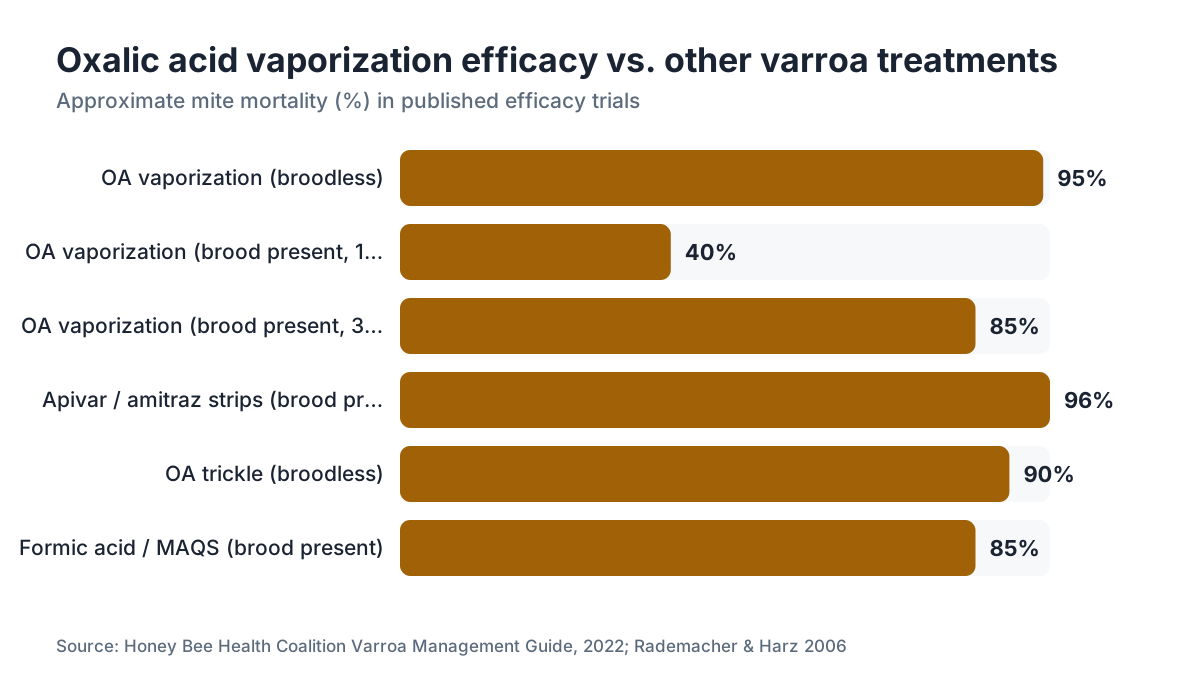
Vaporization out-kills trickle in most trials. Rademacher and Harz (2006) reported 90 to 97% efficacy for vaporization in broodless colonies, and repeated applications held that efficacy without the colony disruption trickle causes [3]. For anyone running even 10 to 20 hives, the time saved covers the vaporizer cost fast.
What is the correct oxalic acid dosage for bees?
The EPA label dose for vaporization is 1 gram of oxalic acid dihydrate per brood box, capped at 2 grams per colony when the colony spreads across multiple brood boxes [4]. That's the whole rule. More is not better. Overdosing causes temporary brood mortality and queen trouble.
For trickle, the label calls for 5 mL of 3.2% solution (roughly 50 mg of oxalic acid) per occupied bee space, up to 50 mL per colony. Concentration matters here. You can't mix your own ratio and wing it. Use an EPA-registered product mixed exactly per label.
A few numbers worth pinning down:
| Method | Dose per colony | Max treatments per year | Brood present? |
|---|---|---|---|
| Vaporization | 1 g OA dihydrate per brood box | No explicit EPA cap on annual treatments; label says repeat as needed | Yes, but efficacy drops sharply |
| Trickle | 5 mL of 3.2% solution per bee space, max 50 mL | 1 treatment per winter cluster season | Broodless only |
| Spray | Per label (packages only) | N/A for hive management | No brood |
The 1-gram dose applies to Apis mellifera colonies in standard Langstroth equipment. It's also the dose used in the research comparing oxalic acid to synthetic miticides, so the efficacy numbers you read line up with legal label use. Keep other species? Check with your state apiarist. Our overview of varroa mite biology explains why brood timing is the variable that dose alone can't rescue.
Which products are EPA-registered and legal to use in the US?
You can't legally vaporize raw oxalic acid crystals from a hardware store or industrial supplier. The Federal Insecticide, Fungicide, and Rodenticide Act (FIFRA) requires any pesticide use in the US to follow an EPA-registered label. For vaporization, the main registered product is Api-Bioxal, made by Chemicals Laif and sold through beekeeping supply channels [4].
Api-Bioxal is 97.8% oxalic acid dihydrate with a little glucose and sucrose as inert carriers. The EPA registration number is 86972-1. Using unregistered "pure" crystals from lab or food sources is off-label and technically illegal in the US, even though the chemistry is identical. Enforcement varies by state, but using non-registered product can cost you organic certification.
Certified organic operations can use Api-Bioxal. Oxalic acid sits on the National List of Allowed and Prohibited Substances under the National Organic Program [5], which makes it one of the few varroa treatments compatible with organic certification. Follow the label rates exactly anyway.
Need to find registered product or compare pricing? The beekeeping supply companies roundup covers the main US distributors.
What equipment do you need to vaporize oxalic acid safely?
The risk to you, the beekeeper, is real. Oxalic acid vapor irritates the airways and is a possible carcinogen at high exposures. NIOSH lists it as a workplace hazard with a recommended exposure limit of 1 mg/m3 as an 8-hour time-weighted average [6]. One vaporization cycle blows past that inside the hive, so whatever leaks out of the entrance or the wand is what you're breathing.
Required protective gear per the Api-Bioxal label [4]:
- A NIOSH-approved respirator with an OV/P100 combination cartridge (organic vapor plus particulate). A dust mask does nothing here.
- Chemical-resistant gloves (nitrile at minimum, butyl for repeated use).
- Eye protection or a full face shield.
- Long sleeves and closed shoes.
Don't stand downwind of the entrance during or right after treatment. Don't treat inside a shed or garage. Outdoors in moving air is the floor, not the ceiling, of safe practice.
For the vaporizer itself, you've got two categories: electric wand vaporizers (battery-powered, like the Varrox or ProVap 110) and propane-torch heated pans. Both work at the right temperature. Battery wands run cleaner and safer because you're not swinging an open flame near dry hive woodenware. Prices run from about $80 for a basic wand to $300 and up for commercial electric units. You'll find vaporizers under general beekeeping supplies, but confirm the unit is built for oxalic acid before you buy.
When is the best time of year to treat with oxalic acid crystals?
One scheduling rule outweighs the rest: treat when your colonies are broodless or close to it. Oxalic acid only kills mites riding on adult bees. Mites in sealed cells survive completely, then re-infest the adult population as brood emerges. This isn't a defect in the product. It's biology.
Across most of the continental US, the natural broodless window lands in mid-winter, roughly December through January depending on climate. One treatment in that window, timed after the cluster has drawn in around the queen and she's stopped or nearly stopped laying, drops mite loads hard heading into the new year.
Treating outside the broodless window because counts are high and you can't wait? Then repeated vaporizations are the play. The Honey Bee Health Coalition's Varroa Management Guide recommends treating every 3 to 5 days for a series of 3 to 4 rounds, which covers mites emerging from capped cells across the 12-day post-capping stretch [1]. More labor, but it plugs the gap.
Some beekeepers manufacture a broodless window by caging the queen for about 24 days before treating. All capped brood emerges, every mite gets exposed, and a single application can wipe out nearly the whole load. It works. It also adds queen management and some risk of losing her on re-introduction. Worth it for a heavily infested colony in fall.
A quick seasonal framework:
- Late fall / early winter: Natural broodless window, 1 to 2 treatments, best return on time invested
- Summer with heavy mite load: Series of 3 to 4 treatments every 3 to 5 days
- After pulling supers before winter prep: Good window with lower brood volume
- Spring buildup: Treat only if a mite wash shows over 2 to 3% infestation; brood present means you need the repeated series
How effective is oxalic acid vaporization compared to other treatments?
The efficacy numbers move around by study and conditions, but the steady finding holds: oxalic acid vaporization in a broodless colony kills 90 to 97% of mites [3]. That's the same performance tier as Apivar (amitraz strips), which usually shows 93 to 99% in trials, though Apivar keeps working with brood present.
The Honey Bee Health Coalition's 2022 Varroa Management Guide frames the trade-off plainly: "Oxalic acid vapor is highly effective against mites on adult bees, but has no effect on mites in sealed brood, so brood status is a critical factor in effectiveness." [1]
Against the synthetics (Apivar, Apistan, CheckMite+), oxalic acid's edge is resistance: none documented in field populations to date. Varroa resistance to tau-fluvalinate (Apistan) is widespread across the US and Europe. Amitraz resistance is showing up in some US populations. Oxalic acid kills through contact irritation rather than a specific biochemical pathway, so there's little for mites to evolve around [11].
It also frees up honey timing. Because it leaves no detectable residue above background in honey at label doses, you can technically treat with supers on, though most beekeepers pull them first for cleaner vapor distribution and to avoid an awkward customer conversation.
Where it falls down: high-brood summer colonies. If 60 to 70% of your mite population is tucked in capped cells, even a flawless adult kill leaves a reservoir that rebounds within weeks. That's the case for a brood break or a miticide that reaches capped cells (Apivar at label dose).
Is oxalic acid safe for bees at the label dose?
Short answer: yes, with caveats. At 1 gram per brood box, adult bee mortality from vaporization is low, similar to or below the mortality you cause with a routine inspection. Gregorc and Ellis (2011) found no statistically significant difference in adult bee mortality between vaporized colonies and untreated controls when dosed correctly [7].
Brood is touchier. Overexposure, either from dosing above label or treating a colony in a cramped space where vapor concentrates, can leave spotty brood and dead larvae. Hold to the 1 gram per box rule and keep the vaporizer pan at the entrance or bottom board, not sitting inside the box where vapor pools before the bees can spread it.
Queens draw the most worry. The published data doesn't show a significant queen loss rate at label doses, but you'll find plenty of hobbyist reports of queens failing or turning drone-layer a few weeks after treatment. Nobody has clean controlled data separating a treatment effect from coincidental winter queen failure. Here's my honest take: treat in the broodless window, use the label dose, and check your queen in early spring no matter what. Don't pin a queen problem on oxalic acid when it may have started before you ever fired up the wand.
Package bees and small splits deserve a note. Thin populations can be more sensitive because the vapor concentration per bee runs higher. Drop the dose proportionally or use trickle for very small clusters.
How do you actually do an oxalic acid vaporization, step by step?
Here's the working sequence for a standard Langstroth hive:
- Put on all your gear before you open any product. Respirator with OV/P100 cartridges, gloves, eye protection. No exceptions.
- Weigh the dose. Use a scale accurate to 0.1 g. Measure 1 gram of Api-Bioxal per brood box. One deep plus one medium as a brood nest is 1 to 1.5 grams depending on how much brood the medium holds. The label allows up to 2 grams per colony.
- Load the pan. Crystals go in the pan before it enters the hive. Don't spill.
- Close off the hive. Block the entrance with foam or a board. Tape or foam any screened bottom board openings. You want the vapor to stay put for the treatment period.
- Insert the wand through the entrance or a small drilled access hole in the bottom board. Vaporizers differ; follow the maker's instructions.
- Fire the heater. For electric wands, apply power and wait. Sublimation runs 2 to 3 minutes. Stay upwind. Don't crouch by the entrance.
- Wait 10 minutes total from the moment vapor stops forming. That gives the condensed acid on the bees time to work.
- Unseal. Pull the block. Let the hive air for at least 10 minutes before you take your respirator off nearby.
- Log it. Date, product lot number, dose, colony ID. Records earn their keep when you're chasing a resistance question or a health problem later. VarroaVault's free hive tracking log is built to capture exactly this kind of treatment event.
- Repeat on schedule (broodless: 1 to 2 treatments; active brood season: every 3 to 5 days for 3 to 4 rounds).
What do alcohol wash or sugar roll results tell you about when to treat?
Mite monitoring isn't optional if you want to use oxalic acid with any brains. You need a number before you decide to treat and another number after to know it worked. The standard tool is the alcohol wash: pull a roughly 300-bee sample (about half a cup) from a brood frame, wash in 70% isopropyl alcohol, count the mites that drop. Mites divided by bees, times 100, gives your percentage.
The Honey Bee Health Coalition and most US extension programs use 2% (2 mites per 100 bees) as the brood-season action threshold, with some states using 3% [1]. At or above that, treat now. Below it, monitor monthly.
Winter ratios read differently because the bee count is smaller. A colony with 200 mites on 5,000 winter bees (4%) is in real trouble. The same 200 mites on 40,000 summer bees (0.5%) is fine. Context is everything.
Run a post-treatment wash 7 to 10 days after finishing your series. Knock mites from 5% down to 0.5% and the treatment worked. Still sitting at 3 to 4%? You either had a pile of mites emerge from brood after treatment, or something nearby is reinfesting you (a collapsing neighbor colony, robbing). Our varroa mite population page helps you read those rebound numbers.
Some hobbyists skip monitoring and treat on a calendar. I get the pull, but it means treating colonies that don't need it (extra oxalic acid exposure for nothing) and missing colonies carrying unusually heavy loads. A 15-minute alcohol wash per hive, twice a season, earns its time back.
Can you use oxalic acid with honey supers on?
Technically, yes. The Api-Bioxal label doesn't prohibit treating with honey supers in place, and the EPA approved it without a pre-harvest interval because residue data shows oxalic acid doesn't build up above background in honey [4]. An EPA fact sheet documents oxalic acid concentrations in honey from vaporization-treated colonies coming out statistically indistinguishable from untreated controls [10].
In practice, most serious beekeepers pull supers before treating. The reason is distribution. Vapor has to climb through every box between the entrance and the cluster. A tower of supers dilutes the dose reaching the bees you're aiming at. You'd soak the bottom box and shortchange the cluster up in a deep.
The other reason is optics. Even when the chemistry says the honey is clean, selling honey from hives you treated yesterday is a conversation most hobbyists would rather skip. Pull the supers, treat, wait a week, put them back. Problem gone.
Certified organic operations: the National Organic Program confirms Api-Bioxal use is consistent with organic status, but your certifier still needs your treatment records on file [5]. Don't skip the paperwork.
What are the risks and common mistakes with oxalic acid crystal treatments?
The mistakes I see over and over:
Using unregistered oxalic acid. Food-grade or technical-grade crystals from a hardware or lab supplier are chemically identical to Api-Bioxal but aren't registered for this use in the US. Sell honey or hold organic certification, and this is real legal and certification exposure. Use Api-Bioxal.
Cheaping out on protection. A paper dust mask stops essentially nothing here. People skip real gear because the wand looks low-tech and the job goes fast. The vapor is genuinely hazardous. A 3M 6200 series respirator with 6001/6002 cartridges runs about $30 to $40 at a hardware store and lasts a season or more. Buy it.
Overdosing on the theory that more must be better. Doubling the dose doesn't double the kill. Mites in contact with label-dose vapor are already dying. All doubling buys you is brood stress and higher queen risk. Stay at 1 gram per box.
Treating in full summer with no plan for brood. A single vaporization in July with a laying queen and packed brood nest kills the mites on adults and leaves 70 to 80% of the population alive in cells. See no rebound and declare victory, and you've measured nothing. Commit to the 3-to-4 round series or switch to a brood-penetrating miticide for mid-summer.
Skipping the before-and-after wash. With no alcohol wash, you don't know if the treatment worked or if something else, like a failing queen pulling drifting mites off a collapsing neighbor, is driving your numbers.
Building a first-season kit? The beekeeping supplies guide covers what to buy first.
How does oxalic acid fit into a full-season varroa management plan?
Oxalic acid isn't a full-season answer on its own in most US climates. Brood is present 9 to 10 months a year across much of the country, and the brood-blind limitation means you either pair it with other tactics or aim it at the windows where it earns its keep.
The Honey Bee Health Coalition's Varroa Management Guide lays out a framework many extension apiarists follow [1]. The shape of it:
- Late summer (August, September): Your most important window, because the bees reared now are your winter bees. High mite loads here predict winter losses directly. A synthetic like Apivar (amitraz strips, 42-day treatment) or formic acid (MAQS) is often the better call because it works with brood present. If loads are moderate and you can create a brood break, oxalic acid is a fair alternative.
- Winter (December, January): The ideal oxalic acid window. Broodless or near-broodless cluster, one or two vaporizations, big mite reduction heading into spring.
- Spring buildup (March, April): Monitor only unless counts climb. Treat with an oxalic acid series if you're over threshold, and know efficacy is capped once the colony carries heavy brood.
Rotating oxalic acid into a multi-treatment plan to slow resistance in the mite population is a legitimate reason to use it even outside its best window. Its mode of action differs from the synthetics, which makes it a good rotation partner.
VarroaVault's free protocol tools include a seasonal treatment calendar you can tune to your climate and colony count, which turns this framework into real dates instead of vague seasons.
Frequently asked questions
How many times can you treat a hive with oxalic acid in one year?
The Api-Bioxal label doesn't cap annual vaporization treatments explicitly, unlike trickle, which is limited to once per broodless season. In practice, most beekeepers do one to two treatments in the winter broodless window and a series of three to four (every 3 to 5 days) for mid-season loads. More than six to eight total in a year is unusual and points to figuring out why mites keep rebounding rather than treating more often.
Does oxalic acid vaporization work with brood present?
Partially. It kills mites on adult bees even with brood present, but mites inside sealed cells are fully protected. At typical brood levels, 70 to 80% of your mite population may be capped at any moment, so a single treatment leaves most of them alive. With brood present, you need a series of three to four treatments every 3 to 5 days to catch mites as they emerge, or you combine oxalic acid with a miticide that reaches capped brood.
What respirator do I need for oxalic acid vaporization?
A NIOSH-approved half-face or full-face respirator fitted with OV/P100 combination cartridges (organic vapor plus particulate). A dust mask, N95, or surgical mask does nothing meaningful against the vapor. The Api-Bioxal label specifically requires this class of respirator. A 3M 6200 series with 60926 cartridges is a common, affordable option, around $30 to $50 complete at most hardware stores.
Can I make my own oxalic acid solution instead of buying Api-Bioxal?
You cannot legally use unregistered oxalic acid for varroa treatment in the US under FIFRA, even though the chemistry is identical to Api-Bioxal. Unregistered product can jeopardize organic certification and technically counts as an off-label pesticide application. Regulations differ in some other countries. In the US, stay with Api-Bioxal (EPA registration 86972-1) to keep it legal and hold your certification.
How long after oxalic acid treatment can I add honey supers?
The Api-Bioxal label has no pre-harvest interval, so there's no mandatory wait before adding supers or harvesting. Residue studies show oxalic acid doesn't accumulate above background in honey at label doses. Even so, most beekeepers wait a few days after the final treatment in a series as a practical precaution, and pulling supers before treatment is cleaner both for vapor distribution and for customer peace of mind.
What temperature is needed to sublimate oxalic acid crystals?
Oxalic acid dihydrate sublimes at about 157 C (315 F). Purpose-built wands are designed to reach and hold that range. Most electric wands fully sublimate a 1-gram dose in 2 to 3 minutes. Push much hotter and you start producing formic acid as a decomposition byproduct, which irritates both bees and beekeeper. Quality vaporizers regulate temperature to prevent that. Don't improvise a heat source.
Is oxalic acid safe to use around honey bees, does it harm them?
At the label dose of 1 gram per brood box, published research shows no statistically significant rise in adult bee mortality compared to untreated controls. Bees groom the acid off each other and excrete it. Brood is more sensitive to overdose than adults, which is why the labeled dose matters. Very small colonies and packages can be more sensitive to vaporization; trickle may be gentler for those.
How do I know if my oxalic acid treatment worked?
Run an alcohol wash 7 to 10 days after finishing your series. Count mites in a sample of about 300 bees. A successful treatment should cut your mite percentage by 90% or more in a broodless colony. If counts stay high, you either had significant brood during treatment (protecting mites in cells) or reinfestation from collapsing neighbors is topping you back up. A second wash two weeks later helps tell the two apart.
What is the difference between oxalic acid dihydrate and anhydrous oxalic acid?
Oxalic acid dihydrate (C2H2O4 with two bound water molecules) has a molecular weight of 126 g/mol and sublimes around 157 C. Anhydrous oxalic acid has a higher melting point and behaves differently when heated. Api-Bioxal is the dihydrate form, which is what all label dosing (1 gram) refers to. If you somehow got anhydrous oxalic acid, the same gram would carry a higher actual concentration. One more reason to use only registered product.
Can you use oxalic acid on a hive that has American foulbrood?
No, and you shouldn't treat any diseased colony with a miticide instead of diagnosing and handling the primary disease. American foulbrood is bacterial, and oxalic acid does nothing to it. A colony confirmed with AFB must be handled per your state's rules, which usually means burning equipment or treating with oxytetracycline under a veterinary prescription. Applying oxalic acid to an AFB colony wastes product and delays real disease management.
Does oxalic acid treatment affect the queen?
At label doses in controlled studies, vaporization shows no statistically significant effect on queen survival or laying. Anecdotal reports of queens failing weeks after treatment exist, but they're hard to separate from normal winter queen mortality, which runs 10 to 30% in some studies regardless of treatment. The safest approach: treat during the natural broodless window when the queen is minimally active, and plan a spring inspection to confirm her status.
How much does Api-Bioxal cost, and how many treatments does one package make?
Api-Bioxal typically sells in 35-gram containers in the US, around $25 to $35 depending on supplier as of 2024. At 1 gram per brood box, a 35-gram container yields roughly 17 to 35 single-box treatments, or about 8 to 17 two-box colony treatments. For a small operation of 5 to 10 hives doing one or two winter treatments, one container lasts one to two seasons. A beekeeping supply company often beats local farm stores on per-gram price.
What mite count threshold should trigger an oxalic acid treatment?
Most US extension apiculture programs and the Honey Bee Health Coalition use 2% as the action threshold during brood season (2 mites per 100 bees on an alcohol wash). Some use 3% for summer. In winter, a lower absolute count still spells trouble because the bee population is smaller. If your winter wash shows even 1 to 2 mites per 100 bees on a small cluster, treating is reasonable given how fast populations climb in spring buildup.
Sources
- Honey Bee Health Coalition, Varroa Management Guide (2022 edition): OA vapor is highly effective against mites on adult bees; recommended treatment threshold is 2% mites per adult bee sample; repeated vaporizations every 3-5 days recommended when brood is present
- European Food Safety Authority (EFSA), Oxalic acid EU maximum residue level classification: Oxalic acid classified as a natural substance with no maximum residue level required in EU honey; background OA in untreated honey approximately 10-20 mg/kg
- Rademacher & Harz (2006), Journal of Apicultural Research, OA efficacy in broodless colonies: Vaporization achieved 90 to 97% efficacy in broodless colonies
- EPA, Api-Bioxal Pesticide Product Label (Registration No. 86972-1): Labeled dose is 1 gram oxalic acid dihydrate per brood box, maximum 2 grams per colony; no pre-harvest interval; requires OV/P100 respirator
- USDA National Organic Program, National List of Allowed and Prohibited Substances: Oxalic acid is on the National List as allowed for use in organic livestock/apiculture production
- NIOSH Pocket Guide to Chemical Hazards: Oxalic acid: NIOSH recommended exposure limit (REL) for oxalic acid is 1 mg/m3 as an 8-hour TWA
- Gregorc & Ellis (2011), Journal of Apicultural Research, bee mortality after OA vaporization: No statistically significant difference in adult bee mortality between OA-vaporized colonies and untreated controls at label doses
- Penn State Extension, Oxalic Acid for Varroa Control in Honey Bee Colonies: Practical guidance on OA vaporization timing, PPE, and brood-season treatment series protocols for US beekeepers
- University of Florida IFAS Extension, Honey Bee Varroa Mite Management: OA vaporization versus trickle method efficacy comparison in broodless colonies; seasonal treatment timing guidance
- EPA, Oxalic Acid (006481) Fact Sheet: Residue data showing OA does not accumulate above background in honey from vaporization-treated colonies; basis for zero pre-harvest interval
- USDA Agricultural Research Service, Varroa destructor management and resistance: No documented field resistance to oxalic acid in Varroa destructor populations; OA mode of action differs from synthetic miticides
Last updated 2026-07-10