Oxalic acid dribble solution concentration mixing guide
TL;DR
- The EPA-registered oxalic acid dribble is 3.2% weight-by-volume: 35 grams of oxalic acid dihydrate dissolved in 1 liter of 1:1 sugar syrup.
- Apply 5 mL per seam of bees, capped at 50 mL per colony, once per treatment period, only when the colony is broodless.
- Mix it wrong and you either kill bees or leave mites alive.
What concentration does the EPA require for the oxalic acid dribble?
The approved dribble concentration is 3.2% weight-by-volume (w/v) oxalic acid dihydrate in a 1:1 sugar-water solution. That number comes straight from the Api-Bioxal label, the only oxalic acid product currently registered with the EPA for honey bee colonies in the United States. [1]
Here is what 3.2% w/v means in practice. For every 100 mL of finished solution, you want 3.2 grams of oxalic acid dihydrate dissolved in it. Scale it up and the ratio holds. A one-liter batch needs 35 grams. A 500 mL batch needs 17.5 grams. Simple.
The acid has to be the dihydrate form (OA·2H₂O). That is the compound used in Api-Bioxal and in the university research that set these numbers. Anhydrous oxalic acid has a different molecular weight, so the same gram weight lands you at a different concentration. Do not use it.
One wrinkle on the label language. Api-Bioxal packets arrive pre-measured at 35 grams, designed to dissolve into one liter of finished syrup. The label does not ask you to weigh raw acid from a bulk bag. It sells you the premeasured active. If you buy bulk oxalic acid dihydrate for another purpose and mix your own, you are off-label, and some state apiarists enforce that line. Know where your state stands before you decide how to source it. [2]
How do you actually mix the dribble solution step by step?
Start with the syrup, not the acid. Mix granulated table sugar with warm water at 1:1 by weight: 100 grams of sugar to 100 mL of water, or 500 grams to 500 mL, and so on. Stir until the sugar dissolves, then let the syrup cool below about 40°C (104°F) before the oxalic acid goes in. Heat degrades oxalic acid and can throw off formic acid as a byproduct. That is not what you want near your bees.
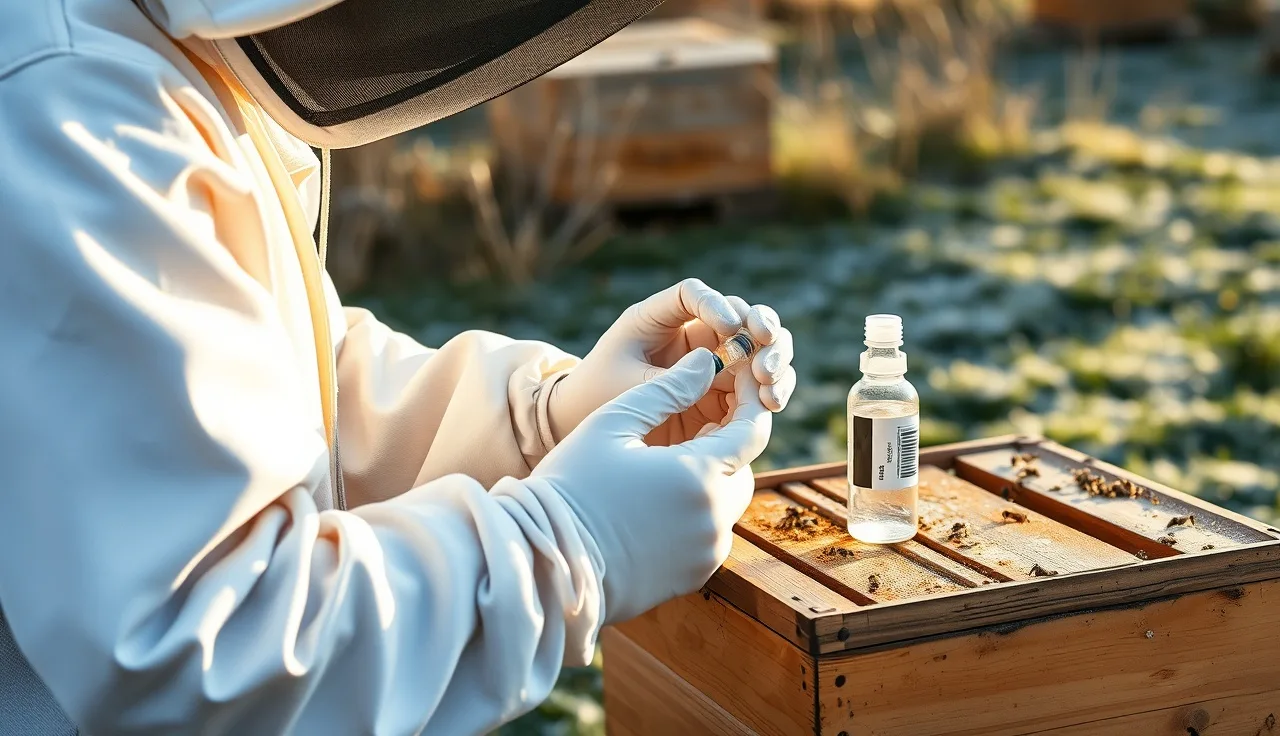
Once the syrup is cool, weigh 35 grams of oxalic acid dihydrate for each liter of finished solution. Add it to the syrup and stir until it disappears. It dissolves fast at room temperature. The finished solution reads clear or a faint yellow.
Steps in order:
- Make your 1:1 sugar syrup and let it cool.
- Weigh the oxalic acid dihydrate on a kitchen or postal scale (0.1-gram resolution is plenty).
- Add the oxalic acid to the cooled syrup. Stir until dissolved.
- Load a labeled, dedicated syringe or dribble applicator. Never reuse a food container.
- Apply within a few hours. Leftover solution keeps in a sealed container away from heat and light for a short while, but fresher is better.
Protective equipment matters here. Oxalic acid irritates skin and lungs. Nitrile gloves and safety glasses at minimum. Mixing indoors or in a shed? A respirator rated for organic vapors earns its keep. The Api-Bioxal label spells out required PPE and you are obligated to follow it. [1]
A digital kitchen scale with a tare button makes all of this easy. Do not eyeball it. Miss by 10 grams on a one-liter batch and you slide from 3.2% to 4.2% or 2.2%. Both directions cause problems.
What is the correct dose to apply per colony?
The label allows 5 mL of the 3.2% solution per seam of bees, with a hard cap of 50 mL per colony per treatment. [1] A seam is the gap between two adjacent frames where bees cluster. You count the seams the bees actually occupy, not the total frames in the box.
A winter cluster on 6 seams gets 30 mL total. A smaller fall cluster on 4 seams gets 20 mL. You want to wet the bees, not flood them. Too little misses mites. Too much chills the cluster and stresses the colony.
Use a syringe or a dedicated dribble bottle. Move along the top bars slowly and let the solution run down into each seam. Work from one side of the cluster to the other. Keep the tip close so the liquid lands on bees, not on wood.
The label allows one dribble treatment per year. [1] You do not repeat it every week the way some people run sublimation. One clean application during a broodless window is the whole protocol.
Why does the colony need to be broodless for dribble to work?
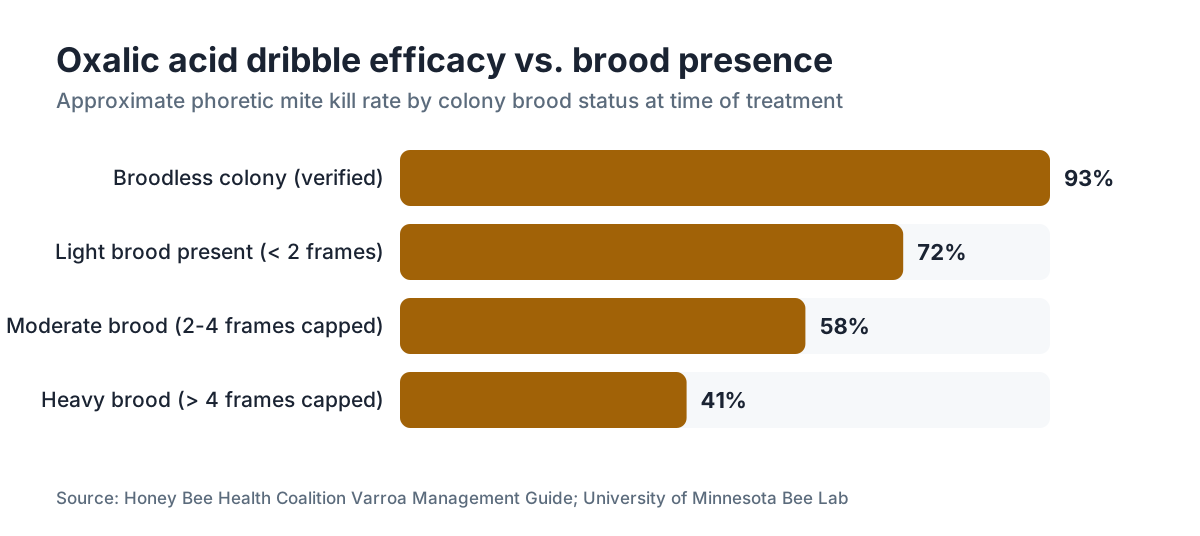
Oxalic acid kills varroa on adult bees by direct contact. It cannot touch mites reproducing inside capped brood cells, because the liquid never reaches them. [9] Treat a colony sitting on heavy capped brood and you knock down only the phoretic mites riding the adults. The mites sealed inside cells survive and re-infest within days as brood emerges.
The Honey Bee Health Coalition's Varroa Management Guide states that oxalic acid treatments are "most effective when honey bee colonies are broodless." [3] University of Minnesota Bee Lab data puts dribble efficacy at 90% or higher against phoretic mites in broodless colonies, falling off sharply once capped brood is present. [7]
Natural broodless windows open in temperate climates during mid-winter, roughly December through January across much of the US, shifting with your latitude and that year's weather. You can also force a temporary broodless state by caging the queen for 24 days, long enough for all capped brood to emerge, before you treat. That is a heavier lift.
Check for brood before you treat. Pull a center frame from the cluster and look for capped cells. More than a couple of patches means you wait or switch strategies. Sublimation with oxalic acid handles brood better because you repeat every few days to catch emerging mites, though vapor still does not reach inside sealed cells directly. [3]
How does dribble compare to oxalic acid vaporization for mite control?
Both methods use the same active ingredient at slightly different effective concentrations inside the hive, but the delivery and use cases differ enough that they are not interchangeable.
| Feature | Dribble | Vaporization (sublimation) |
|---|---|---|
| Application contact | Liquid on adult bees | Vapor throughout the hive |
| Broodless required? | Yes, for good efficacy | Less critical (repeat applications) |
| Treatments per label period | 1 | Up to 3 per year (label specific) |
| Equipment cost | Syringe, a few dollars | Vaporizer, $150-$400+ |
| Bee mortality risk | Low if dosed correctly | Low if hive sealed properly |
| Efficacy (broodless colony) | 90%+ | 90%+ |
| Efficacy (brood present) | 40-65% | Better with repeat treatments |
| Best season | Mid-winter | Fall or spring, any broodless window |
A hobbyist with a few hives treating in a true December broodless window should reach for the dribble. It is cheaper and just as effective. You need a syringe, some sugar, and an Api-Bioxal packet. Larger operations, or anyone who cannot confirm the colony is broodless, get more control from vaporization and its repeat-treatment flexibility.
The Honey Bee Health Coalition recommends checking your mite load with an alcohol wash or sugar roll before treating and again 10 to 14 days after, to confirm it worked. [3] That feedback loop matters no matter which method you pick. You can track results across seasons using the free monitoring tools at VarroaVault, built around the same HBHC thresholds.
For sourcing supplies, see our guide to beekeeping supply companies and free shipping honey bee supply companies to compare where to buy Api-Bioxal at a fair price.
What can go wrong with the mixing math, and how bad is it?
Two failure modes, opposite directions, both real.
Too dilute (below 3.2%): mite kill drops off. Research summarized in Apidologie on oxalic acid concentration found that solutions below roughly 2.8% show noticeably weaker efficacy against phoretic Varroa destructor than the 3.2% standard. [4] You stressed the colony and left a real mite population behind. That is the worst outcome, because you walk away thinking the job is done.
Too concentrated (above 3.2%): bee mortality climbs. Studies testing concentrations up to 5% found elevated adult bee deaths with no matching gain in mite kill. [4] The window is real but not razor-thin. Being 10 to 15% over (say 3.7%) is unlikely to wreck a colony. Being 50% over (4.8%) will hurt it.
The common mixing errors:
- Using volume of water instead of weight for the sugar ratio (volume and weight run close but not identical for granulated sugar)
- Dissolving the acid in plain water instead of finished syrup (the sugar keeps the solution stable and palatable to bees)
- Miscounting seams and dosing too much total volume
- Forgetting the water already in the syrup when you calculate 35g/L (the "L" is the finished syrup, not the water you started with)
Unsure of your math? Run a sanity check. Make 500 mL of syrup (250g sugar dissolved in 250 mL water), add 17.5 grams of oxalic acid dihydrate. That batch treats about 10 seams at 5 mL each, enough for one to two typical winter colonies.
Does the sugar concentration in the syrup matter?
It does, and the label is specific. The dribble requires a 1:1 syrup by weight, equal parts sugar and water. [1] You might wonder whether 2:1 thick winter syrup works the same, or whether plain water passes in a pinch. Neither is right.
A thicker syrup gets sticky and hard to spread evenly across the seams. It also shifts the tonicity relative to what bees can process off their bodies. Go thinner than 1:1 and you dump more liquid volume onto the cluster, which raises chilling risk in winter.
Plain water without sugar shows up in informal experiments and older European protocols, but it sits off the current US label, and the research behind the 3.2% number used sugar syrup as the carrier. Stick with 1:1.
One note on water. Clean tap water or distilled water both work. Chlorinated tap water does not meaningfully change oxalic acid chemistry, though very hard water high in minerals can cloud the syrup. Minor issue in practice, but worth knowing.
Is it legal to mix your own oxalic acid solution from bulk OA?
In the US, technically no. This is where federal and state rules rub against real beekeeper behavior.
The EPA registration covers Api-Bioxal (oxalic acid dihydrate, 99.2% pure). The label carries the force of law under FIFRA, the Federal Insecticide, Fungicide, and Rodenticide Act, 7 U.S.C. § 136. [5] Mixing a dribble from a non-registered oxalic acid source is off-label use of an unregistered pesticide, which federal law prohibits. As FIFRA puts it, it is unlawful "to use any registered pesticide in a manner inconsistent with its labeling." [5]
Enforcement is messier than the statute. Plenty of beekeepers, sideliners especially, have long bought technical-grade oxalic acid dihydrate from wood-bleaching or food-grade suppliers because it costs a fraction of Api-Bioxal per gram. Before EPA registered Api-Bioxal in 2015, there was no legal option at all. Some states look the other way. Others do not.
The Honey Bee Health Coalition tells beekeepers to use registered products with full label compliance. [3] If you join a state apiary inspection program, take cost-share funds, or sell honey commercially, the risk of off-label OA is real. For most hobbyists, Api-Bioxal runs cheap enough (roughly $20 to $30 for a 350-gram packet that treats about 10 colonies) that buying the registered product is the easy call.
For more on managing varroa mites legally and effectively, that overview covers the full treatment landscape.
What temperature and colony conditions are required on treatment day?
The Api-Bioxal label sets a floor: ambient temperature must be at or above 0°C (32°F) at application. [1] Below freezing the solution stops flowing right and the bees face greater chilling risk. Most practitioners hold out for a day of at least 5 to 10°C (40 to 50°F), even with the cluster tight.
Treat on a calm day. Wind slows you down and keeps the hive open longer than you want in the cold.
Colony strength counts too. A weak cluster under 3 to 4 seams is hard to treat well and may be too far gone to survive winter regardless. If your fall monitoring flagged high loads and you are now dribbling a struggling December colony, treat it anyway, but be honest with yourself about whether it is viable.
Do not feed after treatment until the bees clean up the dribbled syrup, usually a day or two. You do not want them storing oxalic acid solution as food.
How do you confirm your treatment actually worked?
Count mites before and after. That is the only honest answer. An alcohol wash is the most reliable method: pull about 300 bees (roughly half a cup) from the brood nest, wash them in 70% isopropyl alcohol, count the mites that fall out, and figure mites per 100 bees. [3]
The Honey Bee Health Coalition recommends treating when mite loads pass 2% (2 mites per 100 bees) during the brood-rearing season, and 1 to 2% in late summer as winter bees are being raised. [3] After a good dribble in a broodless colony, your recheck 10 to 14 days later should read below 1%.
A sticky board gives you a rough read on mite drop, less precise than an alcohol wash. Expect a spike in mite carcasses on the board 2 to 4 days after a dribble that worked. No spike may mean the treatment missed much of the cluster, or your concentration was off.
Still above 2% two weeks out? Something went wrong. Check whether brood was present, whether your solution was mixed right, and whether you hit every seam. Re-treating gets complicated, because the label allows only one dribble per year, so you may have to switch to a different OA method or a different treatment category altogether.
Where can you find the official label, guidelines, and further reading?
Your primary sources: the Api-Bioxal product label (from the EPA pesticide registration database or the manufacturer, Véto-pharma) [1], the Honey Bee Health Coalition's Varroa Management Guide (free PDF from their website) [3], and your state department of agriculture apiary program for any state-specific oxalic acid rules. [2]
University extension programs give you strong regional guidance. Penn State Extension's apiculture program, the University of Minnesota Bee Lab, and Oregon State University's honey bee program all publish practical treatment guides that translate the label into beekeeper-friendly protocols. [6] [7] [8]
The EPA pesticide registration page for Api-Bioxal (Reg. No. 86044-1) lets you download the current master label, which supersedes older versions. Reading a guide published before 2015, or one that talks about "homemade oxalic acid" without mentioning Api-Bioxal? Treat it with skepticism. The product and regulatory picture changed a lot. [10]
VarroaVault's free protocol tools schedule your dribble treatment against your mite counts, track results across seasons, and flag when to escalate to another treatment. They run on the HBHC thresholds and the current EPA label requirements.
For the physical gear, from syringes to protective equipment to hive tools, our overview of beekeeping supplies helps you stock up before treatment day.
Frequently asked questions
Can I use food-grade oxalic acid crystals instead of Api-Bioxal?
Technically this is off-label under US EPA rules, because only Api-Bioxal is registered for honey bee colonies. Food-grade oxalic acid dihydrate is chemically similar, but using it for varroa control violates FIFRA. Some beekeepers do it anyway, especially before Api-Bioxal became widely available. If you join state inspection programs or sell honey commercially, the legal risk is real. For most hobbyists, Api-Bioxal is cheap enough that buying the registered product makes sense.
How long does a mixed oxalic acid dribble solution stay good?
A few days in a sealed, labeled container away from heat and light. The sugar acts as a preservative, but the solution degrades over time and can mold or ferment if you keep it too long. Mix what you need for the day. Leftover from a small batch keeps in the refrigerator for 3 to 5 days. When in doubt, mix fresh.
What happens if I accidentally apply too much solution to a seam?
The label limit is 5 mL per seam and 50 mL total per colony. Going a little over on one seam is unlikely to be catastrophic, but excess solution pools at the bottom of the frames, chills the bees that contact it, and can stress or kill bees at the base of the cluster. In cold weather, excess liquid is the bigger danger. Measure your dose per seam rather than eyeballing it.
Can I treat a nucleus colony (nuc) with the oxalic acid dribble?
Yes, with adjusted volumes. Count the seams of bees in the nuc the same way you would a full colony, apply 5 mL per seam, and stay under 50 mL total (unlikely in a 5-frame nuc). A winter nuc on 3 to 4 seams gets 15 to 20 mL. The broodless requirement still holds: dribble only works when the nuc has no capped brood.
Does oxalic acid dribble affect honey in the supers?
The Api-Bioxal label prohibits application when honey supers intended for human consumption are on the hive. [1] Oxalic acid occurs naturally in honey at trace levels, but treating with supers in place risks pushing those levels above what regulators accept. Remove all supers before treating. The label is explicit, and it also makes practical sense, since you should be treating in winter when supers are off anyway.
How many Api-Bioxal packets do I need to treat 10 hives?
One 350-gram packet makes roughly 10 liters of solution. At 5 mL per seam and an average winter colony on 6 seams, each colony gets about 30 mL. Ten colonies need 300 mL total. So one packet is theoretically enough for about 33 colonies at that dosage. For 10 hives you use far less than one packet. Many beekeepers split a packet across seasons if it is stored well, though check the expiration date.
Does the dribble method work for Africanized honey bee colonies?
Oxalic acid dribble works against varroa on any Apis mellifera subspecies, including Africanized colonies. The concentration, dosing, and broodless requirement stay the same. The practical catch is that Africanized colonies are more defensive, which makes cold-weather inspection and treatment more dangerous. If you manage Africanized honey bees, take extra care on treatment day: full protective gear, calm conditions, a lit smoker ready.
What mite level should trigger a dribble treatment in fall or winter?
The Honey Bee Health Coalition recommends treating when mite loads pass 2 mites per 100 bees during the brood-rearing season, and some researchers push for action at 1% or lower in late summer to protect the winter bee cohort. [3] In winter, any measurable mite load in a broodless colony is worth treating, because the colony cannot dilute mites with new brood. If your alcohol wash shows any mites in a December broodless cluster, treat.
Can I mix oxalic acid dribble solution in a plastic container?
Yes. Oxalic acid solution at 3.2% is a mild organic acid and does not corrode most food-grade plastics (HDPE, LDPE, polypropylene). Avoid metal, especially aluminum or galvanized steel, because the acid reacts with them. Use a dedicated plastic container, label it clearly for pesticide use only, and never use it for food or water again. Glass works too if you prefer.
How is oxalic acid dribble different from the older powder dusting method?
Dusting bees with dry oxalic acid powder was used in some European countries before liquid formulations were standardized. It is not approved under the current US EPA label and has largely been dropped, because efficacy was less consistent and powder distribution was hard to control. Dribble and vaporization are the two approaches sanctioned in the US. Dusting is not a workaround to pursue.
Is there a minimum colony size for the dribble method to be safe?
The label does not set a minimum size, but common sense applies. A cluster under 2 to 3 seams of bees may not have the thermal mass to recover from the chilling and stress of a winter dribble. Those colonies are often already failing. Treat them anyway if mites concern you, but also weigh the colony's overall viability and whether you should combine it with a stronger unit.
Should I feed the colony right before or after a dribble treatment?
Avoid feeding right before or after treatment. Adding syrup from a feeder on top of an oxalic acid dribble creates excess moisture in the hive and may push bees to store the treated syrup. Wait at least 2 to 3 days after treatment before resuming any feeding. In mid-winter, treating a broodless cluster, the colony usually does not need supplemental feed if stores are adequate anyway.
What personal protective equipment does the Api-Bioxal label require?
The label requires chemical-resistant gloves (nitrile works), protective eyewear, and long-sleeved clothing. For mixing concentrated solution, a NIOSH-approved respirator for dust and mist is recommended if you handle dry oxalic acid dihydrate in an enclosed space. During application, the main risk is splash to eyes and skin. Your usual beekeeper veil covers your face. Read the full PPE section of the current label before your first treatment.
Sources
- EPA - Api-Bioxal Registration Label (Reg. No. 86044-1), Véto-pharma: 3.2% w/v oxalic acid dihydrate in 1:1 sugar syrup; 5 mL per seam, max 50 mL per colony; one treatment per year by dribble; PPE requirements; no supers on during treatment; minimum 0°C ambient temperature
- Honey Bee Health Coalition - Varroa Management Guide: Oxalic acid treatments are most effective when colonies are broodless; treatment threshold of 2 mites per 100 bees during brood season; alcohol wash recommended for pre- and post-treatment monitoring
- Apidologie - Nanetti et al., oxalic acid concentration and honey bee colony tolerance studies: Solutions below approximately 2.8% show reduced varroa efficacy; solutions above 3.2% increase bee mortality without proportional mite kill gains
- US Government Publishing Office - Federal Insecticide, Fungicide, and Rodenticide Act (FIFRA), 7 U.S.C. § 136: FIFRA requires that pesticides used in the US be registered with the EPA and makes it unlawful to use a registered pesticide in a manner inconsistent with its labeling
- Penn State Extension - Apiculture and honey bee programs: University extension programs publish practical oxalic acid treatment protocols translated from the EPA label for hobbyist beekeepers
- University of Minnesota Bee Lab - Varroa Management: Oxalic acid dribble efficacy in broodless colonies reported at 90% or higher against phoretic varroa mites; efficacy drops substantially when capped brood is present
- Oregon State University Extension: Field data supporting high phoretic mite kill with oxalic acid dribble in verified broodless colonies; efficacy drops with substantial sealed brood present
- Journal of Apicultural Research - Gregorc and Planinc, oxalic acid treatments for varroa control: Research establishing oxalic acid's mechanism of action via direct contact with phoretic mites; no efficacy against mites in capped brood cells
- EPA - Pesticide Registration program: The pesticide label is a legal document; using a pesticide in a manner inconsistent with its labeling is prohibited under FIFRA
Last updated 2026-07-09