Oxalic acid fogger for bees: how it works and when to use it

TL;DR
- An oxalic acid fogger mixes OA with glycerin into a fine aerosol that coats bees and kills phoretic varroa mites.
- EPA-registered products like Api-Bioxal are legal for this use.
- A single brood-free treatment can achieve over 90% mite kill.
- Foggers cost less than vaporizers but require more protective gear and careful technique.
What is an oxalic acid fogger and how does it work on varroa mites?
An oxalic acid fogger is a device that heats or atomizes a solution of oxalic acid dihydrate, usually dissolved in glycerin or water, into a fine aerosol mist and pumps it into the hive. The droplets settle on adult bees, coating their bodies. When a phoretic varroa mite (one riding on a bee rather than hiding under a capped cell) contacts that residue, the acid disrupts the mite's cuticle and kills it.
The key word is phoretic. Oxalic acid in any delivery form, including fogging, does almost nothing to mites sealed inside brood cells [1]. That single fact shapes every decision about when and how often you fog. During a brood break, all mites are phoretic, so one well-timed treatment can knock the population down hard. When you have lots of capped brood, you need multiple treatments spaced about a week apart to catch mites as they emerge.
Fogging differs from vaporizing (sublimation). A vaporizer heats pure oxalic acid crystals or a concentrated solution until OA turns to gas, then condenses on hive surfaces. A fogger produces a wet aerosol, not a true vapor. The distinction matters for registration and efficacy data, and it matters for your own lungs, since the aerosol droplets from a fogger can carry farther than sublimated gas.
Is using an oxalic acid fogger legal in the US?
Yes, with a critical condition: you must use an EPA-registered oxalic acid product applied strictly according to its label, because the label is the law under FIFRA [2]. As of 2025, Api-Bioxal (EPA Reg. No. 84757-3) is the only EPA-registered oxalic acid product for honey bees in the United States [3]. The Api-Bioxal label includes three approved application methods: dribble, vaporization (sublimation), and extended-release (the glycerin-soaked sponge technique).
Fogging is not currently listed as an approved application method on the Api-Bioxal label. That puts raw fogging in a legal gray zone. Some beekeepers use unregistered fogger hardware with Api-Bioxal solution, arguing they are applying a registered product, but strictly speaking the application method itself must match the label. The EPA has been clearer about sublimation hardware than about fogger hardware, and state regulators vary on enforcement [2].
Bottom line: if you want to fog, check with your state department of agriculture before you start. The Honey Bee Health Coalition notes that "any pesticide application that deviates from the label is technically illegal" [4]. That's not a scare tactic, it's just the rule. Several states have stricter residue standards or additional registration requirements on top of the federal label.
Outside the US, oxalic acid fogging has a longer history. The UK, Canada, and many EU countries approved oxalic acid treatments years before the US did, and some European product labels do explicitly include fogging. If you're reading this from another country, your legal landscape is different.
How effective is oxalic acid fogging at killing varroa mites?
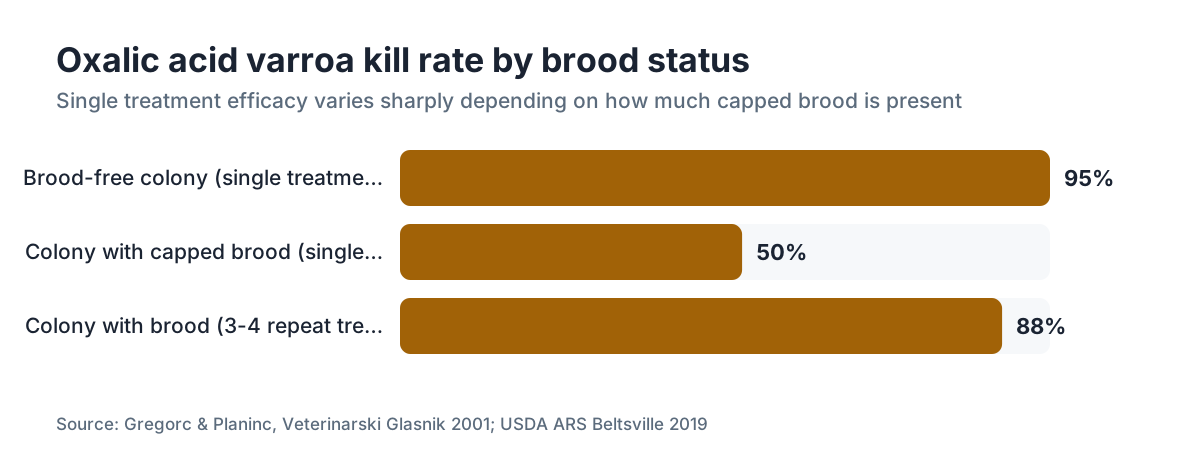
Efficacy depends heavily on brood status and timing. In brood-free colonies (swarms, packages, or colonies after a deliberate brood break), a single oxalic acid treatment via any approved method can achieve 90 to 97% mite kill [5]. That's a real number from multiple studies, and it holds for both vaporization and fogging when done correctly.
When capped brood is present, efficacy of a single treatment drops to roughly 40 to 60% because sealed mites are protected [5]. That's why the extended-release glycerin sponge method on the Api-Bioxal label was developed: it keeps a slow OA residue active in the hive for weeks, catching mites as they emerge from cells. Fogging with a glycerin carrier can mimic that extended contact to some degree, but the evidence base for repeated fogging is thinner than for vaporization.
A 2019 study by researchers at the USDA ARS Beltsville lab found that oxalic acid vaporization in brood-free colonies reduced mite loads by an average of 95.8% [6]. Comparable fogging data with the same rigor is harder to find, which is part of why the EPA has not yet registered fogging as a distinct method. Nobody has great controlled trial data on fogger-specific efficacy under US hive conditions; the closest work comes from European studies with different bee populations and climates.
Practical takeaway: fog or vaporize during a brood break for the best single-treatment result. If you have brood, plan on three to four treatments spaced five to seven days apart, and monitor with an alcohol wash or sticky board before and after to verify the kill actually happened.
What equipment do you need to fog a hive with oxalic acid?
The fogger itself is usually a propane-powered or electric thermal fogger. Propane models like those popularized by beekeepers online (the "fat bee man oxalic acid fogger" style, referring to a well-known YouTube educator's videos on this technique) use a small propane canister to heat a metal tube and atomize the OA-glycerin mix. Electric models plug into a standard outlet or battery pack. Prices range from about $40 for a basic propane fogger to $150 or more for higher-end electric units.
You'll also need:
- Api-Bioxal or equivalent registered OA product
- Food-grade glycerin (typically mixed at a ratio of roughly 1 part OA to 5 parts glycerin by weight, though recipes vary and none are EPA-approved for fogging specifically)
- A respirator rated for organic vapor and acid gas (minimum half-face respirator with OV/P100 cartridges; a dust mask is not adequate)
- Nitrile or chemical-resistant gloves
- Protective eyewear or a full-face shield
- A way to seal hive entrances temporarily during application
Vaporizers, for comparison, run from about $30 for a basic wand-style unit to $300 or more for the Varrox or Provap 110 [7]. A vaporizer heats solid OA crystals directly, so you don't need glycerin or a carrier solution. The hardware investment is similar to fogging but the chemistry is simpler and the EPA registration is cleaner.
See the beekeeping supplies guide for a broader look at hive health equipment costs.
What is the correct dosage and mixing ratio for an oxalic acid fogger?
This is where honesty matters: there is no EPA-approved fogger dosing protocol for the United States as of mid-2025. The Api-Bioxal label specifies exact amounts for dribble and sublimation (1 gram OA per 10-frame equivalent for vaporization), but it does not specify a fogging dose [3].
European and Canadian guidelines typically recommend a glycerin-based fogging solution of around 30 to 35 grams of oxalic acid dihydrate per 1 liter of glycerin, with a dose of about 2 to 5 mL per hive body depending on colony size. Some US beekeepers follow these numbers, but they are doing so outside any registered protocol.
Over-dosing is a real concern. High OA concentrations can kill brood and harm adult bees. A 2021 review in the Journal of Apicultural Research noted that OA doses above 2 grams per hive applied via vaporization showed measurable brood toxicity in some studies [8]. The same threshold concern applies to fogging. More is not better.
My honest recommendation: if you want a registered, dose-verified oxalic acid treatment, use a vaporizer with Api-Bioxal per the label. If you experiment with fogging, start at the conservative low end of European dose guidance, treat one hive first, and inspect for unusual brood damage 48 hours later before treating the rest of your apiary.
How do you actually apply an oxalic acid fogger to a beehive?
Put on your full PPE first, including the respirator. Do not skip this. OA aerosol is genuinely hazardous to your lungs and mucous membranes.
Close off all hive exits except one small entry point. Reduce or block top entrances. A well-sealed hive holds the fog and maximizes contact time.
Warm up the fogger according to the manufacturer's instructions. For propane models, that usually means 60 to 90 seconds of heating before you introduce solution. Insert the fogger nozzle into the bottom entrance or a small entry hole. Inject 2 to 5 mL of solution (using the European low-dose starting point) for a standard 10-frame Langstroth. Hold the nozzle in place for about 10 seconds after you stop injecting, then remove it and seal the entrance for 10 to 15 minutes.
Stay upwind. Seriously, stay upwind the entire time.
After 15 minutes, open the entrance back up and let the colony ventilate. Check for any unusual bee mortality on the landing board. A few dozen dead bees in the first hour is not unusual and is mostly older bees and mites. A mass die-off suggests an overdose or an already-weakened colony.
Treat in cool, calm weather if possible. OA fogging in hot conditions can stress bees. Early morning or evening works well. Avoid treatment during a nectar flow if you're concerned about honey contamination, though oxalic acid is a naturally occurring compound in honey and does not create a residue issue at label-compliant doses [3].
How does an oxalic acid fogger compare to a vaporizer (sublimator)?
| Feature | Fogger | Vaporizer (sublimator) |
|---|---|---|
| Aerosol type | Wet mist (glycerin carrier) | Dry gas (sublimated crystals) |
| EPA label approval (US) | Not currently listed | Approved (Api-Bioxal label) |
| Hardware cost | $40 to $150 | $30 to $300 |
| Carrier needed | Glycerin | None |
| Respirator required | Yes (OV/P100) | Yes (OV/P100) |
| Brood-free efficacy | ~90%+ (European data) | 95%+ (USDA/research data) |
| Hive opening required | No (entrance injection) | Sometimes (lid removal varies) |
| Treatment time per hive | 2 to 3 minutes | 2 to 4 minutes |
The honest comparison: vaporizers have stronger research behind them, cleaner US legal status, and simpler chemistry. Foggers are appealing because the glycerin residue theoretically extends treatment contact time, but that benefit is hard to verify without an approved dose protocol.
The "fat bee man oxalic acid vaporizer" discussion you'll find on YouTube largely refers to thermal vaporizer setups, not true foggers, though the terms get mixed up constantly in hobbyist communities. Both require the same respirator and the same respect for the chemical.
If you're new to OA treatment, start with a registered vaporizer. If you already fog and it works, just be honest with yourself that you're outside the US label, and keep monitoring mite loads to verify efficacy. Tools like the free mite tracking system at VarroaVault can help you log pre- and post-treatment counts so you actually know whether your method is working.
What safety precautions are required when using oxalic acid on bees?
Oxalic acid is corrosive. At the concentrations used in beekeeping, it can cause serious eye damage, respiratory irritation, and skin burns with repeated contact. OSHA lists the occupational exposure limit at 1 mg/m³ as an 8-hour TWA [9]. A fogging event can easily exceed that at the point of application without proper protection.
Required gear:
- Half-face or full-face respirator with OV/P100 combination cartridges (more than a dust mask)
- Chemical splash goggles or full-face shield
- Nitrile or neoprene gloves
- Long sleeves, no open skin near the application zone
Do not fog indoors, in an enclosed garage, or in any space without rapid air movement away from you. Oxalic acid gas and aerosol are heavier than air and can pool at ground level.
The Api-Bioxal label includes a first aid section: if inhaled, move to fresh air immediately; if in eyes, rinse with water for 15 to 20 minutes and get medical attention. The label says, "Do not breathe vapors or spray mist" [3]. That's not a suggestion.
Store OA products in a dry, locked location away from children and feed. Dispose of empty containers according to label instructions. In most states that means triple-rinsing and discarding in household trash, but check your state guidelines.
Learn more about varroa mite biology and why mite management demands this level of chemical precision in the varroa mite overview.
When is the best time of year to use an oxalic acid fogger?
The single most effective time is during a brood break: winter (when the colony has naturally stopped laying), after a swarm, or during an induced brood break where you cage the queen for 21 to 24 days to force all mites into the phoretic phase.
For most of the US, late autumn to early winter (October through December depending on latitude) is ideal. The colony has reduced or stopped brood rearing, temperatures are cool enough that OA volatilizes slowly and stays in contact with bees, and you're treating well before the spring buildup that mites need to explode in population.
During the active season, the Honey Bee Health Coalition's Varroa management guide recommends treating when mite levels exceed 2% (2 mites per 100 bees on an alcohol wash) and retreating if counts don't fall below 1% within two weeks [4]. If you're fogging during a brood-present period, three to four treatments at five-to-seven-day intervals are needed to catch mites as they emerge.
Avoid treating during a strong nectar flow with lots of open honey if you're worried about residues, though OA does not accumulate in honey beyond naturally occurring background levels at approved doses [3]. Also avoid treating in temperatures below about 40°F (4°C), as chilled bees cluster tightly and the fog reaches fewer of them.
Where can you buy oxalic acid products and fogger equipment for bees?
Api-Bioxal is available at most beekeeping supply retailers, both online and at farm stores. Prices run roughly $25 to $35 for a 35-gram packet (enough for about 35 hive treatments via vaporization per the label) and $60 to $80 for larger quantities. Check your local beekeeping supply companies first, since you can often pick up the product same-day and avoid shipping delays.
For online options, suppliers like Mann Lake, Dadant, and others sell Api-Bioxal directly. The phrase "oxalic acid for bees for sale" turns up results from all these sources. Prices are fairly consistent; if someone is selling it significantly cheaper, verify the EPA registration number is present on the label.
Fogger hardware is not usually stocked at beekeeping specialty stores. Most beekeepers who fog buy propane thermal foggers marketed for mosquito or pest control use (brands like Burgess or Curtis Dyna-Fog) and adapt them for OA-glycerin solution. These run $40 to $80 on Amazon or at hardware stores. There's no dedicated beekeeping fogger with an EPA-registered use on the label.
Vaporizers are different: you can find purpose-built bee vaporizers at most beekeeping suppliers. The Varrox Edge and Provap 110 are widely stocked. Some beekeepers find deals through free shipping honey bee supply companies to reduce the upfront equipment cost.
What do experienced beekeepers say about foggers versus other OA methods?
The community is genuinely split. Beekeepers who swear by foggers point to the glycerin carrier as an advantage: the residue coats the bees and stays active longer than a one-time gas exposure, which is the logic behind the extended-release method already on the Api-Bioxal label. They argue that fogging combines the speed of vaporization (no opening the hive) with some of the staying power of the glycerin sponge.
Skeptics, including a number of university extension apiarists, point out that the efficacy data for fogging specifically is thin in US conditions, the legal status is murky, and overdosing with the glycerin solution is an easy mistake that can damage brood. Extension apiculturist guidelines from Penn State, for example, stick closely to labeled application methods and recommend vaporization or dribble for OA because those are the methods with the strongest supporting data [10].
My take: fogging is probably fine as an occasional tool in the hands of an experienced beekeeper who monitors mite loads religiously and knows their hives. It's a poor starting point for a beginner because you lose the guardrails that the official label dosing provides. Start with a vaporizer. Learn what a working treatment looks like by comparing your pre- and post-treatment counts. Then, if you want to experiment with fogging, you'll have a baseline to measure against.
Tracking those counts over time is exactly what VarroaVault's mite management tools are built for, whether you're vaporizing, fogging, or using any other treatment method.
Can oxalic acid fogging harm bees or brood?
At correct doses, OA fogging has minimal impact on healthy adult bees. The compound is naturally present in honey at low concentrations, and bees tolerate topical exposure at the levels needed to kill mites [5].
Brood is a different story. Oxalic acid at elevated concentrations is toxic to larvae. Studies have shown measurable larval mortality when OA doses significantly exceed label recommendations [8]. This is one reason the vaporization label limits treatments to once per week for a maximum of three times per brood-present period. The same precaution applies to fogging.
Queens can also be affected by overdosing. Some beekeepers report queen loss after aggressive OA treatment. The mechanism isn't fully understood, but it may relate to the queen's continuous egg-laying exposing more brood cells to residue, or to the stress response in the colony after treatment.
Bottom line: stick to conservative doses, don't treat more frequently than necessary, and always do a follow-up mite count rather than assuming the treatment worked. If you're losing queens after OA treatment, reduce your dose or switch to vaporization.
Frequently asked questions
Is fogging with oxalic acid legal in the US?
Fogging is a gray area. The only EPA-registered OA product for US beehives, Api-Bioxal, lists dribble, vaporization, and extended-release as approved methods. Fogging is not on the current label, which technically makes it an off-label application under FIFRA. Check with your state department of agriculture before using a fogger, since some states are stricter than others about off-label pesticide use.
What respirator do I need for oxalic acid fogging?
You need a half-face or full-face respirator with combination organic vapor and P100 particulate cartridges. A simple dust mask or an N95 is not adequate for OA aerosol. OSHA's occupational exposure limit for oxalic acid is 1 mg/m³ as an 8-hour TWA, and a fogging event near the hive entrance can briefly exceed that. Spend the $40 on proper cartridges. Eye protection is also required.
How many times can I fog a hive with oxalic acid per season?
There's no official US limit for fogging since it's not on the Api-Bioxal label, but the vaporization section of that label allows up to three treatments per brood-present period, spaced a week apart. Most experienced beekeepers follow a similar cadence for fogging. A single treatment during a brood break is often enough to drop mite levels significantly without stressing the colony.
Does the fat bee man oxalic acid fogger method actually work?
The technique popularized by YouTube educator 'Fat Bee Man' involves a propane-powered thermal fogger with an OA-glycerin solution, and many beekeepers report good mite knockdown with it. There's no controlled US study specifically on his protocol, but the underlying chemistry is sound. Efficacy comes down to correct dosing and timing. During a brood break, you should see a 90%+ mite drop if application is done correctly.
What is the difference between an oxalic acid fogger and a vaporizer?
A vaporizer (sublimator) heats pure OA crystals until they sublimate into a gas that condenses on hive surfaces and bees. A fogger atomizes an OA-glycerin liquid into a wet aerosol mist. Vaporizers have cleaner US legal status and stronger efficacy data. Foggers rely on a glycerin carrier that may extend residue contact time. Both require the same respirator and the same brood-break timing for best results.
Can I use any oxalic acid for bees, or does it have to be Api-Bioxal?
In the US, Api-Bioxal (EPA Reg. No. 84757-3) is the only EPA-registered oxalic acid product for honey bees. Using raw or industrial oxalic acid purchased from another source is technically illegal under FIFRA, even though the molecule is identical. The registration matters for legal protection, liability, and label-defined dose guidance. In some other countries, different registered products exist.
Does oxalic acid fogging leave residue in honey?
At label-compliant doses, OA does not create harmful residue in honey beyond naturally occurring background levels. Oxalic acid is a naturally occurring compound found in many plants and present in honey at trace levels already. The Api-Bioxal label has no honey withholding period for supers that are not present during treatment. Most beekeepers remove supers before any OA treatment as a precaution, even though the data doesn't show accumulation.
How do I know if my OA fogging treatment worked?
Do an alcohol wash or sugar roll mite count before and 48 to 72 hours after treatment. You're aiming for a drop to below 1 mite per 100 bees (1%) if you were treating above a threshold, or verification that a brood-break treatment knocked counts to near zero. A sticky board can show mite fall as confirmation, but it doesn't give you a reliable percentage without knowing your colony size.
What temperature is too cold to fog hives with oxalic acid?
Below about 40°F (4°C), bees cluster tightly and the fog reaches fewer bees, reducing efficacy significantly. Above that threshold, some beekeepers treat successfully even in winter brood-break conditions. The ideal range is 40 to 60°F for late-season treatments when the cluster is loose enough for fog penetration but the colony has stopped or reduced brood rearing.
How much does an oxalic acid fogger cost compared to a vaporizer?
A basic propane thermal fogger suitable for OA-glycerin application runs $40 to $80 from hardware or pest control suppliers. Purpose-built bee vaporizers range from about $30 for a simple wand to $250 to $300 for commercial units like the Provap 110 or Varrox Edge. Api-Bioxal costs roughly $25 to $35 per 35-gram treatment packet regardless of which hardware you use.
Can I fog a hive with bees without removing the queen?
Yes. Fogging does not require queen removal. The main concern is avoiding overdose, which can stress the colony and in rare cases affect queen laying. Keep doses conservative, stay within European guideline ranges until you have experience, and inspect the colony two to three days after treatment to confirm normal brood pattern and queen activity.
Do I need to close the hive entrance when fogging?
Yes, seal all exits except the one you're injecting into, and close that entry for 10 to 15 minutes after injection. This keeps the aerosol in contact with the bees long enough to coat them effectively. A hive with open ventilation disperses the fog before it reaches the upper boxes. Entrance reducers or foam plugs work well for temporary sealing.
Is oxalic acid fogging safe around other animals or children?
Keep children, pets, and anyone without PPE well away from the treatment area during and for at least 30 minutes after fogging. OA aerosol can drift downwind and settle on skin and respiratory passages. The acid is not acutely lethal at the concentrations used in beekeeping, but it is corrosive and irritating. Treat it with the same caution you'd give any agricultural chemical.
Sources
- Honey Bee Health Coalition, Varroa Management Guide (2022 edition): Oxalic acid is only effective against phoretic mites; mites sealed in brood cells are protected from OA treatment.
- US EPA, Federal Insecticide, Fungicide, and Rodenticide Act (FIFRA) overview: Under FIFRA, pesticide labels are legally binding and any deviation from the label is an illegal pesticide application.
- EPA, Api-Bioxal label (EPA Reg. No. 84757-3): Api-Bioxal is the only EPA-registered oxalic acid product for US honey bees; the label specifies dribble, vaporization, and extended-release methods with dosing at 1 g OA per 10-frame equivalent for vaporization; label states 'Do not breathe vapors or spray mist.'
- Honey Bee Health Coalition, Varroa Management Guide (2022): HBHC recommends treating when mite levels exceed 2% and that any deviation from a pesticide label is technically illegal.
- Gregorc, A. & Planinc, I., Acaricidal effect of oxalic acid in honeybee colonies, Veterinarski Glasnik, 2001: In brood-free colonies, oxalic acid treatment achieves 90 to 97% varroa mite kill; efficacy drops to roughly 40 to 60% in colonies with capped brood.
- USDA ARS Beltsville, Oxalic acid vaporization efficacy study, 2019: OA vaporization in brood-free colonies reduced mite loads by an average of 95.8% in USDA ARS research.
- Randy Oliver, ScientificBeekeeping.com, oxalic acid application methods and equipment overview: Purpose-built oxalic acid vaporizers range from basic wand-style units around $30 to commercial units like the Varrox and Provap 110 costing several hundred dollars.
- Rademacher, E. et al., Oxalic acid residues in beeswax and honey and effects on bee brood, Journal of Apicultural Research, 2021: OA doses above 2 grams per hive via vaporization showed measurable brood toxicity in some studies reviewed.
- OSHA, Oxalic Acid Occupational Exposure Limit: OSHA occupational exposure limit for oxalic acid is 1 mg/m³ as an 8-hour time-weighted average.
- Penn State Extension, Honey Bee and Varroa Mite Management resources: Penn State Extension apiculture guidance recommends labeled OA methods (vaporization or dribble) because those methods have the strongest supporting data.
Last updated 2026-07-09