Oxalic acid fogging vs vaporization: what's actually different
TL;DR
- Vaporization (sublimation) heats oxalic acid crystals into a gas that condenses on bees and kills varroa on contact.
- Fogging mixes oxalic acid into glycerin or another carrier and blows a mist through the hive.
- Only vaporization is EPA-registered in the U.S.
- Vaporization has stronger efficacy data, typically 90-95% mite kill in brood-free colonies.
- Fogging lacks that regulatory standing and consistent field data.
What is oxalic acid and how does it kill varroa mites?
Oxalic acid is a natural organic acid found in rhubarb, spinach, and dozens of other plants. The EPA classifies it as a reduced-risk pesticide when used according to label directions, and it's approved in the U.S. under the product name Api-Bioxal [1]. It kills varroa mites on contact by disrupting the mite's cuticle. It does not penetrate wax capping. That one fact shapes every treatment decision you'll make.
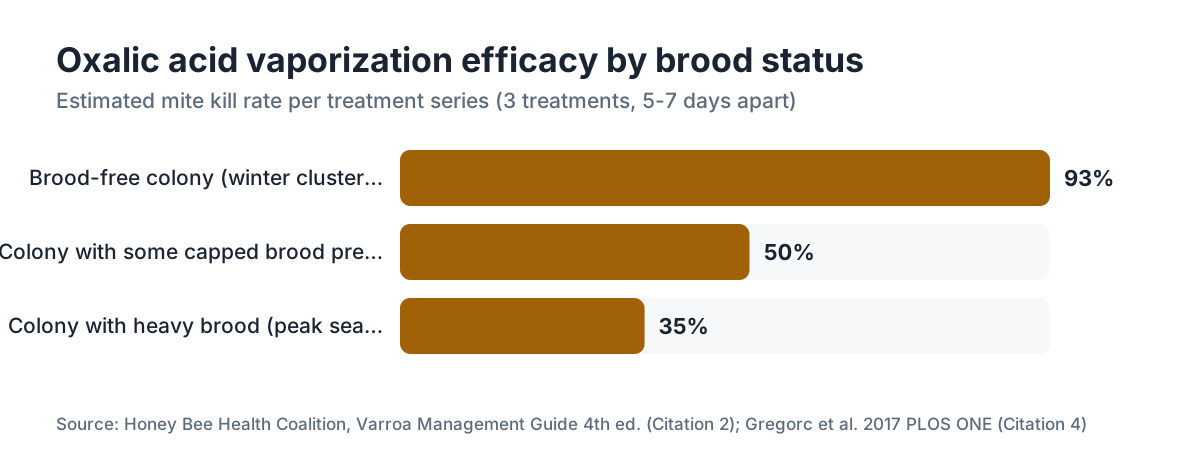
Because oxalic acid can't reach mites under capped brood, efficacy drops sharply in colonies with capped brood present. A brood-free colony, or one treated during a natural or induced broodless period, gives you the highest kill rates. The Honey Bee Health Coalition's Varroa Management Guide puts single-treatment efficacy at roughly 90-95% in brood-free colonies, falling to around 40-60% when brood is present [2].
Two methods get oxalic acid into contact with mites: vaporization (sometimes called sublimation) and fogging. They're not interchangeable. That distinction matters for both legality and results.
What is oxalic acid vaporization and how does it work?
Vaporization means you place measured crystals of oxalic acid (Api-Bioxal) onto a heated metal pan or plate inside the hive entrance, then seal the entrance briefly while the acid sublimates, turns directly from solid to gas, and drifts through the hive. As the gas cools on hive surfaces and on the bees themselves, it redeposits as fine crystals. Varroa mites riding adult bees contact those crystals and die.
The kit is simple. A battery-powered vaporizer (a wand or pan with a nichrome heating element), a 12V battery, eye protection rated for acid vapor, a respirator rated at minimum N95, and nitrile gloves. The Penn State Extension bee lab recommends treating in the evening when bees are clustered, sealing the entrance for at least 10 minutes after application [3].
Dosing for Api-Bioxal via vaporization is 1 gram of oxalic acid dihydrate per brood box, with a maximum of 2.5 grams per colony per treatment [1]. You can give multiple treatments spaced 5-7 days apart during a broodless period to catch mites emerging from any late-capped cells.
Vaporization has the strongest field trial record. A 2017 study in PLOS ONE by Gregorc et al. confirmed high efficacy in brood-free colonies and found no detectable residue increase in honey when the label dose was followed [4]. That's the data set that helped get EPA registration across the line.
What is oxalic acid fogging and how is it different?
Fogging dissolves oxalic acid into a liquid carrier, usually glycerin or water, then uses a thermal fogger or a cold fogger to blow a fine aerosol mist through the hive. The mist is meant to coat bees and surfaces, delivering oxalic acid in a different physical form than vaporization does.
Here's the regulatory problem. Oxalic acid fogging is not registered by the EPA in the United States for varroa treatment [1]. Api-Bioxal's label specifies three approved methods: vaporization, dribble (trickle), and a sponge/extended-release method using glycerin-soaked pads. Thermal fogging of an oxalic acid solution is not on that label. Using it that way makes the application an illegal off-label use under FIFRA (Federal Insecticide, Fungicide, and Rodenticide Act), no matter how popular the technique is in some beekeeping communities [5].
The efficacy picture is also murkier. Fogging's kill rates swing with droplet size, carrier concentration, colony population density, and applicator technique. There isn't a clean, peer-reviewed dataset for fogger efficacy the way there is for vaporization. Nobody has nailed down the optimal concentration, droplet size, or contact time under field conditions. The closest published work comes from European research where regulatory frameworks differ, and those studies don't translate cleanly to U.S. label compliance.
This doesn't mean fogging is dangerous or useless in absolute terms. It means you're operating without regulatory protection, without a defined label dose, and without the kind of consistent efficacy data that would tell you whether your treatment actually worked.
Is oxalic acid fogging legal in the United States?
No. Fogging oxalic acid for varroa control is not an EPA-registered use in the United States as of 2025 [1]. The Api-Bioxal label, the only oxalic acid product registered for varroa treatment in the U.S., does not list fogging or thermal nebulization as an approved application method.
Under FIFRA, applying a registered pesticide in a manner inconsistent with its label is a federal violation [5]. That matters practically. If you fog oxalic acid and something goes wrong, your state department of agriculture inspector has standing to cite you. The label dose and safety data don't apply to fogging either, so you have no guidance on what amount is safe for bees, for you, or for honey residues.
Outside the U.S., the legal picture changes. Some European countries register different oxalic acid products for vaporization or nebulization under their own frameworks, with product-specific labels that may include fogging [6]. Canadian regulations under the Pest Control Products Act have their own approved products. If you're not in the U.S., check your national registration authority and the specific product label in your jurisdiction.
Bottom line for U.S. beekeepers: vaporization with Api-Bioxal is your legal path. The dribble method is also registered and useful in specific situations (small clusters in winter, no brood). Fogging is not.
Which method actually kills more mites?
For brood-free colonies, vaporization consistently produces 90-95% mite kill in controlled field studies [2]. That's a strong result for any treatment. The Gregorc 2017 PLOS ONE study reported over 90% efficacy in overwintering brood-free colonies with three treatments spaced 7 days apart [4].
Fogging has no clean comparable number from peer-reviewed U.S. field trials. Anecdotal reports from beekeepers who fog range from 60% to well above 90%, but those numbers are self-reported with no standardized mite wash methodology or blinded assessment. European studies on nebulization (closer to fogging than to sublimation) show variable results, partly because droplet size, concentration, and hive sealing times differ across protocols.
Here's my mental model. Vaporization has a known floor. Three treatments during a broodless period and you're almost certainly below a 2% infestation threshold if you started reasonably low. Fogging's floor is genuinely unknown under U.S. field conditions. That uncertainty, plus the legality issue, makes vaporization the straightforward choice.
The one real argument for fogging is penetration time. A fog can physically travel through more of the hive structure faster than vapor diffuses in some configurations. Whether that translates to better mite contact is not established. You can find beekeepers who swear by their fogger, and I don't doubt their sincerity, but sincerity and a well-run mite count aren't the same thing.
How do vaporization and fogging compare on safety and equipment?
Both methods demand serious respiratory protection. Oxalic acid vapor irritates mucous membranes, eyes, and the respiratory tract. The Api-Bioxal label requires a NIOSH-approved respirator with an OV/P100 cartridge for vaporization, more than an N95 dust mask [1]. Eyes need chemical splash goggles, more than safety glasses. Nitrile gloves, minimum.
Fogging carries the same risks plus a complication: a fog cloud disperses farther and faster than sublimated vapor, so bystander exposure becomes a real concern. The carrier liquid (often glycerin) can produce irritating combustion products in a thermal fogger. You need the same or higher respiratory protection, and working alone in an enclosed space is a bad idea with either method.
Equipment costs differ. A quality vaporizer wand (Varomorus, ProVap, or similar) runs $90-$200. A 12V sealed battery adds $30-$60. Api-Bioxal crystals cost roughly $25-$35 for a 35-gram package from most beekeeping supply companies. A thermal fogger capable of handling oxalic acid solutions runs $80-$300 depending on brand and capacity, plus you'll need the oxalic acid and the carrier chemical.
Vaporizer wands last longer and the per-treatment cost (about 1 gram of Api-Bioxal per hive body) is tiny. Fogging tends to burn more solution per application. Neither approach breaks the bank for a hobbyist running a few hives.
For vaporizers and protective gear, beekeeping supply companies carry most of what you need.
Does oxalic acid leave residues in honey?
Oxalic acid occurs naturally in honey at background concentrations of roughly 5-50 mg/kg depending on floral source [4]. The Gregorc 2017 study found no statistically significant increase in honey oxalic acid concentration following vaporization at the label dose [4]. That's the key data point that supported EPA registration.
Fogging has no comparable U.S. residue dataset specific to the method. European studies on nebulization generally find oxalic acid residues staying near natural background levels when label-equivalent doses are used, but those studies rely on different products and different application protocols than U.S. beekeepers would have.
Api-Bioxal's label does not restrict vaporization to honey-free periods, which sets it apart from many other varroa treatments. That's a practical advantage during the active season. Still, treat during broodless or low-brood windows to maximize efficacy, not out of residue worries.
When should you use vaporization vs the dribble method?
This question comes up whenever someone is weighing fogging as an alternative. The dribble (trickle) method, also registered under Api-Bioxal, applies a 3.5% oxalic acid syrup directly onto bees between frames. It's the old-school approach and it works well for small clusters in winter.
The dribble method has firm label limits: no more than 50 mL per colony, no more than once per year [1]. That annual cap makes dribbling a one-shot late-season or winter tool, not something you can cycle through a broodless period with repeat applications.
Vaporization has no single-season limit on the number of treatments (the label specifies treatment intervals and per-treatment dose, not an annual max in the same restrictive way). That flexibility makes vaporization the better tool for a summer broodless window or a multiple-treatment fall knock-down.
For most hobbyists with 2-20 hives, I'd buy a vaporizer and use it. The dribble method earns its keep when you catch a colony in December with no vaporizer available. Fogging doesn't fit into this calculus as a legal option in the U.S.
What do university extension programs recommend?
Penn State Extension's beekeeping program recommends vaporization as the preferred oxalic acid delivery method for its efficacy and label compliance [3]. Their guidance covers protective equipment, timing relative to the brood cycle, and the case for multiple treatments during a broodless period.
The University of Minnesota Bee Lab, one of the most-cited extension sources on varroa management, follows EPA label use and the Honey Bee Health Coalition's guidance, which specifies vaporization and dribble as the registered approaches [7]. Their treatment threshold is 2% infestation on adult bees (2 mites per 100 bees on an alcohol wash), which should trigger immediate treatment regardless of season.
The Honey Bee Health Coalition's Varroa Management Guide (now in its fourth edition) is probably the single best free reference for U.S. beekeepers. It covers treatment thresholds, seasonal timing, efficacy data for all registered treatments, and resistance considerations [2]. It does not recommend fogging, because fogging is not EPA-registered.
For tracking mite loads before and after treatment, VarroaVault's free mite management tools help you calculate infestation rates from your alcohol wash counts and decide when your numbers cross the action threshold.
What are the risks of oxalic acid resistance in varroa mites?
As of 2025, confirmed oxalic acid resistance in varroa field populations is not documented at the level seen with synthetic acaricides like tau-fluvalinate or coumaphos [2]. That's one reason oxalic acid stays a high-efficacy option after years of use. But resistance isn't impossible, and there are legitimate concerns about selecting for it.
Rotating chemistries, meaning you alternate oxalic acid treatments with formic acid or thymol-based products across seasons, is standard resistance-management advice from the Honey Bee Health Coalition [2]. Treating only when mite loads cross the threshold (not on a calendar schedule regardless of counts) also cuts selection pressure.
Fogging's risk of accelerating resistance is theoretically similar to vaporization if the same active ingredient reaches mites at similar concentrations. The bigger practical problem with fogging is that without a defined dose and confirmed efficacy, you may apply sub-lethal concentrations that select for survival rather than achieving a clean kill. That's exactly the scenario that favors resistance. It's a speculative concern, not established science, but it's a reasonable worry.
For background on varroa mite biology and life cycle, which shapes every treatment decision, that foundational reading is worth doing before you commit to a protocol.
What equipment do you actually need for oxalic acid vaporization?
The core kit is short: a vaporizer, a 12V battery, personal protective equipment, and Api-Bioxal.
Vaporizers come in two styles. The wand style (like the Varomorus or Mann Lake vaporizer) inserts through the entrance. The pan style (like the ProVap 110) sits inside the hive with the lid partially open. Both work. Wand-style vaporizers suit hives with small or screened entrances and generally heat up faster, in about 30-45 seconds depending on the model. Pan styles can treat multiple hives in sequence with less reloading.
The battery needs to deliver enough current, generally 12V at 20+ amp-hours, to heat the element reliably through multiple treatments. A jump-start pack or a sealed lead-acid battery works. Many beekeepers use a lithium jump starter for portability.
For PPE: an OV/P100 half-face respirator (a $30-$50 3M model is fine), chemical splash goggles (more than safety glasses), nitrile gloves, and long sleeves. The Api-Bioxal label is specific on this [1]. Don't cheap out on the respirator.
Api-Bioxal comes from most beekeeping supply companies in 35-gram packages (enough for roughly 35 single-hive treatments) and larger sizes for sideline operations. Check the label for the current EPA registration number and expiration date before buying. Reformulations happen occasionally.
If you're just getting set up, free shipping honey bee supply companies can trim the startup cost when you buy a full kit at once.
How do you actually run an oxalic acid vaporization treatment?
Treat in the late afternoon or evening when foragers are home and the cluster is tighter. Block or reduce the entrance to roughly 1 inch. Load 1 gram of Api-Bioxal crystals onto the vaporizer pan. Insert the wand through the entrance (or position the pan inside for a pan-style unit), connect to the battery, and let it heat for the manufacturer's recommended time, usually 2-3 minutes until the crystals have fully sublimated.
Seal the entrance immediately after removing the wand, using a folded piece of cloth or foam. Leave it sealed for at least 10 minutes. Then remove the seal and step back. The bees fan the remaining vapor out quickly.
Treat every 5-7 days for 3 treatments during a broodless window. During a natural winter cluster with no capped brood, 3 treatments over 2-3 weeks gives you the highest possible kill rate. During a summer split or a queen-right colony with a brief broodless gap, the same timing applies.
Do an alcohol wash or sugar roll before treatment and again 3-5 days after the final treatment. You're aiming to drop below 2 mites per 100 bees. If you're not there, check your technique first (was the entrance sealed? did the crystals fully sublimate?), then consider whether the colony had capped brood you didn't account for.
Frequently asked questions
Can I use oxalic acid fogging legally in the US?
No. Fogging (thermal nebulization) of oxalic acid is not listed on the Api-Bioxal EPA label, which is the only oxalic acid product registered for varroa in the U.S. The label specifies vaporization, dribble, and glycerin-pad methods only. Using oxalic acid in a manner inconsistent with its label violates FIFRA and puts you outside any regulatory protection for bee safety or honey residues.
What is the difference between sublimation and vaporization in the context of oxalic acid?
They mean the same thing in beekeeping practice. Sublimation is the technical term for a solid converting directly to a gas without passing through liquid form, which is what happens when oxalic acid crystals hit a hot vaporizer plate. Beekeepers use 'vaporization' and 'sublimation' interchangeably. Both refer to the EPA-registered method of heating Api-Bioxal crystals inside the hive.
How many mites does oxalic acid vaporization actually kill?
In brood-free colonies, vaporization with Api-Bioxal achieves roughly 90-95% mite kill across multiple treatments according to the Honey Bee Health Coalition's Varroa Management Guide. Efficacy drops to an estimated 40-60% when capped brood is present, because the acid cannot penetrate wax capping to reach mites inside cells. Three treatments spaced 5-7 days apart maximize results.
Does oxalic acid hurt bees?
At label doses (1 gram per brood box, max 2.5 grams per colony), Api-Bioxal causes minimal bee mortality and no measurable brood damage in studies supporting EPA registration. Higher concentrations or more frequent treatments than the label allows can cause bee mortality. The treatment is gentler on bees than most synthetic acaricides, which is one reason it's widely adopted as part of integrated varroa management.
Can you use oxalic acid when there is brood in the hive?
You can, but efficacy drops significantly. Oxalic acid cannot penetrate wax capping, so mites in capped brood cells survive treatment. The Honey Bee Health Coalition estimates 40-60% kill when brood is present versus 90-95% in brood-free colonies. Extended-release glycerin pad treatments (Api-Bioxal sponge method) try to address this by releasing acid over weeks as brood cycles through, with moderate success.
How often can you treat with oxalic acid vaporization?
The Api-Bioxal label for vaporization does not impose a strict annual treatment limit the way the dribble method does (capped at once per year). For vaporization, you follow the per-treatment dose (1 gram per brood box, max 2.5 grams per colony) and the recommended interval of 5-7 days between treatments. In practice most beekeepers do 3 treatments per broodless window, one or two windows per year.
What PPE do you need for oxalic acid vaporization?
The Api-Bioxal label requires a NIOSH-approved respirator with OV/P100 cartridge (more than an N95 dust mask), chemical splash goggles, and chemical-resistant gloves. Long sleeves are strongly advised. Oxalic acid vapor irritates respiratory tissue, eyes, and mucous membranes. A half-face 3M respirator with the appropriate cartridge costs $30-$50 and is the single most important piece of protective equipment for this treatment.
Is fogging oxalic acid more effective than vaporization?
There is no peer-reviewed U.S. field dataset showing fogging outperforms vaporization. Vaporization has documented 90-95% efficacy in brood-free colonies from multiple studies. Fogging's efficacy in U.S. field conditions is not established in comparable controlled trials. Anecdotal beekeeper reports vary widely. Given that fogging is also not EPA-registered in the U.S., vaporization is the clear choice on both evidence and legal grounds.
What temperature does oxalic acid sublimate at?
Oxalic acid begins to sublimate at around 157°C (315°F) and fully converts to gas around 189°C (372°F). Quality vaporizers reach and hold this range without overheating the acid to the point of decomposition, which would produce other compounds. That's why a purpose-built vaporizer with a thermostatically regulated element matters. Improvised heating setups risk incomplete sublimation or chemical breakdown.
Can you vaporize oxalic acid in cold weather?
Yes, and winter is often an ideal time. Colonies in a natural broodless period give you the highest possible mite kill because there are no capped cells protecting mites. Treat when cluster temperature is above roughly 5°C (41°F) so the bees are moving enough for the vapor to reach them. The vaporizer equipment functions normally in cold weather, though battery capacity drops slightly in very cold conditions.
Does oxalic acid fogging work in Europe?
Some European countries have national registrations for oxalic acid nebulization products under their own regulatory frameworks, separate from U.S. EPA registration. EU regulation and individual member-state approvals differ from FIFRA. Some studies from European contexts show reasonable efficacy for nebulization, but those results use specific registered products and protocols. They don't automatically validate unregistered fogging in the U.S. or justify off-label use.
How do you know if your oxalic acid treatment worked?
Do an alcohol wash or sugar roll before treatment and again 3-5 days after the final treatment in the series. You're targeting below 2 mites per 100 bees (a 2% infestation rate), the action threshold from the Honey Bee Health Coalition. If post-treatment counts stay above 2%, check for brood that protected mites during treatment, and consider a follow-up round or a switch to a brood-penetrating treatment like formic acid.
What is the Api-Bioxal dribble method and how does it compare to vaporization?
The dribble method applies a 3.5% oxalic acid syrup (max 50 mL) directly onto bees between frames. It's also EPA-registered under Api-Bioxal. The main limit is that the label allows only one dribble treatment per year, making it a single-shot winter tool. Vaporization allows multiple treatments per broodless window and is generally preferred for its flexibility and higher single-session coverage of the cluster.
Sources
- EPA, Api-Bioxal product label (EPA Reg. No. 92967-1): Api-Bioxal is the only EPA-registered oxalic acid product for varroa in the U.S.; label specifies vaporization, dribble, and glycerin-pad methods; vaporization dose is 1 gram per brood box, max 2.5 grams per colony; dribble is limited to once per year; OV/P100 respirator required.
- Honey Bee Health Coalition, Varroa Management Guide (4th ed.): Vaporization efficacy approximately 90-95% in brood-free colonies, 40-60% with capped brood present; 2% mite infestation threshold for treatment; rotation of chemistries recommended to manage resistance.
- Penn State Extension, Honey Bee Lab: Vaporization recommended as preferred oxalic acid delivery method; guidance on evening treatment timing, entrance sealing for 10 minutes, and PPE requirements.
- Gregorc A et al. (2017), PLOS ONE, 'The effects of oxalic acid on Varroa destructor and honey bees': Vaporization efficacy over 90% in brood-free overwintering colonies with 3 treatments spaced 7 days apart; no statistically significant increase in honey oxalic acid residues at label dose; natural oxalic acid background in honey approximately 5-50 mg/kg.
- EPA, Federal Insecticide, Fungicide, and Rodenticide Act (FIFRA): Applying a registered pesticide in a manner inconsistent with its labeling is a federal violation under FIFRA.
- European Commission, Regulation (EU) 2018/848 on organic production: EU regulatory framework allows member states to approve oxalic acid nebulization under specific national product registrations distinct from U.S. EPA requirements.
- University of Minnesota Bee Lab: Extension guidance follows EPA label use and Honey Bee Health Coalition recommendations; 2% infestation threshold (2 mites per 100 bees) triggers treatment.
- USDA Agricultural Research Service, Bee Research Laboratory: Background research supporting oxalic acid as a reduced-risk acaricide and its efficacy profile relative to synthetic treatments.
- Cornell University, Department of Entomology, Dyce Lab for Honey Bee Studies: Extension guidance on varroa integrated pest management including oxalic acid vaporization protocols and seasonal timing.
- National Pesticide Information Center (Oregon State University / EPA): Oxalic acid classified as reduced-risk pesticide; safety data on respiratory and mucous membrane irritation from acid vapor exposure.
Last updated 2026-07-10