Oxalic acid glycerin sponge treatment: how it works and whether it's worth it
TL;DR
- Oxalic acid glycerin sponge treatment soaks cellulose sponges in a mixture of oxalic acid dihydrate and glycerin, then places them on top bars so bees contact and spread the acid through normal movement.
- Studies show 90-plus percent mite kill in broodless colonies and 70-90 percent in colonies with brood, with residual activity lasting 4-8 weeks per application.
- EPA-registered products exist; mixing your own is not federally legal.
What is the oxalic acid glycerin sponge method?
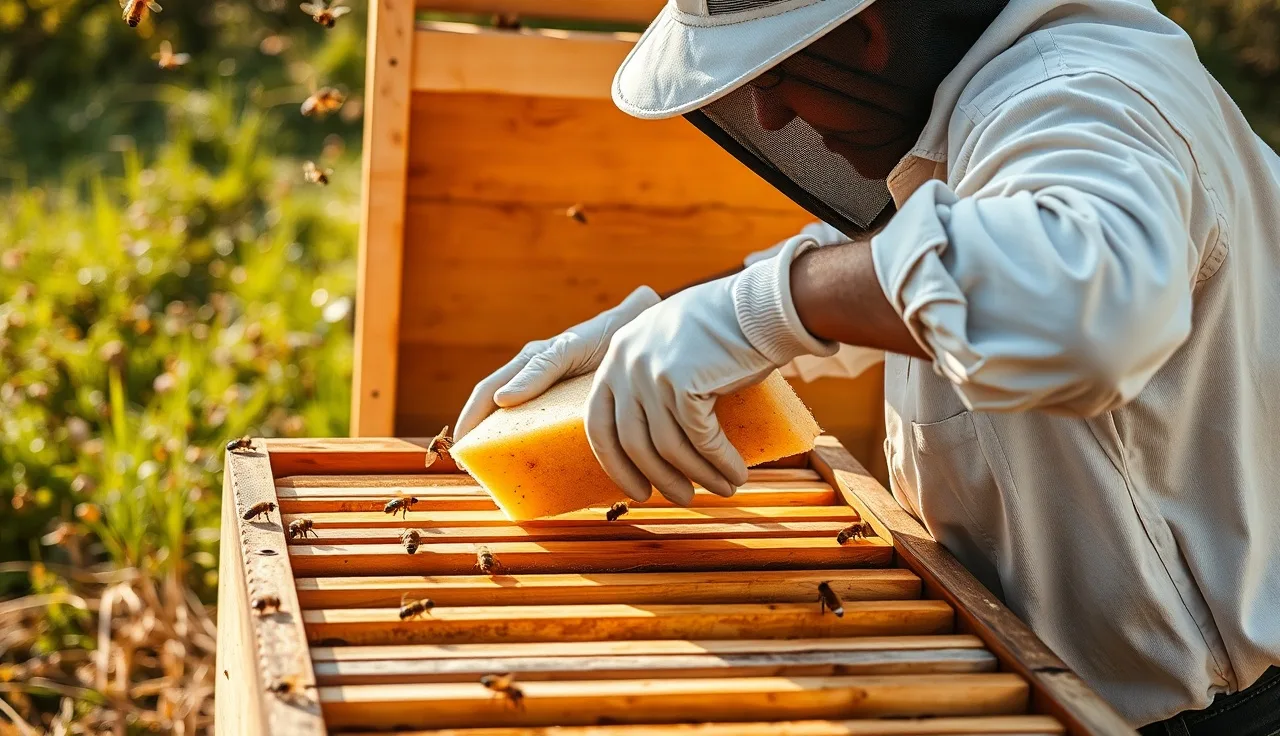
The oxalic acid glycerin sponge method is an extended-contact varroa treatment. You saturate an absorbent cellulose sponge (or a strip of sponge material) with a mixture of oxalic acid dihydrate and food-grade glycerin, then lay that sponge directly on the top bars of the brood nest. Bees walk across it, pick up microscopic amounts of oxalic acid on their body hairs, and spread it through normal contact in the cluster. The glycerin acts as a slow-release carrier, keeping the acid available on the sponge surface for weeks rather than minutes.
This is a different animal from oxalic acid dribble or vaporization. Dribble is a one-shot treatment that delivers acid directly to bees between frames. Vaporization sublimates crystals into gas that coats surfaces and bees. The sponge method sits between the two. It's slower than vapor, more passive than dribble, and it keeps working as bees move through the hive over multiple weeks.
The practical appeal is obvious. You don't need a vaporizer, you don't need to remove honey supers for most applications (check the specific product label), and you don't have to wait for a broodless period to get decent efficacy. That last point is what has driven so much beekeeper interest, because broodless windows are short, unpredictable, and hard to time in many climates.
Is the oxalic acid glycerin sponge method EPA-registered and legal to use?
Yes, with one qualifier that matters: you must use an EPA-registered product, and you cannot legally mix your own sponges from bulk oxalic acid and glycerin under federal law in the United States [1].
The EPA first registered a glycerin-based oxalic acid product for honey bees in 2015 under the broader oxalic acid registration. As of 2024, Api-Bioxal is the flagship registered product covering multiple application methods, including the extended-contact (sponge/towel) format added to the label through supplemental registration [2]. The label language specifically describes saturating cellulose material with a set ratio of oxalic acid to glycerin.
Some states layer their own pesticide registration requirements on top of federal EPA registration, so check your state department of agriculture before buying or applying. Plenty of beekeepers have used homemade mixtures for years, and the homemade versions do work, but they carry regulatory risk. More practically, you lose the label-specified formulation ratio that the efficacy data is built around.
The Honey Bee Health Coalition's Varroa Management Guide tells you to use only label-compliant products: "Always follow the pesticide label, which is a legal document" [3]. That's not a throwaway line. Label compliance matters for food safety, residue limits in honey and wax, and your legal protection if something goes wrong.
How do you make or prepare an oxalic acid glycerin sponge?
If you're using a commercial registered product, the preparation is done for you. Products following the Api-Bioxal supplemental label come pre-saturated or come with clear mixing instructions on the label. Follow them exactly.
Here's what the formulation looks like, because it helps you understand how the thing works. The typical ratio in registered products is roughly 1 part oxalic acid dihydrate by weight to 3-4 parts glycerin by weight, though the exact ratio varies by product and is spelled out on the label. The resulting mixture is thick, viscous, and faintly yellow. Cellulose kitchen sponges or polishing cloths work well as the substrate. Synthetic sponges don't absorb and hold the mixture the same way.
Application steps under a standard label protocol:
- Confirm the colony has bees actively moving across the top bars (the treatment only works if bees contact the sponge).
- Cut the sponge or cloth to cover roughly half to two-thirds of the top bars over the brood nest, not the full width of the box.
- Place the sponge directly on the top bars, centered over the cluster.
- Close the hive. No special PPE beyond what you'd use for any oxalic acid work: nitrile gloves, safety glasses, avoid inhaling dust.
- Leave it in place for the full treatment period (typically 4-8 weeks per the label; do not remove early).
Leaving the sponge too long is its own problem. Some label versions specify maximum placement duration and maximum number of applications per season, and you should treat those limits seriously because oxalic acid accumulates in wax at some rate, even if it degrades over time [4].
How effective is the glycerin sponge method against varroa mites?
The efficacy data is genuinely good but not uniform, and the variation changes how you plan your treatments.
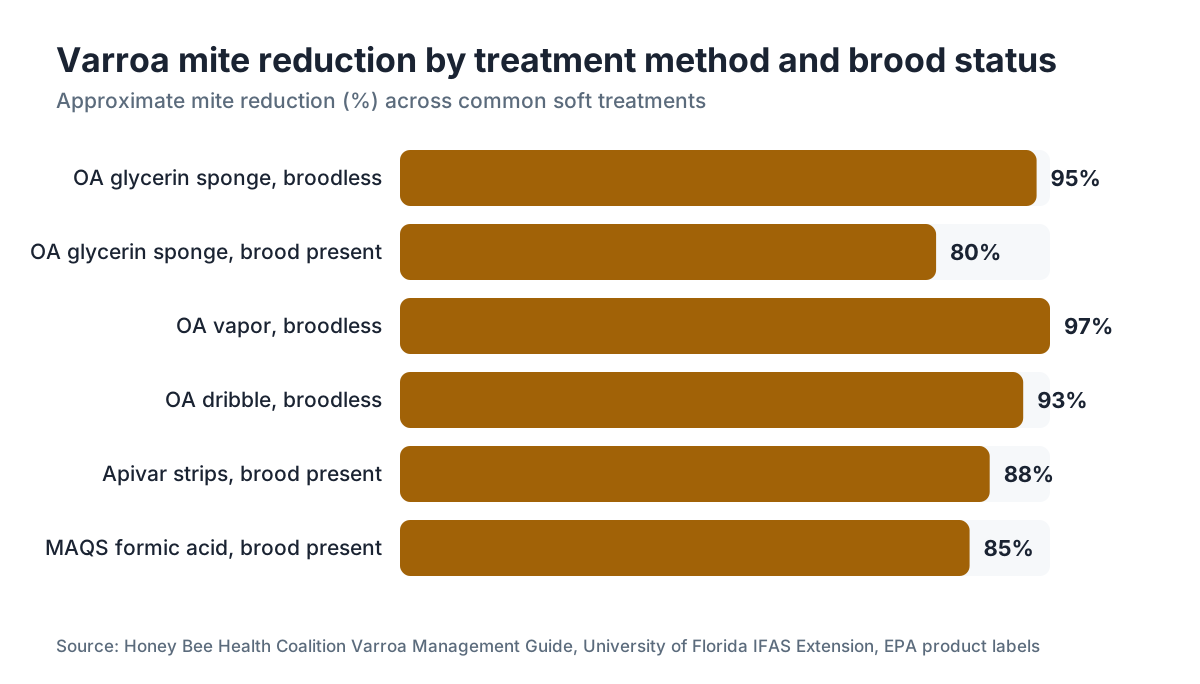
In broodless colonies, oxalic acid by any method works well because all mites are phoretic (on adult bees) and exposed to the acid. Studies have found 93-97 percent mite reduction in broodless colonies treated with extended-contact OA methods [5]. That's roughly on par with a well-timed vapor treatment on a broodless colony.
With brood present, the picture gets messier. Mites hiding in capped cells are protected from contact with the acid, so efficacy drops. Published data on extended-contact OA glycerin treatments in colonies with brood shows roughly 70-90 percent mite reduction over a 4-8 week treatment period, depending on the study, brood amount, colony size, and ambient temperature [6]. University of Florida IFAS extension work has reported that multiple sponge applications over a season can produce cumulative mite suppression competitive with other soft treatments, though no single application matches the knockout of a broodless vapor treatment [6].
The extended contact duration is what partly makes up for brood presence. As capped brood emerges over the weeks the sponge is in place, newly emerged bees and the mites riding them hit the treated surface before the mite can find a new cell. It's not perfect, but it's a real mechanism.
Temperature drives performance. Bees have to be actively moving across the top bars for contact transfer to happen. Below about 50°F (10°C), cluster movement slows, bees avoid the sponge surface, and efficacy drops hard. Above about 95°F (35°C), the glycerin mixture can turn overly fluid and drip, and bees may abandon the top bars from heat stress anyway.
| Treatment scenario | Approximate mite reduction | Source |
|---|---|---|
| OA glycerin sponge, broodless colony | 93-97% | Extended-contact OA trials [5] |
| OA glycerin sponge, brood present (single treatment) | 70-90% | University of Florida IFAS extension data [6] |
| OA vapor, broodless colony | 95-99% | Multiple published trials |
| OA dribble, broodless colony | 90-95% | HBHC Varroa Management Guide [3] |
| Apivar (amitraz) strips, with brood | 80-95% | Apivar label efficacy data [7] |
How does the glycerin sponge compare to oxalic acid vaporization?
This is the question most beekeepers actually care about, and the honest answer is this: vaporization is probably more effective per treatment on a broodless colony, but the sponge method has real advantages vaporization doesn't.
Vaporization delivers a high-concentration hit of OA gas that reaches bees across the whole hive in minutes, including cracks and clusters a sponge can't touch. But it's over fast, so it gives you no residual protection. You have to repeat treatments every 5-7 days during broodless periods to catch newly emerging bees, which means multiple hive entries and multiple vapor exposures for you.
The sponge method is a single placement that works for weeks. Run 30 hives and the labor math changes fast. One sponge placement per colony every 4-6 weeks versus 3-5 vapor treatments per colony per broodless window is a big difference in time and equipment cost.
The vaporizer itself is a real cost. A decent OA vaporizer runs $150-300 for a quality unit from most beekeeping supply companies, and you still need a power source in the field. Sponges add a few dollars per colony per treatment. Over a season, the sponge method is cheaper for beekeepers who don't already own a vaporizer.
Vapor wins clearly in three spots: emergency knockdowns, colonies with dangerously high mite loads where you need a fast high-percentage kill, and broodless winter clusters where vapor gets close to 99 percent in a single well-timed treatment. I'd still own a vaporizer if I ran more than 5 colonies, because some situations demand that speed. But the sponge method earns a real place in the rotation, especially for summer treatment when brood is always present.
When should you use the oxalic acid glycerin sponge method?
Summer is where this method makes the most sense. From roughly late spring through early fall in temperate North America, colonies raise brood continuously, so you can't get a broodless window to maximize vapor efficacy without manipulating the queen. Even if you do, mite loads rebound fast from incoming foragers.
The sponge method's extended contact window works for you here. Place a sponge in July, leave it for 6 weeks, then monitor your wash counts. That's a reasonable summer protocol. It matches the Honey Bee Health Coalition's guidance on integrated varroa management, which recommends planning treatments around the colony's brood cycle and mite infestation level [3].
Fall is a strong window too. Getting mite levels down before the winter bee generation is raised (roughly August through September in most of the U.S.) is one of the most important moves in varroa management. Long-lived winter bees that are heavily parasitized don't survive winter well, and the colony that comes out in spring is already compromised. A sponge placed in early August, left through mid-September, can carry the colony into its broodless fall period with much lower mite loads. University of Minnesota Bee Lab materials line up with this seasonal logic [10].
Winter use isn't recommended. At cluster temperatures below 50°F, bee movement across the top bars is minimal, contact transfer drops off, and you're wasting a sponge. Winter is the right time for vapor on a broodless cluster, not extended-contact methods.
Spring is workable but lower priority. Mite populations usually sit at their seasonal low in early spring, and the colony needs its energy for expansion. If your spring mite wash shows counts above 2 percent (2 mites per 100 bees), treat. If counts are under 1 percent, monitor and plan your summer treatment. You can read more about the varroa mite life cycle and what drives seasonal population swings in our coverage of mite biology.
What do you need to monitor mite levels before and after sponge treatment?
Treating without monitoring is guessing. You need a pre-treatment mite wash to know whether treatment is warranted and which method fits, and a post-treatment wash 4-6 weeks after placement to check whether it worked.
The two standard methods are the alcohol wash and the sugar roll. Alcohol wash is more accurate. The Honey Bee Health Coalition recommends sampling at least 300 bees (about half a cup) from the brood area, washing them in 70 percent isopropyl alcohol, and counting mites in the wash liquid [3]. An infestation rate above 2 percent (6 mites in a 300-bee sample) during the active season generally warrants treatment. Above 3 percent during the summer brood-raising period, treatment is urgent.
After a sponge treatment, don't expect your post-treatment wash to hit zero. With brood present during treatment, some mites finish their reproductive cycle in capped cells and emerge. A 70-80 percent reduction from your pre-treatment baseline is a reasonable outcome. Seeing less than 50 percent reduction points to one of three things: the treatment may not have made adequate contact (check sponge placement and bee traffic over it), the ambient temperature may have been too low, or the colony may have an unusually high brood-to-adult ratio that limited exposure.
VarroaVault has a free mite monitoring log and seasonal treatment calendar to track wash results and treatment timing across multiple colonies. It's the piece most hobbyist beekeepers skip and then regret in November.
Does the sponge method leave oxalic acid residues in honey or wax?
This is a legitimate concern and deserves a straight answer. Oxalic acid occurs naturally in honey at low concentrations, typically 8-40 mg/kg depending on floral source [4]. Treatment with oxalic acid does raise residues somewhat, but published research has found that oxalic acid residues in honey following label-compliant treatments stay within or near the natural background range, and they degrade over time.
A widely cited study by Bogdanov and colleagues in Apidologie found that oxalic acid residues in treated honey were not significantly elevated above background levels in honey harvested after the treatment period [4]. That's part of why the EPA and EFSA have accepted oxalic acid's safety profile for use in honey bee colonies.
Wax is a different story. Oxalic acid accumulates in beeswax more readily than in honey, and unlike some lipophilic treatments, it doesn't degrade out of wax as fast. The practical implication: don't treat with honey supers in place unless your specific product label explicitly permits it. The Api-Bioxal label has carried different language at different times on this point, so read the current version before applying. Most label versions require super removal or specify timing to keep harvestable honey clean.
Beeswax from treated hives can carry elevated oxalic acid levels, which matters if you sell wax or use it for lip balm and cosmetics. It doesn't appear to matter much for foundation reuse within your own apiary, but the data here is thinner than I'd like. Nobody has a great long-term dataset on accumulated OA in repeatedly treated wax.
What are the downsides and risks of the glycerin sponge method?
No treatment is perfect. Here's what can go wrong.
Bee avoidance is real. Some colonies, especially defensive or feral-type stock, will actively avoid the sponge, ball it up, or propolize around it to cut contact. If the bees aren't walking across it, you're getting no treatment. Check the sponge after 3-4 days and look for traffic. If it's propolis-coated and shoved to one side, that colony needs a different approach.
Queen issues show up in beekeeper reports, though the mechanism isn't nailed down in published literature. Queens laying across the top bars sit near the sponge, and some beekeepers report queen loss after sponge treatments, possibly from direct contact with high-concentration acid. Keeping the sponge over the outer frames rather than dead-center over the queen's main laying area may help. Here I'll hedge: the risk is probably real but probably low, and the published data doesn't give a clean number.
Residue accumulation in wax over repeated seasonal use is a genuine unknown. Treat 3 times a year with sponges for several years and the wax in that brood comb keeps picking up OA at some rate. I'd rotate old brood comb out as part of general hive hygiene regardless, and this is one more reason to do it.
Efficacy in large colonies with heavy brood can disappoint. A colony boiling with bees in July, nine frames of brood, has a huge share of its mite population sealed in capped cells at any moment, safe from contact treatment. The sponge won't reach them. You may need to pair sponge treatment with brood manipulation, a split, or a formic acid product that penetrates cappings.
One more thing. The method does nothing except kill varroa. It won't touch small hive beetles, nosema, or anything else. Diagnose before you treat.
How many sponge applications can you use per season?
The EPA-registered label for Api-Bioxal extended-contact application sets a maximum number of applications per colony per year. As of the most recent supplemental label, this is typically 1-2 applications per treatment period with specific timing restrictions. Read your product's current label, because the language has shifted through supplemental registrations and the number you remember from two years ago may be stale [2].
From a biological standpoint, you could argue for more frequent intervention if mite counts demand it, but label compliance isn't optional. Exceeding label application rates raises residue risk in wax and honey, and it strips your legal protection.
The practical answer for most hobbyist beekeepers running 5-20 colonies is one summer sponge treatment (July through August) combined with monitoring and, if needed, a fall vapor treatment during the broodless window. That combination covers the two most important intervention windows and uses each method where it's strongest. If your summer mite wash comes back at 4 percent or above and it's mid-June, don't wait for a sponge treatment. Hit it fast with something that penetrates brood like formic acid (MAQS or Formic Pro), or reach for an Apivar strip, then follow up with monitoring.
Where can you buy oxalic acid glycerin sponge products?
Api-Bioxal is the benchmark product, sold by most major beekeeping supply retailers. Expect to pay roughly $25-45 for a package covering 10-50 colonies depending on size, which works out to $1-3 per colony per treatment application. That makes it one of the lower per-colony-cost options on the shelf. See beekeeping supplies for a broader look at hive health equipment.
Some suppliers sell pre-made saturated sponge products under their own labels that use the same registered active ingredient. Check that the product carries an EPA registration number on the label. No registration number means it isn't a registered pesticide product, and using it carries regulatory risk.
Generic cellulose sponges are not a substitute for a registered product, even soaked in the same ratios you've read about online. The registration covers specific formulations and application methods. Buying bulk oxalic acid and mixing your own may be common in the beekeeping community, but it's not legal under federal law in the U.S., and state enforcement varies.
If cost is a real barrier, look at group purchasing through a local beekeeping association. Many state associations negotiate bulk pricing on registered treatments that bring the per-colony cost down. Some beekeeping supply companies also offer quantity discounts for orders covering 50 or more colonies. Beekeepers watching every dollar sometimes compare shipping too; our list of free shipping honey bee supply companies can help.
Frequently asked questions
Can I make my own oxalic acid glycerin sponge at home legally in the US?
No, not under federal law. Mixing bulk oxalic acid with glycerin and applying it to colonies is an unregistered pesticide use under FIFRA. You must use an EPA-registered product like Api-Bioxal with the extended-contact supplemental label. Some beekeepers do it anyway, and state enforcement is inconsistent, but you have no label protection if something goes wrong and you may face fines if inspected.
How long does an oxalic acid glycerin sponge stay effective in the hive?
Most published studies and label protocols describe effective residual activity of 4-8 weeks per sponge placement, depending on temperature, bee traffic, and how quickly bees deplete the surface. Warmer temperatures and heavy bee traffic burn through the oxalic acid faster. After 8 weeks, inspect the sponge: if it's dried out or heavily propolized, its contact-transfer activity is essentially over and you should assess mite levels and decide whether a follow-up is needed.
Does the oxalic acid glycerin sponge method work in winter?
Not effectively. At temperatures below about 50°F (10°C), bees in the cluster aren't moving actively across the top bars and won't make enough contact with the sponge. Winter treatment is better handled with oxalic acid vapor applied to the broodless cluster, which can achieve 95-99 percent mite reduction. Save the sponge method for periods when the colony is active and bees are regularly crossing the brood area.
Will the sponge hurt my queen?
It shouldn't, if placed correctly, but queen loss has been reported anecdotally by some beekeepers. The most plausible mechanism is direct queen contact with a high-concentration portion of the sponge. Position the sponge over the outer frames of the brood nest rather than dead-center, and avoid pressing it against the top bars right over where the queen is actively laying. No clean published data gives a loss rate, so treat this as a low-probability risk worth mitigating with placement.
What's the difference between Api-Bioxal dribble, vapor, and extended-contact (sponge) applications?
All three use the same active ingredient, oxalic acid dihydrate, registered under the same EPA registration. Dribble delivers liquid OA directly onto bees between frames, fast and one-shot. Vapor sublimates crystals into gas coating the hive interior, also fast. Extended-contact (sponge) keeps OA available on a surface for weeks, letting bees pick it up gradually. Broodless efficacy is highest for vapor, but the sponge method offers meaningful efficacy with brood present through its extended duration.
Can I leave a honey super on during sponge treatment?
Only if your specific product label explicitly permits it. The Api-Bioxal extended-contact label has gone through several versions, and super removal requirements have varied. The current label is the legal standard, not older versions or online summaries. If the label requires super removal, remove them. Oxalic acid naturally occurs in honey, but intentionally treating through supers may push residues above background and isn't covered by the food safety data used in the EPA registration.
How do I know if the bees are actually using the sponge?
Open the hive 3-4 days after placement and look at the sponge surface. If bees are walking across it freely and it shows some surface wear, contact transfer is happening. If the sponge is intact, clean, and has been propolized or pushed aside, the bees are avoiding it. Try repositioning it closer to where the heaviest bee traffic crosses the top bars. Colonies that consistently reject the sponge may need a different treatment method.
What mite count threshold should trigger sponge treatment?
The Honey Bee Health Coalition recommends treating when alcohol wash results exceed 2 percent (2 mites per 100 bees, or 6 mites in a 300-bee sample) during the active brood-rearing season. At 3 percent or above in summer, treatment is urgent. The sponge method is appropriate at 2-4 percent; at higher loads with heavy brood, consider a faster or brood-penetrating treatment first to knock the population down before a sponge follow-up.
Can I combine the sponge method with other varroa treatments at the same time?
Generally no, not simultaneously. Stacking treatments increases chemical exposure to bees and the potential for queen issues, and it's usually not covered by any product label. The standard protocol is to complete one treatment, wait for the full application period, do a mite wash, then decide whether a second treatment or a different method is needed. Formic acid and oxalic acid should not be applied simultaneously; thymol-based products similarly should not be layered with OA.
How does ambient temperature affect oxalic acid glycerin sponge efficacy?
Temperature matters two ways. First, bees have to be active enough to walk across top bars and contact the sponge, which needs ambient temperatures above roughly 50°F. Second, very high temperatures (above 95°F) can make the glycerin mixture overly fluid, causing dripping and reduced surface concentration. The sweet spot for placement is warm-season months when bees are active but heat stress isn't driving them out of the top of the hive.
Does oxalic acid glycerin treatment cause any harm to the bees themselves?
At label-compliant doses, published research shows minimal impact on adult bee survival or colony weight gain when sponges are applied correctly. Some studies show a temporary dip in bee numbers in the first week or two after placement, likely from foragers contacting the treatment surface, but colonies typically recover quickly. Overdosing, off-label concentrations, or applying during cold weather when bees cluster tightly around the sponge can raise bee mortality. Follow the label formulation and placement guidance.
How many sponge applications are allowed per colony per year?
The current Api-Bioxal extended-contact label sets the maximum number of applications per colony per year, which has been 1-2 applications per labeled treatment period in recent versions. Always check the current label, because supplemental registrations have changed these limits over time. Exceeding label application rates is illegal under FIFRA and raises the risk of oxalic acid accumulation in hive wax beyond studied safety margins.
Is the glycerin sponge method approved for organic beekeeping?
Oxalic acid is listed as permitted for use in organic production by the USDA National Organic Program, but approval for organic certification depends on your certifying agency and the specific product you use. Api-Bioxal is the registered product. Check with your certifier before treating certified-organic colonies. Many certifiers require documentation of the specific product and application method, so keep your treatment records, including the product label version you used.
Sources
- EPA, Pesticide Registration (FIFRA) program page: Mixing and applying an unregistered pesticide formulation violates FIFRA; registered products must be used according to the label.
- EPA, Pesticide Product and Label System (Api-Bioxal, oxalic acid registration): Api-Bioxal is EPA-registered for honey bee varroa control, with an extended-contact (sponge/towel) format added through supplemental registration specifying application counts and timing.
- Honey Bee Health Coalition, Varroa Management Guide: HBHC recommends treating when alcohol wash exceeds 2 percent mite infestation rate, describes 300-bee alcohol wash sampling, and states 'Always follow the pesticide label, which is a legal document.'
- Bogdanov, S. et al., Oxalic acid residues in honey and beeswax, Apidologie (2002): Oxalic acid occurs naturally in honey at 8-40 mg/kg; treatment-derived residues in honey stay near natural background levels at label-compliant doses, and OA accumulates more persistently in beeswax than in honey.
- Rademacher, E. and Harz, M., Oxalic acid for the control of varroosis in honey bee colonies, Apidologie (2006): Oxalic acid treatments in broodless colonies achieve roughly 93-97 percent mite reduction because all mites are phoretic and exposed.
- University of Florida IFAS Extension, Honey Bee Research and Extension Laboratory: Extended-contact OA glycerin treatments with brood present show roughly 70-90 percent mite reduction per application, with cumulative multi-application suppression competitive with other soft treatments.
- Elanco Animal Health, Apivar (amitraz) product label, EPA Reg. No. 68890-1: Apivar label efficacy data indicates 80-95 percent mite reduction in colonies with brood when strips are used according to label directions.
- USDA Agricultural Marketing Service, National Organic Program: Oxalic acid is listed on the USDA National Organic Program's National List as a substance allowed for use in organic livestock production, including honey bees.
- University of Minnesota Extension, Bee Lab: University of Minnesota Bee Lab research and extension materials support seasonal timing of extended-contact OA treatments relative to colony brood cycle and mite population dynamics.
- Gregorc, A. and Smodiš Škerl, M.I., Oxalic acid treatment of Varroa destructor in honey bee colonies, Acta Veterinaria Brno (2007): Published trials found oxalic acid extended-contact methods caused minimal adult bee mortality at label-compliant doses, with temporary reductions in forager numbers recovering within 2-3 weeks.
Last updated 2026-07-09