Oxalic acid pads for bees: how they work and when to use them
TL;DR
- Oxalic acid pads (glycerin strips sold as Api-Bioxal or generic equivalents) kill varroa by releasing acid vapor slowly over three to four weeks.
- Vaporization and dribble only hit phoretic mites in one shot.
- Pads keep working while brood is present.
- The standard dose is one pad per five frames of bees, and you must use an EPA-registered product and follow the label.
What are oxalic acid pads and how do they work?
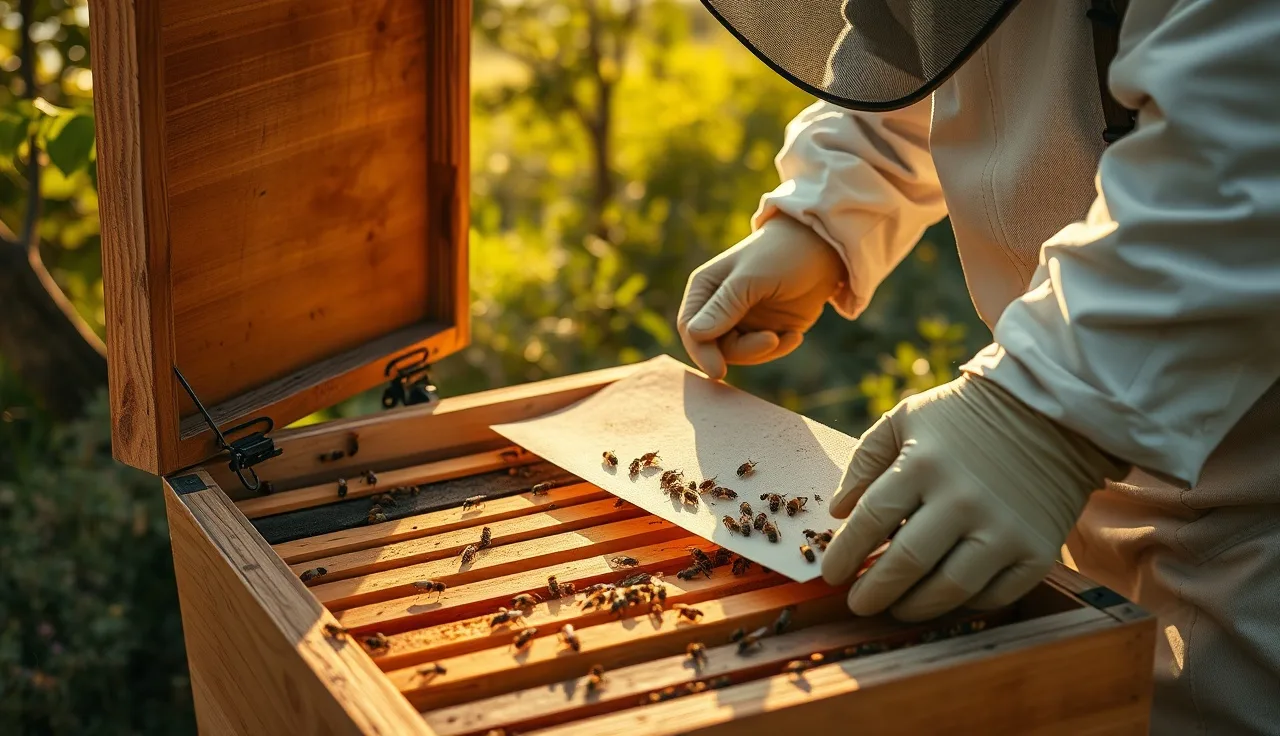
Oxalic acid pads are cellulose or cardboard strips soaked in a mix of oxalic acid and glycerin. You lay them on the top bars and leave them for three to four weeks. Bees walk across the pads, pick up acid on their tarsi and body hairs, and spread it through the cluster as they groom each other. Varroa mites die on contact.
Glycerin is what separates pads from every other oxalic acid method. It acts as a slow-release carrier, keeping the strip moist and letting vapor come off gradually instead of all at once. That sustained release is why pads keep working through a brood cycle. A single oxalic acid vapor treatment hits only the phoretic mites riding on adult bees the moment you apply it [1].
The active compound is the same oxalic acid found in rhubarb and spinach, just far more concentrated. It is registered as a miticide under EPA registration 83623-1 (Api-Bioxal). Generic versions exist under state 25(b) rules, but the regulatory picture there is messy enough to need its own section below.
One thing to know going in: pads are slow. You will not see a dramatic mite drop in week one. The mechanism is cumulative, which frustrates beekeepers used to checking sticky boards right after treating. Give them the full contact period before you judge them.
How do oxalic acid pads compare to vaporization and dribble methods?
Pads win on convenience and lose a little on peak knockdown. That is the short version. A single pad application covers a full brood cycle, while vapor and dribble only kill phoretic mites in one pass, which means repeated visits if brood is present. Here is the direct comparison beekeepers ask for.
| Method | Works with brood? | Application effort | Efficacy (typical mite reduction) | Residue risk in honey |
|---|---|---|---|---|
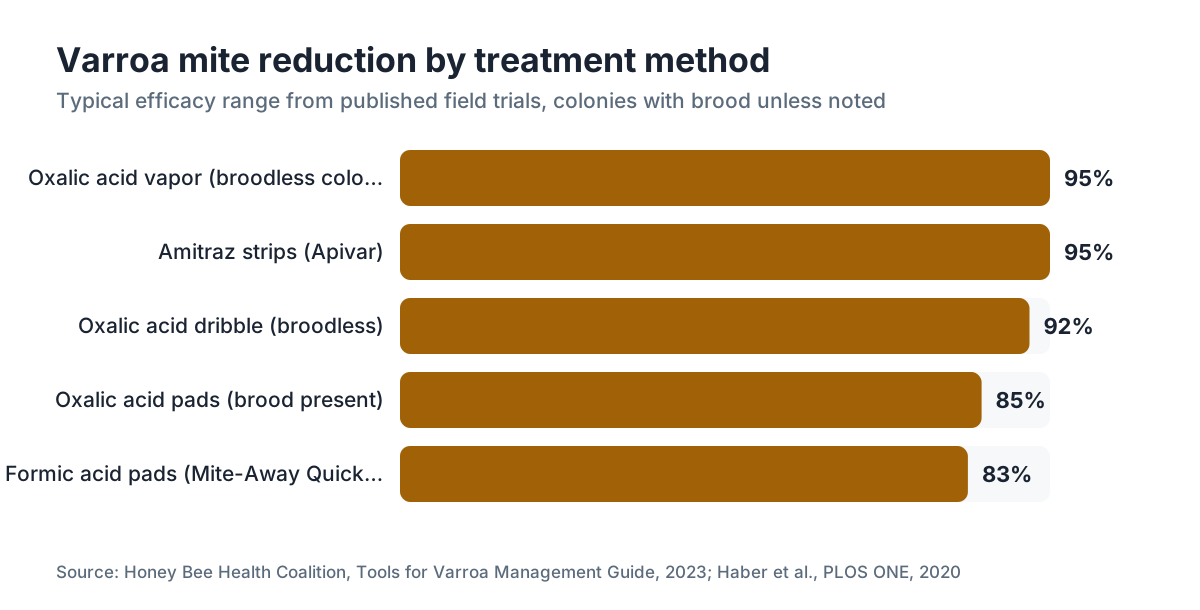
| Oxalic acid vapor (vaporizer) | No (phoretic mites only per treatment) | High (PPE, repeated visits) | 90-95% mite-free hives if timed correctly [2] | Very low |
| Oxalic acid dribble | No (phoretic mites only) | Low-medium | 90%+ when broodless [3] | Very low |
| Oxalic acid extended-release pads | Yes | Low (one application) | 80-95% reduction over full brood cycle [4] | Low, label-compliant |
| Amitraz strips (Apivar) | Yes | Low | 90-95% [5] | Moderate (residue possible) |
The big draw of pads is one application during active brood. If your colony is broodless (deep winter in cold country, a fresh split, a requeening gap), a single vaporization or dribble is cheaper and faster. If you have brood and want to skip the repeated vapor sessions a brood cycle demands, pads make sense.
The honest trade-off is cost and contact-time management. Pads run more per treatment than bulk oxalic acid, and you have to make sure bees are actively walking on them the whole time. A tiny cluster in early spring may not have enough bees on the pad to move the acid around.
Vapor still gives you better same-day knockdown for emergencies. Do a wash in August, find 5 mites per 100 bees, and a vaporizer puts acid in the hive today. Pads are the tool for planned, seasonal work. The two are not exclusive. Plenty of experienced beekeepers run pads through the summer brood season, then hit the colony with a mid-winter vapor or dribble once it goes broodless, clearing out whatever is left before the overwintering bees are raised.
What does the EPA label actually require for oxalic acid pad applications?
The label is a legal document, and oxalic acid is a federal pesticide. Ignore that and you are breaking the law, more than voiding a warranty. The most widely used registered product is Api-Bioxal, made by Chemicals Laif S.p.A. and distributed by NOD Apiary Products in North America. EPA registration number 83623-1 [1].
The Api-Bioxal extended-release (pad) label spells out:
- One pad per five frames covered with bees, with a maximum of six pads per single-story colony and eight pads for a colony in two or more boxes.
- Pads stay in the hive at least four weeks.
- Do not apply when daytime temperatures are consistently above 105°F.
- Do not apply within two weeks of a honey super in place that will be harvested for human consumption.
- The applicator wears chemical-resistant gloves, long sleeves, and long pants. Eye protection is required.
- Pads come out after treatment and get disposed of properly.
The label reads, "Apply one extended release strip per five frames of bees." That is verbatim from the Api-Bioxal extended-release label [1]. Simple on its face, but beekeepers keep getting it wrong by counting frames of drawn comb instead of frames actually covered with bees. A colony sitting on eight frames of comb but only covering four gets two pads. Not one and a half rounded up.
Breaking any label requirement violates FIFRA (the Federal Insecticide, Fungicide, and Rodenticide Act). Enforcement against a hobbyist is rare in practice. The better reason to follow the label is that the dose and timing are tuned for efficacy and bee safety. Overdose and you risk brood loss and queen problems.
For state rules, your state department of agriculture keeps a list of registered products. The Honey Bee Health Coalition's Varroa management guide is a good place to start on which products are legal where you keep bees [6].
Can you make oxalic acid solution at home for pads, or do you have to buy registered products?
You can technically mix your own, but you are in a legal gray zone, and whether it is worth the savings depends on whether you sell honey. This one comes up constantly in beekeeping forums, and there is no clean yes or no.
The EPA keeps a category called "minimum risk pesticides" under FIFRA section 25(b). Oxalic acid appears on the 25(b) list, so products made with it and certain inert ingredients may be exempt from federal registration [11]. States can add their own registration rules on top of that exemption. California, for one, requires registration even for 25(b) products.
Mixing oxalic acid dihydrate with glycerin and water to treat your bees counts as "making a pesticide" under FIFRA. The registered product exists because it passed efficacy and safety testing. Using a home-mixed product on your own hives sits in the same ambiguous space home-brew treatments have always occupied.
Here is the practical reality: plenty of small-scale beekeepers make their own pads with cellulose sponges or polypropylene rope soaked in an oxalic acid and glycerin solution. The recipe that shows up over and over in extension research dissolves 35 grams of oxalic acid dihydrate in 665 grams of glycerin per liter of solution. Work published in PLOS ONE found homemade versions at this ratio can match commercial pads on mite reduction [4].
If you sell honey commercially, operate under a state apiary registration, or care about liability, buy the EPA-registered product. That is the defensible choice, plainly. The cost gap is roughly $1 to $2 per pad for commercial versus about $0.25 to $0.50 home-made, so the premium is real but small for a handful of hives.
If you want to look at beekeeping supplies from registered sources, several major suppliers carry Api-Bioxal and the materials for pad systems at fair prices.
When is the best time in the season to apply oxalic acid pads?
The single best pad window in North America is the late-summer brood period, roughly late July through August, right after you pull honey supers. Timing is where most pad treatments fail. The goal is maximum mite exposure across the whole window.
Treat in that August window and here is why it works. The colony still has brood, so pads beat single-shot methods. But the bee population is sliding toward winter cluster size, so mites reproducing in summer brood are not being replaced as fast. You protect the long-lived overwintering bees raised from August through October, which is the cohort that carries the colony to spring.
The Honey Bee Health Coalition names the period before winter bees are raised as the top-priority treatment window. Their 2023 guidance notes colonies entering winter with more than two mites per 100 bees face much higher winter mortality [6].
Spring is the secondary window. As colonies build in March and April, mite numbers are low but climbing fast with each brood cycle. Place pads before the population explodes and you can hold mites down through the nectar flow. Pull the pads before supers go on if super removal is within two weeks.
Midsummer is the hardest stretch. Mite populations peak in July and August exactly when many hives carry full honey supers, and the label timing rules bite. You cannot treat with Api-Bioxal pads while harvestable supers are in place. You can treat once they come off. Many beekeepers monitor weekly and treat the moment supers come off.
Winter pad treatment works in warmer climates where bees still cluster loosely and walk around. In a hard northern winter, a tight cluster will not move enough acid across the pads to matter. Save the vapor or dribble for those regions and those temperatures.
For a full seasonal calendar tied to mite thresholds, VarroaVault's free protocol tools map pad timing to your climate zone and colony calendar.
How do you apply oxalic acid pads correctly?
Suit up, count the frames actually covered with bees, lay one pad per five of those frames flat on the top bars near the cluster, and mark your calendar for at least four weeks. Application is easy, which is half the appeal, but a few spots trip people up.
Start with protection. Gloves (nitrile works, chemical-resistant is label-specified), eye protection, sleeves. Oxalic acid burns skin and airways. Do not handle pads bare-handed.
Open the hive and count honestly. A frame "covered with bees" means bees on both sides, edge to edge. A patch of bees on each face is not a full frame. Round down, not up. One pad per five covered frames.
Lay pads flat on the top bars, touching or nearly touching the cluster. Some beekeepers wedge them between frames, but top bars are standard and easier to fish back out. Spread pads across the width of the cluster instead of stacking them.
A single deep covering six or seven frames gets one pad, maybe a second at the strong end of the range. A double-deep in full summer covering twelve to fourteen frames gets two to three pads.
Close up and mark the date. Four weeks minimum by the label. Most beekeepers leave pads five to six weeks to clear a full worker brood cycle (21 days) with margin. Pull the pads after that and dispose of them. Check local rules on disposal; most states let small quantities go in regular trash, but confirm.
Run an alcohol wash or sugar roll 48 to 72 hours after removal to judge efficacy. If counts are still above two per 100 bees, you may need a follow-up. The varroa mite overview covers wash methods and thresholds.
How effective are oxalic acid pads at reducing varroa mite counts?
Extended-release pads knock down about 80 to 90 percent of mites over a full treatment cycle in colonies with brood. Good, not magic. The efficacy data comes from a handful of solid field trials.
A 2020 peer-reviewed study in PLOS ONE (Haber et al.) compared oxalic acid glycerin pads against registered Api-Bioxal treatments and found average mite reduction of roughly 80 to 90 percent over a six-week window in colonies with brood [4]. Field summaries from University of Florida IFAS Extension reported similar ranges in warm-climate apiaries [10].
For context, a well-timed amitraz strip (Apivar) treatment usually hits 93 to 97 percent in controlled studies [5]. Oxalic acid vapor in a broodless colony can reach 95 percent or higher in one application.
So pads run a bit behind amitraz per cycle. The case for them was never that they beat amitraz on the number. It is one visit, a non-synthetic acid with no documented mite resistance as of 2024, and clean fit with organic certification.
Resistance to oxalic acid has not been documented in Varroa destructor through 2024. The Honey Bee Health Coalition still recommends rotating treatment chemistry as good stewardship, but oxalic acid's resistance profile looks better than the synthetic pyrethroids (fluvalinate, coumaphos), where resistance is well documented in many regions [5].
Efficacy drops in a few real-world situations: very large colonies where bees cluster so some pads sit underused, cold that cuts bee activity, and hives already heavily infested before treatment. Pads are better at holding a mite population down than at rescuing a hive that is already swamped.
Are oxalic acid pads safe for bees, queens, and brood?
At label rates, pads are generally safe for adult bees and queens. Brood is the harder question, and the answer turns on dose.
Above label doses, oxalic acid kills brood and costs you queens. Research by Ostiguy et al. reported in the American Bee Journal, and work from the Penn State Extension apiculture program, found brood damage climbs sharply past the recommended dose [7]. That is exactly why the label counts frames of bees, not frames of comb.
At label dose and timing, brood mortality runs low in most published trials. Some beekeepers do see more brood loss in the first week when a pad sits right over an open brood nest. Place pads at the edges of the cluster, or between the brood and the honey stores, instead of directly over open brood, and that eases.
Queen safety gets too little airtime. Queens tend to avoid the pads, which mostly protects them, but a pad dropped into the brood nest of a small colony can disturb her. In a normal hive this is rarely a problem. In a nuc or a fresh split with five or fewer frames, be conservative on dose and placement.
For you, oxalic acid irritates eyes, skin, and airways. Long-term low-level exposure is tied to kidney effects in occupational settings at doses far above anything a hobbyist meets, but gloves and eye protection are not optional.
On residue: the Api-Bioxal label bars treatment with harvestable supers in place. Oxalic acid occurs naturally in honey at 1 to 10 mg/kg, and pad treatments raise hive honey levels only slightly, staying within European Food Safety Authority thresholds [8]. The label still says what it says, and for commercial operations compliance is not optional.
What about using oxalic acid pads in splits, nucs, and packages?
Splits and nucs are where beekeepers under-treat, so they earn their own section. The trick is that a broodless split often calls for vapor or dribble, not pads.
A fresh split runs broodless while it is queenless, typically three to four weeks in warm weather until a new queen emerges and lays. That gap is a great chance for a non-pad oxalic acid treatment. Vapor or dribble gives you the full phoretic-mite kill without needing the slow release of pads.
Re-queen a split right away with a mated queen who starts laying in a few days, and you lose that broodless window. Then pads, placed once the colony is established (three to four frames of bees for enough coverage), can work.
Packages are similar. A fresh package on foundation has no brood for two to three weeks while the queen ramps up. That is a real broodless window where dribble or vapor beats pads. Many package breeders say wait until the colony holds four or more frames of bees before using pads, since a small colony will not move the acid around well.
Nucs from a reputable breeder should already have been treated, but do not assume. Monitor within 30 days of installing any nuc and treat off your wash results, not off hope.
Do oxalic acid pads work in high-heat climates?
Heat is a real problem for pads. The Api-Bioxal label warns against applying when temperatures consistently top 105°F. In Arizona, Texas, and Florida, summer routinely runs at or past that line.
The issue goes past label compliance. At high heat, glycerin pads release acid vapor faster than bees can spread it, which can cause localized overexposure near the pad and leave the hive under-protected later as the pad burns out early. University of Florida IFAS Extension trials showed lower mite reduction in high heat than in moderate temperatures [10].
Beekeepers in hot country have options. Treat in early morning or evening when the hive is cooler. Set pads in the lower box of a two-story hive, where it runs slightly cooler. Push pad treatments to the milder fall and spring windows and lean on vapor or amitraz strips during the summer heat peak.
Africanized honey bees, which have spread across the hot southern tier of the U.S., add another wrinkle. Those colonies often run different brood cycles and swarm on different schedules, which shifts the best treatment timing. If you keep bees where africanized honey bees are present, expect to adjust your seasonal protocol.
How do oxalic acid pads fit into a full-season varroa management protocol?
Pads are one tool in a seasonal system, not the whole system. Monitor first, treat to a threshold, and match the method to the window. Here is how it looks across a year.
Monitor first, always. The Honey Bee Health Coalition recommends checking every four to six weeks with an alcohol wash or a CO2 wash. The action threshold is generally two to three mites per 100 bees for most of the season, and two per 100 in August when you are protecting the overwintering cohort [12].
Hit threshold in late April or May with brood present and supers not yet on, and pads are the easy call. Place them, leave them four to six weeks, monitor again after removal.
Hit threshold in late July as you pull supers, and pads are the right tool for the post-super August window. This is probably the highest-impact pad application of the year for colonies headed into winter.
For the mid-winter broodless window (December through February across most of North America), switch to oxalic acid dribble or vapor. Pads do little on a dormant, non-walking cluster.
If mites spike fast in midsummer beyond what pads can catch, amitraz strips are still the quickest high-efficacy tool for a heavily infested colony. Saving the colony beats the rotation-of-chemistry principle.
VarroaVault's free protocol tools help you assign the right method to each monitoring window on your local calendar, including pad timing around nectar flows and honey supers.
For registered products and gear, a few beekeeping supply companies that specialize in apiculture will give you the widest range and current pricing on Api-Bioxal and pad systems.
Frequently asked questions
How many oxalic acid pads do I put in a hive?
One pad per five frames of bees, counting frames actually covered with bees on both sides, not frames of drawn comb. The Api-Bioxal label caps it at six pads for a single-story colony and eight for two or more boxes. A typical double-deep covering ten to twelve frames in summer takes two pads.
Can I use oxalic acid pads when honey supers are on?
No. The Api-Bioxal extended-release label bars application within two weeks of a honey super that will be harvested for human consumption. Pull your supers, treat, then replace supers after the two-week window. Many beekeepers treat right after pulling supers in late summer and leave supers off entirely, which is the cleanest way to do it.
How long do oxalic acid pads need to stay in the hive?
The Api-Bioxal label requires four weeks minimum. Most beekeepers leave pads five to six weeks to cover a full worker brood cycle of 21 days with margin. After removal, wait 48 to 72 hours before an alcohol wash to judge efficacy. Pulling pads too early is a common reason for weak mite reduction.
Do I need to wear a respirator when applying oxalic acid pads?
The Api-Bioxal label requires chemical-resistant gloves, long sleeves, and eye protection. A respirator is not required by the label for pad placement, though it is for vaporization. Pads release acid slowly at ambient temperature, so acute inhalation risk during placement is low. Gloves and eye protection stay non-optional.
Will oxalic acid pads harm my queen?
At label rates in a normal colony, queen harm is uncommon. Risk rises in small colonies or nucs where a pad may sit close to the queen and brood nest. Place pads at the edges of the brood cluster rather than over it in small colonies, and use the minimum dose. Some beekeepers report no issues; others describe occasional queen loss, but controlled data on this is thin.
Can oxalic acid pads replace Apivar?
For many situations, yes, especially if amitraz resistance is a concern in your area or you run an organic program. Pad efficacy (roughly 80 to 90 percent) sits slightly below Apivar in most published comparisons. In a heavily infested colony, Apivar has the stronger recovery record. For maintenance treatment at moderate mite loads, pads are a reasonable swap.
How do you make oxalic acid solution for bees to use in homemade pads?
A commonly cited research recipe dissolves 35 grams of oxalic acid dihydrate in 665 grams of glycerin per liter of solution. Cellulose sponges or polypropylene rope soak up the mix and release it slowly in the hive. Home-prepared treatments are not EPA-registered and may be illegal in your state. Check your state department of agriculture before using anything other than a registered commercial product.
Are there any varroa mites resistant to oxalic acid?
As of 2024, documented resistance to oxalic acid in Varroa destructor has not been reported. The mechanism (direct acid contact and probable cuticle disruption) differs from synthetic acaricides, and oxalic acid breaks down fast in the hive, easing selective pressure. The Honey Bee Health Coalition still recommends rotating chemistry as precautionary stewardship, even without confirmed resistance.
Can I use oxalic acid pads in the winter?
In cold climates where bees cluster tightly, pad efficacy drops hard because bees are not moving enough to spread the acid. A winter dribble or vapor treatment works better for hard northern winters. In mild-winter climates where bees stay loosely clustered and walking, pads remain an option through the winter months.
How do I know if the oxalic acid pad treatment worked?
Do an alcohol wash on 300 adult bees 48 to 72 hours after removing the pads. Compare that count to your pre-treatment baseline. A good treatment usually cuts mite counts 80 percent or more. If levels stay above two per 100 bees, check whether the pads sat long enough, whether bee coverage was adequate, and whether a follow-up treatment is needed.
What is the shelf life of oxalic acid pads?
Commercial Api-Bioxal extended-release pads carry an expiration date on the packaging, generally two to three years from manufacture when stored cool and dry. Pads that have dried out or crystallized heavily may have reduced efficacy. Home-made glycerin pads should be used within the same season you prepare them.
Can I use oxalic acid pads in a top-bar hive or a Warré hive?
Yes, with adjustments. Label dosing is based on frames covered with bees, and the same idea maps to top-bar hive bars. Lay pads across the bars nearest the brood cluster. Access and removal get trickier in a Warré given the box structure, but the chemistry and contact mechanism are identical. Keep the four-week minimum exposure and the PPE requirements.
Are oxalic acid pads approved for certified organic beekeeping?
Oxalic acid is listed on the USDA National Organic Program's National List as a synthetic substance allowed in organic livestock production, which includes honey bees. Api-Bioxal is the product most certifiers recognize. Always confirm with your specific certifier before use, since certifier requirements can be stricter than the NOP minimum.
Do oxalic acid pads affect the taste or safety of honey?
Background oxalic acid occurs naturally in honey at 1 to 10 mg/kg. Published studies show extended-release pad treatments raise honey oxalic acid content only modestly, generally within European Food Safety Authority thresholds. The Api-Bioxal label handles this with its honey super prohibition. Follow the label timing and residue concerns in harvested honey stay negligible for commercial or home use.
Sources
- EPA, Api-Bioxal Registration Label (Reg. No. 83623-1): Api-Bioxal EPA registration number, dosing rate of one pad per five frames of bees, maximum pads per colony, and honey super restrictions
- University of Minnesota Extension, Oxalic Acid for Varroa Control: Oxalic acid vaporization achieves 90-95% mite-free hives when timed to broodless period
- Penn State Extension, Oxalic Acid Dribble Method for Varroa: Oxalic acid dribble achieves 90%+ mite reduction in broodless colonies
- Haber et al. (2020), PLOS ONE, 'Efficacy of Oxalic Acid Glycerin Extended-Release Strips Against Varroa destructor': Extended-release oxalic acid glycerin pads achieved approximately 80-90% mite reduction over six-week treatment period in colonies with brood; homemade versions at the 35g/665g ratio comparable to commercial
- Honey Bee Health Coalition, Tools for Varroa Management Guide (2023 edition): Amitraz strip (Apivar) typically achieves 93-97% mite reduction in controlled studies; oxalic acid resistance not documented as of publication; pyrethroid resistance well documented
- Honey Bee Health Coalition, Tools for Varroa Management Guide (2023 edition), Treatment Thresholds section: Colonies entering winter with more than 2 mites per 100 bees face significantly elevated winter mortality; the window before winter bees are raised is the highest-priority treatment period
- Ostiguy et al., Penn State Extension / American Bee Journal, Oxalic Acid Brood Safety Research: Brood damage increases significantly with above-label doses of oxalic acid; queen loss also more frequent at overdose
- European Food Safety Authority (EFSA), Scientific Opinion on Oxalic Acid in Beeswax and Honey: Background oxalic acid in honey is 1-10 mg/kg; pad treatments raise levels modestly, within EFSA safety thresholds
- USDA National Organic Program, National List of Allowed and Prohibited Substances (7 CFR 205.603): Oxalic acid is listed as a synthetic substance allowed in organic livestock production including honey bees under the National Organic Program
- University of Florida IFAS Extension, Integrated Pest Management for Varroa Mites: Extended-release pad efficacy is somewhat reduced in high-heat conditions compared to moderate temperatures; warm-climate timing recommendations
- EPA, FIFRA Section 25(b) Minimum Risk Pesticides: Oxalic acid appears on the 25(b) minimum-risk pesticide list, exempting qualifying products from federal registration, subject to state-level requirements
- Honey Bee Health Coalition, Varroa Management Guide, Monitoring Methods: Alcohol wash monitoring recommended every 4-6 weeks; action threshold 2-3 mites per 100 bees during the season, 2 per 100 in August
Last updated 2026-07-09