Oxalic acid sublimation process explained simply
TL;DR
- Oxalic acid sublimation heats crystalline oxalic acid dihydrate to about 315°F (157°C), turning it into a gas that coats bees and comb, killing varroa on contact.
- One 2.275-gram dose per brood box treats a colony in roughly two minutes.
- It works year-round but kills only phoretic mites, never those sealed under brood cappings.
What is oxalic acid sublimation and how does it kill varroa?
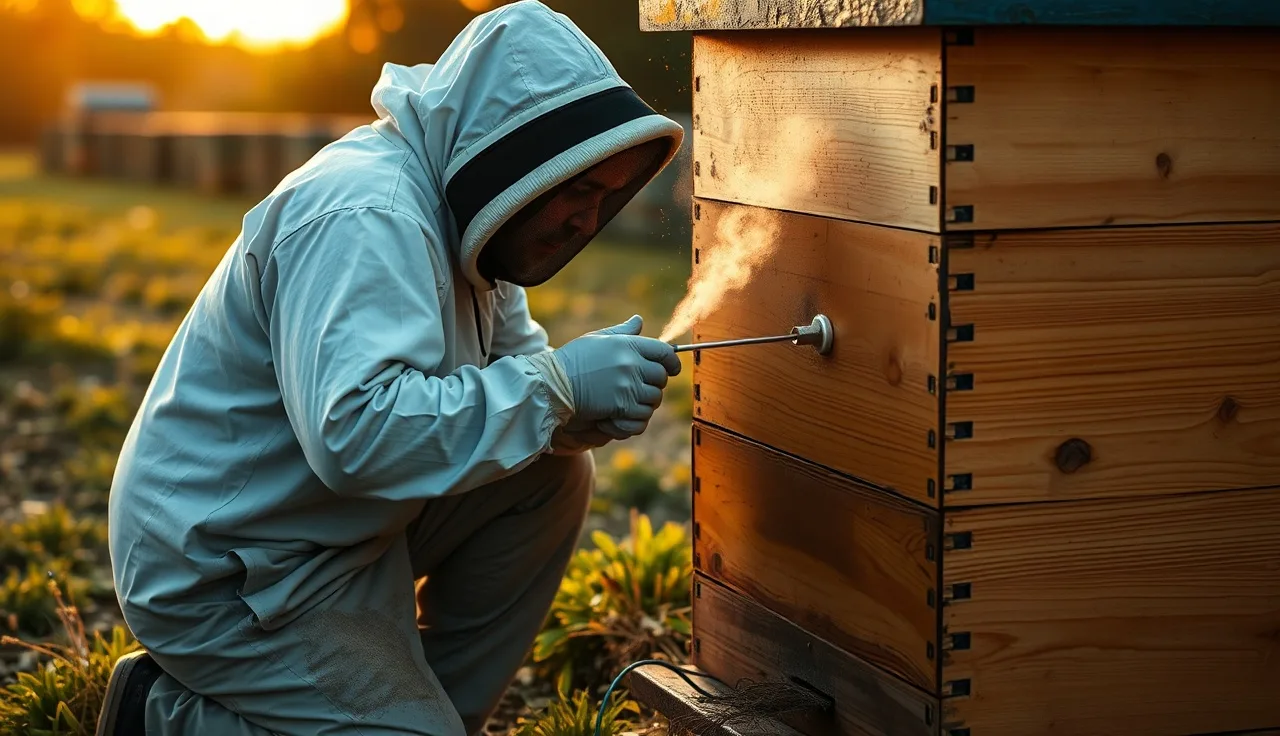
Sublimation is a phase change. A solid skips the liquid stage and turns straight into gas. Load oxalic acid dihydrate crystals onto a heated metal pan at the hive entrance, bring the pan to around 315°F (157°C), and the crystals vaporize. That gas drifts through the hive and settles as microscopic crystals on every surface it touches, including the bodies of bees and the varroa riding them.
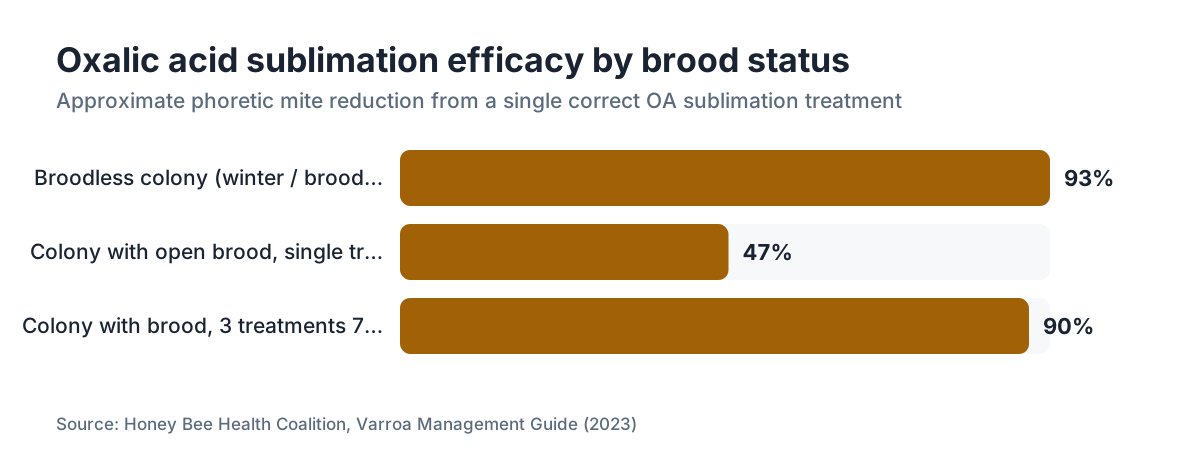
The mites die from contact with those deposited crystals. The exact mechanism is not settled in the literature. The leading explanation is that oxalic acid damages the mite's cuticle and disrupts basic physiological function. What efficacy studies do tell us is clear: a single treatment applied correctly to a broodless colony cuts the phoretic mite population by 90 percent or more [1].
The vapor does not reach mites inside capped brood cells. That one fact shapes everything about how and when you use this treatment. Mites under wax cappings are untouched, which is why timing against the colony's brood cycle matters so much. A varroa mite rides an adult bee for roughly 5 to 6 days before slipping back into a cell [9], so treatments timed to the brood cycle can catch the population as mites emerge and become exposed.
What equipment do you need to vaporize oxalic acid?
You need three things: a registered oxalic acid product, an EPA-registered vaporizer, and proper personal protective equipment. None of that is optional.
The common vaporizer in the U.S. market is a wand with a metal cup on one end wired to a 12-volt power source, usually a car battery or a lithium pack. You load the measured dose, slide the wand into the hive entrance or a small floor opening, seal the gaps with foam or a shop rag, and wait for the cup to hit temperature. Cycle time runs 2 to 3 minutes depending on the device. Then you leave the hive sealed another 10 minutes to let the vapor settle before opening.
Here's what to have staged before you power anything on:
| Item | Why it matters |
|---|---|
| EPA-registered OA product (e.g., Api-Bioxal) | Legal requirement; specifies dose and method [2] |
| Vaporizer registered under FIFRA | Required by the product label |
| Full-face respirator with acid-gas cartridges (OV/P100) | Oxalic acid vapor damages lungs and eyes |
| Nitrile or rubber gloves | Skin contact causes burns |
| Eye protection (if not using full-face respirator) | Splash and vapor risk |
| Foam or shop rag to seal entrance | Keeps vapor in the hive |
You can source gear from most beekeeping supply companies. Skip the cheap unregistered wand even when it looks identical to a registered one. The EPA label is a legal document. Using an unregistered device means your treatment falls outside label directions, and that is a pesticide law violation in every U.S. state [7].
What is the correct dose of oxalic acid for sublimation?
The registered Api-Bioxal label, the most widely used product in the U.S., specifies 2.275 grams of oxalic acid dihydrate per brood box [2]. That number is not negotiable. More is not better. Overdosing raises bee mortality and sets the colony back, and the label dose already proved out in multiple trials.
A colony in a single deep gets one dose. A colony in two deeps, or a deep plus a medium with bees present, gets a dose per box. In practice many beekeepers load the amount once per application event rather than per physical box, because the vapor spreads through the cluster. Read your specific product label. The Api-Bioxal label governs, and the EPA registration is the legal ceiling on how you can use it [2].
The Honey Bee Health Coalition's Varroa Management Guide states that oxalic acid works best "when applied to colonies with no or minimal sealed brood," because its efficacy against phoretic mites is high while efficacy against mites in sealed cells is essentially zero [1]. That is not a defect in the product. It's the chemistry.
When is the best time of year to use oxalic acid sublimation?
Any time the colony holds little or no capped brood. That points to two windows.
The first is midwinter, roughly December through February across most of the northern U.S., when a colony sits broodless or nearly so. A single treatment then hits the highest share of the total mite population at once because nearly every mite is phoretic. Many beekeepers treat once on a calm day above 40°F, when bees are clustered but not flying in numbers.
The second is any broodless gap you engineer or find: a fresh swarm just hived, a split made broodless for treatment, or a queen-right colony after a controlled brood break. Some beekeepers pull all the capped brood frames into a nuc, treat the main colony and the nuc separately three to five days apart, then recombine. It's a lot of handling. It also drives summer mite counts down hard, when a single ordinary treatment would leave every capped-brood mite alive.
For summer use with brood present, the Honey Bee Health Coalition recommends three treatments spaced 7 days apart, catching mites as they emerge between rounds [1]. University of Minnesota Extension has documented this schedule in field trials [3]. It works. It demands discipline. Miss a treatment by three days and you lose the timing advantage.
Winter is the simpler play. One treatment, done well, during the broodless period drops mite loads by over 90 percent. Build your year around that single event if you're a hobbyist.
How do you actually perform an oxalic acid vaporization step by step?
Here's the honest walkthrough, the way somebody who has done it a hundred times would coach you through your first try.
Suit up completely before you open any product packaging. Full-face respirator with a fresh OV/P100 cartridge (replace cartridges on the manufacturer's schedule, not by feel), gloves, and a veil if your respirator doesn't already cover your face. Oxalic acid vapor is colorless. You will not know you're breathing it until your lungs are already irritated.
Measure your dose on a small postal or jewelry scale, or use pre-measured packets if your product ships that way. The Api-Bioxal dose is 2.275 grams per box with bees [2].
Close the top entrance if you have one. You want vapor staying in the box, not venting up and out.
Load the dose into the cup, connect the power source, and slide the wand into the hive entrance. Seal the gap around the wand with foam. Most wands carry a shield or collar; push it snug against the entrance.
Power on and step upwind. Some vaporizers show an indicator light at temperature; others you time yourself. Follow the device instructions. Most wands finish vaporization in about 2 minutes.
Power off and leave the entrance sealed at least 10 minutes. The vapor needs time to circulate and deposit.
Remove the wand, open the entrance, and step back. Residual vapor will drift out.
Log the treatment: date, product, lot number, dose, method. It's good practice, and on commercial operations it's a legal requirement in some states.
VarroaVault has a free protocol tracker and hive log that keeps this recordkeeping straight across a whole apiary through the season.
Is oxalic acid sublimation safe for bees and for brood?
At label doses, oxalic acid sublimation has low toxicity to adult bees. Studies show some brood mortality in colonies with open brood when the vapor contacts larvae directly, one more reason to target broodless windows when you can [3]. Cornell University's honey bee program reports that at proper doses the compound is "essentially non-toxic" to adult bees, while warning that over-treatment raises risk [4].
Honey is the question that comes up constantly. Oxalic acid occurs naturally in honey at low levels, roughly 8 to 58 mg/kg depending on floral source [5]. The European Food Safety Authority reviewed this and found that residues from OA treatments do not meaningfully lift honey OA above the natural background [5]. The EPA approved oxalic acid for honey bee colonies in the U.S. with no honey withdrawal period when used as directed [2].
About the queen: occasional reports of queen loss after vaporization exist, mostly in colonies that are very small or weak, or where the wand ran too long at a high dose. It happens at the margins. Healthy, well-populated colonies take the treatment without queen trouble in normal practice. The error I see most is treating a tiny nuc or a weak late-season colony with the full 2.275-gram dose meant for a packed brood box. Three frames of bees do not need what eight frames need.
What PPE do you need and what are the health risks to the beekeeper?
Oxalic acid vapor is a respiratory irritant and a corrosive. Heavy exposure can cause pulmonary edema, a serious and potentially life-threatening condition where fluid fills the lungs. This is not theoretical. Documented cases of serious respiratory injury from OA sublimation without proper PPE exist.
The minimum PPE on the Api-Bioxal label is an organic vapor respirator with a P100 particulate filter plus chemical splash goggles [2]. A full-face air-purifying respirator with OV/P100 combination cartridges is what most experienced beekeepers reach for, because it covers face, eyes, and airway in one unit.
Never vaporize in an enclosed space. Work outdoors, stand upwind of the entrance, and leave the immediate area during the active cycle. The vapor disperses fast in open air.
OV cartridges have a limited service life. Once opened, a cartridge starts adsorbing organic vapors from the air whether or not you're using it. Follow the manufacturer's replacement guidance. The EPA label sets no cartridge change-out schedule, so you track it yourself. Most manufacturers recommend swapping cartridges after 40 hours of use or 6 months after opening, whichever comes first.
How does sublimation compare to other oxalic acid application methods?
Three legal methods exist for applying oxalic acid to honey bee colonies in the U.S.: sublimation (vaporization), dribble (trickle), and extended-release strips.
| Method | Brood required? | Efficacy (broodless) | Efficacy (with brood) | PPE complexity | Cost per treatment |
|---|---|---|---|---|---|
| Sublimation | No | 90%+ [1] | Lower; needs repeat | High (respirator) | Low (product is cheap) |
| Dribble/trickle | No (clusters only) | 90%+ [1] | Not labeled for brood | Medium (gloves, goggles) | Low |
| Extended-release strips | Yes | Comparable | Yes, over time | Low | Higher per application |
The dribble method pours a 3.2% OA syrup directly onto clustered bees between frames. It works in winter but is labeled only for broodless colonies, and you can't repeat it on a short schedule the way you can with vapor. Sublimation repeats on a 7-day cadence when brood is present, which makes it the more flexible summer option [2].
Extended-release strips (Api-Bioxal in strip form) got EPA approval in 2023 for use in colonies with brood. They sit in the hive for several weeks, releasing OA gradually. That's a genuinely different tool, handy for beekeepers who can't make repeat visits. The tradeoffs are higher cost and, under some labeling, the need to pull the strips before adding honey supers.
For a hobbyist with one apiary and the ability to visit repeatedly, wand sublimation is almost always the cheapest and most flexible method. The product is inexpensive, the technique is quick once it's in your hands, and broodless-period efficacy is hard to beat.
Does oxalic acid sublimation work with honey supers on?
This one gets beekeepers into trouble. The Api-Bioxal label does not allow treatment while honey supers are on the hive if that honey is meant for human consumption [2]. The label is specific: pull the supers before treating.
The reasoning is precautionary. It's not that residue levels are known to be dangerous (see the honey safety section above). It's that the U.S. approval pathway for OA didn't include testing with supers in place, so the label excludes it.
That's a real logistical squeeze on summer treatment. Most beekeepers either pull supers, treat, and replace them after the hive airs out, or they hold off on sublimation until after the honey harvest. Fall timing fits well, because it lands right when you want mite counts driven down before the winter bees are raised, roughly August through September in most northern states.
How do you know if the treatment actually worked?
You count mites. Before treating, set a baseline with an alcohol wash or sugar roll. The Honey Bee Health Coalition and most university extensions recommend an alcohol wash of a 300-bee sample (about half a cup of bees) as the most accurate method [1][8]. Count the mites in the wash and divide by 300 for an infestation rate.
A rate above 2 percent (2 mites per 100 bees) in summer is the threshold where most guidance says treat [1][8]. After treatment, give it 48 to 72 hours for mite mortality to stabilize, then read the sticky board for drop. A heavy drop is encouraging but not a precise count. Run a fresh alcohol wash 2 to 3 weeks after a broodless-period treatment to see where the population landed. If you did a three-treatment summer series 7 days apart, sample two weeks after the last round.
If counts still sit above 2 percent after a properly timed broodless treatment, check three things. Verify your vaporizer temperature (a cheap infrared thermometer aimed at the cup helps), confirm your dose, and make sure the hive sealed tight. It's also possible the treatment worked and reinfestation from neighboring colonies or robbing already kicked in. Mites move between colonies freely.
What are the legal requirements for using oxalic acid in the U.S.?
Oxalic acid for varroa falls under FIFRA, the Federal Insecticide, Fungicide, and Rodenticide Act. In the U.S. you must use a registered product (Api-Bioxal is the primary one as of 2025) and follow the label exactly. The label is a legal document. Using it off-label, say a higher dose or a different method than the label specifies, is a federal pesticide violation [7].
Some states add registration requirements or require a private pesticide applicator license for certain uses. California, for example, has historically kept stricter rules around pesticide use records. Check your state department of agriculture's website for what applies where you keep bees.
The Api-Bioxal registration lives on the EPA's pesticide registration pages [2]. The registration number is 84190-1. Keep that number handy in case an inspector or state apiarist asks you to document what you used.
What mistakes do beekeepers most commonly make with oxalic acid sublimation?
The biggest one is treating in peak brood season with a single shot and assuming the job's done. One summer treatment with open brood present might kill 40 to 50 percent of the mite population. The rest sit under cappings and emerge within two weeks. Mite counts bounce back fast.
Second most common: skimping on PPE. I won't soften this. Working without a proper respirator because it's hot or inconvenient is a real health risk. The vapor is invisible, and you can take in a harmful dose before you feel a thing.
Third: treating a colony that's already crashing and expecting a rescue. Oxalic acid kills mites. It does not fix starvation, laying worker syndrome, or a queenless hive. Check colony health before you treat.
Fourth: sloppy sealing. Leave the entrance gap open around the wand or a top vent uncovered, and the vapor escapes before it circulates. Foam weather-stripping costs a few dollars. Cut it to fit and spend the two minutes.
Fifth: guessing at the dose. The 2.275-gram amount is specific. A kitchen spoon won't get you there. A small scale runs about $10 to $15 and pays for itself immediately in consistent results and less overdose risk.
If you're building a full-season varroa plan across multiple hives, the free tools at VarroaVault track treatment timing, mite counts, and brood-cycle windows in one place.
Frequently asked questions
Can I use oxalic acid sublimation when there is brood in the hive?
Yes, but a single treatment kills only phoretic mites on adult bees, never mites sealed in capped cells. The Honey Bee Health Coalition recommends three treatments 7 days apart to catch mites as they emerge between rounds. With brood present, one treatment might drop the mite population 40 to 50 percent at best; a properly timed series reaches 90 percent or better.
How long does it take to vaporize oxalic acid in a hive?
Most registered wand vaporizers finish the active cycle in about 2 to 3 minutes once the pan hits operating temperature. After powering off, leave the hive sealed at least 10 minutes so the vapor circulates and deposits onto surfaces. Total time per hive, from loading the dose to reopening the entrance, runs roughly 15 to 20 minutes.
How many times can I treat with oxalic acid per year?
The Api-Bioxal label allows a series of three applications 7 days apart under the EPA registration. The label is the legal ceiling. In practice most hobbyists do one well-timed winter treatment plus one fall series before winter bees are raised in late summer, staying well within label limits while hitting the mite population at its most exposed moments.
Does oxalic acid sublimation leave residue in honey?
Oxalic acid occurs naturally in honey at 8 to 58 mg/kg depending on floral source. Studies reviewed by the European Food Safety Authority found OA treatment does not meaningfully raise honey residue above this natural range. The EPA approved Api-Bioxal with no honey withdrawal period when used as directed. Supers meant for human consumption must come off before treatment per the label.
What temperature does oxalic acid need to reach to sublimate?
Oxalic acid dihydrate sublimes at around 315°F (157°C). Registered vaporizers are built to reach and hold that temperature. Run too cool and the crystals won't fully vaporize, so efficacy drops. An inexpensive infrared thermometer confirms your pan is hitting temperature. Don't use unregistered devices; their temperature consistency is unverified.
Is a respirator really necessary for oxalic acid sublimation?
Yes. The Api-Bioxal label requires an organic vapor respirator with a P100 particulate filter as a minimum. Oxalic acid vapor is a respiratory corrosive, and documented cases of serious lung injury from unprotected exposure exist. The vapor is colorless, so you can't rely on smell or discomfort as a warning. A full-face OV/P100 respirator costs around $30 to $60 and is the most important gear after the vaporizer itself.
Can I treat with oxalic acid when honey supers are on?
No. The Api-Bioxal label prohibits treatment while honey supers meant for human consumption sit on the hive. This is a regulatory restriction, not a residue safety finding. Pull the supers, treat, let the hive air out, then replace them. Most beekeepers schedule fall treatments after the main harvest, which sidesteps the constraint entirely.
How do I measure 2.275 grams of oxalic acid accurately?
Use a small digital scale accurate to 0.1 grams. Postal and jewelry scales in the $10 to $20 range are precise enough. Some Api-Bioxal packaging ships in pre-measured sachets, handy for field use. A kitchen spoon or eyeballing it won't cut it. Underdosing kills efficacy; overdosing raises bee and brood mortality and breaks label directions.
Will oxalic acid vaporization harm the queen?
At label doses in a healthy, well-populated colony, queen loss from OA sublimation is rare. Reports cluster around small or weak colonies treated with a full dose, or cases where the vaporizer ran too long. If your colony is very small (three frames of bees or fewer), adjust your approach or check extension guidance on dosing for nucs and small colonies before treating.
How soon after treatment can I check my hive?
Wait at least 10 minutes after powering off before removing the wand and opening the entrance. Once it's open, give it a few more minutes before inspecting inside. There's no required waiting period before a health inspection, but let the bees settle a few hours after the disturbance of a treatment before a thorough frame-by-frame check.
What mite count triggers the need for treatment?
The Honey Bee Health Coalition and most university extensions use 2 percent as the summer threshold: 2 or more mites per 100 bees in an alcohol wash of a 300-bee sample. In late summer (July through August in northern states), some guidance drops this to 1 percent because high mite loads entering winter are so damaging. Below 1 percent in winter with a healthy cluster, most beekeepers can wait and monitor.
Is oxalic acid sublimation approved for organic beekeeping?
In the United States, oxalic acid is listed by the National Organic Program as a permitted substance for varroa management in certified organic operations, provided it's used according to the registered label. Check the USDA National Organic Program materials list and your certifier's requirements, since certifiers can add restrictions on top of the federal baseline.
How does oxalic acid compare to synthetic miticides like Apivar?
Apivar (amitraz strips) acts over 6 to 8 weeks and works with brood present, so it's very effective for summer infestations without repeat visits. OA sublimation is faster per treatment and has no documented resistance so far; amitraz resistance is emerging in some populations. Many beekeepers use OA in winter and rotate to Apivar in summer. Neither alone is a full year-round program.
Sources
- Honey Bee Health Coalition, Varroa Management Guide (2023): Oxalic acid treatments are most effective when applied to colonies with no or minimal sealed brood; single broodless-period treatments reduce phoretic mite populations by 90% or more; 2% mite count threshold for treatment.
- EPA, Api-Bioxal Pesticide Registration (Reg. No. 84190-1): Label specifies 2.275 grams per brood box via vaporization; requires OV/P100 respirator PPE; prohibits use with honey supers intended for human consumption; no honey withdrawal period when used as directed.
- University of Minnesota Extension, Bee Lab, Varroa Mite Management: Three oxalic acid vaporization treatments spaced 7 days apart documented as effective summer protocol when brood is present; efficacy against phoretic mites confirmed; some brood mortality possible when open brood contacted by vapor.
- Cornell University College of Agriculture and Life Sciences, Honey Bee Program: At label-specified doses, oxalic acid is essentially non-toxic to adult bees; over-treatment increases risk of adverse effects.
- European Food Safety Authority, Scientific Opinion on the safety of oxalic acid for honey bees (EFSA Journal 2016): Oxalic acid occurs naturally in honey at 8 to 58 mg/kg depending on floral source; OA treatment does not significantly increase honey residue levels above natural background.
- USDA National Organic Program, Allowed and Prohibited Substances: Oxalic acid is listed as a permitted substance for varroa mite control in certified organic honey bee operations.
- EPA, Federal Insecticide, Fungicide, and Rodenticide Act (FIFRA) Overview: Pesticide products must be registered under FIFRA and used according to label directions; off-label use is a federal violation.
- Pennsylvania State University Extension, Varroa Mite Management for Honey Bees: Alcohol wash of 300-bee sample is the most accurate method for measuring varroa infestation rate; 2 mites per 100 bees threshold for summer treatment.
- University of Florida IFAS Extension, Honey Bee Pests and Diseases: Mites spend roughly 5 to 6 days as phoretic mites on adult bees before re-entering a brood cell; treatment timing should account for this cycle.
- Honey Bee Health Coalition, Tools for Varroa Management Guide, Table of Treatments: Comparison of OA sublimation, dribble, and extended-release strip methods including efficacy with and without brood; sublimation rated highly effective for broodless-period use.
Last updated 2026-07-10