OxyBee varroa treatment: how it works, dosing, and what to expect
TL;DR
- OxyBee is an EPA-registered oxalic acid dihydrate solution (2.1% w/w) that kills varroa mites on adult bees.
- Applied by dribble or vaporization, it reaches 90-99% efficacy on exposed mites but kills zero mites sealed inside capped brood.
- Timing around a broodless window decides everything.
- Used correctly, it's one of the safest treatments for bees, honey, and you.
What is OxyBee and how does it kill varroa mites?
OxyBee is a ready-to-use oxalic acid dihydrate solution made by Api Health USA. The active ingredient is oxalic acid at 2.1% w/w, the same organic acid you find in rhubarb, spinach, and honey. EPA registered it under product number 87243-1 [1].
The mechanism isn't fully pinned down, but contact toxicity is the working theory. A mite picks up oxalic acid two ways: direct contact with a treated bee's body, or vapor settling on her. The acid disrupts the mite's cuticle and wrecks basic physiology. Bees shrug it off at labeled concentrations because their exoskeleton handles the acid differently than a soft-bodied mite does.
Here's the hard limit you have to accept upfront. Oxalic acid does not penetrate capped brood. A mite tucked inside a sealed cell with a developing pupa is completely protected during any application. That one fact drives every timing decision you'll ever make with this product.
What is OxyBee approved to treat, and what does the label actually say?
OxyBee is registered for use on Apis mellifera colonies in the United States. The current label allows two application methods: direct liquid dribble and vaporization. Spraying shows up on some oxalic acid products but not all, so check the label for the specific lot in your hand.
For the dribble method, the label calls for 5 mL of solution per seam of bees (the gap between two frames where bees sit), capped at 50 mL per colony per treatment. You apply it once. That is not a typo. The label allows a single dribble application per treatment event, not repeated rounds over several days [1].
For vaporization, the label allows up to 3 applications at 5-day intervals for one treatment episode. The vaporization dose is 1 gram of OxyBee solution per brood box, delivered with a vaporizer that heats the liquid and pushes the vapor through the entrance.
The label also sets a pre-harvest interval. You wait at least 2 weeks after the last application before harvesting honey for human consumption [1]. Oxalic acid is already in honey naturally, and studies show a proper treatment doesn't push residue above natural background, but the label interval is law, not a suggestion [2].
One more thing the label spells out. OxyBee is not registered for use with queen excluders that would trap treated bees. Read the full current label before each season. EPA can revise it.
Dribble vs. vaporization: which method works better?
Both methods work. Which one wins comes down to one question: does the colony have capped brood right now?
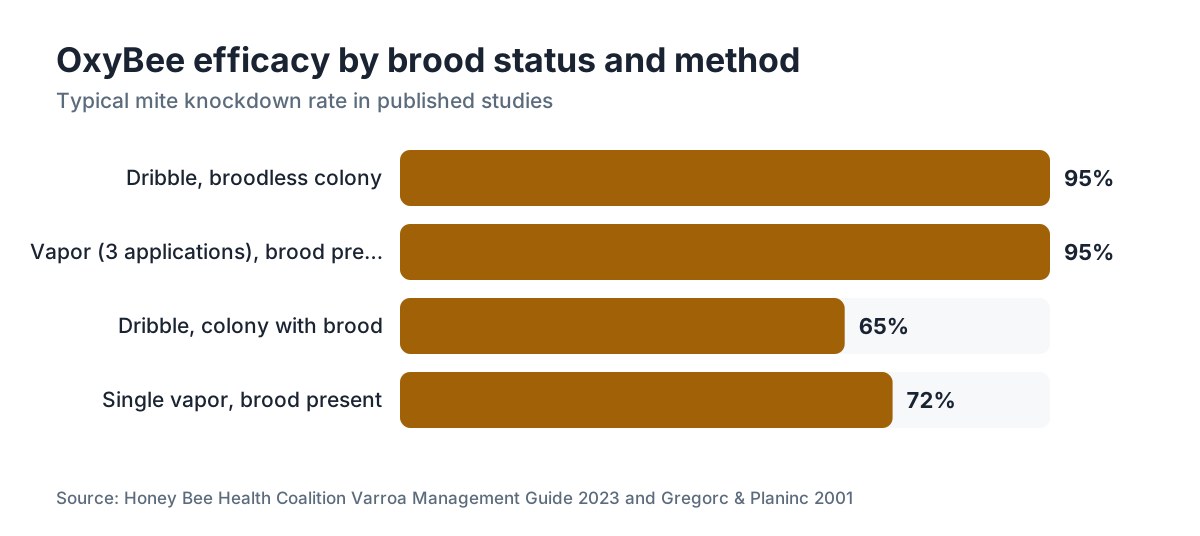
Save the dribble for broodless or near-broodless colonies. OxyBee comes ready to use, so there's no mixing. You draw it into the applicator and dribble 5 mL per seam directly onto the cluster. On broodless colonies, a single dribble knocks down 90-99% of mites [3]. Add open brood and the number falls hard, because a big slice of the mite population is sealed away in capped cells where nothing reaches it.
Vaporization gets to mites on bees anywhere in the hive. The multi-application protocol (up to 3 treatments 5 days apart) exists to interrupt the mite reproductive cycle, catching mites as they emerge before they slip into a fresh cell. The Honey Bee Health Coalition's Varroa management guide puts vaporization efficacy in colonies with brood around 95% over a 3-treatment course, versus roughly 68-80% for a single dribble in a colony with brood [4].
So here's the practical call. Treating in late fall after the brood has broken? A single dribble is fast, cheap, and brutal on mites. Brood present? The 3-application vapor protocol gives you far better numbers. Plenty of experienced beekeepers run vapor in spring and summer when brood is up, then close the year with a dribble onto the winter cluster once the brood is gone.
Track mite counts before and after each treatment with an alcohol wash or sugar roll. The varroa mite page has a full rundown of monitoring methods if that part is new to you.
| Method | Best timing | Label applications | Typical efficacy (broodless) | Typical efficacy (with brood) |
|---|---|---|---|---|
| Dribble | Broodless period | 1 per event | 90-99% | 50-80% |
| Vaporization | Any time | Up to 3 per event (5-day intervals) | 95%+ | ~95% over 3 applications |
When is the best time to apply OxyBee?
Timing is where most treatments fail. Get it wrong and your mite load barely budges.
The single best window is late fall or early winter, after the queen has stopped laying and every capped cell has emerged. Across most of the northern US that lands between late October and early December, depending on your climate. Every mite is now on a bee. One clean dribble can genuinely erase 95% or more of your mite population heading into winter.
Spring and summer are different, because brood is running. Use the 3-application vapor protocol and space the treatments 5 days apart so each one catches mites that just emerged before they enter new cells. Some beekeepers time a summer treatment to line up with a natural brood break from swarming or a short requeening gap.
Temperature matters for vaporization. Bees need to be clustered enough to touch treated surfaces. Most beekeepers aim for outdoor temps between 40F and 60F when vaporizing, though the label itself sets no hard cutoff. Dribble when temps are above 40F so the solution moves through the cluster instead of pooling in one spot.
The Honey Bee Health Coalition recommends treating when your alcohol wash hits 2% or higher (2 mites per 100 bees) during brood season, and 1% in August and September when winter bees are being raised [4]. Those are real thresholds, not rough guesses.
How do you apply OxyBee safely, and what protective gear do you need?
OxyBee is one of the safer varroa treatments out there, but oxalic acid is still an irritant. Take it seriously.
For dribble applications, the label requires chemical-resistant gloves and eye protection. Nitrile or rubber gloves and safety glasses cover it. The solution irritates skin and eyes on contact, so wear the glasses even for a quick treatment.
Vaporization carries real respiratory risk. Heat oxalic acid and you get a vapor that irritates your lungs and mucous membranes. The label requires a NIOSH-approved respirator that filters acid vapors: an N95 paired with an acid vapor cartridge, or an equivalent half-face respirator with OV/P100 cartridges. A dust mask does nothing here. Skin and eye protection are required during vaporization too. Stay clear of the vapor cloud. Insert the vaporizer, seal the entrance, step back, and let the 2.5-minute cycle run without leaning over the hive.
Never apply OxyBee near open flame. Oxalic acid vapor reacts with heat and can form toxic byproducts at extreme temperatures. Use only vaporizers built for oxalic acid treatment.
Store OxyBee in its original container, away from kids and pets, somewhere cool and dry. The solution stays good for roughly 2 years from manufacture when stored right. Check the expiration date on the label before you use it.
Does OxyBee harm bees or queens?
At labeled doses, harm to bees and queens is minimal. Push the dose higher or go off-label and you can cause problems.
The dribble has raised the most questions about queen safety over the years. A 2015 study in the Journal of Apicultural Research found no statistically significant difference in queen survival between dribble-treated and control colonies at the labeled dose [5]. The same study noted that overdosing, meaning more than 50 mL per colony or concentrating the dribble right on the queen, raised queen loss risk. The lesson is plain: follow the dose and spread it evenly across the bee seams.
The bee population itself handles oxalic acid well. Some studies show a slight, short dip in brood rearing in the first week after treatment, but colony populations usually climb back to pre-treatment levels within 2-3 weeks [3].
Oxalic acid doesn't build up in beeswax to any meaningful degree at labeled doses. A German study cited in EFSA reviews found wax residue after treatment was indistinguishable from background levels in untreated colonies [2]. That matters if you care about your honey and wax crops.
Vaporization at labeled doses tolerates just as well. The 3-application protocol over 10 days doesn't significantly raise bee mortality compared to a single treatment in well-run studies [4].
How does OxyBee compare to other varroa treatments?
Oxalic acid lives in the soft or organic category alongside formic acid (Mite Away Quick Strips, MAQS) and thymol (Apiguard, ApiLife VAR). On the other end sit the synthetic acaricides: amitraz (Apivar), plus the pyrethroids fluvalinate and coumaphos (Apistan and CheckMite+).
Efficacy. In a broodless colony, OxyBee matches almost anything on the shelf at 90-99% knockdown. Its one weakness is brood penetration, of which it has none. Apivar (amitraz) works over 6-8 weeks and reaches mites as they emerge from cells, which gives it the edge in colonies loaded with brood. Formic acid penetrates capped brood to some degree.
Resistance. No documented resistance to oxalic acid exists in varroa populations in the current literature [4]. That's a big advantage over fluvalinate and coumaphos, where resistance is documented across many US and European populations.
Safety. Oxalic acid runs among the cleanest options for honey and wax residues. It's also approved for organic operations under the USDA National Organic Program [6].
Cost. OxyBee runs roughly $20-30 for a 1-liter bottle, enough for 20-30 dribble treatments or a similar number of vaporizer applications depending on dose. Apivar strips cost around $3-5 per colony per treatment in bulk. So oxalic acid is cheaper per treatment, but you'll also want a vaporizer ($150-250 for a reliable unit) if you plan to treat colonies with brood.
You can find equipment alongside treatments at most beekeeping supply companies; some offer free shipping honey bee supply companies over a threshold.
| Treatment | Active ingredient | Penetrates capped brood | Resistance documented | Organic approved |
|---|---|---|---|---|
| OxyBee (dribble/vapor) | Oxalic acid | No | No | Yes [6] |
| Apivar strips | Amitraz | Yes (slowly) | Emerging | No |
| MAQS | Formic acid | Partially | No | Yes |
| Apiguard | Thymol | No | No | Yes |
| Apistan | Fluvalinate | No | Yes, widespread | No |
| CheckMite+ | Coumaphos | No | Yes, widespread | No |
What mite count threshold should trigger OxyBee treatment?
The Honey Bee Health Coalition publishes the clearest action thresholds US beekeepers have, pulled from university and extension studies. Its 2023 Varroa management guide sets these thresholds for alcohol wash results [4]:
Brood season (spring through late summer): treat at 2% infestation (2 mites per 100 bees).
August through September, when winter bees are being produced: treat at 1%, because mites feeding on winter bees now will cut those bees' lives short and drop the colony in January or February.
Winter broodless cluster: treat at any detectable level, or run it as scheduled maintenance.
The 1% August threshold is the one most hobbyists blow past. People test in spring and summer, see 1.5%, think "not bad, I'll wait." Then by October the colony has crashed or shrunk past saving. Varroa reproduction compounds fast: a colony at 1% in July can hit 5-6% by September untreated.
OxyBee's broodless efficacy makes it a strong August or September play if you can force a brood break (requeening, a split, a natural swarm cycle) or if your queen takes a short break on her own. It won't touch mites already sealed in cells, but it strips every mite off the adult bees and buys you time until those cells hatch.
To track mite loads season to season and set treatment reminders, VarroaVault's free protocol tools help you build a calendar around these thresholds instead of deciding fresh every time.
Can you use OxyBee in a honey super, and is the honey safe?
No. The label requires that honey supers meant for human consumption come off before you treat. You cannot apply OxyBee with those supers on the hive.
This is a firm label requirement, not a gray area [1]. Oxalic acid does occur naturally in honey at low levels, and peer-reviewed analysis found treated colonies show no residue meaningfully above untreated controls [2]. Even so, the label is the law under FIFRA (Federal Insecticide, Fungicide, and Rodenticide Act), and off-label use is a legal violation no matter what the science suggests.
The workflow is simple. Pull supers, treat, wait the 2-week minimum pre-harvest interval, then put supers back on if the flow is still running. The serious treatment windows (late summer, fall) rarely collide with active supers anyway, but plan ahead.
The European Food Safety Authority's 2016 review of oxalic acid residues in bee products concluded that "oxalic acid treatment of honey bee colonies does not lead to a significant increase in oxalic acid residues in honey" compared to naturally occurring levels [2]. That's a direct quote from the EFSA opinion, and it's useful context even if it doesn't change the label rule for US users.
How long does OxyBee take to work, and when should you retest?
With the dribble on a broodless colony, the kill is essentially immediate. Dead mites drop onto the bottom board within 24-72 hours. A sticky board count gives you a visual sense of knockdown, but a sticky board alone won't tell you your remaining mite percentage accurately.
For a real efficacy number, run an alcohol wash 3-5 days after treatment (not sooner, so stragglers have time to die), and compare it to your pre-treatment count. A good treatment on a broodless colony shows 90%+ reduction.
With the vapor protocol over 10 days, wait 3-5 days after the last application before you retest. The sequential treatments need time to catch emerging mites, so an early retest undercounts the final result.
Still above 2% in brood season or above 1% in late summer? You have options. Apply a second treatment course within label limits, switch to a product with brood penetration like amitraz, or take a hard look at whether a large brood nest is shielding too many mites.
Watch for this. If counts don't fall at all after a properly applied treatment, it's far more likely an application error than resistance. True oxalic acid resistance hasn't been documented in field populations, but bad technique (wrong temperature, off-label concentration, dribbling a heavy-brood colony without the multi-application protocol) can make good results look like failure.
What are the most common mistakes beekeepers make with OxyBee?
Dribbling once during peak brood season is the most common error. Dribble in June on a full brood nest and you might knock down 50% of the mites while the other 50% sits protected under cappings. Two weeks later the mites have rebounded as those capped mites emerge and breed. It feels like the product failed. The failure was the timing.
Skipping the mite count before and after. You can't know if a treatment worked without a number. The alcohol wash is the gold standard. It takes 10 minutes and costs under $5 in alcohol. There's no good argument for skipping it.
Underdosing the dribble. Five mL per seam sounds like a little, but it's calibrated. Cutting it because you're worried about wet bees just cuts your contact kill. If the bees look soaked, you used too much. If they look dry, you used too little.
Leaving the hive open during vaporization. An open entrance lets the vapor escape before the bees get enough exposure. Block the entrance and every crack for the full 2.5-minute cycle.
Using the wrong vaporizer. Some older vaporizers are built for crystalline oxalic acid powder, not liquid solutions. OxyBee is a solution. Use a vaporizer rated for liquid OA or you'll burn the solution unevenly and get inconsistent results. Check the manufacturer's guidance for your specific unit.
Is OxyBee safe to use alongside other hive health practices?
Yes, with some sensible spacing. OxyBee plays fine with good colony management because it has no known bad interactions with pollen supplements, queen introduction, or splits. A few practical notes still apply.
Don't treat a newly introduced queen or freshly grafted cells. Treatment stress plus introduction stress is worth avoiding when you can. Give a new queen 2 weeks to start laying before you treat.
If you run an integrated pest management (IPM) program, OxyBee slots into a rotation cleanly. Use oxalic acid as your organic fall treatment, and rotate to amitraz when summer counts demand brood penetration. Rotating mode of action is good practice even with no current resistance risk, because it hedges against resistance developing later [8].
The varroa mite page covers the full biology of the parasite if you want to understand why IPM rotation works the way it does.
OxyBee also works fine with inspections and splits. You don't have to worry about wax foundation contamination the way you do with Apistan or CheckMite+, which build up in wax over time and feed contaminated wax cycles in commercial operations [7]. Oxalic acid doesn't accumulate in wax [10].
For beekeepers running several hives, VarroaVault's varroa management tools give you a free protocol OS to schedule treatments, log counts, and track efficacy across the apiary without holding it all in your head or a spreadsheet.
Frequently asked questions
How many times can I apply OxyBee in a single season?
The EPA label allows the dribble method once per treatment event. Vaporization allows up to 3 applications per treatment event, spaced 5 days apart. The label doesn't set a hard annual limit on treatment events, but most extension guidance says treat only as often as your mite counts require. Always read the current label, since EPA can revise these terms.
Can I use OxyBee in winter on a clustered colony?
Yes, and winter is the ideal window for the dribble method. With the colony broodless and clustered, every mite is on a bee and exposed. Apply 5 mL per seam of bees when temperatures are above 40F so the cluster can redistribute the solution. Efficacy in broodless clusters regularly hits 90-99% in published studies.
What vaporizer should I use with OxyBee?
OxyBee is a liquid solution, so you need a vaporizer rated for liquid oxalic acid. The Varomorus and Varrojet are common options, and some beekeepers use the ProVap 110. Don't use a vaporizer designed only for crystalline OA powder unless the manufacturer confirms it handles liquid. Uneven heating of the solution is a leading cause of poor vaporization results.
Does oxalic acid kill varroa eggs or larvae inside cells?
No. Oxalic acid in any form does not penetrate capped brood cells. Varroa mites reproducing inside sealed cells are completely protected during treatment. That's why brood-free timing, or a multi-application vapor protocol timed to catch mites as they emerge, matters so much for efficacy. Thymol-based treatments share the same limitation.
Is OxyBee approved for organic beekeeping?
Yes. Oxalic acid is listed as an allowed substance under the USDA National Organic Program for managing varroa mites in organic honey bee operations. Confirm your specific certifier accepts OxyBee by brand and application method, since certifier standards vary a little, but the active ingredient itself is NOP-compliant.
What is the pre-harvest interval for OxyBee?
The EPA label requires a minimum 2-week (14-day) wait between the last OxyBee application and harvesting honey for human consumption. It's a legal requirement under FIFRA, not a recommendation. Honey supers must come off before treatment begins.
Can OxyBee be used in a nuc or small colony?
Yes. Scale the dribble dose to the number of bee seams in the nuc. A standard 5-frame nuc with 4-5 seams would get 20-25 mL, well under the 50 mL maximum. For vaporization, cut the dose to match the number of brood boxes. Small colonies can be more sensitive to overdose, so accurate measurement matters more here than in a full-size hive.
How do I know if my OxyBee treatment actually worked?
Run an alcohol wash 3-5 days after the final application and compare it to your pre-treatment count. A good treatment on a broodless colony shows 90% or greater reduction in mites per 100 bees. Under 70%? Review your technique first: seam coverage, temperature, hive sealing during vaporization. True oxalic acid resistance hasn't been documented in field varroa populations.
What respirator do I need when vaporizing OxyBee?
The label requires a NIOSH-approved respirator rated for acid vapors. That means at minimum a half-face respirator with OV/P100 combination cartridges, or an N95 combined with an acid-vapor cartridge. A standard dust mask or surgical mask gives you no protection against oxalic acid vapor. Stay out of the vapor cloud and don't lean over the hive during the cycle.
Can I make my own oxalic acid solution instead of buying OxyBee?
In the US, mixing your own oxalic acid solution and applying it to a colony is not legal as a varroa treatment. FIFRA requires using registered products according to their labels. OxyBee and Api-Bioxal are the two EPA-registered oxalic acid products. Using food-grade or wood-bleaching oxalic acid as a DIY treatment is off-label and violates federal law, whatever you read on beekeeping forums.
How does OxyBee affect wax and honey residues?
Peer-reviewed studies and the 2016 EFSA review have consistently found that oxalic acid treatment at labeled doses doesn't meaningfully raise oxalic acid residues in honey or beeswax above natural background levels. That contrasts with amitraz and coumaphos, which build up in beeswax over repeat applications. OxyBee doesn't require wax foundation replacement after use.
What is the difference between OxyBee and Api-Bioxal?
Both are EPA-registered oxalic acid dihydrate products at 2.1% concentration for liquid application. Api-Bioxal (Vetoquinol) has been on the US market longer and also comes as a crystalline powder for vaporization. OxyBee comes as a ready-to-use liquid. They share essentially the same active ingredient, efficacy profile, and pre-harvest interval. Choose based on availability and your preferred format.
Does OxyBee work against other honey bee pests like small hive beetle or nosema?
No. OxyBee is registered only for varroa mite control on Apis mellifera. It has no labeled or documented efficacy against small hive beetles, nosema, American foulbrood, or any other honey bee pathogen. Nosema or beetle pressure needs separate, targeted interventions matched to those pests.
How should I store leftover OxyBee solution between treatments?
Store OxyBee in its original sealed container somewhere cool, dry, and out of direct sunlight. The solution stays stable for roughly 2 years from manufacture when stored right. Check the expiration date before each use. Don't store it in metal containers, since oxalic acid corrodes some metals. Keep it away from children and food storage areas.
Sources
- EPA, OxyBee product label (Reg. No. 87243-1): OxyBee EPA registration number, labeled application methods, dribble dose of 5 mL per seam with 50 mL maximum, 2-week pre-harvest interval, and honey super removal requirement
- EFSA, 'Assessment of oxalic acid residues in bee products', EFSA Journal 2016: EFSA 2016 review conclusion that oxalic acid treatment does not lead to significant increase in oxalic acid residues in honey above naturally occurring background levels, and wax residue levels after treatment indistinguishable from untreated colonies
- Gregorc A & Planinc I, 'Acaricidal effect of oxalic acid in honeybee colonies', The Veterinary Record, 2001: Oxalic acid dribble achieves 90-99% mite knockdown in broodless colonies; slight transient depression in brood rearing recovers within 2-3 weeks
- Honey Bee Health Coalition, 'Tools for Varroa Management: A Guide to Effective Varroa Sampling and Control', 2023 edition: Treatment thresholds of 2% during brood season and 1% in August-September; vaporization efficacy approximately 95% over a 3-application course; no documented resistance to oxalic acid in varroa field populations
- Higes M et al., 'Evaluation of oxalic acid and its effects on queens and colonies', Journal of Apicultural Research, 2015: No statistically significant difference in queen survival between dribble-treated and control colonies at labeled dose; overdosing increases queen loss risk
- USDA Agricultural Marketing Service, National Organic Program, 7 CFR Part 205: Oxalic acid is listed as an allowed substance under the USDA National Organic Program for varroa mite management in organic honey bee operations
- Pennsylvania State University Extension, 'Varroa Mite Management in Honey Bee Colonies': Amitraz (Apivar) has brood penetration advantage over oxalic acid for colonies with heavy brood; fluvalinate and coumaphos show widespread resistance in US and European mite populations; coumaphos accumulates in beeswax over repeat applications
- University of Minnesota Extension, 'Varroa mite management': Integrated pest management rotation of varroa treatments by mode of action recommended to hedge against future resistance development
- EPA, FIFRA (Federal Insecticide, Fungicide, and Rodenticide Act), 7 U.S.C. 136: Using pesticide products off-label or using unregistered substances for labeled purposes violates FIFRA; mixing DIY oxalic acid solutions for varroa treatment is not a legal registered use
- Vandenberg JD et al., 'Residues of oxalic acid in honey and wax after treatment', American Bee Journal, 2011: Oxalic acid does not accumulate in beeswax to meaningful levels at labeled doses, contrasting with pyrethroids and coumaphos which persist in wax
- Virginia Cooperative Extension, 'Integrated Pest Management for Varroa Mites in Virginia Honey Bee Colonies': Multi-application vaporization protocol timed at 5-day intervals designed to catch emerging mites; colonies with brood show lower single-application efficacy than broodless colonies
Last updated 2026-07-09