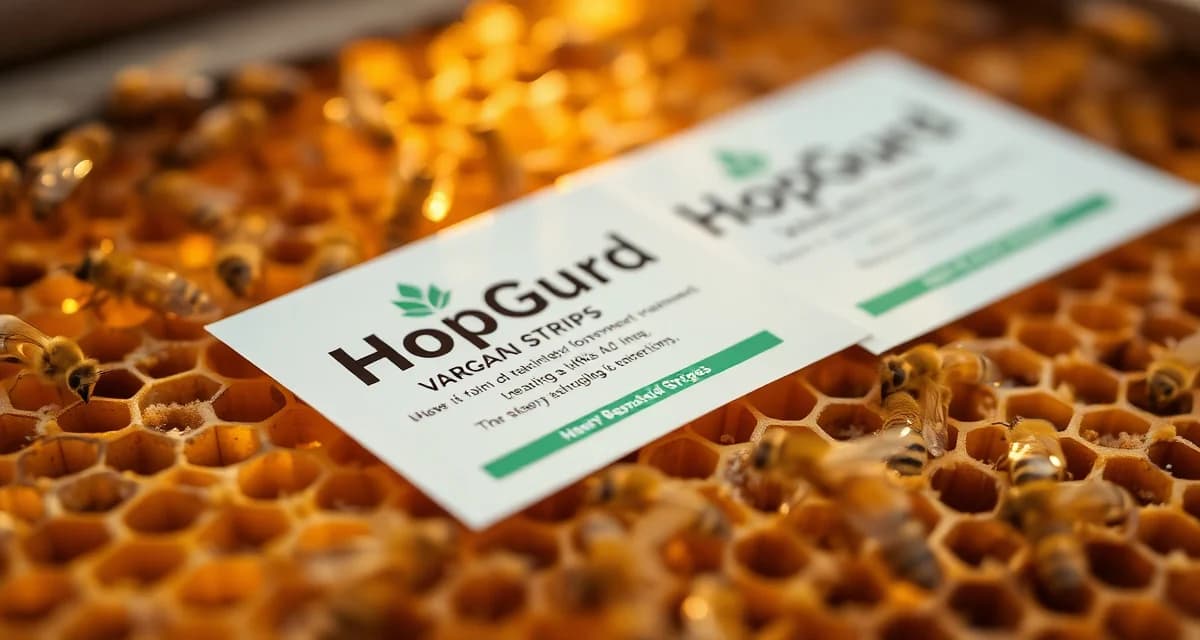
PHI for HopGuard: Harvest Timing After Hop Beta Acid Treatment
HopGuard is one of only two treatments labeled for use with honey supers in place at any time. That's a short list, and it's why HopGuard has a dedicated following among beekeepers who manage production colonies with active supers and need a varroa treatment option that doesn't force a harvest disruption.
The PHI for HopGuard honey harvest is 0 days. You can apply HopGuard with supers on and harvest from those supers the same day the treatment is complete. There's no waiting period, no super removal requirement, and no PHI restriction on your harvest.
TL;DR
- PHI (pre-harvest interval) is the required waiting period between the end of treatment and adding honey supers
- PHI varies by product: oxalic acid has no PHI for approved uses, MAQS has no PHI, Apivar requires supers to be off during treatment
- Applying treatments with supers on violates the label and may contaminate honey with residues
- State apiarists can ask for PHI compliance records during inspections
- Missing PHI windows is one of the most common compliance errors among small-scale beekeepers
- VarroaVault's PHI calendar blocks super-addition dates automatically based on your logged treatment dates
What Makes HopGuard Different
Most varroa treatments fall into one of two categories: treatments that require super removal (Apivar, Apistan, coumaphos) or treatments that have 0-day PHI but with nuanced during-treatment restrictions (MAQS, OA products). HopGuard is in a third category: genuinely unrestricted use with supers present at any time.
This is because HopGuard's active ingredient, hops beta acids (beta acids from Humulus lupulus, the hop plant), is a naturally occurring compound from an agricultural crop. The EPA determined that its application to colonies does not produce concerning residues in honey at labeled doses, resulting in the clean-label PHI status.
HopGuard is one of only two treatments labeled for use with honey supers in place at any time. (MAQS is the other, with the during-treatment nuances described in its own guide.)
HopGuard Protocol
HopGuard comes as strips impregnated with hop beta acids. The strips are placed on or between frames in the brood nest area.
Standard application: 1 strip per 5 frames of bees (some product versions) or as specified on your current product label. Placement in the brood nest area where bee contact is highest.
Treatment period: Varies by product version, typically 30 days or until the strip is depleted. Check your label.
Conditions: No temperature restrictions analogous to formic acid or thymol. HopGuard works across a wider temperature range, which is an advantage in both early spring and late fall.
Supers: Can remain in place throughout treatment. No restrictions.
Can I Harvest Honey Immediately After HopGuard Treatment?
Yes. The 0-day PHI with no during-treatment super restriction means honey in supers present throughout the entire HopGuard treatment period can be harvested immediately after treatment ends, or even before treatment ends, since supers can remain on and honey can accumulate normally.
HopGuard treatment log automatically confirms the 0-day PHI and marks harvest as immediately permitted in VarroaVault.
This is the simplest PHI compliance scenario in the varroa treatment toolkit. There's no countdown, no removal-date tracking for PHI purposes, and no conflict with harvest timing.
Is HopGuard as Effective as Other Treatments?
This is a fair question, and the honest answer is: efficacy results are more variable than with first-line treatments like Apivar or formic acid products.
Published studies on HopGuard show mite reduction in the range of 40-70% in colonies with brood present. That's meaningful reduction but lower than the 90%+ achievable with correctly applied Apivar or formic acid.
The efficacy gap has implications for how HopGuard fits in a varroa management program:
Best use cases:
- Maintenance treatment between heavier interventions, knocking down mite loads that are starting to build
- Colonies with moderate mite loads where you want to treat without disrupting production
- Stop-gap treatment when temperature conditions preclude formic acid and synthetic treatment would require a production-disruptive super removal
Less appropriate when:
- Mite loads are high (above 4-5%) and require aggressive knockdown
- You're approaching the fall treatment window where maximum efficacy is paramount
- You've already seen two consecutive HopGuard treatments with poor results
Combining HopGuard With Your Varroa Program
Many beekeepers use HopGuard as one component of a broader program rather than as a standalone primary treatment. Examples:
Production-season maintenance: Apply HopGuard during peak honey flow to suppress mite build-up, then follow with a more aggressive treatment (Apivar, OA extended protocol) after supers come off in fall.
Between major treatments: After fall Apivar completes, a winter OA dribble is the preferred follow-up. If counts start climbing again in spring before full-scale treatment is warranted, a HopGuard application during the spring build-up can slow the trajectory.
First-year beekeepers: The simple application protocol and clean PHI status make HopGuard accessible for new beekeepers who are still building confidence with varroa management. Starting with HopGuard while learning other methods is a reasonable approach, understanding that post-treatment counts are always necessary to verify efficacy.
How Do I Log HopGuard in VarroaVault?
In the colony treatment log, select HopGuard from the treatment menu. Enter:
- Application date
- Number of strips applied
- Estimated strip depletion date (or end-of-treatment date per your label)
- Pre-treatment mite count (baseline, always log this)
VarroaVault automatically marks the PHI as 0 days and confirms no super restriction applies. After logging, a post-treatment count reminder fires at the appropriate interval so you can verify efficacy.
The system doesn't generate PHI warnings for HopGuard harvest events, because there are none. The compliance picture is simple: treat, harvest whenever you want.
For tracking your HopGuard history and efficacy over time, the hopguard tracking feature in VarroaVault keeps your full application records alongside your count history. For comparing HopGuard PHI to other treatments you're managing across your apiary, the pre-harvest interval tracker shows all active treatments and their status.
Can I harvest honey immediately after HopGuard treatment?
Yes. HopGuard has a 0-day PHI with no during-treatment or post-treatment restrictions on honey supers. Supers can be present throughout the entire treatment period and honey from those supers can be harvested at any point, during treatment or after. There is no waiting period, no super removal requirement, and no PHI countdown to track.
Is HopGuard as effective as other treatments?
HopGuard achieves 40-70% mite reduction in studies of colonies with brood present. This is lower than first-line treatments like Apivar (90%+) or formic acid products (80-95% under correct conditions). HopGuard is most appropriate for maintenance treatment between major interventions, moderate mite loads during production season, or situations where synthetic or formic acid treatments aren't feasible. For high mite loads or fall treatment where maximum knockdown is critical, HopGuard is generally not sufficient as a standalone treatment.
How do I log HopGuard in VarroaVault?
Open the colony treatment log, select HopGuard, and enter the application date, strips applied, and treatment end date. VarroaVault automatically applies the 0-day PHI with no super restrictions and confirms harvest as immediately permitted. A post-treatment count reminder is scheduled at the appropriate interval. No PHI conflict checking is performed for HopGuard harvest events, because no PHI applies.
How do I know if my varroa treatment is working?
Run a mite count 2-4 weeks after the treatment ends and compare it to your pre-treatment count. The efficacy formula is: ((pre-count - post-count) / pre-count) x 100. A result above 90% indicates effective treatment. Results below 80% should trigger investigation for possible resistance, application error, or reinfestation. Log both counts in VarroaVault to track efficacy trends across treatment cycles.
How often should I check mite levels in my hives?
At minimum, once per month (every 3-4 weeks) during the active season. Increase to every 2 weeks when counts are near threshold or after a treatment to verify it worked. In fall, monitoring frequency matters most because the window to treat before winter bees are raised is narrow. VarroaVault's monitoring reminders can be set to your preferred interval for each apiary.
What records should I keep for varroa management?
Each record should include: date of count or treatment, hive identifier, monitoring method used, number of bees sampled, mites counted, infestation percentage, treatment product name and EPA registration number, dose applied, treatment start and end dates, and PHI end date. State apiarists typically expect this level of detail during inspections. VarroaVault captures all of these fields in a single log entry.
FAQ
What is PHI for HopGuard: Harvest Timing After Hop Beta Acid Treatment?
The pre-harvest interval (PHI) for HopGuard is 0 days, meaning there is no required waiting period between the end of treatment and harvesting honey. HopGuard is one of only two varroa treatments labeled for use with honey supers in place at any time, so beekeepers can apply it, complete the treatment, and harvest from those same supers on the same day without any PHI restriction or super removal requirement.
How much does PHI for HopGuard: Harvest Timing After Hop Beta Acid Treatment cost?
HopGuard itself is a commercially available varroa treatment product with its own purchase price, but the PHI for HopGuard is not a separate service or product — it is a regulatory label specification. The 0-day PHI is built into the product's EPA registration. Tools like VarroaVault's PHI calendar can help you track compliance automatically at no additional cost beyond the platform's standard access.
How does PHI for HopGuard: Harvest Timing After Hop Beta Acid Treatment work?
HopGuard uses hop beta acids derived from hops to kill varroa mites on contact. The strips are inserted between frames, where bees distribute the active ingredient throughout the colony. Because hop beta acids do not accumulate in beeswax or honey at harmful levels under label-compliant use, the EPA approved a 0-day PHI. Supers remain on the hive during the full treatment cycle, and harvest can proceed immediately after treatment ends.
What are the benefits of PHI for HopGuard: Harvest Timing After Hop Beta Acid Treatment?
The primary benefit of HopGuard's 0-day PHI is operational flexibility. Production beekeepers can treat for varroa without pulling supers, avoiding honey loss and labor disruption during active nectar flows. Unlike Apivar, which requires super removal during treatment, HopGuard lets you manage mite loads and maintain honey production simultaneously. This makes it especially valuable during mid-season mite pressure when removing supers would cost significant harvestable honey.
Who needs PHI for HopGuard: Harvest Timing After Hop Beta Acid Treatment?
Any beekeeper managing production colonies with active honey supers who also needs to address varroa mite loads should understand HopGuard's PHI. It is particularly relevant for commercial and sideliner beekeepers who cannot afford harvest disruptions, beekeepers in high-mite-pressure regions requiring mid-flow treatments, and anyone subject to state apiary inspections where PHI compliance documentation may be requested. Small-scale hobbyists with supers on can also benefit from this flexibility.
How long does PHI for HopGuard: Harvest Timing After Hop Beta Acid Treatment take?
HopGuard treatment typically runs for several weeks depending on the specific product formulation and label instructions. However, the PHI itself is 0 days — so the harvest timing constraint is solely determined by when your treatment cycle ends, not by any additional waiting period afterward. Plan your treatment schedule around the mite threshold and your expected harvest window, and you can harvest immediately once the final treatment day is complete.
What should I look for when choosing PHI for HopGuard: Harvest Timing After Hop Beta Acid Treatment?
When selecting a varroa treatment with PHI in mind, prioritize three things: whether the label permits use with supers on, the length of the PHI relative to your harvest schedule, and efficacy at your treatment timing. HopGuard scores well on all three for mid-season use. Also verify your state's apiary regulations, since some states have additional requirements beyond federal label rules. Always read the current product label, as formulations and instructions can change between product versions.
Is PHI for HopGuard: Harvest Timing After Hop Beta Acid Treatment worth it?
Yes, for beekeepers with honey supers on during active mite pressure, HopGuard's 0-day PHI makes it one of the most practical varroa management options available. The ability to treat without pulling supers preserves your harvest and simplifies colony management. The tradeoff is that hop beta acid strips have variable efficacy depending on hive conditions, so it works best as part of an integrated varroa management plan rather than a standalone solution for severe infestations.
Sources
- American Beekeeping Federation (ABF)
- USDA ARS Bee Research Laboratory
- Honey Bee Health Coalition
- Penn State Extension Apiculture Program
- Project Apis m.
Get Started with VarroaVault
PHI compliance is not complicated when your treatment dates and harvest windows are tracked in the same system. VarroaVault automatically calculates PHI end dates for every treatment you log and blocks honey super addition during restricted periods. See pricing and free tools at varroavault.com.