Phoretic varroa mites: what they are and why they matter
TL;DR
- A phoretic varroa mite is one riding on an adult bee rather than reproducing inside a capped cell.
- This phase lasts roughly 5 to 11 days in a colony with brood.
- Phoretic mites are the ones your alcohol wash or sugar roll actually counts.
- Target them during broodless periods and you hit the most mites per treatment you ever will.
What is a phoretic varroa mite, exactly?
A phoretic varroa mite (Varroa destructor) is a mite attached to an adult honey bee instead of sealed inside a capped brood cell. The word comes from the Greek "phorein," meaning to carry. The bee carries the mite. Not the other way around.
This matters because varroa lives two very different lives. The reproductive stage happens entirely inside capped cells, mostly worker brood (about 9-day cappings) and especially drone brood (about 14-day cappings). The phoretic stage is everything in between. The mite rides on the bee, feeds on fat body tissue [1], and waits for a chance to slip into a new cell before it gets capped.
For decades the textbooks said varroa fed on hemolymph, the bee's blood. A 2019 study in PNAS by Samuel Ramsey and colleagues proved that wrong. They confirmed varroa feeds mostly on the fat body, which is the bee's main immune and nutritional organ. That single correction explains why varroa-damaged bees are so immunocompromised, though it doesn't change how you count or treat phoretic mites.
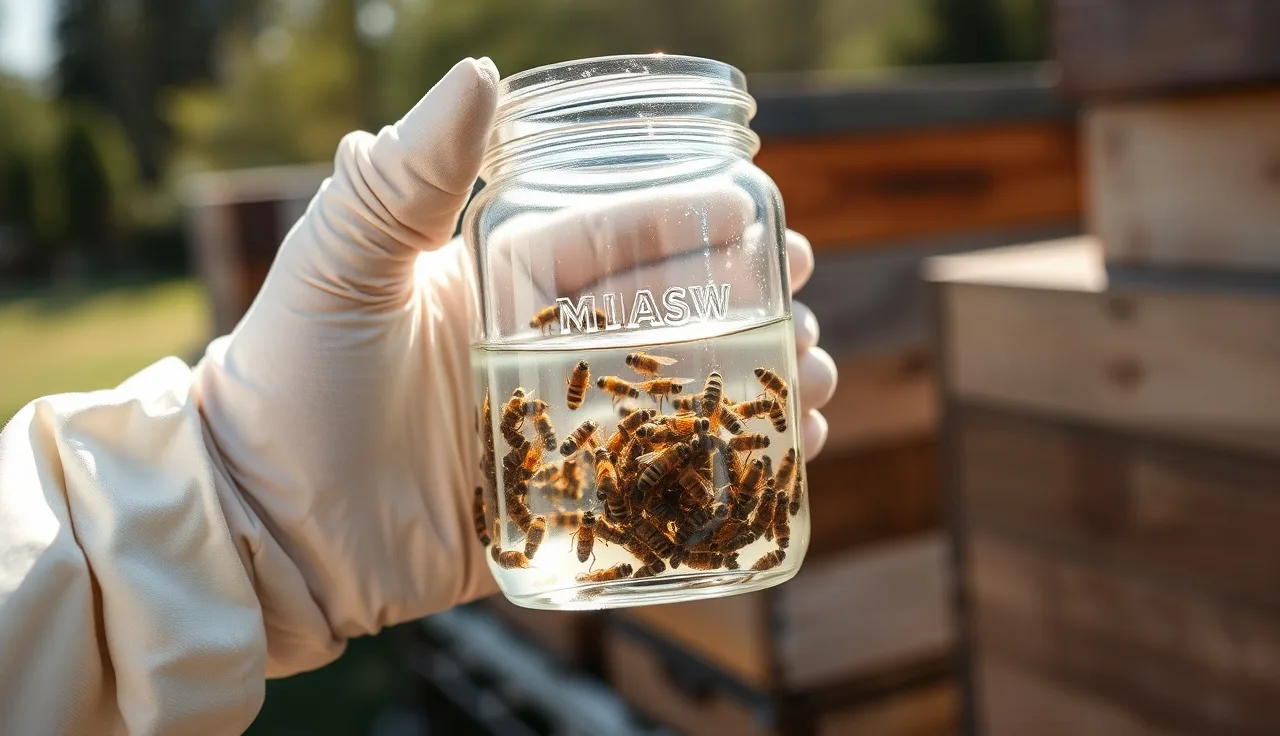
The phoretic mite is the only stage you can sample. When you run an alcohol wash or a sugar roll, you're counting phoretic mites on adult bees. Mites sealed inside cells are invisible to those tests. That gap between what you measure and what's actually crawling around your hive is the whole problem with varroa management in one sentence. Our varroa mite overview covers the full biology.
How long does the phoretic phase last?
In a colony with normal brood, a phoretic mite spends roughly 5 to 11 days riding adult bees before it finds a cell to enter. That range comes from modeling and direct observation, including the varroa population work by John Harbo and others at the USDA Bee Research Laboratory [2].
The phoretic period is not fixed. A few things stretch it or compress it:
- Brood availability. More open cells means mites find a ride into reproduction faster, so the average phoretic period shrinks. Fewer cells means mites ride longer.
- Season. In a broodless winter colony, every mite is phoretic. There's nowhere else to be. That's exactly why winter and intentional broodbreaks are such strong treatment windows.
- Mite age. Foundress mites that haven't reproduced yet enter cells more readily than mites that have already finished one or more cycles.
During a full broodless period, the entire mite population goes phoretic. If that stretch lasts three weeks or more (longer than a full brood cycle), a treatment aimed at phoretic mites can hit close to 100% of the mites in a single application. Compare that to treating into a colony full of capped brood, where a single oxalic acid dribble might contact only 20 to 30% of the mites present [3].
So here's the practical version. The phoretic phase is your window. The reproductive phase is where the mites hide from you.
What percentage of mites are phoretic at any given time?
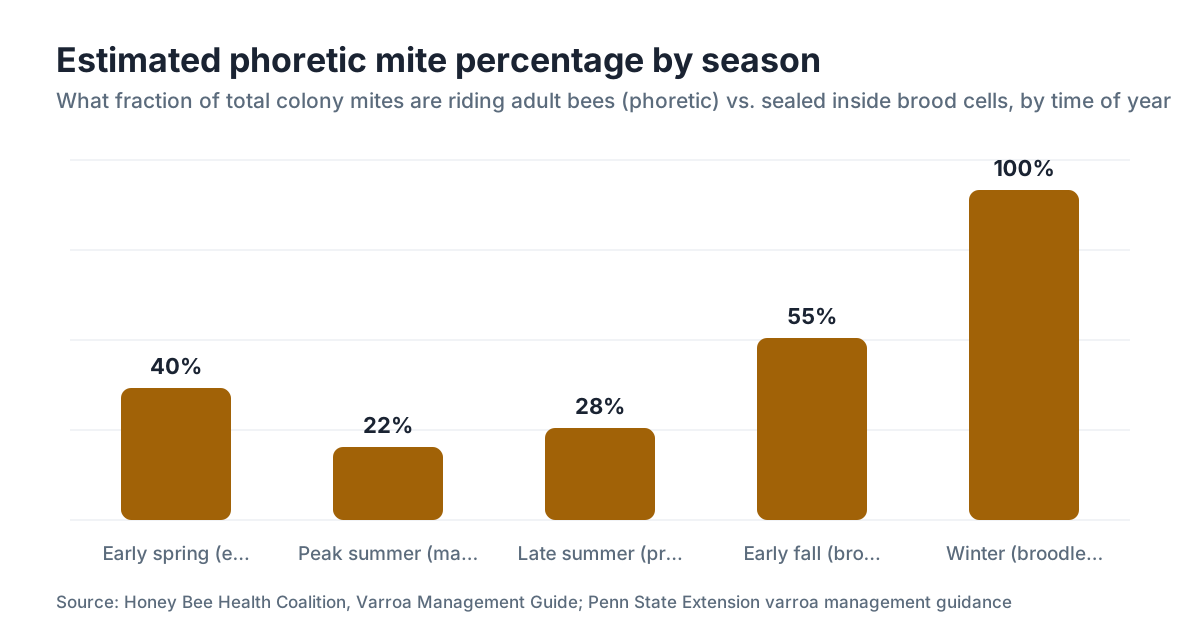
In a colony rearing brood during the main season, only 20 to 30% of the total mite population is phoretic at any given moment [3]. The other 70 to 80% sit inside capped cells, reproducing, shielded from most treatments. This is the number that trips up new beekeepers, because it means your wash is sampling the minority.
That ratio flips at certain times of year. In late fall and winter across temperate climates, when queens slow or stop laying, the phoretic share climbs toward 100%. Colonies in cold-winter regions can go fully broodless for 8 to 12 weeks, which hands you a long window where every mite is reachable.
The ratio also swings during a swarm or after a queen loss. A colony can sit queenright but broodless for three to five weeks while a new queen matures and starts laying. Plenty of beekeepers miss that window because it shows up at an inconvenient moment.
Why does this matter for your counts? An alcohol wash of 2 mites per 100 bees in midsummer means the true total load is likely 7 to 10 times higher, because you only sampled the phoretic fraction. The Honey Bee Health Coalition's Varroa Management Guide sets the common treatment threshold at 2 to 3 mites per 100 bees on an alcohol wash. That threshold is built around this reality: it's low enough to force you to treat before the hidden brood-phase mites bury you [4].
How do you measure phoretic mite levels accurately?
The alcohol wash is the most accurate field method for counting phoretic mites. You collect about 300 bees (roughly half a cup) from a frame of open brood where nurse bees gather, drop them into 70% isopropyl alcohol, shake for 60 seconds, then pour through a mesh screen and count the mites in the liquid [4]. Result is mites per 100 bees, so divide your mite count by 3 if you started with 300 bees.
The sugar roll frees the bees alive, which people like, but it undercounts by 20 to 40% next to an alcohol wash [5]. If you roll with sugar, adjust your number upward in your head. A sugar roll reading 1.5 mites per 100 bees might be a true load of 2 to 2.5.
The sticky board (bottom board insert) counts mites that fall on their own. It won't give you a phoretic percentage. What it gives you is a 24-hour or 72-hour natural drop count. The link between natural drop and true infestation is real but loose. Debris, colony strength, and season all move the number around. Most extension services now favor the alcohol wash over the sticky board for precise monitoring [4].
A few things I'd insist on:
- Sample nurse bees near open brood, never foragers at the entrance. Foragers carry fewer phoretic mites and hand you a falsely low count.
- Sample every 30 days through the active season, and always before and after a treatment.
- Never skip the post-treatment check. It's the only way to know your treatment actually worked.
Why is the phoretic phase the best window for varroa treatment?
Every EPA-approved varroa treatment works better when more mites are phoretic. This isn't a subtle nudge. It's the difference between killing 95% of your mites and killing 30%.
Oxalic acid (OA) is the clearest case. Applied as a dribble or vaporized into a colony with no capped brood, oxalic acid can reach efficacy above 90 to 95% in a single treatment [6]. Push that same dribble into a colony with fully capped brood and efficacy drops to roughly 40 to 60%, because the in-cell mites never touch the acid [6].
Amitraz strips (Apivar) and formic acid (Mite Away Quick Strips) can partly reach mites under cappings, but even these work best when the phoretic population is at its peak. The MAQS label spells out temperature windows and ventilation requirements that decide how much formic vapor actually reaches mites inside cells [7].
The broodless treatment idea is more than theory. Field work summarized in the Honey Bee Health Coalition guide found that colonies treated with oxalic acid during a broodless period carried lower spring mite loads than colonies treated in fall with brood present, using the same product [4].
Can't get a natural broodless period? Caging the queen for about 24 days manufactures one. It's more work, but it's how some serious sideliners stack the odds their way.
What do phoretic mites do to the bees they ride?
Phoretic mites are not passive hitchhikers. They feed on the bee's fat body, which stores protein, lipids, and immune compounds. Every hour a mite rides, it's draining that bee's reserves.
Bees exposed to high mite loads as larvae and pupae emerge with less fat body mass, weaker immune gene expression, and shorter lives [1]. Phoretic mites on adults do damage too, and it lands hardest on long-lived winter bees. A winter bee needs an intact fat body to survive five or six months, to make royal jelly for spring brood, and to break down pesticide residues. A winter bee that carried several phoretic mites in her first week may already have a depleted fat body before the cold sets in.
Phoretic mites also move viruses, and Deformed Wing Virus (DWV) is the worst of them. A single mite can pass DWV to several bees during its phoretic phase as it shifts hosts. The link between high varroa loads and high DWV titers is well established [1]. This is why heavy mite loads in late summer are so destructive. The winter bees being raised in August and September get parasitized and infected during their most vulnerable days, which sets up a weak cluster and a likely spring dieout.
The takeaway is blunt. There's no mite count low enough to ignore. Even at 1 mite per 100 bees, virus transmission is happening.
How do phoretic mites spread between colonies?
Phoretic mites travel between colonies whenever bees do. Drifting bees (drones drift the most), robbing bees, and swarms all carry phoretic mites with them.
Drone drift moves mites efficiently. A drone may visit several colonies on mating flights, and he carries any phoretic mites from his home hive straight into the next one. Research points to drone-driven transmission re-infesting treated colonies within a single season when neighboring apiaries run hot [2].
Robbing is the other big vector. When a weak, high-mite colony gets robbed out, every robber that leaves with honey leaves with phoretic mites. One robbing event can move hundreds of mites into a clean colony in a day. That's the strongest argument for hard mite management I know: your high-mite hive is a threat to your neighbors, and theirs to you.
Swarms usually leave with fewer mites than the parent colony, because the queen stops laying before the swarm issues, which shifts mites toward the phoretic state, and the swarm carries a smaller share away. But swarms from unmanaged feral colonies (including africanized honey bee populations in southern states) can still seed mites into a new site.
In an area thick with hobbyist hives, your mite management is partly a neighborhood problem. Even a perfectly treated hive can climb back to treatable levels within 4 to 8 weeks if high-mite colonies sit nearby [4].
How does the phoretic-to-reproductive ratio change by season?
The seasonal swing in phoretic percentage is the foundation of smart treatment timing. Here's how it runs in a temperate northern hemisphere climate:
Spring (March to May): Queen laying hard, brood nest expanding. Phoretic share is moderate (30 to 50%) early, then drops toward 20 to 30% as brood area peaks. Mite numbers are still low from winter, but the ratio is drifting toward a dangerous mix.
Summer (June to August): Peak brood, lowest phoretic share (often 15 to 25%). This is the hardest stretch to treat with products that only hit phoretic mites. It's also when mite populations grow fastest, because reproductive slots are everywhere. The gap between your wash and the true load is at its widest.
Late summer and early fall (August to September): Mite population at or near its annual peak. This is the treatment window that decides your winter. Miss it and you've named the single most common cause of spring colony loss.
Fall (October to November): Brood area shrinks, phoretic share climbs. In many northern climates colonies go broodless by November. OA vaporization efficacy peaks here.
Winter (December to February): Every mite phoretic. Ideal for one OA treatment if the cluster is big enough to reach. The EPA label for Api-Bioxal (oxalic acid dihydrate) names broodless colonies as a use case [6].
A seasonal protocol planner can map these windows to your region and your inspection notes, so you're not guessing when your broodless periods actually land.
Which treatments work best against phoretic mites specifically?
Every approved varroa treatment works on phoretic mites. The real question is which ones also reach the reproductive mites inside cells, because that decides how many total mites you kill per cycle.
| Treatment | Phoretic efficacy | Penetrates cappings? | Broodless requirement? |
|---|---|---|---|
| Oxalic acid dribble | >90% (broodless) | No | Yes, for full efficacy |
| Oxalic acid vaporization | >90% (broodless) | Minimal | Yes, for full efficacy |
| Formic acid (MAQS) | High | Partial | No, label allows brood present |
| Amitraz (Apivar strips) | High | Partial | No |
| Thymol (Apiguard) | Moderate | Minimal | No, but temperature-limited |
| Hop Beta Acids (HopGuard) | Moderate | No | No, label allows brood present |
Oxalic acid in a broodless colony is the cheapest strong option for most hobbyists. Api-Bioxal runs roughly $25 to $40 for a packet that treats several hives, and one vaporization in a broodless colony routinely clears over 95% of the mites [6].
Apivar strips are the pick when you have to treat into brood, because amitraz penetrates cappings somewhat and the 6 to 8 week window outlasts most brood cycles. The costs are money (roughly $3 to $6 per strip, two strips per hive) and resistance, which builds with repeated synthetic acaricide use.
Formic acid (MAQS) is the one product labeled to treat with brood present and kill some reproductive mites at the same time [7]. The tradeoff is temperature (don't apply above 85 degrees F) and the occasional dead queen.
For sourcing, the beekeeping supply companies page lists vendors worth using.
Can you use mite wash results to estimate total colony mite load?
You can estimate, with honest uncertainty attached. If you know your phoretic percentage (roughly 20 to 30% during active brood season), you can back into a rough total mite population.
Example: your alcohol wash shows 2 mites per 100 bees, and your colony has 30,000 bees. Phoretic mites work out to 600 (2% of 30,000). If phoretic mites are 25% of the total, your total mite population estimate is about 2,400.
That estimate is imprecise. Phoretic percentage varies by colony, by day, by measurement. But it beats the raw wash count alone, which too many beekeepers read as if it were the whole infestation.
Researchers have built more precise tools. Varroa population models, refined over the years by COLOSS network members, let you project mite growth forward from a measured phoretic count while accounting for seasonal brood levels [8]. These are more for researchers than for someone checking hives on a Saturday morning, but they make the point plain: even a 2% wash in July can mean a colony headed for a crash by September without action.
The Honey Bee Health Coalition recommends treating when the alcohol wash hits 2 mites per 100 bees during the brood season, precisely because of this hidden multiplier [4]. That threshold is conservative on purpose.
What research has shaped our understanding of phoretic varroa biology?
The foundational work came out of the Soviet Union and Europe in the 1970s and 1980s, as Varroa destructor spread off its original host (Apis cerana) onto European honey bees (Apis mellifera). Researchers like Wolfgang Ritter in Germany and Yves Le Conte in France built the early reproduction models that set up the phoretic versus reproductive split we still use.
In the US, the USDA Bee Research Laboratory in Beltsville, Maryland has turned out a steady run of varroa biology work. John Harbo's population models and hygienic behavior research from the 1990s and 2000s still show up in extension publications [2].
Samuel Ramsey's 2019 PNAS study on fat body feeding corrected decades of received wisdom. The paper's stated conclusion was that "Varroa destructor is primarily feeding on fat body tissue rather than hemolymph" [1], which reframes how parasite damage stacks up in a colony. It doesn't change treatment protocols, but it explains why mite-damaged bees show immune suppression and pesticide sensitivity that hemolymph feeding alone could never produce.
The COLOSS network, a European consortium of bee researchers, publishes multi-country data on varroa spread, treatment efficacy, and colony loss. Its annual winter loss surveys are among the largest systematic datasets in beekeeping [8].
On the practical end, the Honey Bee Health Coalition's Varroa Management Guide (now in its third edition) is the most field-tested synthesis of all this for working beekeepers. It's free to download and worth reading front to back [4].
What is a broodless period and how do you plan one to target phoretic mites?
A broodless period is any stretch when your colony has no capped brood. It happens naturally (winter, post-swarm, queen failure) or you engineer it by removing or caging the queen.
Natural broodless periods take the least effort. In USDA hardiness zone 5 and colder, most colonies go broodless for 6 to 12 weeks in midwinter. One oxalic acid vaporization in that window, with temperatures above 40 degrees F for a few hours, hits nearly every mite in the colony [6].
An engineered broodless period costs work. The standard move is to cage the queen in a push-in cage or queen cage for 24 to 27 days. Twenty-four days covers the longest worker brood cycle from egg to emergence, so all capped brood has hatched and every reproductive mite is back on the bees as a phoretic mite. Then you treat, wait 5 to 7 days for the contact-killed mites to drop, and release the queen.
Some beekeepers use a split and recombine method instead: split the colony, let the queenless half raise an emergency queen, treat that half during the roughly 25-day gap before the new queen lays, then recombine. It avoids handling the queen directly.
The labor is real. For a hobbyist with 5 hives, caging queens is an afternoon. For a sideliner with 50, it's a serious time sink. That's why many sideline operations lean on Apivar in fall (brood-tolerant) and save broodless-window OA for winter. Neither is wrong. The right protocol is the one you'll actually run every year.
Frequently asked questions
How many phoretic mites is too many?
The Honey Bee Health Coalition's treatment threshold is 2 mites per 100 bees (2%) on an alcohol wash during the brood season, dropping to 1 mite per 100 bees (1%) in late summer when winter bees are being raised. These are set low because phoretic mites are only 20 to 30% of total load when brood is present. A 2% wash likely means a real mite population 7 to 10 times that count.
Do phoretic mites die on their own without treatment?
No. Phoretic mites feed on bee fat body tissue and can survive several months riding adult bees in a broodless colony. Left alone, mite populations grow fast, because each reproductive cycle produces female offspring that become new phoretic mites. A colony that starts spring with a modest load can reach collapse-level infestation by fall with no intervention at all.
Can a sugar roll replace an alcohol wash for counting phoretic mites?
A sugar roll frees the bees alive, which many beekeepers prefer, but it undercounts mites by 20 to 40% next to an alcohol wash. University extension research from several states confirms the gap. If you use sugar rolls, read your result as a floor, not a true number, and consider a lower action threshold to compensate. An alcohol wash on 300 bees is still the most accurate field method a hobbyist has.
Do phoretic mites prefer nurse bees or forager bees?
Phoretic mites strongly prefer young nurse bees over foragers. Nurse bees work the brood nest where cells are being prepared for capping, which gives mites better access to reproduction. Foragers spend much of their day outside the hive and carry far fewer phoretic mites. This is why you sample nurse bees near open brood frames for a wash, never bees at the entrance.
How do I know if my varroa treatment worked on phoretic mites?
Run an alcohol wash 3 to 5 days after treatment ends, using the same protocol as your pre-treatment sample. If you treated during a broodless period, a good result drops the count below 0.5 mites per 100 bees. If you're still above 1 to 2%, the treatment may have failed from resistance, application error, or re-infestation from nearby colonies, and you need to figure out which and retreat.
How fast do phoretic mites reproduce once they enter a brood cell?
A foundress mite enters a cell just before capping, usually when the larva is about 7 to 8 days old. Inside, she lays her first (unfertilized, male) egg, then fertilized female eggs roughly every 30 hours. In a worker cell (capped about 9 days) she typically produces 1 to 2 reproductive daughters. In a drone cell (capped about 14 days) she can produce 2 to 3. Those daughters become phoretic mites after the cell opens, and the cycle starts over.
Is oxalic acid safe to use on phoretic mites in winter clusters?
Yes. Oxalic acid vaporization during a broodless winter period is EPA-registered and considered the safest treatment window for bees, since no brood is exposed to the acid. The Api-Bioxal label allows vaporization when temperatures sit above roughly 40 degrees F for a working window. A single vaporization in a truly broodless colony can clear over 95% of phoretic mites, which makes it the most efficient use of oxalic acid available to hobbyists.
Can phoretic mites spread between hives in the same apiary?
Yes, through drifting bees, drones, and robbing. Drones are especially mobile and can carry phoretic mites across several hives in a single day. A robbing event can move hundreds of mites from a high-load colony into a treated one within hours. So mite management is never fully an individual-hive job. High-load colonies in your apiary, or in neighboring apiaries within about a mile, are a re-infestation source for your treated hives.
What diseases do phoretic mites transmit while riding on bees?
Deformed Wing Virus (DWV) is the most damaging. Phoretic mites spread DWV as they move between host bees during the riding phase, and as they puncture the cuticle of pupae inside cells. Sacbrood virus, Acute Bee Paralysis Virus (ABPV), and Kashmir Bee Virus have also been tied to varroa transmission. DWV gets the most study because high varroa loads track almost perfectly with high DWV titers and visible wing deformity in emerging bees.
How long can a phoretic mite survive without a host bee?
Off the bee entirely, a phoretic mite lasts only a few hours to a day or two, depending on temperature and humidity. They're obligate parasites and can't feed or reproduce without a bee host. Varroa can't persist in empty equipment or in a hive once all the bees have died, which is useful to know if you're reusing comb from a collapsed colony, though standard cleaning is still worth doing.
Does drone brood removal actually help reduce phoretic mite levels?
It helps, but on its own it's rarely enough. Varroa reproduces at roughly 8 to 10 times the rate in drone cells versus worker cells, so trapping mites in drawn drone comb and cutting it out before emergence removes a disproportionate share of reproductive mites. Studies suggest it meaningfully slows population growth. Extension services recommend it as a supplement to approved acaricides, not a replacement [9].
Why do some colonies seem to tolerate high phoretic mite loads better than others?
Genetic traits like Varroa Sensitive Hygiene (VSH) and suppressed mite reproduction (SMR) let some colonies detect and pull mite-infested brood before reproductive mites finish. VSH bees hold much lower mite growth rates under the same field conditions as non-VSH stock. Grooming behavior varies too. Buying VSH-trait queens is a real tool, but it works best paired with ongoing monitoring, not as an excuse to stop checking.
Do feral or wild honey bee colonies have phoretic varroa mites too?
Yes. Nearly all unmanaged feral Apis mellifera colonies in North America carry varroa. Some feral colonies in Europe and the US have survived years with mites, likely from selection for hygienic or survivor traits. But most feral colonies die within 1 to 3 years of infestation. Surviving colonies interest VSH researchers and shouldn't be read as proof that varroa turns harmless over time without management.
Sources
- PNAS, Ramsey et al. 2019, 'Varroa destructor feeds primarily on honey bee fat body tissue': Varroa destructor feeds primarily on the fat body of honey bees rather than hemolymph, as confirmed by histological and chemical analysis.
- USDA Agricultural Research Service, Bee Research Laboratory, Beltsville MD: Foundational varroa population models estimating phoretic phase duration and mite population growth rates in managed honey bee colonies.
- Penn State Extension, 'Varroa mite management in honey bee colonies': During active brood season, approximately 20-30% of total varroa mites are phoretic (on adult bees) while 70-80% are inside capped cells.
- Honey Bee Health Coalition, Varroa Management Guide (3rd edition): Treatment threshold of 2% (2 mites per 100 bees) on alcohol wash during brood season; 1% in late summer; alcohol wash is the gold standard sampling method.
- University of Minnesota Extension, 'Varroa mite sampling methods compared': Sugar roll undercounts mites by 20-40% compared to alcohol wash in side-by-side studies; alcohol wash recommended for accuracy.
- EPA, Api-Bioxal (Oxalic Acid) product label and registration documents: Oxalic acid dihydrate (Api-Bioxal) achieves greater than 90-95% efficacy against phoretic mites when applied in broodless colonies; single dribble in colonies with brood reduces efficacy to approximately 40-60%.
- EPA, Mite Away Quick Strips (formic acid) product label: MAQS is labeled for use in the presence of brood and has partial penetration of cappings; temperature limit of 85F applies; queen loss possible.
- COLOSS Network, annual honey bee colony loss surveys and varroa research publications: Multi-country systematic data on varroa spread, treatment efficacy, and colony winter loss rates across European and North American apiaries.
- Virginia Cooperative Extension, 'Integrated Pest Management for Varroa mites': Drone brood removal as a supplemental IPM strategy can meaningfully reduce varroa population growth rate but is not sufficient as a standalone treatment.
- Ohio State University Extension, 'Monitoring and managing varroa mites in honey bee colonies': Natural mite drop counts have loose correlation to true infestation rates; alcohol wash on nurse bees near open brood frames is recommended for accurate phoretic mite assessment.
Last updated 2026-07-09