Placing Apivar strips: the complete how-to guide
TL;DR
- Use one Apivar strip per five frames of bees, two strips minimum per colony.
- Hang them vertically in the brood nest, wedged between frames of capped brood.
- Leave them 42 to 56 days, never less, never more.
- Treat in late summer or early spring when brood is limited.
- Wear nitrile gloves.
- Write your placement date on the box.
What is Apivar and how does it kill varroa mites?
Apivar is an amitraz-based acaricide the EPA registered for controlling Varroa destructor in honey bee colonies. Each strip is a plastic matrix loaded with 500 mg of amitraz. The active ingredient off-gasses slowly, bees pick it up as they move through the brood nest, and they pass it to mites by contact. It hits the mite's nervous system.
Amitraz is a monoamine oxidase inhibitor. It works fast enough that you'll usually see mites dropping onto a sticky board within the first few days. The slow-release matrix is why the 42-to-56-day window exists. You need sustained exposure to catch mites as they climb out of capped cells over more than one brood cycle. A summer brood cycle runs roughly 21 days, so a full treatment covers at least two of them [1].
Apivar sells over the counter in the U.S. No prescription. But the EPA label is a legal document, and following it exactly matters for two reasons: it kills more mites, and it keeps amitraz out of your honey [2].
How many Apivar strips do you need per hive?
One strip per five frames of bees, minimum two strips, maximum four per colony [2]. That's the label, and it isn't a suggestion. Under-dosing is the fastest way to breed amitraz-resistant mites, and a varroa population rebounds hard when you skimp on strips or pull them early.
Here's a quick reference:
| Frames of bees covered | Strips needed |
|---|---|
| Up to 5 frames | 2 strips (minimum) |
| 6 to 10 frames | 2 strips |
| 11 to 15 frames | 3 strips |
| 16 to 20 frames | 4 strips (maximum per colony) |
For a two-deep Langstroth in peak summer, two strips is usually right if the bees cover about 10 frames or fewer. A booming colony in late July might spread across 12 to 16 frames and needs three. Count the frames that actually have bees on them, not the frames in the box.
Running a single-deep nuc or a small split? Two strips is still the floor even if the colony only covers three or four frames. One strip is off-label.
Where exactly do you place Apivar strips in the hive?
Hang the strips vertically, between frames, inside the brood nest. That's the warm, crowded zone where nurse bees and capped brood sit together. A strip wedged in the bee space between two frames of capped brood gets maximum contact with bees moving in and out of cells.
For two strips in a single box, split them roughly symmetrically, one on each side of the brood cluster. In a 10-frame hive, between frames 3 and 4 and between frames 7 and 8 works well. You want coverage across the width of the brood nest, not both strips jammed in the middle.
In a two-box setup, put both (or all) strips in the lower brood box where the queen works most. If the upper box holds active brood and bees, you can split placement, but the strips have to stay in the brood area, never in a honey super [2].
Each strip has a hook or tab at the top. Hang it so it touches the bottom bar of the frame above and the top bar of the frame below, or wedge it snug between the two frame bodies. It needs to sit in the bee space, not flop loose in an open cavity. Contact is the whole point.
When you're running varroa mite treatments across several hives, mark each placement spot in pencil on the top bar. Come day 42, you'll know exactly which frames to pull.
When is the best time of year to place Apivar?
Late summer and early spring, when brood is limited, give you the best mite kill. The logic is simple: amitraz kills phoretic mites (the ones riding on adult bees) well, but it can't reach mites sealed inside capped cells. Treat when less brood is present, and more mites spend more time exposed out in the open.
For most beekeepers in temperate climates, the two windows are late summer (roughly August into early September) and late winter or early spring (February through March, before buildup). The Honey Bee Health Coalition's Varroa Management Guide names late summer as the highest-impact timing because it protects the long-lived winter bees that carry a colony to spring [3].
Spring treatment works too, before supers go on. The label bans applying or leaving strips in the hive when honey supers meant for human food are present [2]. That single rule shapes spring timing more than anything else: finish the treatment and pull the strips before your nectar flow starts. In much of the U.S., that means starting no later than early April.
Fall treatment after pulling supers is the most common approach, and for good reason. A 3% or higher mite infestation on adult bees in August is a colony in real trouble headed into winter [3]. Treat before you hit that number. If you're already there, treat now.
Can you use Apivar with honey supers on the hive?
No. The EPA label flatly prohibits applying Apivar or leaving strips in the hive when honey supers for human consumption are present [2]. Amitraz and its breakdown products get into honey, and that's not a residue you want to gamble on.
Pull every honey super before you treat. Doing a fall treatment after the main flow? Harvest, pull the supers, then place strips. Doing a spring treatment? Finish and remove the strips before the flow starts and supers go back on.
The timing math is unforgiving. If your main flow starts May 15 and strips need 42 to 56 days in the hive, place them no later than March 20 to have them out by May 10. Learn your local bloom calendar and work backward from it.
How long do you leave Apivar strips in the hive?
A minimum of 42 days, a maximum of 56 [2]. Both ends of that range have teeth.
Pull strips before 42 days and you cut the treatment short before mites in the last capped cells have emerged and gotten dosed. You leave a surviving mite population behind, and whatever amitraz tolerance those survivors carry, you've just selected for it. Don't.
Leave strips past 56 days and you're off-label, building amitraz residue in your wax. Beeswax soaks up fat-soluble compounds easily, and amitraz is lipophilic. Studies have found amitraz residues in comb wax at levels that hurt queen sperm viability and larval development when colonies live on heavily contaminated comb over long stretches [4]. The 56-day cap isn't arbitrary.
Write the placement date on the outside of the hive the day the strips go in. Permanent marker on the box, or a hive card. Forty-two days arrives faster than you expect in a busy season.
What protective gear do you need when handling Apivar strips?
Chemical-resistant gloves, and this one's worth respecting. Amitraz absorbs through skin, and the real concern is repeated low-level exposure, not a single quick touch. Nitrile gloves get used most often and hold up reasonably well. Latex resists amitraz poorly, so if that's all you have, double-glove or switch to nitrile [2].
You don't need a respirator for normal placement. Airborne amitraz during the few minutes of handling is low. Treating dozens of hives in a row inside a confined space is a different story, and extra respiratory protection makes sense there. For a hobbyist working one to ten hives outdoors, gloves plus a thorough hand-wash afterward is the standard.
Don't puff your smoker right over the strips. Burning amitraz produces formamide compounds that harm bees [5]. Smoke the bees to calm them before you open up, then set the smoker aside before you touch the strips.
How do you monitor whether Apivar is actually working?
Slide a sticky board under your screened bottom board when you start, then check it at 48 to 72 hours. A heavy mite drop in the first few days tells you the strips are making contact and the amitraz is doing its work. Near-zero drop in the first week on a colony you suspected had mites is a red flag: maybe the strips aren't in good contact, maybe the colony is queenless and broodless in some way you missed, or, less often, you're looking at a resistant mite population.
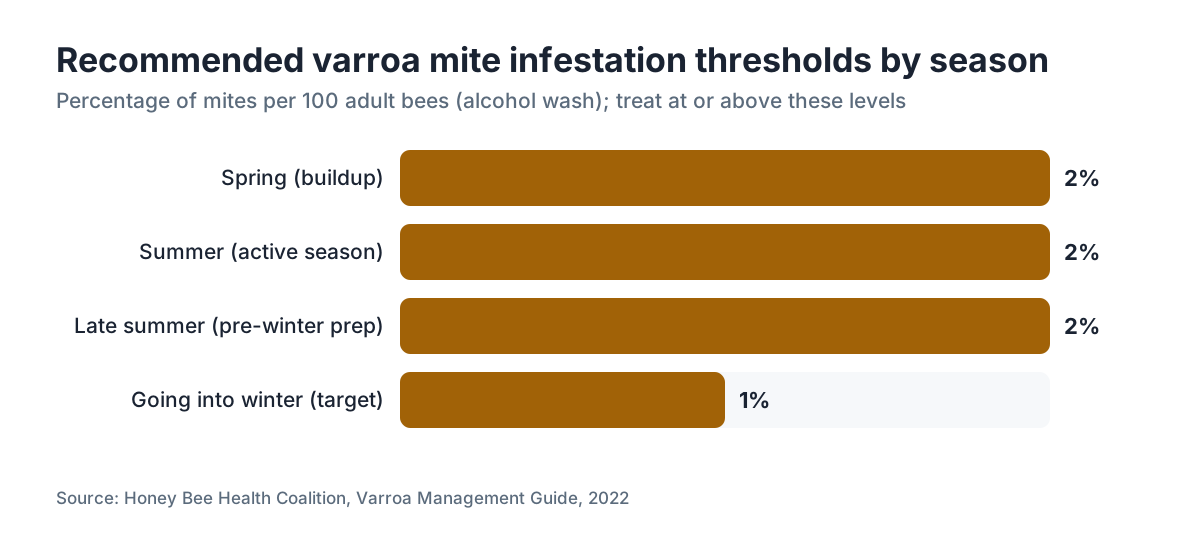
Re-test with an alcohol wash or sugar roll after the full 42-to-56-day treatment. Aim for under 2 mites per 100 bees (2%) at any point in the active season, and under 1% going into winter [3]. Still above 2% after a complete Apivar run? The usual suspects are reinfestation from neighboring colonies, a treatment cut short, under-dosing, or resistance. Rotate to a different treatment class next cycle.
VarroaVault's free mite counting and treatment log tools let you track pre- and post-treatment counts across hives, so you can spot which colonies keep re-infesting.
What are the most common mistakes beekeepers make placing Apivar?
Pulling strips too early tops the list. Life gets busy, you crack the hive at day 30, the mite count looks fine, and out they come. The colony re-infests within weeks.
Using too few strips runs a close second. One strip in a full double-deep is a massive under-dose. Count your frames of bees and do the arithmetic before you open the package.
Placing strips outside the brood nest happens more than you'd think. A strip hanging in an empty honey super, or in a box the bees have mostly left, gets almost no contact. If you don't see bees walking across the strip after 24 hours, it's in the wrong spot.
Leaving honey supers on. Some beekeepers know the rule and talk themselves into an exception because pulling supers is a hassle. Don't. Amitraz in honey is a regulatory and health problem, more than a label technicality.
Skipping treatment rotation. Run Apivar three or four times straight with no switch to oxalic acid, formic acid, or another mode of action, and you're running a resistance-breeding program. The Honey Bee Health Coalition recommends rotating treatments to slow resistance [3].
Recording nothing. You'll forget the placement date, the strip count, the pre-treatment number. Keep a hive card or a plain notebook. When a colony dies in January and you're trying to figure out why, those records are what you'll reach for.
Can you use Apivar in nucs and small colonies?
Yes, and the two-strip minimum holds even for a small nuc. You can cut strips in half for very small colonies (a split covering only two or three frames), but only if your country's label permits partial strips. The U.S. EPA label says nothing about cut strips, so doing it is an off-label use [2]. The under-dosing risk in a small colony is real, because mite loads in nucs can spike fast.
For overwintering nucs or small two-to-three-frame splits, an oxalic acid dribble or vaporization often fits better. Apivar shines when a settled bee population moves through the brood nest with regularity. A tiny colony may not have enough bees to keep both strips well-trafficked.
How does Apivar compare to other varroa treatments?
Apivar's strengths are ease of use and a wide working temperature range. Formic acid (MAQS or Formic Pro) has a narrow window of roughly 50 to 85°F and can kill queens above that, while amitraz works reasonably from about 50°F on up through summer heat [5][6]. Oxalic acid needs broodless conditions for high efficacy; Apivar doesn't, though it still does its best work when brood is limited.
The big drawback is wax residue. Amitraz builds up in comb over time, and the research literature raises real concern about long-term effects on queens and larvae in heavily contaminated wax [4]. Rotating comb and not re-treating with Apivar every cycle keeps that in check.
Resistance is the other worry. Amitraz resistance in varroa is documented in some European populations and has turned up at low levels in some U.S. apiaries [7]. Rotating with oxalic acid, which kills by a different mode of action, is the standard fix.
On price, a pack of 10 Apivar strips (five colonies at two strips each) typically runs $25 to $35 depending on supplier. Formic Pro and oxalic acid vaporization land at similar or lower per-colony cost, but they ask for tighter timing or equipment.
Shopping for supplies? Check beekeeping supply companies for current pricing, since strip costs have moved as demand shifted through recent colony loss cycles.
| Treatment | Active ingredient | Temp range | Broodless needed | Honey super restriction | Typical treatment window |
|---|---|---|---|---|---|
| Apivar | Amitraz | ~50°F and above | No | Yes | 42 to 56 days |
| Formic Pro | Formic acid | 50 to 85°F | No | No (varies by label) | 14 to 20 days |
| Oxalic acid dribble | Oxalic acid | Above 40°F | Yes (for high efficacy) | No | Single treatment |
| Oxalic acid vaporization | Oxalic acid | Above 40°F | Broodless best; multi-dose for brood | No | 3 doses over 21 days |
| Mite Away Quick Strips | Formic acid | 50 to 85°F | No | No | 7 days |
[1][5][6]
How do you dispose of used Apivar strips?
Toss used strips in the trash (municipal solid waste), which is what the label says [2]. Don't burn them. Burning amitraz makes toxic decomposition products. Don't drop them on the ground near your hives either, because bees and wildlife can contact them.
Used strips still hold residual amitraz. Handle them with the same gloves you wore for placement. Seal them in a zip-lock bag or fold them back into the original packaging before they go in the trash. Quick step, and it cuts needless exposure.
Some beekeepers save used strips for a second run. The label doesn't authorize reuse. Efficacy falls off hard after the first treatment because most of the amitraz has already off-gassed. Reusing strips is off-label. Skip it.
Where can you find the official Apivar label and further guidance?
The current U.S. EPA-registered Apivar label lives in the EPA pesticide label database. Always follow the label that came with your product, since formulations and instructions change between registration cycles. The Honey Bee Health Coalition's Varroa Management Guide is a free download and the clearest plain-language treatment of timing, thresholds, and resistance management available to U.S. beekeepers right now [3].
Your state's university extension service is a good source of regionally tuned advice. The University of Minnesota Bee Lab, the NC State apiculture program, and Penn State Extension all publish Apivar guidance matched to local bee seasons and mite pressure [8][9][10].
For free varroa tracking and scheduling, VarroaVault's protocol tools log strip placement dates, mite counts, and treatment history across your whole apiary in one place. That makes rotation and timing calls easier season over season.
Frequently asked questions
Do I need a prescription to buy Apivar in the United States?
No. Apivar sells over the counter in the U.S. with no veterinary prescription. The EPA registers it as a pesticide for use in bee colonies. Some other amitraz products for livestock do require a prescription, but Apivar strips sold for beekeeping don't. Buy from a licensed beekeeping supply retailer and keep your receipt in case your state apiarist ever asks for treatment records.
Can I use Apivar during a honey flow?
No. The EPA label bans Apivar when honey supers meant for human food are on the hive. Pull all supers before placing strips. Time the treatment so the full 42-to-56-day period finishes before your main nectar flow starts and supers go on. Amitraz contaminates honey, and the U.S. has set no tolerance for it in honey for human consumption.
What temperature is too cold for Apivar to work?
The label recommends treating above 50°F (10°C). Below that, amitraz off-gasses more slowly and bee activity drops, cutting contact between bees and the strip. Fall treatments placed while daytime highs are still in the 50s can work, but don't start one when a long cold spell is forecast. Late summer to early fall placement, before sustained cold, gives the best results.
Can varroa mites become resistant to Apivar?
Yes. Amitraz resistance in Varroa destructor is documented in some U.S. apiaries and more widely in parts of Europe [7]. Warning signs: very low mite drop on a sticky board after 72 hours in a colony you know is loaded, and mite counts that barely move after a full treatment. Rotating with oxalic acid between Apivar treatments is the standard way to slow resistance.
How do I know if the Apivar strips are in the right place?
Check 24 hours after placement. You should see bees walking across and around the strip. If a strip hangs where bee traffic is thin, move it toward the center of the brood nest. Check your sticky board at 48 to 72 hours too: a visible mite drop confirms the bees are picking up and spreading the amitraz. No mite drop at all after 72 hours on a colony you know has mites needs investigating.
Can I use Apivar in a Warré hive or a top-bar hive?
Apivar is labeled for honey bee colonies, not specifically for Langstroth hives, so you can use it in other hive styles. The tricky part is placement: strips need to hang vertically in bee space within the brood area. In a top-bar hive, attach strips to a frame wire or wedge them between adjacent brood combs. Count the frames of bees covered by brood comb to set your strip count, same as any format.
What do I do if I accidentally left Apivar strips in longer than 56 days?
Remove them the moment you catch the mistake. Residue building up in wax is the concern with extended exposure. You can't undo what's already there, but stopping it is the right move. On your next comb rotation, think about retiring the most exposed combs if you have drawn comb to replace them. Note the error in your hive log so you can watch for downstream effects on queen performance.
Can I use Apivar alongside other varroa treatments at the same time?
The label doesn't authorize running Apivar with other varroa treatments at once, so combining them is off-label. There's a practical reason to avoid it too: stacking treatments can stress a colony without buying you proportionally better mite control, and it muddies your read on which one is actually working. Use Apivar solo for its full 42-to-56-day cycle, then check mite levels before deciding on a follow-up with a different class.
How soon can I add honey supers after removing Apivar strips?
The label sets no waiting period between strip removal and adding supers, but most extension services suggest waiting a day or two after removal, just to let any residual amitraz vapor clear the hive. In practice you're usually pulling strips in early spring before the flow starts, so you'll often have a week or two between removal and super placement anyway.
Does Apivar harm the queen or brood?
At label doses and durations, Apivar is generally considered safe for adult bees, queens, and brood. Research shows amitraz residues in wax at high concentrations (from repeated treatments over years) can hurt queen sperm viability and larval development [4]. That's why comb rotation and treatment class rotation matter. A single properly dosed Apivar treatment on relatively clean comb carries low risk to brood or queens.
How many Apivar treatments can I do per year?
The label allows up to two treatments per year [2]. Most beekeepers run one in late summer and one in early spring if needed. Two back-to-back Apivar treatments with no rotation to another class speeds up resistance selection and adds to the wax residue load. If mite counts stay high after one full Apivar treatment, rotate to oxalic acid for the follow-up rather than firing off a second Apivar cycle.
Do I need to treat all my hives at the same time?
Treat all colonies in your apiary together. Strongly. Infested colonies you skip will drift and share mites with your treated ones, driving fast reinfestation. Even one untreated hive in a small apiary can undo a whole-apiary treatment. If a neighbor keeps bees within a few kilometers, drift from their untreated colonies is a risk too, harder to control but worth knowing about.
What mite count threshold should trigger an Apivar treatment?
The Honey Bee Health Coalition recommends treating at 2% or higher on an alcohol wash during the active season, and treating preemptively in late summer regardless of count because late-summer mite pressure runs consistently high [3]. A 3% count in August is a genuine emergency for winter survival. Many experienced beekeepers treat in late July or August as routine and don't wait to hit a specific number.
Sources
- Honey Bee Health Coalition, Varroa Management Guide (6th ed., 2022): A single brood cycle in summer is roughly 21 days; a full 42-to-56-day treatment covers at least two cycles for sustained mite exposure.
- EPA, Apivar (amitraz) registered label, Reg. No. 92647-2: Label specifies one strip per five frames of bees, minimum two strips, maximum four strips per colony; 42-to-56-day treatment window; prohibition on use with honey supers; gloves required; disposal in municipal solid waste; up to two treatments per year.
- Honey Bee Health Coalition, Varroa Management Guide: Late summer is identified as the single highest-impact treatment timing; 2% mite infestation threshold for treatment; below 1% recommended going into winter; treatment rotation recommended to slow resistance.
- Journal of Apicultural Research, studies on amitraz residues in beeswax and effects on queens and larvae: Amitraz residues in comb wax at high concentrations can reduce queen sperm viability and affect larval development in colonies kept on heavily contaminated comb over long periods.
- Apidologie, studies on temperature effects on acaricide efficacy in honey bee colonies: Amitraz off-gasses more slowly and efficacy decreases below 50°F; burning amitraz produces formamide decomposition products harmful to bees.
- EPA, Formic Pro (formic acid) registered label: Formic Pro label specifies an effective temperature range of 50 to 85°F, with queen loss risk above that threshold.
- USDA Agricultural Research Service, honey bee and varroa research: Amitraz resistance in Varroa destructor is documented in some European populations and detected at low levels in some U.S. apiaries.
- University of Minnesota Bee Lab, varroa management resources: University extension guidance on Apivar use calibrated to regional bee seasons and mite pressure.
- NC State Extension, Apiculture program resources: State extension service guidance on varroa treatment timing and product use for southeastern U.S. apiaries.
- Penn State Extension, Honey Bee program: Extension guidance on Apivar placement, timing, and mite monitoring protocols for northeastern U.S. beekeepers.
Last updated 2026-07-09