Robber screen installation to reduce varroa spread between hives
TL;DR
- Robbing bees carry varroa mites home.
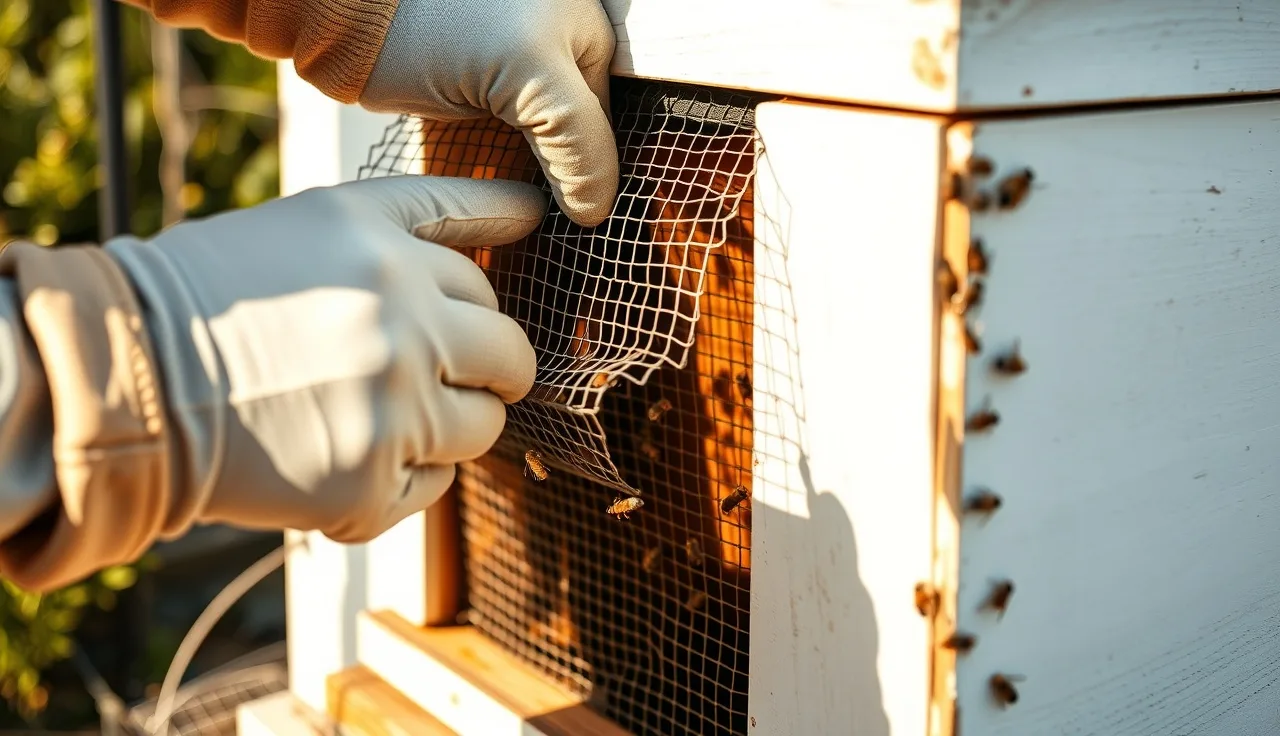
- A robber screen covers the hive entrance and pushes returning foragers through an offset side or top hole that robbers can't find, which cuts robbing pressure hard.
- Installation takes under ten minutes.
- Paired with mite treatment, a robber screen is one of the cheapest ways to slow mite movement between hives in your apiary.
How do robber bees spread varroa mites between hives?
A weak or collapsing colony is a buffet. Neighboring bees rush in to loot the honey, and they pick up varroa the same way foragers pick up pollen: the mites climb aboard bees that walk across infested comb or crowd against infested bees. The robbers fly home, mites and all, and seed their own colony with a fresh wave of parasites.
This is horizontal mite transmission, and it's one of the main reasons a whole apiary can crash within weeks of a single colony going down. A 2015 study in PLOS ONE by Thomas Seeley and Michael Smith found that crowding colonies in an apiary raises their vulnerability to varroa, with mite loads spreading between hives through bee movement [1]. The Honey Bee Health Coalition's Varroa Management Guide names robbing as a known route of mite movement and recommends physical barriers as part of an integrated plan [2].
The mite math is ugly. A collapsing colony sitting at a 10 percent or higher wash count can carry thousands of phoretic mites on its adult bees. Every robber that visits and returns home carries some of them.
You don't need a full collapse for this. Weak colonies during a dearth get probed constantly, and even failed robbing attempts put strange bees crawling across the entrance and against the guards, which is contact enough for a mite to switch hosts.
Drift makes it worse. Bees confused by wind, or disoriented after you've torn a hive apart for an inspection, wander into the wrong box every day. The University of Minnesota Bee Lab's varroa guidance treats mite movement between colonies as an apiary-scale problem, not a single-hive one [3].
What is a robber screen and how does it block mite transfer?
A robber screen is a hardware cloth cage that covers the normal entrance and reroutes bees to a different exit, usually a hole on the upper side or far end of the screen box. Resident bees learn the new door in a day or two because they know their hive by its location and its smell. Robbers don't. They keep slamming into the blocked front and eventually give up.
The logic is simple. A robber orients to the entrance it hit last time, or the entrance it can smell first. It lands at the front, finds mesh, and has no reason to hunt for an offset hole three inches up and over. Resident bees relearn fast because they come home to the same spot hundreds of times a day and the chemical cues of home pull hard.
A good robber screen also slows small hive beetles at the door and can knock down yellow jacket harassment in fall. Those are bonuses. The real job is breaking the robbing cycle that hauls mites out of a hot hive and into healthy ones.
This is a different tool than an entrance reducer. A reducer just makes the door smaller. A determined robbing force still piles through a reduced entrance, and the mites ride along. A robber screen misdirects the whole approach, which is a different kind of intervention.
Before you settle on a management plan, read up on varroa mites and how they breed inside capped brood. That primer explains why containment alone never fixes an infestation.
When should you install a robber screen?
Install before robbing starts, not after. Once a frenzy is going, you can't get a screen on without heavy stinging, and some mite transfer has already happened.
The highest-risk windows are late summer and fall dearth, when nectar stops and strong colonies turn mean, and early spring before dandelion bloom when stores run thin. If you're somewhere with a hard midsummer dearth (much of the American South and Southwest), that gap counts too.
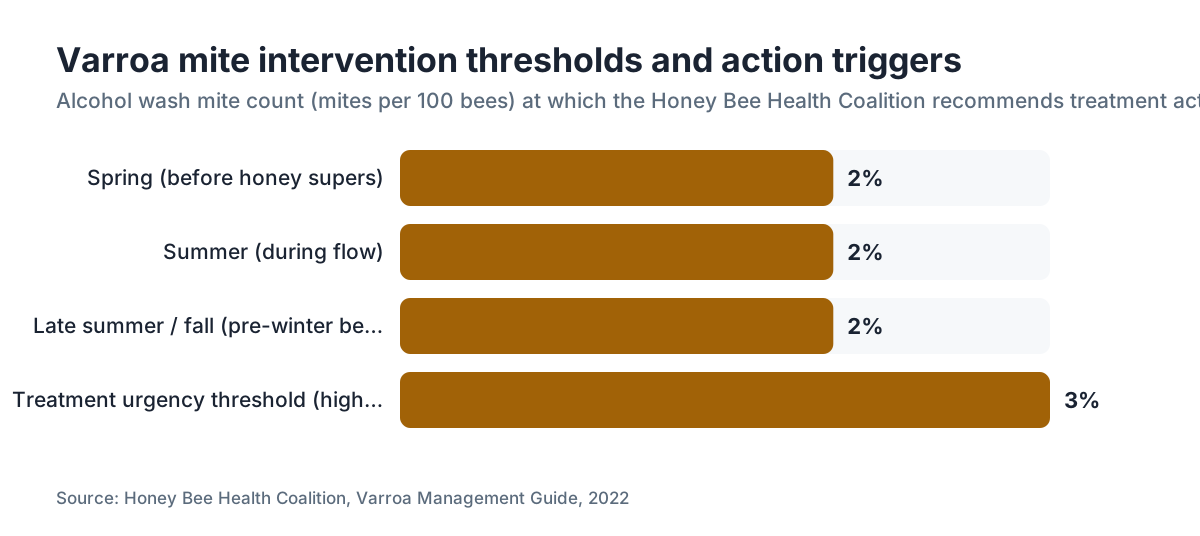
Specific triggers to watch for: bees fighting at the entrance of a weaker hive, a mite count above 2 percent on a sugar roll or alcohol wash, a heavily infested colony you're treating with oxalic acid or a miticide (you want to keep those mites from hitchhiking out during the treatment window), or a hive left in a disrupted state after a split or a combine.
Some beekeepers run robber screens all summer when their hives sit in high-density areas or next to other people's apiaries. That's defensible. Resident bees adapt completely, and after the learning period the screen causes no measurable hit to foraging, according to University of Florida IFAS Extension's write-up on robbing behavior [4].
If you keep hives near Africanized populations (see the background on africanized honey bees), a robber screen matters more, because Africanized colonies rob aggressively and carry their own mite loads.
What materials do you need to install a robber screen?
Commercial robber screens run about $8 to $20 each depending on the supplier and whether they're cut for a Langstroth 8-frame, 10-frame, or some other body [5]. You can also build one in an hour from hardware store parts.
For a DIY screen you need hardware cloth (1/8 inch mesh, galvanized), a thin wooden frame cut to your entrance width, staples or small nails, and a drill with a 1-inch bit for the alternate exit hole. Material cost is usually under $5 per screen once you buy hardware cloth by the roll.
Keep these on hand while you work: a staple gun, wire cutters, a tape measure, and sandpaper to knock down the sharp wire ends so bees don't cut themselves. A lit smoker helps too, especially if robbing has already started.
Many beekeeping supply companies stock ready-made robber screens right next to the entrance reducers. Some retailers bundle equipment with free shipping; check this list of free shipping honey bee supply companies to compare before you order.
You need no woodworking skill for this. It's a real beginner project.
How do you install a robber screen step by step?
Step 1: Time it right. Early morning or late evening, when forager traffic is low. If this hive is already being robbed, suit up all the way.
Step 2: Light your smoker and give the entrance two or three gentle puffs to push bees back inside. Don't overdo it. You want calm bees, not alarmed ones.
Step 3: Block the entrance temporarily with a folded cloth or an entrance reducer while you mount the frame. That keeps bees off the screen while you work.
Step 4: Attach the screen frame over the entrance. Commercial screens hook on, screw on, or press against the landing board. DIY versions usually take two short screws per side into the lower box. Cover the entire original entrance with no gaps at the edges where a bee could slip past without going through the mesh.
Step 5: Open the alternate exit. On most commercial designs it's a 1-inch hole on the upper face or side of the housing. Drill it before mounting if you're building your own. Put it at least 3 inches above and to one side of the old entrance. That offset is what confuses robbers.
Step 6: Remove the entrance block and watch for five minutes. Resident bees should start finding the alternate hole within a few minutes, then returning through it. If they pile up on the screen face and can't find the exit, tap the screen gently near the hole to guide them.
Step 7: Check back the next morning. Most colonies fully adapt within 24 hours. Fighting at the main screen face means robbing is being blocked, which is the point. Bees jammed on the front for more than 48 hours without sorting it out usually means the alternate hole is too small or blocked.
Leave the screen up through the whole dearth. Pulling it mid-dearth resets what the robbers know about the entrance and can trigger a new assault within hours.
Does a robber screen actually reduce mite levels in a hive?
Directly? No. A robber screen kills zero mites already in the colony, and it doesn't replace treatment. What it does is limit how many new mites arrive from outside.
That matters at the apiary scale. The Honey Bee Health Coalition's Varroa Management Guide treats robbing and drifting as pathways that link the mite populations of colonies in the same yard, and it tells beekeepers to manage robbing pressure as part of their varroa strategy [2]. The guide doesn't put a number on mite reduction from screens alone, because no large controlled trial has isolated that one variable. That's an honest gap in the data.
What we do have is solid mechanism. Seeley and Smith's PLOS ONE work showed mite loads in an apiary drifting toward equilibrium across colonies through bee movement, so a high-mite hive drags up the counts in its neighbors [1]. Block that movement with a physical barrier and the logic holds, the same way it holds in integrated pest management everywhere else.
In the field, most experienced beekeepers report better long-term control from robber screens plus synchronized treatment (every colony treated at once) than from treating hives one at a time while ignoring the flow between them. The University of Minnesota Bee Lab's apiary-level framing supports that approach [3].
So here's the honest answer. A robber screen is not a mite treatment. It's a mite containment tool. Run it alongside alcohol wash monitoring and whatever EPA-registered treatment fits your timing and temperature. VarroaVault's free mite tracking tools let you watch counts before and after a treatment cycle to see whether inter-colony transfer is pulling numbers back up.
What are the most common installation mistakes and how do you avoid them?
The most frequent mistake is leaving gaps at the edges. If a bee can squeeze around the side of the frame, robbers find that gap fast. Seal anything larger than 1/4 inch with extra hardware cloth or foam weatherstripping.
Second: putting the alternate exit too close to the old entrance. Robbers orient to the general entry zone, so a hole right at the front face is easy for them to find. The offset has to be real. Go at least 3 to 4 inches to the side or 4 to 5 inches above the original entrance.
Third: installing during active robbing without prep. If hundreds of robbers are in frenzy mode, they mob you and the hive at once. Block the entrance hard first (a wet towel draped over the front works), wait 20 to 30 minutes for the frenzy to settle, then mount the screen.
Fourth: mesh that's too coarse. Hardware cloth sold as 1/4-inch mesh usually works, but check it. If any opening runs larger than about 4mm, big bees can force through under pressure. Standard 1/8-inch hardware cloth is the safer buy.
Fifth: pulling the screen too early. Beekeepers often yank it the moment robbing looks like it stopped, but if the dearth is still on, robbing comes back within a day or two. Leave it up until you've confirmed a real nectar flow, either on your hive scale or by finding fresh nectar in uncapped cells.
Do robber screens work with all hive types?
Most commercial robber screens fit standard Langstroth 10-frame boxes, with 8-frame versions available from several suppliers. Top-bar and Warré hive users usually build their own, because off-the-shelf screens don't match the entrance geometry.
For a top-bar hive the concept doesn't change: screen the full entrance width, put the alternate exit on the upper part of the screen, offset to one side. The catch is that top-bar entrances vary a lot by builder. Measure your entrance width and height before you cut any hardware cloth.
Flow Hive users can run a standard Langstroth-compatible screen, because the brood box base sits on standard Langstroth dimensions.
Nucs benefit as much as full hives, maybe more, because a 5-frame nuc has a smaller defensive force and robbers know it. Small-entrance nuc screens exist commercially, though the selection is thinner.
Long horizontal hives need a custom screen. The entrance usually sits at one end, and the same offset-hole rule applies.
How do robber screens compare to other robbing prevention methods?
| Method | Cost | Mite transfer reduction | Ease of use | Limitations |
|---|---|---|---|---|
| Robber screen | $8-$20 or $5 DIY | Moderate to high (blocks robbers) | Easy once made | Bees must re-learn exit |
| Entrance reducer | $2-$5 | Low (slows but doesn't stop robbers) | Very easy | Robbers still get through |
| Combining weak colony | $0 | High (removes the robbing target) | Moderate | Loses one colony |
| Treating all colonies at once | Cost of treatment | High (cuts the mite source) | Moderate | Doesn't stop robbing itself |
| Moving hive location | $0 | Moderate | Labor-intensive | Robbers may follow |
| Bee-tight cover during dearth | $0 | Temporary only | Easy | Restricts ventilation |
Entrance reducers are fine for early fall when robbing pressure is mild. For a sustained dearth or a known high-mite hive next door, a robber screen is meaningfully better.
Combining a failing colony is the right call when it's too weak to survive on its own, but it does nothing to protect your other hives from the robbers that were already working the weak one.
Apiary-wide simultaneous treatment is the single highest-impact move for shrinking the mite reservoir that drives robbing-based spread. The robber screen is what you use to slow new mite imports while the treatment works, and during the weeks between treatment windows.
Should you use a robber screen year-round or only seasonally?
Seasonally, for most beekeepers. The alternate-exit learning period costs a day or two of slightly slower foraging, and cycling bees through that relearning for no reason isn't worth it.
The seasons to have screens ready: late summer dearth (roughly August through September across most of the continental US), the fall nectar gap (October in many regions), and early spring before the first strong flow. In areas with a true midsummer dearth, add that window.
Year-round use makes sense if you have chronic robbing pressure, if you keep colonies at high density (more than 8 to 10 hives per yard in a low-forage area), or if neighbors run untreated colonies you can't control. Bees adapt to a permanent screen, and University of Florida IFAS Extension reports no long-term colony harm from continuous use once the bees have learned the exit [4].
Winter is the one stretch where a screen matters least. Colonies cluster instead of forage, and robbing is rare. You can pull screens in late November in most climates and put them back in late July or early August. Some beekeepers just leave them on through winter for convenience, which is fine.
How does a robber screen fit into a full varroa management protocol?
A robber screen is one piece of a larger system. On its own it doesn't treat the mites already in your colony, and it won't rescue a colony in crisis. It reduces the rate at which a treated colony gets re-infested from its neighbors or from a collapsing hive in your own yard.
The Honey Bee Health Coalition recommends monitoring at least monthly during the active season, treating when counts pass 2 percent on an alcohol wash, and treating every colony in the yard at the same time to stop mite redistribution [2]. Robber screens back up that last point by cutting the redistribution pathway during and after treatment.
Here's a workable seasonal protocol built around screens. Alcohol wash in July. Treat any colony above 2 percent with an EPA-registered miticide chosen for your temperature and brood state (oxalic acid, Apivar, Apiguard, or another registered product) [6]. Install screens on all hives at once before the August dearth lands. Re-monitor four to six weeks after treatment. If counts climb faster than expected, inter-colony flow is a suspect, and the screens help you rule it out or slow it down.
To track this across several colonies, VarroaVault's free monitoring tools let you log wash counts by hive and flag any colony that's pulling apiary-wide numbers up.
Replacement hardware, entrance reducers, and robber screens all come from the usual beekeeping supplies retailers. Order before peak dearth. Stock runs thin in August.
What does the research say about apiary-level mite spread?
The clearest published work is Thomas Seeley and Michael Smith's 2015 PLOS ONE study, which found that crowding honey bee colonies in an apiary raises their vulnerability to varroa, with bee movement between colonies acting as a real transmission route [1]. The study doesn't test robber screens, but the mechanism it describes is exactly what a screen addresses.
Work in the Journal of Apicultural Research has documented that drifting bees carry mites at rates tied to their home colony's infestation, meaning a bee that drifts in from a 10-percent-infested colony brings proportionally mite-heavy cargo [7].
The Honey Bee Health Coalition's Varroa Management Guide pulls this literature together and concludes that colonies in an apiary aren't isolated units, and that robbing and drifting link their mite populations [2]. That's about as close to a consensus statement as the field has.
No one has published a randomized controlled trial comparing apiary-wide mite levels with and without robber screens across a full season. That's an honest gap. The mechanism is solid; the direct efficacy number doesn't exist yet in peer-reviewed form. If you're deciding, weight the mechanism and the practitioner consensus from sources like the HBHC guide, and keep that missing number in mind.
Frequently asked questions
Will a robber screen stress my bees or reduce honey production?
There's a short adjustment period of one to two days after you install a screen. Foragers returning to the old entrance have to find the new exit, which puts a small temporary cluster on the screen face. After that, colonies adapt fully and foraging returns to normal. No study has documented a measurable honey production loss from long-term robber screen use once a colony has learned the new exit.
Can I install a robber screen while robbing is already happening?
Yes, but carefully. Drape a wet towel over the entrance for 20 to 30 minutes first to break the frenzy and let flying bees disperse. Then mount the screen with the alternate exit already open. Wear your full suit. The frenzy will likely flare again briefly but should taper within an hour as robbers keep failing to get through. Don't install bare-handed during an active robbing event.
What size mesh should I use for a DIY robber screen?
Use 1/8-inch hardware cloth (about 3mm openings). It's fine enough that bees can't force through under robbing pressure. Some builders use 1/4-inch, which works for most bees but can occasionally let a smaller bee squeeze through when a mob presses hard. Galvanized or vinyl-coated hardware cloth both hold up outdoors, and galvanized is easier to find by the roll.
How long should I leave a robber screen on?
Through the whole dearth, plus a few days after the nectar flow resumes and robbing clearly stops. A good rule: if bees are fighting at any entrance in your yard, keep every screen on. Remove them only after you've confirmed fresh nectar in uncapped cells, which signals foragers are bringing in enough that robbing motivation drops. Pulling screens during a false break in the dearth restarts the problem fast.
Do robber screens help with small hive beetles too?
Yes, as a secondary benefit. Small hive beetles (Aethina tumida) enter through the main entrance, and a robber screen slows their access because the alternate hole is small and the bees guard it. This isn't a substitute for beetle traps or good hive placement, but beekeepers in the Southeast and Gulf Coast report fewer beetles in screened hives during peak beetle pressure.
Do I need a robber screen on every hive or just weak ones?
Put them on every hive in the yard, including your strongest. Strong hives are the ones most likely to be robbing the weak ones, which means they're the ones importing mites. Screening only the weak hives lets your strong hives keep making mite-laden robbing runs and hauling those mites home. Apiary-wide installation is the only approach that actually limits inter-colony mite flow.
What's the difference between a robber screen and a robbing screen?
Nothing. The terms are interchangeable in the beekeeping community. Some suppliers list them as robber screens, others as robbing screens or anti-robbing screens. They're the same device: a screen enclosure over the entrance that reroutes bees through an offset alternate exit. If you're shopping, search both terms to widen your results.
Can I use a robber screen on a nuc?
Yes, and nucs probably need them more than full colonies, because their defensive population is smaller. Standard Langstroth nuc screens are sold by some suppliers, though the selection is thinner than for 10-frame hives. Or build one from hardware cloth to fit your nuc's entrance. A 3/4-inch alternate exit hole, rather than the full 1-inch used on full hives, suits a 5-frame nuc.
How does mite transfer through robbing compare to mite transfer through drifting?
Both are real. Drifting is continuous and low-level: bees from infested colonies drift into neighbors every day, carrying mites at a rate tied to their home colony's infestation. Robbing is episodic but intense: one large robbing event can move hundreds of mites into a clean colony in a few hours. Robber screens mainly address robbing. Spacing hives and marking them distinctly cuts drift, though drift is harder to fully stop.
Should I combine a collapsing colony instead of using a robber screen?
If the collapsing colony's mite load is very high, combining it into a healthy one is risky, because you import those mites directly. Treat the collapsing colony with oxalic acid first if you can, then consider combining after its count drops below 2 percent. A robber screen on the healthy target colony during that window reduces mite importation from the dying colony's robbers while you decide.
Are there any hive designs where a robber screen won't work?
Screens are harder to adapt for hives with multiple small entrance holes or entrance tubes (some observation hives or experimental designs), because you'd have to screen each opening. They also lose effectiveness on hives with structural gaps from old or warped woodware, since bees and robbers find those gaps before the alternate exit. Fix the woodware first, then install the screen.
Does moving a hive to a new location stop robbing?
Moving the hive more than two to three miles resets robbing bees' knowledge of the location and breaks an active assault. Moving within the same yard doesn't help; robbers relocate the hive by smell within a day. Relocation at that distance is labor-intensive and impractical as a routine measure. It's a last resort, not a replacement for robber screens and treatment.
How soon after installing a robber screen should I see mite counts drop?
Don't expect a fast drop from the screen alone. It limits new imports, but the mites already in your colony keep breeding on brood. Install the screen at the same time as an appropriate treatment, and you should see the alcohol wash count fall over four to six weeks. The screen's job is keeping that count from rebounding as fast through re-infestation from neighbors.
Can I make a robber screen from window screen mesh instead of hardware cloth?
Window screen mesh (fiberglass or aluminum, usually 18x16) works for the screen face that blocks the original entrance. It's finer than hardware cloth and holds up reasonably. The drawback is durability: bees and weather degrade fiberglass faster than galvanized hardware cloth. Aluminum screen lasts longer. Either functions; hardware cloth just outlasts them and is easier to handle without tearing during the build.
Sources
- PLOS ONE, Seeley & Smith 2015, "Crowding honeybee colonies in apiaries can increase their vulnerability to the deadly ectoparasite Varroa destructor": Crowding colonies in an apiary raises their vulnerability to varroa; mite loads spread across colonies through bee movement including drifting and robbing.
- Honey Bee Health Coalition, Varroa Management Guide (2022 edition): Robbing and drifting are pathways for mite redistribution between colonies; HBHC recommends monitoring monthly, treating above 2% on alcohol wash, and treating all apiary colonies simultaneously.
- University of Minnesota Bee Lab, Varroa management recommendations: Mite loads travel between colonies through drift; apiary-level multi-colony management is the recommended framing.
- University of Florida IFAS Extension, "Robbing Behavior in Honey Bees": Colonies fully adapt to robber screen alternate exits; no long-term harm to foraging efficiency documented after the adjustment period.
- Mann Lake Ltd. and Dadant & Sons (major US beekeeping supply retailers), current catalog pricing: Commercial robber screens retail for approximately $8 to $20 depending on supplier and hive size.
- EPA, Registered Pesticides for Use in Beehives (Apivar, Apiguard, oxalic acid product labels): Oxalic acid, Apivar (amitraz), and Apiguard (thymol) are EPA-registered varroa treatments with specific temperature and brood-state requirements on their labels.
- Journal of Apicultural Research (Taylor & Francis), drifting bees and mite transfer research: Drifting bees carry mites at rates tied to their home-colony infestation levels, so bees from a heavily infested colony bring proportionally heavy mite loads when they drift.
- Pennsylvania State University Extension, "Varroa Mite Management": Alcohol wash monitoring and integrated management including physical barriers are recommended components of varroa control for hobbyist beekeepers.
- Virginia Cooperative Extension, "Honey Bee Diseases and Pests": Robbing behavior peaks during dearth periods and is a recognized pathway for disease and parasite transmission between colonies.
- USDA Agricultural Research Service, Bee Research Laboratory, varroa biology overview: Varroa destructor phoretic mites ride adult bees and transfer to new hosts through bee-to-bee contact during robbing and drifting events.
Last updated 2026-07-10