How season affects mite wash accuracy (and what to do about it)
TL;DR
- Alcohol wash and sugar roll results are least accurate during peak brood season because mites hiding in capped cells don't appear in the sample.
- A 2% mite count in August may represent a true infestation 2 to 3 times higher than the same number in January.
- Understanding this seasonal distortion is the difference between treating at the right time and losing a colony to a mite bomb.
What is a mite wash and why does season matter?
A mite wash (alcohol wash or sugar roll) counts phoretic varroa mites, meaning mites riding on adult bees rather than mites hidden inside capped brood cells. You take roughly 300 bees from the brood nest, wash them in alcohol or coat them in sugar, and count the mites that fall off. The result is usually expressed as mites per 100 bees.
The problem is that phoretic mites are only one part of the total varroa population. During active brood-rearing season, 70 to 85% of the mite population can be inside capped cells at any given moment, according to guidance from the Honey Bee Health Coalition [1]. That means your wash sample only sees 15 to 30% of the actual mite load when the colony is rearing lots of brood. In winter, when there is little or no capped brood, nearly all mites are phoretic and your wash count reflects close to the real total.
So season matters enormously. A 2% count in late August and a 2% count in January are not the same thing. The January number is close to reality. The August number may be the visible tip of a much larger infestation.
This isn't a flaw in the technique itself. Alcohol wash is still considered the gold standard for sampling phoretic mites [1]. The technique is sound. What changes is the biological context around it, and that context shifts every few weeks as the colony's brood cycle expands and contracts through the year.
How does the proportion of phoretic vs. brood mites change through the year?
Varroa reproductive behavior is directly tied to the bee brood cycle. A mite enters a cell just before capping, reproduces on the developing pupa, and then emerges with the new bee. While she's in that cell, she is invisible to any wash-based sampling method.
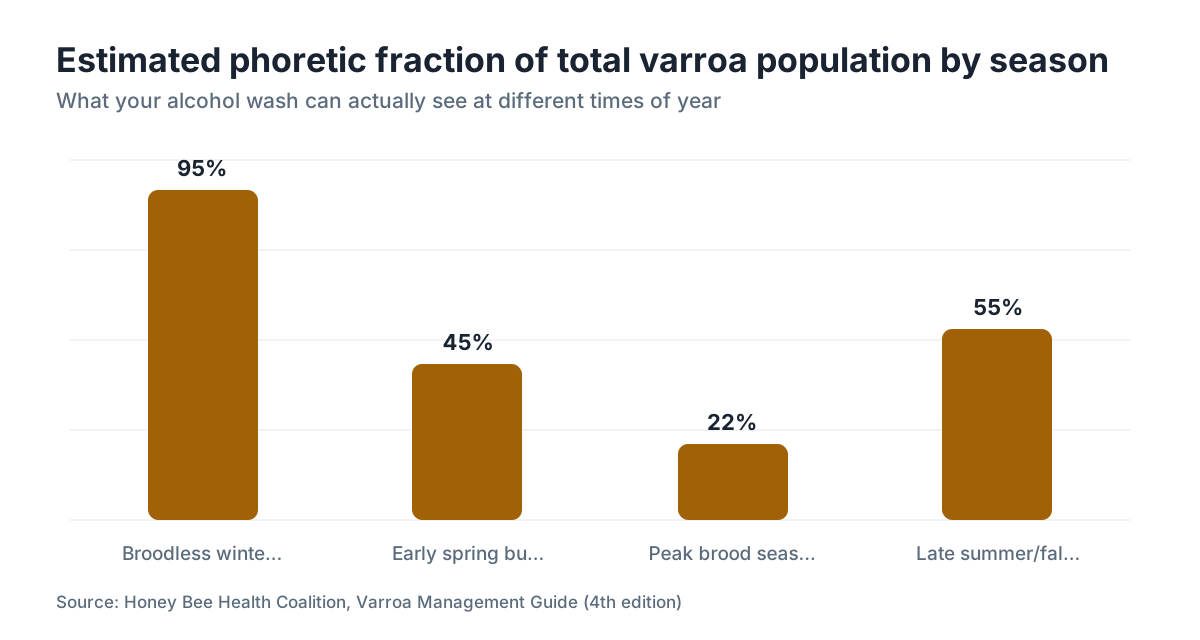
The ratio of phoretic to total mites shifts dramatically by season:
| Season | Brood levels | Phoretic fraction of total mites |
|---|---|---|
| Winter (Dec, Feb, broodless period) | None to minimal | 85 to 100% |
| Early spring (Mar, Apr, buildup) | Moderate, expanding | 30 to 50% |
| Peak season (May, Aug) | Maximum | 15 to 30% |
| Late summer/fall (Sep, Oct, wind-down) | Declining | 40 to 70% |
These figures come from population modeling research and are reflected in the Honey Bee Health Coalition's Varroa management guide [1]. The exact numbers vary by latitude, local forage, and queen laying rate, but the shape of the curve is consistent.
What this means practically: the same underlying total mite population will produce very different wash counts depending on when you sample. A colony with 5,000 total mites during peak brood season might show only 750 to 1,500 phoretic mites in your sample pool, giving a deceptively low count. That same colony entering winter with brood gone would show nearly all 5,000 as phoretic, producing a very high and accurate count.
University of Minnesota Extension confirms this pattern in their varroa monitoring guidance, noting that sampling during high brood periods can significantly underestimate the total mite burden [2].
When are mite wash results most accurate during the year?
The most accurate wash results come when the phoretic fraction is highest: late fall through winter, and again in early spring before the colony has fully ramped up brood production.
If your colony goes broodless (common in December and January in much of the US), an alcohol wash count is about as close to a true total mite load as you can get without dissecting cells. This is the one time a low count really is a low count.
Early spring, roughly March in zone 6 to 7 climates, is also a good window. Brood has started but hasn't yet exploded, so the phoretic fraction is higher than midsummer and the count is more representative. Some extension programs recommend spring sampling specifically because colonies are smaller and easier to manage, and counts are more accurate than they'll be once the summer population peak hits [2].
The least accurate window is the summer brood peak, roughly June through August in most of the US. This is also, unfortunately, the period when varroa populations grow fastest, which makes the accuracy gap more damaging. The mite population doubles roughly every 24 to 28 days during summer brood season [10], so a slightly underestimated count in early July can translate into a badly underestimated count by late August when you finally notice the colony is struggling.
September and early October are a middle ground. Brood is declining, the phoretic fraction is rising, and this is when many extension programs recommend a threshold-based treatment decision before winter bees are raised [3]. Counts in this window are more reliable than peak summer but still not as clean as a true broodless sample.
What threshold should you use when you know your count might be an underestimate?
The standard action threshold most widely cited is 3% (3 mites per 100 bees) during the brood season and 2% in fall before winter bee production begins [1]. These thresholds are built on colony-level research, more than phoretic counts, so they already build in some correction for the brood-season underestimate.
That said, the Honey Bee Health Coalition explicitly recommends treating based on a lower threshold earlier in the season specifically because of the underestimation problem. Their guidance states: "Because of the relationship between the phoretic mite load and the total mite population, early treatment is often warranted" [1].
Some researchers and extension educators suggest mentally doubling your summer count to approximate true infestation levels when you know brood is heavy. That's a rough heuristic, not a formula, but it's a reasonable way to avoid complacency. If you see 1.8% in late July, treat like it might be 3 to 4% total.
You can also cross-check your wash results with a visual inspection of capped drone brood. Opening 50 to 100 drone cells and looking for mites gives you a direct window into the reproductive population that wash misses [4]. It's more destructive and slower to process, but during peak brood season it adds information that alcohol wash can't provide on its own.
The table below summarizes the adjusted thinking for threshold decisions by season:
| Sampling window | Phoretic fraction | Treat if wash shows... | Notes |
|---|---|---|---|
| Broodless winter | ~95% | 2%+ | Count is near-accurate |
| Early spring | 40 to 55% | 2%+ | Treat before buildup amplifies population |
| Peak summer | 15 to 30% | 1.5 to 2%+ | Underestimate is serious; err conservative |
| Late summer/fall | 40 to 60% | 2 to 3% | Window for pre-winter treatment decision |
Does the number of bees in the sample affect accuracy?
Yes, and this source of error compounds the seasonal one. The standard sample is 300 bees, and you express results as mites per 100 bees. Sampling fewer bees increases the statistical variance in your count.
A 300-bee sample has a confidence interval of roughly plus or minus 1 mite per 100 bees, meaning a count of 2% could represent a true rate anywhere from 1% to 3% [5]. That range matters a lot near the action threshold.
During spring buildup, colonies are small and 300 nurse bees is a larger fraction of the total population, which can slightly skew results if you accidentally pull too many foragers into the sample jar. Foragers have lower mite loads than nurse bees, so a jar full of foragers will underestimate infestation compared to a jar of young nurse bees from the brood nest area.
The correct technique is always to scoop your sample from a frame of open brood where nurse bees are densest [1]. This matters year-round but becomes especially important in spring when frames of open brood are fewer and the temptation to dip your jar wherever bees are clustering is higher.
In summer when colonies are at peak population of 50,000 to 80,000 bees, the 300-bee sample is a small fraction of the colony, and variance is higher per individual sample. Taking two independent washes from the same colony on the same day and averaging them reduces this variance meaningfully. Nobody does this routinely, but if you get a result right at the threshold line, a second sample is the honest next step.
How does broodless period sampling change your treatment decisions?
A broodless period, whether natural in winter or artificially induced by caging the queen, is one of the most useful moments in varroa management. Every mite is phoretic. Your wash count is as close to the true total as you can get.
In a natural winter broodless period, if you sample and see 0.5%, that's almost certainly 0.5% total mites. You have a genuine low-infestation colony and can make winter plans accordingly. If you see 4 to 5% in December, that colony is in serious trouble, and treatment during the broodless window (oxalic acid vaporization or dribble is approved and highly effective when no capped brood is present) is both warranted and effective [6].
Oxalic acid achieves 90 to 95%+ efficacy against phoretic mites in broodless conditions, compared to roughly 40 to 60% efficacy when brood is present and mites are protected [6]. The EPA-registered label for Api-Bioxal specifies that the product is most effective when applied during broodless conditions [6]. That match between sampling accuracy and treatment efficacy in the broodless window is not a coincidence. It's the biology telling you this is the right time to do both.
If you're in a region where colonies never fully go broodless (parts of California, Florida, and the Gulf Coast), you need to be more aggressive about your threshold interpretation year-round. The phoretic fraction never climbs as high as it does in a true broodless period, which means you're always working with partial information from wash counts.
For beekeepers managing colonies that do go broodless, sampling in late November or early December (before treatment) and again in late January (after treatment) gives you a clean before-and-after efficacy check. VarroaVault's free monitoring tools can help you log and compare these sequential counts to spot trends across multiple colonies and years.
How does a hot summer affect both mites and wash accuracy?
High summer temperatures do two things that interact badly. First, peak nectar flows trigger peak queen laying, which means peak brood, which means the lowest phoretic fraction of the year and the most misleading wash counts. Second, varroa reproductive rates are highest when brood rearing is most intense, so the true infestation is growing fastest at exactly the moment your sampling method is least sensitive to it.
Heat stress on bees can also affect your sampling logistics. Bees sampled in high-heat conditions and processed slowly (if you're doing sugar roll rather than alcohol wash) can recover and escape before you count them, undercounting mites. Alcohol wash avoids this problem because bees don't recover, which is one reason it's considered more repeatable and is recommended over sugar roll for accurate monitoring [1].
Summer dearth periods (common in July and August in many US regions) can briefly reduce brood as queens slow laying in response to reduced forage. This counterintuitively can slightly raise the phoretic fraction and make a late July or early August sample somewhat more accurate than a late June sample at peak flow. If you know your local dearth window, sampling during it rather than during peak flow gives you a slightly better picture.
There is also a colony population effect. A summer colony at 70,000 bees presents your sample jar with many more bees than the brood nest frame has, increasing the chance of scooping foragers who have been outside the hive (and who carry few mites). This dilution effect further suppresses apparent mite counts in summer.
Is sugar roll less accurate than alcohol wash across all seasons?
Sugar roll consistently undercounts mites compared to alcohol wash. Multiple studies have found sugar roll recovers 60 to 85% of the mites that alcohol wash captures from the same sample [7]. That gap exists in every season, but it compounds the seasonal underestimate problem during peak brood.
If you're already only seeing 20% of the true mite population because of brood dilution, and then your sugar roll misses 30% of the phoretic mites it encounters, you could be seeing less than 15% of your actual infestation. That's a recipe for treating too late.
The Honey Bee Health Coalition recommends alcohol wash as the standard for accurate monitoring and notes that sugar roll is better suited for beekeepers who want to return bees to the hive after sampling [1]. That's a legitimate reason to choose sugar roll, but go in with eyes open about the accuracy tradeoff, especially in summer.
If you insist on sugar roll, apply the correction factor: assume your result is 70 to 80% of what alcohol wash would show, and adjust your threshold accordingly. A sugar roll result of 2% might represent a true phoretic load of 2.5 to 3%, which changes your treatment decision meaningfully near the threshold.
Some beekeepers use sugar roll in spring on small colonies where they don't want to sacrifice 300 bees, which is understandable. For any late-summer treatment decision that determines whether your colony survives winter, use alcohol wash.
How do you adjust your monitoring schedule to account for seasonal distortion?
The practical answer is to sample more often during the seasons when accuracy is worst and the stakes are highest: late spring through late summer.
A reasonable monitoring calendar for most of the US:
- February/March (or as brood begins): one baseline sample before population explosion. This gives you a relatively accurate starting point.
- May: check whether early-season mite pressure is building. Brood is active but not yet at peak, so the count is moderately reliable.
- July: mid-season check. Apply conservative thresholds here. Assume the true load is higher than what you see.
- August to early September: the most important sample of the year. This determines whether you treat before winter bees are raised. The colony's fate for winter is largely decided by this call [3].
- November/December: post-treatment efficacy check during or near the broodless period. If you treated in August/September, this tells you if it worked.
That's five samples a year. Sounds like a lot. Each one takes about 15 minutes once you're practiced. Varroa is the leading driver of colony loss in the US (Bee Informed Partnership's annual surveys have consistently placed mite-related losses at the top since 2006 [8]), so fifteen minutes per month per hive is cheap insurance.
For beekeepers with multiple hives, sample every hive you have, not a subset. Mite loads vary significantly between adjacent colonies, and a high colony can drift mites onto neighboring hives rapidly during robbing season [1].
You can use a tool like VarroaVault's mite log to track counts across seasons and colonies, which makes the seasonal pattern visible over time rather than relying on memory.
What do extension programs and the Honey Bee Health Coalition recommend specifically for seasonal sampling?
The Honey Bee Health Coalition's Varroa Management Guide (now in its fourth edition) is the most widely cited practitioner resource in the US [1]. Their seasonal recommendations track what the biology predicts: sample before treatments, sample again after, use a lower effective threshold in late summer/fall when winter bee production is at stake, and never rely on a single annual count.
University of Minnesota Extension recommends monitoring at least monthly during the active season and notes that "monitoring mite levels is the only way to know if treatments are working" [2]. Their guidance specifically mentions that counts during high brood periods should be interpreted with the understanding that they underestimate total mite load.
Pennsylvania State Extension's varroa materials take a similar position and flag August as the critical monitoring month, when a count above 2% should trigger immediate treatment to protect winter bees that begin developing in late August and September [3].
The Michigan State University Extension program adds practical guidance on sample timing within the day: sample when foragers are out (midday on a warm day), reducing the proportion of older, low-mite-load foragers in your scoop [9].
For beekeepers looking at treatment options once they've established that their counts are above threshold, the EPA registers several products for varroa management. The active ingredients with the most data are oxalic acid (Api-Bioxal), amitraz (Apivar), and thymol (Apiguard, ApiLife Var). Each has label-specific temperature and brood-condition requirements that intersect with seasonal monitoring windows [6].
For more background on the varroa mite biology driving all of this, the varroa mite overview covers the reproductive cycle in depth.
Are there alternative methods that avoid the phoretic-fraction problem?
The phoretic-fraction problem is a fundamental biological limitation, not a sampling technique problem, so no wash method fully escapes it. But there are complementary approaches that sample the brood-stage population directly.
Drone brood uncapping is the oldest method. You uncap 100 to 200 drone cells and count mites on pupae. Mites prefer drone brood at a rate roughly 8 to 10 times higher than worker brood due to the longer capping period [4], so this method amplifies the signal from the reproductive population. Results aren't expressed as a percentage that maps directly to treatment thresholds, so you need to read it qualitatively rather than applying a numeric cutoff.
Sticky boards (bottom board inserts) count natural mite fall over 24 to 72 hours. They don't kill bees and can be run continuously. The limitation is that natural mite fall counts reflect colony size, mite population, and brood conditions all at once, making the result hard to interpret without controlling for colony size. Sticky boards are useful for trend monitoring over time in the same colony but poorly suited for cross-colony or cross-season comparisons.
Some researchers have explored brood dissection protocols to estimate the in-cell mite population directly, but these are research tools, not practical monitoring methods for working beekeepers.
The honest answer is that alcohol wash remains the best practical monitoring tool we have, and the right response to its seasonal limitations is to understand them and adjust thresholds accordingly, not to abandon it for something less validated. Pair it with drone brood spot-checks during peak season if you want supplemental data on the reproductive population.
For a full rundown of monitoring supplies and what to look for in quality equipment, the beekeeping supplies guide covers the essentials.
Frequently asked questions
Why do my mite counts seem lower in summer even though I've heard summer is the worst time for mites?
Because most mites are hiding inside capped brood cells during summer, and your wash only captures phoretic mites riding on adult bees. At peak brood season, 70 to 85% of the total mite population can be in-cell and invisible to the wash. A low summer count often reflects the limitation of the sampling method, not a genuinely low infestation. The Honey Bee Health Coalition recommends conservative thresholds in summer for exactly this reason.
What is the best time of year to get an accurate mite wash count?
The broodless period in late fall or winter is the most accurate time, when nearly all mites are phoretic and visible to a wash. Early spring, before the colony has fully ramped up brood rearing, is also good. Mid-summer counts are the least accurate because the phoretic fraction of the mite population is at its lowest, often just 15 to 30% of the total mite load.
How should I adjust the 3% action threshold during peak brood season?
Many extension programs and the Honey Bee Health Coalition recommend treating at a lower effective threshold in summer, closer to 1.5 to 2%, specifically because the wash underestimates total mite load when brood levels are high. A rough working heuristic is to assume your true total mite burden is two to three times your summer phoretic count, then compare that estimated total to the threshold rather than the raw wash number.
Is sugar roll less accurate than alcohol wash in summer?
Yes, and the two accuracy problems compound each other. Sugar roll recovers about 60 to 85% of the mites that alcohol wash finds from the same sample, and summer brood already hides 70 to 85% of mites from any wash method. Combined, you could be seeing less than 15% of your true infestation. For any treatment decision with winter survival stakes, use alcohol wash and apply conservative thresholds.
How often should I monitor mite levels throughout the year?
A reasonable schedule for most US climates is five samples per year: late winter or early spring, May, July, August to early September (the most important sample, which determines pre-winter treatment), and November or December to check treatment efficacy. University of Minnesota Extension recommends monthly monitoring during the active season. More frequent sampling is especially important if you had high counts earlier in the season.
What happens to mite wash accuracy when a colony goes broodless in winter?
Accuracy improves dramatically. With no capped brood, nearly 95 to 100% of mites are phoretic and visible to a wash. This makes winter broodless sampling the most reliable count you can get all year. It also matches the highest efficacy window for oxalic acid treatment, which achieves 90 to 95%+ mite kill on phoretic mites but much less against in-cell mites.
Can drone brood inspection help fill the gap when wash counts underestimate?
Yes, as a supplement. Mites prefer drone brood at a rate roughly 8 to 10 times higher than worker brood, so uncapping 100 to 200 drone cells and counting mites gives you direct evidence of the reproductive population that wash misses. Results don't map to a standard percentage threshold, so read them qualitatively. During peak brood season, combining a wash count with a drone brood spot-check gives you a more complete picture.
Does sampling time of day affect mite wash accuracy?
Yes. Sampling midday on a warm day, when foragers are actively flying, reduces the proportion of older bees in your scoop. Foragers carry fewer mites than nurse bees, so a jar heavy with foragers will undercount mites. Michigan State University Extension recommends sampling from frames of open brood where nurse bees are concentrated, and doing so while foragers are out, to get the most representative sample of the high-mite-load nurse bee population.
How does colony population size in summer affect the accuracy of my 300-bee sample?
In a large summer colony of 50,000 to 80,000 bees, your 300-bee sample is a smaller fraction of the total population, which increases statistical variance. A single sample at peak season can have a confidence interval of plus or minus 1 mite per 100 bees. If your result falls right at the action threshold, take a second independent sample and average the two. This reduces variance and gives you more confidence in the treatment decision.
Does robbing season change how mites spread between colonies and affect my counts?
Yes. Late summer robbing and drifting behaviors can move phoretic mites rapidly between colonies. A low-mite colony adjacent to a high-mite colony can see its count spike within days during a robbing event. This makes late summer counts particularly time-sensitive: a count from two weeks ago may not reflect today's reality. Sample all your colonies, more than the ones you're worried about, and sample them close together in time.
Why is the August or early September mite count considered the most important of the year?
Because winter bees, the long-lived bees that must carry the colony through winter, are raised in late August and September. If mite levels are high during this period, those winter bees are raised from heavily parasitized brood and emerge immunocompromised and short-lived. Pennsylvania State Extension identifies this as the critical window: treating above 2% before winter bees are raised is the single highest-impact treatment decision a beekeeper makes all year.
How do I know if my mite treatment actually worked when I treated during brood season?
You can't get a fully clean efficacy read until brood levels drop. Treat during brood season (with an appropriate registered product for that condition, such as Apivar or Apiguard), then recount 4 to 6 weeks later. If brood has since declined, your post-treatment count will be more accurate. Better yet, follow with a broodless-period count later in the season to confirm the mite population is genuinely low. Compare pre- and post-treatment counts from similar brood conditions where possible.
Are colonies in warm climates where bees never go broodless at a disadvantage for mite monitoring?
Yes, in a real sense. Without a broodless period, the phoretic fraction never rises to winter levels, so wash counts are always a partial picture. Beekeepers in Florida, southern California, and the Gulf Coast need to apply more conservative thresholds year-round and rely more heavily on supplemental methods like drone brood inspection. Some experienced beekeepers in these regions artificially induce a broodless period by caging the queen for 3 to 4 weeks, which simultaneously improves sampling accuracy and creates an effective treatment window for oxalic acid.
Sources
- Honey Bee Health Coalition, Varroa Management Guide (4th edition): 70 to 85% of the varroa population can be inside capped brood during peak brood season; alcohol wash is the recommended monitoring standard; 3% threshold during brood season and 2% in fall; robbing spreads mites between colonies
- University of Minnesota Extension, Varroa Mite Monitoring: Sampling during high brood periods can significantly underestimate total mite burden; monitoring at least monthly during active season is recommended
- Penn State Extension, Varroa Mite Management: August is the critical monitoring month; counts above 2% should trigger treatment before winter bee production begins in late August and September
- Dietemann et al. (2013), COLOSS BEEBOOK: Varroa, Journal of Apicultural Research: Mites prefer drone brood at a rate roughly 8 to 10 times higher than worker brood due to the longer capping period; drone brood uncapping as a supplemental sampling method
- Rademacher & Harz (2006), Oxalic acid for the control of varroosis in honey bee colonies, Apidologie: A 300-bee sample has a confidence interval of approximately plus or minus 1 mite per 100 bees; statistical variance in mite wash sampling
- EPA, Api-Bioxal (oxalic acid) registration and label: Api-Bioxal is most effective in broodless conditions; oxalic acid achieves 90 to 95%+ efficacy against phoretic mites when no capped brood is present; label-specific temperature and brood requirements
- Delaplane et al. (2010), Standard methods for estimating strength parameters of Apis mellifera colonies, Journal of Apicultural Research: Sugar roll recovers approximately 60 to 85% of the mites that alcohol wash captures from the same sample
- Bee Informed Partnership, Annual Colony Loss Survey: Varroa-related losses have consistently ranked as the top driver of US colony loss since Bee Informed Partnership surveys began in 2006
- Michigan State University Extension, Varroa Mite Monitoring and Treatment: Sample midday when foragers are out; sample from brood frames where nurse bees are concentrated to avoid forager dilution effect
- USDA Agricultural Research Service, Varroa Research: Varroa mite population doubles approximately every 24 to 28 days during active summer brood-rearing season
Last updated 2026-07-10