Signs of varroa mites: how to know your hive is infested
TL;DR
- Varroa mites show up several ways: reddish-brown dots on adult bees, deformed wing virus crumpling the wings of emerging bees, sunken or perforated brood cappings, a heavy mite drop on a sticky board, and a colony crash in late summer.
- Any one of these means you do an alcohol wash or sugar roll count today, not next weekend.
What do varroa mites actually look like on bees?
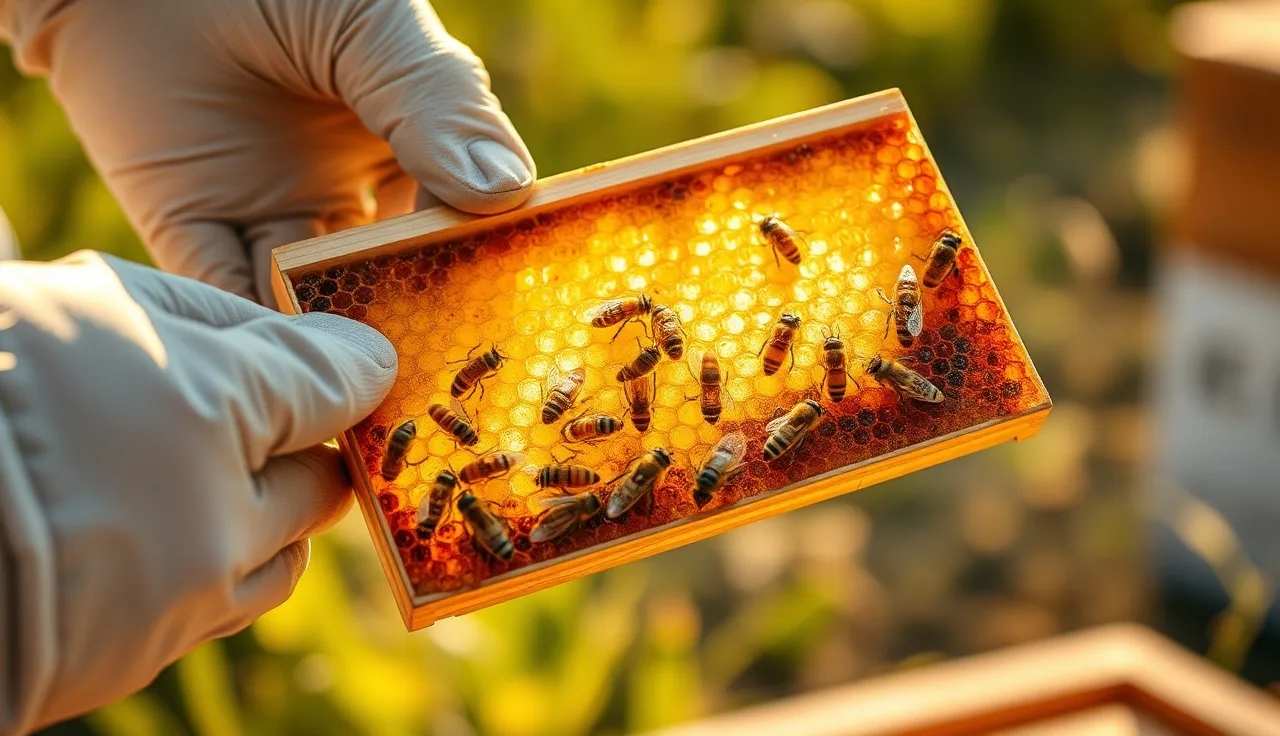
Varroa destructor is small but not invisible. An adult female is about 1.1 mm wide and 1.6 mm long, reddish-brown, shaped like a flattened oval. She looks like a dried drop of apple juice pressed against the bee's thorax or abdomen [1]. Males are smaller, paler, and almost never seen outside the capped cell. The female is what you're hunting for.
On a forager or nurse bee, the mite clings between the abdominal segments or on the thorax, pressed flat against the cuticle. You can spot one with the naked eye in good light. New beekeepers do mistake pollen grains and debris for mites the first few times, though. Here's the tell: a pollen grain is roughly round and not laterally compressed, while a varroa mite has visible legs if you look close. A 10x hand lens settles it.
One mite on one bee is not a crisis. The crisis is the number you can't see, sealed inside capped brood. Research summarized by the Honey Bee Health Coalition puts roughly 70 to 80% of the total mite population inside capped cells at any given moment [2]. That's why counting mites on adult bees almost always undercounts the real infestation. Seeing mites on bees means you're already behind.
What does deformed wing virus look like and why does it matter for varroa?
Deformed wing virus (DWV) is the clearest indirect sign of a varroa problem. Newly emerged bees with crumpled, stubby, or crooked wings are the signature. The wings look crimped before they could open. These bees can't fly, can't forage, and get dragged out of the hive within hours. A few of them on the landing board means mite loads have been high for at least one brood cycle [3].
Mites don't cause DWV directly. They suppress the bee's immune response while feeding, which lets DWV and the other viruses they carry replicate to damaging levels. A colony can carry DWV quietly for years at low mite loads, then throw a wave of deformed bees once counts push past roughly 2 to 3% infestation in summer [4].
Other neurological signs like bees walking in circles or trembling at the entrance have been loosely linked to high viral loads in mite-heavy colonies. Deformed wings stay the most reliable visual marker. See them, and skip straight to an alcohol wash the same day.
How do you read the signs in capped brood?
Open brood shows nothing. Capped brood tells the story. Beekeepers throw around terms like "mummy" or "shotgun" brood, but those cover several different problems, so be specific about what you actually see.
With heavy varroa, cappings sometimes look sunken inward instead of convex and waxy. They may be perforated with pinholes or look greasy and damp. Bees uncap and recap cells when mite reproduction leaves damaged pupae that trigger hygienic behavior, and the result is an uneven pattern with scattered empty cells among the capped ones.
Pull a suspect capping and look inside. You may see the mite itself: a reddish-brown dot on the white pupa, usually on the abdomen. Heavily infested cells hold several mites. Most cells with a single foundress hold one adult female plus one to several offspring at different life stages [2]. The offspring are white and nearly translucent.
Sunken or perforated cappings also signal American foulbrood (AFB) or sacbrood, so run a ropy test before you blame varroa. Push a toothpick into a discolored cell and pull slowly. AFB draws out into a stringy filament that ropes an inch or more. One problem doesn't rule out the other, so check.
What does a sticky board tell you about mite levels?
A sticky board under an open-mesh floor catches mites that fall off bees and out of cells during normal hive traffic. The 24-hour natural drop is a fast first screen. It's also less accurate than an alcohol wash, so treat it as a smoke alarm, not a diagnosis.
Here's the standard read. Fewer than 1 to 2 mites per 24 hours counts as low in late spring. Two to 10 per day means a moderate and growing population. More than 10 per day is a high-alert reading by most state extension thresholds, though the exact numbers shift by region and season [4]. Some programs use 100 mites over 3 days as a simpler trigger.
The catch is real. Natural drop doesn't track infestation percentage in a straight line. A colony full of open brood drops more mites because mites are leaving cells. A colony in a brood break drops fewer even when the population is huge. The Honey Bee Health Coalition recommends the alcohol wash or sugar roll over drop counts for a dependable percentage [2]. Screen with the sticky board, confirm with a wash.
Don't leave the board in permanently either. Small hive beetles will breed in the oil or petroleum jelly. Pull it after counting and replace it fresh next time.
How do you do an alcohol wash and what result means treatment is needed?
An alcohol wash is the most accurate practical method a beekeeper has for measuring infestation rate. The Honey Bee Health Coalition's management guide covers the full procedure [2], and the steps are simple.
Scoop about 300 adult bees (roughly half a cup) into a jar, ideally from a brood frame where nurse bees gather, and keep the queen out. Add isopropyl alcohol (70% works, higher is fine), cap the jar, shake 30 to 60 seconds, then pour the liquid through a mesh lid into a white tray. Count the mites in the tray. Divide by the number of bees (estimate 300 from a half-cup, or count a smaller sample and scale up). Multiply by 100 for the percentage.
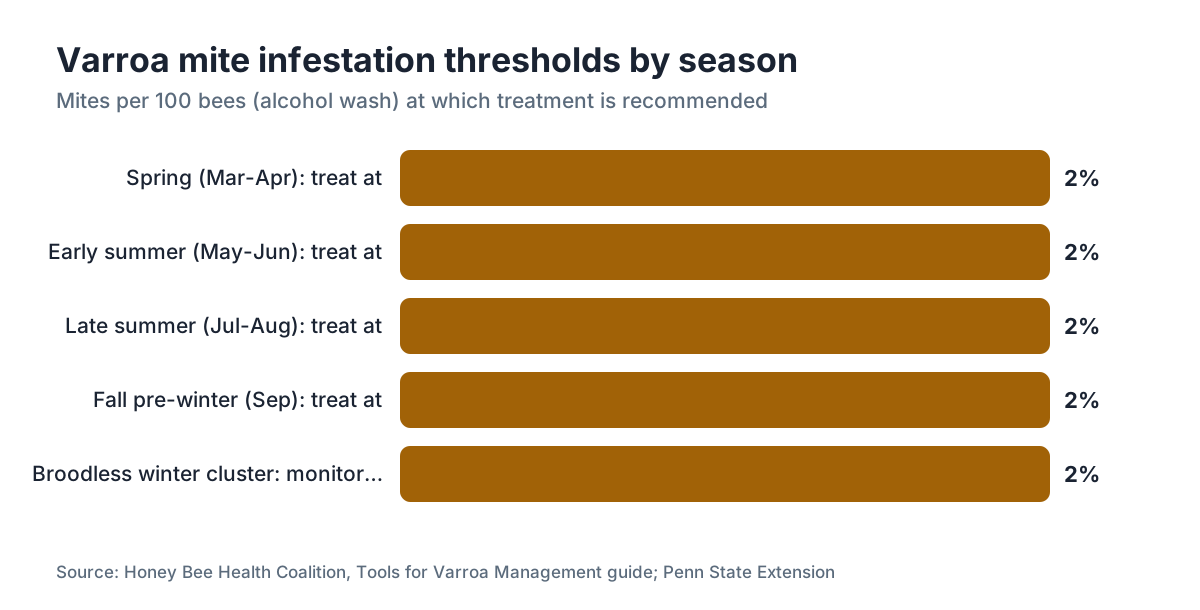
The action threshold used across the United States is 2% in summer brood-rearing season, meaning 2 or more mites per 100 bees [4]. Some programs push 3% when colonies still have strong populations. Waiting until 3% in July or August routinely leaves colonies too damaged to recover before winter. My own line: treat at 2% from May through August, no exceptions. A treatment costs a few dollars. A dead colony costs a season.
A broodless winter cluster tolerates a slightly higher count because mites have nowhere to breed. Any reading above 2 to 3% heading into fall still needs treatment before the winter bees are raised.
What do the bees' behavior tell you about a varroa infestation?
Behavior changes are late signs. That's their weakness and their value at once. If you're watching behavior shift, the infestation has usually been climbing for weeks.
The clearest behavioral sign is bees grooming hard, themselves or each other, sometimes chewing into mite-infested pupae. You might catch adult bees pulling larvae or pupae out of cells and dropping them on the landing board. The term for it is uncapping and removal. It cuts mite reproduction in truly hygienic lines, but in most commercial-stock colonies it just shows up as ragged brood removal with little mite benefit [3].
A colony that collapses fast in August or September with no obvious disease is almost always varroa-driven. It looked fine in June, made a decent honey crop, then fell apart. The summer bees were raised on mite-parasitized pupae and emerged with shrunken fat bodies and weak immune systems. They live shorter lives, foraging drops, and the colony heads into fall with too few adults to cover the brood nest. Beekeepers call it population collapse, or the mite bomb.
Drift makes it worse. Parasitized foragers wander into neighboring colonies, carrying mites along. In an apiary with several hives, one mite bomb can seed the whole yard inside a few weeks.
What visual signs show up on the hive exterior?
You don't have to open the hive for early warning. Stand at the entrance for two minutes first.
Bees with deformed wings on the landing board are the loudest external sign. One or two crawlers on a given day might be bees that clipped the entrance reducer. A knot of bees that can't fly, walking in circles or dragging crumpled wings, is a mite symptom until proven otherwise.
Dead or dying bees piling up at the entrance in late summer, especially in a colony that was big and busy, can point to adults with shortened lifespans from varroa-linked viral loads. A die-off faster than normal colony churn, with undersized or malformed bees, means you sample now.
An entrance that's oddly quiet during a nectar flow, in a colony that should be roaring, is another flag. Shrinking population plus weak summer foraging is the pre-collapse pattern.
None of this replaces an alcohol wash. These are reasons to do the wash today instead of next weekend.
How is varroa different from other bee problems that look similar?
New beekeepers mix up varroa signs with other conditions, and the diagnosis matters because the treatments are nothing alike.
DWV from varroa looks different from chilled brood, where bees die of temperature stress, turn grayish, and stay in position instead of emerging deformed. It's also different from sacbrood, where larvae die as sac-shaped husks curled into an S and go yellow-brown, not as wingless adults. Sacbrood cappings can look sunken too, overlapping one varroa symptom, so check the larva itself.
The scattered-removal brood pattern from varroa can mimic European foulbrood, which also leaves dead and dying larvae and uneven capping. EFB larvae die twisted and melted-looking with a sour smell. Varroa-affected brood has no strong odor, and the pupae look more normally formed except for the mites. If you're stuck, the USDA Bee Research Laboratory at Beltsville accepts samples for diagnosis [5].
Tracheal mites (Acarapis woodi) once caused similar declines but are rarely a primary problem in North America now. They live inside the trachea, never show as external mites, and don't cause deformed wings. If you see deformed wings, it's almost certainly DWV from varroa, not tracheal mites.
For the full varroa mite biology and life cycle, that background explains why these signs appear when they do.
When during the year are signs of varroa most visible?
Varroa populations follow a predictable seasonal arc in temperate climates, and the signs ride that arc.
Early spring is the annual low. A small winter cluster carries few mites because the colony spent months broodless, choking off the mite's breeding cycle. Signs are faint and counts often sit below threshold even in colonies that struggled all fall. It's the worst time to judge varroa, because it hands you false comfort.
April through July, mite populations double roughly every 4 to 6 weeks as the brood nest expands [2]. Sample every 4 to 6 weeks even when you see nothing. The signs lag the real population because most mites are hidden in brood.
August is the peak danger. The mite-to-bee ratio is at its worst right as the colony tries to raise the long-lived winter bees that have to survive to spring. A colony sitting at 4% infestation in August is building its winter bees on heavily parasitized larvae. Those bees come out physiologically wrecked, and the colony often dies between September and November. Beekeepers write it off as mystery die-off or absconding.
Winter opens a narrow window. Broodless or nearly broodless colonies from December through February are open to oxalic acid dribble or vaporization, which hits hard when mites have no capped cells to hide in [6]. Miss that window and you start spring with a higher baseline than you want.
What's the right order of actions when you spot signs of varroa?
Signs give you a reason to act. This is the sequence that actually saves the colony.
Step one: do an alcohol wash the same day you notice signs. Don't wait for a scheduled inspection. The wash gives you a real percentage, so the decision runs on data instead of nerves.
Step two: if the wash reads at or above 2% during brood-rearing season, pick a registered treatment matched to your temperatures and time of year. The EPA registers several active ingredients, including oxalic acid, amitraz (Apivar), and thymol products (ApiLife Var, Apiguard), each with its own temperature range and label rules [7]. Follow the label. It's federal law under FIFRA, and off-label use is both illegal and usually useless.
Step three: treat every colony in the apiary at once. Treat one hive and leave others high, and you've kept a reinfestation source. Forager drift walks those mites right back into your treated hive within weeks.
Step four: retest 4 to 6 weeks after treatment to confirm it worked. Amitraz resistance is documented in some populations [8], and a retest is the only way to know your treatment did the job.
For planning and tracking across multiple colonies, VarroaVault's free tools let you log wash results and schedule treatment windows by region and month, which makes that step-four retest easier to remember.
Need gear before your next inspection? Check options through beekeeping supply companies that stock sticky boards, alcohol wash kits, and approved treatments.
How many mites is too many? Understanding the treatment thresholds
Treatment thresholds exist because treating at zero mites is impractical and treating too late is fatal. The numbers below reflect the most widely cited American guidelines.
The Honey Bee Health Coalition recommends treating at 2% (2 mites per 100 bees on an alcohol wash) during the active brood-rearing season, generally March through August in the continental US [2]. The same guide notes that some beekeepers run 3% as a summer threshold to cut the number of treatments per year, but that gamble bites hard in August.
For fall, the recommended threshold is 2% in September, because any mites present will breed on the last brood and wreck the winter bees. The University of Minnesota Extension uses that same 2% September threshold [4].
For a broodless winter cluster, some programs flag anything above 1 to 2% as worth treating, since the broodless stretch is the most efficient window there is.
Thresholds do vary by source. The Honey Bee Health Coalition's guide describes 2% as the level at which colonies face significant risk of decline during the brood-rearing season [2]. Penn State Extension uses similar language [4].
Nobody has good data on what threshold applies during a nectar flow versus a dearth, or in Africanized-genetics colonies, which often groom harder and tolerate fewer mites. The 2% rule is the best we have for typical managed honey bee colonies.
Can you have a varroa problem with no visible signs at all?
Yes. This is the most dangerous situation of all.
A colony can carry a 1 to 3% infestation, climbing toward the late-summer peak, with no deformed wings, no visible mites on bees, and a brood pattern that looks clean to any inspecting eye. The mites are there. They're in the cells. That's the whole reason sampling protocols exist. Visual inspection catches advanced infestations. It misses the early and moderate ones entirely.
So the Honey Bee Health Coalition, Penn State Extension, and nearly every university apiculture program in North America say to sample every colony at least three times a year regardless of symptoms [2][4]. Sample in spring for a baseline, in early summer to catch the accelerating curve, and in late summer before the winter bee window.
Beekeepers who only sample when they see a problem stay behind the mite curve every year. By the time deformed wings show up, the colony has already raised a full brood cycle of damaged bees. That's 21 days of harm you can't take back.
The only dependable early warning is scheduled, quantitative sampling. Signs help. Sampling is the job.
Frequently asked questions
Can you see varroa mites with the naked eye?
Yes. Adult female varroa mites are about 1.1 mm wide and reddish-brown, visible without magnification on a light-colored bee in good light. They look like a tiny flattened oval dot clinging between body segments. A 10x hand lens makes them unmistakable. The catch is that most mites hide inside capped brood cells and stay invisible during a standard visual inspection.
What does deformed wing virus look like in a hive?
Bees emerging with crumpled, shriveled, or lopsided wings that won't extend. These bees often look smaller than normal and can't fly. You'll find them crawling on the landing board or on the ground out front. Even a handful of deformed-wing bees at once means mite loads have been high for at least one full brood cycle, and an alcohol wash is overdue.
How do I know if my brood pattern is showing varroa damage?
Look for sunken, greasy, or perforated cappings in an otherwise healthy pattern. Some cells may be uncapped and empty where bees pulled infested pupae. Open a suspect cell and you may see a reddish-brown mite on the white pupa. Uneven patterns with scattered empty cells can mean varroa, but also American or European foulbrood, so rule those out with a ropy test and a smell check first.
What's a normal mite count on a sticky board?
Under 1 to 2 mites per 24 hours is generally low, 2 to 10 per day signals a growing population, and above 10 per day is a high-alert reading by most extension guidelines. But sticky board counts trail an alcohol wash in accuracy and can undercount badly when the colony has heavy brood. Use a sticky board as a quick screen, never as your primary diagnostic number.
How do I tell the difference between varroa and other mites or parasites?
Varroa destructor is distinctively reddish-brown and laterally flattened. Tracheal mites live inside the trachea and never show externally. Small hive beetle larvae look like elongated white grubs in the comb, not flat dots on the bee. Pollen mites on pollen loads are far smaller and white. A flat, reddish, sesame-seed-sized dot on an adult bee is varroa.
What time of year are varroa signs hardest to spot?
Early spring is the hardest, because mite populations sit at their annual low after a winter broodless period. Colonies look fine and counts often fall below threshold. The population then doubles roughly every 4 to 6 weeks through summer. Signs like deformed wings usually don't appear until the infestation passes 2 to 3%, typically mid to late summer, which is why spring and early summer sampling is essential.
What should I do if I find varroa mites during a honey flow?
First, do an alcohol wash for an actual percentage. If it reads at or above 2%, you treat even during a flow, but with a honey-safe product. Oxalic acid and some thymol-based products are approved with honey supers on under specific label conditions. Check the EPA label for whatever you choose. Leaving a 3%-plus infestation untreated to protect the crop usually costs you the colony.
Can a strong, large colony have a serious varroa problem?
Yes, and it trips up experienced beekeepers often. A large colony makes more brood cells per day, which gives varroa more places to breed. A booming June population can carry a 2% infestation that hits 4 to 5% by August. Hive strength masks the problem right up until the August crash. Colony size is not a proxy for mite load. The only proxy is an alcohol wash.
Do varroa mites kill bees directly?
The feeding itself does some direct harm, opening wounds and draining tissue. But the main damage is indirect: mites suppress the immune system and transmit deformed wing virus and other pathogens to developing pupae. The bees that emerge live shorter lives, carry smaller fat bodies, and catch secondary infections easily. Death is usually viral, nutritional, or both, with the mite as the enabler.
How often should I check for signs of varroa?
Inspect visually at every hive opening, which should be every 7 to 14 days during the active season. Visual signs alone aren't enough, though. The Honey Bee Health Coalition and Penn State Extension both recommend a quantitative alcohol wash at least three times a year: early spring, early summer, and late summer before winter bees are raised. Add a wash any time you see deformed wings, fast decline, or odd brood.
Will varroa signs go away on their own without treatment?
No. Varroa populations grow exponentially until they collapse the colony. There's no documented case of a managed European honey bee colony clearing a varroa infestation on its own without treatment or replacement with highly hygienic genetics. Some feral colonies survive longer through natural selection, but managed colonies average a 3 to 4 year collapse without intervention. Seeing signs and waiting is not a plan.
Is there a photo guide to help me identify varroa signs in person?
The Honey Bee Health Coalition's Varroa Mite Management guide includes detailed images of mites on bees, deformed wing virus, and brood abnormalities. Penn State Extension and the University of Minnesota Bee Lab both maintain free online photo galleries of hive health indicators. Your state department of agriculture apiarist can also do a hands-on assessment, which is free in most states.
What's the difference between a sugar roll and an alcohol wash for spotting varroa?
Both collect about 300 bees and dislodge mites for counting. The alcohol wash kills the bees and runs more accurate, typically catching 85 to 95% of mites present. The sugar roll is bee-safe and lets you return the sample, but it dislodges fewer mites and tends to undercount by 20 to 30% in some studies. For a definitive number, use the alcohol wash. Use the sugar roll when you want to keep the bees or sample near the queen.
Sources
- USDA ARS Bee Research Laboratory, Beltsville (Varroa destructor identification): Adult female Varroa destructor measures approximately 1.1 mm wide and 1.6 mm long, reddish-brown, laterally flattened
- Honey Bee Health Coalition, Tools for Varroa Management guide (latest edition): Approximately 70-80% of mite population is inside capped brood at any time; 2% infestation threshold during brood season; alcohol wash is preferred sampling method; colonies should be sampled at least 3 times per year
- University of Minnesota Extension (varroa mites and deformed wing virus): Deformed wing virus manifests as crumpled wings in newly emerged bees; varroa mite suppresses bee immune system allowing DWV to replicate to pathological levels
- Penn State Extension (varroa mite thresholds and monitoring): Action threshold of 2% on alcohol wash during summer brood-rearing season; 2% threshold again in September to protect winter bees
- USDA ARS Bee Research Laboratory, Beltsville (diagnostic services): USDA Beltsville Bee Lab accepts hive samples for disease diagnosis including varroa, EFB, and AFB
- EPA, Pesticides program (oxalic acid registration for varroa): Oxalic acid is EPA-registered for varroa mite treatment and is most effective in broodless colonies where mites cannot shelter in capped cells
- EPA, Pesticides program (registered miticides for honey bee hives): EPA registers amitraz (Apivar), oxalic acid, and thymol-based products (ApiLife Var, Apiguard) for varroa treatment; label use is required under FIFRA
- USDA ARS Bee Research Laboratory, Beltsville (amitraz resistance in Varroa destructor): Resistance to amitraz has been documented in some Varroa destructor populations; post-treatment re-sampling is necessary to confirm treatment efficacy
- University of Minnesota Extension (bee lab sampling methods): Sugar roll dislodges 20-30% fewer mites than alcohol wash; alcohol wash detects 85-95% of mites; sugar roll allows bees to be returned to hive
- Honey Bee Health Coalition, Tools for Varroa Management guide (population growth rates): Varroa mite population doubles roughly every 4-6 weeks during the active brood-rearing season in temperate climates
- Penn State Extension (seasonal varroa management): Colonies should be sampled in early spring, early summer, and late summer; late summer sampling protects winter bee production
Last updated 2026-07-09